Messier 97 Owl Planetary Nebula and Messier 108 Surfboard Galaxy

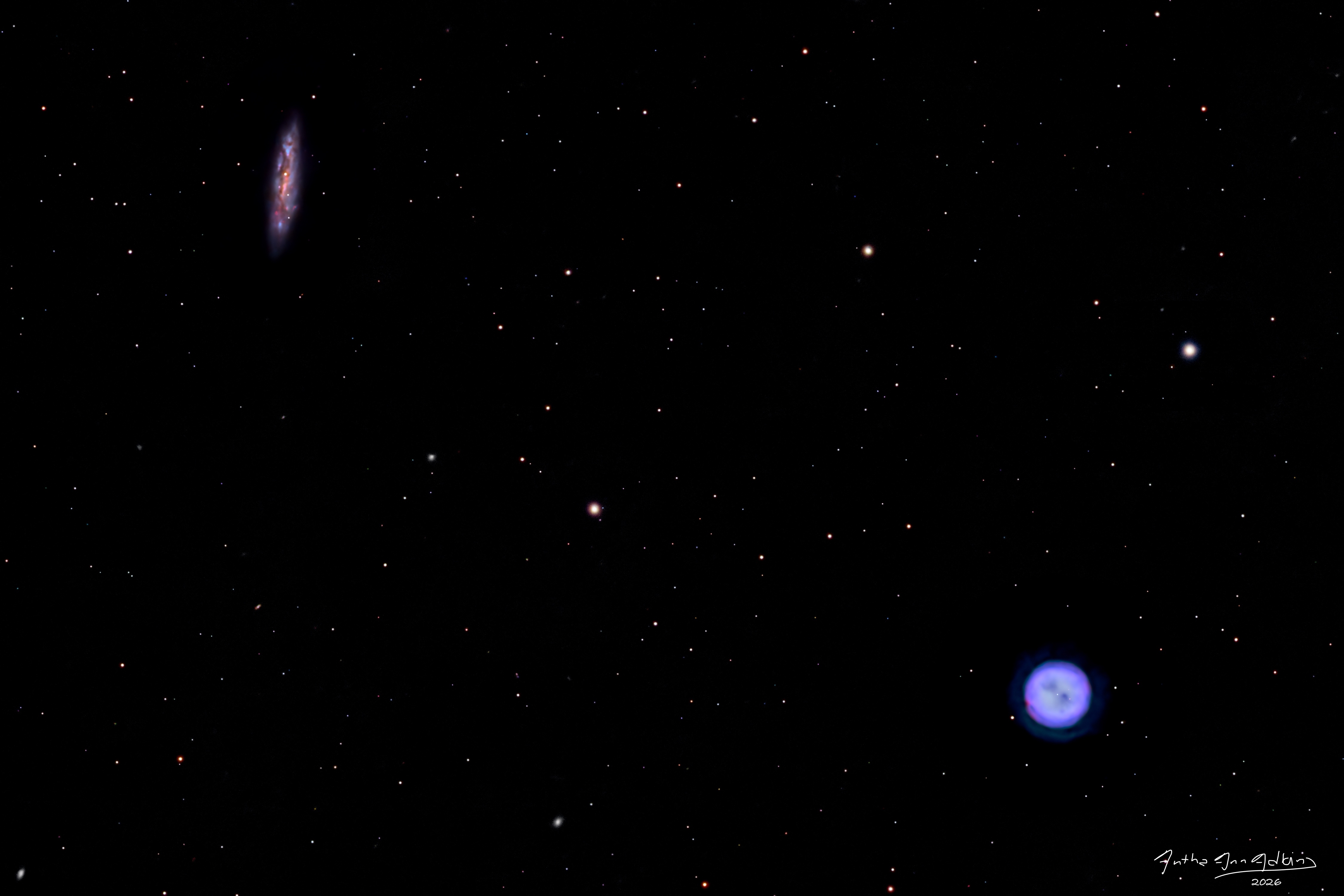
Messier 97, the Owl Nebula, and Messier 108, the Surfboard Galaxy, are about 50 arc minutes apart in the sky, so they are often imaged together.  I think they make an interesting contrast, including needing different processing paths.  I collected data using both Red Green Blue (RGB) filters and narrowband Hydrogen alpha (Ha) and Oxygen iii (Oiii) filters, but how I combined the narrowband data and RGB data differed.
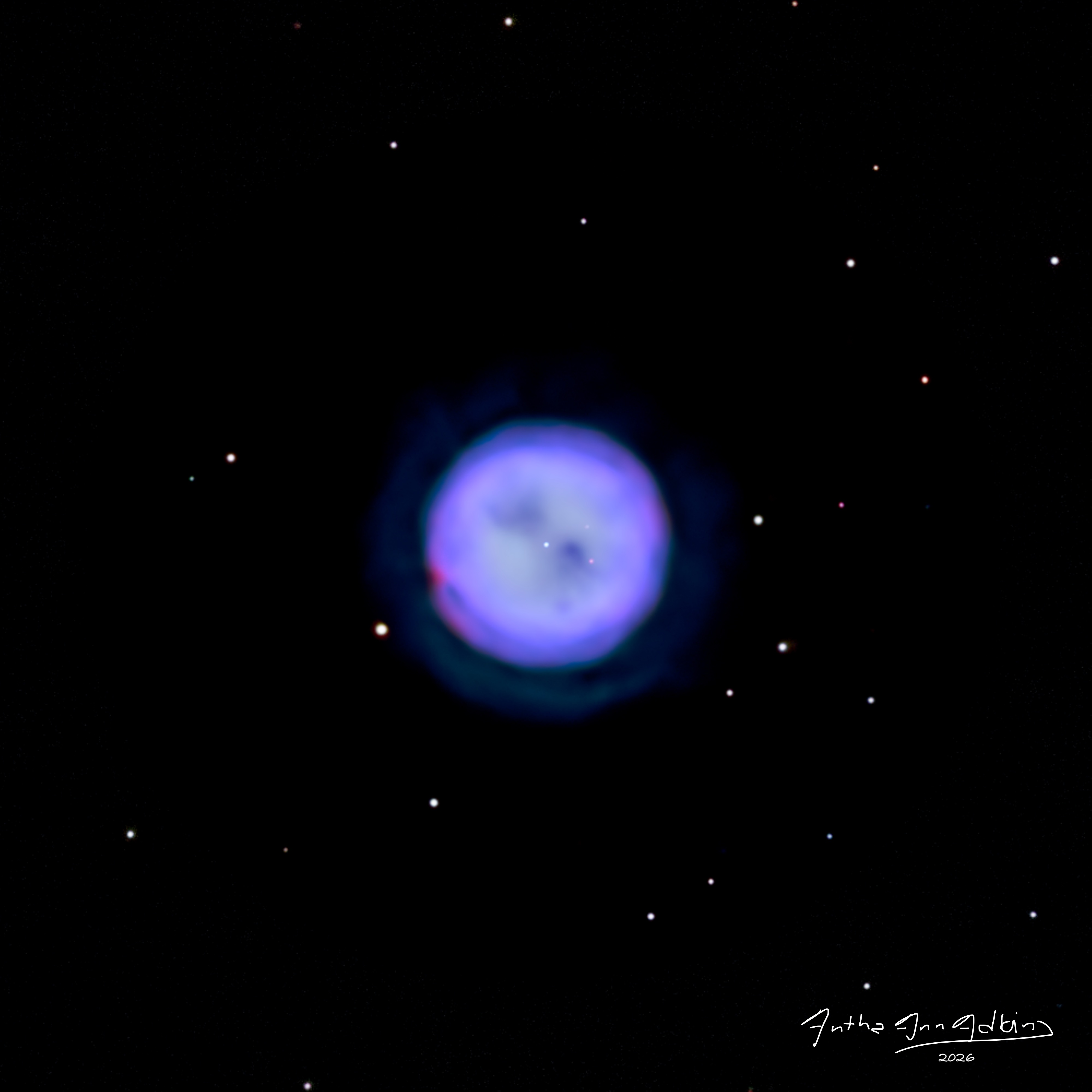
Messier 97, also called the Owl Nebula and numbered New General Catalogue (NGC) 3587, is a planetary nebula – the gases expelled from a low to intermediate mass (0.8 to 8 times the mass of the sun) red giant star before it becomes a white dwarf, lit up by that star.  It’s located in the Milky Way, approximately 2640 light years away, and including the outer Oiii halo is about 4 arcminutes across in this image, making it 3 light years across.  It’s estimated to be 8400 years old based on the expansion of the nebula.

The blue star in the center of the nebula is the white dwarf that is the remainder of the original star, which is estimated to be 5 billion years old and initially 1.5 to 2.5 times the mass of the sun before it created the planetary nebula and 0.58 to 0.62 times the mass of the sun after.

I find these small nebulae beautiful and fascinating. Each has its own unique structure.  This one is spherical and has an outer Oiii halo, an Ha ring, and an inner filled section that appears to have two voids, or eyes, in it. The voids appear to have a more complicated structure that looks somewhat like fingers, or, sticking to the face analogy, eyelashes.  Since there is no evidence for present-day stellar wind, the complex cavities may be relics from the time when the stellar wind was present.

M97 is bright enough that it showed up in the RGB filter data as well as in the narrowband Ha and Oiii data.  In the RGB data, the red Ha ring was clearly visible, and I wanted to show that in the final image as well as the much dimmer outer Oiii halo.  Because planetary nebulae are narrowband sources, the red I could see in the RGB data was from the Ha emissions and the blue/green I could see in the RGB data was from the Oiii emissions.  So I used PixInsight’s CombineRGBAndNarrowband script to combine the RGB and Ha/Oiii data together.  
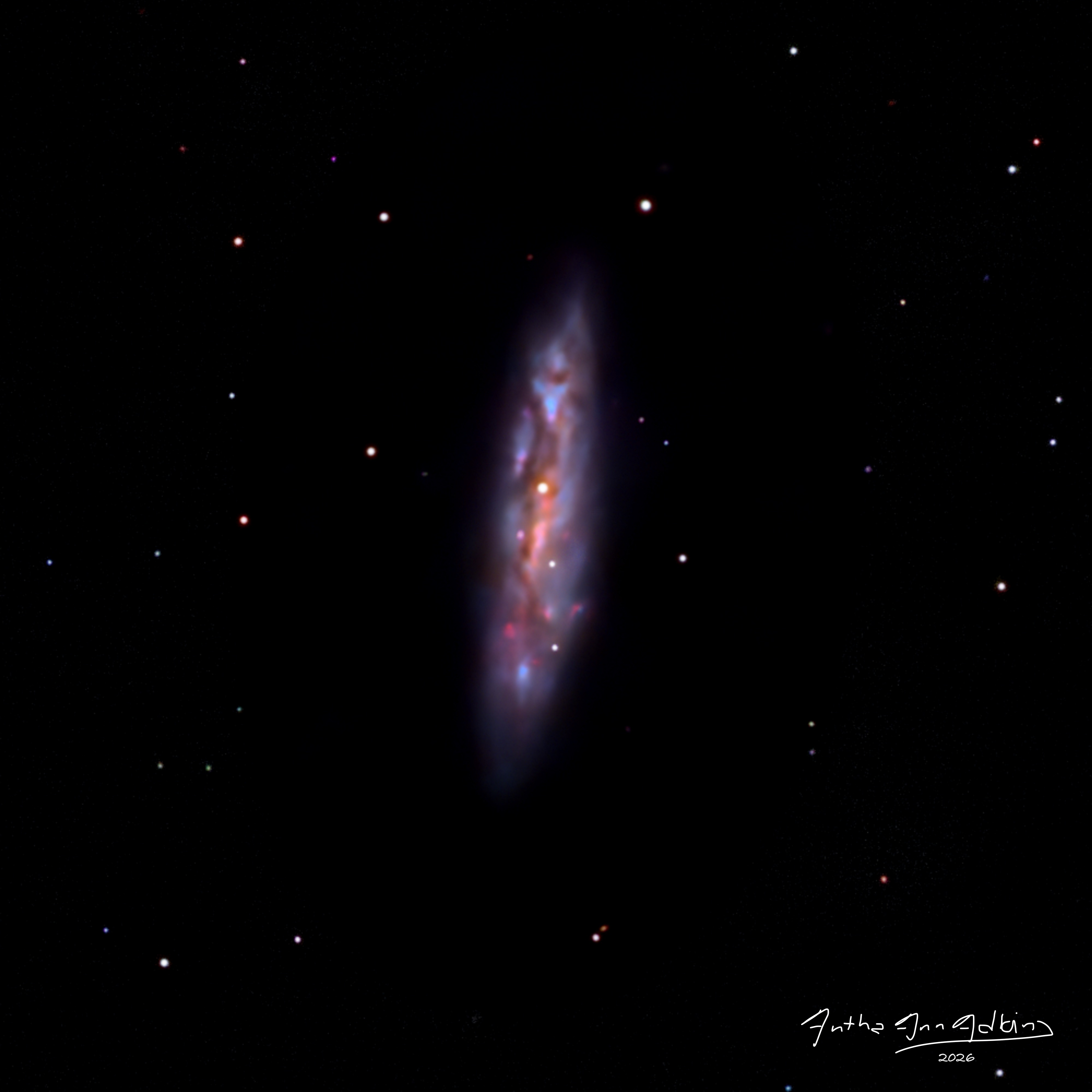
Messier 108, the Surfboard Galaxy and numbered NGC 3556, is a member of the Ursa Major group of galaxies within the Virgo supercluster of galaxies, of which our own Milky Way galaxy is a member.  There’s a cool map of the Virgo supercluster here.  Sources vary on the distance to M108, with recent values of 27.6 million +/- 6.2 million light years away based on a 2022 paper using the Tully-Fisher method or 32.3 million light years away based on a 2018 paper using the redshift method.  In this image, it has an apparent visual size of 1 by 7 arcmin.  Its size depends on its distance as well as its visual size, so depending upon the distance, it is 8 by 53 thousand light years across or 9.4 by 66 thousand light years across.  Older measurements show it even further away, which would make it even bigger.  It is classed as a barred spiral galaxy, and it contains a supermassive black hole 24 million times the mass of our sun. 

Galaxies are wideband sources, so the narrowband Ha and Oiii data included light that was not from Ha or Oiii sources but just happened to be at that same wavelength.  So before I added the Ha and Oiii data to the galaxy, I used the NBColourMapper tool to perform continuum subtraction, where I used the original red and green data as a reference to remove the wideband signal from the Ha and Oiii data, respectively.  Then I used PixInsight’s CombineRGBAndNarrowband script to add the Ha and Oiii data to the RGB galaxy. The red Ha data is much more visible as the bright red spots in the final image.

In addition to M108, there are several background galaxies in this image.  I stretched them separately from the stars to bring them out as much as I could, but I’d really need more data to show them well.  

In this image, the stars and galaxies came from images using RGB filters (14 – 31 minutes per color), and the nebula and galaxy used additional images using 4.2 hours of Hydrogen alpha (mapped to red) and 3.5 hours of Oxygen iii (mapped to blue) filters.  The M97 Nebula, M108 galaxy, background galaxies, and stars were processed separately to maximally enhance each.

Camera geek info:

  • William Optics Pleiades 111 telescope
  • ZWO 2” Electronic Filter Wheel
  • Antila HO and RGB filters
  • Blue Fireball 360° Camera Angle Adjuster/Rotator
  • ZWO ASI183MM-Pro-Mono camera
  • ZWO ASiair Plus
  • William Optics Uniguide 32MM F/3.75
  • ZWO ASI220MM-mini
  • iOptron CEM40
  • Friendswood, Texas Bortle 7-8 suburban skies

Frames:

  • February 6, 2026
    • 3 600 second Gain 150 Oiii lights
    • 30 0.2 second Gain 150 Oiii flats
  • February 7, 2026
    • 4 600 second Gain 150 Ha lights
    • 30 0.5 second Gain 150 Ha flats
  • February 22, 2026
    • 94 20 second Gain 150 Red lights
    • 30 0.02 second Gain 150 Red flats
    • 43 20 second Gain 150 Green lights
    • 30 0.01 second Gain 150 Green flats
    • 65 20 second Gain 150 Blue lights
    • 30 0.01 second Gain 150 Blue flats
  • March 13, 2026
    • 2 600 second Gain 150 Oiii lights
    • 30 0.2 second Gain 150 Oiii flats
  • June 23, 2026
    • 10 600 second Gain 150 Oiii lights
    • 30 0.2 second Gain 150 Oiii flats
  • June 24, 2026
    • 14 600 second Gain 150 Ha lights
    • 30 0.5 second Gain 150 Ha flats
  • July 26, 2026
    • 7 600 second Gain 150 Ha lights
    • 30 0.5 second Gain 150 Ha flats
  • July 31, 2026
    • 10 600 second Gain 150 Oiii lights
    • 30 0.2 second Gain 150 Oiii flats
  • 30 Flat Darks from library to match flat time
  • 30 Darks from library to match light time

Processing geek info:

  • PixInsight
  • BlurXterminator
  • NoiseXterminator
  • StarXTerminator
  • NBColourMapper
  • Generalized Hyperbolic Stretch
M33 The Triangulum Galaxy and its H-II Regions

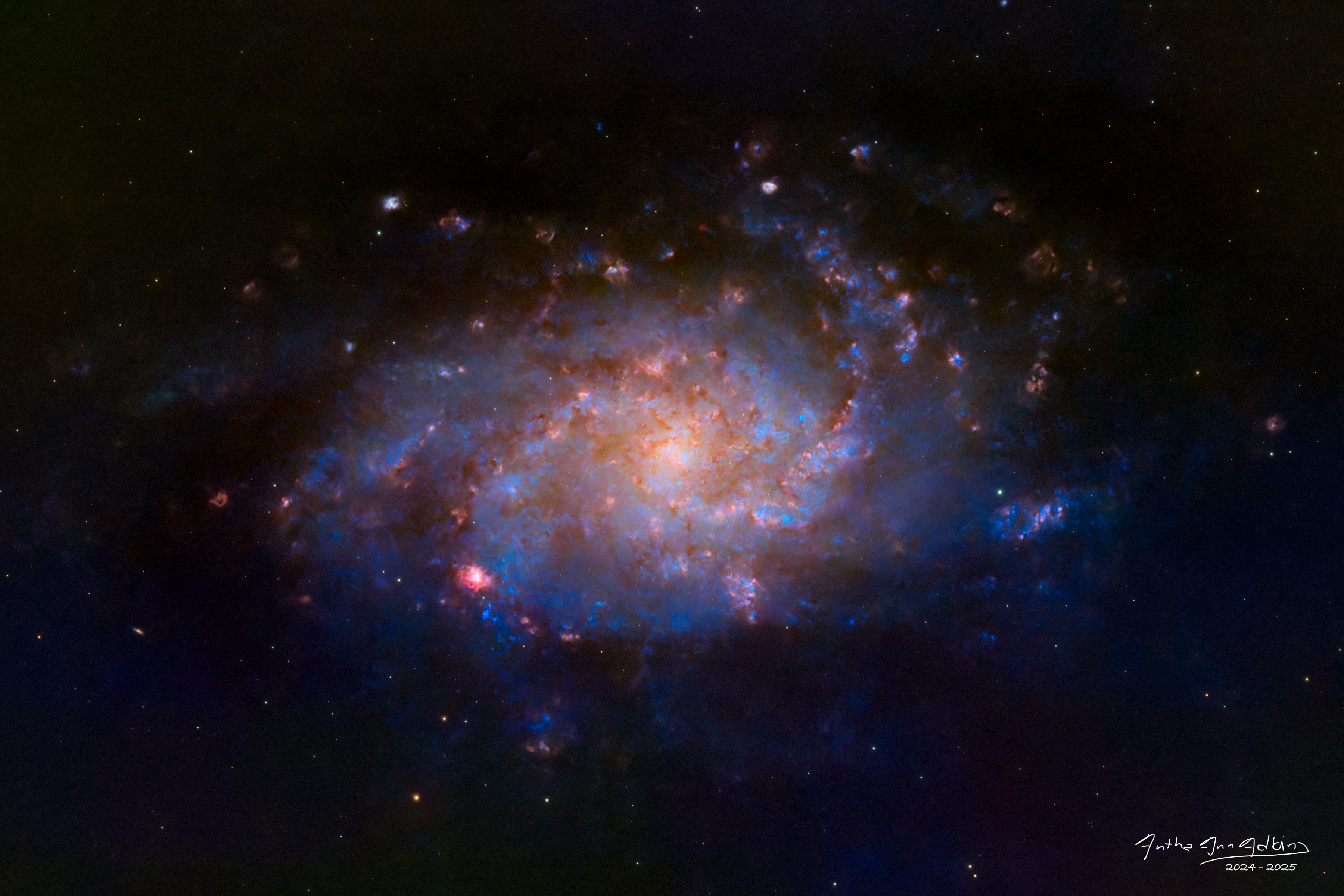
Messier 33, the Triangulum Galaxy, is a galaxy in the same local group as our own Milky Way.  M33 is located approximately 2.74 million light years away, and it has an apparent visual size of 60.26 by 35.48 arcmin, so it is approximately 48 by 28.3 thousand light years across.  It is classed as a flocculant (fluffy, with less well-defined arms) spiral galaxy – in this image, one set of arms curve up from the right side and a second set of arms curve down from the left side.  

Because, by galaxy standards, M33 is relatively nearby (in the same local group as our own galaxy), we can see a lot of detail in it.  In fact, we can see the same kind of things in it that we see in our own galaxy – Hydrogen II (H-II) star forming region nebulas, supernova remnants, and even planetary nebulas.  

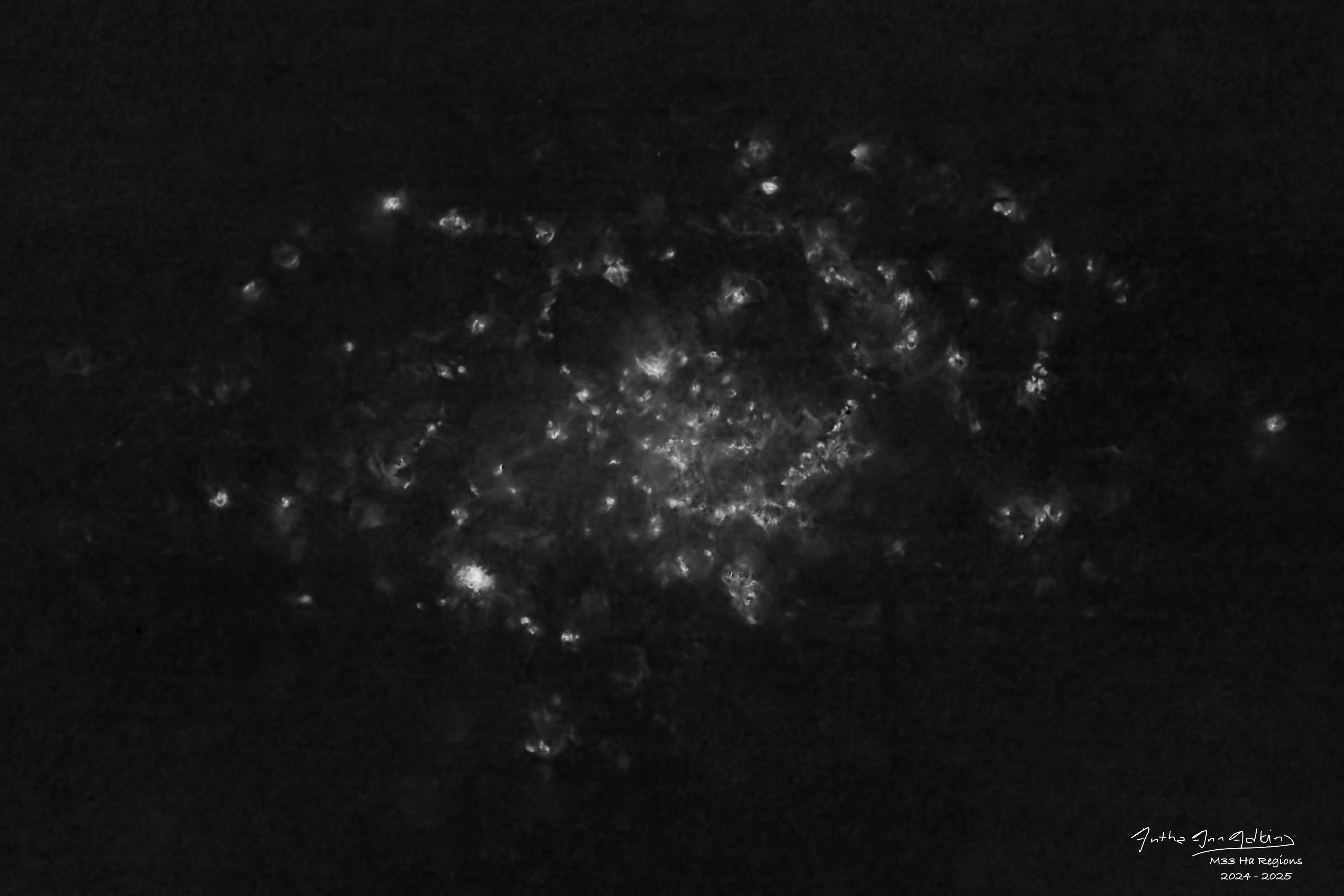
Most obvious in this image and in the black-and-white Hydrogen alpha (H-alpha) image are the enormous, bright, young H-II star forming region nebulas.  These are all clouds of atomic hydrogen ionized and lit up by the young, massive, star clusters that formed within them.

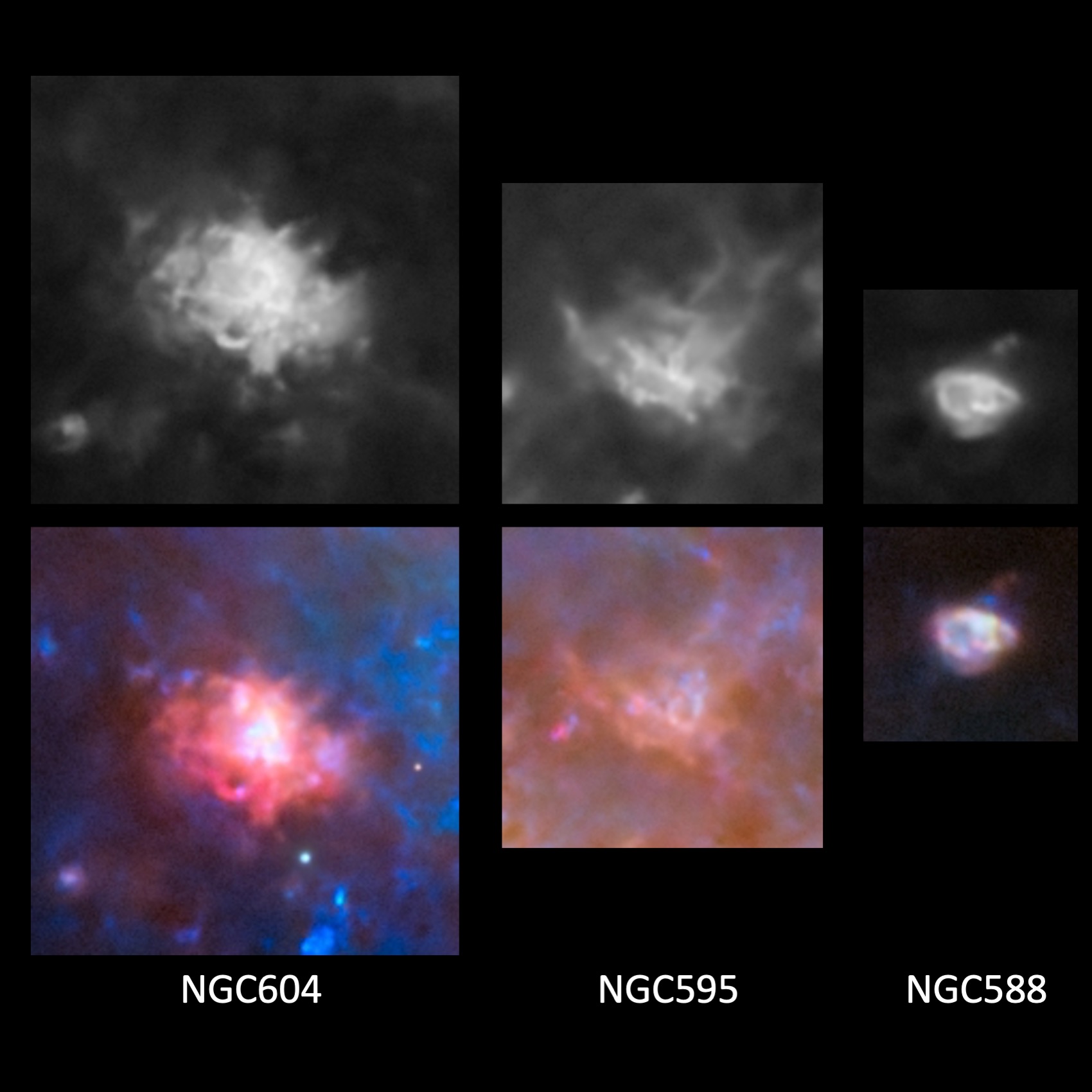
The brightest H-II star forming region in M33 is NGC604 in the innermost arm to the lower left of the main image.  It has an apparent visual size of 2 by 1.2 arcmins, so it is approximately 1600 by 950 light years across.  This region contains 200 massive, young, hot O-type and Wolf-Rayet stars that are about 3 million years old as well as an older population of stars that are 12 million years old.  This region may have hosted a sequence of star forming events, where one set of stars forming triggered the formation of the next set.  

The second brightest H-II star forming region in M33 is NGC595 at the top left of the galaxy core.  It has an apparent visual size of 1 arcmin, so it is approximately 800 light years across.  It contains about 250 type OB stars and 10 Wolf-Rayet stars with an approximate age of 4.5 million years old.

The third brightest H-II star forming region in M33 is NGC588 in the top of the second arm to the right.  It has an apparent visual size of 30 by 50 arcseconds, so it is approximately 400 by 665 light years across.  It contains a young star cluster that is about 3.5 million years old.

I started working on collecting data on M33 at the end of 2024/start of 2025 using my smaller 73 mm “Z” telescope, but I did not end up with sufficient data for a good image.  When I was imaging Comet Lemon with “Z” last fall, I collected more data while I was using that telescope and finally collected enough.

I combined several paths of processing to make this image.  I used only the 30 second Red Green Blue (RGB) data (about 26 minutes per color) to generate the RGB stars.  I used all the RGB data (4.5 hours of red data and 2.6 hours each of green and blue data) to generate an RGB image of the galaxy.  I processed the Hydrogen alpha (H-alpha) data (8.3 hours of data) by continuum subtracting a starless red from the starless H-alpha, then processing and stretching the resulting image.  I processed the Oxygen iii (Oiii) data (6.6 hours of data) by continuum subtracting a starless blue from the starless Oiii data and then processing and stretching the resulting image.  The continuum subtraction removes the “starlight” from the broader-band stars from the H-alpha (or Oiii) data to leave just the H-alpha (or Oiii) sources.  I stretched the H-alpha and Oiii separately to retain some detail in the very bright H-alpha emissions from the NGC604 H-II region as well as detail in the RGB galaxy.  Finally, I used NBColourMapper to add the H-alpha as red and the Oxygen iii as turquoise to the RGB galaxy.  

It is amazing to me that we can see star forming regions in other galaxies.  Our universe is still under construction!

Camera geek info:

  • Williams Optics Zenith Star 73 III APO telescope
  • Williams Optics Flat 73A
  • ZWO 2” Electronic Filter Wheel
  • Antila SHO and RGB filters
  • ZWO ASI183MM-Pro-Mono camera
  • William Optics Uniguide 32MM F/3.75
  • ZWO ASI220MM-mini
  • ZWO ASiair Plus
  • iOptron CEM40
  • Friendswood, Texas Bortle 7-8 suburban skies

Frames:

  • November 23, 2024
    • 229 60 second Gain 150 Ha lights
    • 30 1.0 second Gain 150 Ha flats
  • December 19, 2024
    • 99 60 second Gain 150 Oiii lights
    • 30 0.5 second Gain 150 Oiii flats
  • December 20, 2024
    • 28 60 second Gain 150 Ha lights
    • 30 1.0 second Gain 150 Ha flats
  • December 31, 2024
    • 185 30 second Gain 150 Red lights
    • 30 0.05 second Gain 150 Red flats
  • January 1, 2025
    • 46 30 second Gain 150 Red lights
    • 30 0.05 second Gain 150 Red flats
  • January 23, 2025
    • 24 60 second Gain 150 Ha lights
    • 30 0.5 second Gain 150 Ha flats
  • October 9, 2025
    • 68 60 second Gain 150 Red lights
    • 30 0.05 second Gain 150 Red flats
    • 71 60 second Gain 150 Green lights
    • 30 0.02 second Gain 150 Green flats
    • 69 60 second Gain 150 Blue lights
    • 30 0.02 second Gain 150 Blue flats
  • October 10, 2025
    • 61 60 second Gain 150 Red lights
    • 53 30 second Gain 150 Red lights
    • 30 0.05 second Gain 150 Red flats
    • 64 60 second Gain 150 Green lights
    • 52 30 second Gain 150 Green lights
    • 30 0.02 second Gain 150 Green flats
    • 64 60 second Gain 150 Blue lights
    • 52 3 second Gain 150 Blue lights
    • 30 0.02 second Gain 150 Blue flats
  • October 12, 2025
    • 49 180 second Gain 150 Oiii lights
    • 30 0.5 second Gain 150 Oiii flats
  • October 18, 2025
    • 50 180 second Gain 150 Oiii lights
    • 30 0.5 second Gain 150 Oiii flats
    • 73 60 second Gain 150 Ha lights
    • 30 0.5 second Gain 150 Ha flats
  • 30 Flat Darks from library matching flat lengths
  • 30 Darks from library

Processing geek info:

  • PixInsight
  • BlurXterminator
  • NoiseXterminator
  • StarXTerminator
  • NBColourMapper
  • Generalized Hyperbolic Stretch
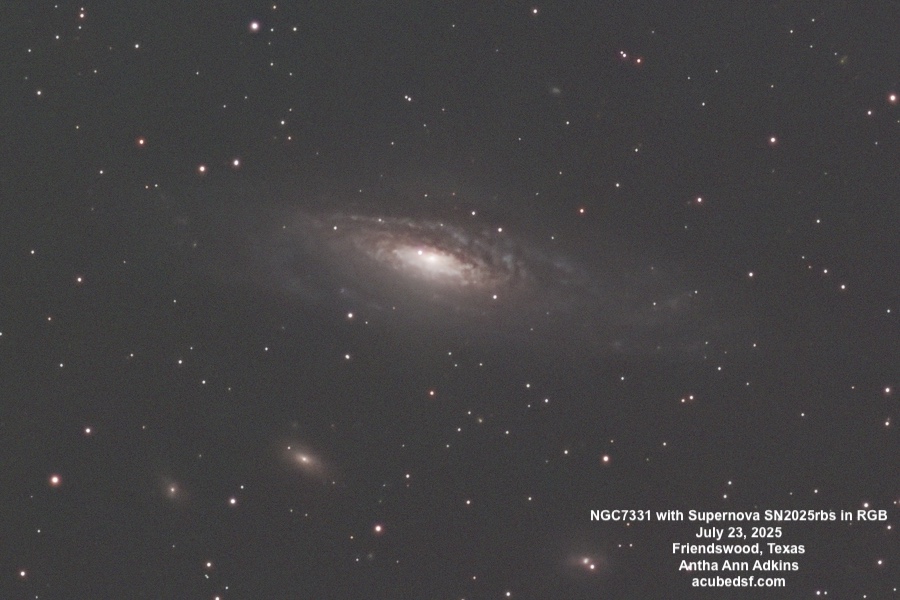
Capturing a new supernova in another galaxy: NGC7331 and SN2025rbs

Usually I don’t image on work nights so I get enough sleep.

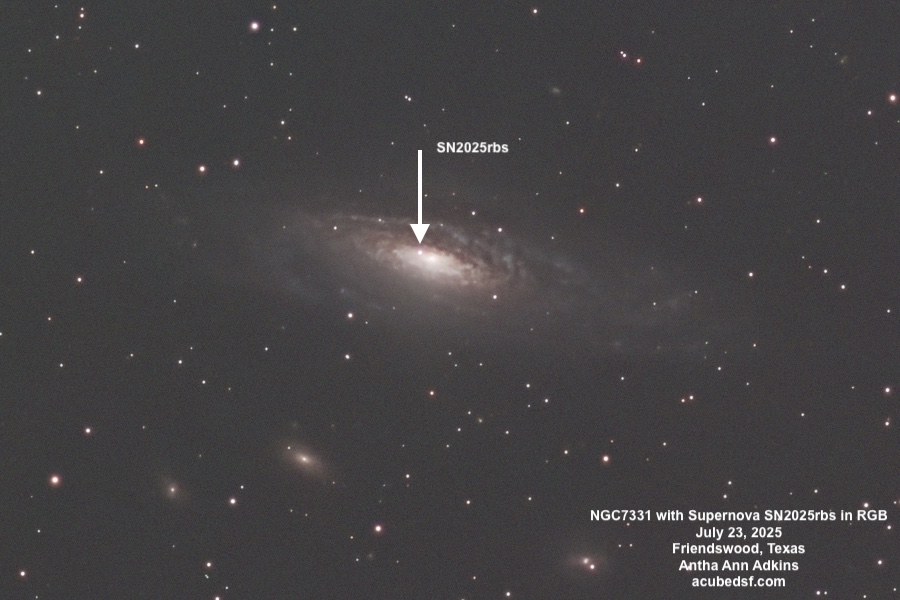
However, the new telescope cloud curse has been strong, and I’ve only had a few clear nights since I bought my new William Optics Pleiades 111 telescope “Blue” earlier this year.  So when it was finally clear on Tuesday, I couldn’t resist taking my new telescope outside.  I continued to collect data on M101, but I had learned through a Facebook post that there was a new supernova in the galaxy NGC7331.  So after M101 set, I spent the rest of the night imaging NGC7331.

NGC7331 is an unbarred spiral galaxy.  It’s located approximately 47 million light years away, and it has an apparent size of 10.47 arcminutes, making it about 144 thousand light years across.  One paper on this galaxy argues that its central bulge rotates in the opposite direction of its outer disk – weird!  Another argues that the stars in the central bulge are old – 13 billion years old, while the stars in the disk are young – possibly 0.2 billion years old.  (This may not be unusual; our own galaxy is still making stars in its outer arms right now, which I also think is really cool.)  

Supernova 2025rbs is a Type 1A supernova, which occurs when a white dwarf star collects material from a companion star, almost reaches the Chandrasekar mass, starts fusing carbon, experiences a runaway reaction, and explodes, releasing an enormous, but predictable, amount of energy.  Type 1A supernovas can be used as standard candles to measure the distance to the supernova (and in cases like SN2025rbs the distance to the home galaxy) because the energy they release and thus their brightness is predictable.  SN2025rbs was discovered by the Gravitational-wave Optical Transient Observer (GOTO) on July 14, 2025.

You can clearly see SN2025rbs as a bright spot near the galaxy center.  In fact, it appears to outshine the galaxy center, which I find amazing.  

When I imaged this, I deliberately used short capture times (15 seconds) so that the bright supernova would not “blow out” and clip to pure white or cause “pixel bloom” where the light overwhelms the pixel capturing it and so bleeds into the nearby pixels.  

I spent a fair bit of time thinking about how this image “should” be processed.  On the one hand, I wanted to preserve the relative amount of light and color for the supernova relative to both the star field and NGC7331, its host galaxy.  On the other hand, astroimages are inherently low-light and high dynamic range, which means that the data has to be non-linearly stretched to show both the relatively bright supernova and stars and the relatively dim galaxy.  

My standard PinInsight processing flow includes using BlurXTerminator (BXT) to sharpen the stars and non-stellar objects, NoiseXTerminator (NXT) to remove noise, and then StarXTerminator (SXT) to separate the stars from the non-stellar objects so they can be stretched separately.

I considered whether I should skip the BXT processing step.  BXT sharpens the stars and makes them smaller, and it did the same to the supernova but not the NGC7331 galactic core.  The BXT documentation says, “BlurXTerminator is trained to conserve flux, the total amount of light associated with a feature such as a star. When a blurred star is made less blurry, the light from some number of pixels is concentrated into a smaller number of pixels. Those pixels must get brighter for the total amount of flux to be the same.”  Based on that statement, I think since BXT preserves the amount of light in each star, it also preserves the relative amount of light between the stars and between the stars and the supernova (assuming none of them are clipped because they exceed the max brightness level, which did not happen in this case).  Further, since stars (and supernovae) are point sources of light and with perfect seeing and optics would only be “seen” in one pixel, using BXT to sharpen the stars and the supernova should be making them more like their “true” amount of light relative to the galaxy as well.  So I left the BXT step in my processing flow.

I also considered whether I should skip the SXT step and stretch the stars, supernova, and galaxies together or use SXT and stretch them separately.  Either way, there is no longer a linear relationship between the brightness of the objects.  If I processed this as a single image, the brightness ordering – what is brighter than what – would be maintained.  If I used SXT so I could stretch the galaxies separately, I could end up making the galaxy core brighter than the supernova, even though it was not in the raw data.  On the other hand, I could show more detail in the galaxy if I processed it separately.  I ended up deciding that, in this case, what was most important to me was to maintain the brightness order and show that the supernova was brighter than the galactic core.  So I processed it as a single image.

My final PixInsight processing flow was:

  • WBPP to calibrate, normalize, and integrate three channels of RGB data
  • ChannelCombination to combine the RGB channels into a single image
  • DBE to remove the excess blue in the background
  • SPCC to calibrate the color
  • BXT to sharpen the stars and the galaxy
  • NXT to to remove some noise since this is only a few hours worth of data from my Bortle 7-8 light polluted skies
  • Histogram Transformation to stretch the image

At some point, I’d like to collect more data on this galaxy and make a nicer picture of it.  But the clouds are back now.  The curse continues …   

Camera geek info:

  • William Optics Pleiades 111 telescope
  • ZWO 2” Electronic Filter Wheel
  • Antila RGB filters
  • Blue Fireball 360° Camera Angle Adjuster/Rotator
  • ZWO ASI183MM-Pro-Mono camera
  • William Optics Uniguide 32MM F/3.75
  • ZWO ASI220MM-mini
  • ZWO ASiair Plus
  • iOptron CEM40
  • Friendswood, Texas Bortle 7-8 suburban skies

Frames:

  • Lights
    • 248 15 second Gain 150 Red lights  (62 minutes)
    • 182 15 second Gain 150 Green lights (45.5 minutes)
    • 168 15 second Gain 150 Blue lights (42 minutes)
    • 30 0.2 second Gain 150 Red flats
    • 30 0.1 second Gain 150 Green flats
    • 30 0.1 second Gain 150 Blue flats
  • Darks, Flat darks from library

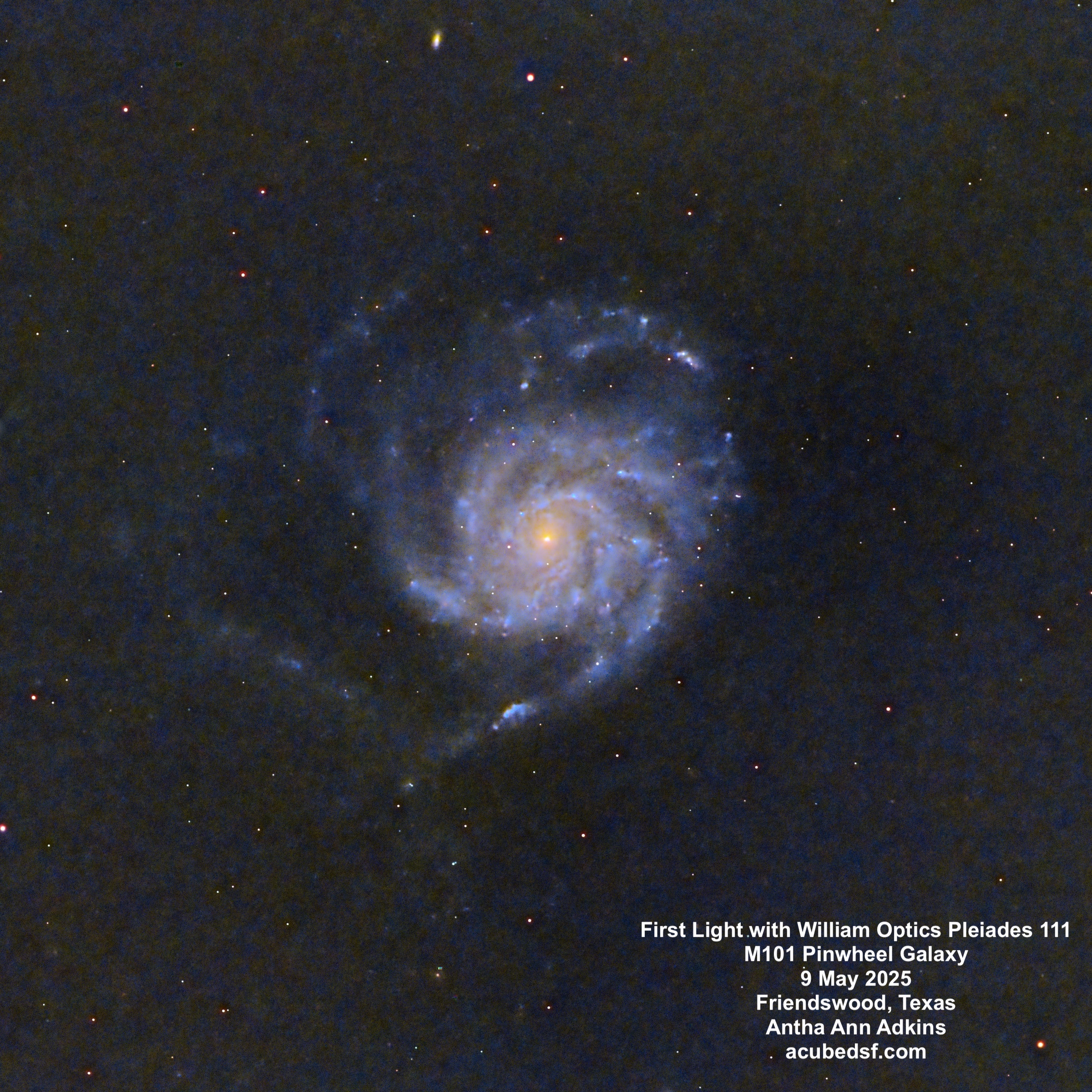
M101: First Light with William Optics Pleiades 111 Telescope “Blue”

It’s a well-known astrophotography curse that buying new equipment means weeks, if not months, worth of cloudy skies.  My new telescope, a William Optics Pleiades 111, a 11.1 cm/4.37 inch diameter refractor that I’ve nicknamed “Blue”, was no exception.  It took about a month after I got the telescope (and the additional two counter weights I needed to balance it) for the skies to at least somewhat clear.  I got everything set up, just to watch the clouds roll in.  Happily, they then rolled back out.  And then rolled back in.  And out.

I ended up with enough data to make a first light picture, but I’ll need to collect more data for a final image.

I had contemplated what to image for first light.  Since the telescope name is Pleiades, the Pleiades would have been a good target, except they’re currently barely above the horizon at sunset.  My favorite nebula, the Orion nebula, would have been a good target, except it’s also currently barely above the horizon at sunset.  It’s “galaxy season,” so I decided to image a galaxy.  I’ve imaged M101 before because it hosted a supernova in 2023, so it gave me a good point of comparison.  

The comparison isn’t entirely a fair one.  On the one hand, this is an entirely new setup, with a much larger diameter telescope, an astro camera instead of a consumer camera, and a guide scope and guide camera to better control the tracking mount.  Additionally, I’ve picked up a lot of processing skill in the last two years, such as using shorter images for the stars so they don’t “bloat.”  On the other hand, this was 3.4 hours of galaxy data from my Bortle 7-8 light polluted driveway instead of 10.6 hours from the Bortle 2-3 dark skies of Dell City.

Because of the light pollution and limited imaging time, there is a lot more background noise in the new image.  But the stars are enormously improved from the old image.  And there is more detail in the new image.  I can’t wait to see how an image with more data turns out!

Once the clouds roll away again ….

Camera geek info May 9, 2025 (new image):

  • William Optics Pleiades 111 telescope
  • ZWO 2” Electronic Filter Wheel
  • Antila RGB filters
  • Blue Fireball 360° Camera Angle Adjuster/Rotator
  • ZWO ASI183MM-Pro-Mono camera
  • William Optics Uniguide 32MM F/3.75
  • ZWO ASI220MM-mini
  • ZWO ASiair Plus
  • iOptron CEM40
  • Friendswood, Texas Bortle 7-8 suburban skies

Frames (new image):

  • May 9, 2025
    • 32 30 second Gain 150 Red lights for stars
    • 24 30 second Gain 150 Green lights for stars
    • 22 30 second Gain 150 Blue lights for stars
    • 53 60 second Gain 150 Red lights for galaxy
    • 66 60 second Gain 150 Green lights for galaxy
    • 86 60 second Gain 150 Blue lights for galaxy
    • 30 0.2 second Gain 150 Red flats
    • 30 0.1 second Gain 150 Green flats
    • 30 0.1 second Gain 150 Blue flats
  • Darks, Flat darks from library

Camera geek info (old image):

  • William Optics Zenith Star 73 III APO telescope
  • William Optics Flat 73A
  • Canon EOS 60D in manual mode, 2 minute exposure, ISO 1600 and ISO 2000, custom white balance 3500K
  • iOptron CEM40
  • Dell City, Texas Bortle 2-3 dark skies

Frames (old image):

  • June 10, 2023
    • Run 1 1600 ISO
      • 99 2 minute lights
      • 31 0.01 second flats
      • 20 0.01 second flat darks
    • Run 2 1600 ISO
      • 39 2 minute lights
      • 31 0.02 second flats
      • 30 0.02 second flat darks
      • 71 2 minute darks
  • June 11, 2023 2000 ISO
    • 151 2 minute lights
    • 31 0.02 second flats
    • 20 0.02 second flat darks
    • 31 2 minute darks
  • June 12, 2023 2000 ISO
    • 30 2 minute lights
    • 31 0.02 second flats
    • 30 0.02 second flat darks
    • 32 2 minute darks

Processing geek info:

  • PixInsight
  • BlurXterminator
  • NoiseXterminator
  • StarXTerminator
  • Generalized Hyperbolic Stretch
M31 Andromeda Galaxy Astrophotography Learning Curve

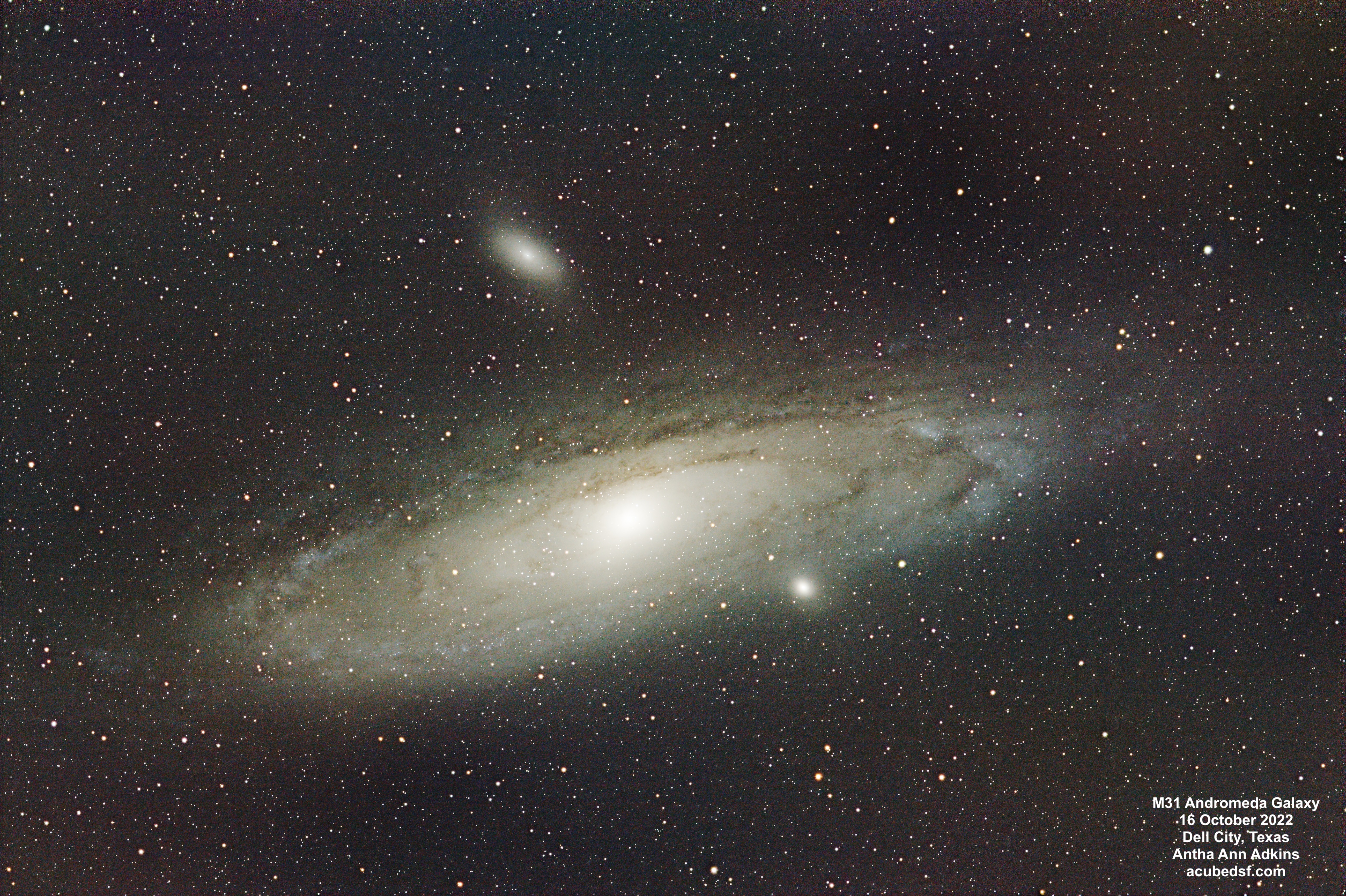
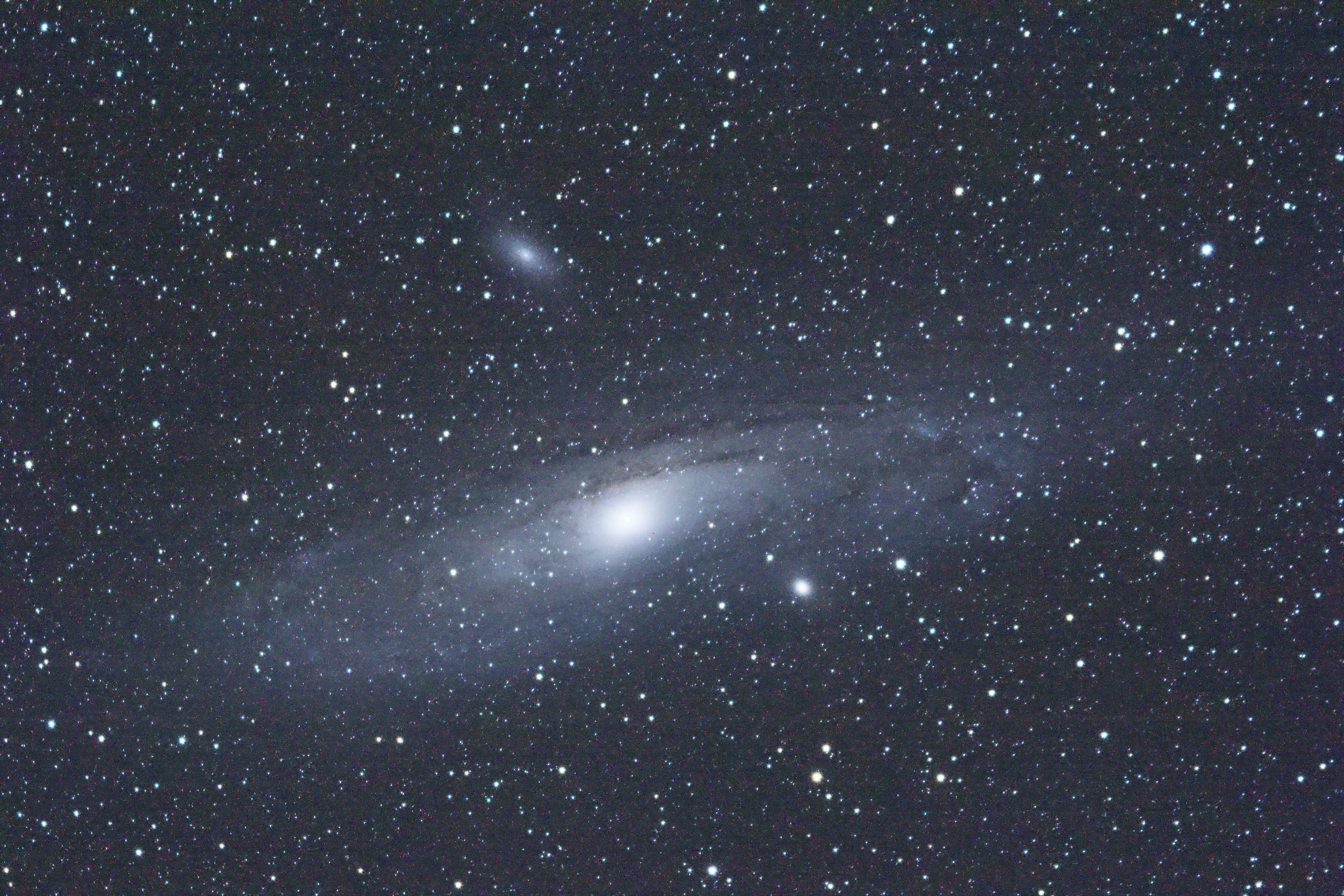
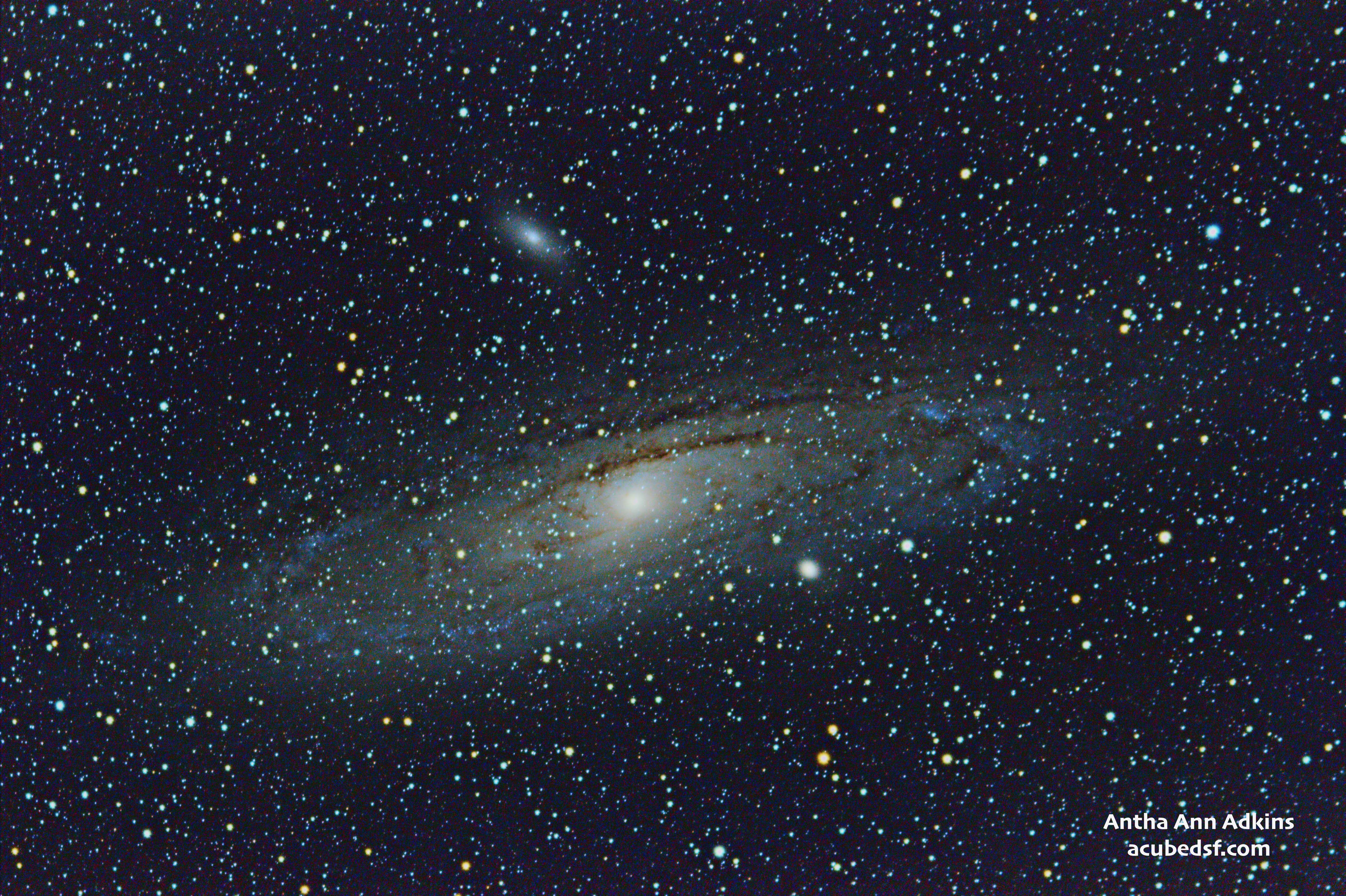
The first object that I got a satisfactory image of with my tracking mount and telescope and DSLR was M31, the Andromeda Galaxy, from the dark skies of Dell City, Texas in October 2022.  My first image, above, was a 3 minute long exposure.  I was so excited to have a good image that I took a picture of my camera’s viewfinder to send the picture to people.  

When I came home to Friendswood, Texas, I did some experiments to see if I could get the same results.  It was not a surprise when the answer was “no” – my home skies are much more light polluted – I expected to get a completely white screen and was surprised when I could still see a hint of the galaxy.

I started to learn how to use PixInsight, a powerhouse astrophotography processing tool, in the winter of 2022.  I learned enough to be able to stack 18 3 minute images to make my Christmas card photo and the picture I am still using as my computer background at work.

I’ve learned a more about astrophotography processing since then, most notably adding Russ Croman’s excellent BlurXterminator, NoiseXterminator, and StarXterminator tools to my toolbox and learning a ton from Adam Block’s videos.  So I reprocessed the data above using my current knowledge and toolset.

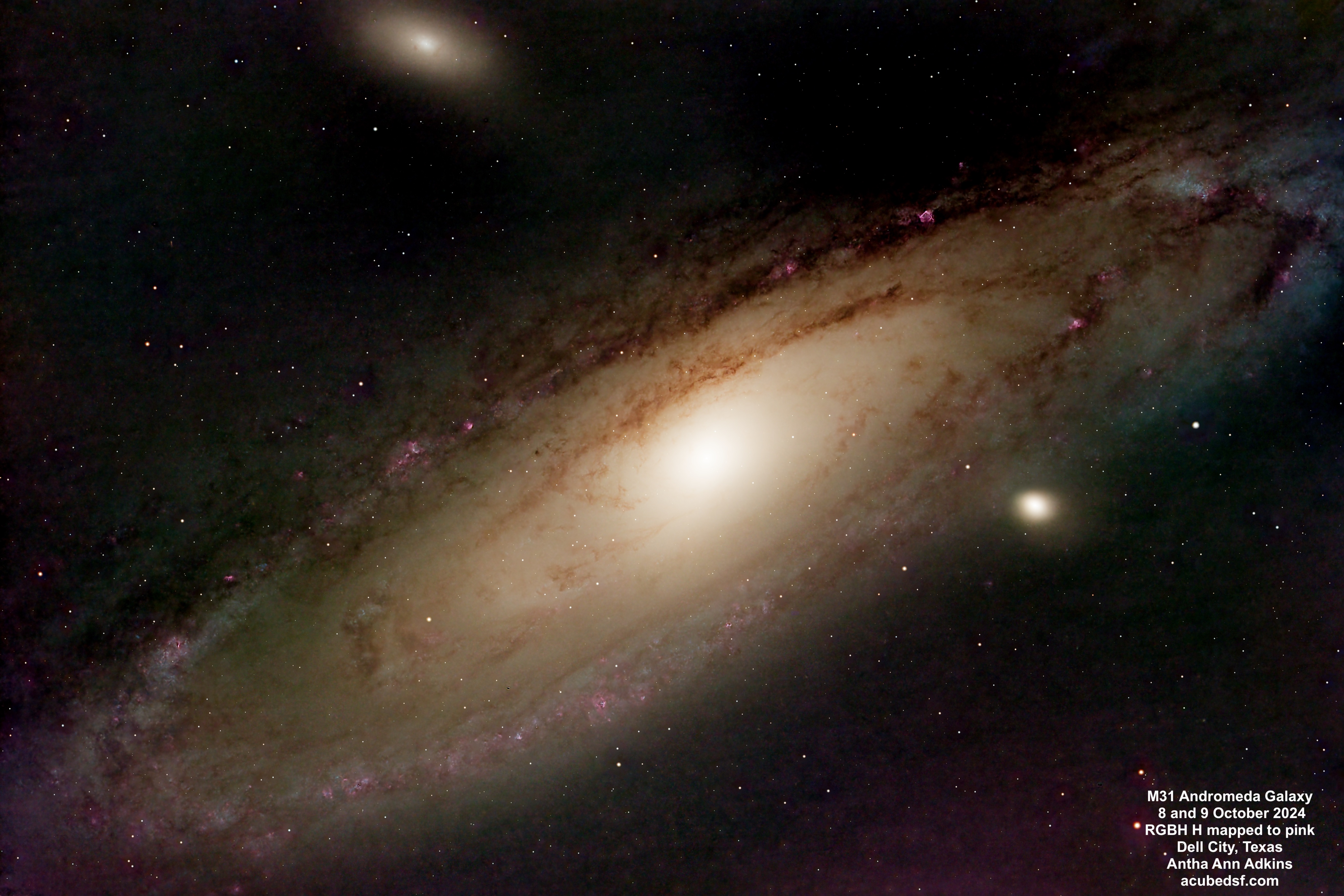
Finally, in October 2024, we were back in Dell City, and I collected new M31 data using an astrocamera and red, blue, green and hydrogen-alpha filters.  I had to learn more in order to be able to merge the Ha data into the RGB data.  Luckily, there are Adam Block’s videos!  One new trick I had to use was “continuum subtraction” – removing the background red from the stars from the Ha data.  

Sometimes, when other things aren’t working out (comet processing), it’s good to step back and see how far you’ve come. I’ve learned a lot over two years … and I’m looking forward to learning a lot more!

What are you learning about?

Celebrating 100 years of understanding galaxies with M31, the Andromeda Galaxy

When we travel to the fabulous dark skies of Dell City, Texas, I try to pick a combination of challenging targets and targets that I’m confident I’ll get good results with.  In October, one of my picks for the “good result” target was M31, the Andromeda Galaxy.

It seemed fitting to image the Andromeda Galaxy now because we are approaching the 100 year anniversary of Dr. Edwin Hubble’s November 23, 1924 New York Times article confirming that some objects classified as nebulae were, in fact, “island universes” – galaxies separate from our own.  Hubble used the Cephid variable stars in the Andromeda Galaxy and in M33 to measure the distance to those two galaxies and determine that they had to be outside of our own galaxy – on the order of 1 million light years away.  Based on that distance and its apparent size, Hubble calculated that the Andromeda Galaxy’s diameter was 45,000 light years.

100 years later, the Andromeda Galaxy is known to be 2.56 million light years away.  Its apparent size is 3.167 degrees by 1 degree, giving it a diameter of 141,000 light years.  So even further and even bigger than Hubble calculated!

It is amazing to me that we’ve only understood that there were other galaxies for 100 years!  And I think it is cool that we keep learning more and more about the universe around us.

This image of the Andromeda Galaxy was captured using red, green, blue and hydrogen-alpha filters. Although Ha actually is in the red part of the spectrum, it is frequently mapped to purple-pink so it stands out, and I have used that mapping here.  These Ha regions are star-forming nebula in the Andromeda Galaxy, similar to our own Orion nebula and Eagle Nebula. 

So while Hubble proved that Andromeda was a galaxy and not a nebula … it also contains its own nebulae. And we can see them!  How amazing is that?

Camera geek info:

  • Williams Optics Zenith Star 73 III APO telescope
  • Williams Optics Flat 73A
  • ZWO 2” Electronic Filter Wheel
  • Antila RGBH filters
  • ZWO ASI183MM-Pro-Mono camera
  • ZWO ASiair Plus
  • iOptron CEM40
  • Dell City, Texas Bortle 2-3 dark skies

Frames:

  • October 8, 2024
    • 196 60 second Gain 150 Ha lights
    • 30 0.5 second Gain 150 Ha flats
    • 168 60 second Gain 150 R lights
    • 30 0.05 second Gain 150 R flats
    • 174 60 second Gain 150 G lights
    • 30 0.02 second Gain 150 G flats
    • 173 60 second Gain 150 B lights
    • 30 0.02 second Gain 150 B flats
    • 30 0.02 second darks
    • 30 0.05 second darks
    • 30 0.5 second darks
    • 30 60 second darks

Processing geek info:

  • PixInsight
  • BlurXterminator
  • NoiseXterminator
  • StarXTerminator
  • NBColourMapper

M106

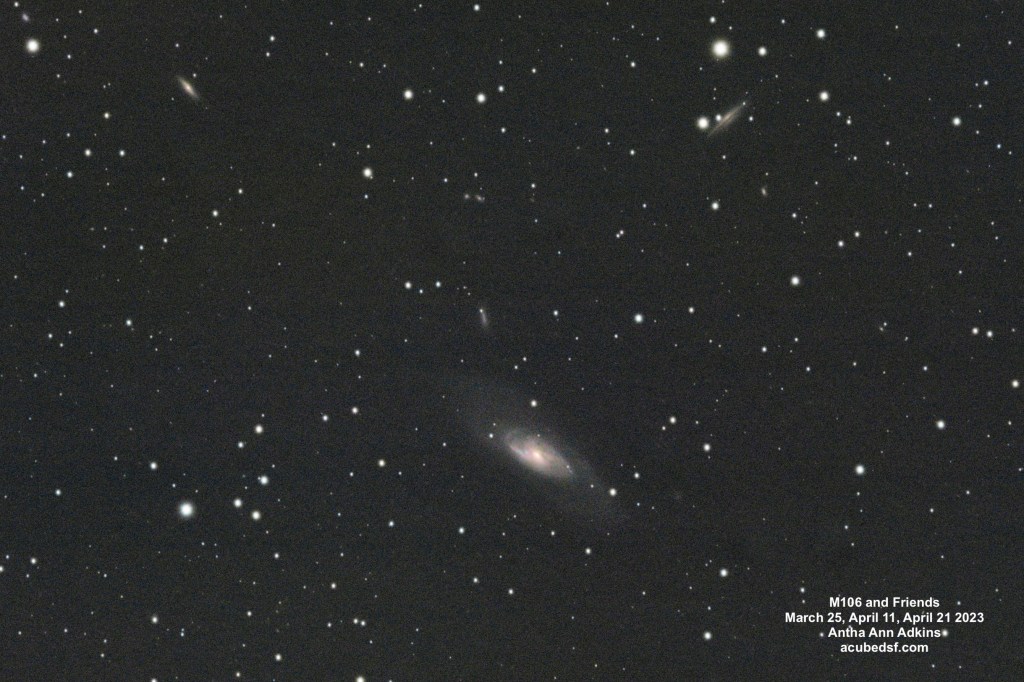
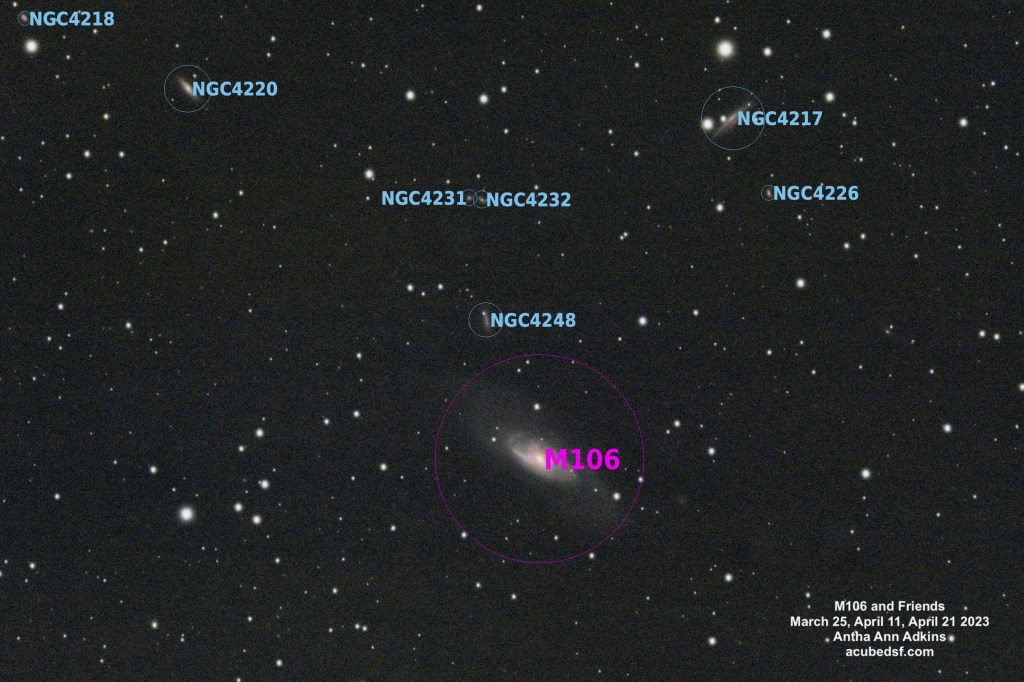
We haven’t had good telescope weather for a while, so I’ve been working on learning more processing techniques.  This is my latest effort: M106, a spiral galaxy containing a supermassive black hole in the center.  It’s got some nearby friends.  How many galaxies can you find?

This is the image where I learned that it’s better to fix the physical alignment of the tracking mount rather than take shorter images to reduce the star trailing – the same amount of time in 30 second images vs 1 minute images takes, well, twice as long to process.  

Camera geek info:

  • Canon EOS 60D in manual mode
  • Williams Optics Zenith Star 73 III APO telescope
  • Williams Optics Flat 73A
  • SkyTech 2” LPRO-MAX CCD Filter
  • iOptron CEM40
  • Friendswood, Texas Bortle 7-8 suburban skies

Frames:

  • March 25 1 minute exposure ISO 800
    • 108 1 minute lights
    • 25 0.03 second flats
    • 27 0.03 second flat darks
    • 40 1 minute darks
  • April 11 1 minute exposure ISO 800
    • 80 1 minute lights
    • 20 0.1 second flats
    • 20 0.1 second flat darks
    • 40 1 minute darks
  • April 21 30 second exposure ISO 1600
    • 471 30 second lights
    • 30 0.03 second flats
    • 30 0.03 second dark flats
    • 42 30 second darks

Processing geek info:

  • PixInsight