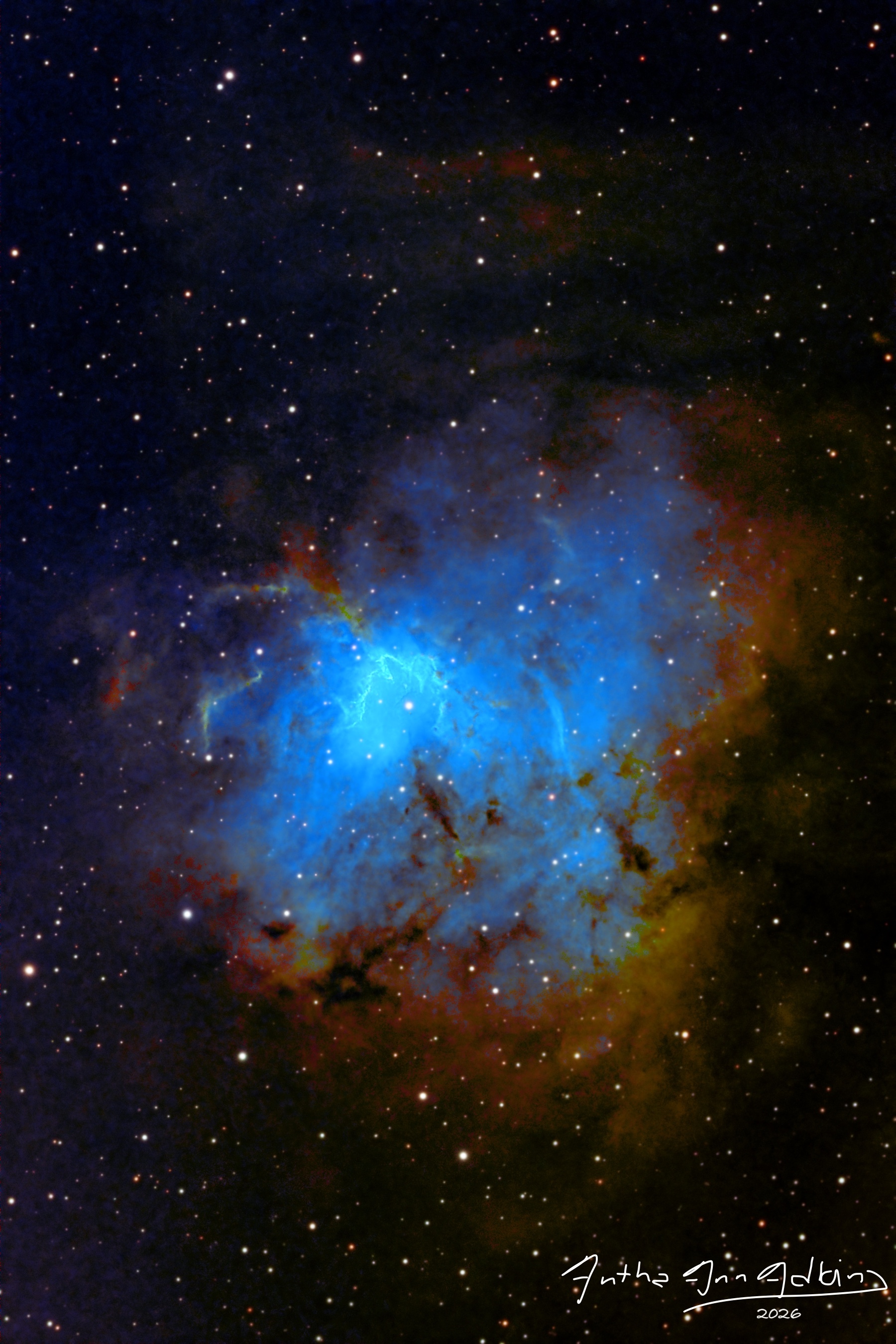
Sh2-206 or NGC1491: The Fossil Footprint Nebula (or, alternately, The Signature Nebula)

Sharpless Sh2-206, also listed as New General Catalogue (NGC) 1491, is commonly called the Fossil Footprint Nebula.  The portion of the nebula in this image is the “heel” of the footprint; the toes are much dimmer and not in this image.  To me, the most obvious feature of the nebula is the bright scribble that looks like a signature.  So I’d call it the Signature Nebula.  What do you think?

Sh2-206 is an H II region emission nebula, a region of ionized atomic hydrogen.  The H II regions in the Sharpless 2 catalog were “defined not only in terms of the ionized gas but also in terms of the hot stars which are responsible for the ionization.

Sh2-206 seems to be associated with one bright star: BD +50 886, which is the bright star just under the “signature” in the nebula.  This star is a type O4 star, young, massive, and hot.  It is approximately 9590 +/- 1000 light years away, which is close to the 9850 light years +/- 2000 light years distance for the nebula itself.  BD +50 886 is considered a runaway star with a 2D peculiar velocity (velocity relative to its environment) of 30.5 +/- 3.9 km/sec.  Not only is it ionizing the gas around it to make this nebula, but the “signature” in the nebula may be a bow shock due to the radiation pressure from the star on the local gas and the relative motion of the star and the local gas.

Sh2-206 is located in the Milky Way, approximately 9850 light years away.  The nebula in this image is 25 arc minutes across, so the nebula in this image is approximately 71 light years across.  

In this image, the stars came from images using red (0.47 hours), green (0.29 hours), and blue (0.3 hours) filters, and the nebula came from images using Sulfer ii (6.5 hours of data mapped to red), Hydrogen alpha (1.5 hours of data mapped to green) and Oxygen iii (7.67 hours of data mapped to blue) filters, the standard SHO mapping.  The nebula was processed separately from the stars to maximally enhance it.

Camera geek info:

  • William Optics Pleiades 111 telescope
  • ZWO 2” Electronic Filter Wheel
  • Antila SHO and RGB filters
  • Blue Fireball 360° Camera Angle Adjuster/Rotator
  • ZWO ASI183MM-Pro-Mono camera
  • William Optics Uniguide 32MM F/3.75
  • ZWO ASI220MM-mini
  • ZWO ASiair Plus
  • iOptron CEM40
  • Friendswood, Texas Bortle 7-8 suburban skies

Frames:

  • December 30, 2025
    • 9 600 second Gain 150 Ha lights
    • 30 0.5 second Gain 150 Ha flats
  • December 31, 2025
    • 15 600 second Gain 150 Oiii lights
    • 30 0.2 second Gain 150 Oiii flats
  • January 2, 2026
    • 15 600 second Gain 150 Sii lights
    • 30 0.5 second Gain 150 Sii flats
  • January 3, 2026
    • 15 600 second Gain 150 Sii lights
    • 30 0.5 second Gain 150 Sii flats
  • January 31, 2026
    • 9 600 second Gain 150 Oiii lights
    • 30 0.2 second Gain 150 Oiii flats
  • February 6, 2026
    • 9 600 second Gain 150 Sii lights
    • 30 0.5 second Gain 150 Sii flats
  • February 21, 2026
    • 84 20 second Gain 150 Red lights
    • 30 0.02 second Gain 150 Red flats
    • 53 20 second Gain 150 Green lights
    • 30 0.01 second Gain 150 Green flats
    • 54 20 second Gain 150 Blue lights
    • 30 0.01 second Gain 150 Blue flats
  • February 28, 2026
    • 2 600 second Gain 150 Oiii lights
    • 30 0.2 second Gain 150 Oiii flats
  • March 12, 2026
    • 8 600 second Gain 150 Oiii lights
    • 30 0.2 second Gain 150 Oiii flats
  • March 13, 2026
    • 12 600 second Gain 150 Oiii lights
    • 30 0.2 second Gain 150 Oiii flats
  • 30 Flat Darks matching flat durations from library
  • 30 Darks matching light durations from library

Processing geek info:

  • PixInsight
  • BlurXterminator
  • NoiseXterminator
  • StarXTerminator
  • Narrowband Normalization
  • Image Blend

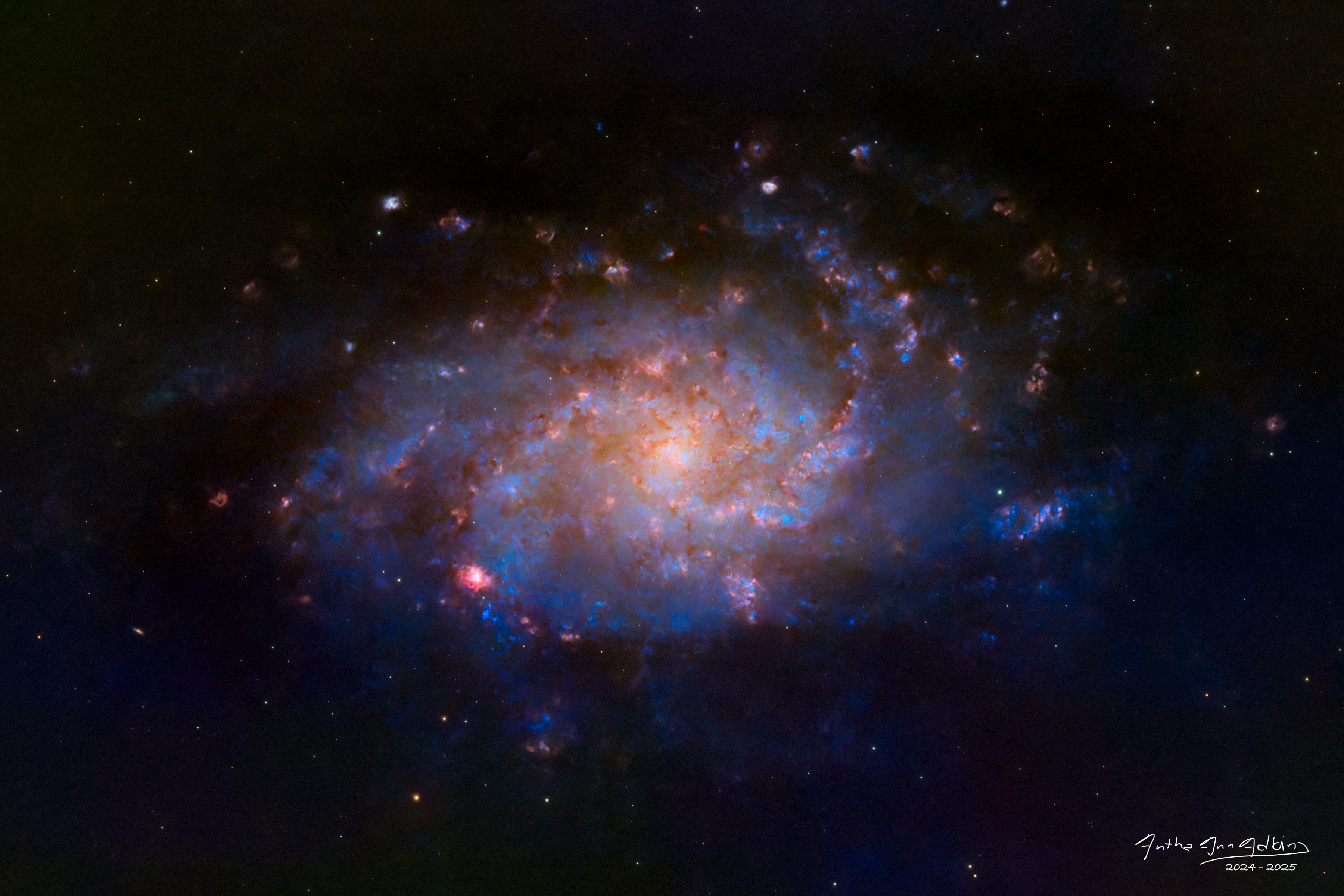
M33 The Triangulum Galaxy and its H-II Regions

Messier 33, the Triangulum Galaxy, is a galaxy in the same local group as our own Milky Way.  M33 is located approximately 2.74 million light years away, and it has an apparent visual size of 60.26 by 35.48 arcmin, so it is approximately 48 by 28.3 thousand light years across.  It is classed as a flocculant (fluffy, with less well-defined arms) spiral galaxy – in this image, one set of arms curve up from the right side and a second set of arms curve down from the left side.  

Because, by galaxy standards, M33 is relatively nearby (in the same local group as our own galaxy), we can see a lot of detail in it.  In fact, we can see the same kind of things in it that we see in our own galaxy – Hydrogen II (H-II) star forming region nebulas, supernova remnants, and even planetary nebulas.  

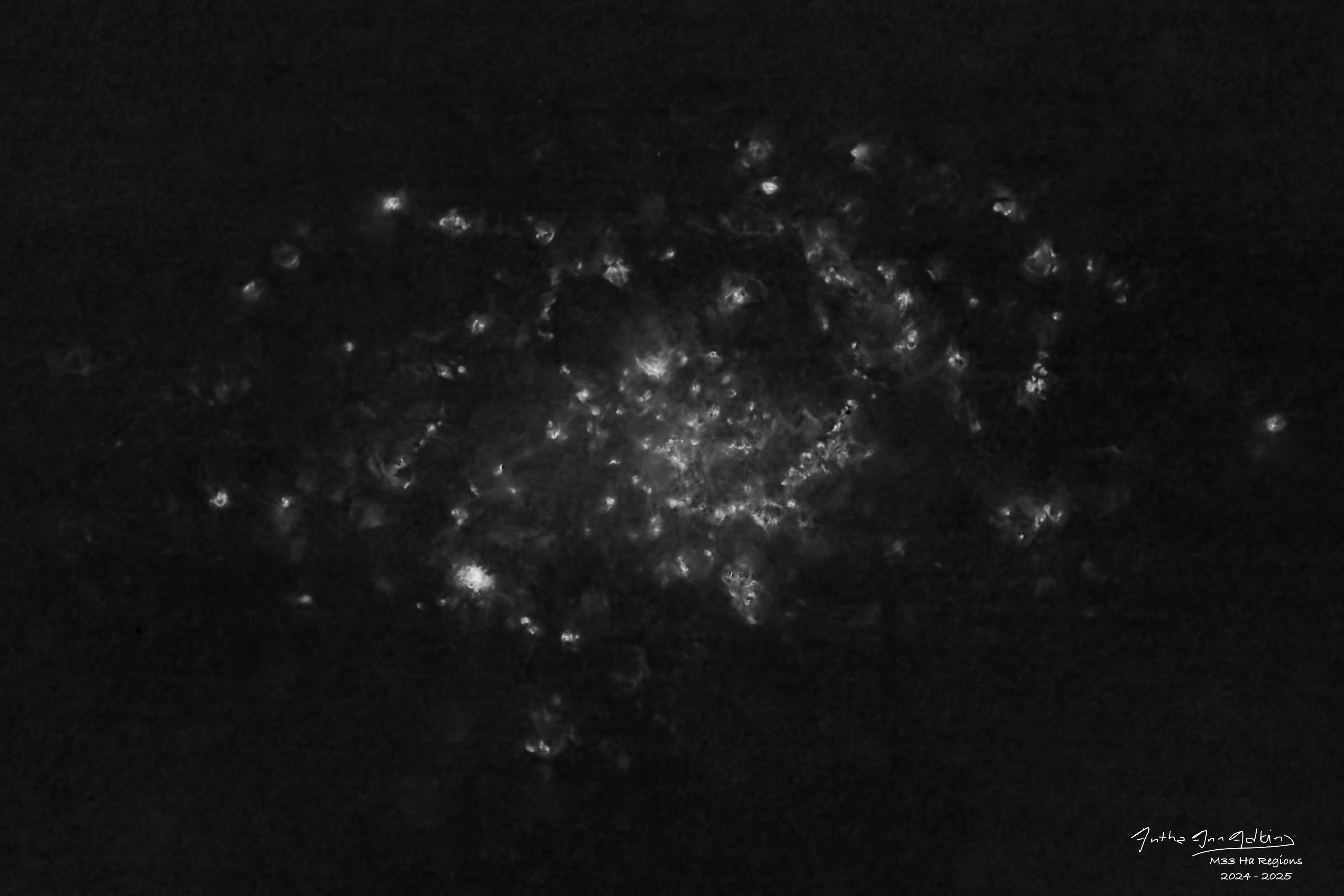
Most obvious in this image and in the black-and-white Hydrogen alpha (H-alpha) image are the enormous, bright, young H-II star forming region nebulas.  These are all clouds of atomic hydrogen ionized and lit up by the young, massive, star clusters that formed within them.

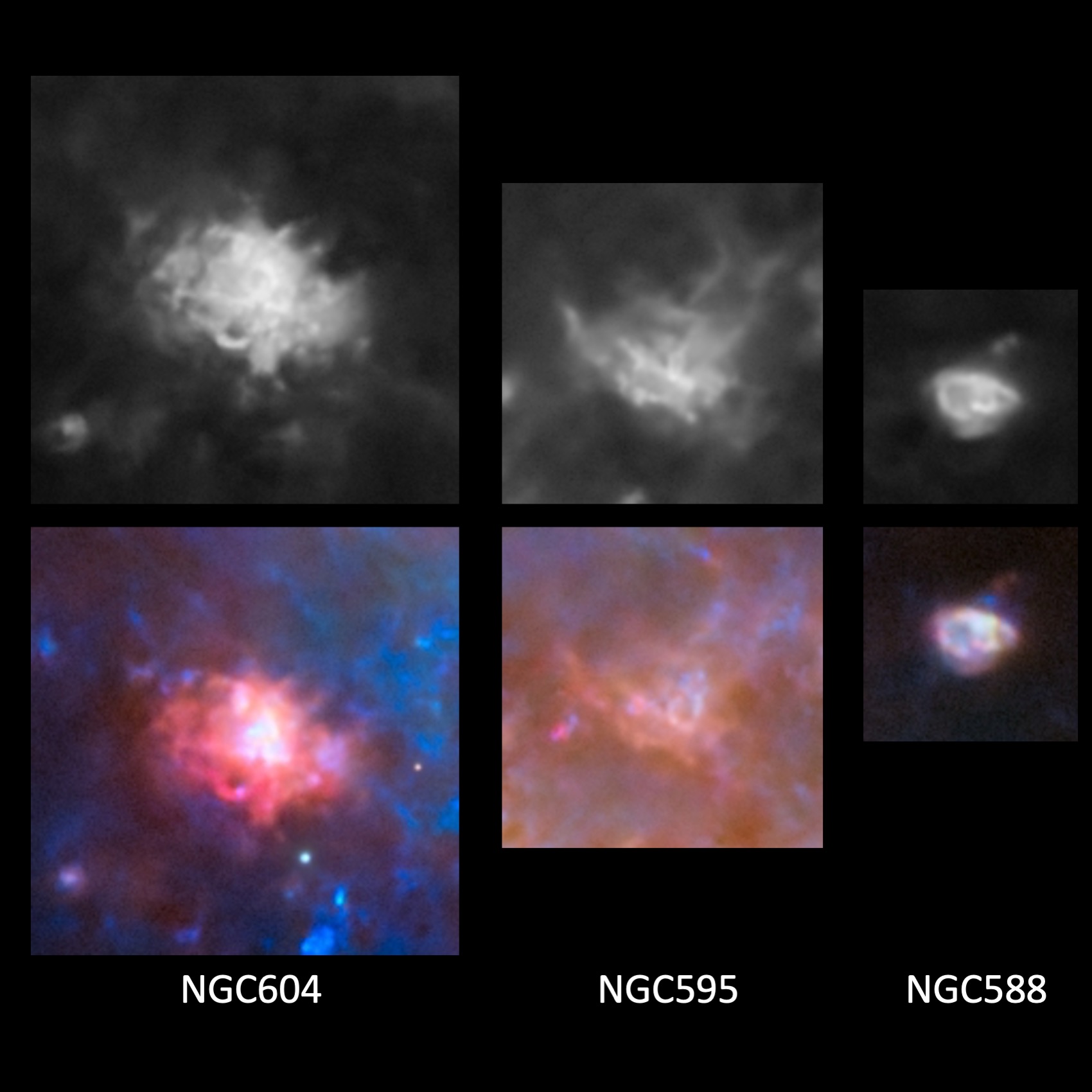
The brightest H-II star forming region in M33 is NGC604 in the innermost arm to the lower left of the main image.  It has an apparent visual size of 2 by 1.2 arcmins, so it is approximately 1600 by 950 light years across.  This region contains 200 massive, young, hot O-type and Wolf-Rayet stars that are about 3 million years old as well as an older population of stars that are 12 million years old.  This region may have hosted a sequence of star forming events, where one set of stars forming triggered the formation of the next set.  

The second brightest H-II star forming region in M33 is NGC595 at the top left of the galaxy core.  It has an apparent visual size of 1 arcmin, so it is approximately 800 light years across.  It contains about 250 type OB stars and 10 Wolf-Rayet stars with an approximate age of 4.5 million years old.

The third brightest H-II star forming region in M33 is NGC588 in the top of the second arm to the right.  It has an apparent visual size of 30 by 50 arcseconds, so it is approximately 400 by 665 light years across.  It contains a young star cluster that is about 3.5 million years old.

I started working on collecting data on M33 at the end of 2024/start of 2025 using my smaller 73 mm “Z” telescope, but I did not end up with sufficient data for a good image.  When I was imaging Comet Lemon with “Z” last fall, I collected more data while I was using that telescope and finally collected enough.

I combined several paths of processing to make this image.  I used only the 30 second Red Green Blue (RGB) data (about 26 minutes per color) to generate the RGB stars.  I used all the RGB data (4.5 hours of red data and 2.6 hours each of green and blue data) to generate an RGB image of the galaxy.  I processed the Hydrogen alpha (H-alpha) data (8.3 hours of data) by continuum subtracting a starless red from the starless H-alpha, then processing and stretching the resulting image.  I processed the Oxygen iii (Oiii) data (6.6 hours of data) by continuum subtracting a starless blue from the starless Oiii data and then processing and stretching the resulting image.  The continuum subtraction removes the “starlight” from the broader-band stars from the H-alpha (or Oiii) data to leave just the H-alpha (or Oiii) sources.  I stretched the H-alpha and Oiii separately to retain some detail in the very bright H-alpha emissions from the NGC604 H-II region as well as detail in the RGB galaxy.  Finally, I used NBColourMapper to add the H-alpha as red and the Oxygen iii as turquoise to the RGB galaxy.  

It is amazing to me that we can see star forming regions in other galaxies.  Our universe is still under construction!

Camera geek info:

  • Williams Optics Zenith Star 73 III APO telescope
  • Williams Optics Flat 73A
  • ZWO 2” Electronic Filter Wheel
  • Antila SHO and RGB filters
  • ZWO ASI183MM-Pro-Mono camera
  • William Optics Uniguide 32MM F/3.75
  • ZWO ASI220MM-mini
  • ZWO ASiair Plus
  • iOptron CEM40
  • Friendswood, Texas Bortle 7-8 suburban skies

Frames:

  • November 23, 2024
    • 229 60 second Gain 150 Ha lights
    • 30 1.0 second Gain 150 Ha flats
  • December 19, 2024
    • 99 60 second Gain 150 Oiii lights
    • 30 0.5 second Gain 150 Oiii flats
  • December 20, 2024
    • 28 60 second Gain 150 Ha lights
    • 30 1.0 second Gain 150 Ha flats
  • December 31, 2024
    • 185 30 second Gain 150 Red lights
    • 30 0.05 second Gain 150 Red flats
  • January 1, 2025
    • 46 30 second Gain 150 Red lights
    • 30 0.05 second Gain 150 Red flats
  • January 23, 2025
    • 24 60 second Gain 150 Ha lights
    • 30 0.5 second Gain 150 Ha flats
  • October 9, 2025
    • 68 60 second Gain 150 Red lights
    • 30 0.05 second Gain 150 Red flats
    • 71 60 second Gain 150 Green lights
    • 30 0.02 second Gain 150 Green flats
    • 69 60 second Gain 150 Blue lights
    • 30 0.02 second Gain 150 Blue flats
  • October 10, 2025
    • 61 60 second Gain 150 Red lights
    • 53 30 second Gain 150 Red lights
    • 30 0.05 second Gain 150 Red flats
    • 64 60 second Gain 150 Green lights
    • 52 30 second Gain 150 Green lights
    • 30 0.02 second Gain 150 Green flats
    • 64 60 second Gain 150 Blue lights
    • 52 3 second Gain 150 Blue lights
    • 30 0.02 second Gain 150 Blue flats
  • October 12, 2025
    • 49 180 second Gain 150 Oiii lights
    • 30 0.5 second Gain 150 Oiii flats
  • October 18, 2025
    • 50 180 second Gain 150 Oiii lights
    • 30 0.5 second Gain 150 Oiii flats
    • 73 60 second Gain 150 Ha lights
    • 30 0.5 second Gain 150 Ha flats
  • 30 Flat Darks from library matching flat lengths
  • 30 Darks from library

Processing geek info:

  • PixInsight
  • BlurXterminator
  • NoiseXterminator
  • StarXTerminator
  • NBColourMapper
  • Generalized Hyperbolic Stretch