10 October 2026 Dell City Fireball with Two Galaxies

One of the things I love doing while running my telescope in Dell City is sitting outside and stargazing.  Under the glorious dark skies, I can clearly see the Milky Way – our own galaxy – and I’ve figured out how to spot the Andromeda Galaxy next to it.  While I was looking at the stars, an amazing – wow – brilliant brighter-than-the-planets fireball went overhead, split into at least three parts, and glowed green!  I had enough time to say “WOW!” but not enough time to pull my phone out of my pocket and try to photograph it.
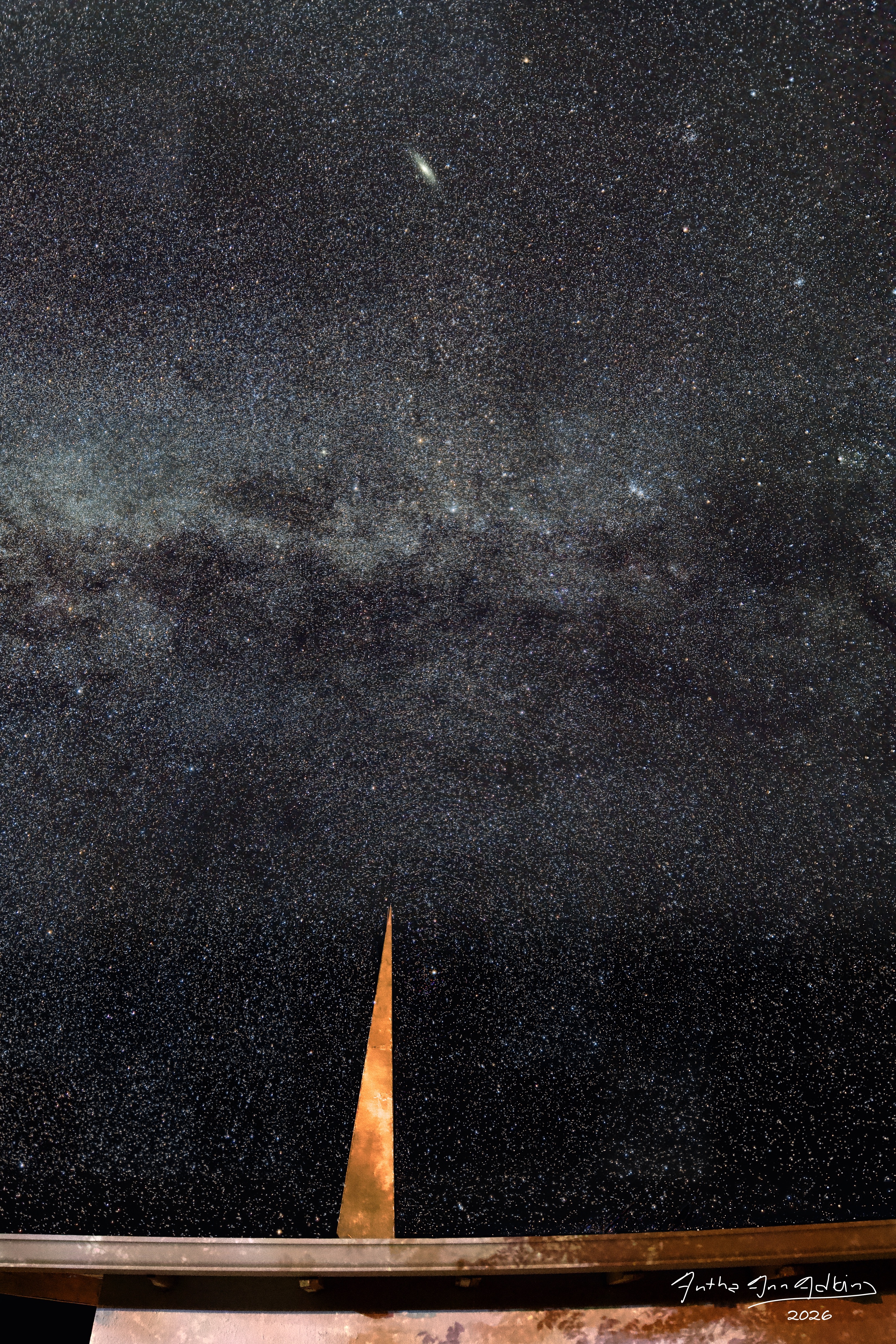
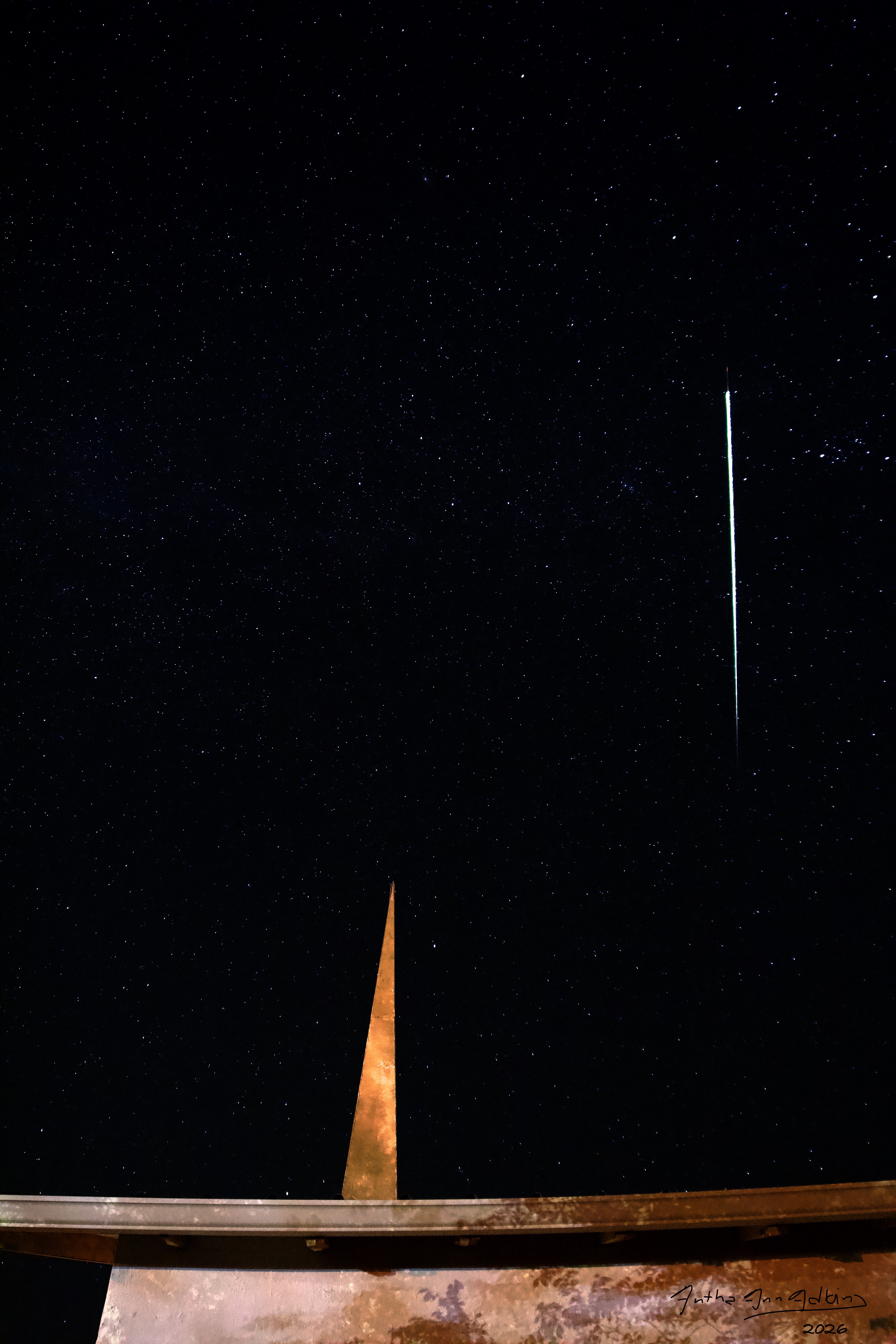
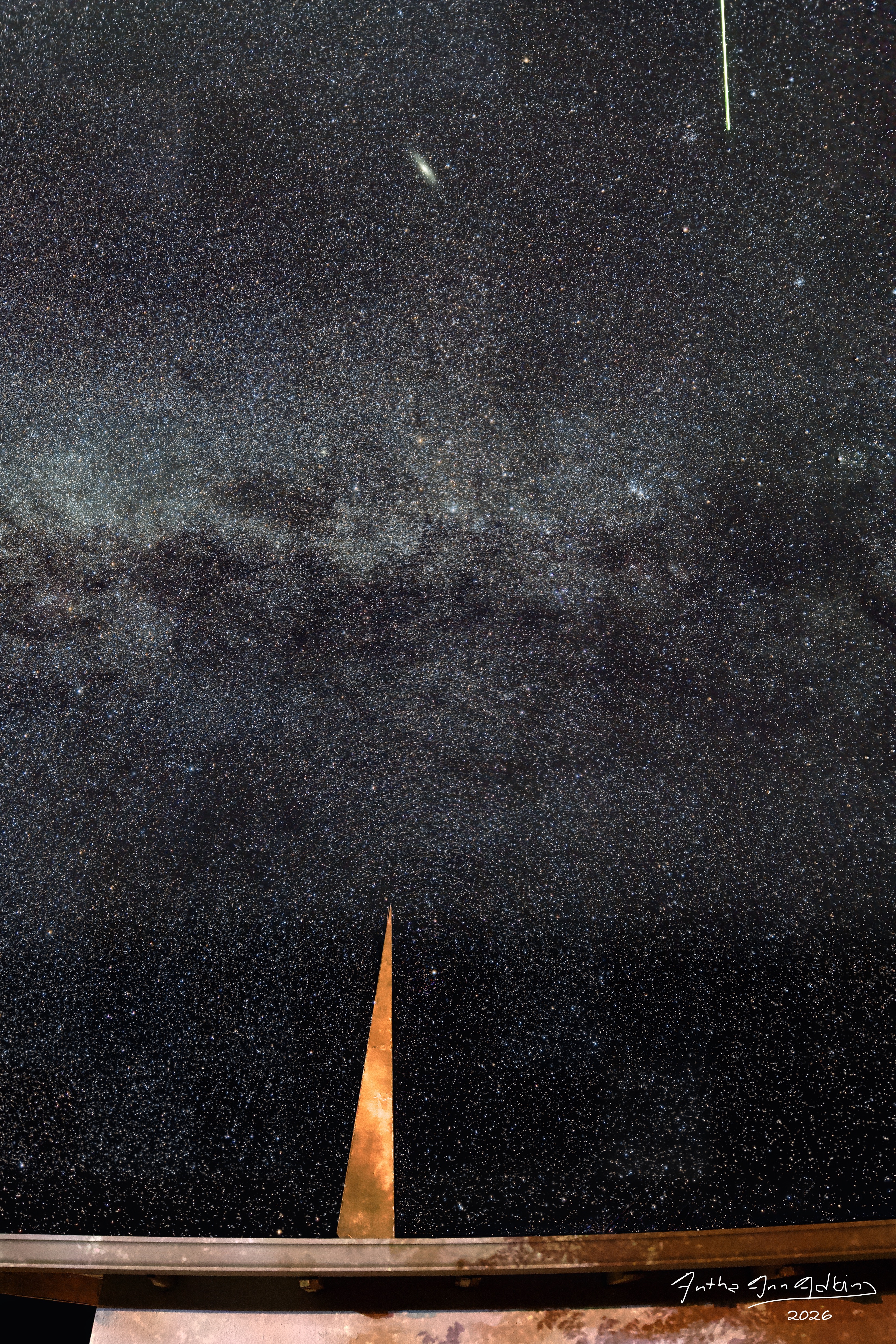
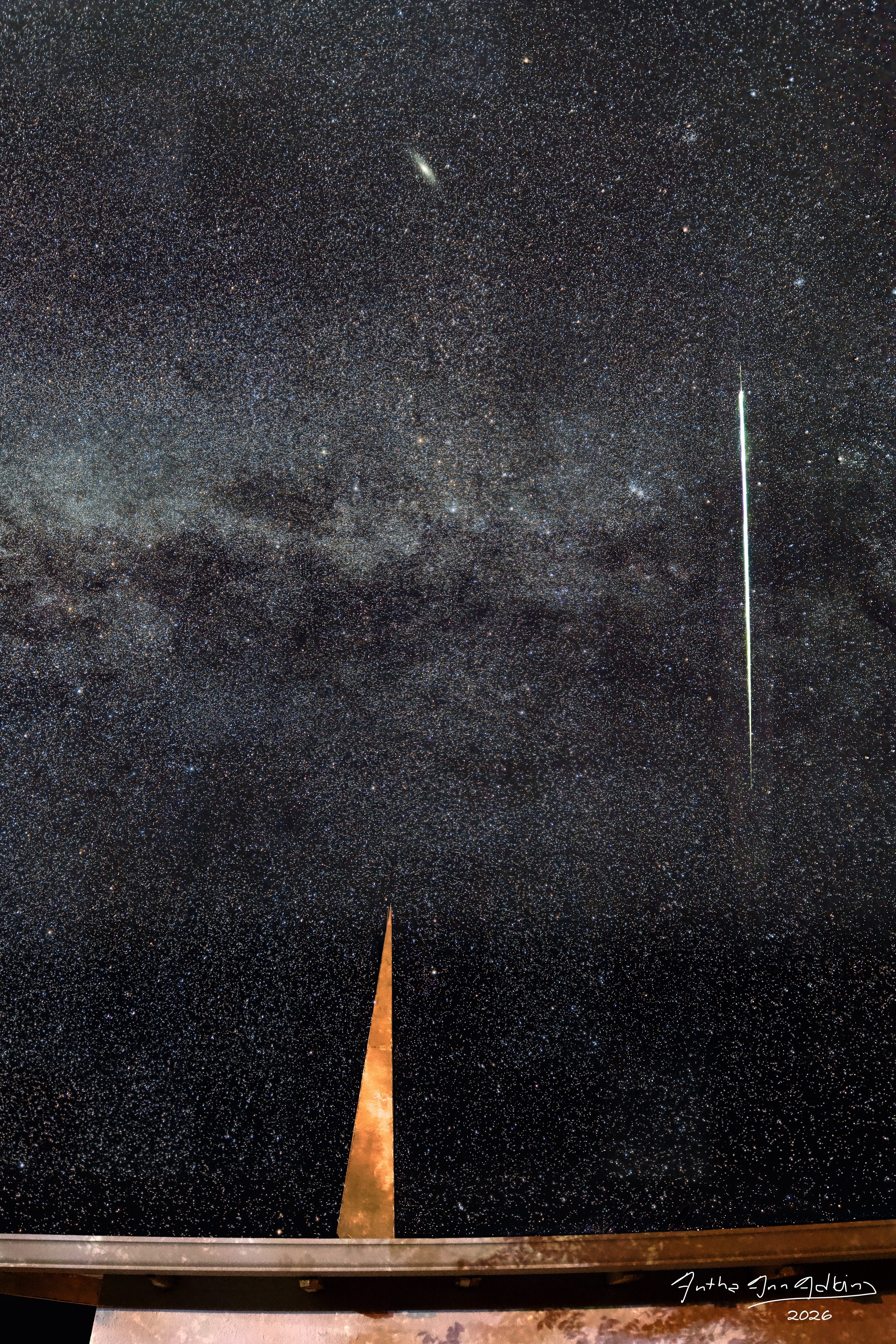
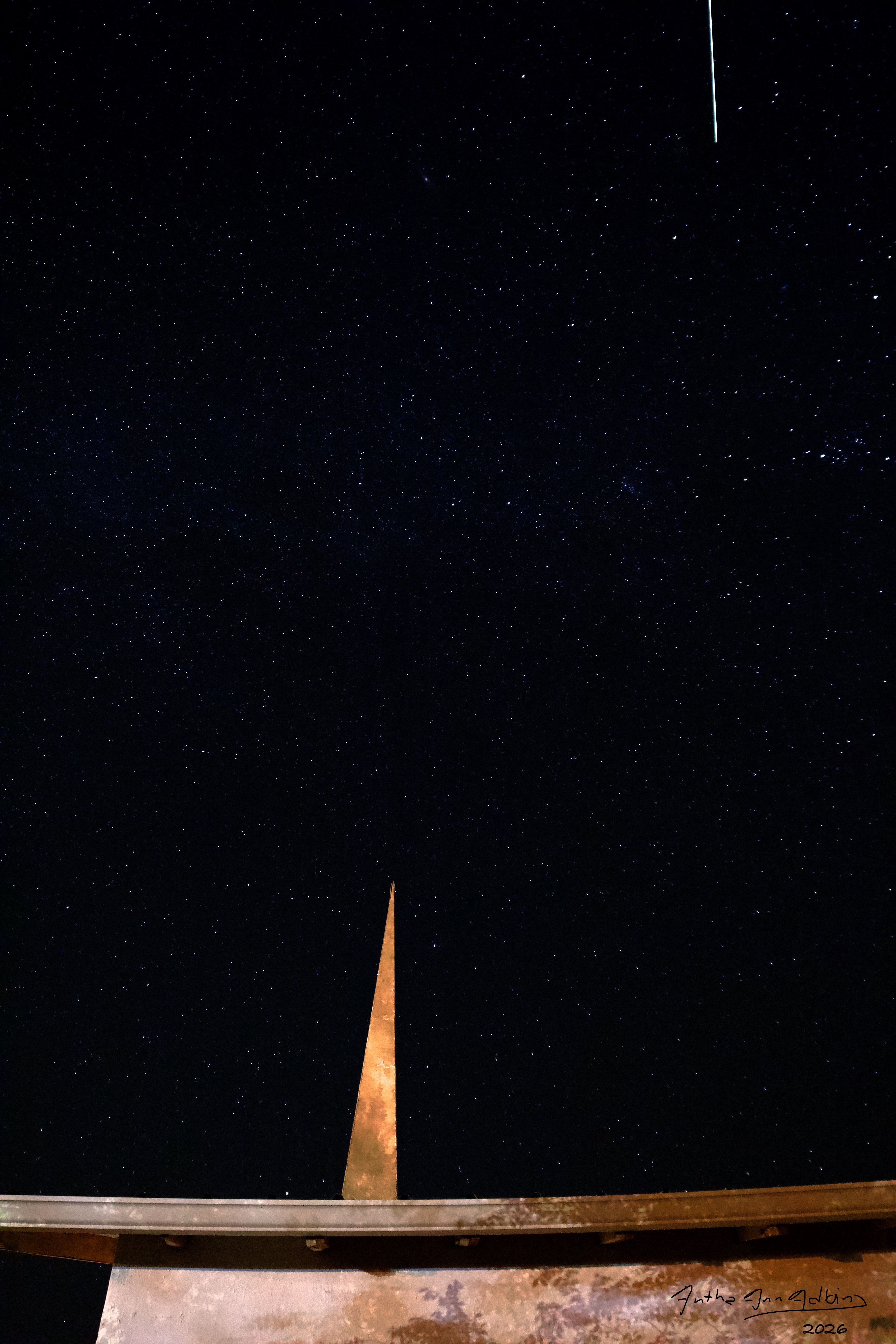
As luck would have it, I was collecting a series of wide-angle images of the Milky Way Galaxy (the side to side bright “cloud”) and the Andromeda Galaxy (bright elliptical object above the Milky Way) over the spire of the church where our very kind friends allow us to stay, and two of the last five images in the sequence of 201 showed the fireball!  The first one shows it coming down from above.  The second one picks it up one second later and captures its train (ionized gas in the air the fireball passed through, in this image the faint line above the fireball) as well as its termination.

These images were processed in five parts: a single shot for the spire, the integration of 201 frames for the stars, the integration of the same 201 frames for the Milky Way and Andromeda galaxies (processed separately from the stars), and single shots for the two fireball images.

For comparison, below are the original single frames for the meteor.  You can see that it was actually much brighter than the Milky Way or the Andromeda Galaxy.
What has made you say WOW recently?

Camera geek info:

  • Canon EOS 60D in manual mode, 9 second exposures, ISO 2000
  • Rokinon 14 mm f2.8 lens, manual focus
  • Intervalometer
  • Tripod

Frames:

  • October 10, 2026
    • 201 9 second lights
    • 32 0.0008 second flats
    • 51 0.0008 second dark flats
    • 35 9 second darks

Fireball Sighting

Yesterday, as my family was driving down the freeway, I saw a bright light in the sky.  Initially, I thought it was a helicopter with its lights on, but it was moving too fast and disappeared midair.

Since watching meteor showers and trying to “catch” a meteor with my camera is a hobby of mine, I suspected I had seen a stray fireball, so I took note of the time and our location (and wished we had a dashcam that would have caught the event).

When I got home, I checked the American Meteor Society web site, and someone else in the area had reported seeing a fireball at the same time!  So I contributed to science and added my observation.

I also checked my favorite satellite visibility web site, and the time and trajectory did not match up with any visible satellites or Iridium flares (and I think it was moving too fast to be either).

That event is now AMS event 1149 with three observers to date.

http://www.amsmeteors.org/fireball_event/2013/1149

Did anyone else in the Houston area see it?  Do you have any stories of other fireballs you have seen?

The most amazing one I’ve ever see was over Florida almost 20 years ago.  Amazingly bright and I was convinced that one landed somewhere.  Unfortunately, I didn’t know how to capture or report that data at the time, but I’ve always wondered what happened to it.

Fireball over Russia

I was planning on blogging about alien design today, but, really, how can I resist blogging about a major meteorite event and a close fly-by of an asteroid happening on the same day? 

Earlier today a fireball came apart over Russia and there are reported associated meteorites.

            http://rt.com/news/meteorite-crash-urals-chelyabinsk-283/

Someone on the American Meteor Society has already estimated a rough orbit:

            http://www.amsmeteors.org/2013/02/large-daytime-fireball-hits-russia/

I cannot wait to see what is learned from this event.  Very exciting!

And on the same day we have a close fly-by of an asteroid (closer to the Earth than the Moon or geosynchronous satellites).  But this one won’t hit us.

            http://www.space.com/19781-asteroid-2012-da14-flyby-webcasts.html

It is an exciting day for space news!