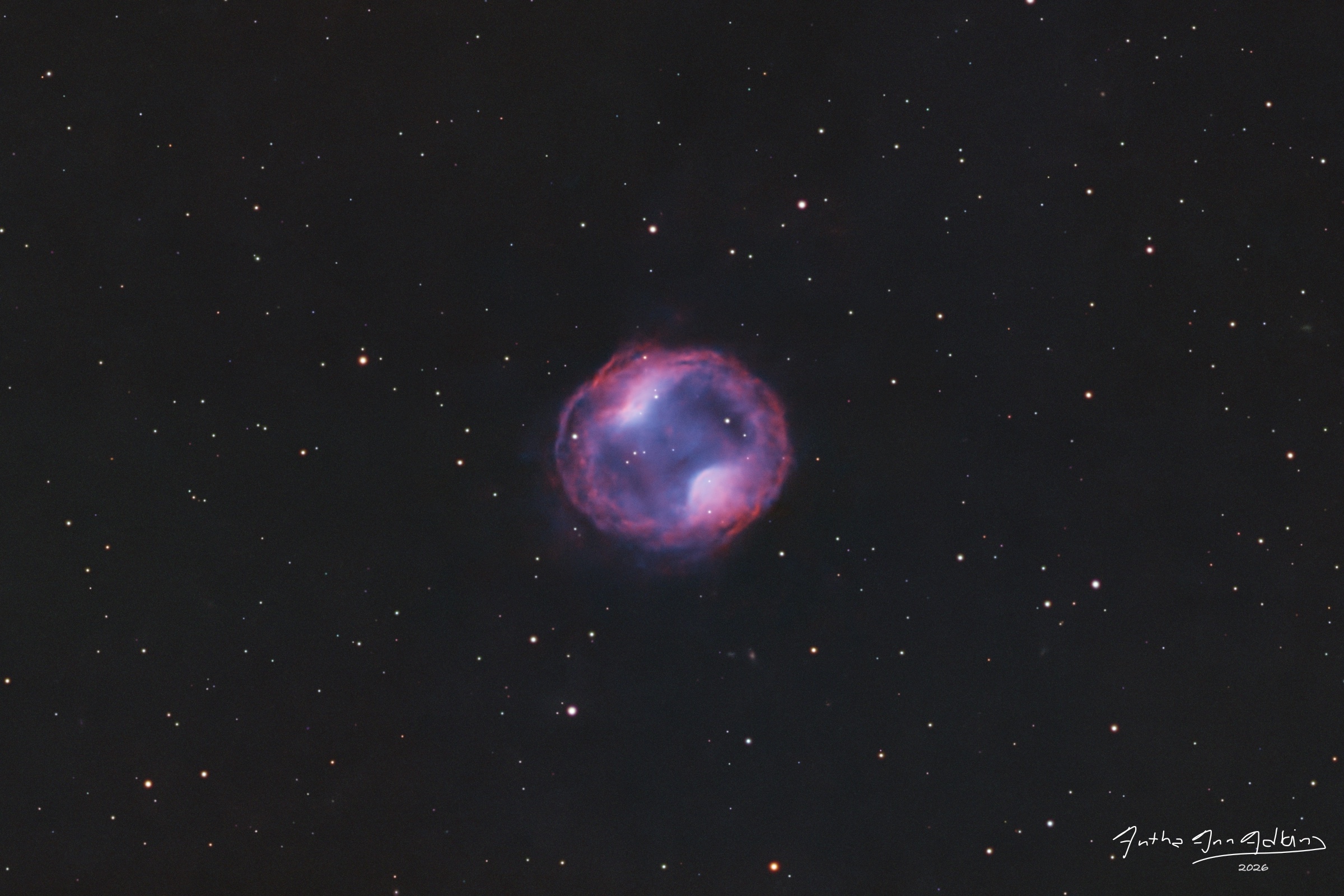
Jones Emberson 1, also called the Headphones Nebula, is a planetary nebula – the gases expelled from a low to intermediate mass (0.8 to 8 times the mass of the sun) red giant star before it becomes a white dwarf, lit up by that star. It’s located in the Milky Way, approximately 3060 light years away, and it has an apparent size of 6.3 arcminutes, making it 5.6 light years across. It’s estimated to be 36,800 +/- 7000 years old based on the expansion of the nebula.
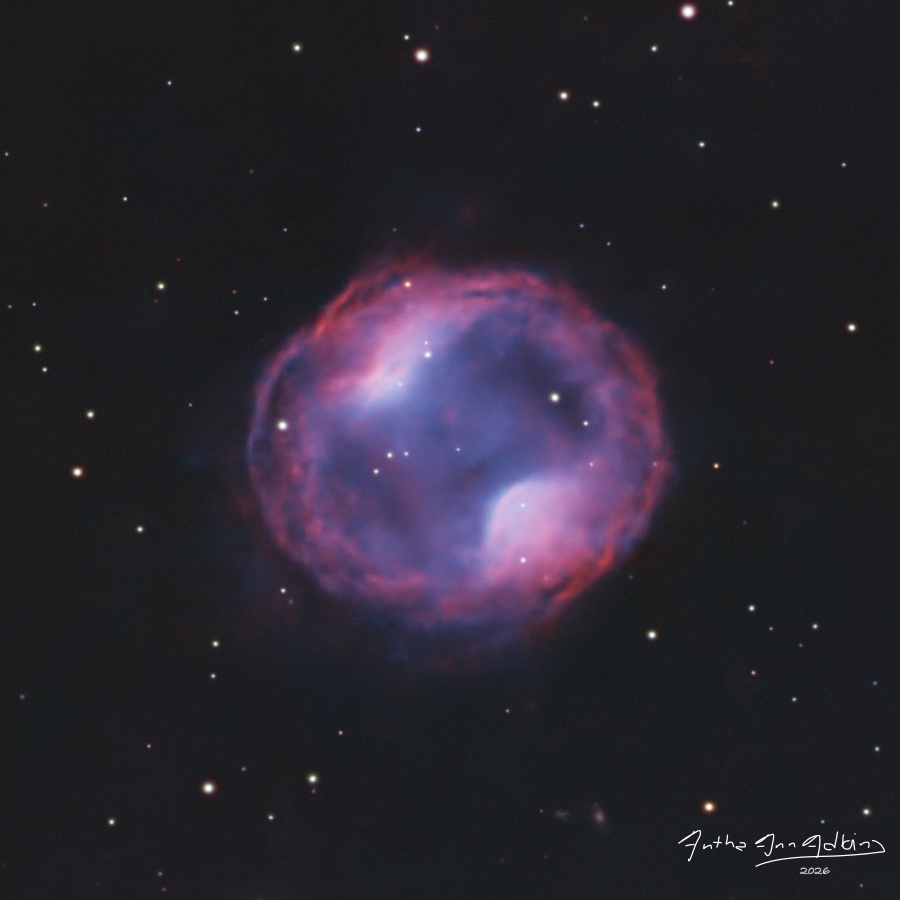
I find these small nebulae beautiful and fascinating. Each has its own unique structure. This one has an outer rim with two opposite inner bumps (the headphones) and an inner section that appears to have two voids in it orthogonal to the bumps. It has Hydrogen Ha emissions (mapped to red) and Oxygen Oiii emissions (mapped to blue). The strongest Ha and Oiii regions are on the two interior bumps. Ha is also much stronger in the bumpy outer ring of the nebula, while the Oiii signal, while stronger in the ring, is also in the nebula interior.
In addition to the nebula, there are several background galaxies in this image. I didn’t spend much time collecting RGB data, so the galaxies are very faint.
In this image, the stars and galaxies came from images using red-green-blue filters (22 – 30 minutes per color), and the nebula came from images using 2.8 hours of Hydrogen alpha (mapped to red) and 7.3 hours of Oxygen iii (mapped to blue) filters. The nebula, galaxies, and stars were processed separately to maximally enhance the nebula and galaxies.
Camera geek info:
- William Optics Pleiades 111 telescope
- ZWO 2” Electronic Filter Wheel
- Antila HO and RGB filters
- Blue Fireball 360° Camera Angle Adjuster/Rotator
- ZWO ASI183MM-Pro-Mono camera
- ZWO ASiair Plus
- William Optics Uniguide 32MM F/3.75
- ZWO ASI220MM-mini
- iOptron CEM40
- Friendswood, Texas Bortle 7-8 suburban skies
Frames:
- December 30, 2025
- 3 600 second Gain 150 Ha lights
- 30 0.5 second Gain 150 Ha flats
- December 31, 2025
- 4 600 second Gain 150 Oiii lights
- 30 0.2 second Gain 150 Oiii flats
- January 31, 2026
- 8 600 second Gain 150 Oiii lights
- 30 0.2 second Gain 150 Oiii flats
- February 5, 2026
- 15 600 second Gain 150 Oiii lights
- 30 0.2 second Gain 150 Oiii flats
- February 6, 2026
- 15 600 second Gain 150 Ha lights
- 30 0.5 second Gain 150 Ha flats
- February 21, 2026
- 90 20 second Gain 150 Red lights
- 30 0.02 second Gain 150 Red flats
- 68 20 second Gain 150 Green lights
- 30 0.01 second Gain 150 Green flats
- 74 20 second Gain 150 Blue lights
- 30 0.01 second Gain 150 Blue flats
- February 28, 2026
- 2 600 second Gain 150 Oiii lights
- 30 0.2 second Gain 150 Oiii flats
- March 12, 2026
- 14 600 second Gain 150 Oiii lights
- 30 0.2 second Gain 150 Oiii flats
- March 13, 2026
- 3 600 second Gain 150 Ha lights
- 30 0.5 second Gain 150 Ha flats
- 30 Flat Darks from library
- 30 Darks from library
Processing geek info:
- PixInsight
- BlurXterminator
- NoiseXterminator
- StarXTerminator
- NBColourMapper
- Generalized Hyperbolic Stretch

