Narrative Summary

I recently realized in my “real job” that I need to write something up in detail before I write a summary of it.  Even though in the recent case in point I knew all I was going to eventually need was the summary, I needed to go through the exercise of thinking through the whole thing.

To some extent, I have always done some version of that.  For example, in five paragraph essays for school (back in the day), I liked to write the three body paragraphs to figure out what I was doing and *then* write the introduction/conclusion.  I’ve done that for technical papers at work as well.

So it shouldn’t have surprised me when I realized I needed to do that in my stories, too.  Having drunk from the “show don’t tell” Kool-Aid, I tend to try to describe step-by-step action to try to capture the visuals that I am seeing in my head.  Unfortunately, this can generate some really, well, *boring* prose.  Yes, seeing an acrobatic troupe build a human pyramid is cool, but describing each jump and flip to make it?  Not so much.

So in the current short project, 173 visually awesome but boring-as-showing words have now been summarized in 23 action-packed narrative summary words.  Much better.

August Stats

I spent August working through the snowflake method to plan a novel.  I am now somewhere between steps 5 and 6, which is to say that I’ve written a character synopsis for my main character the length of the plot synopsis in part 6 and several but not all of my one-page character summaries for the other characters.  As such, I have written lots of words, but none that I can count towards word count.  My plan, BTW, is to finish the character summaries, call steps 5 and 6 done, skip step 7, and go straight to step 8, listing the scenes in the novel.  Then I will be ready to start writing it.

However, I had a short story idea come to me, so that may get written first.

Either way, I expect to generate some actual word count this month.

WORDS WRITTEN: 0

HOURS SPENT WRITING: 12.5

WORDS/HOUR: 0

Aliens as Bad Guys

I am currently working on designing the characters for my new project.  I knew the main character and the basic story arc, but the project wasn’t moving along smoothly because I didn’t really understand anyone else in the story.  All the other characters felt like cardboard cutouts.  So I started planning out several of the other major characters, and now I’ve got a much better (and somewhat different) plan for the story based on the characters.  Which is good.

The bad guys in this story are aliens.  I haven’t planned out any of their characters.  Heck, I haven’t even named them. They weren’t even on my first list of characters to plan, even though my main character is going to spend a significant chunk of time with them.  They’re just nameless, faceless (literally, in this case) bad guys.  And I could leave them like that.

In fact, it’s tempting to leave it like that.  They’re the bad guys, after all.  Why would I want to spend time in their heads?  Why would I want to think about them like they are actually individuals?  Why don’t I just label them as evil and give them some repulsive philosophy and be done with them?

I think there’s a good reason not to.  Because just as planning out my character’s friends has made the story much better and richer, I think planning out my character’s enemies is going to enrich it as well.  And planning out aliens (even evil ones) is generally fun.

So that’s my plan for my writing time this weekend … understanding my bad guys.

June Stats

How the heck did it get to be July?  I must be having fun, because time is passing rapidly.

Here are my stats for June.  Once again, editing and planning have reduced my word count.  Writing less often has been the bigger hit, however.  And now that I know what I *can* do when I write every day … months like this are disappointing.  The bar has been raised, my friends.  The bar has been raised.

WORDS WRITTEN: 1961

HOURS SPENT WRITING: 17.7

WORDS/HOUR: 111

What it means when I start building character family trees …

My new project has gotten larger in scope, and I am currently working on constructing a family tree for my main character.  The last two times I planned out family trees, the project turned into a novel.  I suspect the same thing is happening here.

I am working my way through the Snowflake Method to do the top-level planning for the project, and the one-paragraph summary for step 2 looks like novel material.  I am a planner, and one of the things that I like about the Snowflake Method is that it helps me get a handle on the scope of a piece.  I also like it because I end up with a list of scenes to write – almost a writing to-do list.  And I love lists!  More, I love crossing things off lists.  So the prep work is totally worth it for me.

Do lists work for you?

Apollocon 2013 Report

I just got home from Apollocon 2013, which I consider my “local” science fiction convention.  I’ve been going for a number of years, and I always enjoy it.  As usual, I wished I could borrow Hermione’s time turner so I could attend multiple panels at the same time.

I enjoyed all the typical con things: meeting other authors, expanding my thinking on various issues at the panels, and coming home with new books and a list of more books and blogs that I want to read.

One of the neat things about this particular con is that because it is in Houston, home of NASA/Johnson Space Center, it has some great space science presentations and panels.  This year, the highlights for me were:

– Dr. Paul Abell‘s presentation on the Chelyabinsk meteor that exploded over Russia in February (the audio recordings of this thing are just amazing)

– Astronaut Stanley Love‘s presentation on searching for meteorites in Antarctica (with lots of observations about the physical space spent on logistics and time spent on non-science work which are as invaluable to science fiction authors trying to get it right as it is to NASA mission planners)

– Dr. Paul Abell, Dr. Al Jackson, and Dr. Stanley Love’s panel on Planetary Defense and the work being done to find and categorize near earth objects with the potential to impact our planet and cause local to knock-us-back-to-the-stone-age destruction as well as the work being done to find ways to prevent such an event from occurring should a NEO be found that is predicted to impact the Earth

Of course, I am fascinated by meteorites, so I enjoyed all these talks immensely.

But even if one is not fascinated by meteorites, these guys make their subjects compelling.  I highly recommend going to one of their talks if you ever get the opportunity.

I Write Like

I ran across a post on Will Wheaton’s blog where he ran the text analyzer on I Write Like on his writing and it told him he wrote like Cory Doctorow.

So, of course, I had to see who I write like.

The result:

I Write Like. Analyze your writing!

I didn’t recognize the name, but I did recognize this awesome graduation speech he gave at Kenyon (full version here).

Now I want to read one of his books to see if he writes like me.  😉

I tried the text analysis on another story of mine, one where I had intentionally tried to write in the style of P. G. Wodehouse.  I got the same answer – David Foster Wallace.  But apparently Wodehouse is not in the database.

Who do you write like?

May Stats

Here are my stats for May.  My words/hour ratio is lower than April because I spent the month editing two stories.  But I almost got in my age-old goal of an hour a day (although the current goal is 100 words a day, which seems to work a lot better).

WORDS WRITTEN: 5794

HOURS SPENT WRITING: 27.3

WORDS/HOUR: 206

Human Characteristics in Aliens

Seasaucer002

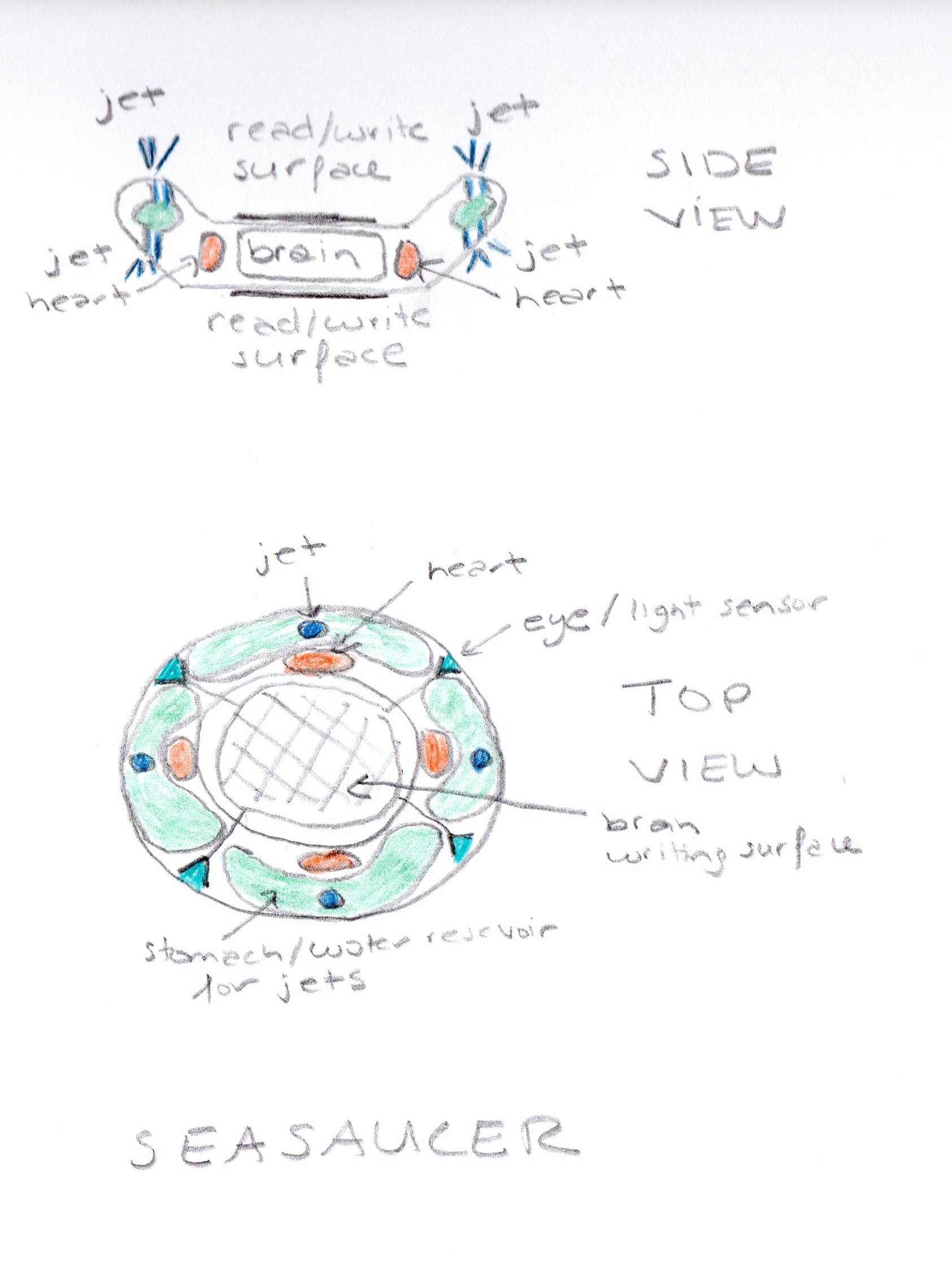
I am working on revising a short story I wrote about sea aliens earlier this year.

The sea aliens are, physically, nothing like humans.  They look like saucers, move by sucking in and blowing out water, and communicate by wrinkling their surfaces.

Even though it is critical to the story that the sea aliens communicate with one another, I missed two obvious opportunities to have them do so.  In both cases, the aliens are in a dangerous situation.  If humans were in a similar situation, we would be nattering away to each other about what to do.  I live on the Texas gulf coast, and whenever a hurricane comes into the gulf and especially when Hurricanes Rita and Ike were headed for us, we were continuously talking about what the hurricane would do, what we should do, and what we could lose.

So why didn’t I have my aliens doing the same thing?

After all, part of the fun of creating aliens is to think about what life would be like for a different type of intelligent being.  What would threaten them? What would be important to them?  What goals would they have?  The answers to these questions depend up on the aliens, of course, and I find them fascinating.

And yet I didn’t have my aliens communicating when they would be.

I think that is because I fell into the laziness trap and didn’t think through how the aliens would behave in these situations.  And, because I didn’t think, I had them behaving like the animals they look like instead of like the aliens they are.

That was wrong, and I am fortunate that some excellent critiquers pointed that error out to me.  I will be fixing it in the rewrite.

Have you thought through how the aliens behave in your SF?

Have you read any SF where you thought the aliens were too much like animals?  Or too much like people?