Orion EFT1 Mission

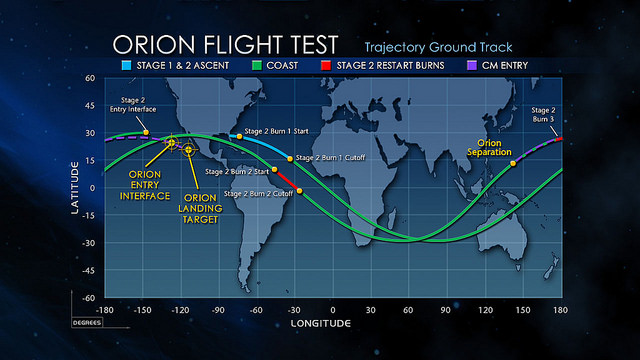
OrionGroundTrack

I got up early yesterday and again today to watch the launch of NASA’s newest spacecraft, Orion. This flight, Experimental Flight Test 1 (EFT1), is, as its name suggests, a flight test to check out critical Orion systems before we send it further away with people on board.

I cheered when it successfully launched this morning and did not get any writing done because I was too intrigued with the Orion TV feed.

Here were the thoughts I had while watching:

– I’m conditioned to watch Space Shuttle launches and know the event timing, and it was odd for me to watch a launch with different timing and steps. Shouldn’t the side rockets fall off after two minutes? Apparently, no.

– I saw some insulation popcorning off the Delta IV in the rocket cam video feed, but I didn’t have to worry about anything hitting Orion since it’s on top of the stack. That’s a big benefit to the top of the stack design.

– I was furious with the idiots who kept tweeting Orion had blown up.  Can I tunnel through the internet and terminate their connections?  Please?

– I cheered when we started getting good telemetry off Orion via its own communication system and the Tracking and Data Relay Satellites (TDRSs).

– I loved the views of Earth from the Orion cameras.

– I was happy when I saw the Orion animation showing Orion was passing the Texas Gulf Coast. Unfortunately, I hadn’t thought to use my screen capture program to catch it. And it was raining here at the time, so there was no point in going out to wave.

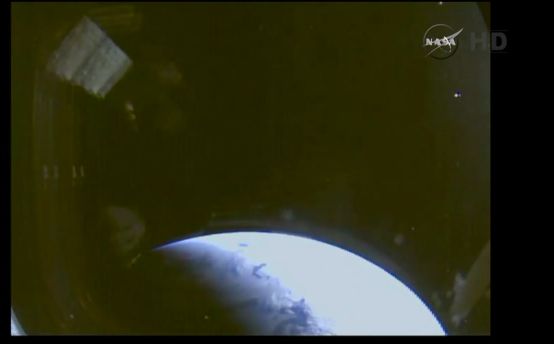
– Once Orion was up in its elliptical orbit, the view of the Earth was a tri-color Earth much like my tri-color Moon from my lunar eclipse photos: white limb, blue middle, and black in shadow. I need to figure out if that’s just an effect of the camera’s dynamic range because if not I want to capture the tri-color effect in the story I’m currently writing.

OrionEarth-4

– Orion did, as expected, experience a communication blackout when the reentry plasma got too thick.

– The video of the landing and splashdown – from the Ikhana drone and Orion itself – were awesome. I loved the infrared point of the approaching Orion and getting to see all the parachutes deploy.

– It was great that NASA TV and ustream broadcast the entire mission, and I enjoyed sharing the event with the twitter community. I don’t tweet often, but this event seemed made for it.

I spent the whole morning watching the flight. What an awesome day!

Congratulations to the NASA and Lockheed Martin Orion teams on a flawless flight! I am such a NASA fangirl! Luckily for me, I work for a NASA contractor and occasionally get to do work for Orion. But today I just got to be a fan.  🙂

[1] Ground track picture from NASA Flickr.

[2] Tri-color Earth picture screen shot from ustream NASA TV feed.

Saturn hovers over Mercury

MercurySaturn20131127Med

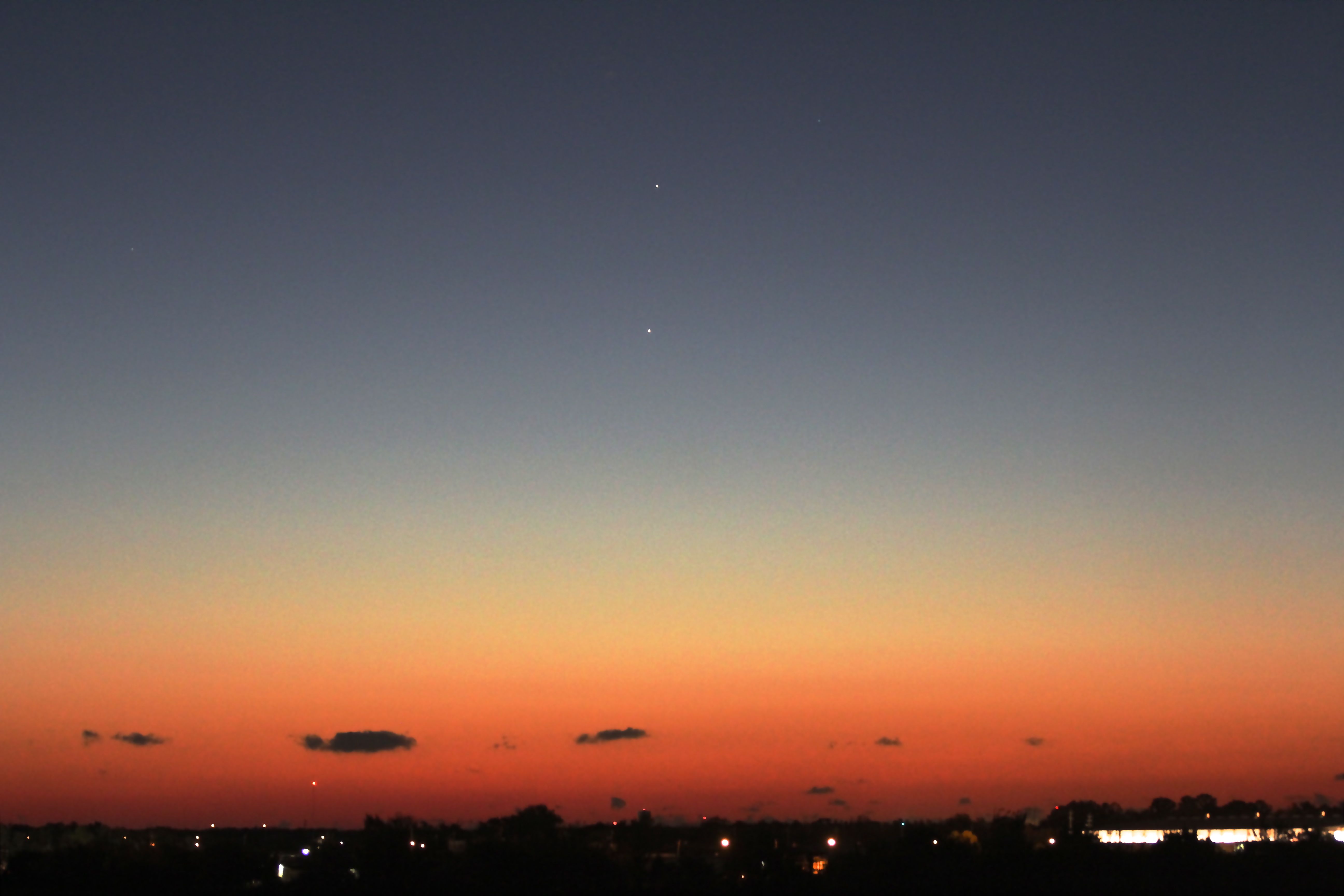
As Murphy would have it, we’ve had heavy clouds and rain this week, so we weren’t able to look for Comet ISON.  The clouds finally blew away this morning, so we braved the cold morning to see if we could spot the comet through the colors of the sunrise.  We didn’t spot the comet, but we did see Saturn hovering above Mercury.  It was quite striking, don’t you think?

Apollocon 2013 Report

I just got home from Apollocon 2013, which I consider my “local” science fiction convention.  I’ve been going for a number of years, and I always enjoy it.  As usual, I wished I could borrow Hermione’s time turner so I could attend multiple panels at the same time.

I enjoyed all the typical con things: meeting other authors, expanding my thinking on various issues at the panels, and coming home with new books and a list of more books and blogs that I want to read.

One of the neat things about this particular con is that because it is in Houston, home of NASA/Johnson Space Center, it has some great space science presentations and panels.  This year, the highlights for me were:

– Dr. Paul Abell‘s presentation on the Chelyabinsk meteor that exploded over Russia in February (the audio recordings of this thing are just amazing)

– Astronaut Stanley Love‘s presentation on searching for meteorites in Antarctica (with lots of observations about the physical space spent on logistics and time spent on non-science work which are as invaluable to science fiction authors trying to get it right as it is to NASA mission planners)

– Dr. Paul Abell, Dr. Al Jackson, and Dr. Stanley Love’s panel on Planetary Defense and the work being done to find and categorize near earth objects with the potential to impact our planet and cause local to knock-us-back-to-the-stone-age destruction as well as the work being done to find ways to prevent such an event from occurring should a NEO be found that is predicted to impact the Earth

Of course, I am fascinated by meteorites, so I enjoyed all these talks immensely.

But even if one is not fascinated by meteorites, these guys make their subjects compelling.  I highly recommend going to one of their talks if you ever get the opportunity.

Fireball Sighting

Yesterday, as my family was driving down the freeway, I saw a bright light in the sky.  Initially, I thought it was a helicopter with its lights on, but it was moving too fast and disappeared midair.

Since watching meteor showers and trying to “catch” a meteor with my camera is a hobby of mine, I suspected I had seen a stray fireball, so I took note of the time and our location (and wished we had a dashcam that would have caught the event).

When I got home, I checked the American Meteor Society web site, and someone else in the area had reported seeing a fireball at the same time!  So I contributed to science and added my observation.

I also checked my favorite satellite visibility web site, and the time and trajectory did not match up with any visible satellites or Iridium flares (and I think it was moving too fast to be either).

That event is now AMS event 1149 with three observers to date.

http://www.amsmeteors.org/fireball_event/2013/1149

Did anyone else in the Houston area see it?  Do you have any stories of other fireballs you have seen?

The most amazing one I’ve ever see was over Florida almost 20 years ago.  Amazingly bright and I was convinced that one landed somewhere.  Unfortunately, I didn’t know how to capture or report that data at the time, but I’ve always wondered what happened to it.

Fireball over Russia

I was planning on blogging about alien design today, but, really, how can I resist blogging about a major meteorite event and a close fly-by of an asteroid happening on the same day

Earlier today a fireball came apart over Russia and there are reported associated meteorites.

            http://rt.com/news/meteorite-crash-urals-chelyabinsk-283/

Someone on the American Meteor Society has already estimated a rough orbit:

            http://www.amsmeteors.org/2013/02/large-daytime-fireball-hits-russia/

I cannot wait to see what is learned from this event.  Very exciting!

And on the same day we have a close fly-by of an asteroid (closer to the Earth than the Moon or geosynchronous satellites).  But this one won’t hit us.

            http://www.space.com/19781-asteroid-2012-da14-flyby-webcasts.html

It is an exciting day for space news!