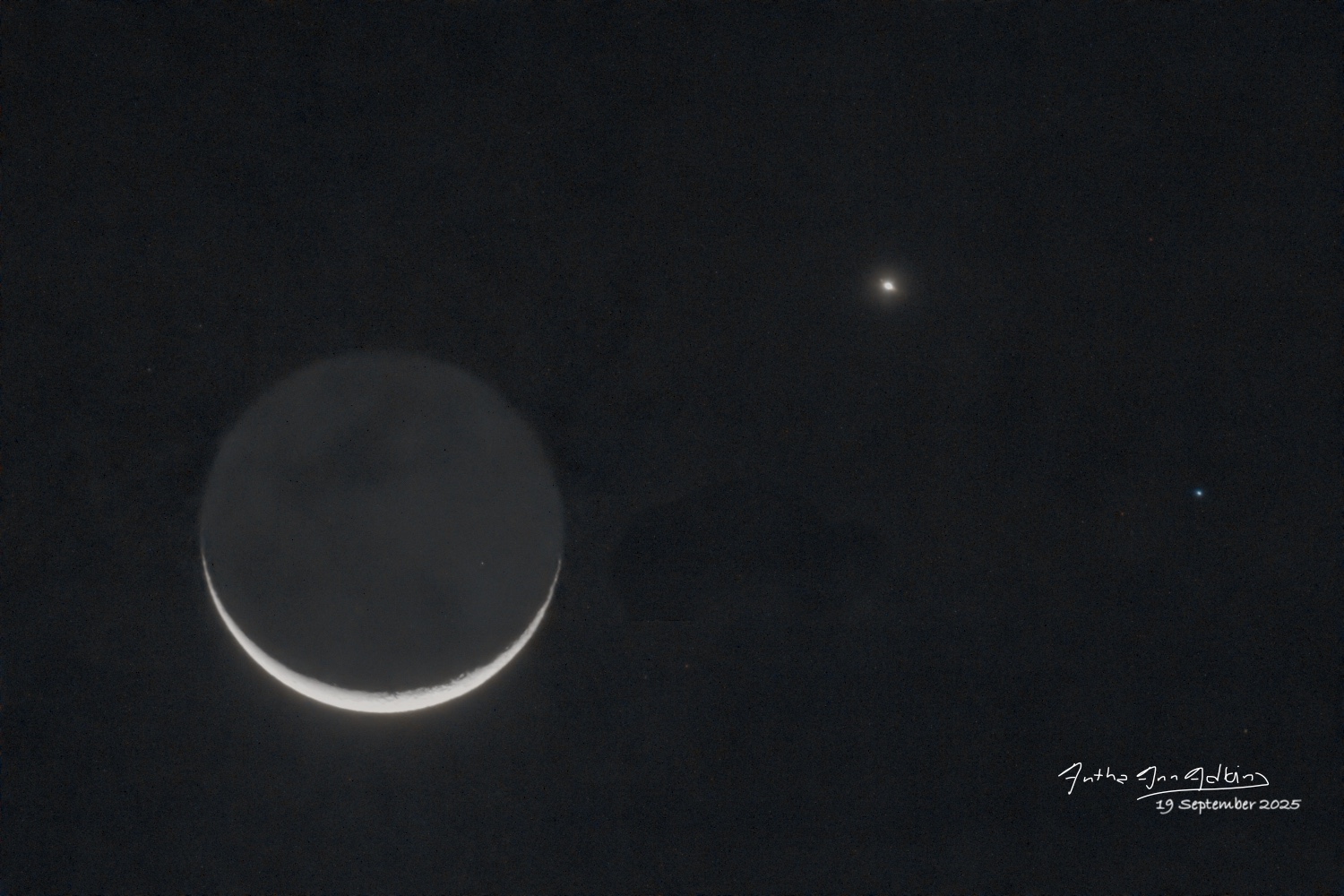
A Beautiful Conjunction: the Moon, Venus, Regulus … and Starlink?

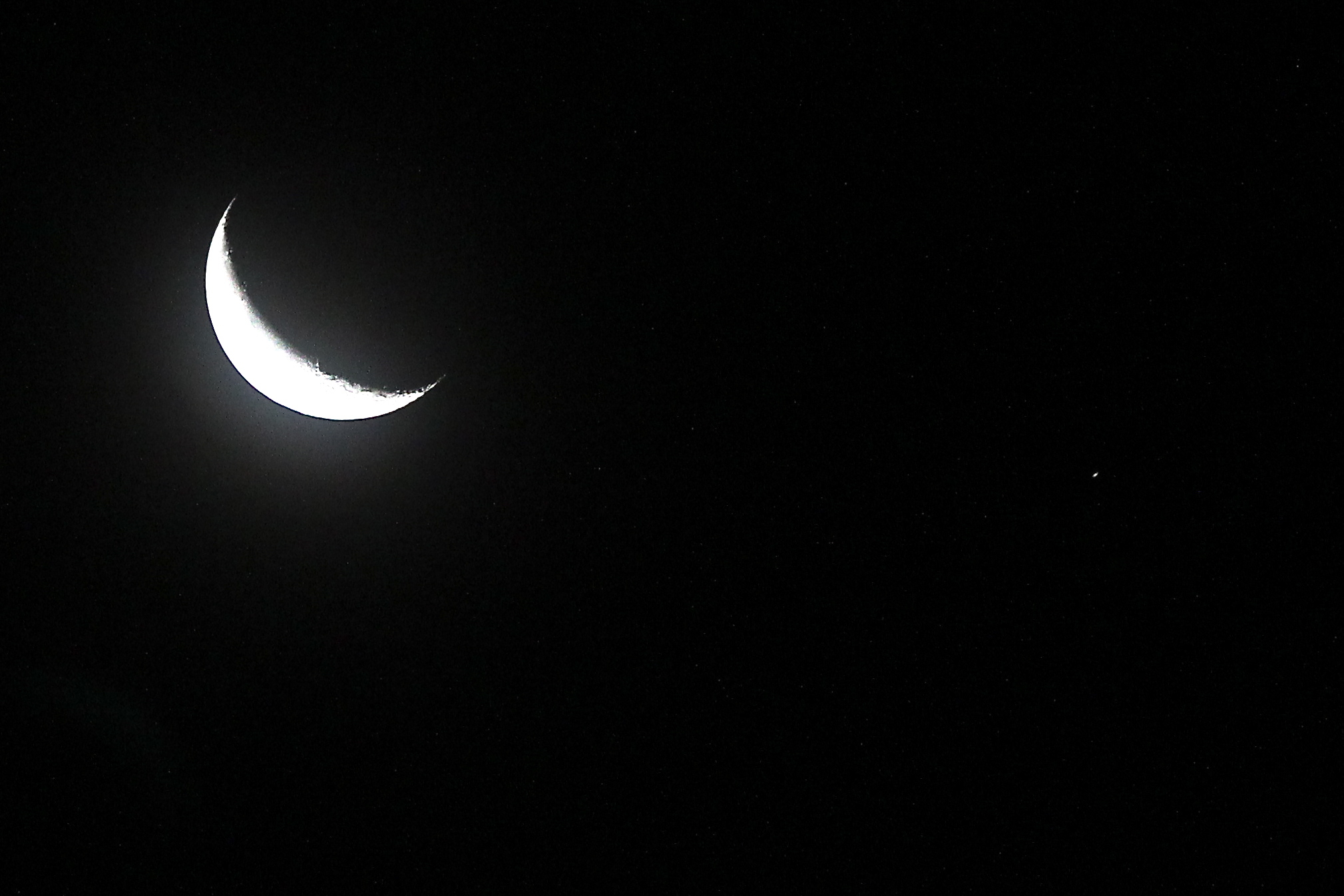
My tracking mount is now in the shop, so I thought I’d have to go without taking astrophotos for a while … but when I woke up early yesterday morning, my husband recommended I go outside and check out the conjunction of the crescent Moon, Venus, and the star Regulus.  It was beautiful!

I got my old setup – my trusty Canon 60D and tripod and intervalometer/cable release and set up to take some pictures.

As I was focusing on the Moon and looking at camera view screen, I saw a satellite moving across the dark face of the Moon!  How cool!  Then I saw a second satellite moving across the dark face of the Moon in the same direction, which made me suspect I was seeing Starlink satellites.  
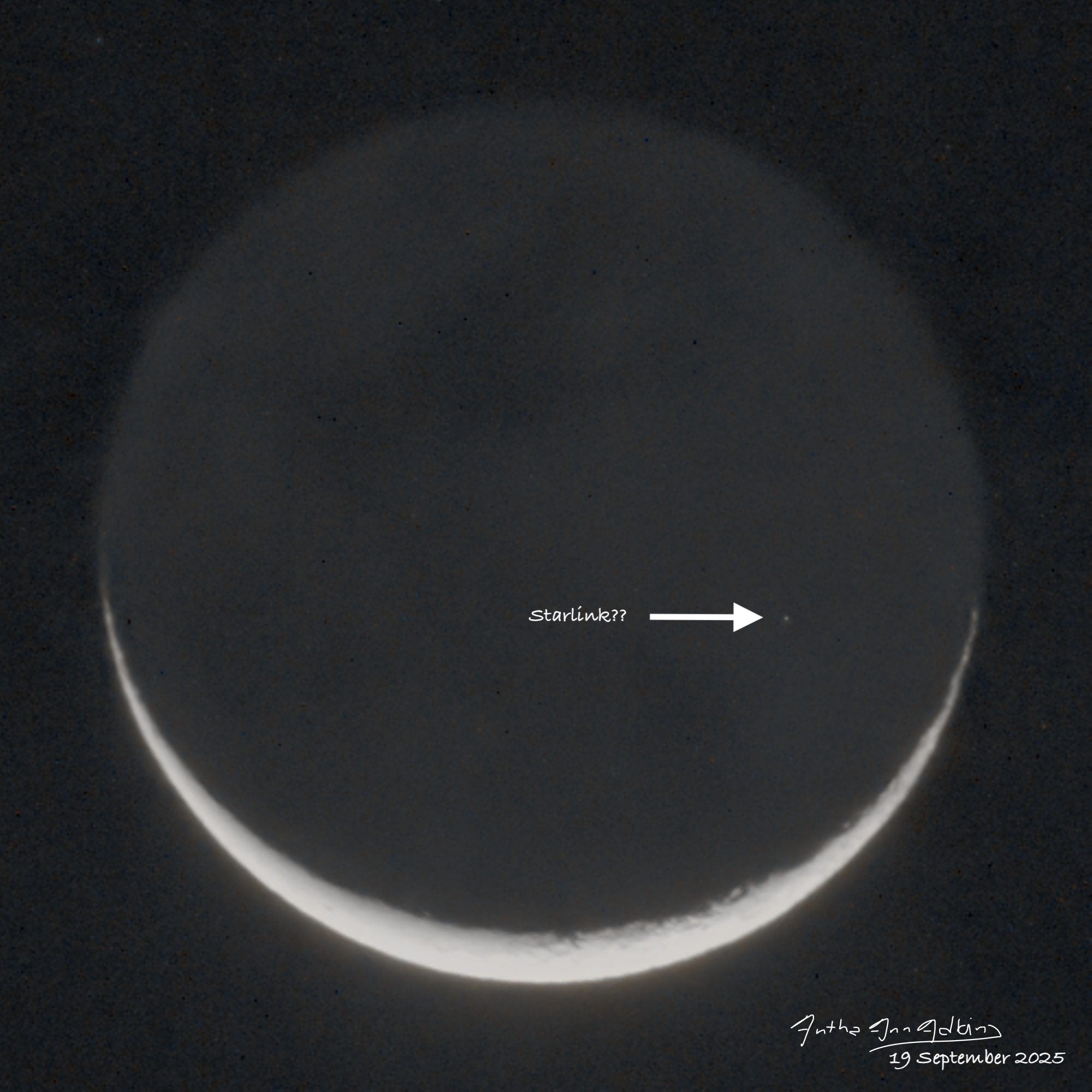
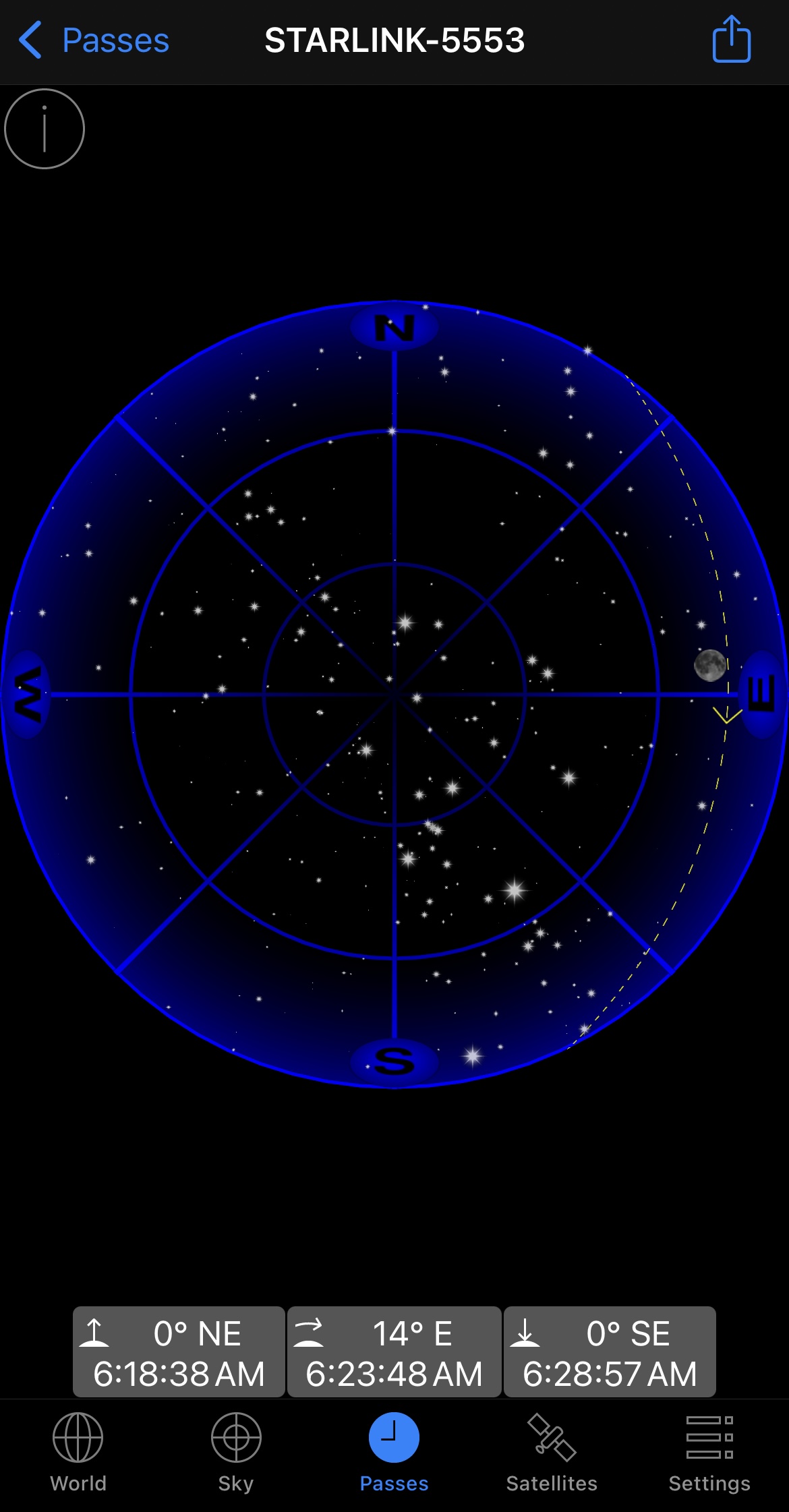
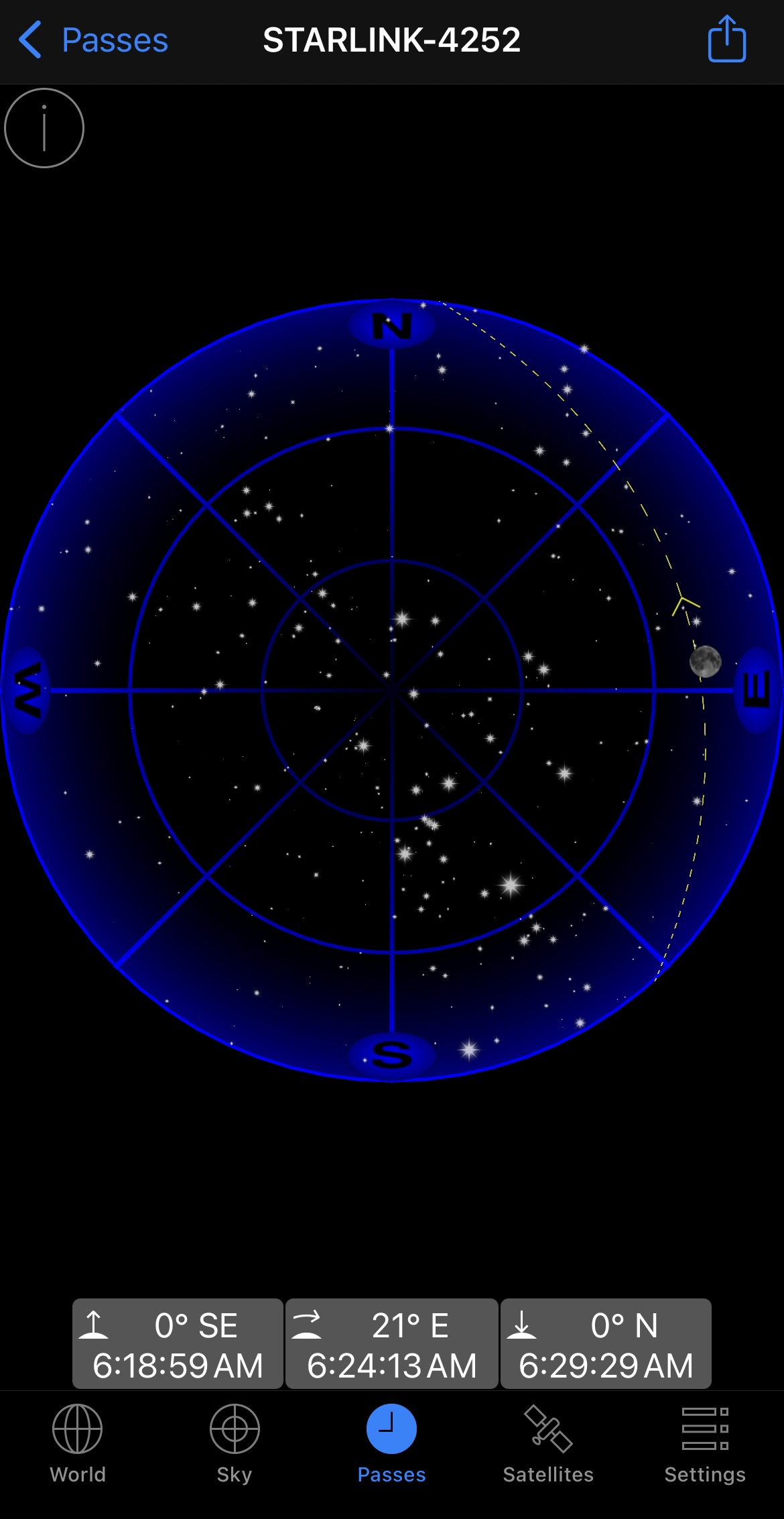
I processed the best image I took in PixInsight and discovered there was a bright spot on the face of the Moon.  So I used the GoSatWatch app on my phone, set to 0 degrees horizon and no limit on magnitude to get all the satellites, and figured out which satellites crossed the face of the Moon when my picture was taken.  There were a ton of Starlinks which made them the very high probability source.  My time stamps are only good to the minute, and I don’t have the exact time the Starlinks crossed the moon although when they were high in the East was a good stand-in, but it looks like there were two potential Starlinks crossing the Moon around the time of my photo!  
It was a pretty neat thing to see, and I think it would be fun to try to capture a bigger satellite (eg the International Space Station) crossing the Moon with my telescope after I get my tracking mount back.  Something to look forward to!

Camera geek info:

  •             Canon EOS 60D in manual mode set at f/4, 1/60 second exposure, ISO 1250
  •             Canon EF 70-200mm f/4L USM lens, set at 200 mm, manual focus on lunar craters
  •             Tripod
  •             Intervalometer used as cable release
Sh2-274 Abell 21 Medusa Nebula

Sh2-274 or Abell 21 or the Medusa Nebula is a planetary nebula – the gases expelled from a red giant star before it becomes a white dwarf, lit up by that star.  It’s located in the Milky Way, approximately 1930 light years away, and it has an apparent size of 10.25 arcminutes, making it 5.75 light years across.  Given the amount of time it would take to reach that size, it is considered to be an “ancient” planetary nebula.  

I find these small nebulae beautiful and fascinating. Each has its own unique structure.  This one has a Ha rim and an Oiii interior and has filaments (the filaments are probably the source of its nickname, the Medusa nebula).

In this image, the stars came from images using red-green-blue filters, and the nebula came from images using Hydrogen alpha (mapped to red) and Oxygen iii (mapped to blue) filters.  The nebula was processed separately from the stars to maximally enhance it.

I had hoped to get enough data on this one the last time we enjoyed the dark skies in Dell City, Texas, but there were a lot of high clouds that limited the amount of data I collected there.  So I collected more data from my driveway at home until I had almost 7 hours of Ha data and 6.7 hours of Oiii data.  

Camera geek info – Narrowband:

  • William Optics Zenith Star 73 III APO telescope
  • William Optics Flat 73A
  • ZWO 2” Electronic Filter Wheel
  • Antila HO and RGB filters
  • ZWO ASI183MM-Pro-Mono camera
  • ZWO ASiair Plus
  • iOptron CEM40
  • Friendswood, Texas Bortle 7-8 suburban skies
  • Dell City, Texas Bortle 2-3 dark skies

Frames:

  • January 24, 2025
    • 14 60 second Gain 150 Ha lights
    • 30 0.5 second Gain 150 Ha flats
  • February 15, 2025
    • 100 30 second Gain 150 Red lights
    • 30 0.05 second Gain 150 Red flats
    • 98 30 second Gain 150 Green lights
    • 30 0.02 second Gain 150 Green flats
    • 60 30 second Gain 150 Blue lights
    • 30 0.02 second Gain 150 Blue flats
  • February 20, 2025
    • 19 60 second Gain 150 Ha lights
    • 30 0.5 second Gain 150 Ha flats
    • 5 60 second Gain 150 Oiii lights
    • 30 0.2 second Gain 150 Oiii flats
  • February 21, 2025
    • 68 60 second Gain 150 Ha lights
    • 30 0.5 second Gain 150 Ha flats
    • 30 60 second Gain 150 Oiii lights
    • 30 0.2 second Gain 150 Oiii flats
  • February 22, 2025
    • 48 60 second Gain 150 Ha lights
    • 30 0.5 second Gain 150 Ha flats
    • 32 60 second Gain 150 Oiii lights
    • 30 0.2 second Gain 150 Oiii flats
  • April 7, 2025
    • 131 60 second Gain 150 Oiii lights
    • 30 0.2 second Gain 150 Oiii flats
  • April 8, 2025
    • 130 60 second Gain 150 Oiii lights
    • 30 0.2 second Gain 150 Oiii flats
  • April 10, 2025
    • 72 60 second Gain 150 Oiii lights
    • 30 0.2 second Gain 150 Oiii flats
  • April 11, 2025
    • 133 60 second Gain 150 Ha lights
    • 30 0.5 second Gain 150 Ha flats
  • April 12, 2025
    • 137 60 second Gain 150 Ha lights
    • 30 0.5 second Gain 150 Ha flats
  • 30 Flat Darks from library
  • 30 Darks from library

Processing geek info:

  • PixInsight
  • BlurXterminator
  • NoiseXterminator
  • StarXTerminator
  • NBColourMapper
  • Generalized Hyperbolic Stretch

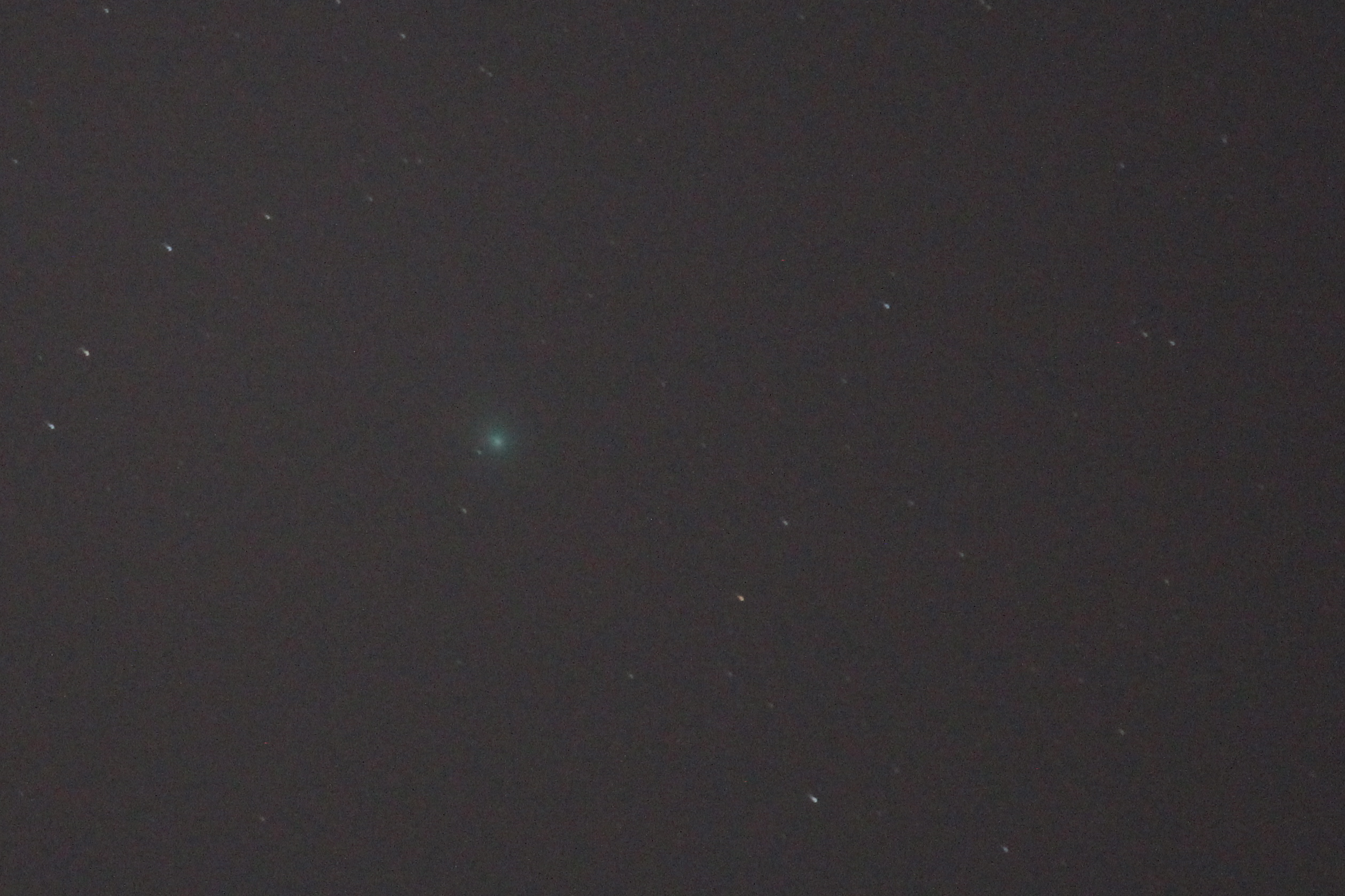
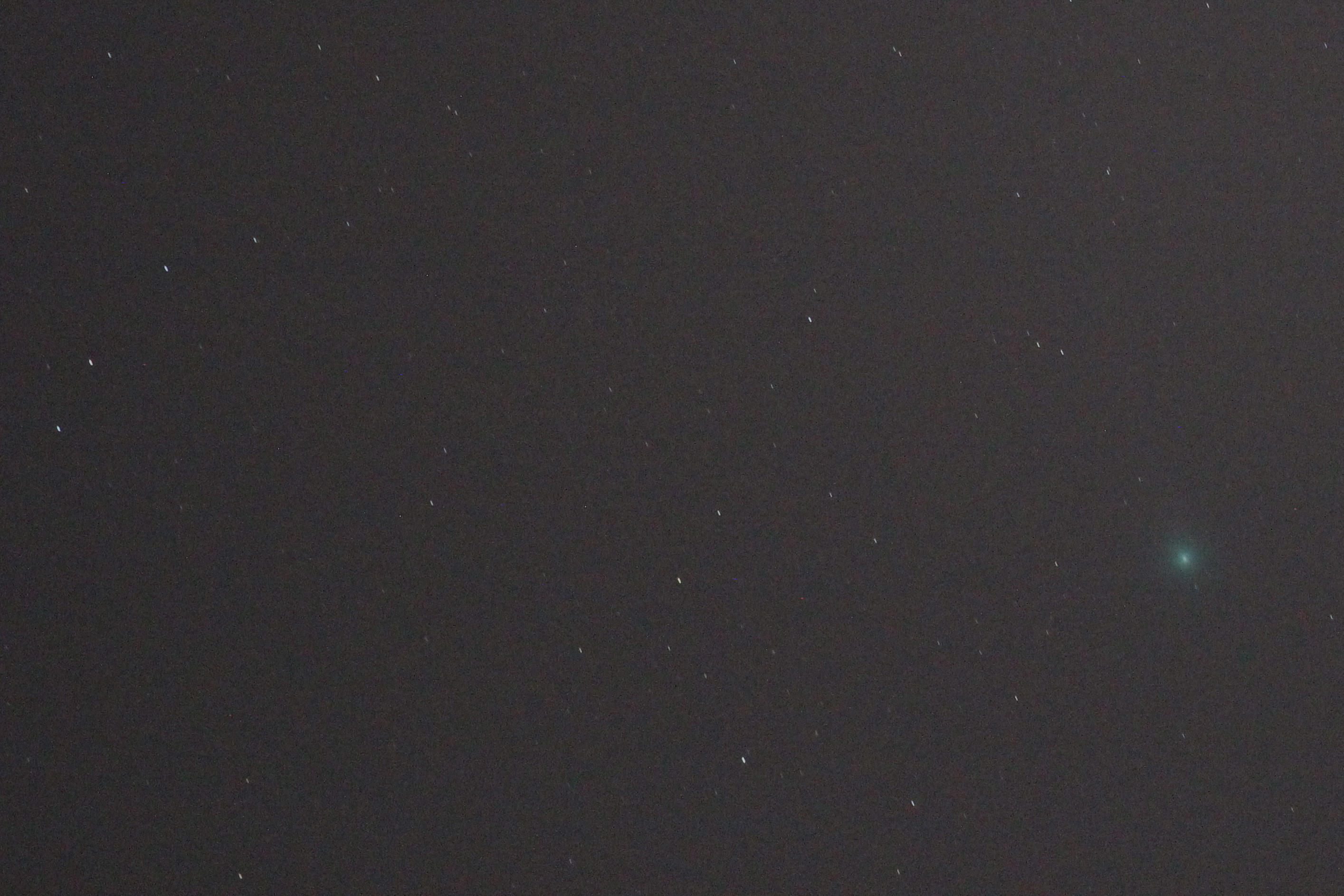
Capturing Comet C/2025 F2 SWAN

In late March 2025, a new comet, C/2025 F2, was found in imagery from the Solar Wind Anisotropies (SWAN) camera on the Solar and Heliospheric Observatory (SOHO). 

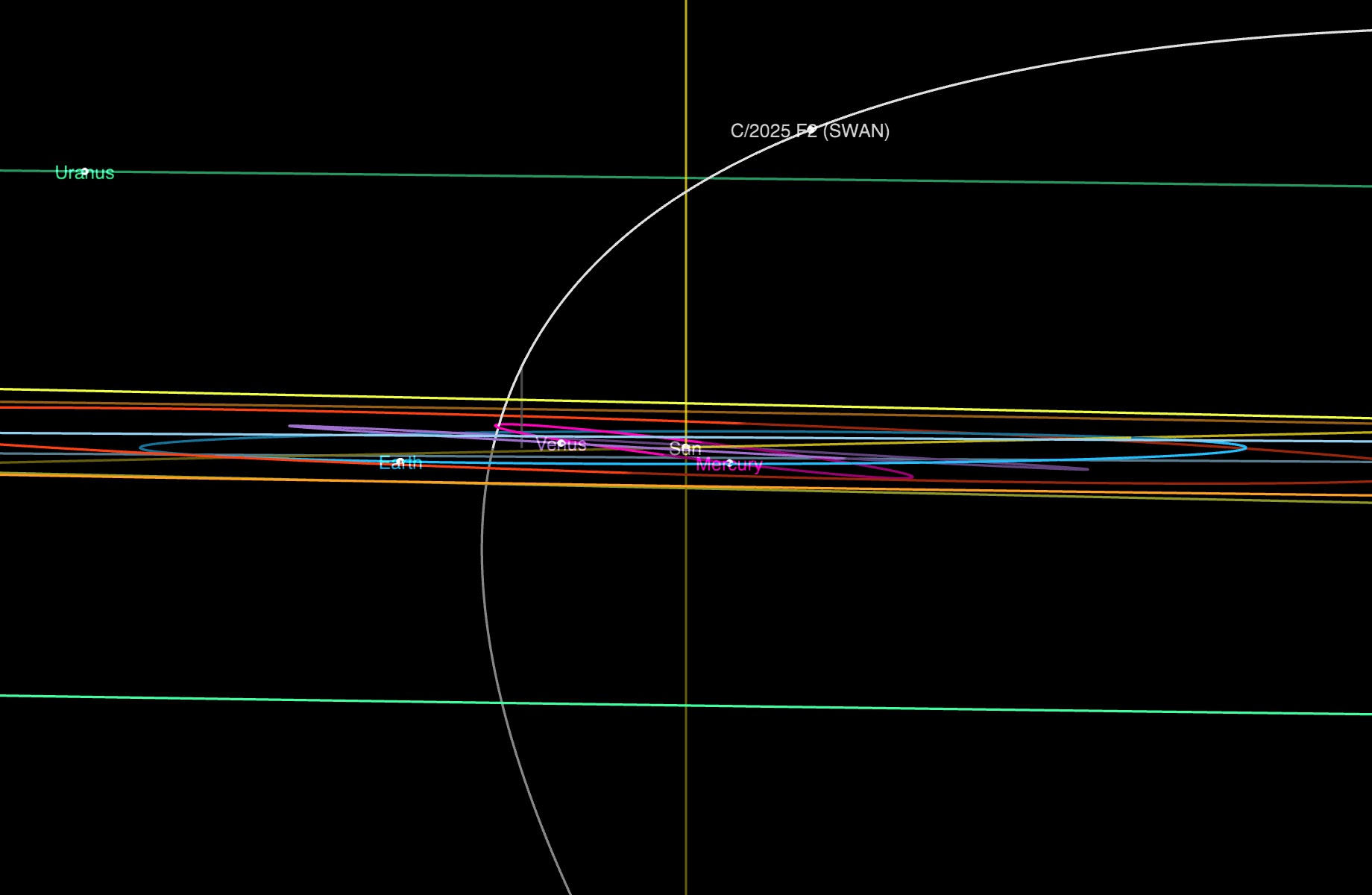
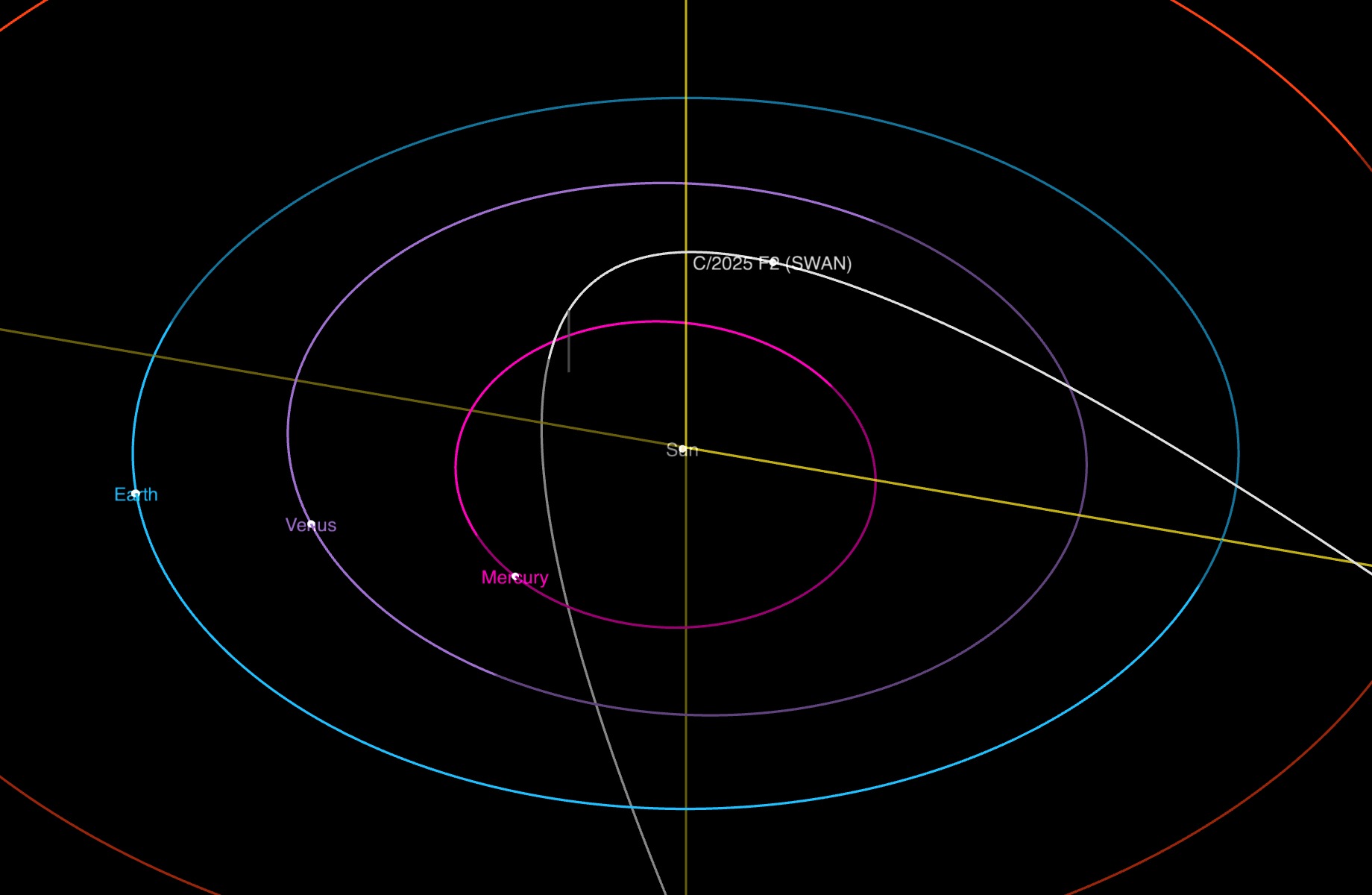
Orbit images Courtesy NASA/JPL-Caltech.

The Jet Propulsion Laboratory (JPL) has a great orbital dynamics viewer where you can see its orbit relative to the planets.  It’s quite fun to play with!  C/2025 F2’s orbit is very parabolic and nearly 90 degrees out of the ecliptic plane.  It is coming in from north of the ecliptic plane, will loop around the sun near Mercury’s orbit on May 1, 2025, and then head back out to the outer solar system south of the ecliptic plane.  So it’s visible from the Northern Hemisphere in the early morning now, but as it approaches the sun, it will get more and more difficult to spot, and it will be more visible from the Southern Hemisphere on its outgoing trajectory.

“Now” was the best time to see it from the Northern Hemisphere, and we have had a nice string of days with clear skies, so last weekend, it was time to go comet hunting!  

I used the JPL Horizons System to predict the comet location and motion so that I knew where to point my telescope and I knew how long the images could be without “smearing” the comet – 15 seconds for my telescope and camera combo.

I loaded up my gear, and my husband and I drove to our favorite early morning comet viewing site in Bacliff, Texas.  By the time I had everything set up, the comet was above the horizon.  My preprogrammed location contained a small, fuzzy object which looked like a comet on the first try!  I was really delighted that everything worked on the first try; this has not always been the case in the past.  I spent some (probably too much) time trying to get it positioned better in the frame and started imaging.  It was brighter in green than in red and blue which, with its fuzziness, confirmed to me that it was likely a comet.  I couldn’t see a tail in my single images.

I set up my regular camera to see if I could get some wider field images.  Given what I ended up with in the telescope images, I do not think the comet will be visible in the wider field images.

Both my husband and I tried to find the comet with binoculars, with no luck at all.  

We finished the morning with a lovely sunrise and breakfast.

Processing comets is still a big challenge for me, with more steps than processing a nebula.  I mostly follow the excellent process outlined by Adam Block in his Comet Academy.  Blinking through my frames, I could see the comet moving across the sky, another sure indicator that I had captured the right object!  After aligning, integrating, and stretching the comet images, I could see a faint tail that stretched all the way across the field of view (about 2 degrees with this telescope and camera combination), but the background noise was brighter than it was.  I tried several methods to make the tail visible, and the one that worked the best was to “murder the background” as Adam says in one of his videos.

I’m probably not going to get another chance to capture this one, but I enjoyed getting to see it at least once.  Has anyone else tried to go out and capture this one?

Camera geek info:

  • William Optics Zenith Star 73 III APO telescope
  • William Optics Flat 73A
  • ZWO 2” Electronic Filter Wheel
  • Antila RGB filters
  • ZWO ASI183MM-Pro-Mono camera
  • William Optics Uniguide 32MM F/3.75
  • ZWO ASI220MM-mini
  • ZWO ASiair Plus
  • iOptron CEM40
  • Bacliff, Texas Bortle 6 suburban skies

Frames:

  • April 12, 2025
    • 47 15 second Gain 150 Green lights
    • 30 0.02 second Gain 150 Green flats
    • 45 15 second Gain 150 Blue lights
    • 30 0.02 second Gain 150 Blue flats
    • 50 15 second Gain 150 Red lights
    • 30 0.05 second Gain 150 Red flats
  • 30 Flat Darks from library
  • 30 Darks 

Processing geek info:

  • PixInsight
  • BlurXterminator
  • NoiseXterminator
  • StarXTerminator
  • Generalized Hyperbolic Stretch

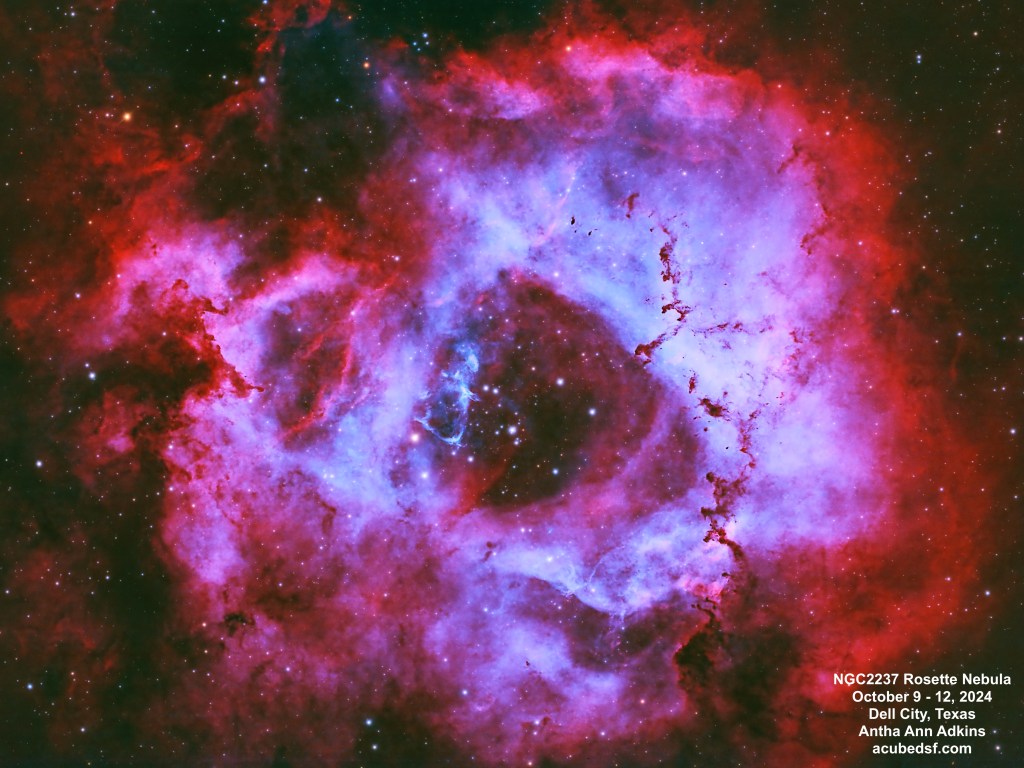
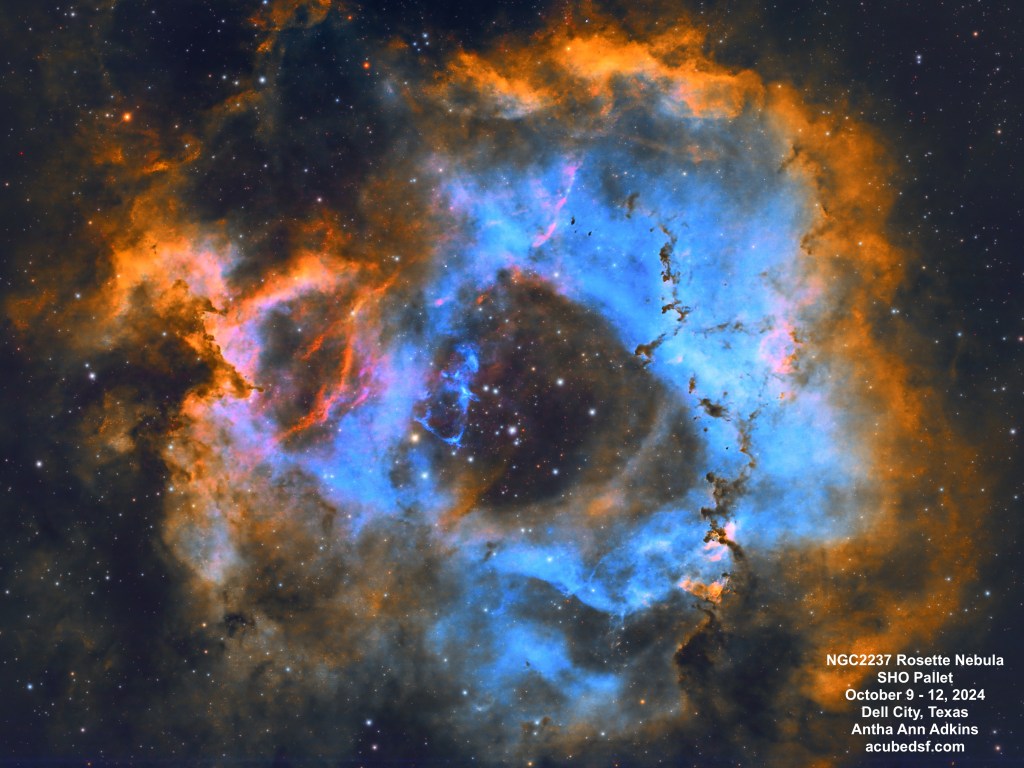
NGC 2237: Rosette Nebula: Natural Palette vs SHO Palette

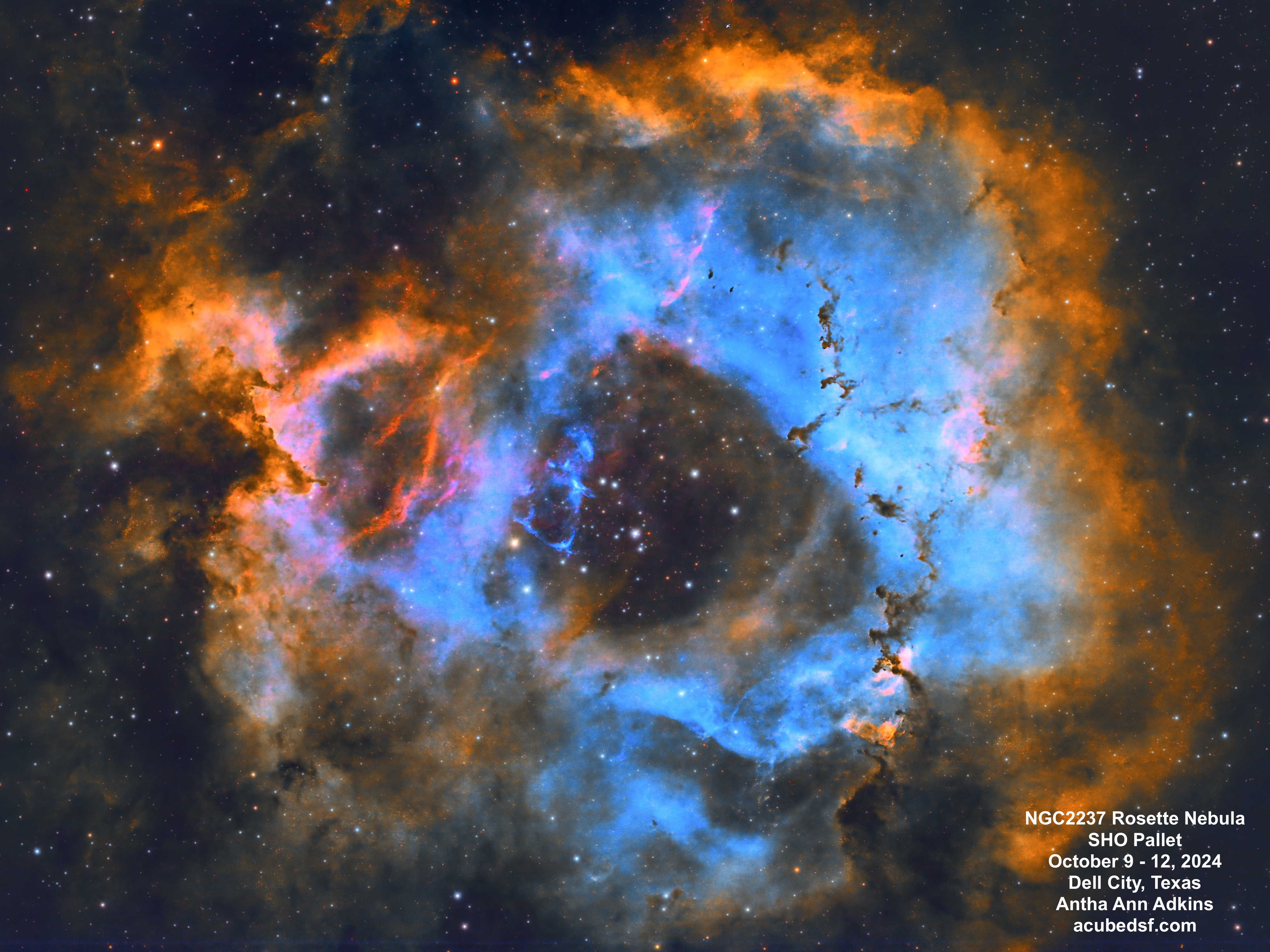
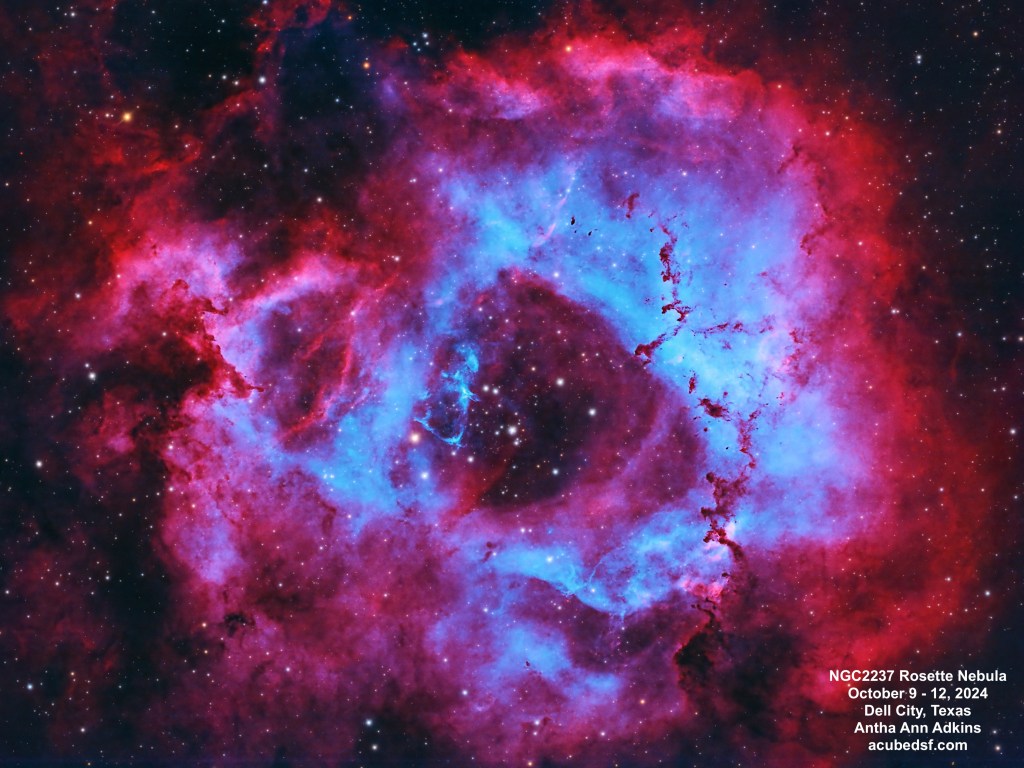
The Rosette Nebula, also numbered New General Catalogue (NGC) 2237 or Caldwell 49, is an emission nebula.  It is a large star-forming region containing the NGC2244 (Caldwell 50) star cluster in its center.  The star cluster was made from the gases in the nebula and contains some massive type O stars, which in turn produce radiation and stellar wind that blow away and light up the nebula around them.  The stars in this cluster are young, less than 5 million years old.  The Rosette Nebula is located in the Milky Way, approximately 5200 light years away, and it has an apparent size of 1.3 degrees, so it is approximately 120 light years across.    

When we visit the lovely dark skies of Dell City, Texas, I try to collect data on some challenging objects that I don’t think I can do from my light-polluted driveway.  I’m not always successful in meeting the challenge (super dim objects take a lot of hours of data to image), so I also try to collect data on some brighter objects so I know I’ll come home with some nice images.  The Rosette Nebula was my choice for one of my “sure it will be nice” images from our last trip. 

I think it is a stunning nebula.  I processed the data using two different palettes, ending up with three different versions.  The first palette, a “natural” palette, maps H-alpha (which is red) to red, Sii (which is also red) to a more pink color, and Oiii (which is blue) to purple/blue.  I tried different weightings/emphasis of the colors and ended up with one version where the nebula center is more blue and one version where the nebula center is more purple.  The second palette, the “Hubble” palette or SHO palette, maps Sii to red, H-alpha to green, and Oiii to blue (and then cuts out most of the green).  I also tried different weightings/emphasis of the colors, and I ended up with one version I liked the best.  I like the colors in the “natural” palette, but I think the Hubble palette does a better job of showing off the details of the nebula.

Which version do you like the best?

Camera geek info – Narrowband:

  • Williams Optics Zenith Star 73 III APO telescope
  • Williams Optics Flat 73A
  • ZWO 2” Electronic Filter Wheel
  • Antila SHO and RGB filters
  • ZWO ASI183MM-Pro-Mono camera
  • ZWO ASiair Plus
  • iOptron CEM40
  • Dell City, Texas Bortle 2-3 dark skies

Frames:

  • October 9, 2024
    • 135 60 second Gain 150 Oiii lights
    • 30 0.5 second Gain 150 Oiii flats
  • October 10, 2024
    • 129 60 second Gain 150 Ha lights
    • 30 0.2 second Gain 150 Ha flats
  • October 11, 2024
    • 27 60 second Gain 150 Red lights
    • 30 0.05 second Gain 150 Red flats
    • 26 60 second Gain 150 Green lights
    • 30 0.02 second Gain 150 Green flats
    • 25 60 second Gain 150 Blue lights
    • 30 0.02 second Gain 150 Blue flats
  • October 12, 2024
    • 129 60 second Gain 150 Sii lights
    • 30 1 second Gain 150 Sii flats
  • 30 Flat Darks from library
  • 30 Darks from library

Processing geek info:

  • PixInsight
  • BlurXterminator
  • NoiseXterminator
  • StarXTerminator
  • Generalized Hyperbolic Stretch

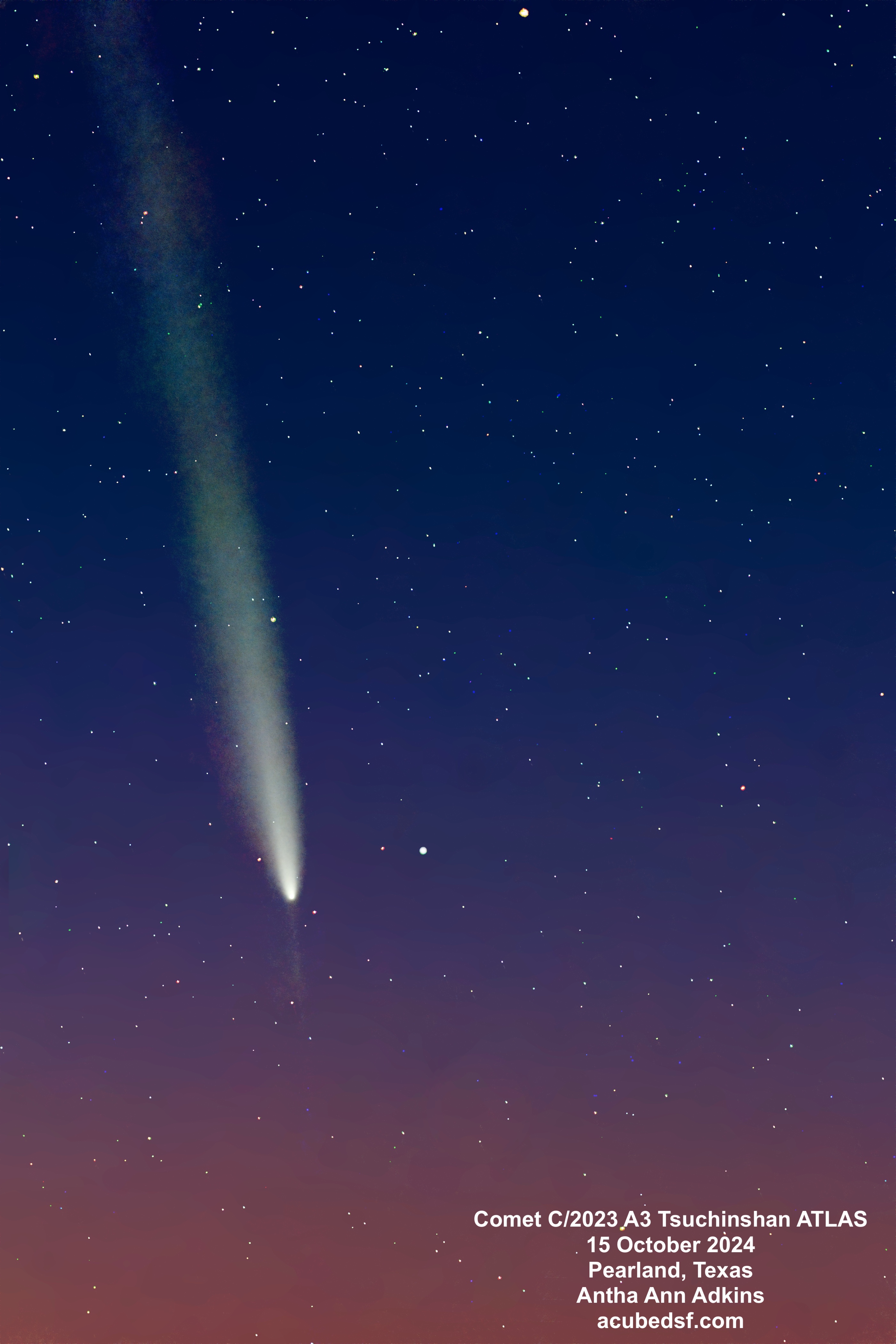
Comet C/2023 A3 Tsuchinshan ATLAS with M5

Comet C/2023 A3 Tsuchinshan ATLAS put on quite a show after it rounded the sun and passed by the Earth on its way likely out of our solar system.  With an orbital eccentricity greater than 1, its orbit appears to be hyperbolic, meaning it’s not coming back unless something perturbs its orbit.

In this picture, you can see the comet’s bright nucleus and coma, its long dust tail, and its anti-tail, but not a separate ion tail.

When comets travel close to the sun, solar radiation heats up the comet nucleus, and it outgasses. Outgassing delivers both gas and dust to the region around the nucleus, forming a coma, a (temporary) atmosphere around the comet.  The solar radiation and solar wind act on this coma to push the gas and dust away from the sun to form a tail.  Three separate tails can be visible: the ion tail, the dust tail, and the anti-tail. The ion tail, also called the gas tail or type I tail, is the tail formed by the ionized gasses pushed away from the comet, and it points away from the sun.  The dust tail, also called the type II tail, is the tail formed by the dust pushed away from the comet, and it stays more in the comet’s orbit and appears to curve away from the gas tail.  The anti-tail consists of the larger dust particles that were not pushed as much and remained in the comet’s orbit.  The anti-tail appears to point towards the sun, and it is only visible when the Earth passes through the comet’s orbital plane near the time when the comet passed by the sun.  Because of these special conditions to see the anti-tail, it is not observed with most comets.

Another item visible in the image is M5, a globular cluster in our galaxy.  It is the large bright “star” to the right of the comet nucleus.  Because this image was taken with an 85 mm lens, and M5 was sorted to the “stars” image in my processing, it just appears to be a large bright star.  I suspect with some additional processing, I could have made it look fuzzier, though there aren’t a lot of pixels at this scale.  The Messier objects are “fuzzy” objects that comet-hunter Charles Messier made a list of because they weren’t comets – so it’s fun to see one next to a comet.  M5 is 24,500 light years away from Earth and has an angular size of 23 arc-minutes, making it about 165 light years across.  It’s thought to be one of our galaxy’s older globular clusters, at 13 billion years old.

Processing this image was tricky for several reasons: 1) it was made from images taken with a camera on a tripod, so the sky was moving in each frame, 2) the comet was moving relative to the sky, and 3) the images were taken at dusk, when the sky gradient is also changing in every image.  I benefited greatly from following the methods and advice in Adam Block’s Comet Academy.  One additional trick I used was to run BlurXterminator in correction only mode on all the registered images as my first step since the 4 second tripod images had visible star trails. 

Getting to this image has taken almost a month of watching videos, learning new tools, and trying various tool combinations and settings.  Some of these steps had to be run on each individual image – all 233 of them – meaning some processing steps took many hours.  After all that work, I am happy with the results.

I started with this image because I thought it would be the easiest of my set of C2023A3 comet images to process … the other images are from darker skies in terms of light pollution but closer to dusk and include a foreground.  But the comet was brighter!  I’m really looking forward to processing them and sharing the result!  Hopefully they won’t take a month each to process!

Camera geek info:

  • Canon EOS 60D in manual mode, 4 second exposures, ISO 1600
  • Canon EF 85 mm f/1.8 lens, manual focus at infinity
  • Intervalometer
  • Tripod
  • Pearland, Texas Bortle 7-8 dark skies

Frames:

  • October 15, 2024
    • 233 4 second lights
    • 30 0.0025 second flats
    • 30 0.0025 second darks

Processing geek info:

  • PixInsight
  • BlurXterminator
  • NoiseXterminator
  • StarXterminator
  • StarNet2
  • NormalizedScaleGradient

Asteroid Research – Orbits

One of the fun things about writing science fiction is learning about science!  My current work in progress is set in the asteroid belt, so I’ve had fun studying it. 

In my story, the aliens travel from the asteroid they live on to visit several asteroids humans live on before returning to their own asteroid.  I wanted to find a set of real asteroids where this made sense.  

In order to find a real set of asteroids, I had to answer two questions: 1) which asteroids would it make sense for humans and aliens to live on?  And 2) how do asteroids move relative to one another and what would it take to travel between them?

For the first question, I thought that humans (and aliens) would establish bases on asteroids big enough to support them.  I thought the most important resources for an asteroid to have are water and organics.  I discovered that many asteroids are members of families, groups of asteroids that have similar orbits (semi-major axis [maximum distance from the sun], inclination [angle from the ecliptic plane], and eccentricity [a measure of how circular the orbit is]).  Asteroid families can be created by collisions, so most of the asteroids in the family were once part of the same parent body and would likely be composed of similar materials.  One such family is the Themis family.  I found multiple papers arguing there is evidence that the Themis asteroids contain water ice and organics (among them: 1, 2, 3, 4).  So, if I use members of the Themis family for the asteroids that my story humans and aliens live on, I can assume they have water, organics, and metal resources to be extracted.  

For the second question, I hoped that having asteroids in the same family might mean the asteroids travel together.  Over the long term (months and longer), orbital dynamics does not work that way (unless the asteroids happen to be at different points in the same orbit and one “follows” the other).  Asteroids closer to the sun have a shorter “year” than asteroids further away, so even with a small difference in semimajor axis, the closer-to-the-sun asteroids will eventually “lap” the further out ones.  So they will be close, and then far away, and then close again.  Plotting a course in the asteroid belt is going to be a challenge!  Happily for me, my story takes place within a short period of time, and I can put my asteroid bases wherever is convenient, so I just needed to find a handful of Themis-family asteroids that are “near” each other at a point in time.  

I found a really cool asteroid simulator on line (Catalina Sky Survey (CSS) Orbit View) where you can enter the asteroids and date of your choice and see where they are and how they move relative to one another. The pictures in this blog post were generated by this awesome tool. It’s really fun just to watch the asteroids move around!

I filtered the Minor Planet Center Orbit (MPCORB) database for Themis family asteroids, put the top 60 into the simulator, let it run starting at 2150, and followed 24 Themis.  In 2243, I found what I was looking for: 6 Themis family asteroids “reasonably” close to one another.  

Note: I am well aware that “reasonably” close together at 3.14 AU is still really far apart.  However, my alien spacecraft does not need to break the laws of physics and exceed the speed of light to get from one to another, which is enough for me.

My next step will be to determine what we know about these asteroids, so I can make these tiny worlds more realistic.

Comet Lovejoy and the Pleiades

Comet Lovejoy and the Pleiades

CometLovejoyPleiades20150118

Comet Lovejoy – Change in Position in One Day

CometLovejoy20150118

CometLovejoy20150119

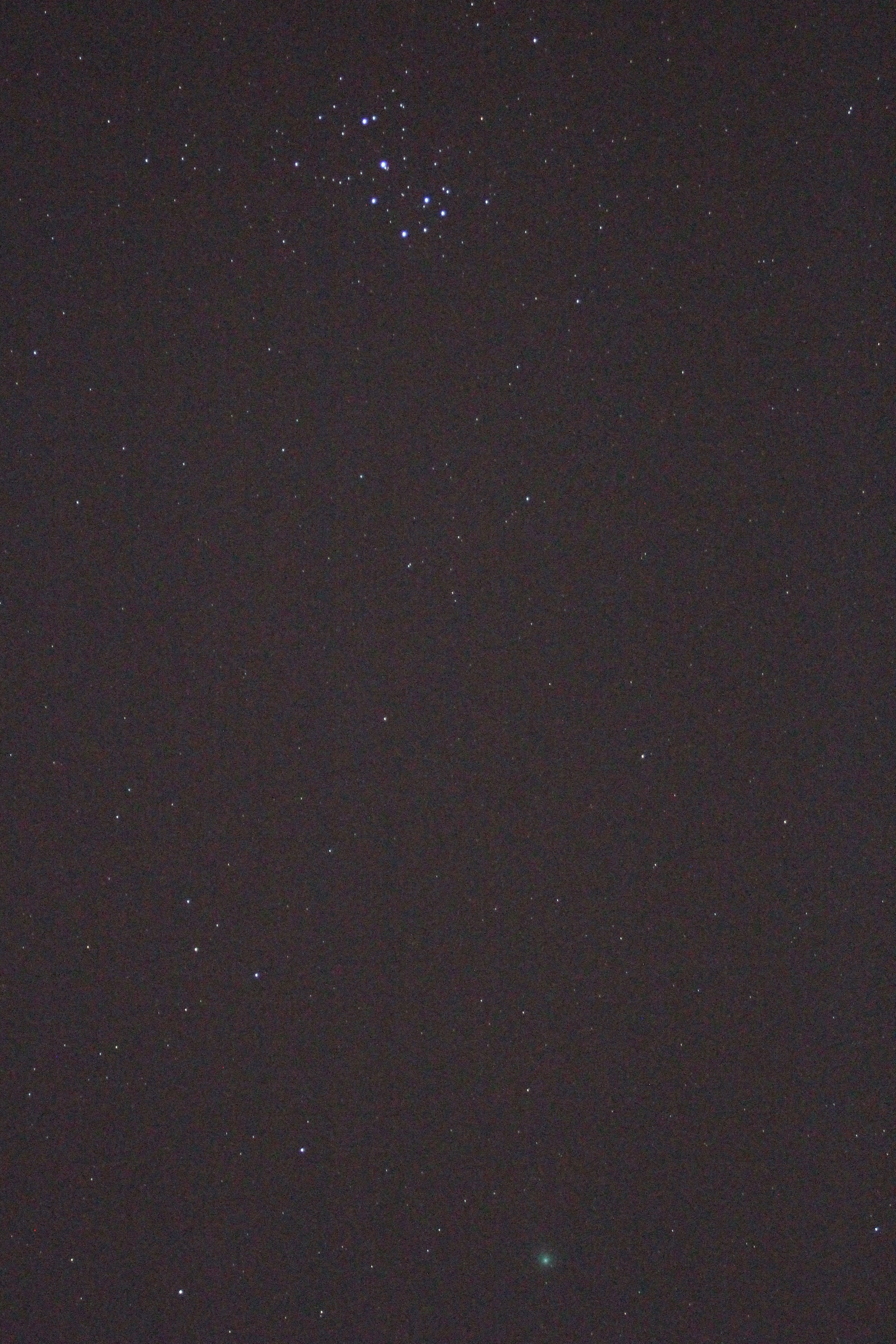
Sunday and Monday evening it was clear, so it was time to find Comet Lovejoy again. This time it was near the beautiful Pleiades. Of course, that is worth a picture.

I thought it would also be fun to see how much the comet had moved over one day – the change is quite visible. I was hoping to go for a three-day comparison, but now it’s cloudy again.

Camera geek info:

  •            Canon EOS 60D in manual mode set at f/4.0, 3.2 second exposure, ISO 6400
  •            Canon EF 70 – 200 mm f/4L lens, set at 94 mm for Pleiades and comet and 200 mm for comet, manual focus at infinity
  •            Tripod
  •            Cable release

In choosing which picture is the best, I find that I am using the following criteria: good focus (automatic toss for out of focus picture unless happen upon cool “artistic” effect), no visible star trails (stars should look like a point, not a line), visibility of comet, color of objects, color of sky, and noise of sky. While I have pictures with darker, less noisy sky, they don’t show the comet as well.

I am also finding that the image quality is far better when I zoom to my desired field of view instead of cropping in post-processing to get there.

Astrophotography – Planets

Conjunction of Moon and Saturn
MoonAndSaturn20150116

Saturn (“One of the These Things is Not Like the Others”)
Saturn20150116

Jupiter and four Galilean Moons
JupiterAndMoons20150116

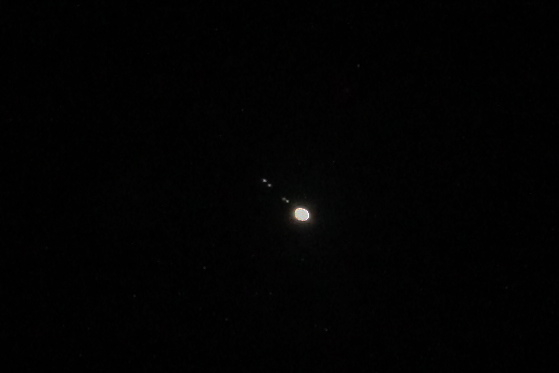
You know you enjoy a hobby when you get up early and go out into the dark cold for it. This morning there was a conjunction of the Moon and Saturn, so I got up and went out. And while I was at it, I took some pictures of Jupiter and its moons, too. I checked – yes all four moons were on the same side of Jupiter this morning. I think it would be fun to make a time lapse of their motion. Might have to try it.

I learned a new astrophotography trick last night. I knew I needed to manually focus for star pictures, but it’s hard to do with dim sources and a camera designed for autofocus. But my camera has a nifty real-time view on the LCD screen with a 10x view … so I could zoom in on the moon or a planet and use the real-time view to help me manually focus. Neat! And *much* sharper pictures.

The real-time view also showed me that, in spite of the solid tripod, the 200 mm is actually quite shaky if I want to crop further in. So I get out my cable release so I could watch the image settle down on the 10x screen and then trigger the camera without actually touching it.

I also already knew that although I could easily see both the Moon and Saturn, Saturn would disappear or the Moon would wash out without some filtering. Graduated neutral density filters to the rescue! I used two (wish I had more and stronger ones) to dim down the Moon so you can see both bodies in the same photo.

Camera geek info:

  •            Canon EOS 60D in manual mode set at f/4.0, 1/60 second exposure for Moon and Saturn, 1/13 second exposure for Jupiter, ISO 2000
  •             Canon EF 70 – 200 mm f/4L lens, set at 200 mm, manual focus at infinity
  •             Singh-Ray Galen Rowell Filter ND-1G-SS + ND-2G-SS for Moon
  •             Tripod
  •             Cable release

Comet Lovejoy

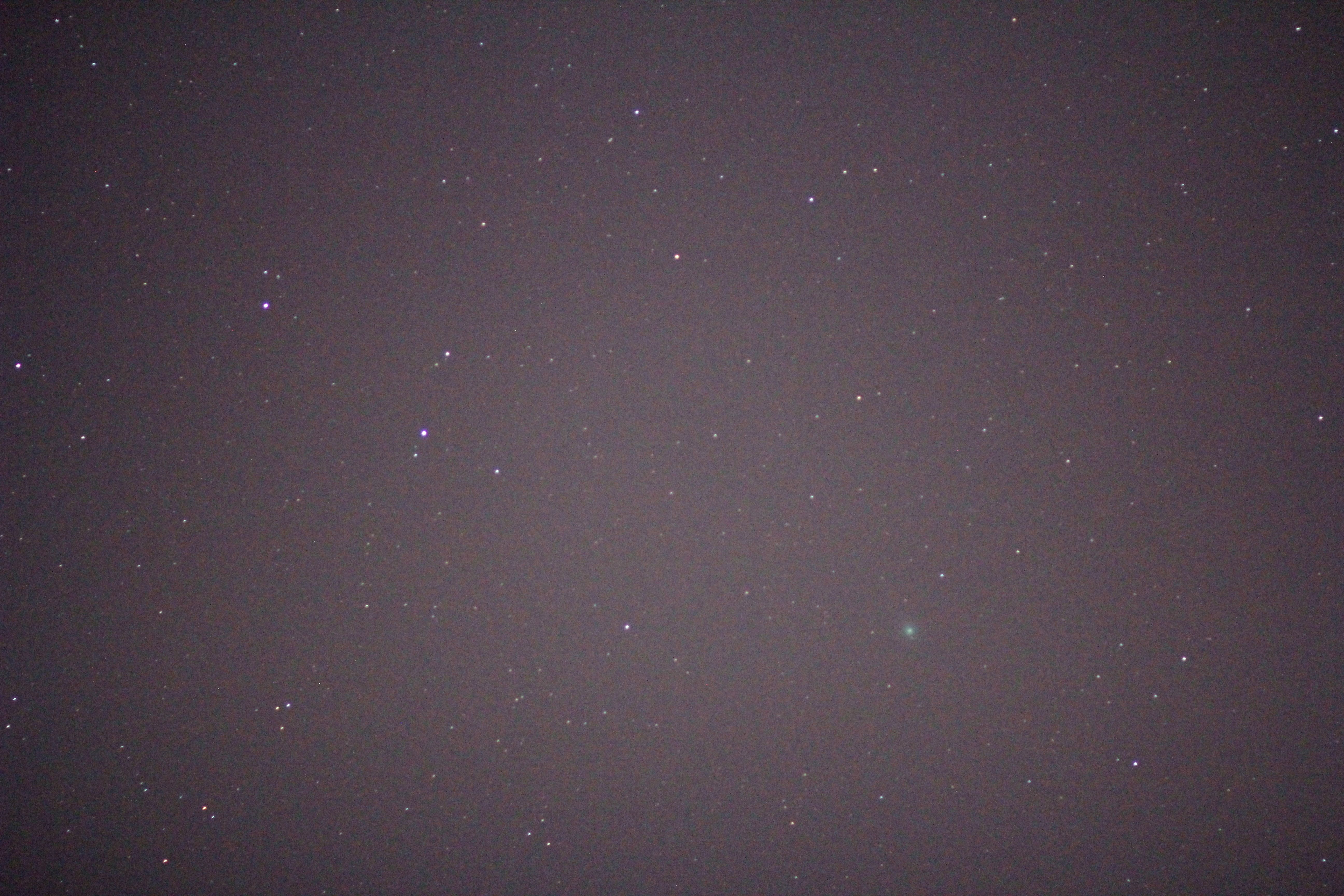
Can you spot the comet?  (Hint: it’s green!)CometLovejoy20150107-1

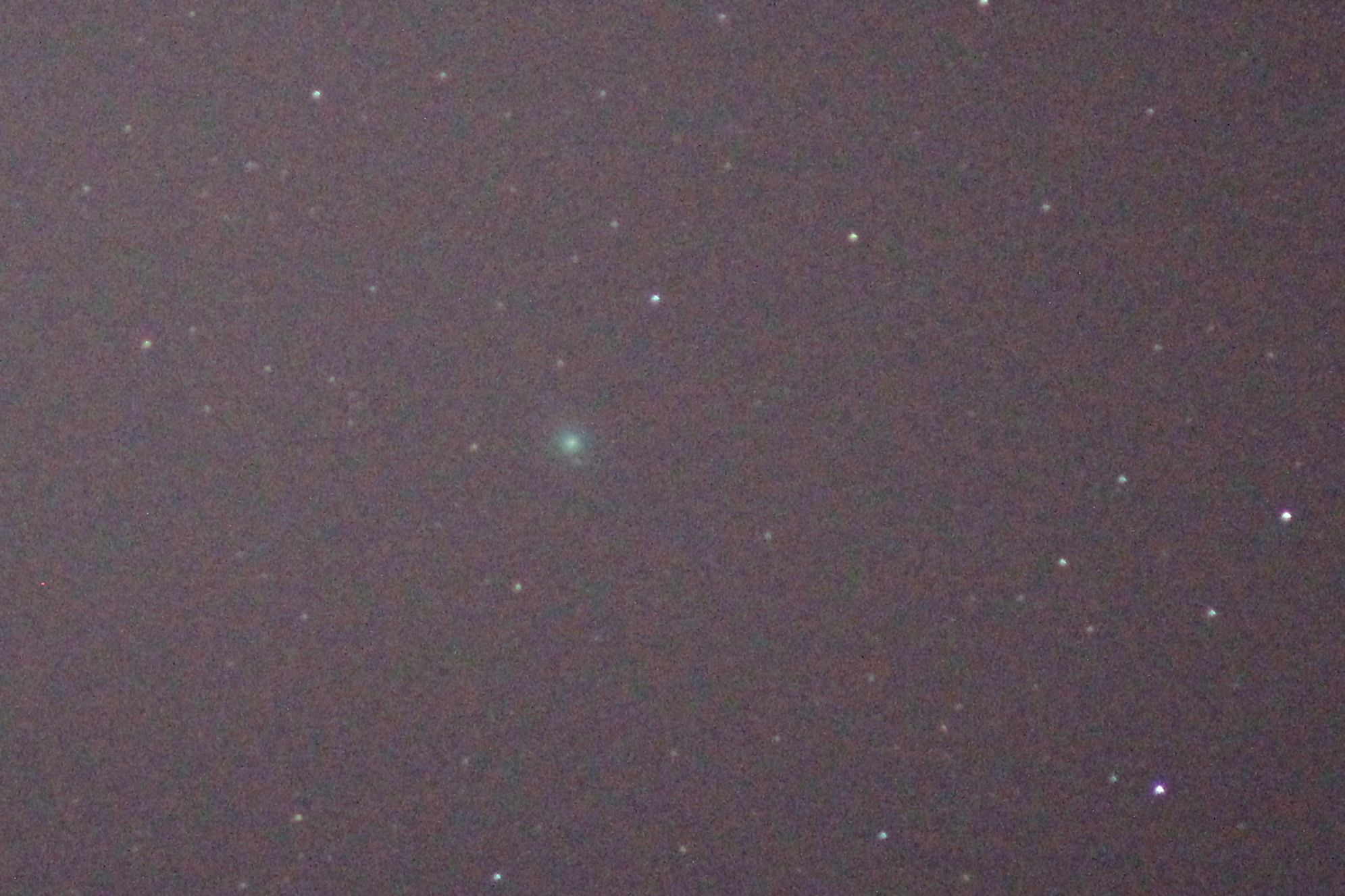
Zooming in … how about now?

CometLovejoy20150107-2

It’s been a long time since there’s been a comet that I could successfully see and photograph! Comet Lovejoy is a star hop from Rigel (Orion’s foot) into Eridanus, where it can easily be seen (at least in the suburbs in the northern hemisphere) with binoculars, a telephoto lens, or a telescope.  It looked gray through the binoculars, but in the pictures it is a beautiful green.

I am glad that our winter clouds cleared away and I got a clear night last night to spot it. I was hoping for a second clear night in a row so I could show that the comet is moving relative to the stars. Alas, the weather did not cooperate, and it looks like it’s going to be cloudy for a while. But I’ll keep looking up!

Orion EFT1 Mission

OrionGroundTrack

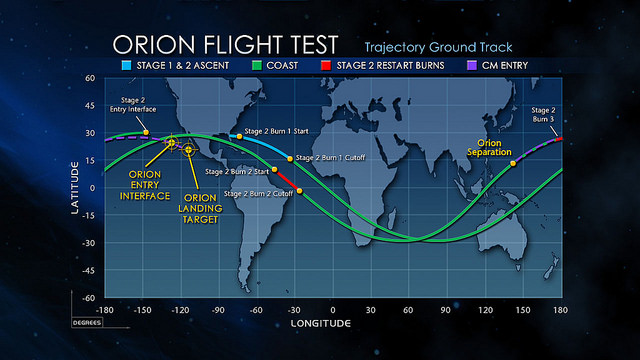
I got up early yesterday and again today to watch the launch of NASA’s newest spacecraft, Orion. This flight, Experimental Flight Test 1 (EFT1), is, as its name suggests, a flight test to check out critical Orion systems before we send it further away with people on board.

I cheered when it successfully launched this morning and did not get any writing done because I was too intrigued with the Orion TV feed.

Here were the thoughts I had while watching:

– I’m conditioned to watch Space Shuttle launches and know the event timing, and it was odd for me to watch a launch with different timing and steps. Shouldn’t the side rockets fall off after two minutes? Apparently, no.

– I saw some insulation popcorning off the Delta IV in the rocket cam video feed, but I didn’t have to worry about anything hitting Orion since it’s on top of the stack. That’s a big benefit to the top of the stack design.

– I was furious with the idiots who kept tweeting Orion had blown up.  Can I tunnel through the internet and terminate their connections?  Please?

– I cheered when we started getting good telemetry off Orion via its own communication system and the Tracking and Data Relay Satellites (TDRSs).

– I loved the views of Earth from the Orion cameras.

– I was happy when I saw the Orion animation showing Orion was passing the Texas Gulf Coast. Unfortunately, I hadn’t thought to use my screen capture program to catch it. And it was raining here at the time, so there was no point in going out to wave.

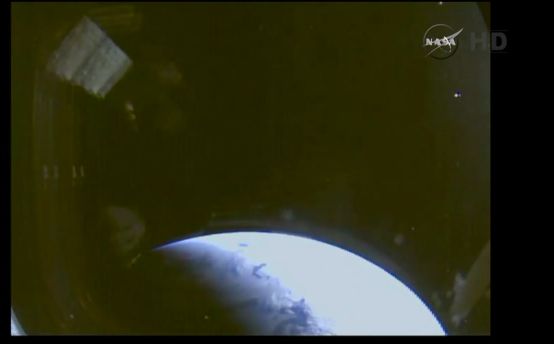
– Once Orion was up in its elliptical orbit, the view of the Earth was a tri-color Earth much like my tri-color Moon from my lunar eclipse photos: white limb, blue middle, and black in shadow. I need to figure out if that’s just an effect of the camera’s dynamic range because if not I want to capture the tri-color effect in the story I’m currently writing.

OrionEarth-4

– Orion did, as expected, experience a communication blackout when the reentry plasma got too thick.

– The video of the landing and splashdown – from the Ikhana drone and Orion itself – were awesome. I loved the infrared point of the approaching Orion and getting to see all the parachutes deploy.

– It was great that NASA TV and ustream broadcast the entire mission, and I enjoyed sharing the event with the twitter community. I don’t tweet often, but this event seemed made for it.

I spent the whole morning watching the flight. What an awesome day!

Congratulations to the NASA and Lockheed Martin Orion teams on a flawless flight! I am such a NASA fangirl! Luckily for me, I work for a NASA contractor and occasionally get to do work for Orion. But today I just got to be a fan.  🙂

[1] Ground track picture from NASA Flickr.

[2] Tri-color Earth picture screen shot from ustream NASA TV feed.