By Friday October 17, 2025, Comet C/2025 A6 Lemmon had become an evening object, so my husband and I drove to Sargent, Texas for darker skies (Bortle 4). Unfortunately, the clouds stayed near the horizon and hid Comet Lemmon. It was quite windy out, so I didn’t want to get out my telescope.
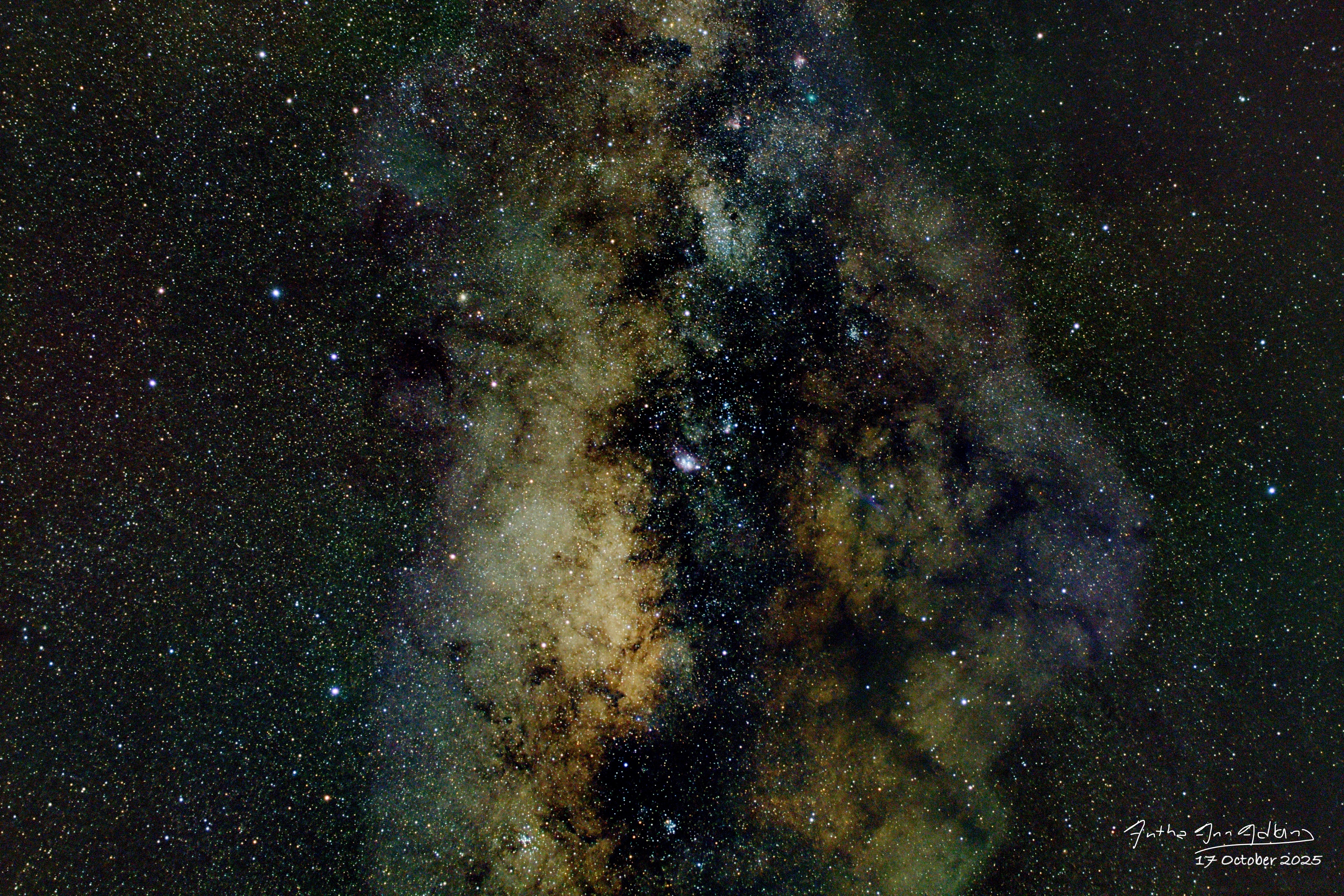
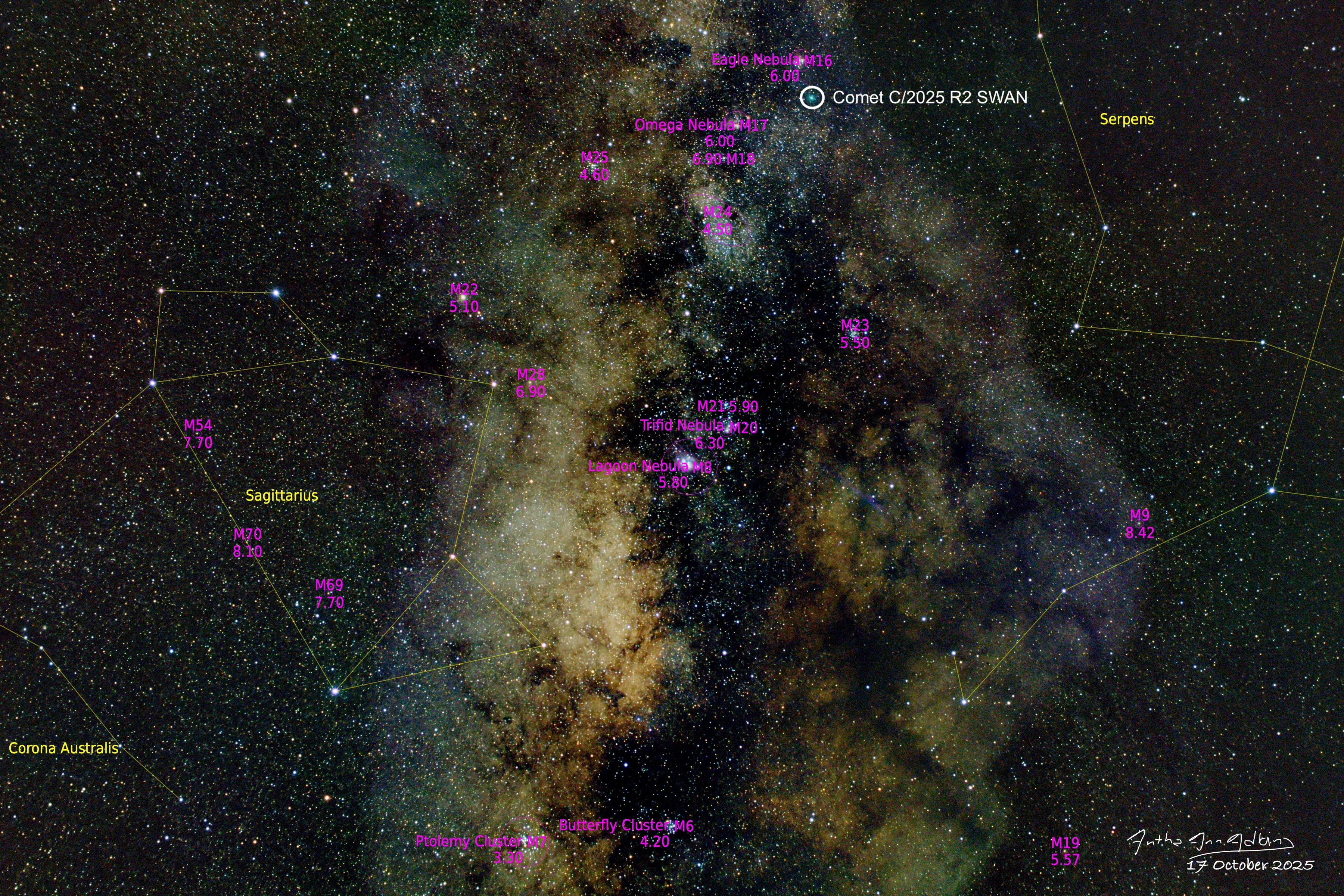
However, there was another bright comet in the sky, C/2025 R2 SWAN, and I also had my camera to try to capture a wide field image, so I set the camera up to capture a wide field with Comet C/2025 R2 Swan. I didn’t have much time to capture it before it was obscured by clouds and only got 7 minutes of data.
The comet was above the constellation Sagittarius which is in the direction of the center of the Milky Way, so it is a particularly bright section of the Milky Way and contains multiple Messier Objects, marked in magenta. Messier Objects are Deep Space Objects that comet hunter Charles Messier put on a list of “not-comets.” There are 17 Messier Objects in this image, four of which I have imaged before in more detail. It’s fun to compare them to an actual comet here. While the comet stands out with its greenness in the image, visually it would be a fuzzy spot like the others … except that it very slowly moves across the field of view.
Apparently I forgot to take flat frames for this image, so I used a synthetic flat.
Camera geek info – camera:
Canon EOS 60D in manual mode set at f/2.8, 10 second exposure, ISO 4000
Sigma 24-70 mm f/2.8EX lens, set at 24 mm, manual focus
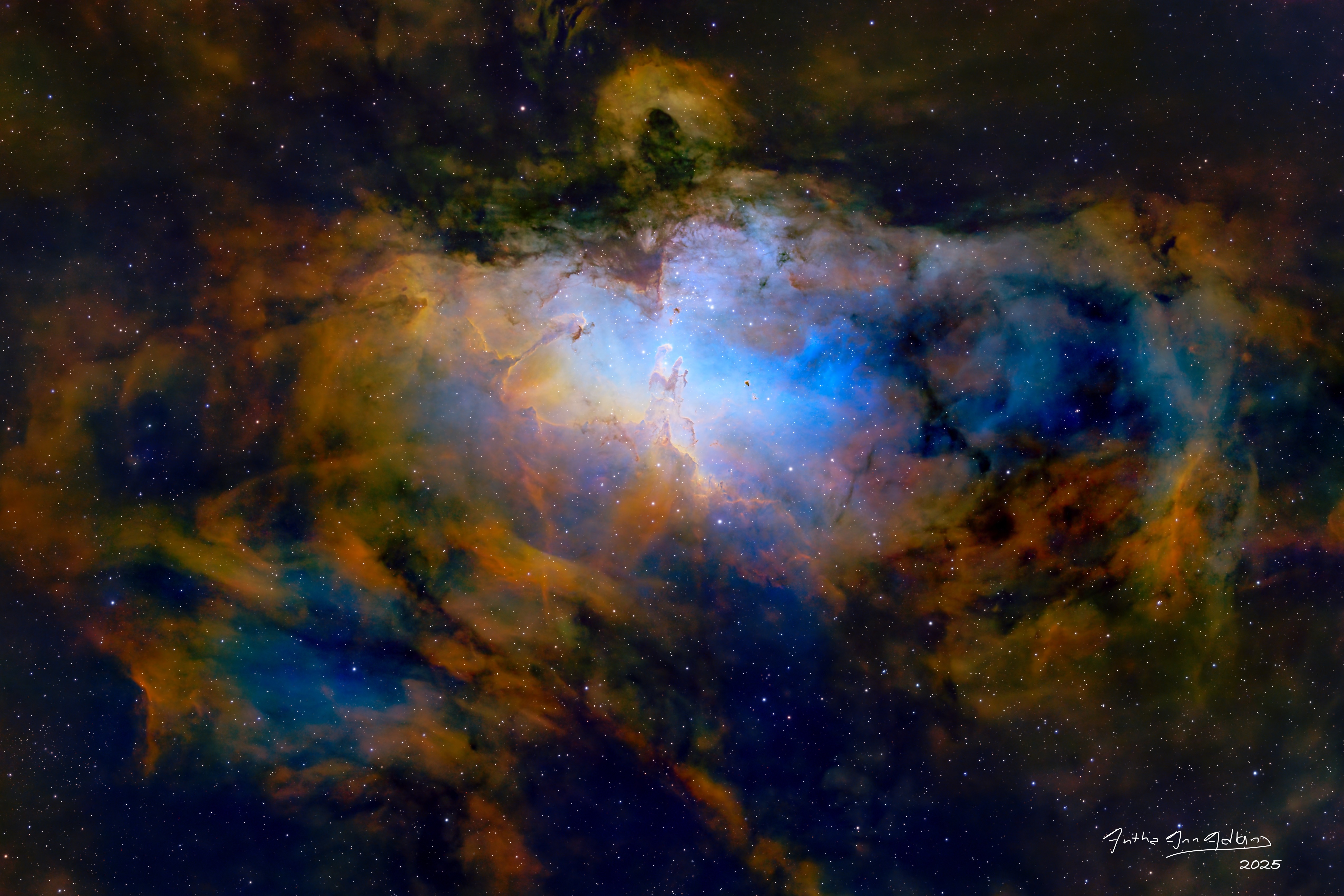
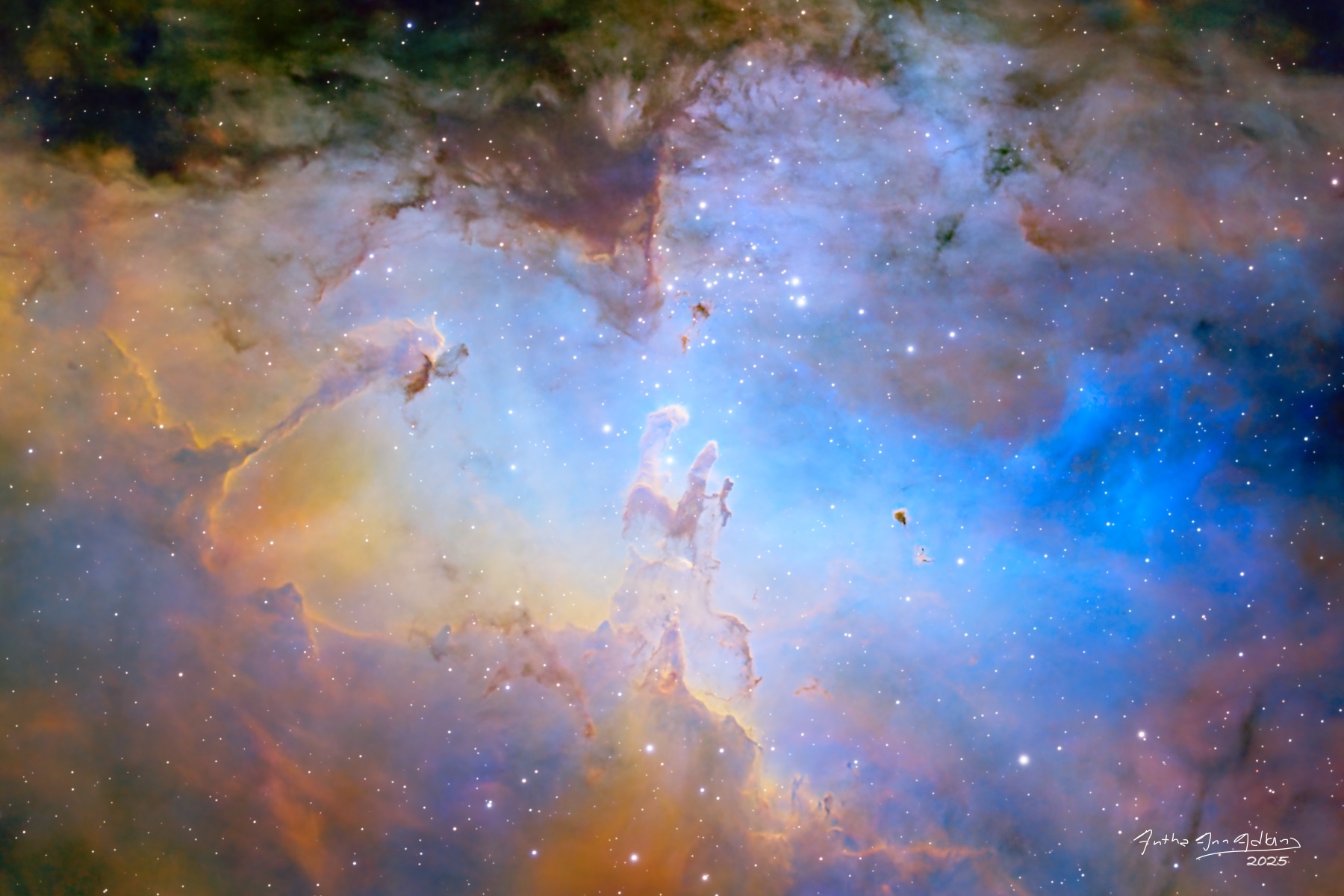
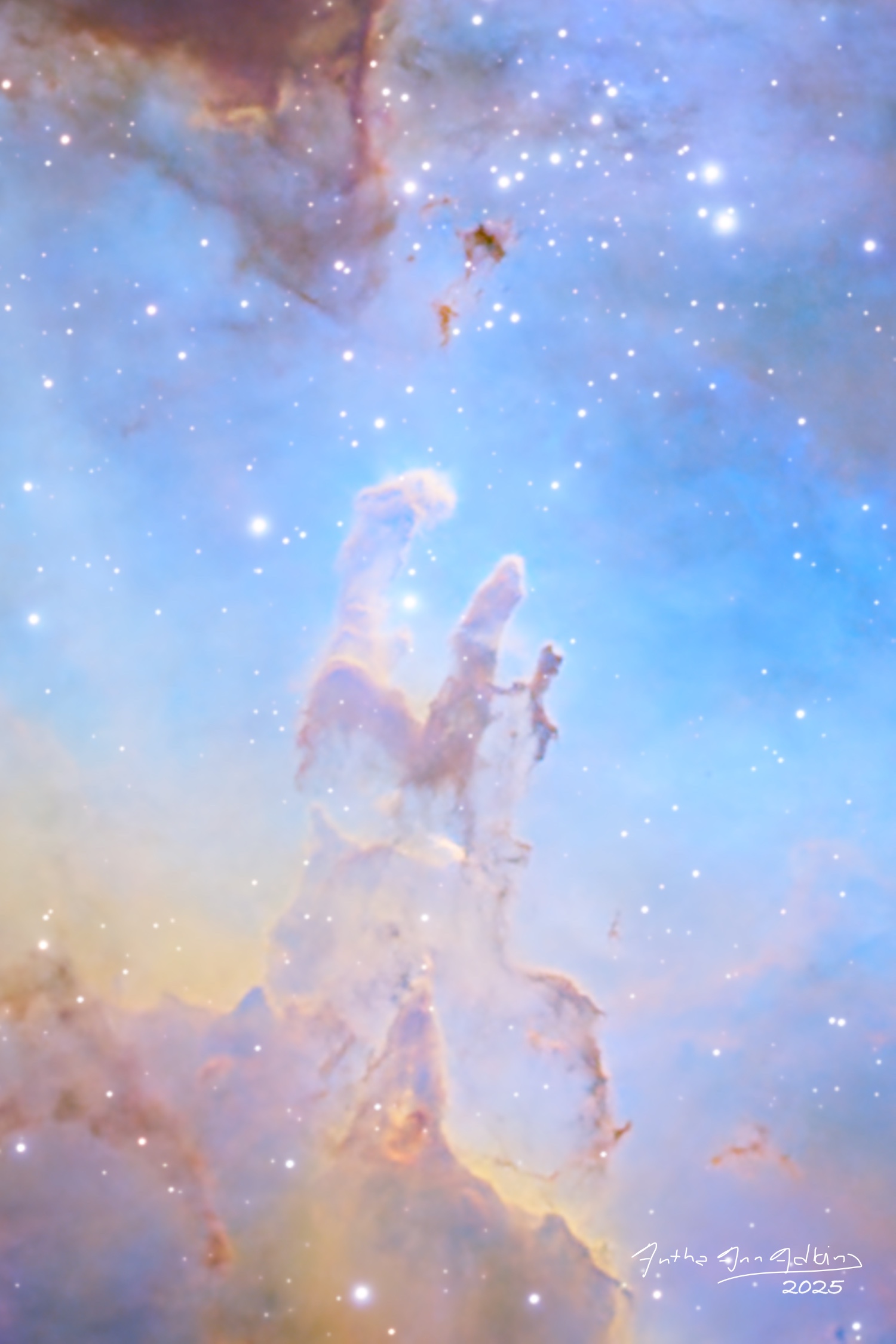
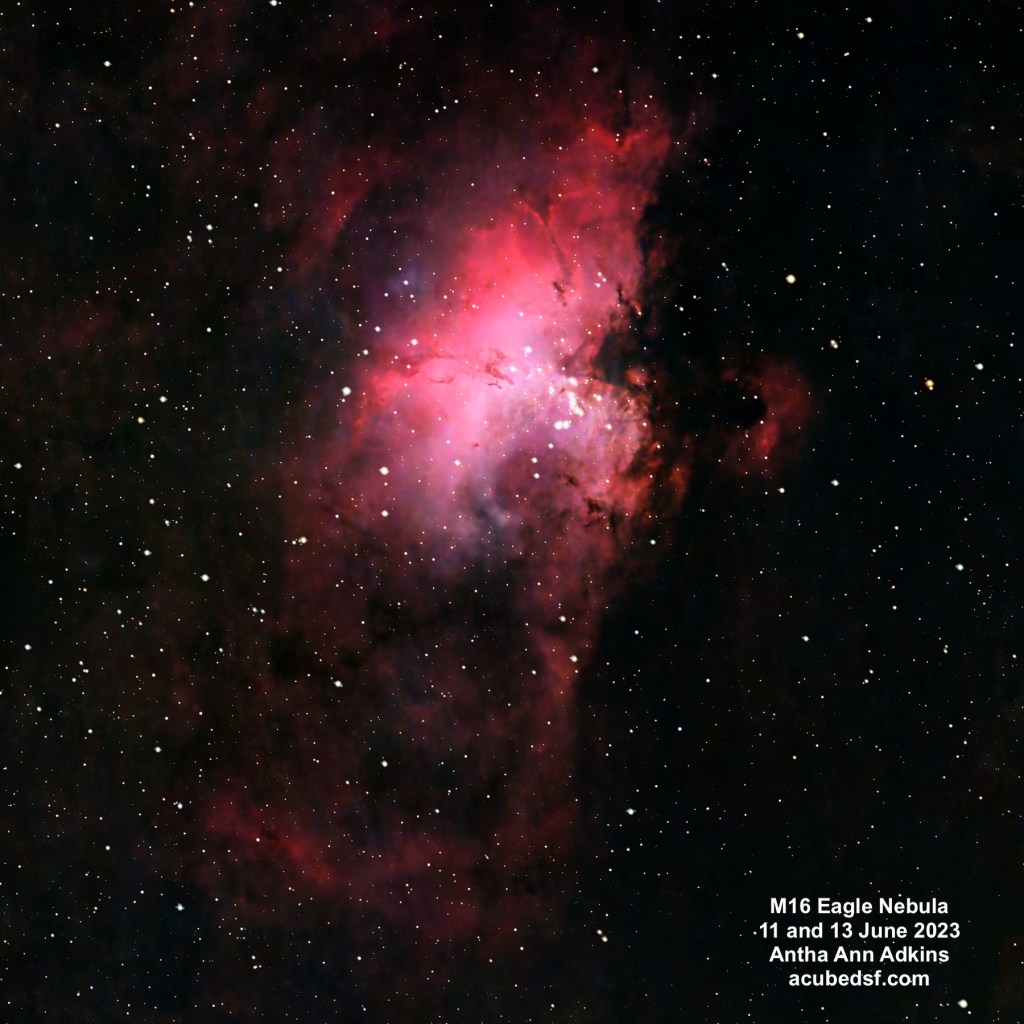
The traditional name for Messier 16 (M16) is the Eagle Nebula or the Star Queen Nebula. However, when I saw the first Hydrogen alpha narrowband images that went into this image, I did not think it looked like a bird. I thought the round nebula on the top looked like the knob on top of the cover of a jewel box (or perfume bottle). The bright inner center of the nebula with its young stars looked like jewels (so I picked the jewel box analogy). And the pillars in this nebula are the famous Pillars of Creation imaged by the Hubble Space Telescope. So I think the name the “Jewel Box of Creation” is also a lovely description of this beautiful Deep Space Object (DSO). What do you think it looks like?
M16 contains two related things: an emission nebula numbered IC4703 or Sharpless Sh2-49 and an open cluster numbered New General Catalogue (NGC) 6611. The emission nebula is part of Giant Molecular Cloud W37, an interstellar cloud of gas molecules, primarily molecular hydrogen (H2) and carbon monoxide (CO), the mass of which is calculated to be 170,000 times the mass of the Sun. The nebula is a large star-forming region ionized by the stars it generated. The open cluster of stars has an inferred population of 8100 stars including at least 137 visible young stars in the Gaia Early Data Release 3 (EDR3) with good data and magnitudes greater than G=17.5 in two populations: one older (7.5 +/- 0.4 million years old) and more spread out and one younger (1.3 +/- 0.2 million years old) and more concentrated. (As a point of reference, our own star, the Sun, is 4.6 billion years old – 3500 times older than the younger stars! What are you 3500 times older than?). The young population includes 19 type O stars which are high mass, hot, blue stars with short lives due to their high mass. One binary pair of these type O stars, HD168076, is the brightest star in the cluster visually, has a mass of 75 to 80 times the mass of the Sun, and is the primary source ionizing the nebula.
M16 is located in the Milky Way, approximately 5513 light years away, and it has an apparent size of 1.3 degrees, so it is approximately 125 light years across.
In this image, the stars came from images using red-green-blue filters with about 30 minutes of data each, and the nebula came from images using Sulfur ii (4.15 hours of data mapped to red), Hydrogen alpha (1.75 hours of data mapped to green) and Oxygen iii (2.25 hours of data mapped to blue) filters, the standard SHO mapping. But after doing that mapping, I used Narrowband Normalization to shift the colors so that it wasn’t overly green and to enhance the reds and blues. This tool made getting the colors in this nebula look right a lot easier! Even so, I ended up making multiple attempts to try to show it well and got some excellent advice on astrobin on how to improve the image. The nebula was processed separately from the stars to maximally enhance it.
I think this nebula and star cluster are absolutely gorgeous! We live in a universe filled with wonders.
Camera geek info – Narrowband:
William Optics Pleiades 111 telescope
ZWO 2” Electronic Filter Wheel
Antila SHO and RGB filters
Blue Fireball 360° Camera Angle Adjuster/Rotator
ZWO ASI183MM-Pro-Mono camera
William Optics Uniguide 32MM F/3.75
ZWO ASI220MM-mini
ZWO ASiair Plus
iOptron CEM40
Friendswood, Texas Bortle 7-8 suburban skies
Frames:
August 28, 2025
96 20 second Gain 150 Red lights
30 0.02 second Gain 150 Red flats
91 20 second Gain 150 Green lights
30 0.01 second Gain 150 Green flats
92 20 second Gain 150 Blue lights
30 0.01 second Gain 150 Blue flats
24 180 second Gain 150 Sii lights
30 0.5 second Gain 150 Sii flats
September 9, 2025
35 180 second Gain 150 Ha lights
30 0.5 second Gain 150 Ha flats
September 11, 2025
45 180 second Gain 150 Oiii lights
30 0.2 second Gain 150 Oiii flats
September 12, 2025
59 60 second Gain 150 Sii lights
30 0.5 second Gain 150 Sii flats
30 Flat Darks matching flat durations from library
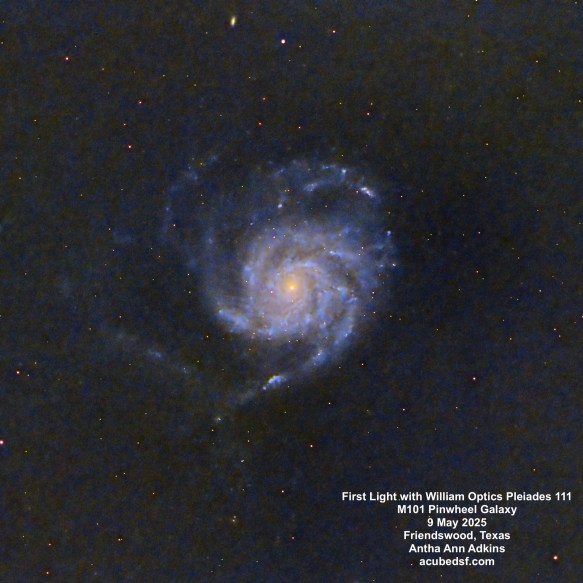
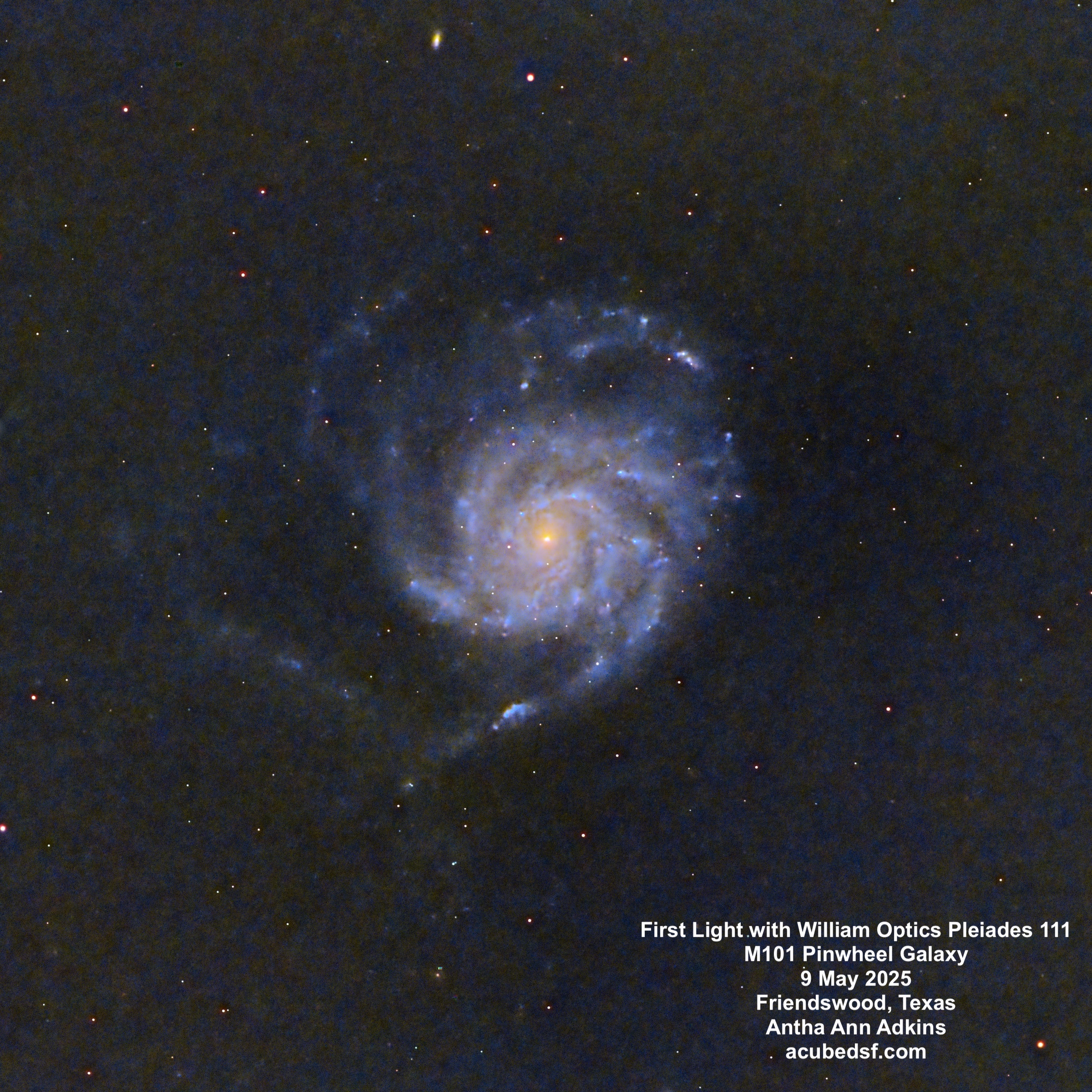
I chose M101 as my “first light” object for my new William Optics Pleiades 111 telescope, “Blue,” because it was galaxy season when I started imaging back in May and I had imaged it before so I could compare the results with my smaller telescope setup.
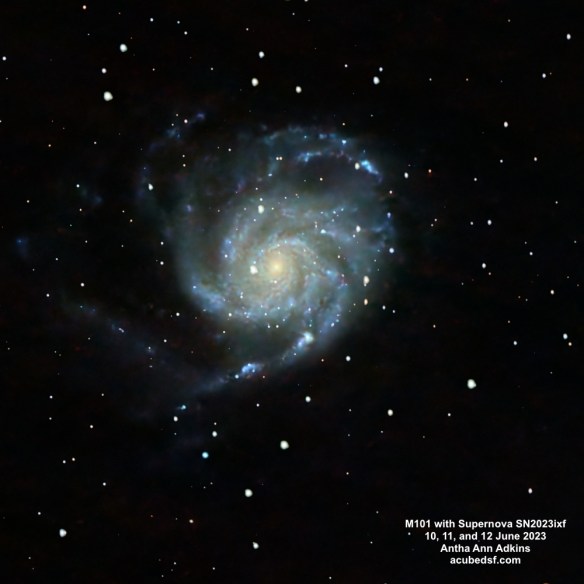
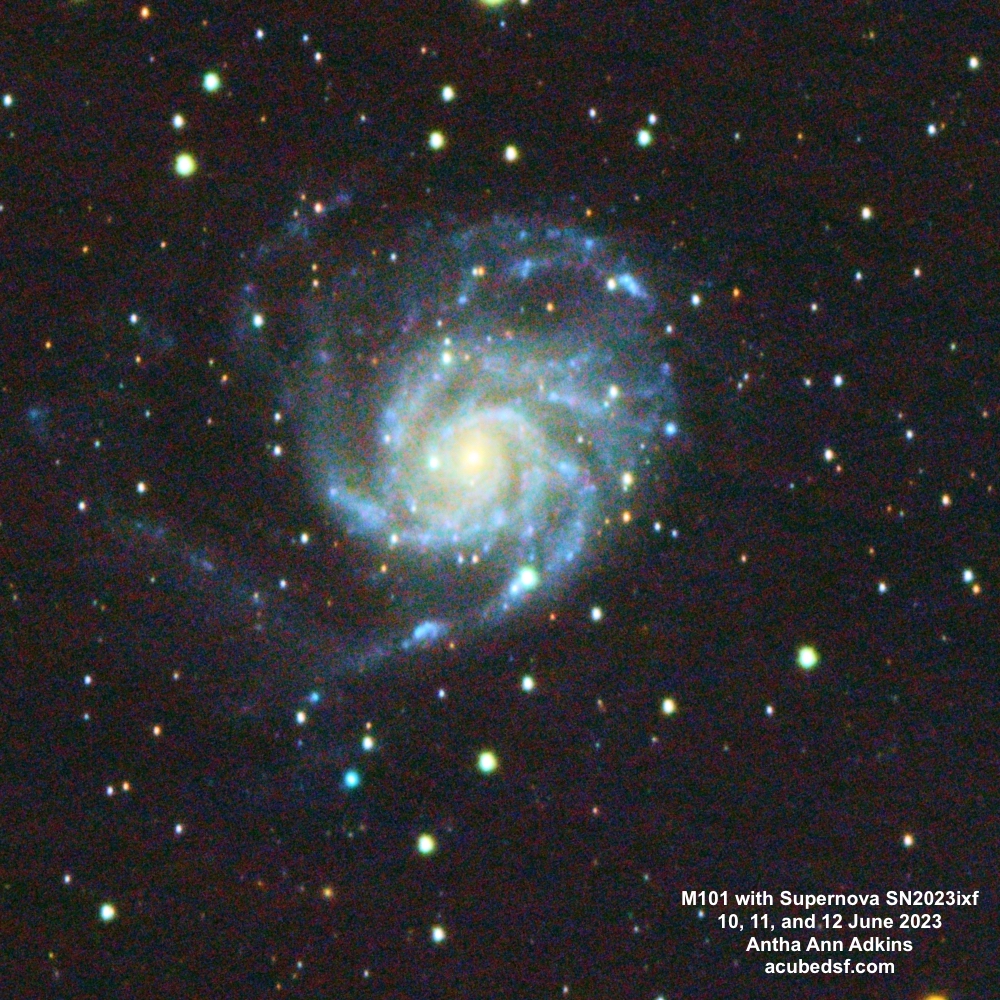
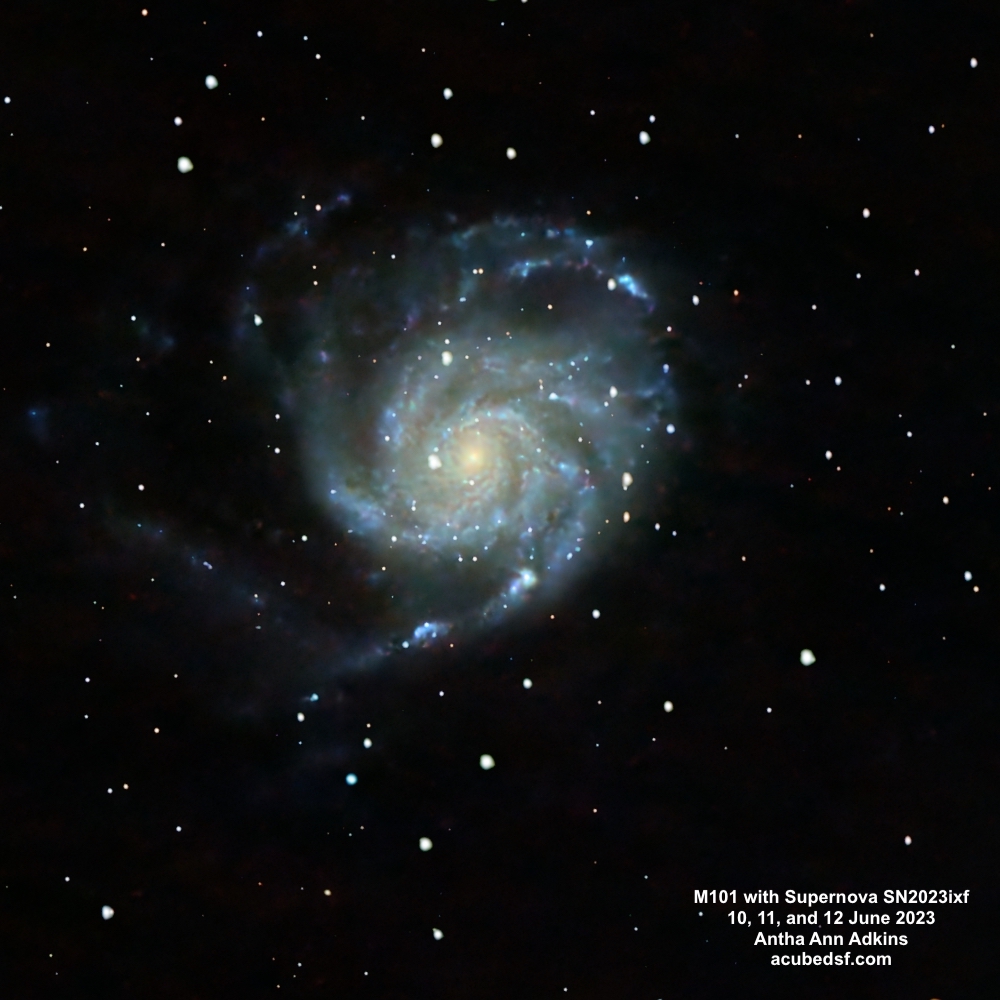
My oldest comparison image is from June 2023, when there was a supernova in the galaxy. I collected the data from the fabulous dark skies in Dell City, Texas, using my William Optics Zenith Star 73 III APO telescope and a Canon 60D camera. The image was made from 10.6 hours of data.
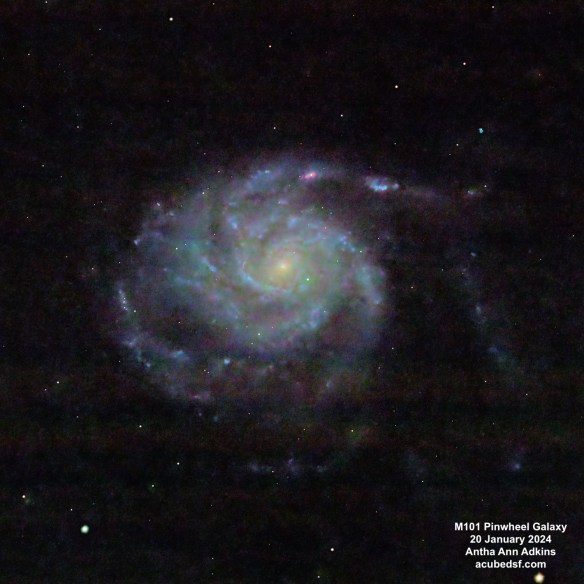
My next comparison image is from January 2024. I collected the data from Friendswood, Texas with suburban light pollution using my William Optics Zenith Star 73 III APO telescope and my at-the-time new ZWO ASI183MM-Pro-Mono camera and ZWO filter wheel. The image was made using 59 minutes of red data, 60 minutes of green data, and 57 minutes of blue data.
My next image is from May 2025 in Friendswood, Texas, and it was the first light on my William Optics Pleiades 111 telescope “Blue” using a new guide camera and using my existing ZWO ASI183MM-Pro-Mono camera. The image used only 52 minutes of red data, 66 minutes of green data, and 86 seconds of blue data, and I had to adjust some of the local normalization parameters to accept lower quality data to get it to process. I had been excited to have a semi-clear night, so I had gotten the telescope out even though seeing wasn’t great.
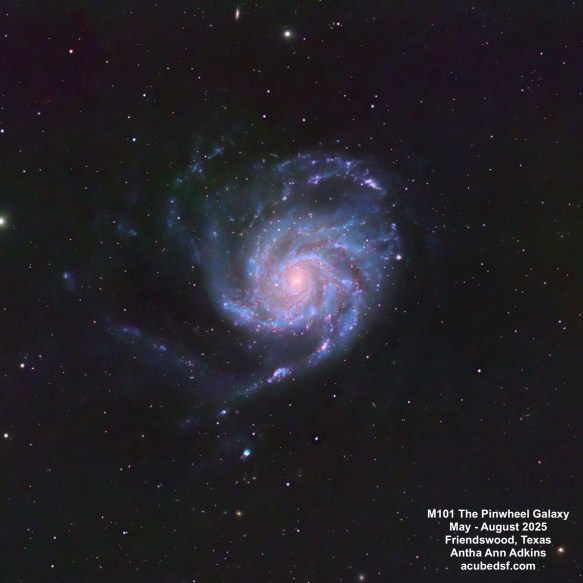
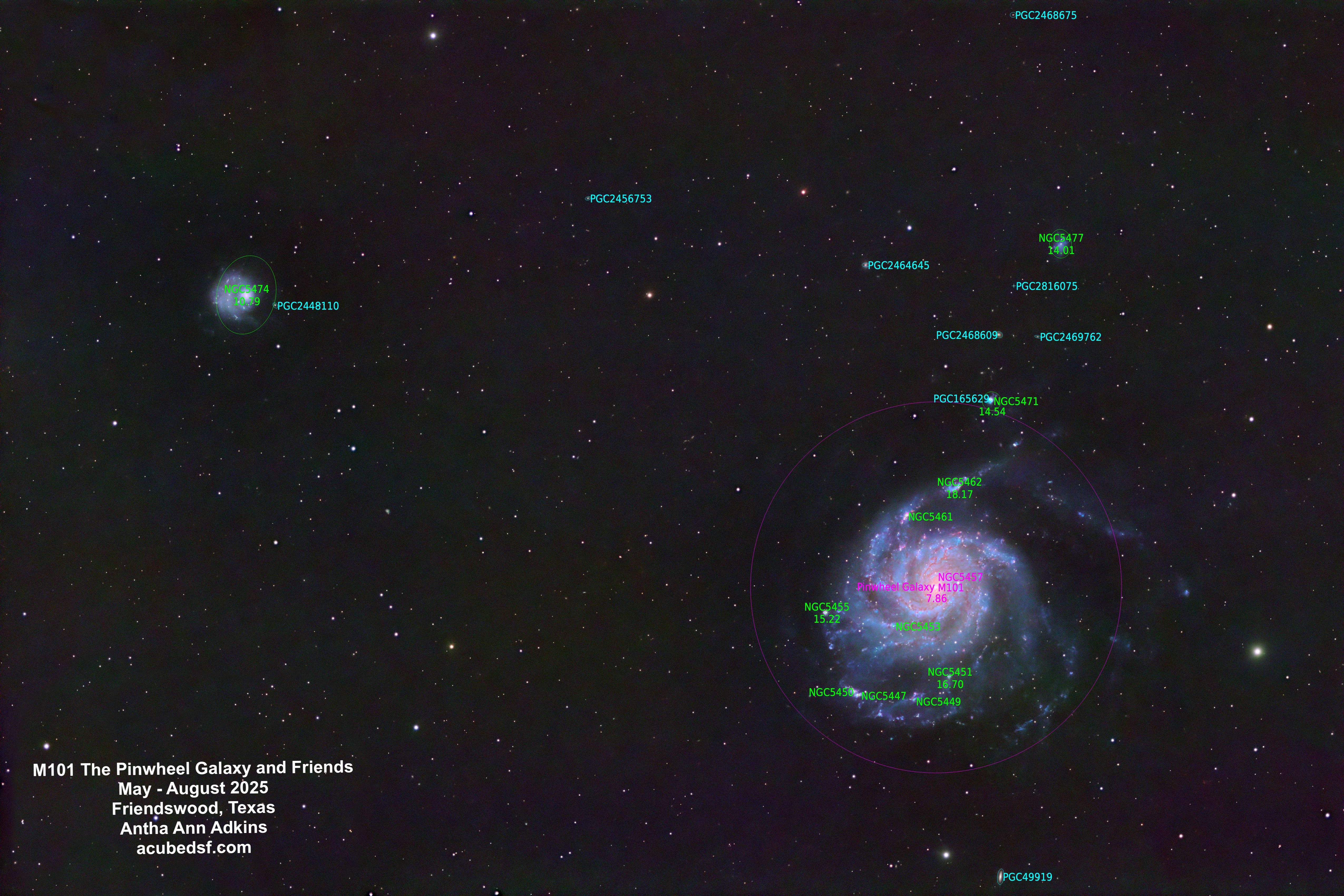
My final (for now) image is from May – August 2025 in Friendswood, Texas. The new telescope cloud curse has been particularly strong with this telescope, and when there weren’t clouds, there was dust or a full Moon. Nevertheless, I persevered over 8 nights to produce the final image, ending up using 5.9 hours of red data, 5.3 hours of green data, and 4.8 hours of blue data.
There was a huge improvement in the detail (most obvious with the stars) when I switched to the astrocamera, and another huge improvement in the detail (most obvious in the galaxy and in the background galaxies) when I switched to the larger telescope and guiding capability.
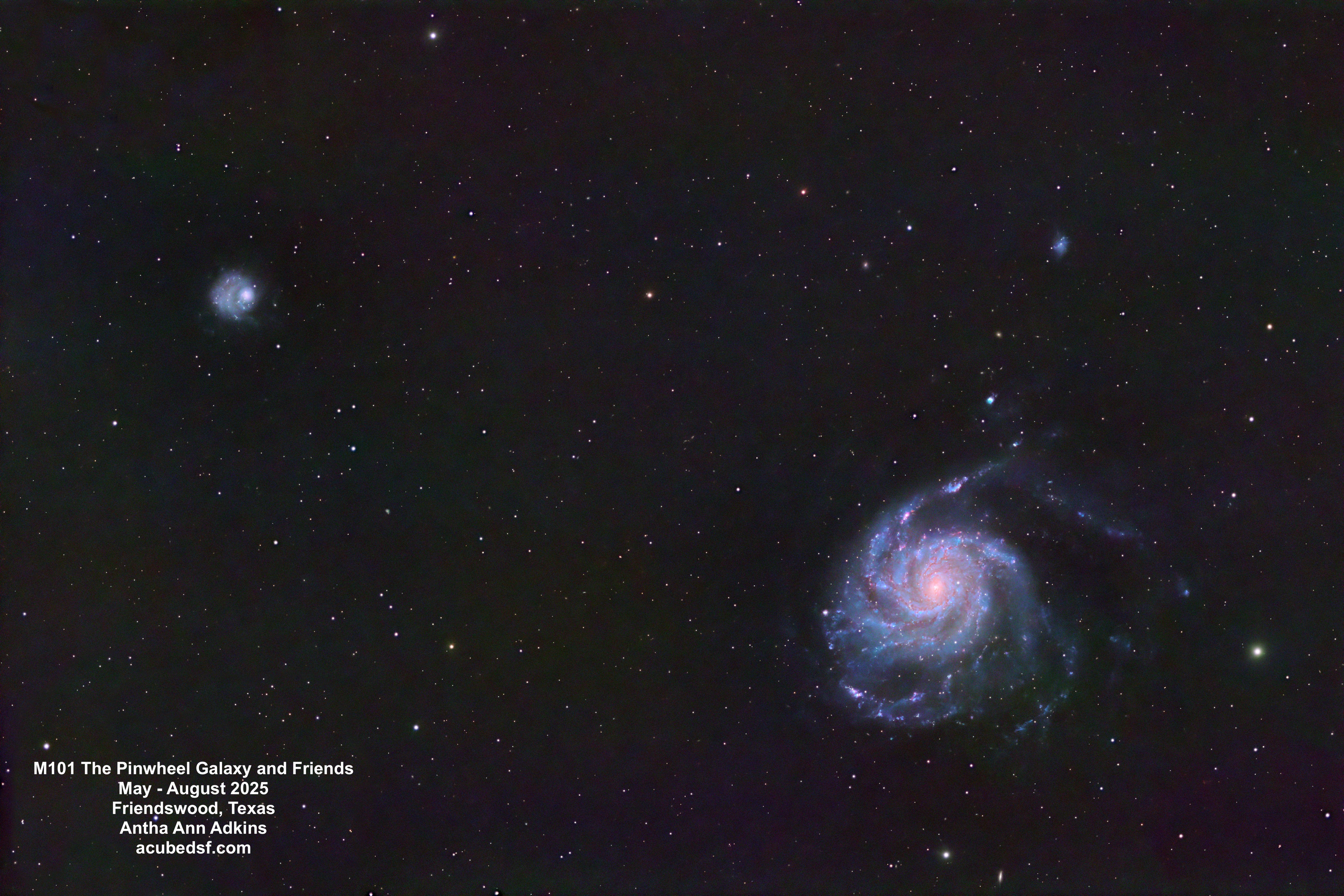
My main subject, M101, the Pinwheel Galaxy, is an intermediate spiral galaxy, between a barred and an unbarred spiral galaxy. It’s located approximately 23.2 million light years away, and it has an apparent size of 24 arcminutes, making it about 162 thousand light years across.
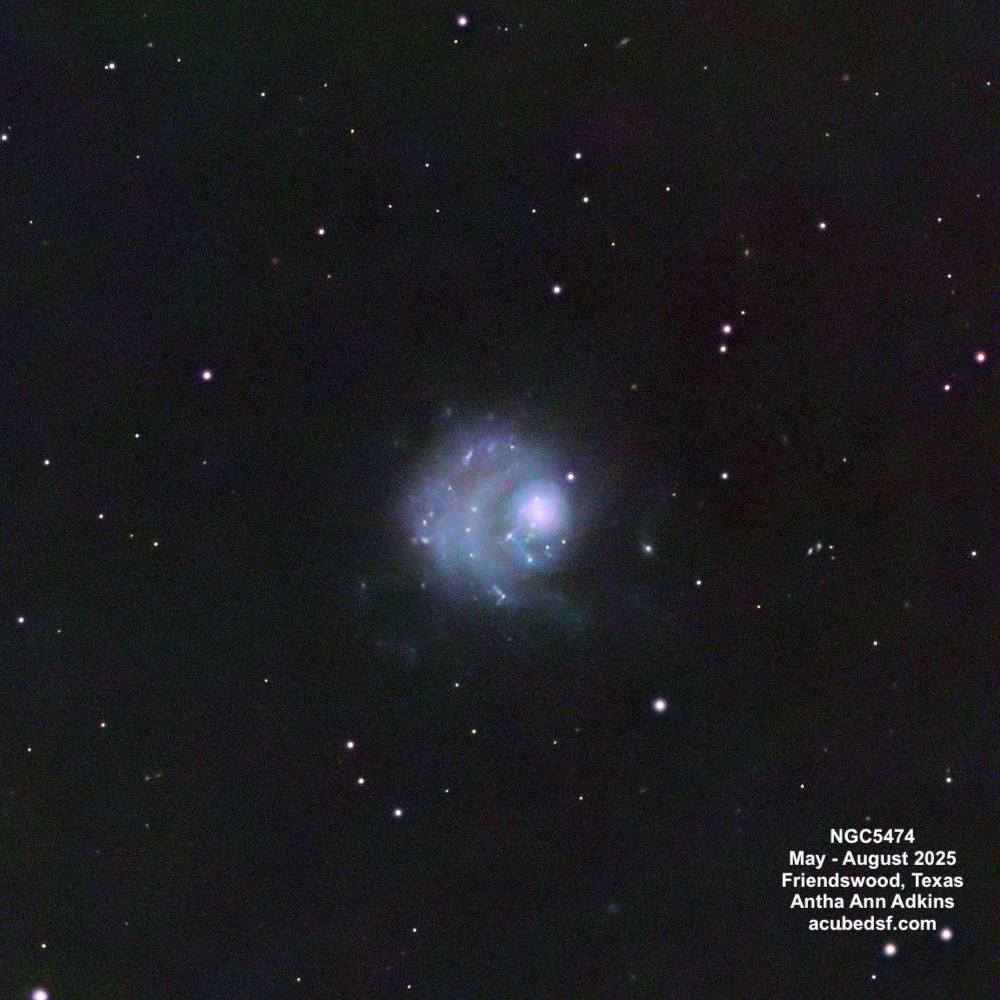
Also obvious during imaging was NGC5474, which is a peculiardwarf galaxy that is a companion to M101. Its interaction with M101 has distorted it. It also appears to have a spiral structure, making it a dwarf spiral galaxy. It’s located approximately 22.4 million light years away, and it has an apparent size of 4.68 arcminutes, making it about 30.4 thousand light years across.
What surprised me with in the final image was the sheer number of tiny galaxies in the background. In addition to NGC5474, there was NGC5477, a dwarf galaxy which is 22.05 million light years away, with an apparent size of 1.7 arcminutes, making it 10.9 thousand light years across. PixInsight also labeled 8 other galaxies in the Principal Galaxies Catalog (PGC). And when I looked in detail at the image, there are a ton more tiny distant galaxies in the background. WOW.
Now M101 is really too low in the sky to get any good data from my driveway, so I am moving on to other subjects. I look forward to coming back to this one in the future and capturing more of the amazing background galaxies.
It’s a well-known astrophotography curse that buying new equipment means weeks, if not months, worth of cloudy skies. My new telescope, a William Optics Pleiades 111, a 11.1 cm/4.37 inch diameter refractor that I’ve nicknamed “Blue”, was no exception. It took about a month after I got the telescope (and the additional two counter weights I needed to balance it) for the skies to at least somewhat clear. I got everything set up, just to watch the clouds roll in. Happily, they then rolled back out. And then rolled back in. And out.
I ended up with enough data to make a first light picture, but I’ll need to collect more data for a final image.
I had contemplated what to image for first light. Since the telescope name is Pleiades, the Pleiades would have been a good target, except they’re currently barely above the horizon at sunset. My favorite nebula, the Orion nebula, would have been a good target, except it’s also currently barely above the horizon at sunset. It’s “galaxy season,” so I decided to image a galaxy. I’ve imaged M101 before because it hosted a supernova in 2023, so it gave me a good point of comparison.
The comparison isn’t entirely a fair one. On the one hand, this is an entirely new setup, with a much larger diameter telescope, an astro camera instead of a consumer camera, and a guide scope and guide camera to better control the tracking mount. Additionally, I’ve picked up a lot of processing skill in the last two years, such as using shorter images for the stars so they don’t “bloat.” On the other hand, this was 3.4 hours of galaxy data from my Bortle 7-8 light polluted driveway instead of 10.6 hours from the Bortle 2-3 dark skies of Dell City.
Because of the light pollution and limited imaging time, there is a lot more background noise in the new image. But the stars are enormously improved from the old image. And there is more detail in the new image. I can’t wait to see how an image with more data turns out!
Once the clouds roll away again ….
Camera geek info May 9, 2025 (new image):
William Optics Pleiades 111 telescope
ZWO 2” Electronic Filter Wheel
Antila RGB filters
Blue Fireball 360° Camera Angle Adjuster/Rotator
ZWO ASI183MM-Pro-Mono camera
William Optics Uniguide 32MM F/3.75
ZWO ASI220MM-mini
ZWO ASiair Plus
iOptron CEM40
Friendswood, Texas Bortle 7-8 suburban skies
Frames (new image):
May 9, 2025
32 30 second Gain 150 Red lights for stars
24 30 second Gain 150 Green lights for stars
22 30 second Gain 150 Blue lights for stars
53 60 second Gain 150 Red lights for galaxy
66 60 second Gain 150 Green lights for galaxy
86 60 second Gain 150 Blue lights for galaxy
30 0.2 second Gain 150 Red flats
30 0.1 second Gain 150 Green flats
30 0.1 second Gain 150 Blue flats
Darks, Flat darks from library
Camera geek info (old image):
William Optics Zenith Star 73 III APO telescope
William Optics Flat 73A
Canon EOS 60D in manual mode, 2 minute exposure, ISO 1600 and ISO 2000, custom white balance 3500K
Messier 46, also numbered New General Catalogue (NGC) 2437, is an open cluster, a cluster of about 500 stars that formed from the same molecular cloud and are similar in age, estimated to be 251.2 million years old. M46 is located in the Milky Way, approximately 4930 light years away, and it has an apparent size of 25.3 arcmin, so it is approximately 36 light years across.
I chose to photograph this open cluster not only because it is a Messier object I haven’t imaged yet but because there is a planetary nebula in front of it, so I was getting to image two objects at the same time.
But when I processed the image and removed the stars, I got a surprise. There wasn’t just one planetary nebula – there were two! I was delighted and felt the joy of discovery. I hadn’t known there was a second planetary nebula there, and yet there it was! I immediately used PixInsight to annotate the image to see if the small planetary nebula was known, and of course it had already been discovered. But it was still super fun to find something unexpected in my image.
The planetary nebula I had been intending to image, NGC 2438 or PK 231+04.2, is located in the Milky Way, approximately 1377 light years away, and it has an apparent size of 1.173 arc min, so it is approximately 0.5 light years across. Because it had a different relative motion relative to us than M46, it is not considered to be part of the open cluster. Before I learned that, I had thought it would be cool if it were part of the cluster and that possibly (since cluster stars are generally of similar age) multiple stars in the cluster could generate visible planetary nebula at the same time. Wouldn’t that be a sight to see?
My surprise planetary nebula, Minkowski M1-18 or PK231+0.41, is located in the Milky way, approximately 14500 light years away, and it has an apparent size of 0.507 arcminutes, so it is approximately 2.1 light years across. So further away and larger than NGC2438.
In this image, the stars came from images using red-green-blue filters, and the two nebulas came from images using Hydrogen alpha (mapped to red) and Oxygen iii (mapped to turquoise) filters. The two nebulas were processed separately to maximally enhance each, which means that they are more equal in brightness in the image than they are in reality (M1-18 is much dimmer).
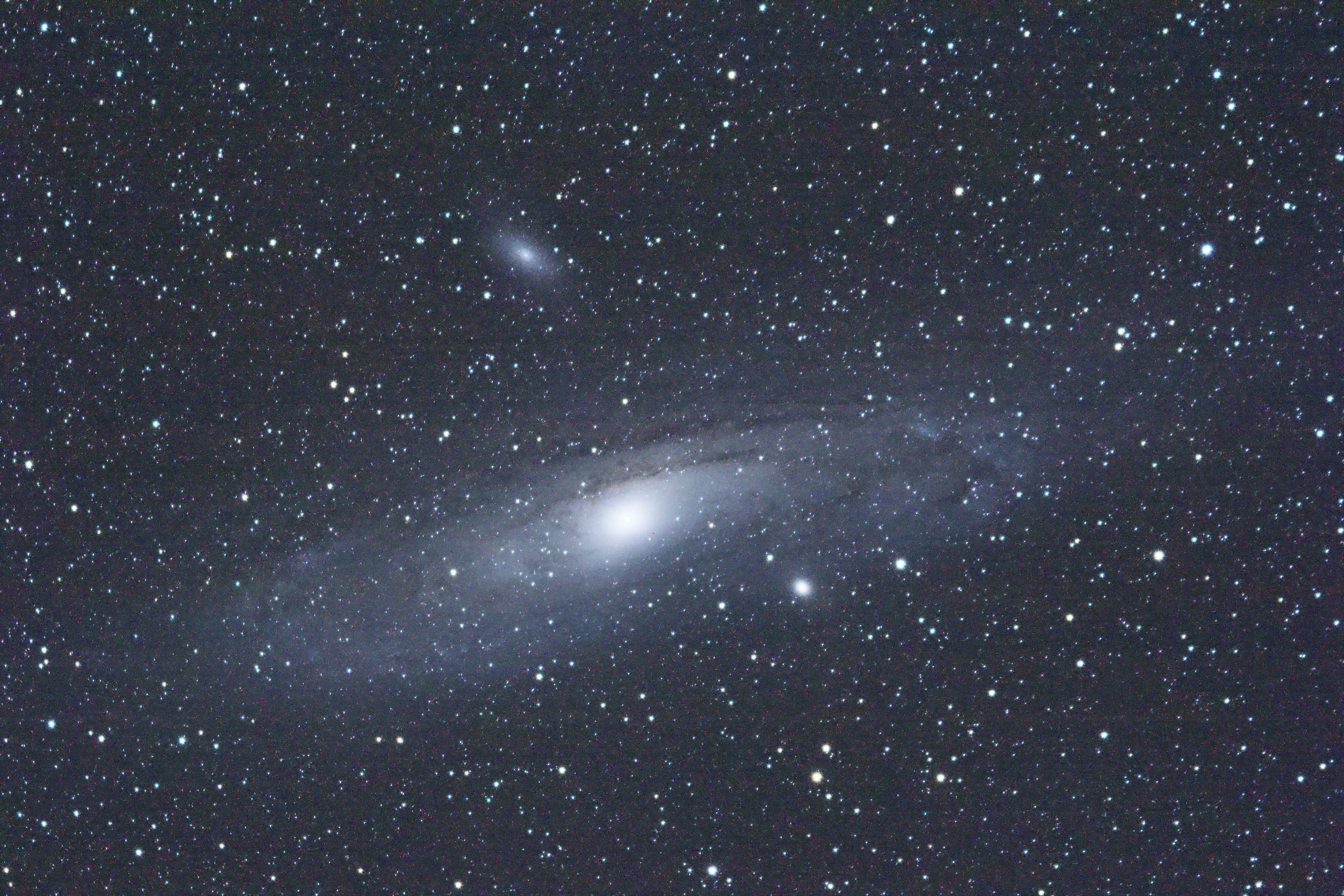
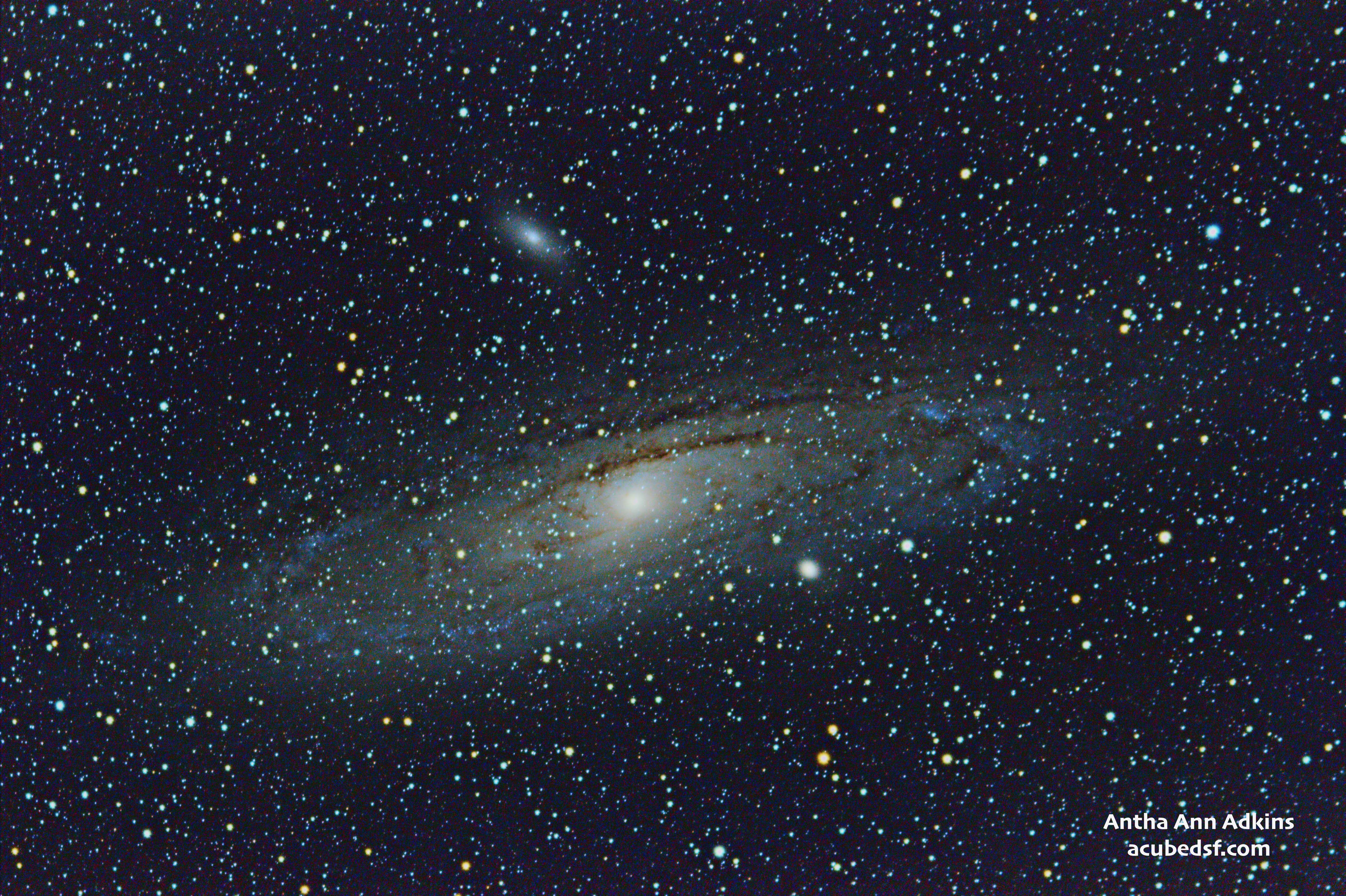
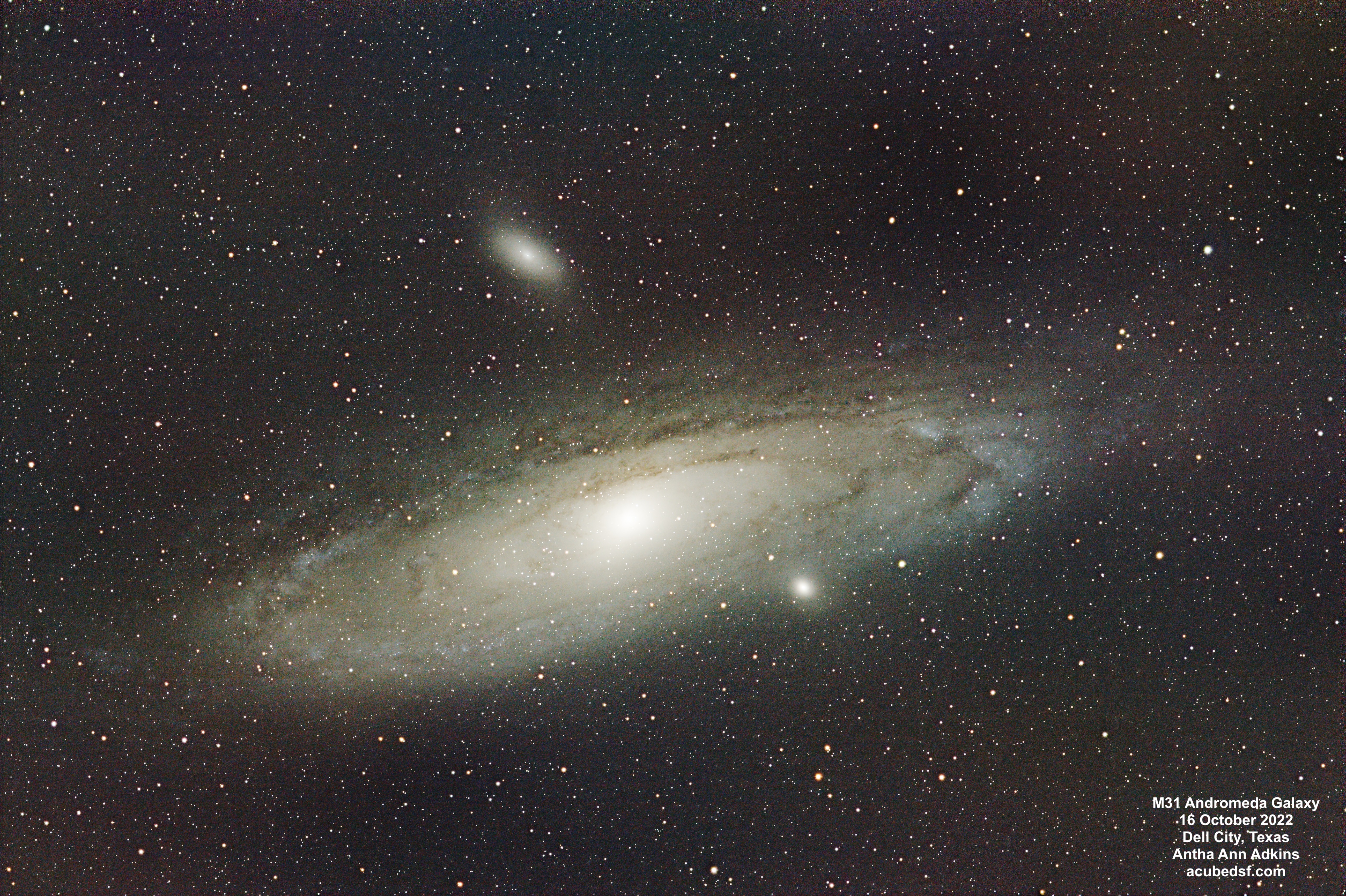
The first object that I got a satisfactory image of with my tracking mount and telescope and DSLR was M31, the Andromeda Galaxy, from the dark skies of Dell City, Texas in October 2022. My first image, above, was a 3 minute long exposure. I was so excited to have a good image that I took a picture of my camera’s viewfinder to send the picture to people.
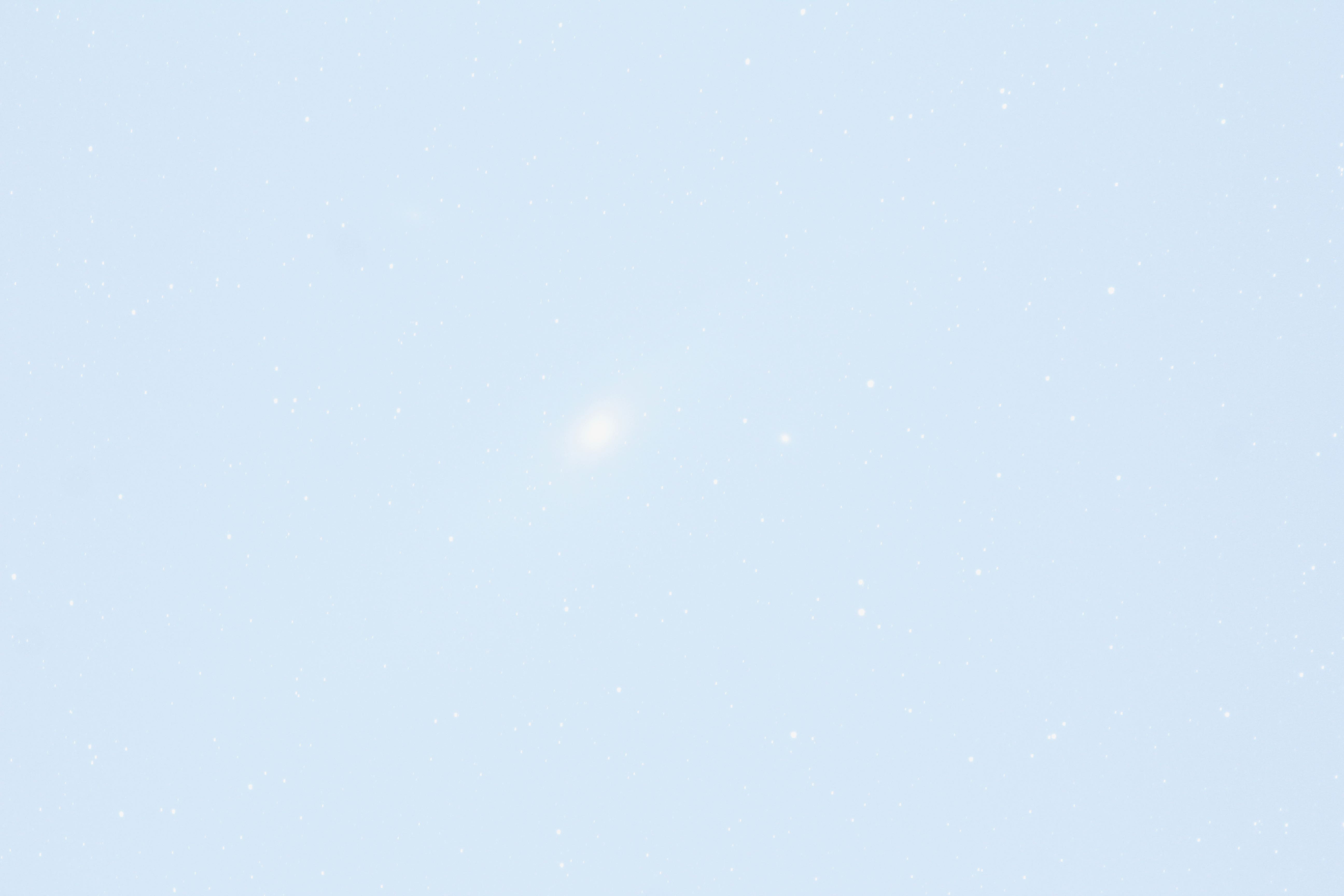
When I came home to Friendswood, Texas, I did some experiments to see if I could get the same results. It was not a surprise when the answer was “no” – my home skies are much more light polluted – I expected to get a completely white screen and was surprised when I could still see a hint of the galaxy.
I started to learn how to use PixInsight, a powerhouse astrophotography processing tool, in the winter of 2022. I learned enough to be able to stack 18 3 minute images to make my Christmas card photo and the picture I am still using as my computer background at work.
I’ve learned a more about astrophotography processing since then, most notably adding Russ Croman’s excellent BlurXterminator, NoiseXterminator, and StarXterminator tools to my toolbox and learning a ton from Adam Block’s videos. So I reprocessed the data above using my current knowledge and toolset.
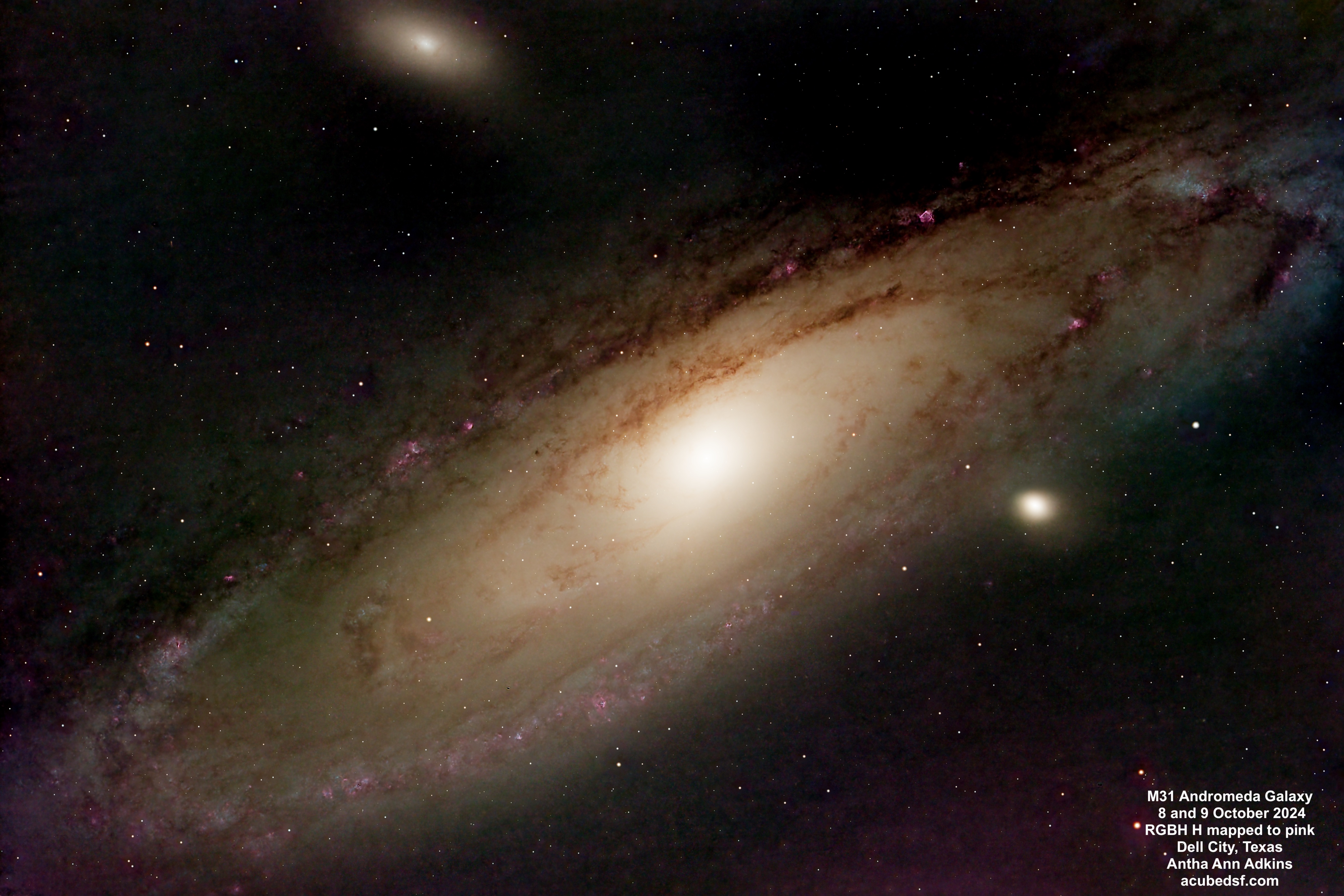
Finally, in October 2024, we were back in Dell City, and I collected new M31 data using an astrocamera and red, blue, green and hydrogen-alpha filters. I had to learn more in order to be able to merge the Ha data into the RGB data. Luckily, there are Adam Block’s videos! One new trick I had to use was “continuum subtraction” – removing the background red from the stars from the Ha data.
Sometimes, when other things aren’t working out (comet processing), it’s good to step back and see how far you’ve come. I’ve learned a lot over two years … and I’m looking forward to learning a lot more!
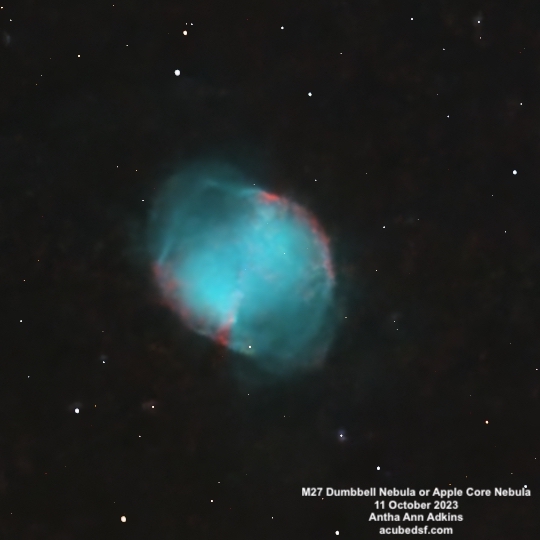
M27, also called the Dumbbell Nebula or Apple Core Nebula, is a planetary nebula – the gases expelled from a red giant star before it becomes a white dwarf, lit up by that star. It’s located in the Milky Way, approximately 1250 light years away, and it has an apparent size of 8 arcmintues, making it 2.9 light years across. It’s estimated to be 12,700 years old.
Planetary nebulae do not last long on an astronomy time scale because the expelled gases grow dimmer as they expand away from the central star. I am glad I live in a time when we can observe them and they can be observed!
Planetary nebulae were originally called that because they looked like a round (like a planet) ball of fuzz by visual observers. However, now we know they have nothing to do with planets and are actually shell(s) of gas expelled from a red giant star. With astrophotography, we can pick up so much more detail than a fuzzball, and so we end up with interesting names. For this nebula, some thought the inner core of this nebula looked like a dumbbell; others thought it looked like an apple core. With the outer fringe, what do you think it looks like?
I used data from my driveway in Friendswood, Texas with suburban Bortle 7 – 8 brightness skies (lots of light pollution) to make this image. In order to capture the outer fringe I needed a lot of data: 12.2 hours of Ha data and 10.65 hours of Oiii data, taken over nine nights.
This is a narrowband image, mapping Oiii to blue and Ha to red. My goal was to capture both the details in the core and the outer fringe. It took three processing tries, but I think I was ultimately successful.
M27 is one of the brighter objects I imaged while we were enjoying the dark skies in Dell City, Texas. This object was a brilliant blue in a single frame, and it was nice not to have to rely on faith that something was there.
This image used only 1.8 hours of data.
M27, also called the Dumbbell Nebula or Apple Core Nebula, is a planetary nebula – the gases expelled from a star before it becomes a white dwarf, lit up by that star. It’s located in the Milky Way, approximately 1250 light years away, and it’s approximately 2.9 light years across, giving it an apparent size of 8 arcminutes. It’s estimated to be 12,700 years old.
Planetary nebulae do not last long on an astronomy time scale because the expelled gases grow dimmer as they expand away from the central star. I am glad I live in a time when we can observe them and they can be observed!
Isn’t our galaxy beautiful?
Camera geek info:
Canon EOS 60D in manual mode, 2 minute exposure, ISO 1600
M101 with Supernova 2023xif – with and without BXT and NTX
M16 Eagle Nebula – with and without BXT and NXT
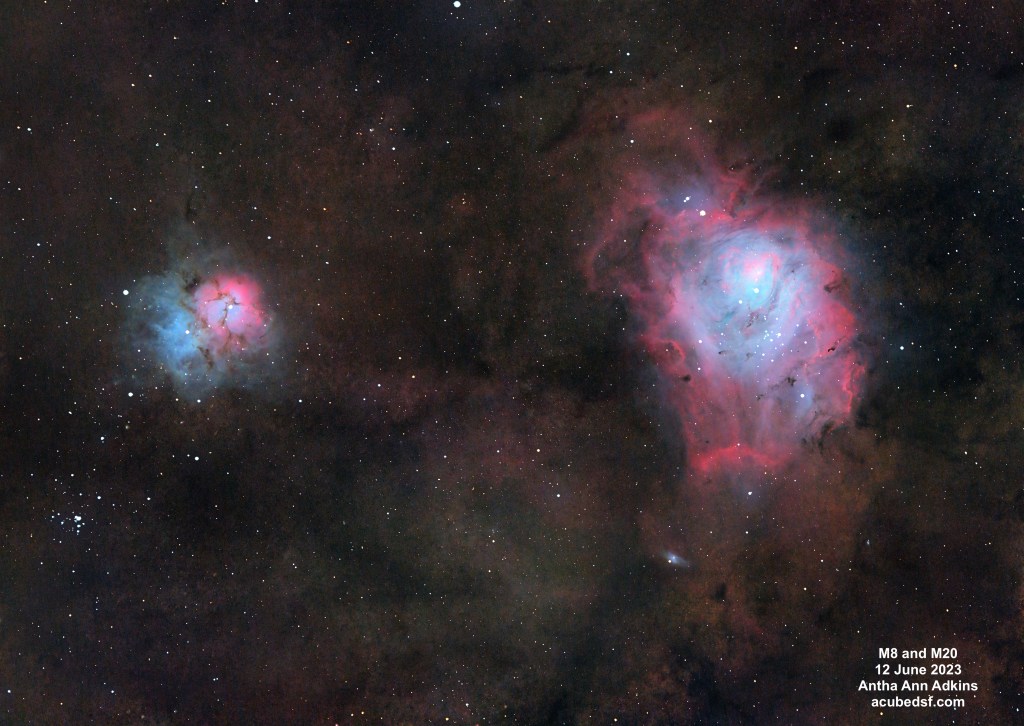
After learning about the powerful BlurXterminator (BXT) and NoiseXterminator (NXT) tools, I reprocessed my M101 and supernova and M16 images that I took from the glorious dark skies of Dell City, Texas earlier this summer. I was amazed that so much detail can be found in images of objects thousands to millions of light years away taken by my small telescope.
M16:
Camera geek info:
Canon EOS 60D in manual mode, 2 minute exposure, ISO 2000
Williams Optics Zenith Star 73 III APO telescope
Williams Optics Flat 73A
iOptron CEM40
Dell City, Texas Bortle 2-3 dark skies
Frames:
June 11, 2023
Run 1
6 2 minute lights
31 0.02 second flats
30 0.02 second flat darks
31 2 minute darks
June 13, 2023
Run 2
88 2 minute lights
30 0.02 second flats
31 0.02 second flat darks
Run 3
83 2 minute lights
31 0.02 second flats
30 0.02 second flat darks
31 2 minute darks
17 frames rejected for a total of 5 hours and 20 minutes of data
Processing geek info:
PixInsight
BlurXterminator
NoiseXterminator
StarXTerminator
Generalized Hyperbolic Stretch
M101:
Camera geek info:
Canon EOS 60D in manual mode, 2 minute exposure, ISO 1600 and ISO 2000






 Space&Aliens