M42 Orion Nebula: Exploring Narrowband and Composite Imagery

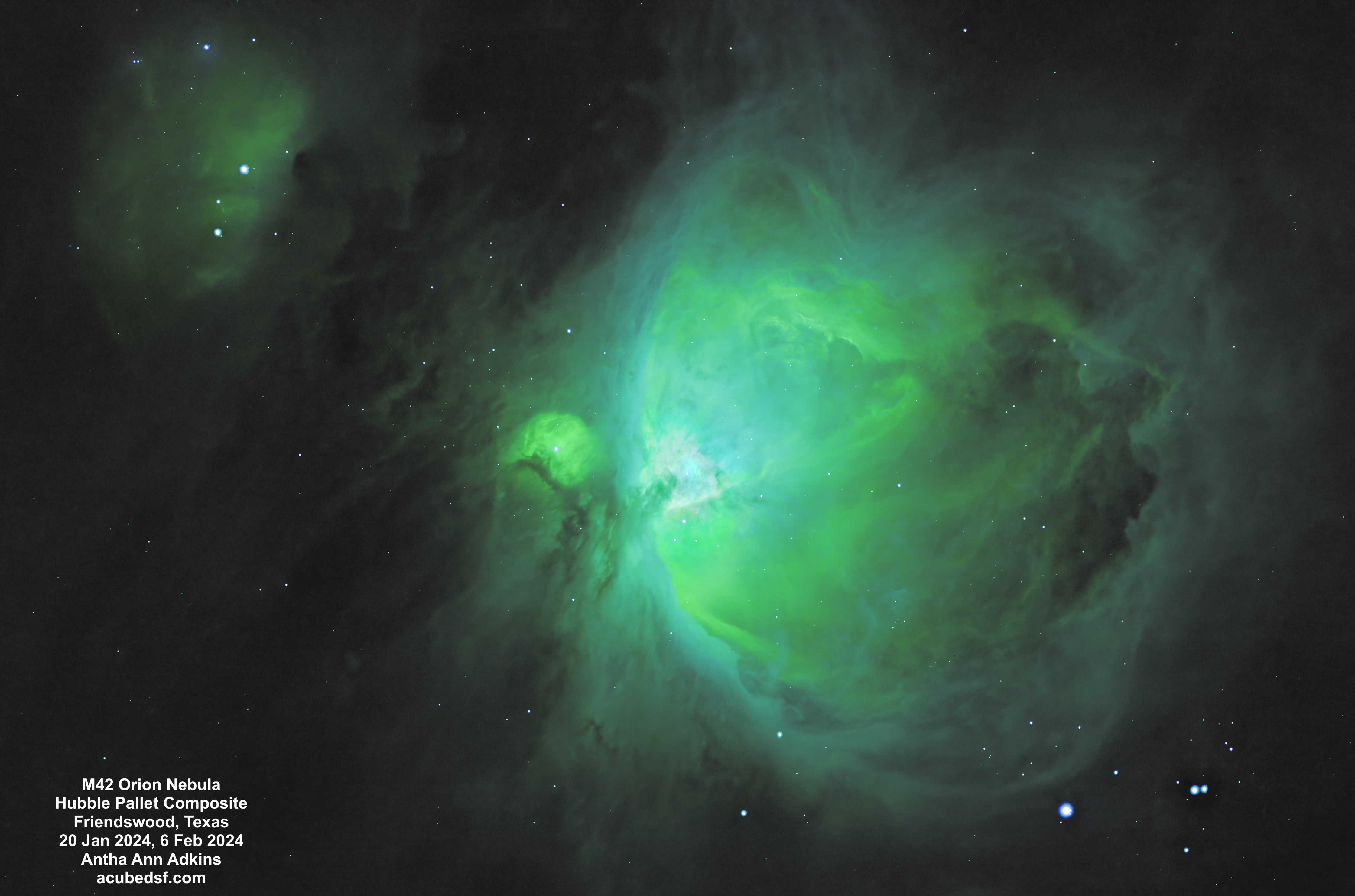
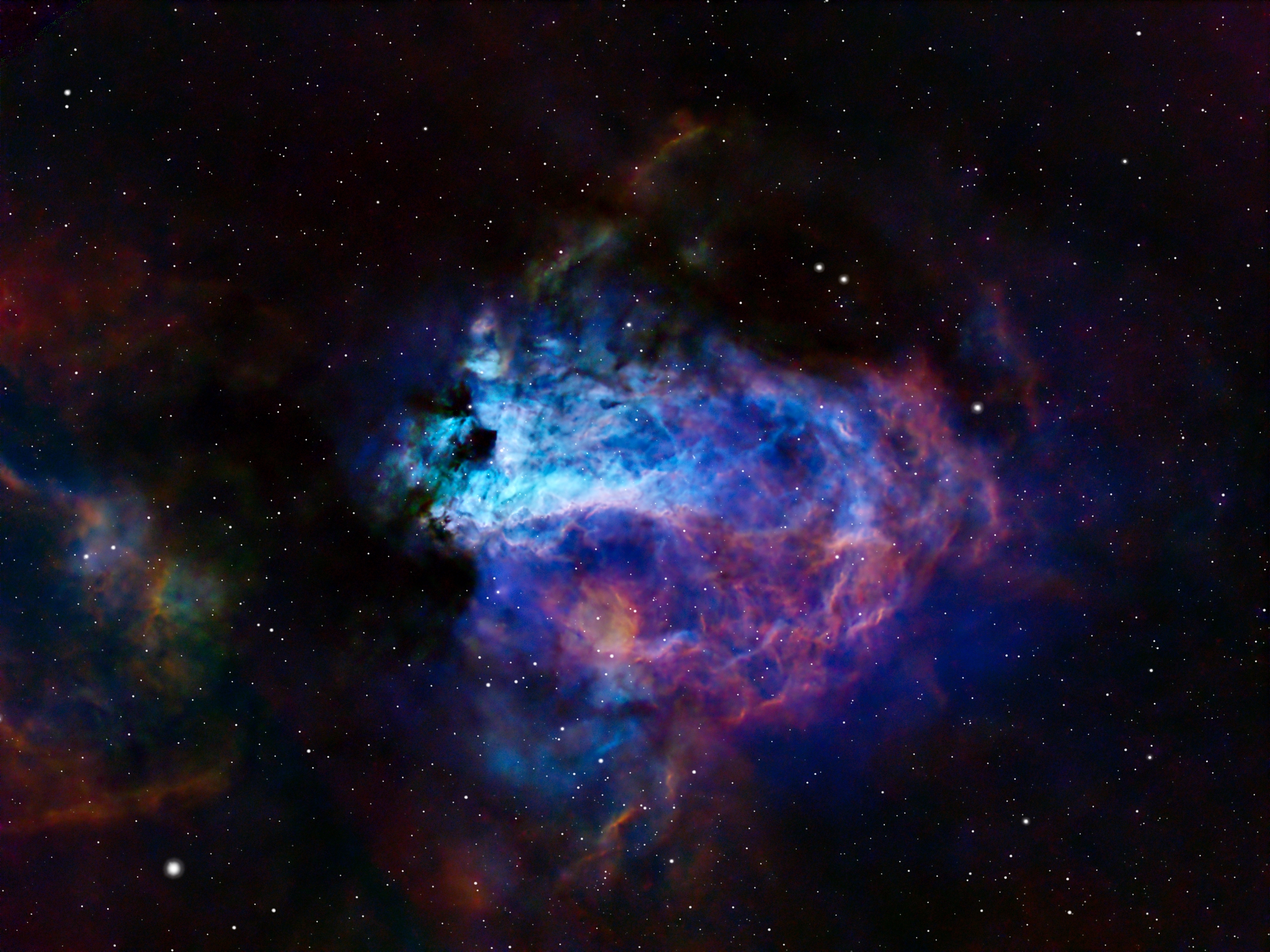
Just as I used M42 the Orion Nebula as the target for first light with my new RGB filters, I also used M42 the Orion Nebula as the target for first light with my new narrowband filters.

I used the standard set of narrowband filters: H-alpha, Oiii, and Sii.

Not only did generating these images involve learning how to use my new hardware, but it also involved learning new processing, both processing narrowband data and making a composite image.

For narrowband imaging, each filter needs to be assigned a color to map it to an RGB image.  The figure below shows how colors map to wavelengths, and the table below shows what colors the three narrowband filters map to.  If a natural mapping is used, the final image will use red and turquoise only.  So a false color mapping is often used to better bring out details.  One common pallet is the Hubble pallet, where Hα is assigned to green, Oiii is assigned to blue, and Sii is assigned to red.  PixInsight has a new tool, NBColourMapper, which can make these color mappings – or any other assignment.  For these images, I only had a limited amount of Sii data, so they are limited in the color that Sii is mapped to.  For these images, I tried both a “natural” mapping and a “Hubble” mapping.  Which do you like better?

Visible-spectrum-400-700-nm
ElementEmission lineWavelengthColor
Hydrogen656.3 nmRed
OxygenOiii500.7 nmTurquoise
SulfurSii671.6 nmRed

The Orion Nebula has an enormous amount of dynamic range – more than can be captured in a single setting.  If the image is exposed to bring out the detail in the core of the nebula, the edges are too faint.  If the image is exposed to bring out the edges of the nebula, the core is blown out.  For these images, I made three versions of the image from two different sets of exposures: a version optimized for the core from the 60 second data, a version optimized for the middle zone from the 180 second data, and a version optimized for the outer edges from the 180 second data.

I tried a number of different processing flows to try to make a good composite from the three images using the new PixInsight tool BlendImage.  What I thought ended up working was the following process:

  • Make mask for core area from bright area of mid version
  • Apply core mask to core image as protecting
  • Use core image as base image in ImageBlend
  • Use mid image as blend image in ImageBlend
  • Blend using lighten/mask
  • Set opacity so edges look good
  • Make mid mask for mid area from bright area of outer version
  • Apply mid mask to mid_core image as protecting
  • Use mid_core image as base image in ImageBlend
  • Use outer image as blend image in ImageBlend
  • Blend using lighten/mask
  • Set opacity so edges look good

Astrophotography often extends what the human eye can see by taking (or integrating to) long exposure times, much longer than the human eye and brain can combine.  To me, narrowband mapping and composite imagery (as long as it’s labeled as such), is just another extension.  What do you think?

Camera geek info:

  • Williams Optics Zenith Star 73 III APO telescope
  • Williams Optics Flat 73A
  • ZWO 2” Electronic Filter Wheel
  • Antila SHO filters
  • ZWO ASI183MM-Pro-Mono camera
  • ZWO ASiair Plus
  • iOptron CEM40
  • Friendswood, Texas Bortle 7-8 suburban skies

Frames:

  • January 20, 2024
    • SHO lights
      • 47 60 second Gain 50 Ha lights
      • 60 60 second Gain 50 Oiii lights
      • 54 60 second Gain 50 Sii lights
    • 30 0.05 second Gain 50 H flats
    • 30 0.05 second Gain 50 O flats
    • 30 0.05 second Gain 50 S flats
    • 30 0.05 second flat darks
    • 30 60 second darks
  • February 6, 2024
    • SHO lights
      • 15 180 second Gain 50 Ha lights
      • 49 180 second Gain 50 Oiii lights
    • 30 0.05 second Gain 50 H flats
    • 30 0.05 second Gain 50 O flats
    • 30 0.05 second flat darks
    • 14 180 second darks

Processing geek info:

  • PixInsight
  • BlurXterminator
  • NoiseXterminator
  • StarXTerminator
  • Generalized Hyperbolic Stretch
  • NBColourMapper
  • ImageBlend

Capturing the 2024 Total Solar Eclipse in Granbury, Texas: Time Lapse Experience

I made a (time lapse) movie to try to capture the 2024 total solar eclipse we experienced in Granbury, Texas.

The movie doesn’t capture the planning and replanning needed to capture this event.  Months ago, looking at the predicted weather, the weather across most of Texas was expected to be favorable for viewing the eclipse. I chose to stay in Temple, Texas which was within the band of totality, not too far from the centerline, and had a reasonably priced place for my husband, daughter, and I to stay.  It turned out to be a great place to stay – we could pick up our daughter from an airport in Dallas and travel to Austin to see the Lady Bird Johnson Wildflower Center (which given the combination of the weekend, eclipse tourists, and peak wildflower season was quite crowded).  Even along the side of the road, the bluebonnets were plentiful, so I got my iconic Texas bluebonnet picture on this eclipse trip.

By the night before the eclipse, it was clear that Temple was going to have a lot of cloud cover for eclipse day.  We were rained on (twice) the last time we tried to see a total solar eclipse, and we did not want to repeat that experience!  So I used the Astropheric app on my phone (with four different cloud cover models) to look south to Austin/San Antonio (did not look promising) and north to Dallas/Fort Worth (looked better), and I settled on going to Hillsboro, Texas (which had temporarily re-named itself Eclipseboro), which was an easy drive up I35 and right on the centerline.  

But Monday morning when I got up, the cloud odds were not looking good for Hillsboro either.  So I looked at the options again and decided to trade time in totality for better cloud odds and decided to drive northwest to Granbury, Texas.  We picked up breakfast and started driving.

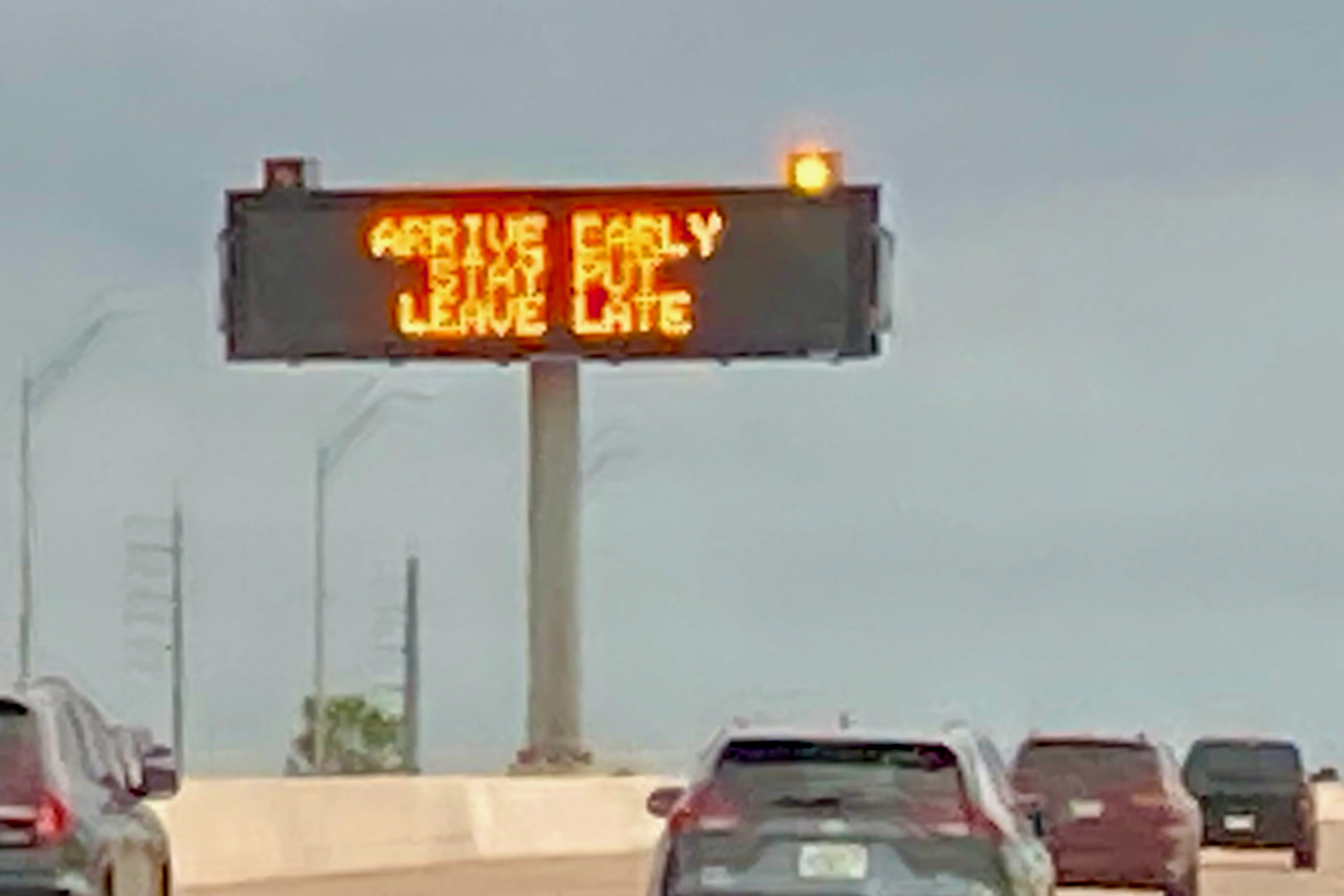
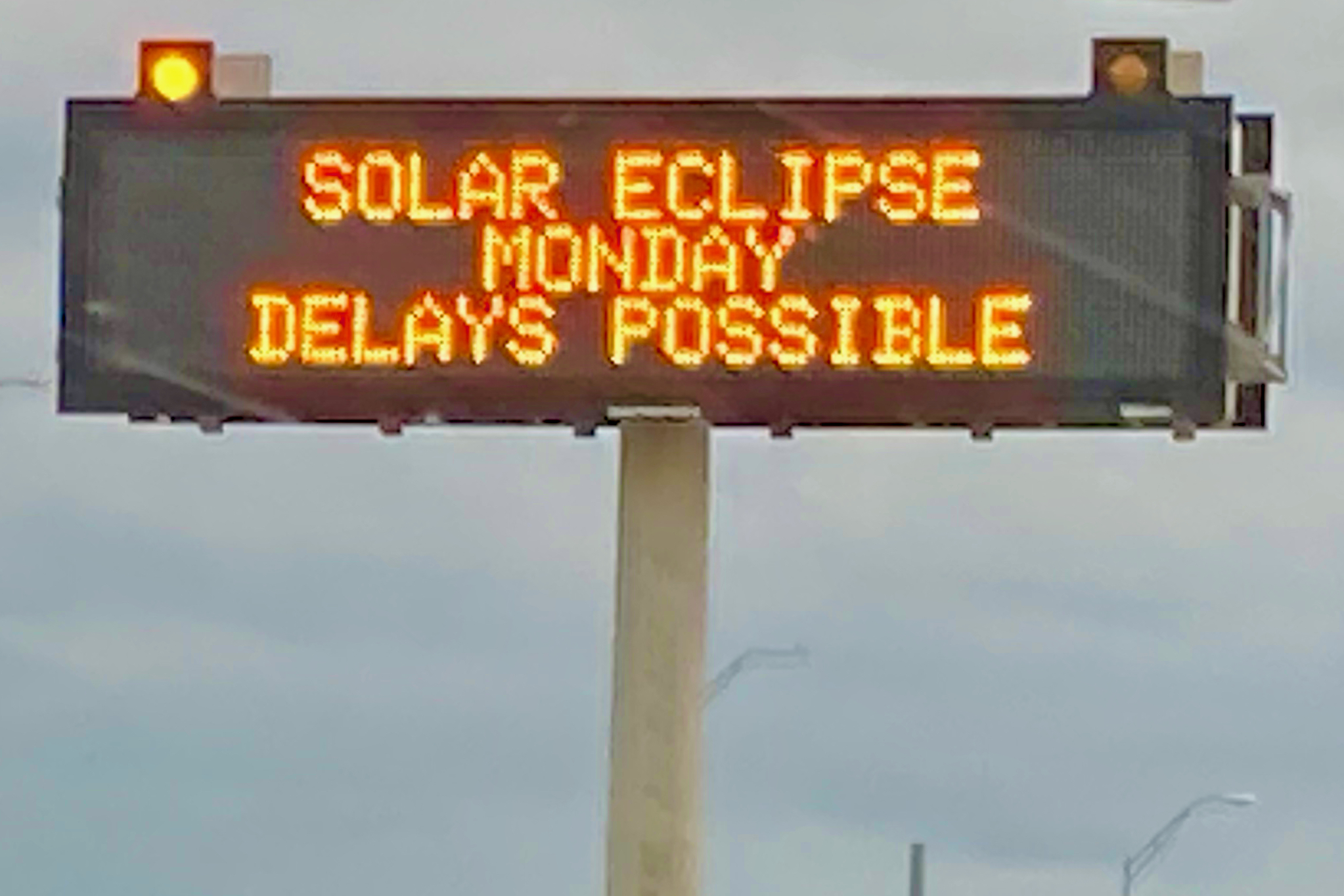
Some had predicted massive traffic, difficulty getting gas, and difficulty getting food.  There were even road signs to warn of the upcoming traffic.  

We didn’t experience any of that.  No traffic, no difficulty getting gas, no difficulty getting food.  And, best of all, we drove out from under the heavy clouds and saw the sun shining in a blue sky with white puffy clouds.

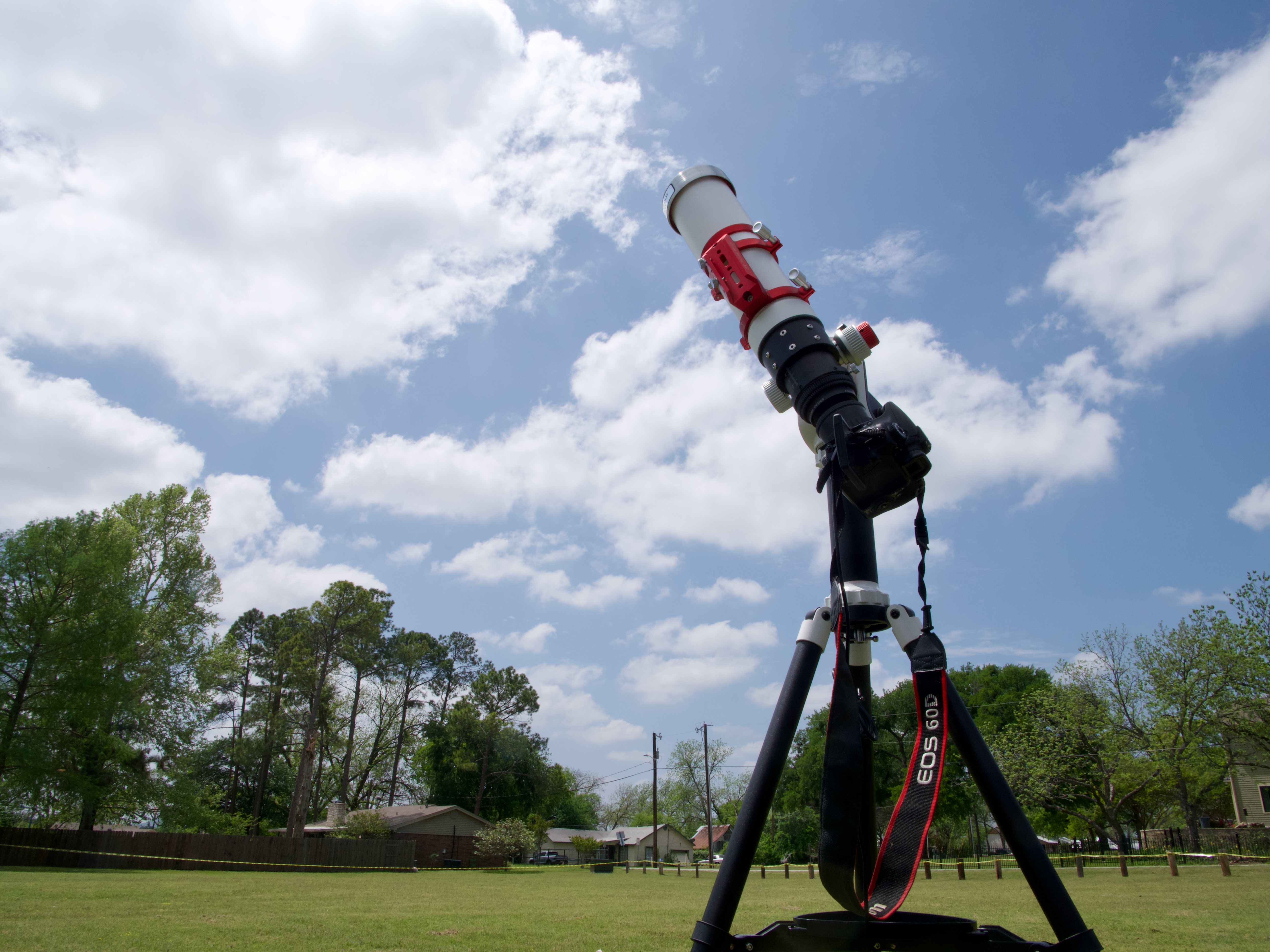
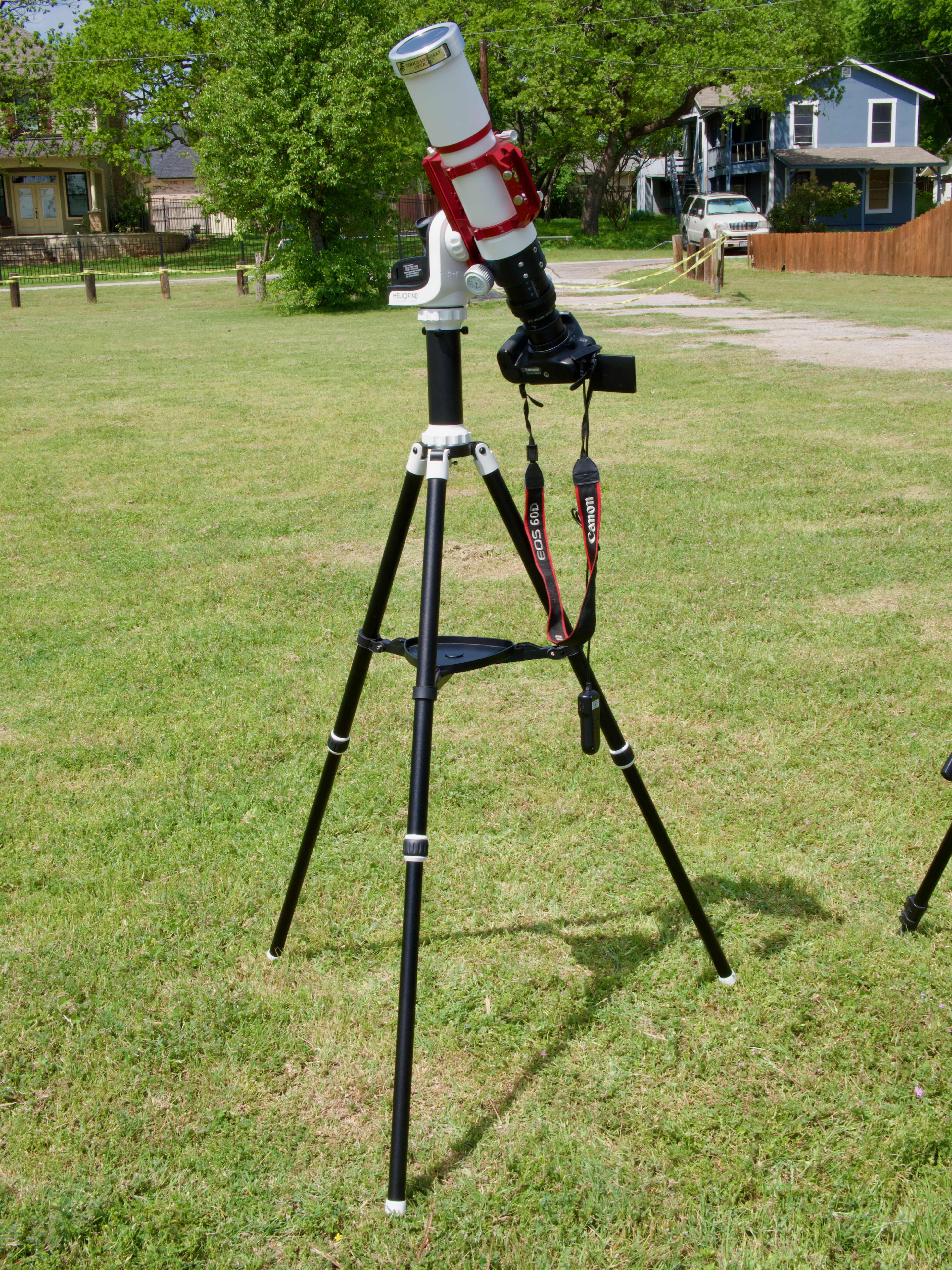
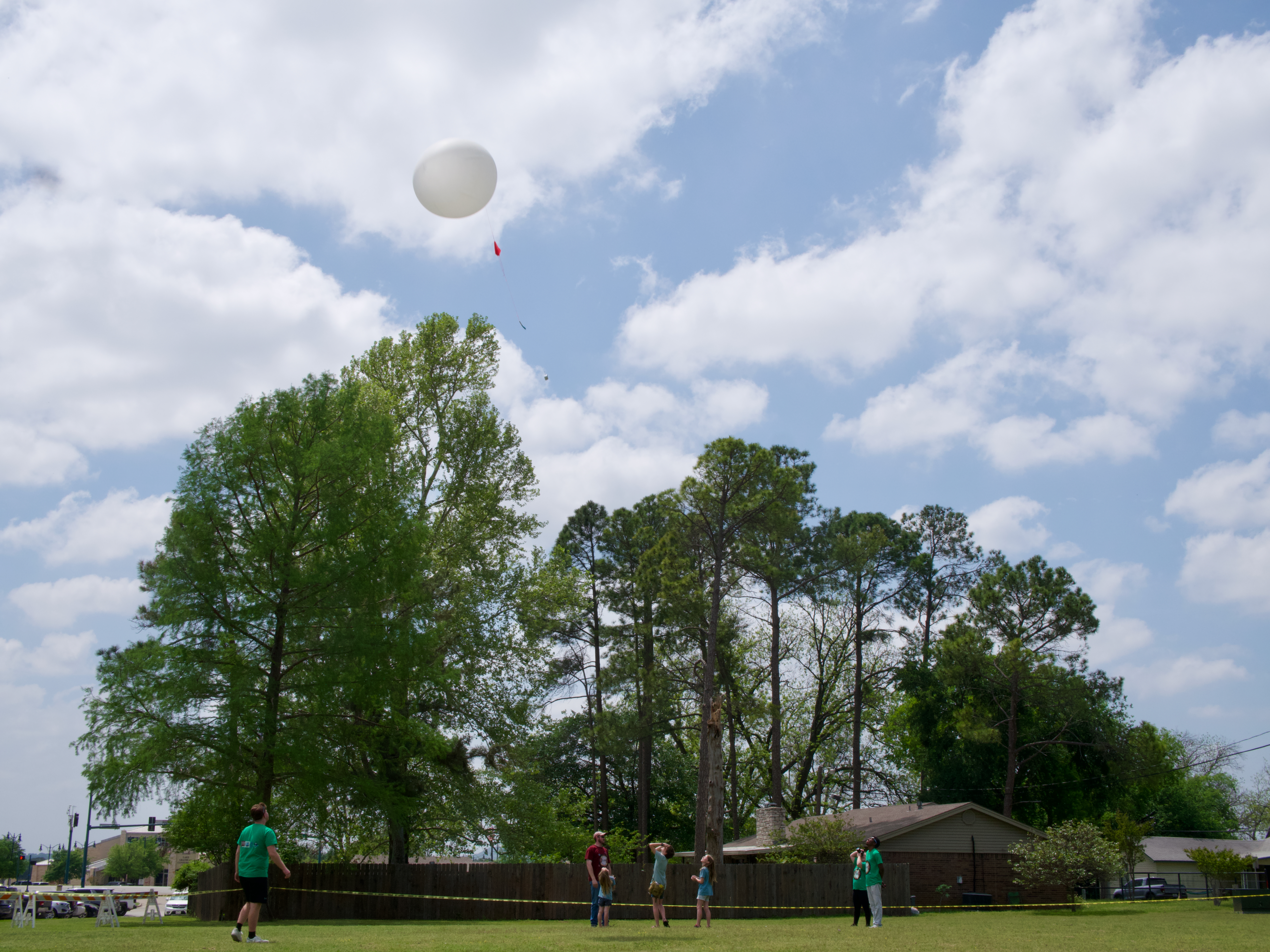
We decided to view the eclipse from Hewlett Park.  A group from New Mexico State University were set up there, doing an experiment with weather balloons.  They allowed us to set up at the periphery of their launch area.  I got my telescope set up well in advance of the eclipse start, so I was able to capture a time lapse of the entire thing.  

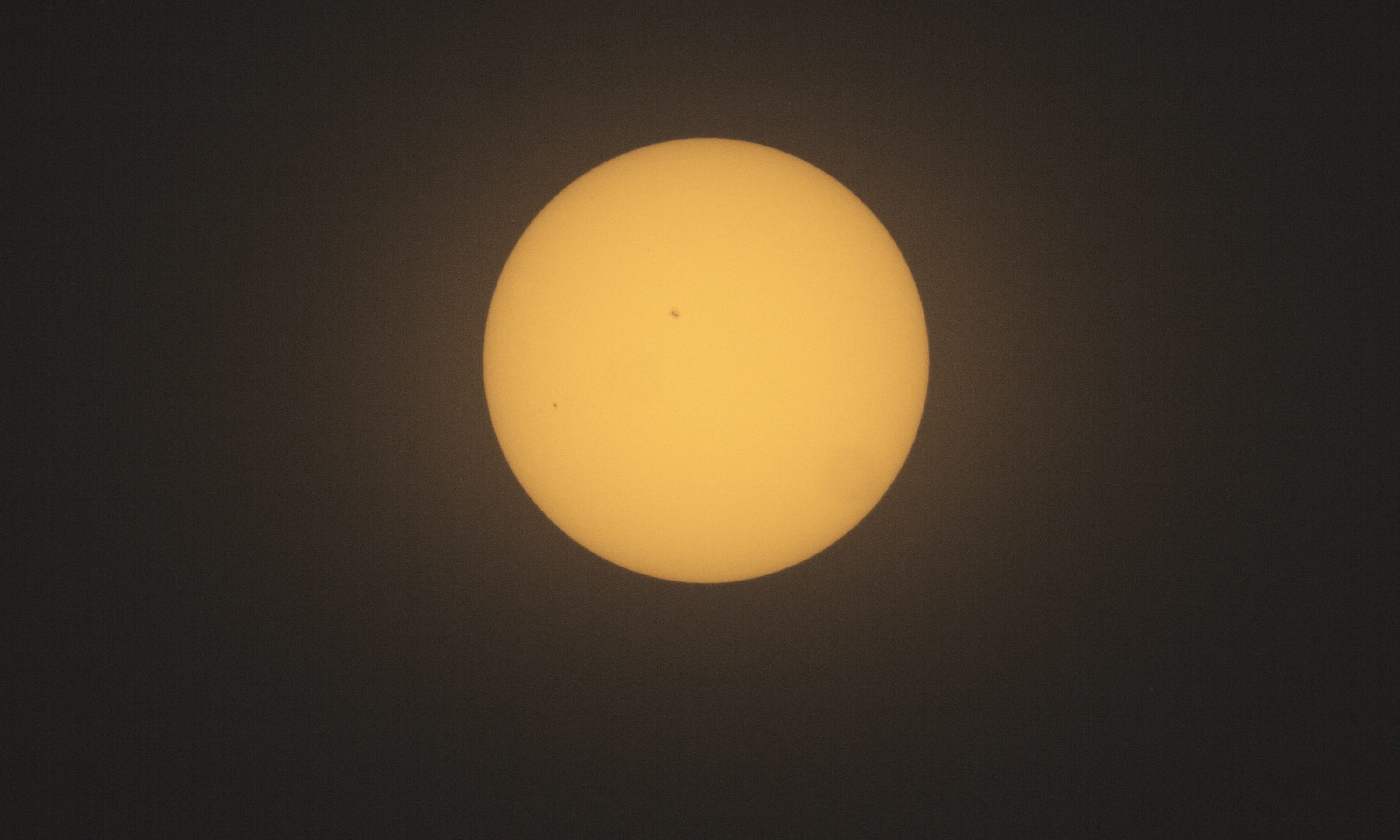
I was able to see sunspots and use them to focus my telescope.  A few minutes before the eclipse, I started my intervalometer to capture a picture a minute.

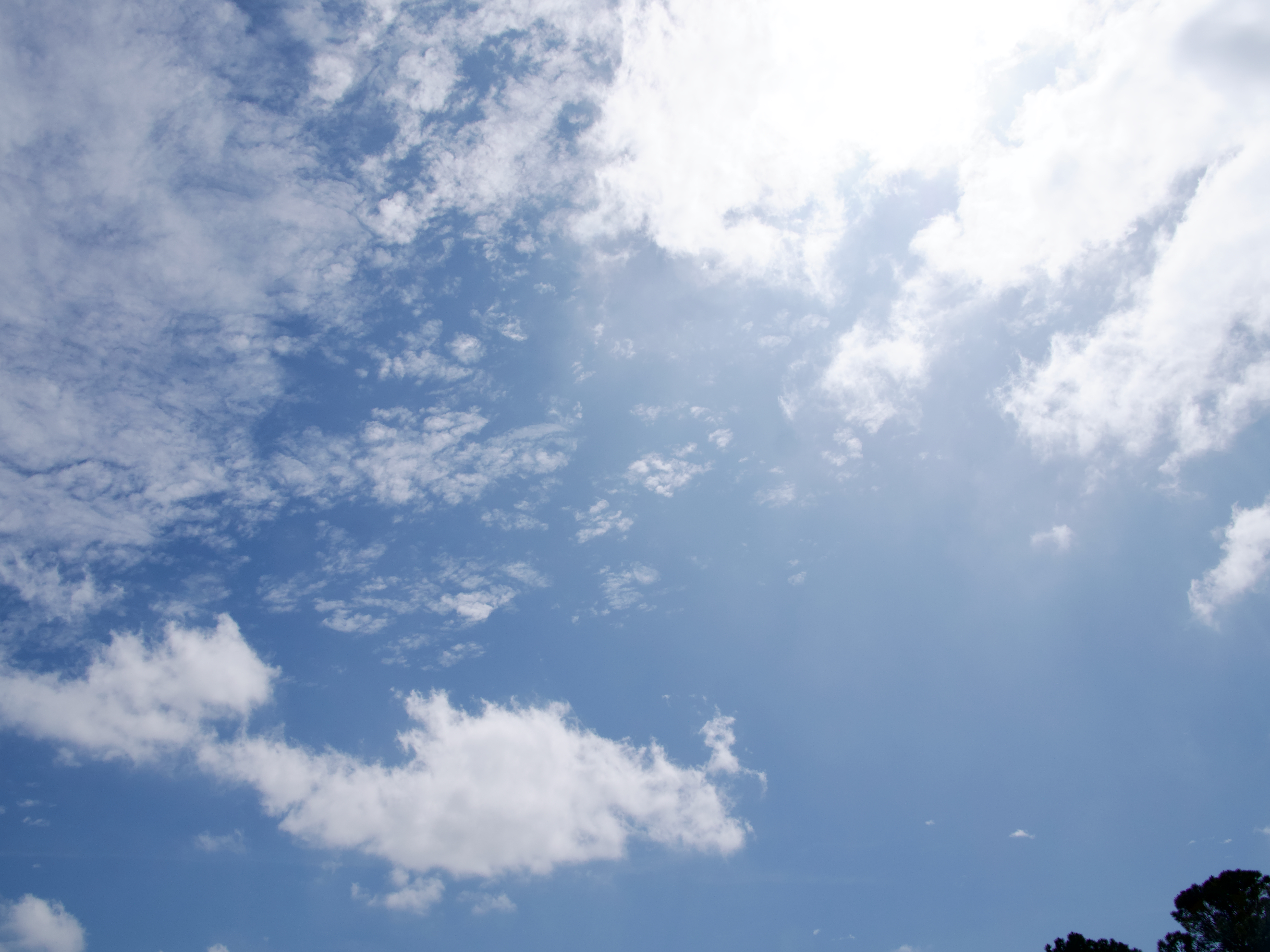
Once the time lapse started, we had some clouds pass in front of the sun, which was worrisome.  But I had noticed in Astropheric that pretty much every prediction had shown fewer clouds during the actual eclipse. And a book I had bought on this trip, Totality: The Great North American Eclipse of 2024, by Mark LIttmann and Fred Espenak explained why.  The Sun heats the Earth and pulls water from lakes and plants into the sky, where it cools and forms clouds.  But when the Moon starts to block the Sun, this heating process stops, water stops being pulled up, and the clouds dissipate.  This effect won’t help with the heavy cloud cover of a front, but does eliminate fluffy white clouds.  And we saw the clouds dissipate and the sky grow clearer.

We also saw the folks from New Mexico State University release their weather balloons.

We walked around looking for cool crescent shadows, but didn’t spot any.  Nor did we spot any changes in color.

But we did see it get really dark.  The sign on the hotel across the street came on as did the streetlights.

I had wanted to take some wide angle pictures with my smaller camera, but I did not get it set up in time.  When we reached totality, I decided not to mess with it and just enjoy the experience and take pictures with my telescope.  

It was the weirdest alien sky I have ever seen. It was dark.  But there was this elliptical bright white glowing spot in the sky, with a perfect black circle in the middle.  I could see the two brightest planets – Venus and Jupiter – on either side.  It.  Was.  Awesome.  

I took the solar filter off my telescope, reaimed the solar tracking mount (either it lost track or I bumped it in my excitement), and manually took pictures.

I looked for the comet, but did not spot it.

I alternated between taking pictures and looking at the sky.  

One of the things that I could see naked eye was a bright pink spot on the lower edge of the Moon.  I thought maybe it was the diamond ring effect, but it lasted for too long.  Later I found out it was a solar prominence.  Amazing!

I saw the edge getting brighter and took a set of pictures to try to capture Bailey’s beads and the diamond ring effect – I got the diamond ring for sure.  

When the picture got super bright, I put the solar filter back on the telescope and returned to letting it take a picture a minute.

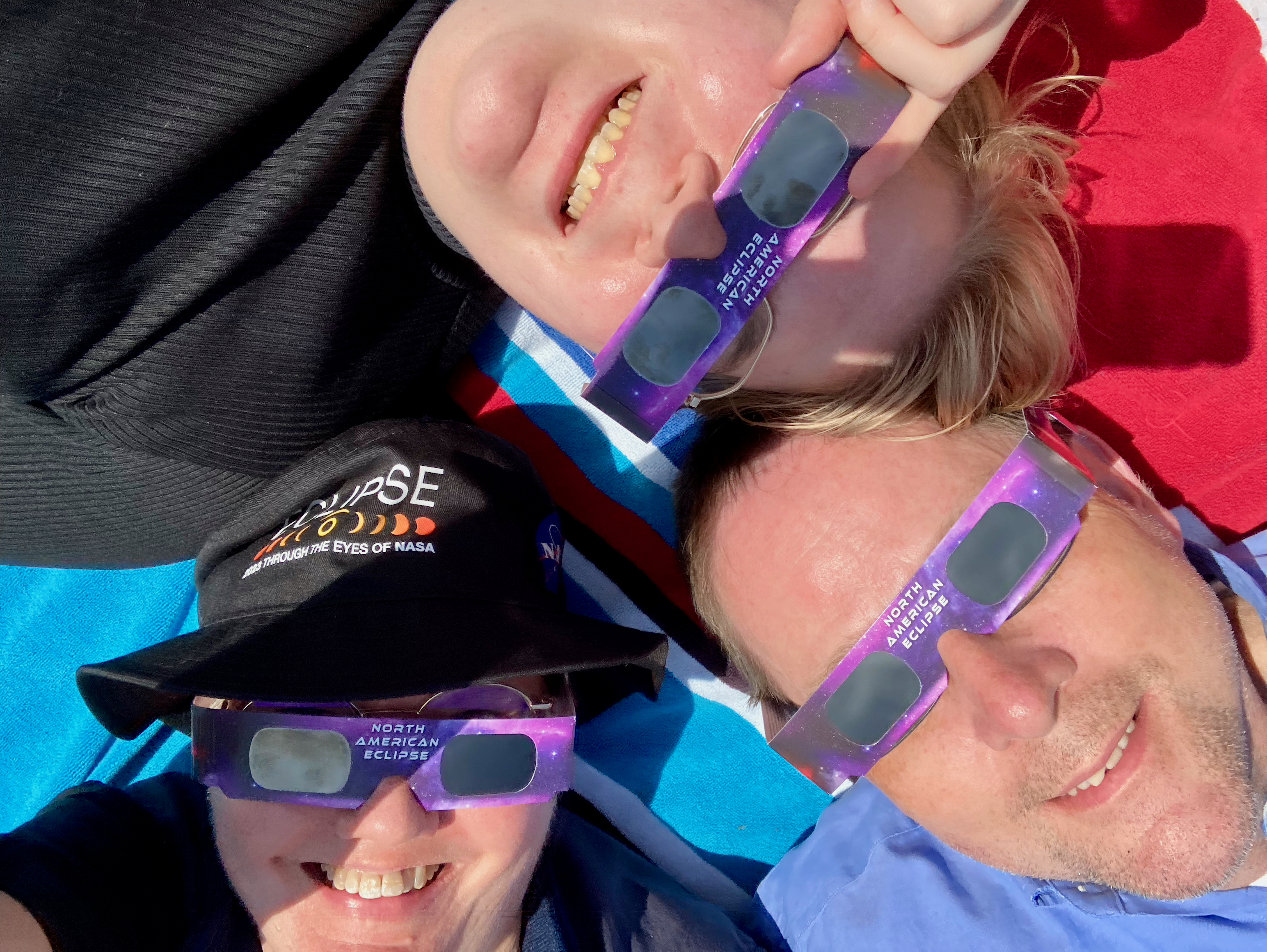
By now the clouds were gone, and we laid on our picnic blanket with our solar glasses and watched the Sun come back out.

We watched until the Sun had fully emerged from behind the Moon.

Friends, before this eclipse, I said that I would rather photograph an annular eclipse because it was a more exciting subject.  I.  Was.  Wrong.  There is nothing like a total solar eclipse.

And so I’m left asking: When can I see this again?

Stay tuned!!

Camera geek info for solar pictures:

  • Canon EOS 60D in manual mode, 1/200 second exposure, ISO 100
  • Intervalometer
  • Williams Optics Zenith Star 73 III APO telescope
  • Williams Optics Flat 73A
  • Thousand Oaks optical solar filter
  • Sky-Watcher SolarQuest HelioFind tracking mount and tripod

Camera geek info for corona pictures:

  • Canon EOS 60D in manual mode, 1/200 second exposure, ISO 100
  • Williams Optics Zenith Star 73 III APO telescope
  • Williams Optics Flat 73A
  • Sky-Watcher SolarQuest HelioFind tracking mount and tripod

Total Solar Eclipse 2024 in Granbury, Texas: Totality and Solar Prominences

One of the things that surprised and amazed me during totality of the solar eclipse was a bright pink spot on the lower edge of the Moon that I could see naked eye.  At first, I thought maybe it was the diamond ring effect, but it was not – it was a solar prominence!  And when I looked at my pictures, I discovered that it was one of several.

Solar prominences are loops of plasma that are anchored to the sun’s surface and extend out into the sun’s corona, following the local magnetic field.  The plasma is made of electrically charged hydrogen and helium. Hot hydrogen emits red light, which is why they appear pink.

Since we are close to the maximum of the solar sunspot cycle (solar max is expected to occur within the next year), there happened to be a lot of prominences for this eclipse.  So cool!  

These pictures show the solar prominences during totality and the diamond ring effect where the sun emerges at the end of totality.

Camera geek info for corona pictures:

  • Canon EOS 60D in manual mode, 1/200 second exposure, ISO 100
  • Intervalometer
  • Williams Optics Zenith Star 73 III APO telescope
  • Williams Optics Flat 73A
  • Sky-Watcher SolarQuest HelioFind tracking mount and tripod

Processing geek info:

  • PixInsight

M42 The Orion Nebula and M101 the Pinwheel Galaxy: First Light with New Astrophotography Equipment

Back at the end of November, I bought some new astrophotography tools/toys: 

  • ZWO 2” Electronic Filter Wheel
  • Antila LRGBSHO filters
  • ZWO ASI183MM-Pro-Mono camera
  • ZWO ASiair Plus

Of course, as the old astrophotography joke goes, buying new tools meant we had seemingly months of cloudy skies.

Happily, this time of year meant I got to have first light with one of my favorite Deep Space Objects: M42 the Orion Nebula.

I finally got an opportunity for first light with the new equipment December 29, 2023, but the filter wheel was jammed by one of the connecting tubes (I ordered a better one) so I didn’t get any good data.  

I got a second opportunity on December 30, 2023 but I had to resort to swapping in the filters by hand, which meant bringing the telescope back inside to change out filters and restarting ASiair every time.  The resulting images ended up rotated relative to one another in such a way that I couldn’t crop out all the sections that weren’t covered by all three filters.  This wasn’t surprising since I had to unscrew all the parts to swap out filters.  I also think I may have mislabeled which set of images was which color since the result came out an odd purple color.  Rotating the color assignments seemed to fix that.  The experience gave me a real appreciation for the filter wheel! 

Here is the processed image:

Camera geek info:

  • Williams Optics Zenith Star 73 III APO telescope
  • Williams Optics Flat 73A
  • Antila RGB filters
  • ZWO ASI183MM-Pro-Mono camera
  • ZWO ASiair Plus
  • iOptron CEM40
  • Friendswood, Texas Bortle 7-8 suburban skies

Frames:

  • December 30, 2023
    • RGB lights
      • 52 60 second Gain 50 R lights
      • 30 60 second Gain 50 G lights 
      • 54 60 second Gain 50 B lights 
    • 30 0.05 second Gain 50 RGB flats
    • 30 0.05 second Gain 50 flat darks
    • 30 60 second Gain 50 darks

Processing geek info:

  • PixInsight
  • BlurXterminator
  • NoiseXterminator
  • StarXTerminator
  • Generalized Hyperbolic Stretch

I got a new ring to connect the filter wheel and got first light on the whole new setup, try 3, on January 20, 2024, and I got data for both M42 the Orion Nebula and M101 the Pinwheel Galaxy which I could compare to previous images taken with my Canon 60D DSLR.  I appreciated the ASiair being able to configure a whole run including switching filters and have it automatically run.  I also appreciated the ASiair connecting to my iPad so I could see each image on my iPad from inside my house where it was warm!  I did still go outside to watch the telescope meridian flip to make sure no wires were caught. 

Here is the processed M42 Orion Nebula RGB image (dated 20 January 2024) with a previous DSLR image in the slideshow. The differences are hard to see and may be related to processing.

Camera geek info:

  • Williams Optics Zenith Star 73 III APO telescope
  • Williams Optics Flat 73A
  • ZWO 2” Electronic Filter Wheel
  • Antila RGB filters
  • ZWO ASI183MM-Pro-Mono camera
  • ZWO ASiair Plus
  • iOptron CEM40
  • Friendswood, Texas Bortle 7-8 suburban skies

Frames:

  • January 20, 2024
    • RGB lights
      • 59 60 second Gain 50 R lights 
      • 60 60 second Gain 50 G lights 
      • 57 60 second Gain 50 B lights
    • 30 0.0417 second Gain 50 G flats (a setting goof)
    • 30 0.0417 second Gain 50 B flats (a setting goof)
    • 28 0.05 second Gain 50 R flats
    • 30 0.05 second flat darks
    • 6 60 second darks

Processing geek info:

  • PixInsight
  • BlurXterminator
  • NoiseXterminator
  • StarXTerminator
  • Generalized Hyperbolic Stretch

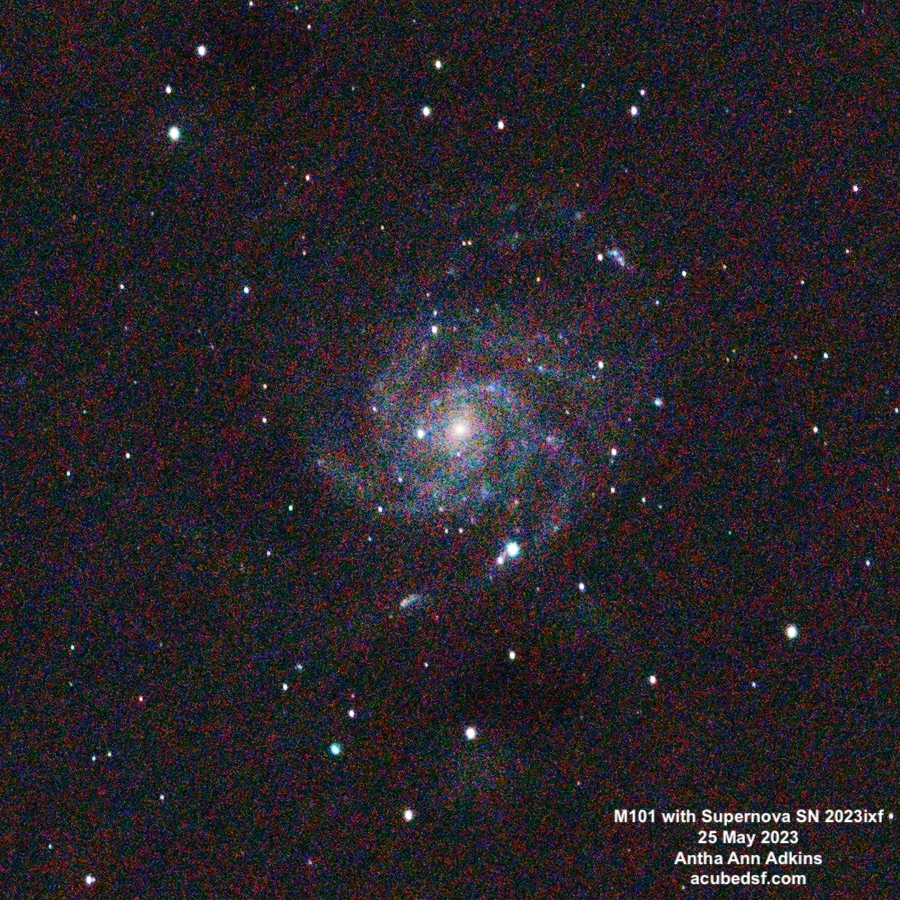
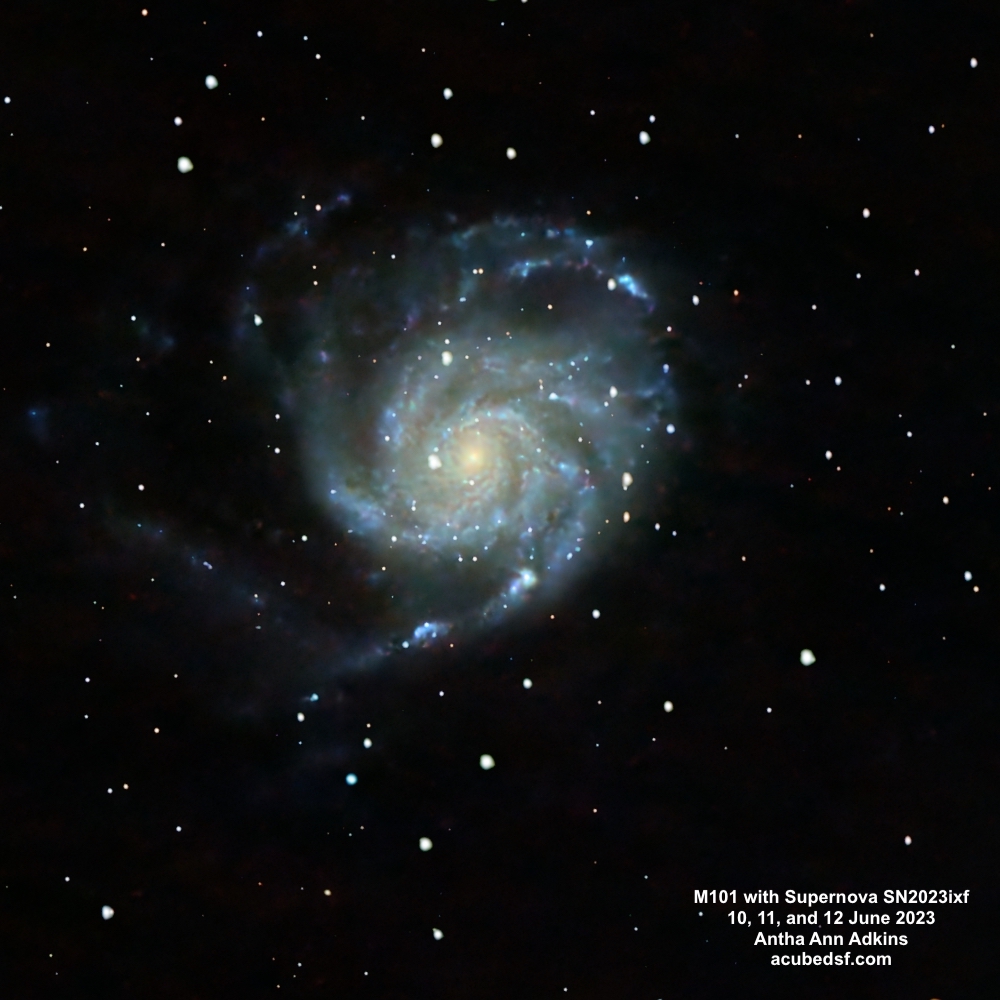
Here is the processed M101 the Pinwheel Galaxy RGB image (dated 20 January 2024) with previous DSLR images in the slideshow. Here, the improvement is obvious, with significantly more detail in the galaxy with the new camera.  It even compares well to images taken from the much darker Dell City skies (February 2023 and June 2023).

Camera geek info:

  • Williams Optics Zenith Star 73 III APO telescope
  • Williams Optics Flat 73A
  • ZWO 2” Electronic Filter Wheel
  • Antila RGB filters
  • ZWO ASI183MM-Pro-Mono camera
  • ZWO ASiair Plus
  • iOptron CEM40
  • Friendswood, Texas Bortle 7-8 suburban skies

Frames:

  • January 20, 2024
    • RGB lights
      • 59 60 second Gain 50 R lights 
      • 60 60 second Gain 50 G lights 
      • 57 60 second Gain 50 B lights
    • 18 0.05 second Gain 50 R flats
    • 24 0.05 second Gain 50 G flats 
    • 17 0.05 second Gain 50 B flats
    • 30 0.05 second flat darks
    • 6 60 second darks

Processing geek info:

  • PixInsight
  • BlurXterminator
  • NoiseXterminator
  • StarXTerminator
  • Generalized Hyperbolic Stretch

I’m really pleased with this new equipment, and I’m looking forward to seeing what I can do with it!

M42 The Orion Nebula and Astrophotography Learning Curve

I’ve bought some new astrophotography gear, so it’s been cloudy for a month (LOL), and I’ve had the opportunity to go back and process some old data of a favorite Deep Space Object (DSO), M42, The Orion Nebula.

The Orion Nebula is an emission nebula of ionized hydrogen gas where star formation is taking place.  It’s located in the Milky Way, approximately 1344 light years away, and it’s approximately 24 light years across, giving it an apparent size of 1 degree.

The Orion Nebula is one of my favorite DSOs because it is bright and can be enjoyed so many ways.  It is visible to the naked eye as the middle “star” in Orion’s sword.  It can be seen to be a fuzzy object with binoculars.  The trapezium of stars in the core can be seen even with a small telescope like mine.  And astrophotography brings out its full size and color.  

The nebula to the left of the Orion Nebula is called the Running Man nebula.  Can you see the dark running man?  The Running Man nebula is a reflection nebula, reflecting the light of local stars.  It is approximately 1500 light years away, and approximately 15 light years across, giving it an apparent size of 34 arc-minutes.  

The image above was made from 66 minutes of data (22 3 minute images) from the fabulous dark skies of Dell City, Texas.

Camera geek info:

  • Canon EOS 60D in manual mode, 3 minute exposure, ISO 1600
  • Intervalometer
  • Williams Optics Zenith Star 73 III APO telescope
  • Williams Optics Flat 73A
  • iOptron CEM40
  • Dell City, Texas Bortle 2-3 dark skies

Frames:

  • October 28, 2022
    • 22 3 minute lights (66 minutes total)
    • 10 6 second darks

Processing geek info:

  • PixInsight
  • BlurXterminator
  • NoiseXterminator
  • StarXTerminator
  • Generalized Hyperbolic Stretch

The Orion Nebula shows my own astrophotography learning curve.  I imaged it in 2019 with just a DSLR, telephoto lens, and a sky tracker.  And I processed a single image from the 2022 set used above before I learned how to use PixInsight.  This set, you’ll notice, did not include the flat and flat dark calibration frames I use now.  

Not having all the calibration frames worked out OK in Dell City … but no such much from my light-polluted skies in suburban Friendswood, Texas.  Here is what I get with no flat calibration frames (note all the dark spots not calibrated out), no light pollution filter, and my current knowledge of PixInsight.  Yes, I could have lost some of the nebula detail and hidden the dark spots, but that’s a cost to not having good calibration frames.  Since it’s fast and easy to take flats, they’re totally worth it.

Camera geek info:

  • Canon EOS 60D in manual mode, 119 second exposure, ISO 200
  • Intervalometer
  • Williams Optics Zenith Star 73 III APO telescope
  • Williams Optics Flat 73A
  • iOptron CEM40
  • Friendswood, Texas Bortle 7-8 suburban skies

Frames:

  • November 26, 2022
    • 27 119 second lights (53.55 minutes total)
    • 6 119 second darks

Processing geek info:

  • PixInsight
  • BlurXterminator
  • NoiseXterminator
  • StarXTerminator
  • Generalized Hyperbolic Stretch

A couple of months after I took the previous image, I learned what calibration frames I needed.  Here is what I got with data taken from my suburban driveway with calibration frames, a light pollution filter, and my current knowledge of PixInsight.

Camera geek info:

  • Canon EOS 60D in manual mode, 19 second exposure, ISO 800
  • Intervalometer
  • Williams Optics Zenith Star 73 III APO telescope
  • Williams Optics Flat 73A
  • SkyTech 2” LPRO-MAX CCD Filter
  • iOptron CEM40
  • Friendswood, Texas Bortle 7-8 suburban skies

Frames:

  • January 26, 2023
    • 143 19 second lights (45.3 minutes total)
    • 25 0.02 second flats
    • 21 0.02 second flat darks
    • 47 20 second darks

Processing geek info:

  • PixInsight
  • BlurXterminator
  • NoiseXterminator
  • StarXTerminator
  • Generalized Hyperbolic Stretch

These three images had similar total exposure lengths.  The Dell City image, with the longest total exposure time, highest ISO, and darkest skies, is the best of the three.  The slightly shorter November 2022 image from Friendswood is flawed due to the lack of calibration frames.  The even shorter January 2023 image from Friendswood is starting to show noise in the background.  But the nebulae themselves are beautiful!

As I said, I’ve recently gotten some new astrophotography gear, and first light on it was the Orion Nebula.  Stay tuned for the results!!

IC2118 The Crone with Galaxies in Her Hair

IC2118 is one of the dimmer objects I imaged while we were enjoying the dark skies in Dell City, Texas.  

This image used only 1.9 hours of data.  I’ve started having trouble with my tracking mount glitching, so I had to toss a bunch of data.  I’ve been researching how to fix that.

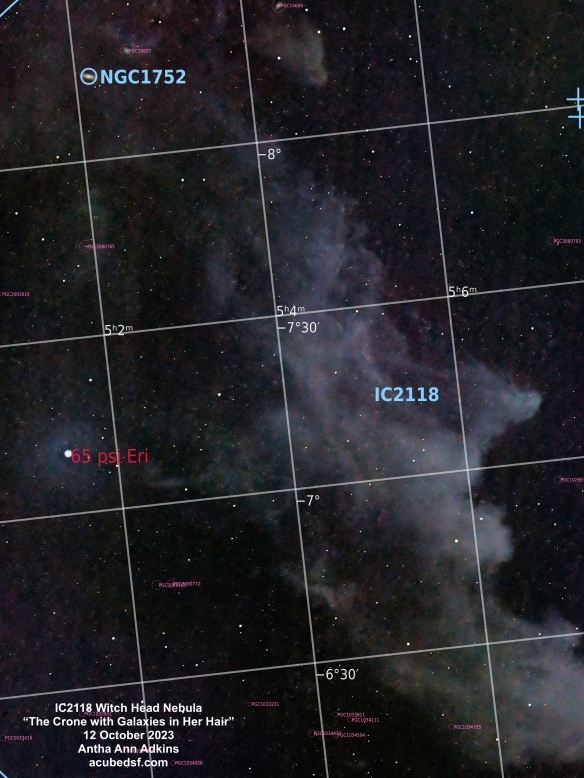
IC2118, also called the Witch Head Nebula, is a reflection nebula – an interstellar cloud of dust that is lit up by a nearby star, in this case Rigel (which is not in this image).  It’s located in the Milky Way, approximately 900 light years away, and it’s approximately 50 light years long, giving it an apparent size of 1 degree by 3 degrees (not all in this image).  

The ”witch” is facing towards the upper right corner, with her nose around the vertical center of the image.  

One thing that surprised me was that I can see multiple galaxies in her hair – NGC1752, PGC16607, and PGC16669.  NGC1752 is a spiral galaxy about 143.5 Mega light years away.  PGC16607 is a galaxy about 179 Mega light years away.  PGC16669 is a galaxy about 500 Mega light years away.  I find the idea of being able to image galaxies so far away … awe-inspiring.

I find the idea of a crone with galaxies in her hair … poetic and inspirational.  And I think she should have a companion: the man with a galaxy under his hat.  Deserving of a story!

Camera geek info:

  • Canon EOS 60D in manual mode, 2 minute exposure, ISO 1600
  • Intervalometer
  • Williams Optics Zenith Star 73 III APO telescope
  • Williams Optics Flat 73A
  • iOptron CEM40
  • Dell City, Texas Bortle 2-3 dark skies

Frames:

  • October 12, 2023 
    • Run 1
      • 57 2 minute lights 
      • 30 0.01 second flats
      • 30 0.01 second flat darks
    • 35 2 minute darks

Processing geek info:

  • PixInsight
  • BlurXterminator
  • NoiseXterminator
  • StarXTerminator
  • Generalized Hyperbolic Stretch

M27 Dumbbell Nebula

M27 is one of the brighter objects I imaged while we were enjoying the dark skies in Dell City, Texas.  This object was a brilliant blue in a single frame, and it was nice not to have to rely on faith that something was there.  

This image used only 1.8 hours of data. 

M27, also called the Dumbbell Nebula or Apple Core Nebula, is a planetary nebula – the gases expelled from a star before it becomes a white dwarf, lit up by that star.  It’s located in the Milky Way, approximately 1250 light years away, and it’s approximately 2.9 light years across, giving it an apparent size of 8 arcminutes.  It’s estimated to be 12,700 years old.

Planetary nebulae do not last long on an astronomy time scale because the expelled gases grow dimmer as they expand away from the central star.  I am glad I live in a time when we can observe them and they can be observed!

Isn’t our galaxy beautiful?

Camera geek info:

  • Canon EOS 60D in manual mode, 2 minute exposure, ISO 1600
  • Intervalometer
  • Williams Optics Zenith Star 73 III APO telescope
  • Williams Optics Flat 73A
  • iOptron CEM40
  • Dell City, Texas Bortle 2-3 dark skies

Frames:

  • October 11, 2023 
    • Run 1
      • 54 2 minute lights 
      • 30 0.01 second flats
      • 30 0.01 second flat darks
    • 35 2 minute darks

Processing geek info:

  • PixInsight
  • BlurXterminator
  • NoiseXterminator
  • StarXTerminator
  • Generalized Hyperbolic Stretch

Sh2-188 Dolphin Nebula or Shrimp Nebula

Sh2-188 is one of the dimmer objects that I imaged during our recent trip to the dark skies at Dell City, Texas.  

Sh2-188, also called the Dolphin Nebula or Shrimp Nebula, is a planetary nebula – the gases expelled from a star before it becomes a white dwarf, lit up by that star.  It’s located in the Milky Way, approximately 2770 light years away, and it’s approximately 8.2 light-years across, giving it an apparent size of 10 arcminutes.  It’s estimated to be 22,500 years old.  

The nebula’s bow shape (as opposed to a circular shape) is theorized to be due to its relatively high velocity interaction with the interstellar medium.

The objects in our galaxy never cease to amaze me!

Camera geek info:

  • Canon EOS 60D in manual mode, 3 minute exposure, ISO 2000
  • Intervalometer
  • Williams Optics Zenith Star 73 III APO telescope
  • Williams Optics Flat 73A
  • iOptron CEM40
  • Dell City, Texas Bortle 2-3 dark skies

Frames:

  • October 9, 2023 
    • Run 1
      • 59 3 minute lights 
      • 30 0.01 second flats
      • 30 0.01 second flat darks
    • Run 2
      • 76 3 minute lights 
      • 30 1/400 second flats
      • 30 1/400 second flat darks
    • 17 3 minute darks

Processing geek info:

  • PixInsight
  • BlurXterminator
  • NoiseXterminator
  • StarXTerminator
  • Generalized Hyperbolic Stretch

NGC 7293 Helix Nebula 2023

On our recent trip to the fabulous dark skies of Dell City, Texas, I mostly tried to image things that would be difficult to capture from my light-polluted driveway at home.  However, a couple of those objects weren’t visible at sunset, so I snuck in some brighter objects as well.

NGC 7293 also called the Helix Nebula or Eye of God Nebula is a planetary nebula – the gases expelled from a star before it becomes a white dwarf, lit up by that star.  It’s located in the Milky Way, approximately 655 light years away, and it’s approximately 2.5 light-years across.  It’s estimated to be 10,600 years old.  Its apparent size is 25 arcminutes, and it has an apparent magnitude of 7.6.  

I’d imaged NGC 7293 last year, and I’d even posted a single 3 minute shot, but I’d never gone back and really processed it.

I processed the data from this year, and then went back and added in the data from last year.  Which version do you like better? I think I actually like the 2023 only version better.

Either way, this shows that less than an hour and a half of data was sufficient time to generate a decent image of this neat object with dark skies.

This is a particularly spectacular planetary nebula, and even last year it made me want to try to image more. Isn’t our galaxy amazing?  

Camera geek info:

  • Canon EOS 60D in manual mode, 3 minute exposure, ISO 1600
  • Intervalometer
  • Williams Optics Zenith Star 73 III APO telescope
  • Williams Optics Flat 73A
  • iOptron CEM40
  • Dell City, Texas Bortle 2-3 dark skies

Frames:

  • October 28, 2022
    • Run 1
      • 10 3 minute lights
  • October 11, 2023
    • Run 2
      • 17 3 minute lights 
      • 30 0.01 second flats
      • 30 0.01 second flat darks

Processing geek info:

  • PixInsight
  • BlurXterminator
  • NoiseXterminator
  • StarXTerminator
  • Generalized Hyperbolic Stretch

October 14, 2023 Annular Solar Eclipse

The Ring of Fire!!

Time lapse movie of the eclipse, with some extra dwell time for annularity.

When I planned our trip to see the October 14, 2023 annual solar eclipse months ago, I planned to see it from Roswell, New Mexico.  As much as I would have liked to have seen it in my home state of Texas, the cloud probabilities were significantly better in Roswell.  And, since the last time we tried to see a total solar eclipse it rained on us, having better cloud odds was the dominant factor in my decision making.

But, on Friday October 13, the cloud cover predictions for Roswell were not looking great.  I made a spreadsheet of the cloud cover predictions for various cities using Astropheric, and my husband calculated how long it would take to drive to each one, and we decided to get up early and drive to Seminole, Texas instead.  We couldn’t find any events planned there, but we did find a nice park.

We got up early and drove to Seminole.  Although we did remember to account for the time zone change for driving back into Texas, we ended up running later than planned, and I eventually had to make a decision as to whether I wanted a complete time lapse movie or a good ring of fire picture – the choice was pretty obvious, and we kept driving to Seminole.

Seminole is in oil territory, and there were pumpjacks in the park, and we could smell the oil – giving us the true Texas eclipse viewing experience!  Alas, there were no longhorns or bluebonnets to make it more iconic.  Maybe in April?

I set up my telescope on my solar tracking mount, set up the intervalometer to take a picture every minute, and let it run.  It worked great, which meant I could enjoy the experience with my husband and daughter: looking at cool shadows and viewing the eclipse through our eclipse glasses.

We noticed that it felt cooler than we would have expected on a sunny day – the sun wasn’t warming us like we’d expect.  And it was dimmer than we would have expected as well.

It was really cool to see the sun change from a u shape to a c shape.

When we neared annularity, I took a bunch of extra pictures, trying to capture the Baily’s Beads effect where the Moon’s terrain breaks up the light of the sun into segments as the terrain blocks the light in some directions but not others.  When we reached annularity, I also tried to get a good ring of fire picture.

With a long time for annularity (over four and a half minutes), I also spent some time looking at cool shadows and just looking (with my eclipse glasses) at the sun as an o shape.  An amazing sight!

After annularity, we enjoyed seeing the sun come back out and feeling it get warm.

What a spectacular day!

Did you get to see the eclipse this year?  Are you planning on seeing the total eclipse that also crosses Texas next year?

Camera geek info for solar pictures:

  • Canon EOS 60D in manual mode, 1/200 second exposure, ISO 100
  • Intervalometer
  • Williams Optics Zenith Star 73 III APO telescope
  • Williams Optics Flat 73A
  • Thousand Oaks optical solar filter
  • Sky-Watcher SolarQuest HelioFind tracking mount and tripod