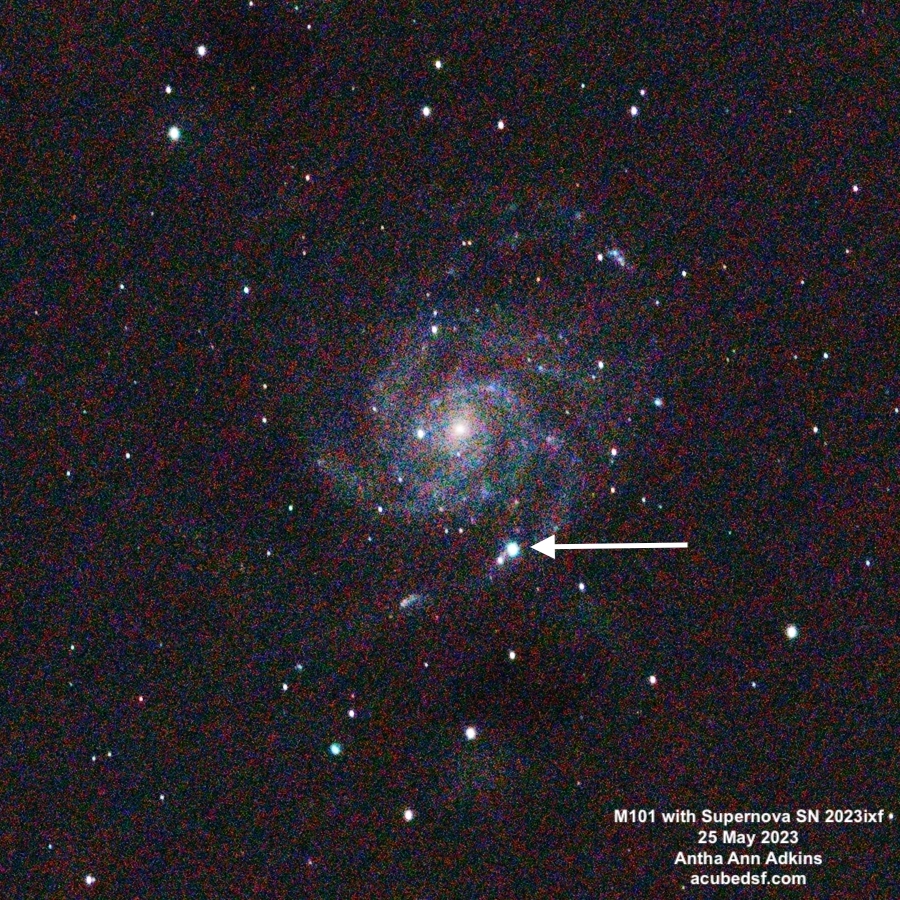
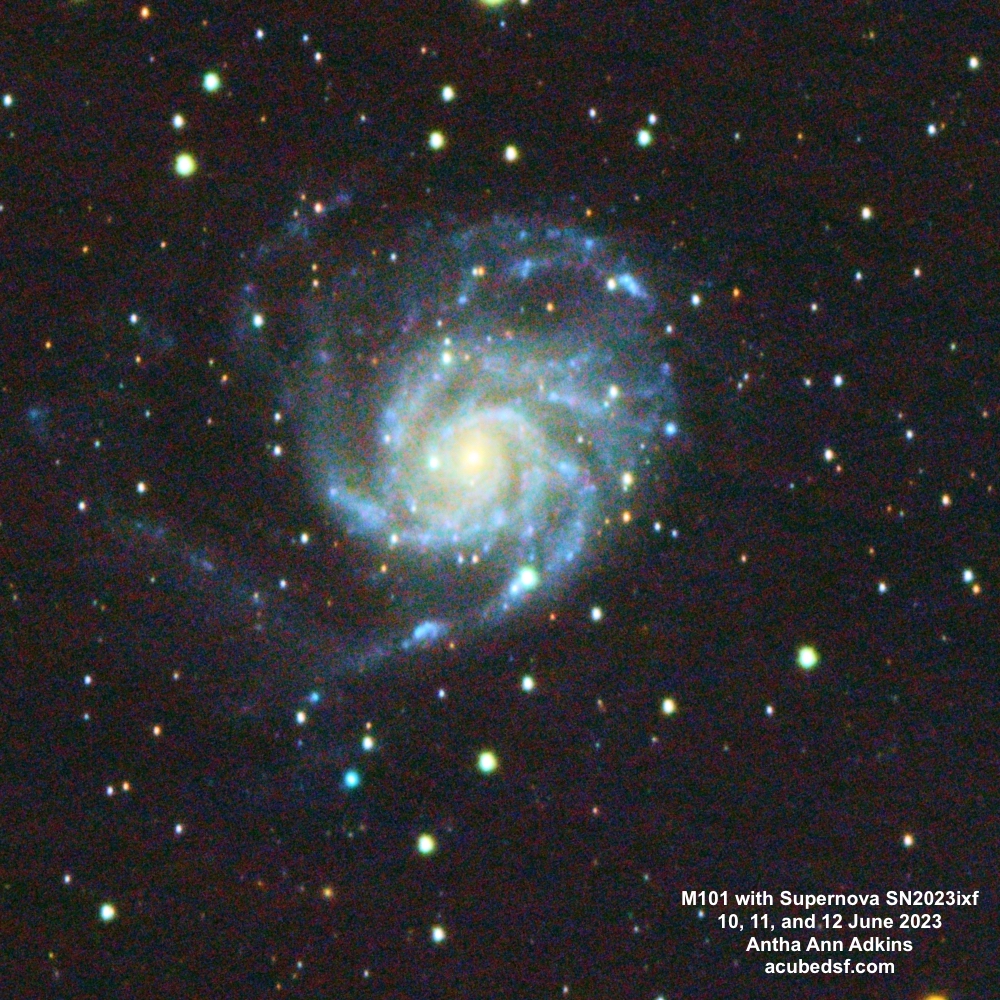
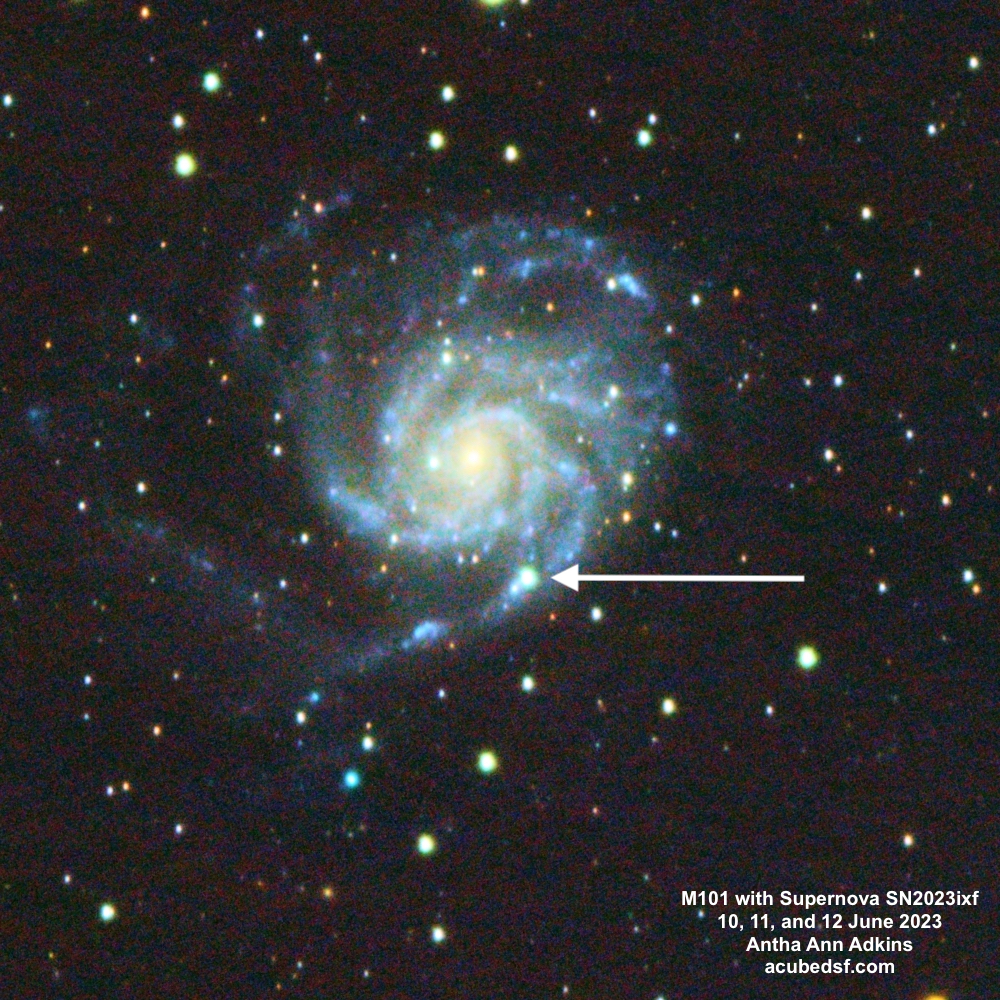
M106

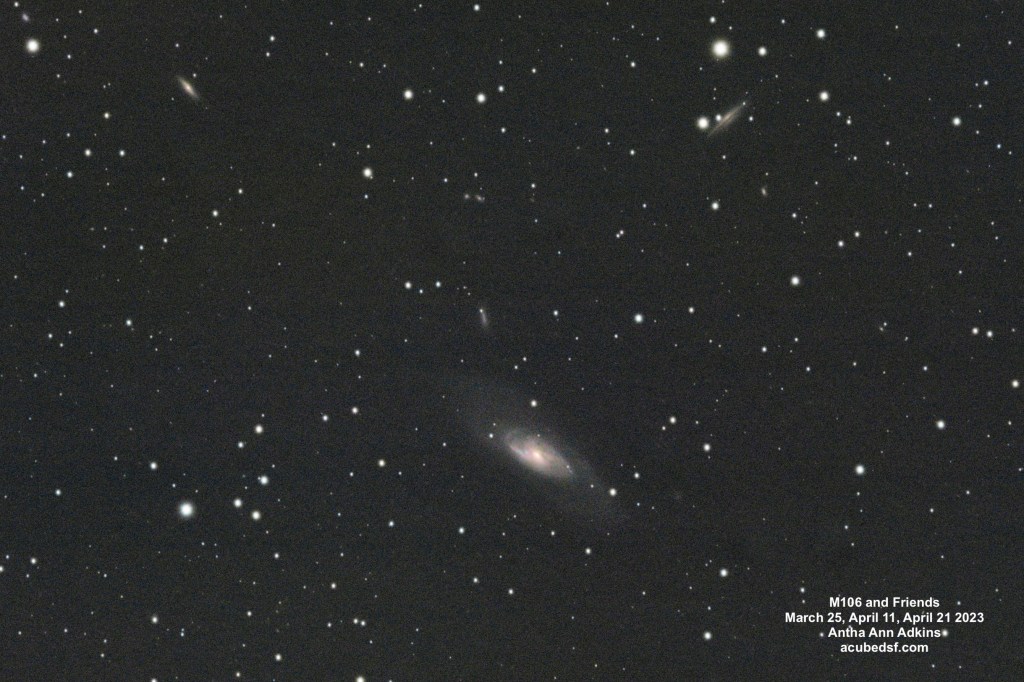
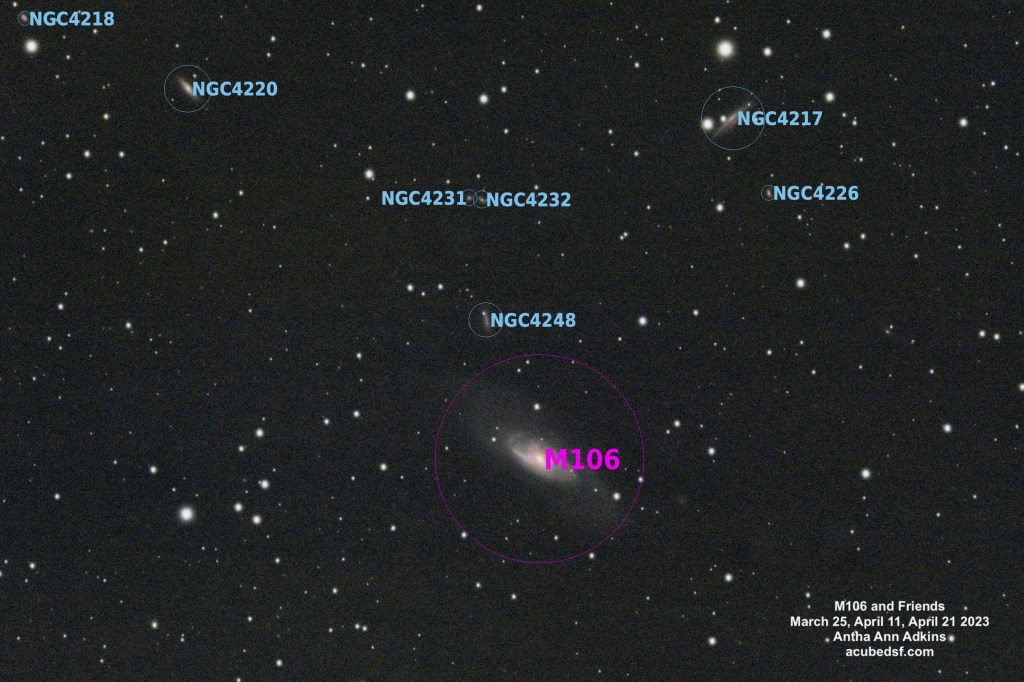
We haven’t had good telescope weather for a while, so I’ve been working on learning more processing techniques.  This is my latest effort: M106, a spiral galaxy containing a supermassive black hole in the center.  It’s got some nearby friends.  How many galaxies can you find?

This is the image where I learned that it’s better to fix the physical alignment of the tracking mount rather than take shorter images to reduce the star trailing – the same amount of time in 30 second images vs 1 minute images takes, well, twice as long to process.  

Camera geek info:

  • Canon EOS 60D in manual mode
  • Williams Optics Zenith Star 73 III APO telescope
  • Williams Optics Flat 73A
  • SkyTech 2” LPRO-MAX CCD Filter
  • iOptron CEM40
  • Friendswood, Texas Bortle 7-8 suburban skies

Frames:

  • March 25 1 minute exposure ISO 800
    • 108 1 minute lights
    • 25 0.03 second flats
    • 27 0.03 second flat darks
    • 40 1 minute darks
  • April 11 1 minute exposure ISO 800
    • 80 1 minute lights
    • 20 0.1 second flats
    • 20 0.1 second flat darks
    • 40 1 minute darks
  • April 21 30 second exposure ISO 1600
    • 471 30 second lights
    • 30 0.03 second flats
    • 30 0.03 second dark flats
    • 42 30 second darks

Processing geek info:

  • PixInsight

Globular Clusters

I’m still working on learning the PixInsight processing software, and I have discovered through the Adam Block videos the Generalized Hyperbolic Stretch process, and now I want to go re-process all the galaxies I’ve been working on.
Imaging galaxies and nebulae from my Bortle 8 skies takes hours of data collection and then more hours of computer crunching.  I have learned that it’s better to fix the physical alignment of the tracking mount rather than take shorter images to reduce the star trailing – the same amount of time in 30 second images vs 1 minutes takes, well, twice as long to process.  

Globular clusters, though, don’t need as much data.  So I don’t need to image as long and the processing is faster.

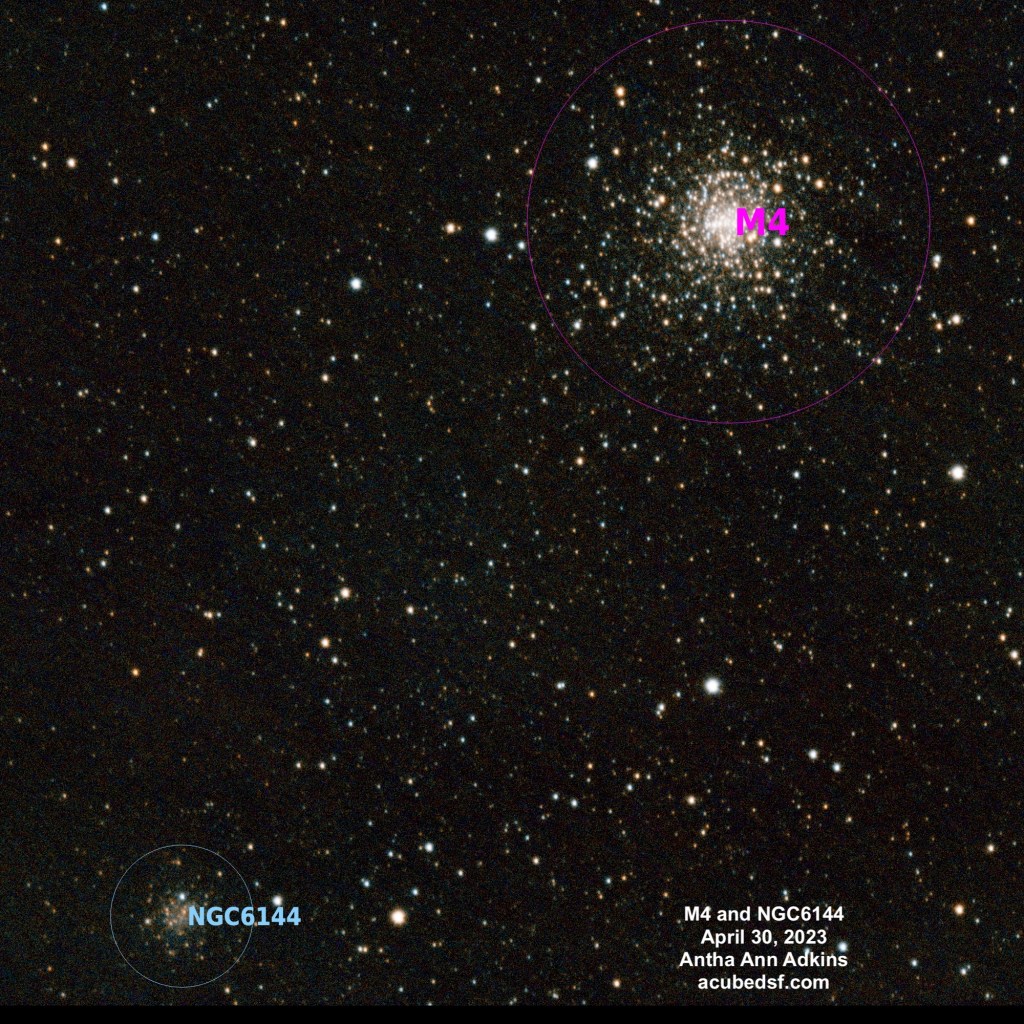
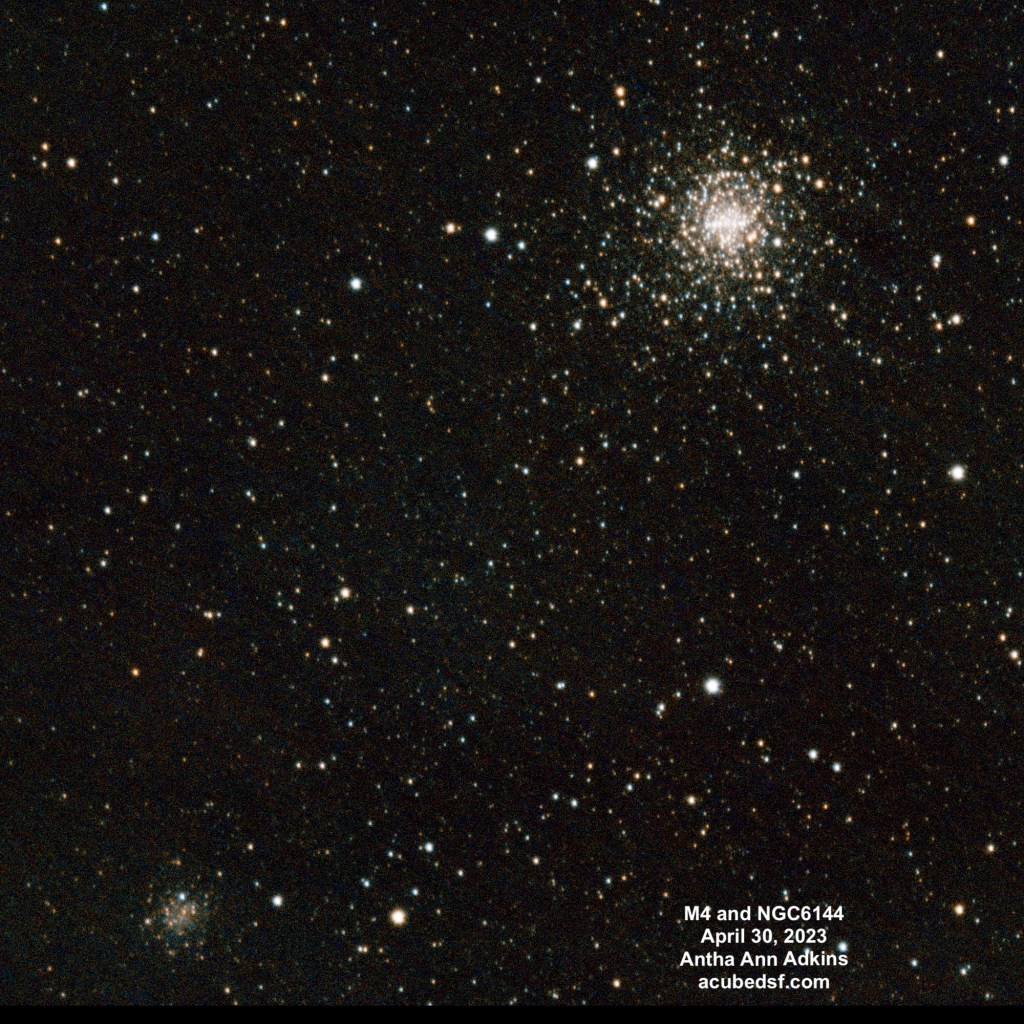
This is M4 and NGC6144, both globular clusters in our Milky Way.  Globular clusters contain hundreds of thousands to millions of stars that are gravitationally bound together.  What would it be like to live in one?  What would the sky look like?

In M4 you can see a “bar” of stars across the middle.  This is apparently a characteristic feature.  

I have imaged M4 before, but with simpler equipment, and without using stacking and other image processing techniques.  I think this version is a vast improvement. 

Camera geek info:

  • Canon EOS 60D in manual mode, 1 minute exposure, ISO 800, custom white balance 3500K
  • Williams Optics Zenith Star 73 III APO telescope
  • Williams Optics Flat 73A
  • SkyTech 2” LPRO-MAX CCD Filter
  • iOptron CEM40
  • Friendswood, Texas Bortle 7-8 suburban skies

Processing geek info:

  • PixInsight
  • 122 1 minute lights
  • 38 1 minute darks
  • 31 0.2 second flats
  • 30 0.2 second flat darks

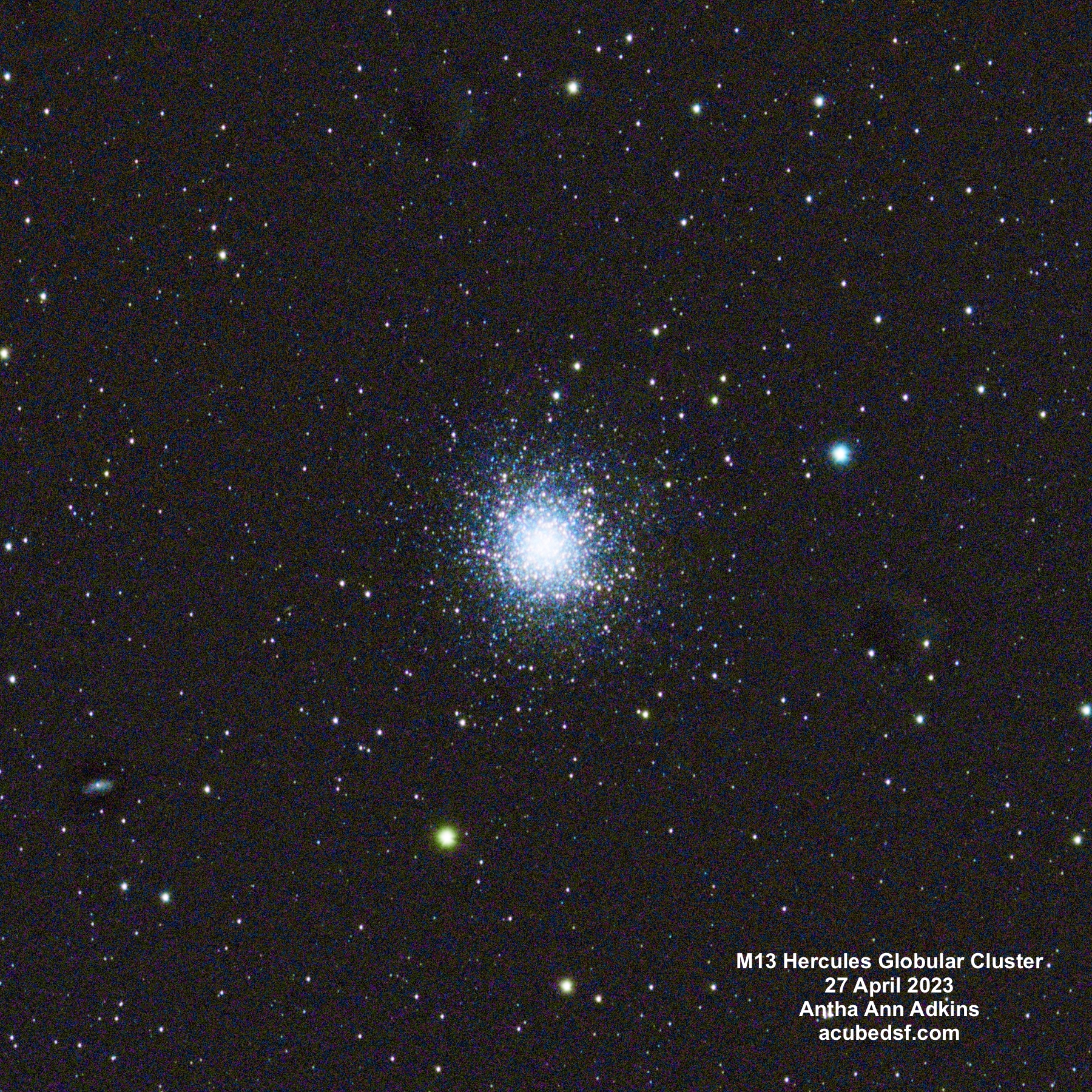
In our rare cloud-free skies this weekend, I also imaged M13, the Hercules Cluster.  

Camera geek info:

  • Canon EOS 60D in manual mode, 1 minute exposure, ISO 800, custom white balance 3500K
  • Williams Optics Zenith Star 73 III APO telescope
  • Williams Optics Flat 73A
  • SkyTech 2” LPRO-MAX CCD Filter
  • iOptron CEM40
  • Friendswood, Texas Bortle 7-8 suburban skies

Processing geek info:

  • PixInsight
  • 113 1 minute lights
  • 40 1 minute darks
  • 23 0.2 second flats
  • 31 0.2 second flat darks

Do you have a favorite globular cluster?

NGC2359 Thor’s Helmet

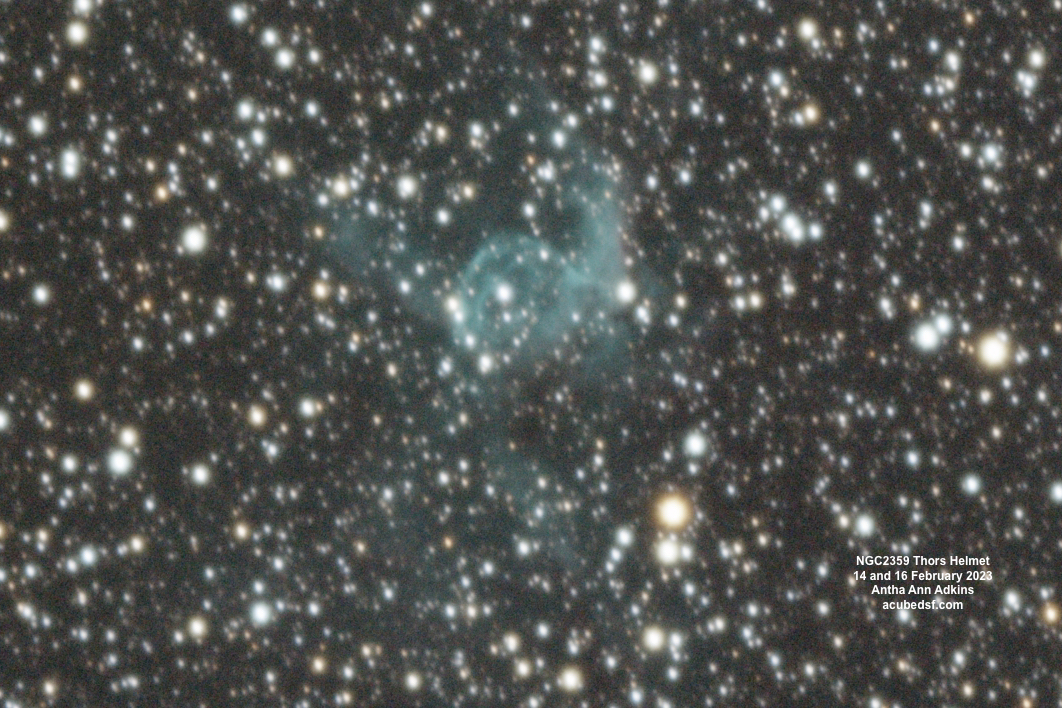
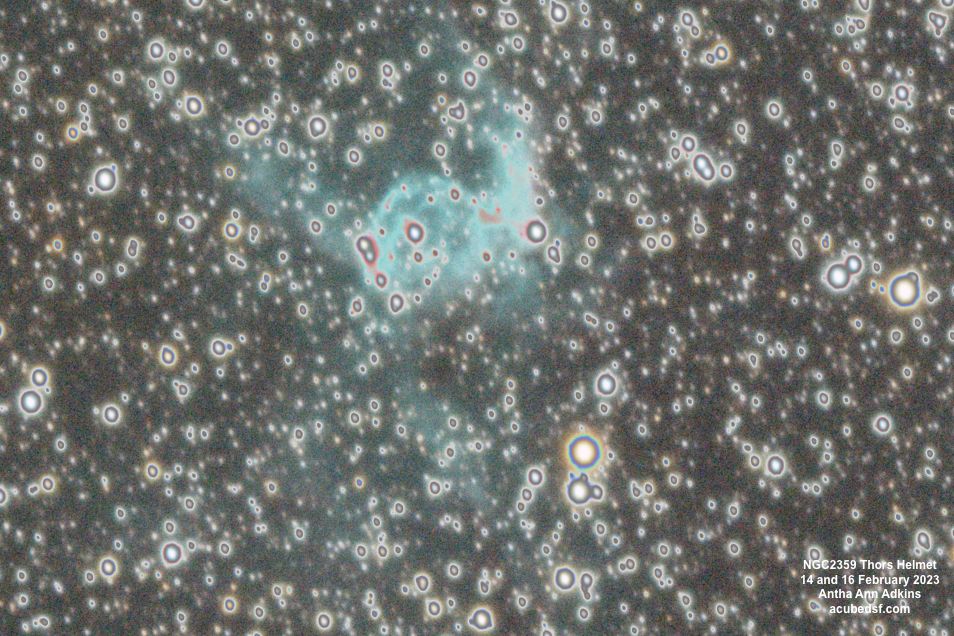
NGC 2359, also called Thor’s Helmet, is an emission nebula that is 15,000 light years away.  It is a bubble of ionized gas around a hot central star, Wolf-Rayet WR7.  It is 16 x 8 arc min in size, and I was pleasantly surprised that I could capture it with my small telescope.  These pictures were made by stacking 64 3 minute images (and cropping).

I’ve been learning PixInsight, and I had some fun with playing with CurvesTransformation on this one.  So, in addition to a standard view of the nebula, I created one I call “Thor in a Snowstorm”.  

Which do you like better?

Camera geek info:

  • Canon EOS 60D in manual mode, 179 second exposure, ISO 2000, custom white balance 3500K
  • Williams Optics Zenith Star 73 III APO telescope
  • Williams Optics Flat 73A
  • iOptron CEM40
  • Dell City, Texas Bortle 2-3 dark skies

Processing geek info:

  • PixInsight
  • 64 3 minute lights
  • 20 3 minute darks
  • 40 0.1 second flats
  • 40 0.1 second flat darks

Making the Invisible Visible – IC434 Horsehead Nebula and NGC2024 Flame Nebula

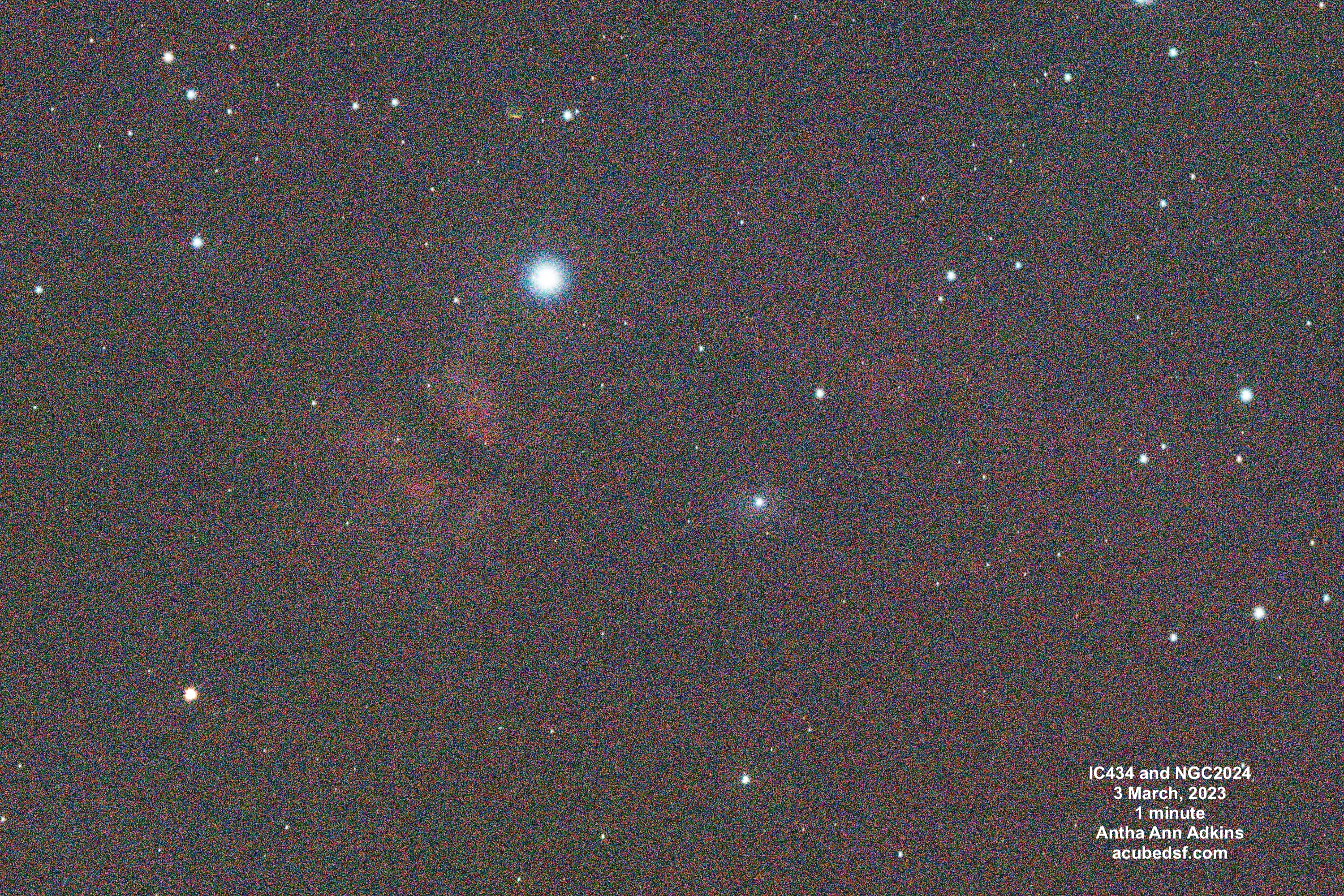
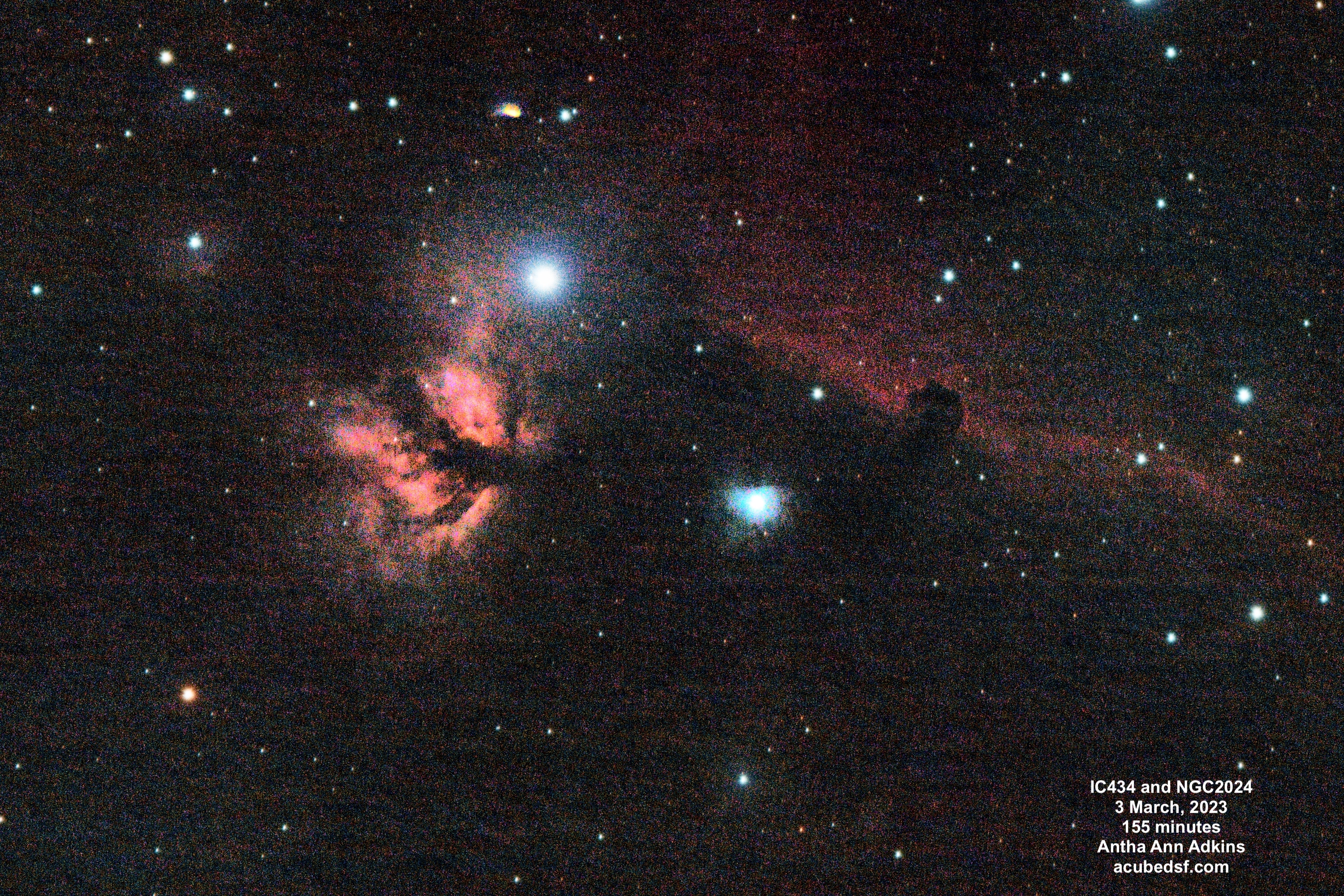
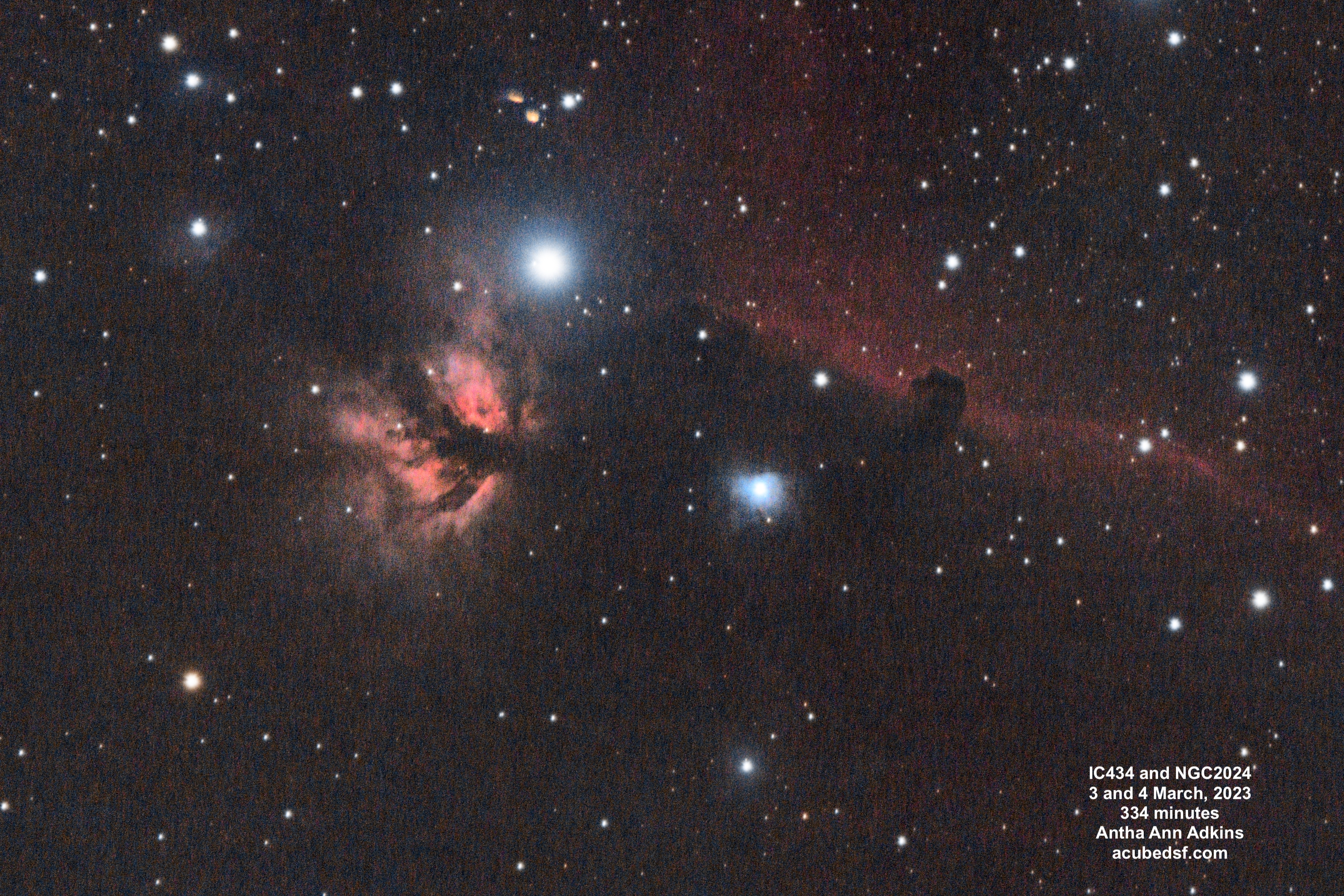
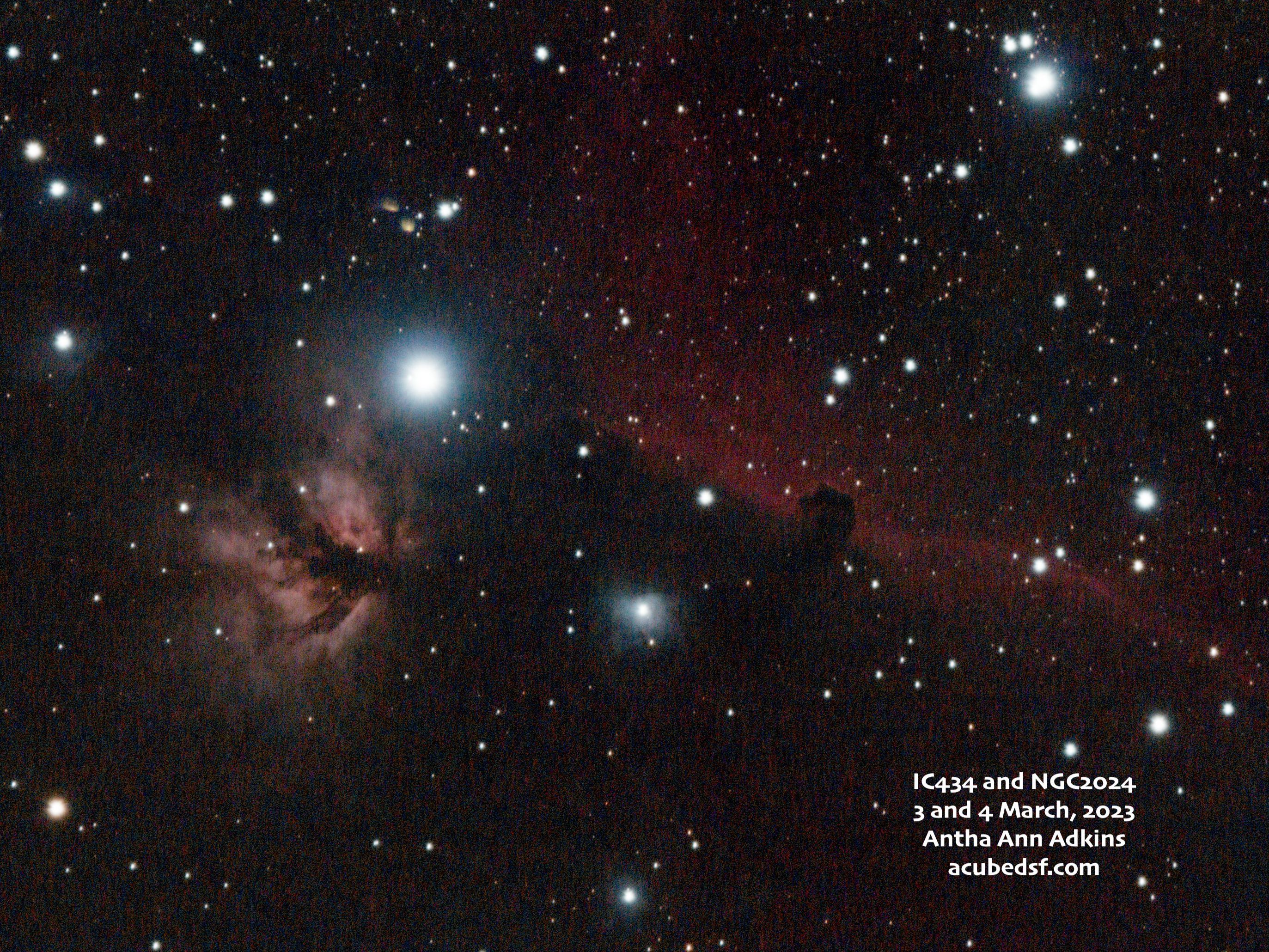
Last weekend I did magic with my camera.  In a single one minute image, I could only see stars.  No signs of nebulosity at all, even zoomed in and brightened on my laptop.  But when I stacked 334 images together (5 hours and 34 minutes, taken over two nights), viola!  IC434 the Horsehead Nebula and NGC2024 the Flame Nebula were both visible.  How cool is that?

Camera geek info:

  • Canon EOS 60D in manual mode, 60 second exposure, ISO 400, custom white balance 3500K
  • Williams Optics Zenith Star 73 III APO telescope
  • Williams Optics Flat 73A
  • iOptron CEM40
  • Friendswood, Texas Bortle 7-8 suburban skies

Processing geek info:

  • PixInsight
  • 344 1 minute lights
  • 28 1 minute darks day 1, 26 1 minute darks day 2
  • 21 0.5 sec flat darks day 1, 20 0.2 sec flat darks day 2
  • 21 0.5 sec flats day 1, 20 0.2 sec flats day 2

Comet C2022/E3 ZTF – First View

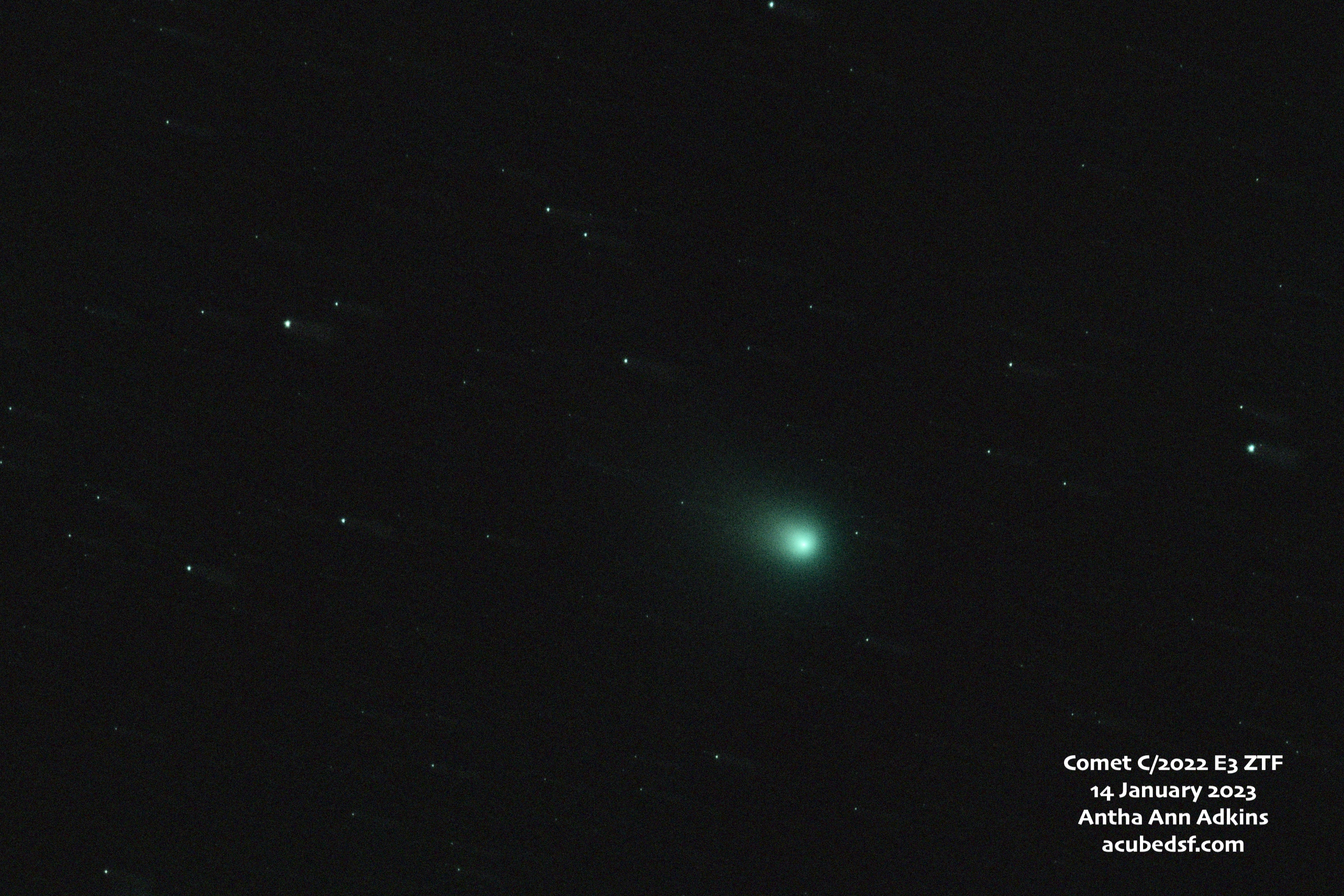
There’s a new comet in the morning skies that hasn’t been in the inner solar system for 50K years and may not return.  I got up at 4 AM on Saturday morning to try to catch it.  You know I love this hobby since I got up early in the cold!  It was an obvious fuzzball in a single 1 minute telescope image, but I couldn’t spot it with image stabilized binoculars.  I’m hoping for more clear days as it gets closer and brighter!  Have you tried to spot it?

I spent about 8 hours learning how to process comets in PixInsight and trying to get rid of the residual star trails.  I’m happy with this image, but look forward to learning some more tricks to improve it!

Camera geek info:

  • Canon EOS 60D in manual mode, 60 second exposure, ISO 800, custom white balance 3500K
  • Williams Optics Zenith Star 73 III APO telescope
  • Williams Optics Flat 73A
  • iOptron CEM40
  • Friendswood, Texas Bortle 7-8 suburban skies

Processing geek info:

  • PixInsight
  • 51 1 minute lights
  • 60 1 minute darks
  • 40 bias frames
  • 20 flats

Andromeda Galaxy – Processed

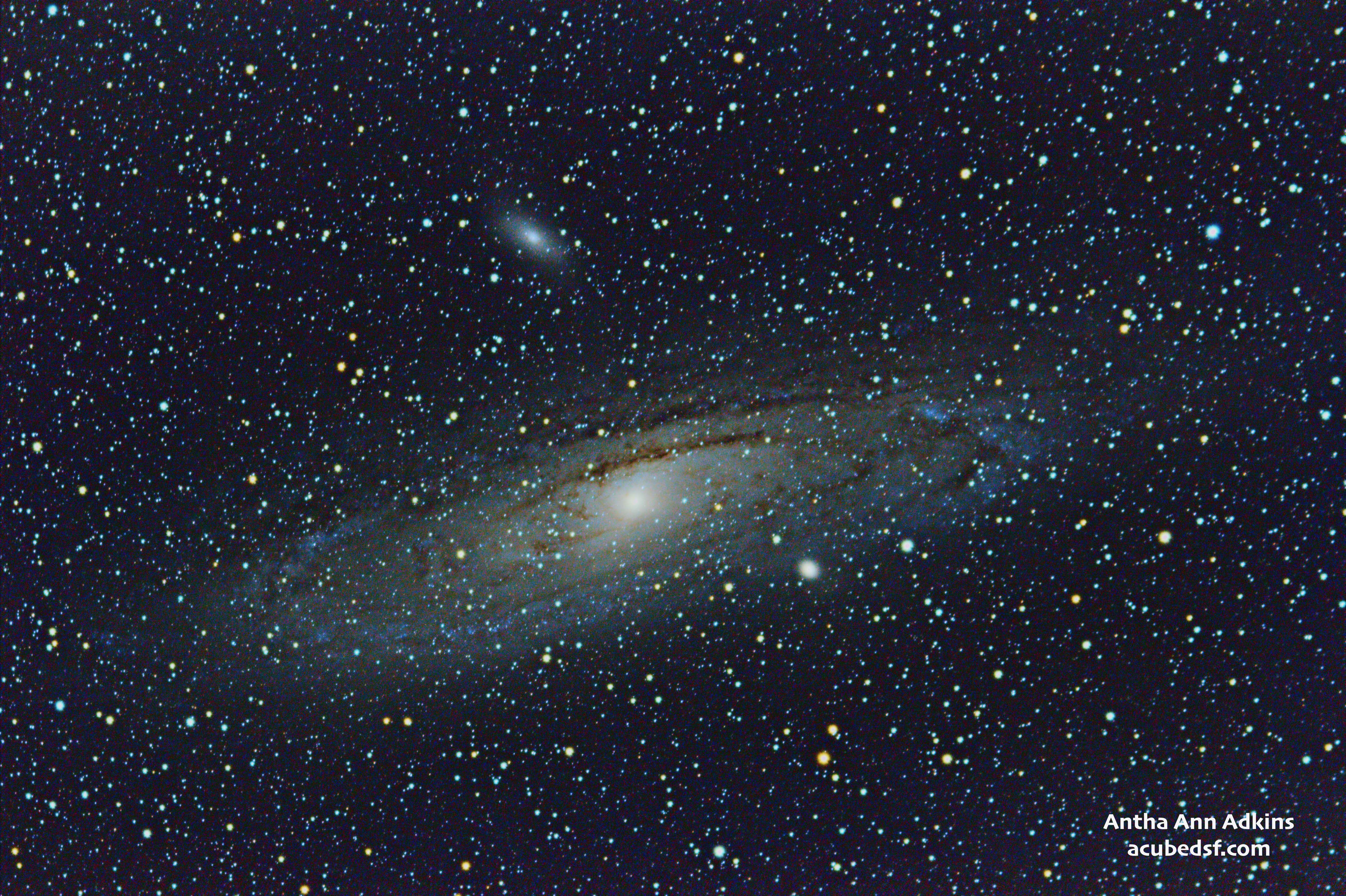
I spent my Christmas holiday working on learning how to use the astrophotography processing tool PixInsight.  There’s an enormous amount to learn, and I’m looking forward to learning more.  But I am happy with the results of my first project – the Andromeda Galaxy.

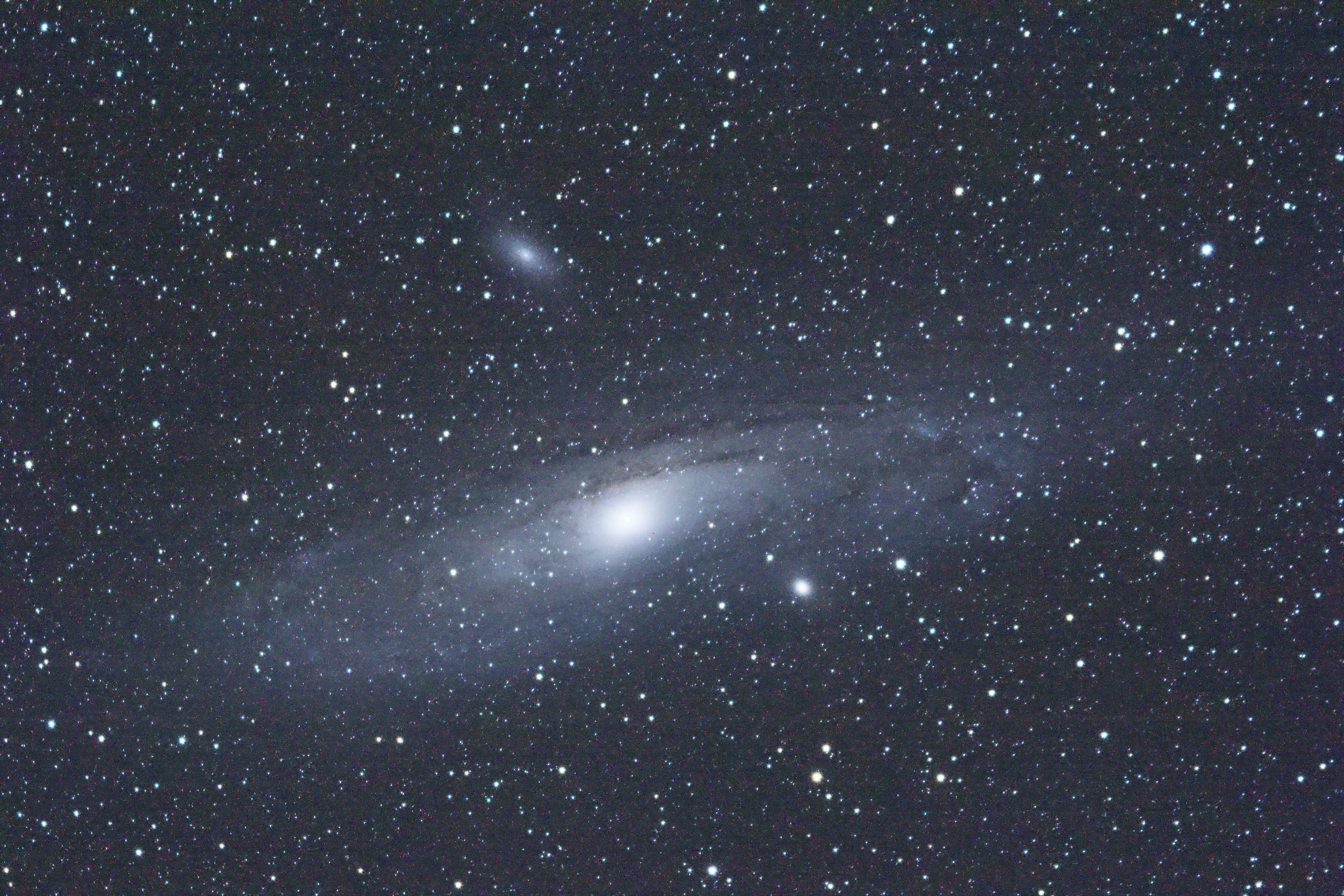
For comparison, here is a single 3 minute shot with only basic processing.  I think the processing is worth it!

Camera geek info:

  • Canon EOS 60D in manual mode, 179 second exposure, ISO 1600, custom white balance 3500K
  • Williams Optics Zenith Star 73 III APO telescope
  • Williams Optics Flat 73A
  • iOptron CEM40
  • Dell City, Texas Bortle 2-3 dark skies

Processing geek info:

  • PixInsight
  • 18 3 minute lights
  • 10 3 minute darks
  • 50 bias frames
  • No flats 
  • ImageIntegration Darks to make Master Dark
  • ImageIntegration and Superbias flats to make Master Flat
  • Lights processed with
    • Blink
    • Subframe Selector
    • Image Calibration
    • Cosmetic Correction
    • Debayer
    • Star Alignment
    • Image Integration
    • Automatic Background Extractor
    • Background Neutralization
    • Color Calibration
    • Histogram Transfer
    • HDR Multiscale Transform
    • Curves Transformation
    • DarkStructureEnhance
  • About 20 hours of labor learning the tool. Whew!

3 Minute Andromeda Galaxy Comparison Part 2

After my previous 3 minute Andromeda Galaxy comparison, I decided I needed to get a light pollution filter to get better pictures from my driveway given our Bortle 7 skies.  I picked up a SkyTech 2” LPRO-MAX CCD Filter and the image above is the result. 

For comparison, here is a picture using the same settings and location with no filter.

And here is a picture using the same settings from Bortle 2 skies.

All these pictures used the same equipment and settings.  For the purposes of this comparison, I did not do any processing.  I think the filter was worth it.  Dark skies are definitely worth it!

Camera geek info:

  • Canon EOS 60D in manual mode, 179 second exposure, ISO 1600, custom white balance 3500K
  • Williams Optics Zenith Star 73 III APO telescope
  • Williams Optics Flat 73A
  • iOptron CEM40

I also experimented with settings to use from my driveway.  Results are in the table below.  Lowering the exposure length and ISO cut down on the sky noise.  I’ll have to see what I can do with the 1 minute ISO 400 images in PixInsight.  

SiteBortleFilterExposure LengthISOResult
Dell City, Texas2 – 3None3 minutes1600Gorgeous detail in M31, M32 and M110 visible
Friendswood, Texas7None3 minutes1600Almost all white picture
Friendswood, Texas7Light Pollution3 minutes1600Bright blue background, M31 as a fuzzball, M110 visible, M32 not obvious
Friendswood, Texas7Light Pollution2 minutes1600Teal blue background, M31 as a fuzzball, M110 visible, M32 not obvious
Friendswood, Texas7Light Pollution1 minutes1600Dark blue background, M31 as a fuzzball, M110 visible, M32 not obvious
Friendswood, Texas7Light Pollution1 minutes400Very dark blue background, M31 as a smaller fuzzball, M110 visible, M32 not obvious

Moon and Mars – Together!

This week, in some parts of the country, the Moon occulted Mars (went between Mars and us).  Down here in Texas, it did not, but the Moon did visually pass very, very close to Mars.  It was partly cloudy here, but I was able to get a picture through the gaps.  And I could see Mars next to the Moon even though the Moon was very close to full.  I was surprised that I could get details in the lunar surface and Mars visible with the same settings.  Mars looked red!

Camera geek info:

  • Canon EOS 60D in manual mode, 1/160 second exposure, ISO 100, auto white balance 
  • Williams Optics Zenith Star 73 III APO telescope
  • Williams Optics Flat 73A
  • iOptron CEM40
  • Bortle 7 skies with clouds

3 Minute Andromeda Galaxy Comparison

In October, I got this fantastic picture of the Andromeda Galaxy from Dell City, Texas with its Bortle 2 – 3 dark skies.  

Camera geek info:

  • Canon EOS 60D in manual mode, 179 second exposure, ISO 1600, custom white balance 3500K
  • Williams Optics Zenith Star 73 III APO telescope
  • Williams Optics Flat 73A
  • iOptron CEM40
  • Dell City, Texas Bortle 2-3 dark skies

I wanted to see what happened when I used the exact same setup and settings from my driveway in Friendswood, Texas with its Bortle 7 (much much brighter) skies.  My suspicion was that the picture would be all white.  

On my first opportunity to try the experiment, there was also a two days past full Moon in the same section of the sky.  As you can see, I did get an almost all-white picture.

I backed off to ISO100 to avoid overexposing the picture, but then I didn’t get near the detail that I got from the dark skies.

I didn’t know how much the overexposure was due to the near-full Moon and how much was due to light pollution.

Yesterday, I got the chance to try the experiment again with no Moon.  As you can see, at the dark skies setting, I again got an almost all-white picture.

I backed off to ISO100 and ISO400 to avoid overexposing the picture, but again I didn’t get the detail I did under darker skies.

All of the pictures in this blog post are unprocessed, other than being saved to a lower resolution format.  It will be interesting to see what I can get when they are processed.

How dark are your skies?

SiteBortleMoonExposure LengthISOResult
Dell City, Texas2 – 3No Moon3 minutes1600Gorgeous detail in M31, M32 and M101 visible
Friendswood, Texas7Near Full Moon3 minutes1600Almost all white picture
Friendswood, Texas7Near Full Moon3 minutes100M31 as a fuzzball, M32 and M101 not obvious
Friendswood, Texas7No Moon3 minutes1600Almost all white picture
Friendswood, Texas7No Moon3 minutes100M31 as a fuzzball, M32 and M101 not obvious
Friendswood, Texas7No Moon3 minutes400M31 as a larger fuzzball, M32 and M101 barely visible