Unknown's avatar

About acubedsf

SFF Author * Engineer * Mom

July 2015 Stats

Spent some time on research last month, but I think I’ve got some things better nailed down and understood … building a world from scratch is a lot of work.

HOURS SPENT WRITING: 10.9

HOURS SPENT WRITING WORDS: 3.2

WORDS WRITTEN: 741

WORDS/HOUR: 231.6

March – June 2015 Stats

One reason I keep and publish stats is to hold myself accountable … another is to develop a feel for how long it really takes for me to write things.

But I run into quandaries about what I should count. Counting words are easy – they’re there or they’re not. Even with editing, I can count new words. But what about other things? What about research to understand the physics of what’s happening in the story? What about writing an orbital dynamics program so I can see what something will actually look like? What about writing a program to start with a certain colony population and propagate it forward N generations? What about reading books to learn about the culture or science background I need for the story? It’s all work, and it’s all work I need to do to write this story … but it’s not writing, so it’s something I haven’t counted in the past.

Starting this month (July), I’m going to start also counting research hours.

But due to all the research activity above, the count for the last four months looks light. I need to get back to actually writing.

March “Apparently I did write down some research hours”

WORDS WRITTEN: 0

HOURS SPENT WRITING: 5.5

WORDS/HOUR: 0

April “But not consistently”

WORDS WRITTEN: 0

HOURS SPENT WRITING: 0

WORDS/HOUR: 0

May “And when my writer’s group met I got motivated to write some words”

WORDS WRITTEN: 1443

HOURS SPENT WRITING: 4.9

WORDS/HOUR: 294.5

June “But not, sigh, consistently”

WORDS WRITTEN: 0

HOURS SPENT WRITING: 0

WORDS/HOUR: 0

July will be better!

Hard SF Homework Set

So a long, long time ago when I was studying engineering in college, we were assigned “homework sets” where we practiced solving the particular sort of problem we were learning about, often with sets of problems where each built on what you worked out in the last. I just finished a self-assigned homework set to understand the physics of what happens at the start of my current novel. It felt good to exercise my brain, but I am pleased that it is done. Now maybe my brain will let me get back to writing.

ApolloCon 2015 – Pictures

I had a blast at ApolloCon 2015, moderating one panel (whose topic was my suggestion!) and participating in three others. As an introvert, it’s tough for me to talk in front of groups and speak on the fly. This actually means that moderating a panel is much easier for me than being a panelist. But for the first time, I felt that I did a good job sitting in both chairs at all my panels. Maybe it was because we had such fun topics.

My first panel was my suggestion: designing aliens. I got to discuss aliens with Larry Friesen (a veteran of many cons and a last-minute addition – thanks!), Kathryn Friesen (a new writer at her first con – welcome!), and Martha Wells (whose books are fantastically rich).

ApolloCon2015-1

My second panel was about good (and bad) science in science fiction. Of course, it’s more fun to trash the bad than to praise the good. Lots of suggestions from our audience on this one. On the panel with me were Deborah Davitt and Alan Pollard.

ApolloCon2015-2

My third panel was on What if We *Are* Alone? We all agreed that we’re probably not, although we could be alone *now*, and we may never be able to reach anyone else. Are we the last ones? Could we be the first ones? So much story fodder. On the panel with me were Alan PollardD. L. Young (a friend from the Houston SFF Writer’s Meetup), and Marshall Ryan Marcesca.

ApolloCon2015-3

My fourth panel was on Translators and translation mishaps. Given that alien communication is one of my favorite subjects? Fun. On the panel with me were Tex ThompsonKathryn Friesen, and Keri Bas (a friend from the Houston SFF Writer’s Meetup).

ApolloCon2015-4ApolloCon2015-5

In addition to talking myself, I also enjoyed panels about traveling beyond Mars, dealing with Near Earth Asteroids (with Stan Love – seriously, if you can ever hear this fellow speak, do it!), and blogging with the Guest of Honor, Jim Hines (who I learned about from his blog, and whose fiction – especially his recent Libriomancer series – I have really enjoyed.)

I’m looking forward to next year.

ApolloCon 2015 Schedule

Hey! I’ll be at my favorite con, ApolloCon, this weekend! It’s at a new location on the west side of Houston, Texas this year.

Here are the panels I will be on:

Saturday, June 20, 10 AM: What’s the Difference?

How do you make aliens truly alien? Some ideas of where to start and on just how different they should be.

Saturday, June 20, 11 AM: Authentic Science

Panelists discuss putting science fact into science fiction and science fantasy.  Examples are cited of good science and possibly, not-so-good science.

Saturday, June 20, 1 PM: What if we really are alone?

Maybe the reason SETI hasn’t found any signs of intelligent life is that there’s nobody else out there.

Sunday, June 21, 12 PM: Lost in translation

As everyone knows, Universal Translators and Babelfish come standard-issue with almost any otherworldly adventure. Still, from the “Darmok and Jalad” episode of Star Trek to Daenerys Targaryen’s first tentative words of Dothraki, it’s clear that language-learning — and language barriers! — offer a wealth of untapped dramatic potential. Come learn how you can use translation and translator-characters in your fiction (even without being a multilingual mastermind) and join us as we celebrate some of the most epic miscommunications in sci-fi and fantasy history.

They all sound great, don’t they? I’m looking forward to the discussion.

Published: Rigel’s Missing Tail

I am pleased to announce that my story “Rigel’s Missing Tail” has been published by Stupefying Stories. The setup for the story – a murder mystery – rattled around in my head, unsolved, for a decade. Then I wrote another story where the victim meets three aliens … and two of the aliens decided they’d solve the mystery for me. I’m so happy to share their success with you!

Comet Lovejoy and the Pleiades

Comet Lovejoy and the Pleiades

CometLovejoyPleiades20150118

Comet Lovejoy – Change in Position in One Day

CometLovejoy20150118

CometLovejoy20150119

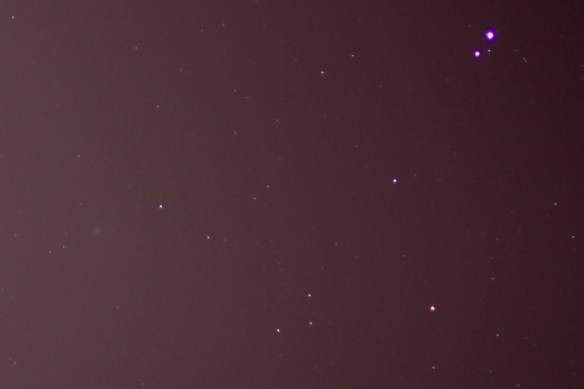
Sunday and Monday evening it was clear, so it was time to find Comet Lovejoy again. This time it was near the beautiful Pleiades. Of course, that is worth a picture.

I thought it would also be fun to see how much the comet had moved over one day – the change is quite visible. I was hoping to go for a three-day comparison, but now it’s cloudy again.

Camera geek info:

  •            Canon EOS 60D in manual mode set at f/4.0, 3.2 second exposure, ISO 6400
  •            Canon EF 70 – 200 mm f/4L lens, set at 94 mm for Pleiades and comet and 200 mm for comet, manual focus at infinity
  •            Tripod
  •            Cable release

In choosing which picture is the best, I find that I am using the following criteria: good focus (automatic toss for out of focus picture unless happen upon cool “artistic” effect), no visible star trails (stars should look like a point, not a line), visibility of comet, color of objects, color of sky, and noise of sky. While I have pictures with darker, less noisy sky, they don’t show the comet as well.

I am also finding that the image quality is far better when I zoom to my desired field of view instead of cropping in post-processing to get there.

Astrophotography – Planets

Conjunction of Moon and Saturn
MoonAndSaturn20150116

Saturn (“One of the These Things is Not Like the Others”)
Saturn20150116

Jupiter and four Galilean Moons
JupiterAndMoons20150116

You know you enjoy a hobby when you get up early and go out into the dark cold for it. This morning there was a conjunction of the Moon and Saturn, so I got up and went out. And while I was at it, I took some pictures of Jupiter and its moons, too. I checked – yes all four moons were on the same side of Jupiter this morning. I think it would be fun to make a time lapse of their motion. Might have to try it.

I learned a new astrophotography trick last night. I knew I needed to manually focus for star pictures, but it’s hard to do with dim sources and a camera designed for autofocus. But my camera has a nifty real-time view on the LCD screen with a 10x view … so I could zoom in on the moon or a planet and use the real-time view to help me manually focus. Neat! And *much* sharper pictures.

The real-time view also showed me that, in spite of the solid tripod, the 200 mm is actually quite shaky if I want to crop further in. So I get out my cable release so I could watch the image settle down on the 10x screen and then trigger the camera without actually touching it.

I also already knew that although I could easily see both the Moon and Saturn, Saturn would disappear or the Moon would wash out without some filtering. Graduated neutral density filters to the rescue! I used two (wish I had more and stronger ones) to dim down the Moon so you can see both bodies in the same photo.

Camera geek info:

  •            Canon EOS 60D in manual mode set at f/4.0, 1/60 second exposure for Moon and Saturn, 1/13 second exposure for Jupiter, ISO 2000
  •             Canon EF 70 – 200 mm f/4L lens, set at 200 mm, manual focus at infinity
  •             Singh-Ray Galen Rowell Filter ND-1G-SS + ND-2G-SS for Moon
  •             Tripod
  •             Cable release