Vela Supernova Remnant and the Discovery of Pulsars

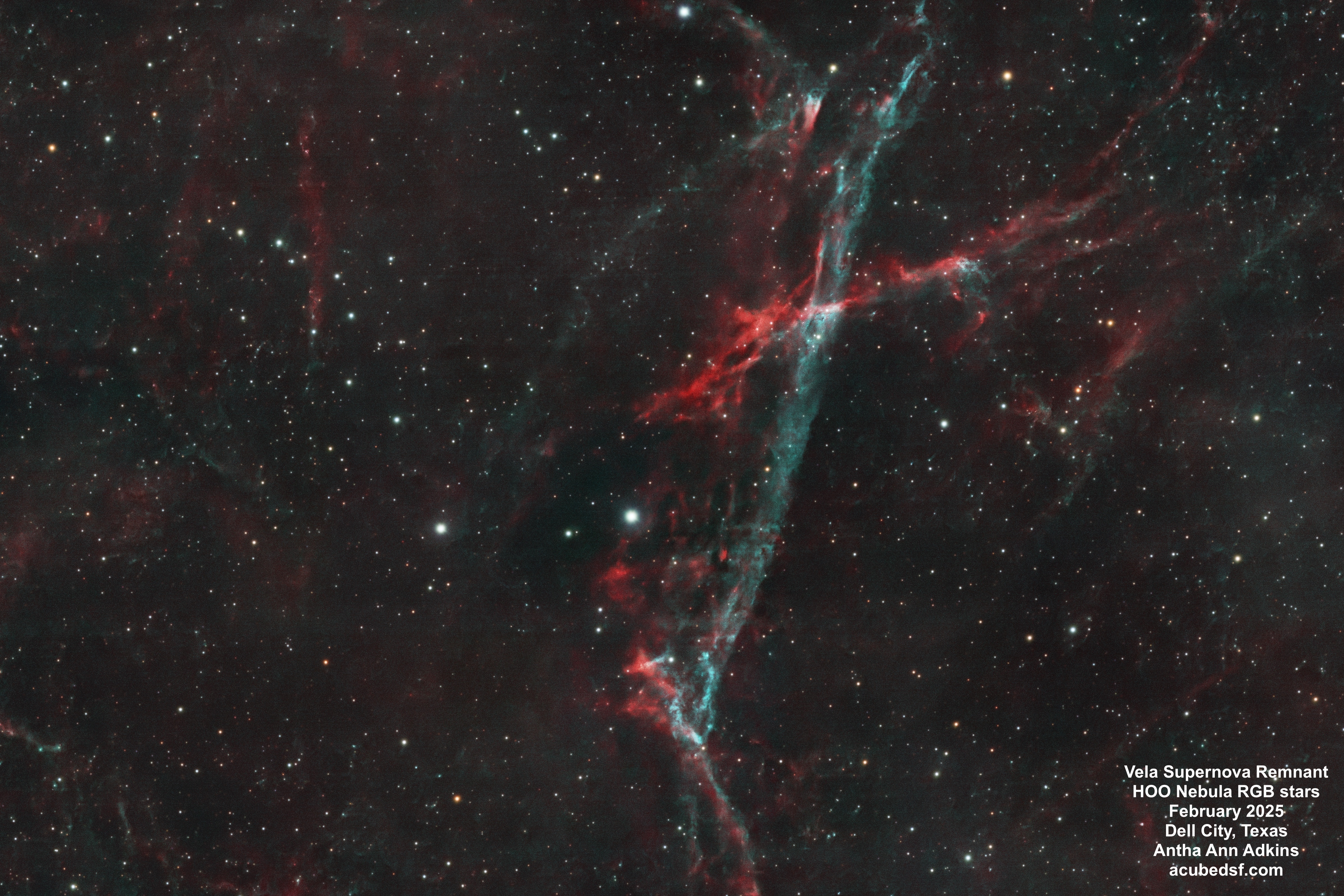
The Vela Supernova Remnant (SNR) or G263.9-03.3 is the material expelled from the explosion of a star in a supernova.  In this case, the original star was estimated to be 8.1 – 10.3 times the mass of the sun, and the final star, PSR J0834-4511 is a pulsar, a magnetized rotating neutron star.  The supernova was estimated to occur 18000 +/-9000 years ago based on its motion away from the SNR.  The Vela SNR located in the Milky Way, approximately 815.5 light years away, and it has an apparent size of 4.25 degrees, making it 60.5 light years across.   

This image is only a portion of the whole nebula.  In this image, the stars came from images using red, green, and blue filters, and the nebula came from images using Hydrogen alpha (mapped to red) and Oxygen iii (mapped to blue) filters.  The nebula was processed separately from the stars to maximally enhance it.  I didn’t really have enough data – only 41 minutes of Oxygen iii data and 185 minutes (3.1 hours) of Hydrogen alpha data, so it took some very careful processing to get even this much of the SNR remnant visible.

I’m looking forward to returning to the fabulous dark skies of Dell City, Texas to collect more data on this beautiful object and also to collecting data from more parts of it.  

While researching this object, I learned that pulsars were first discovered by a woman – Dame Jocelyn Bell Burnett, a Northern Irish astrophysicist.  She discovered a radio signal, determined that it had a regular pulse, and then found three other similar signals.  The physicists had to convince themselves that these were not man-made signals or alien transmissions.  Bell Burnell is listed as the second author on the paper announcing its discovery.  Yet, possibly because she was a graduate student at the time (or because she was a woman), she wasn’t recognized by the Nobel committee when they awarded the prize for this discovery.  She attributed not being recognized to her having been a research student at the time and noted that she was in good company.  Her speech on the discovery is funny and well worth reading.  She stayed active in astrophysics and has received a number of other prestigious awards.  

The other thing I noticed in the data I collected about this object is that when this supernova occurred (even with the longest ago estimate), people would have seen it.  This would have been before recorded history though (even with the shortest ago estimate).  I wonder what they thought?  What do you think they thought?

Camera geek info:

  • William Optics Zenith Star 73 III APO telescope
  • William Optics Flat 73A
  • ZWO 2” Electronic Filter Wheel
  • Antila HO and RGB filters
  • ZWO ASI183MM-Pro-Mono camera
  • ZWO ASiair Plus
  • iOptron CEM40
  • Dell City, Texas Bortle 2-3 dark skies

Frames:

  • February 15, 2025
    • 51 60 second Gain 150 Ha lights
    • 30 1 second Gain 150 Ha flats
  • February 17, 2025
    • 37 30 second Gain 150 Red lights
    • 30 0.05 second Gain 150 Red flats
    • 8 30 second Gain 150 Green lights
    • 30 0.02 second Gain 150 Green flats
  • February 18, 2025
    • 30 30 second Gain 150 Red lights
    • 30 0.05 second Gain 150 Red flats
    • 40 30 second Gain 150 Green lights
    • 30 0.02 second Gain 150 Green flats
    • 39 30 second Gain 150 Blue lights
    • 30 0.02 second Gain 150 Blue flats
    • 9 60 second Gain 150 Ha lights
    • 30 1 second Gain 150 Ha flats
  • February 19, 2025
    • 96 60 second Gain 150 Ha lights
    • 30 0.5 second Gain 150 Ha flats
    • 41 60 second Gain 150 Oiii lights
    • 30 0.2 second Gain 150 Oiii flats
  • February 21, 2025
    • 29 60 second Gain 150 Ha lights
    • 30 0.5 second Gain 150 Ha flats
  • 30 Flat Darks matching flat durations from library
  • 30 Darks from library

Processing geek info:

  • PixInsight
  • BlurXterminator
  • NoiseXterminator
  • StarXTerminator
  • Generalized Hyperbolic Stretch
  • ImageBlend

Capturing a new supernova in another galaxy: NGC7331 and SN2025rbs

Usually I don’t image on work nights so I get enough sleep.

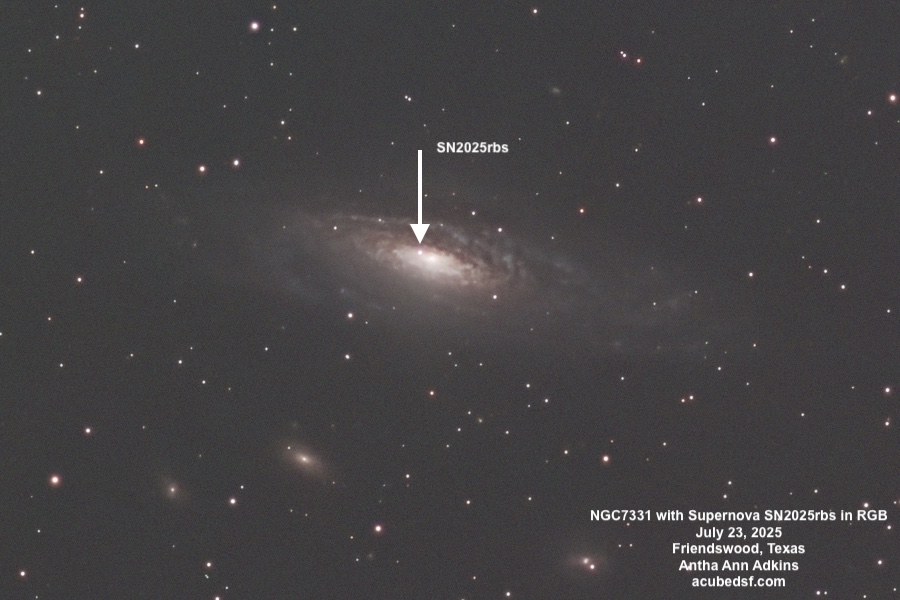
However, the new telescope cloud curse has been strong, and I’ve only had a few clear nights since I bought my new William Optics Pleiades 111 telescope “Blue” earlier this year.  So when it was finally clear on Tuesday, I couldn’t resist taking my new telescope outside.  I continued to collect data on M101, but I had learned through a Facebook post that there was a new supernova in the galaxy NGC7331.  So after M101 set, I spent the rest of the night imaging NGC7331.

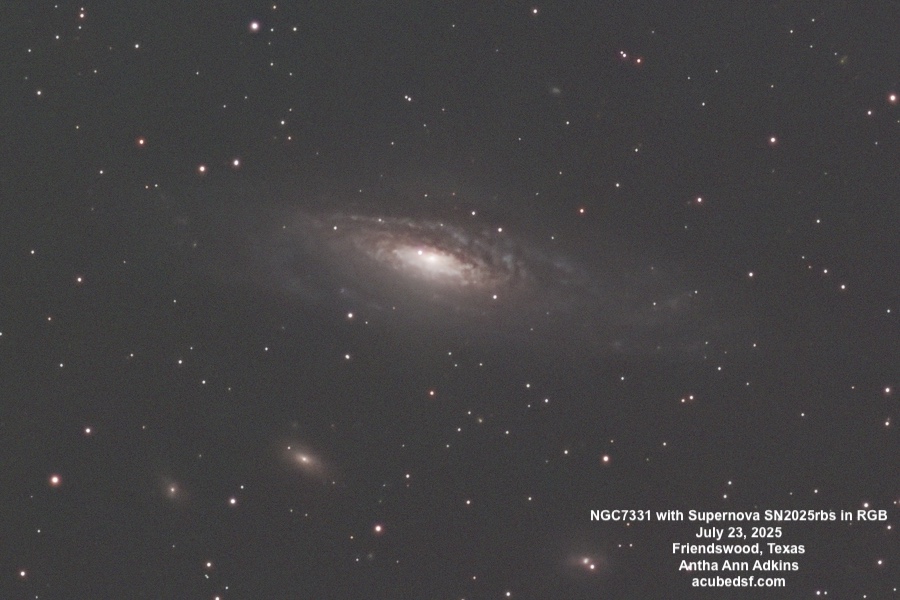
NGC7331 is an unbarred spiral galaxy.  It’s located approximately 47 million light years away, and it has an apparent size of 10.47 arcminutes, making it about 144 thousand light years across.  One paper on this galaxy argues that its central bulge rotates in the opposite direction of its outer disk – weird!  Another argues that the stars in the central bulge are old – 13 billion years old, while the stars in the disk are young – possibly 0.2 billion years old.  (This may not be unusual; our own galaxy is still making stars in its outer arms right now, which I also think is really cool.)  

Supernova 2025rbs is a Type 1A supernova, which occurs when a white dwarf star collects material from a companion star, almost reaches the Chandrasekar mass, starts fusing carbon, experiences a runaway reaction, and explodes, releasing an enormous, but predictable, amount of energy.  Type 1A supernovas can be used as standard candles to measure the distance to the supernova (and in cases like SN2025rbs the distance to the home galaxy) because the energy they release and thus their brightness is predictable.  SN2025rbs was discovered by the Gravitational-wave Optical Transient Observer (GOTO) on July 14, 2025.

You can clearly see SN2025rbs as a bright spot near the galaxy center.  In fact, it appears to outshine the galaxy center, which I find amazing.  

When I imaged this, I deliberately used short capture times (15 seconds) so that the bright supernova would not “blow out” and clip to pure white or cause “pixel bloom” where the light overwhelms the pixel capturing it and so bleeds into the nearby pixels.  

I spent a fair bit of time thinking about how this image “should” be processed.  On the one hand, I wanted to preserve the relative amount of light and color for the supernova relative to both the star field and NGC7331, its host galaxy.  On the other hand, astroimages are inherently low-light and high dynamic range, which means that the data has to be non-linearly stretched to show both the relatively bright supernova and stars and the relatively dim galaxy.  

My standard PinInsight processing flow includes using BlurXTerminator (BXT) to sharpen the stars and non-stellar objects, NoiseXTerminator (NXT) to remove noise, and then StarXTerminator (SXT) to separate the stars from the non-stellar objects so they can be stretched separately.

I considered whether I should skip the BXT processing step.  BXT sharpens the stars and makes them smaller, and it did the same to the supernova but not the NGC7331 galactic core.  The BXT documentation says, “BlurXTerminator is trained to conserve flux, the total amount of light associated with a feature such as a star. When a blurred star is made less blurry, the light from some number of pixels is concentrated into a smaller number of pixels. Those pixels must get brighter for the total amount of flux to be the same.”  Based on that statement, I think since BXT preserves the amount of light in each star, it also preserves the relative amount of light between the stars and between the stars and the supernova (assuming none of them are clipped because they exceed the max brightness level, which did not happen in this case).  Further, since stars (and supernovae) are point sources of light and with perfect seeing and optics would only be “seen” in one pixel, using BXT to sharpen the stars and the supernova should be making them more like their “true” amount of light relative to the galaxy as well.  So I left the BXT step in my processing flow.

I also considered whether I should skip the SXT step and stretch the stars, supernova, and galaxies together or use SXT and stretch them separately.  Either way, there is no longer a linear relationship between the brightness of the objects.  If I processed this as a single image, the brightness ordering – what is brighter than what – would be maintained.  If I used SXT so I could stretch the galaxies separately, I could end up making the galaxy core brighter than the supernova, even though it was not in the raw data.  On the other hand, I could show more detail in the galaxy if I processed it separately.  I ended up deciding that, in this case, what was most important to me was to maintain the brightness order and show that the supernova was brighter than the galactic core.  So I processed it as a single image.

My final PixInsight processing flow was:

  • WBPP to calibrate, normalize, and integrate three channels of RGB data
  • ChannelCombination to combine the RGB channels into a single image
  • DBE to remove the excess blue in the background
  • SPCC to calibrate the color
  • BXT to sharpen the stars and the galaxy
  • NXT to to remove some noise since this is only a few hours worth of data from my Bortle 7-8 light polluted skies
  • Histogram Transformation to stretch the image

At some point, I’d like to collect more data on this galaxy and make a nicer picture of it.  But the clouds are back now.  The curse continues …   

Camera geek info:

  • William Optics Pleiades 111 telescope
  • ZWO 2” Electronic Filter Wheel
  • Antila RGB filters
  • Blue Fireball 360° Camera Angle Adjuster/Rotator
  • ZWO ASI183MM-Pro-Mono camera
  • William Optics Uniguide 32MM F/3.75
  • ZWO ASI220MM-mini
  • ZWO ASiair Plus
  • iOptron CEM40
  • Friendswood, Texas Bortle 7-8 suburban skies

Frames:

  • Lights
    • 248 15 second Gain 150 Red lights  (62 minutes)
    • 182 15 second Gain 150 Green lights (45.5 minutes)
    • 168 15 second Gain 150 Blue lights (42 minutes)
    • 30 0.2 second Gain 150 Red flats
    • 30 0.1 second Gain 150 Green flats
    • 30 0.1 second Gain 150 Blue flats
  • Darks, Flat darks from library

M101 Supernova from Bortle 2 Skies

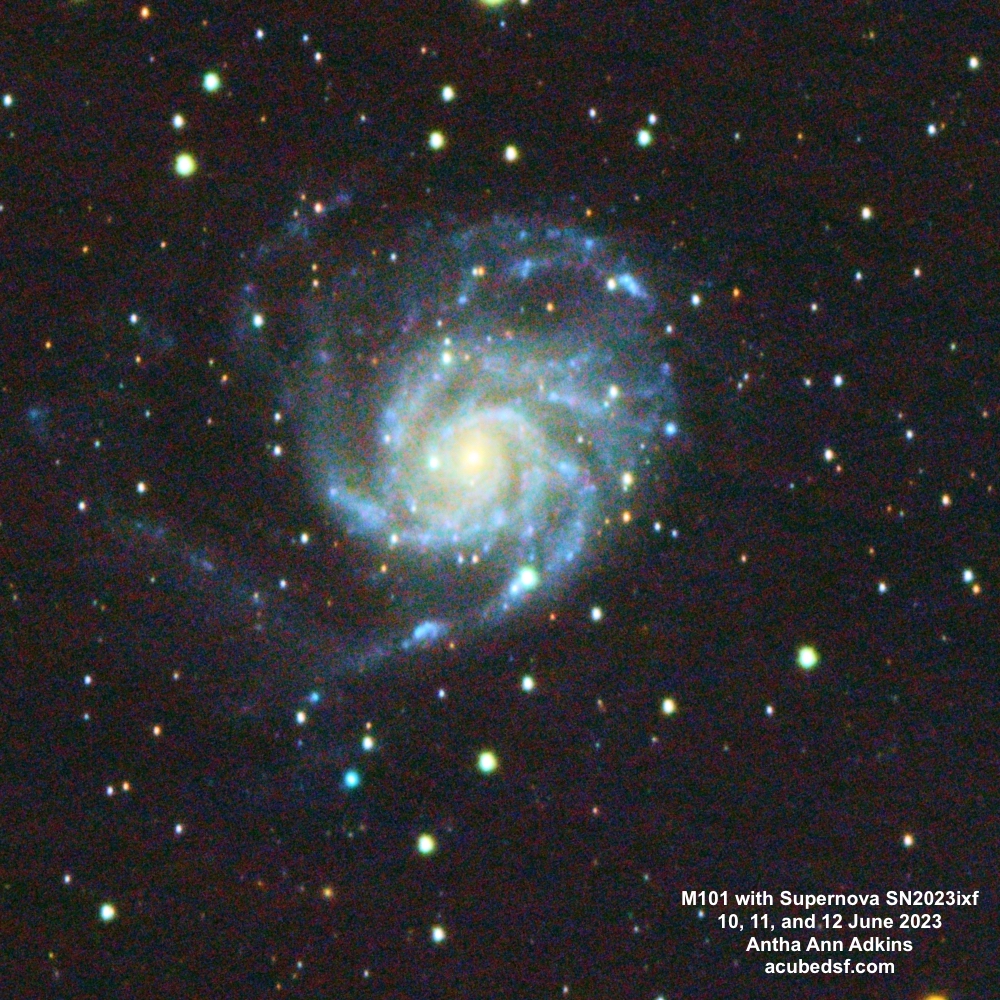
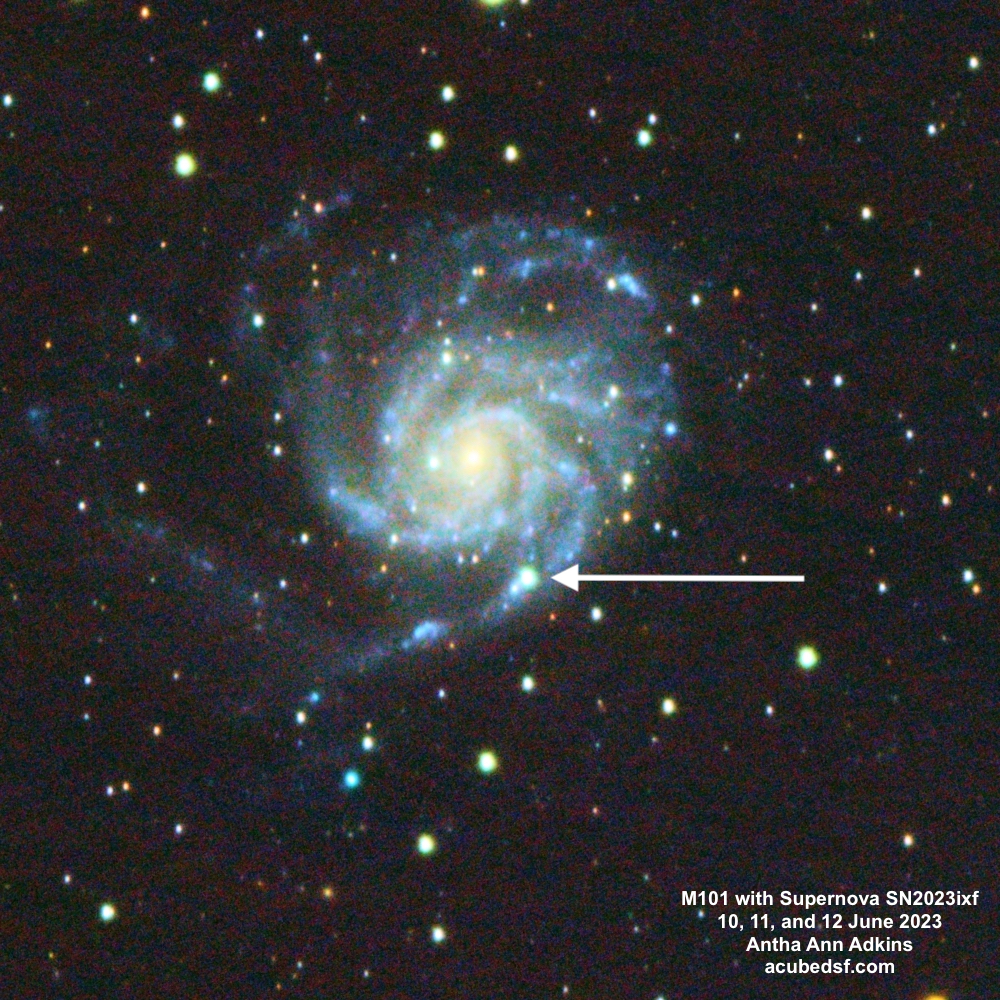
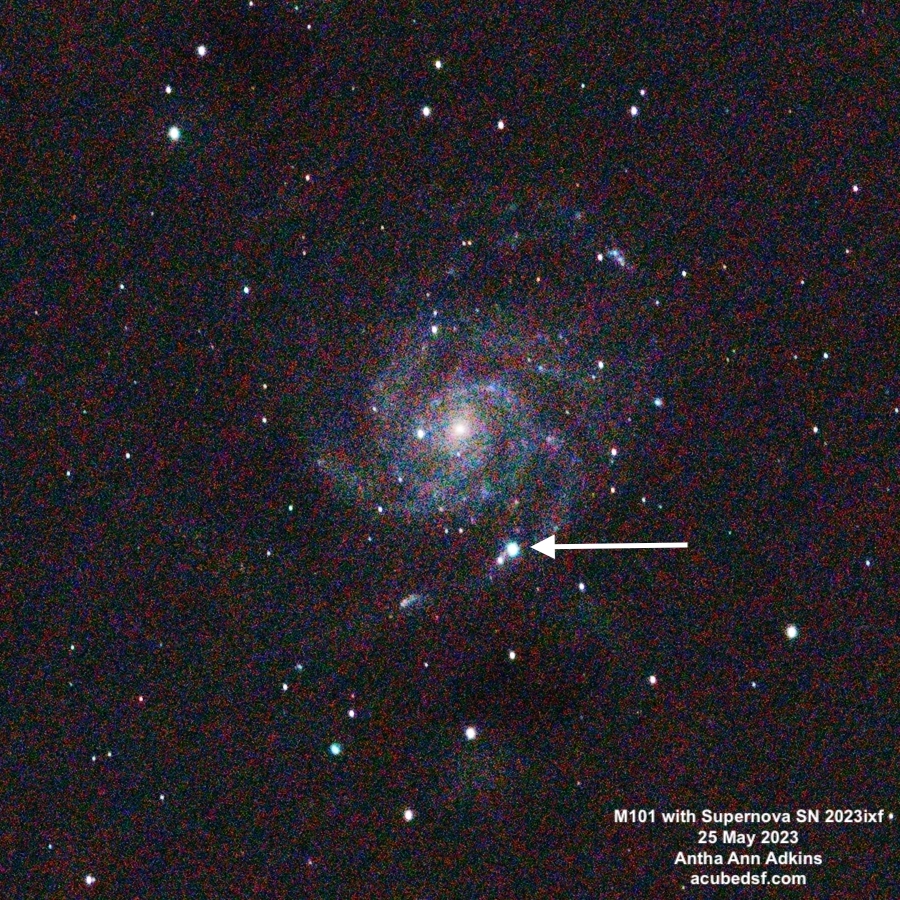
We recently went out to visit our favorite dark skies spot, Dell City, Texas, and we enjoyed 5.5 cloud-free nights and I collected over 30 hours of data.  I spent most of that time on M101 and the supernova (arrow points to the supernova).  

One of the things I’ve taken to doing is taking flats and dark flats before doing a meridian flip so each run is processed with its own calibration frames.  That way if I bump the camera or reorient it, the flats will match the lights.

Now that I’m home, I’m processing the data.  I didn’t use StarXterminator to separate the stars from the galaxy because I wanted the galaxy and the supernova to be processed the same way.

A couple of the light frames were thrown out by PixInsight, so this image ended up using 306 2-minute lights for a total of 10.2 hours of data.  Compared to what I could get from my driveway, I think it was worth it!

Camera geek info:

  • Canon EOS 60D in manual mode, 2 minute exposure, ISO 1600 and ISO 2000, custom white balance 3500K
  • Williams Optics Zenith Star 73 III APO telescope
  • Williams Optics Flat 73A
  • iOptron CEM40
  • Dell City, Texas Bortle 2-3 dark skies

Frames:

  • June 10, 2023
    • Run 1 1600 ISO
      • 99 2 minute lights
      • 31 0.01 second flats
      • 20 0.01 second flat darks
    • Run 2 1600 ISO
      • 39 2 minute lights
      • 31 0.02 second flats
      • 30 0.02 second flat darks
      • 71 2 minute darks
  • June 11, 2023 2000 ISO
    • 151 2 minute lights
    • 31 0.02 second flats
    • 20 0.02 second flat darks
    • 31 2 minute darks
  • June 12, 2023 2000 ISO
    • 30 2 minute lights
    • 31 0.02 second flats
    • 30 0.02 second flat darks
    • 32 2 minute darks

Processing geek info:

  • PixInsight
  • Generalized Hyperbolic Stretch

M101 Supernova in Haiku

Cloudless skies last night.
Supernova shining bright.
A delightful sight.

Antha Ann Adkins

Thursday night we had clear skies (though a near-full Moon) and I was able to take another set of M101 and supernova images.  Comparing to my previous images, you can see that more time from my driveway gave me more galaxy details, but that they don’t compare to what I can get from darker skies.

Camera geek info:

  • Canon EOS 60D in manual mode, ISO 800, 1 minute exposures
  • Williams Optics Zenith Star 73 III APO telescope
  • Williams Optics Flat 73A
  • SkyTech 2” LPRO-MAX CCD Filter
  • iOptron CEM40
  • Friendswood, Texas Bortle 7-8 suburban skies

Frames:

  • 318 1 minute lights
  • 31 0.05 second flats
  • 20 0.05 second flat darks
  • 49 1 minute darks

Processing geek info:

  • PixInsight
  • Generalized Hyperbolic Stretch

M101 Supernova

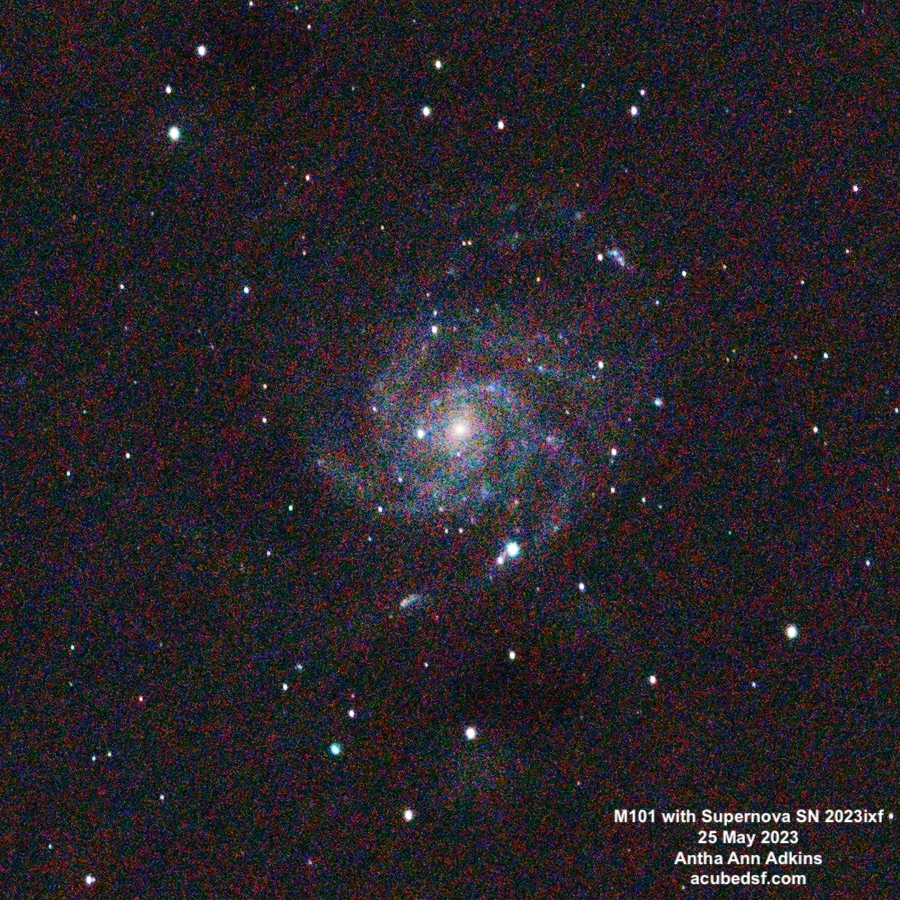
One of these things is not like the others … I got an image of M101 the Pinwheel Galaxy in February from the lovely dark skies of Dell City, Texas. Since then, light from a supernova in one of its arms has reached us … from 20+ million light years away. And I was able to image that from my driveway!  The driveway picture is noisier and dimmer due to light pollution, but you can tell there’s something new there! I’m looking forward to going back out to the dark skies and imaging it again.

Interestingly, the total imaging times of 66×3=198 minutes on 2/16 and 218 minutes on 5/25 are pretty similar, but due to the light pollution, the 5/25 image has less detail, is noisier, and is grainier.  On the other hand, the tracking wasn’t as good on 2/16, emphasized by the longer image times, so the stars aren’t circles and the image isn’t as sharp as I would like.

Camera geek info (February 16 pre supernova):

  • Canon EOS 60D in manual mode
  • Williams Optics Zenith Star 73 III APO telescope
  • Williams Optics Flat 73A
  • iOptron CEM40
  • Dell City, Texas Bortle 2-3 dark skies

Frames:

  • Feb 16 3 minute exposure ISO 1600
    • 66 3 minute lights
    • 21 0.05 second flats
    • 20 0.05 second flat darks
    • 20 1 minute darks

Processing geek info:

  • PixInsight

Camera geek info (May 25 with supernova):

  • Canon EOS 60D in manual mode
  • Williams Optics Zenith Star 73 III APO telescope
  • Williams Optics Flat 73A
  • SkyTech 2” LPRO-MAX CCD Filter
  • iOptron CEM40
  • Friendswood, Texas Bortle 7-8 suburban skies

Frames:

  • May 25 1 minute exposure ISO 800
    • 218 1 minute lights
    • 31 0.05 second flats
    • 30 0.05 second flat darks
    • 49 1 minute darks

Processing geek info:

  • PixInsight