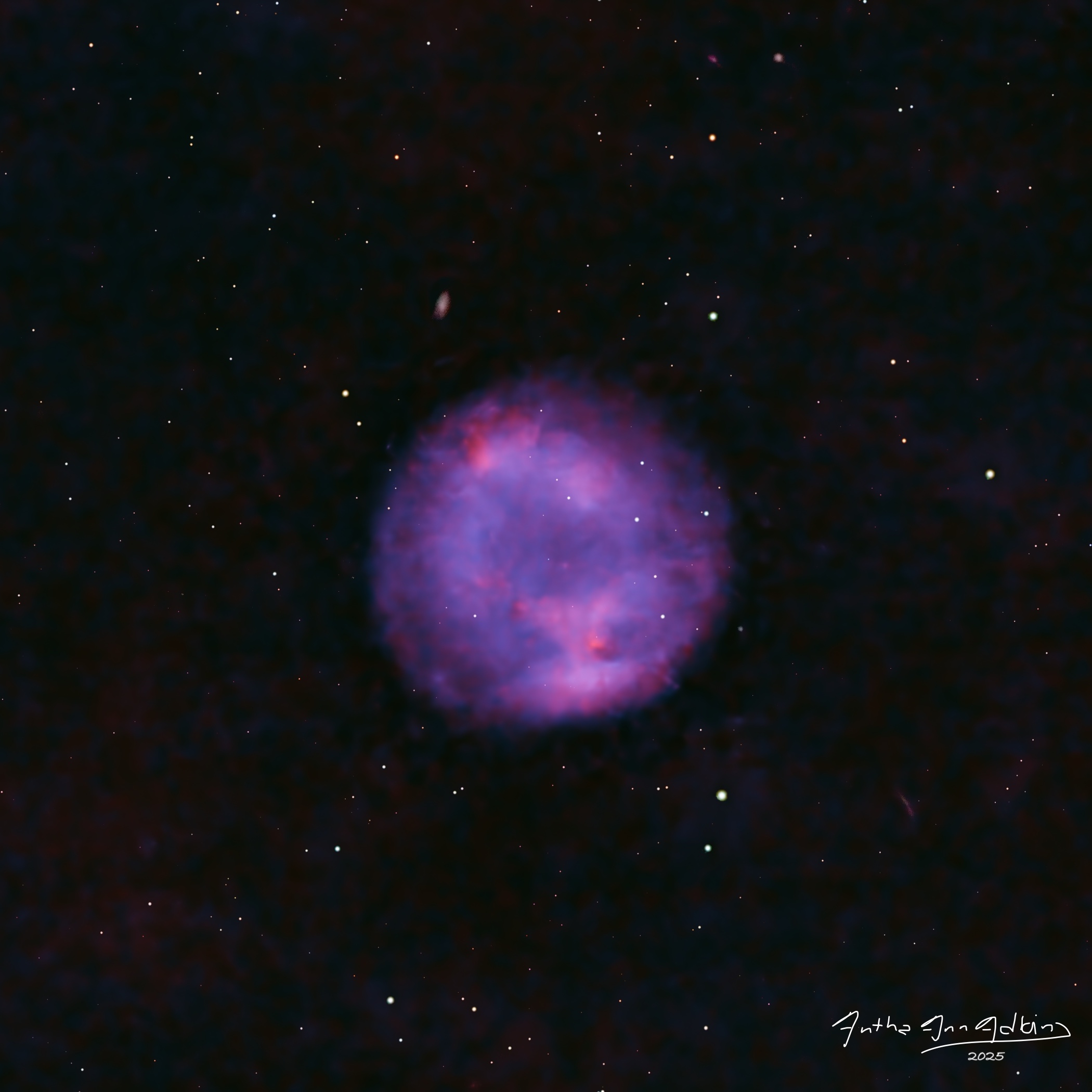
When we travel to the glorious dark skies of Dell City, Texas, I try to image objects that I won’t be able to easily image from my light polluted Bortle 8 driveway. I also try to pick a challenge object – one that needs a lot of time even from the Bortle 2 – 3 skies of Dell City. In November 2025, my challenge object was Abell 7, a planetary nebula. Even in 10 minute images with the Ha and Oiii filters, I could not see the nebula. However, after integrating 10.3 hours of Ha and 8.2 hours of Oiii data, I was able to see and process Abell 7.
Abell 7 is a planetary nebula – the gases expelled from a red giant star before it becomes a white dwarf, lit up by that star. It’s located in the Milky Way, approximately 1680 light years away, and it has an apparent size of 12.733 arcminutes, making it about 6.2 light years across. It’s estimated to be 20,841 years old based on the expansion of the nebula, which is “ancient” for a planetary nebula.
I find these small nebulae beautiful and fascinating. Each has its own unique structure. This one has Hydrogen Ha emissions (mapped to red) and Oxygen Oiii emissions (mapped to blue). Much of the nebula is purple, so it has both Ha and Oiii emissions. The strongest Ha regions are on opposite sides of the nebula. There is a variation in intensity – the center and the outer rim are both dimmer than the brighter middle ring. It also appears to me to be clumpy or fuzzy, which is not surprising given its age.
In addition to the nebula, there are several background galaxies in this image. I didn’t spend much time collecting RGB data, so there’s not a lot of detail in the galaxies. The most prominent one in the image is just above and to the left of the nebula.
In this image, the stars and galaxies came from images using red-green-blue filters, and the nebula came from images using Hydrogen alpha (mapped to red) and Oxygen iii (mapped to blue) filters. The nebula, galaxies, and stars were processed separately to maximally enhance the nebula and galaxies.
Camera geek info:
- William Optics Zenith Star 73 III APO telescope
- William Optics Flat 73A
- ZWO 2” Electronic Filter Wheel
- Antila HO and RGB filters
- ZWO ASI183MM-Pro-Mono camera
- ZWO ASiair Plus
- William Optics Uniguide 32MM F/3.75
- ZWO ASI220MM-mini
- iOptron CEM40
- Dell City, Texas Bortle 2-3 dark skies
Frames:
- November 9, 2025
- 12 600 second Gain 150 Ha lights
- 30 1.0 second Gain 150 Ha flats
- 14 600 second Gain 150 Oiii lights
- 30 0.5 second Gain 150 Oiii flats
- November 10, 2025
- 60 30 second Gain 150 Red lights
- 30 0.05 second Gain 150 Red flats
- 60 30 second Gain 150 Green lights
- 30 0.02 second Gain 150 Green flats
- 60 30 second Gain 150 Blue lights
- 30 0.02 second Gain 150 Blue flats
- 19 600 second Gain 150 Ha lights
- 30 1.0 second Gain 150 Ha flats
- November 11, 2025
- 20 600 second Gain 150 Oiii lights
- 30 0.5 second Gain 150 Oiii flats
- November 12, 2025
- 13 600 second Gain 150 Ha lights
- 30 1.0 second Gain 150 Ha flats
- November 13, 2025
- 8 600 second Gain 150 Ha lights
- 30 1.0 second Gain 150 Ha flats
- 9 600 second Gain 150 Oiii lights
- 30 0.5 second Gain 150 Oiii flats
- November 14, 2025
- 10 600 second Gain 150 Ha lights
- 30 1.0 second Gain 150 Ha flats
- 6 600 second Gain 150 Oiii lights
- 30 0.5 second Gain 150 Oiii flats
- 30 Flat Darks from library
- 30 Darks from library
Processing geek info:
- PixInsight
- BlurXterminator
- NoiseXterminator
- StarXTerminator
- NBColourMapper
- Generalized Hyperbolic Stretch


 Space&Aliens