
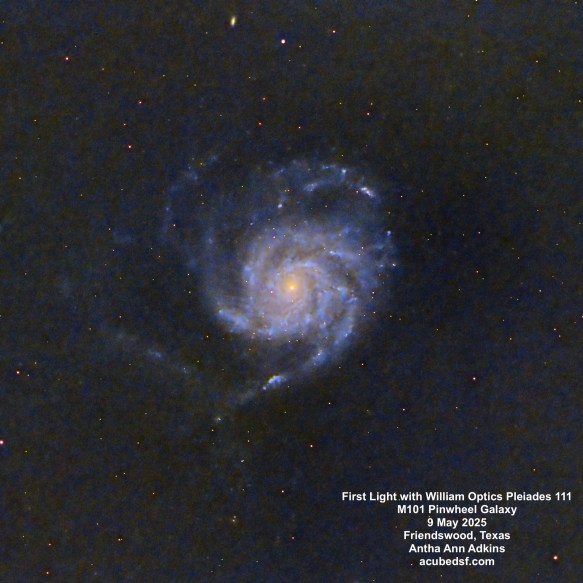
I chose M101 as my “first light” object for my new William Optics Pleiades 111 telescope, “Blue,” because it was galaxy season when I started imaging back in May and I had imaged it before so I could compare the results with my smaller telescope setup.
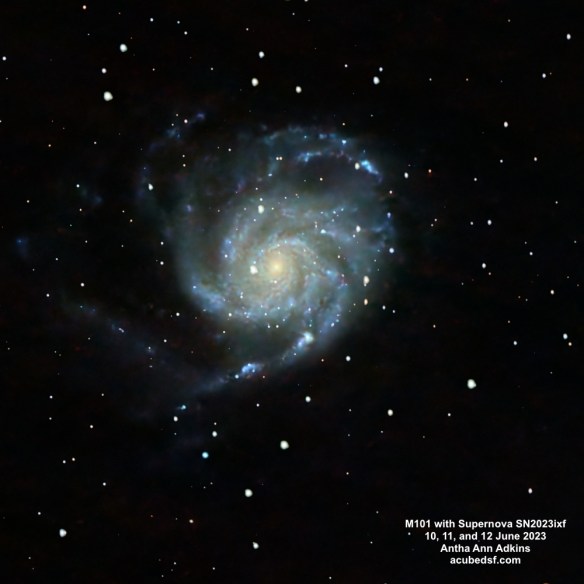
My oldest comparison image is from June 2023, when there was a supernova in the galaxy. I collected the data from the fabulous dark skies in Dell City, Texas, using my William Optics Zenith Star 73 III APO telescope and a Canon 60D camera. The image was made from 10.6 hours of data.
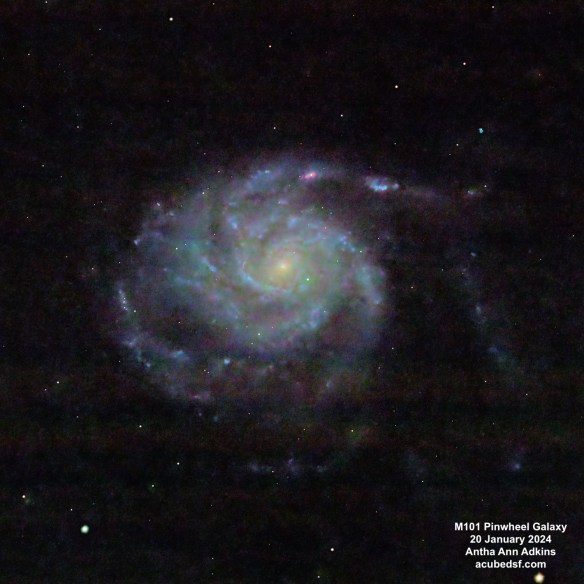
My next comparison image is from January 2024. I collected the data from Friendswood, Texas with suburban light pollution using my William Optics Zenith Star 73 III APO telescope and my at-the-time new ZWO ASI183MM-Pro-Mono camera and ZWO filter wheel. The image was made using 59 minutes of red data, 60 minutes of green data, and 57 minutes of blue data.
My next image is from May 2025 in Friendswood, Texas, and it was the first light on my William Optics Pleiades 111 telescope “Blue” using a new guide camera and using my existing ZWO ASI183MM-Pro-Mono camera. The image used only 52 minutes of red data, 66 minutes of green data, and 86 seconds of blue data, and I had to adjust some of the local normalization parameters to accept lower quality data to get it to process. I had been excited to have a semi-clear night, so I had gotten the telescope out even though seeing wasn’t great.
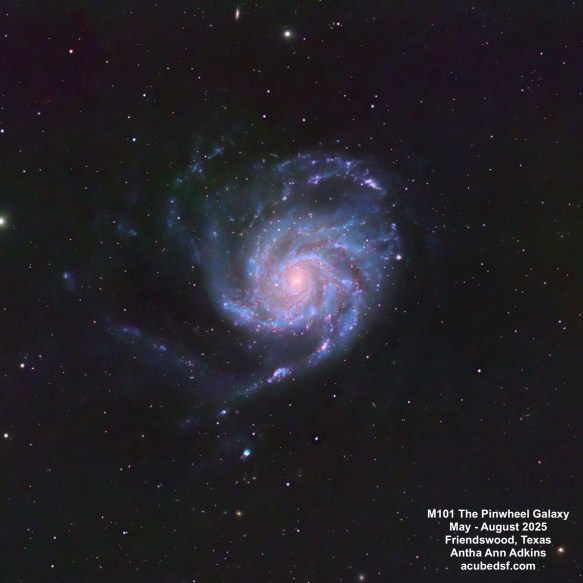
My final (for now) image is from May – August 2025 in Friendswood, Texas. The new telescope cloud curse has been particularly strong with this telescope, and when there weren’t clouds, there was dust or a full Moon. Nevertheless, I persevered over 8 nights to produce the final image, ending up using 5.9 hours of red data, 5.3 hours of green data, and 4.8 hours of blue data.
There was a huge improvement in the detail (most obvious with the stars) when I switched to the astrocamera, and another huge improvement in the detail (most obvious in the galaxy and in the background galaxies) when I switched to the larger telescope and guiding capability.
My main subject, M101, the Pinwheel Galaxy, is an intermediate spiral galaxy, between a barred and an unbarred spiral galaxy. It’s located approximately 23.2 million light years away, and it has an apparent size of 24 arcminutes, making it about 162 thousand light years across.
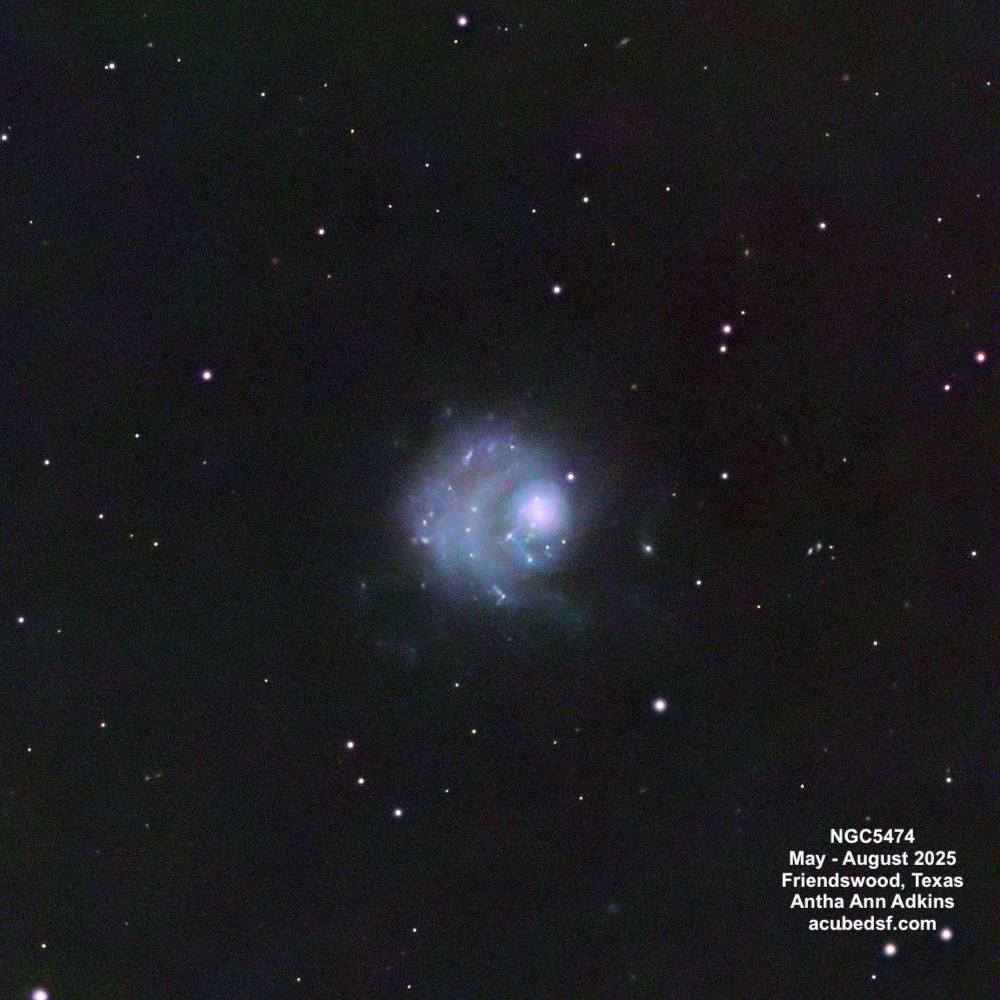
Also obvious during imaging was NGC5474, which is a peculiar dwarf galaxy that is a companion to M101. Its interaction with M101 has distorted it. It also appears to have a spiral structure, making it a dwarf spiral galaxy. It’s located approximately 22.4 million light years away, and it has an apparent size of 4.68 arcminutes, making it about 30.4 thousand light years across.
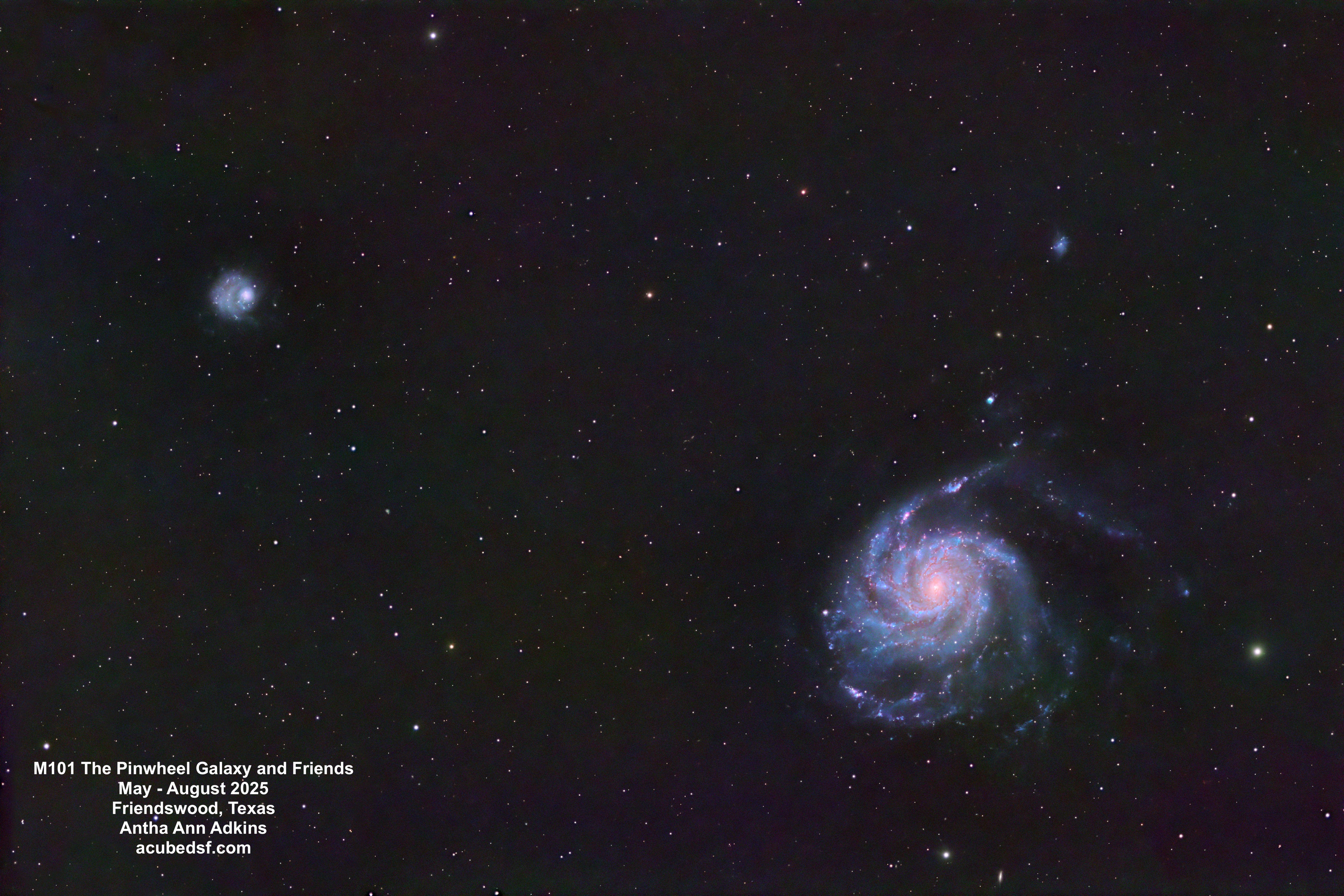
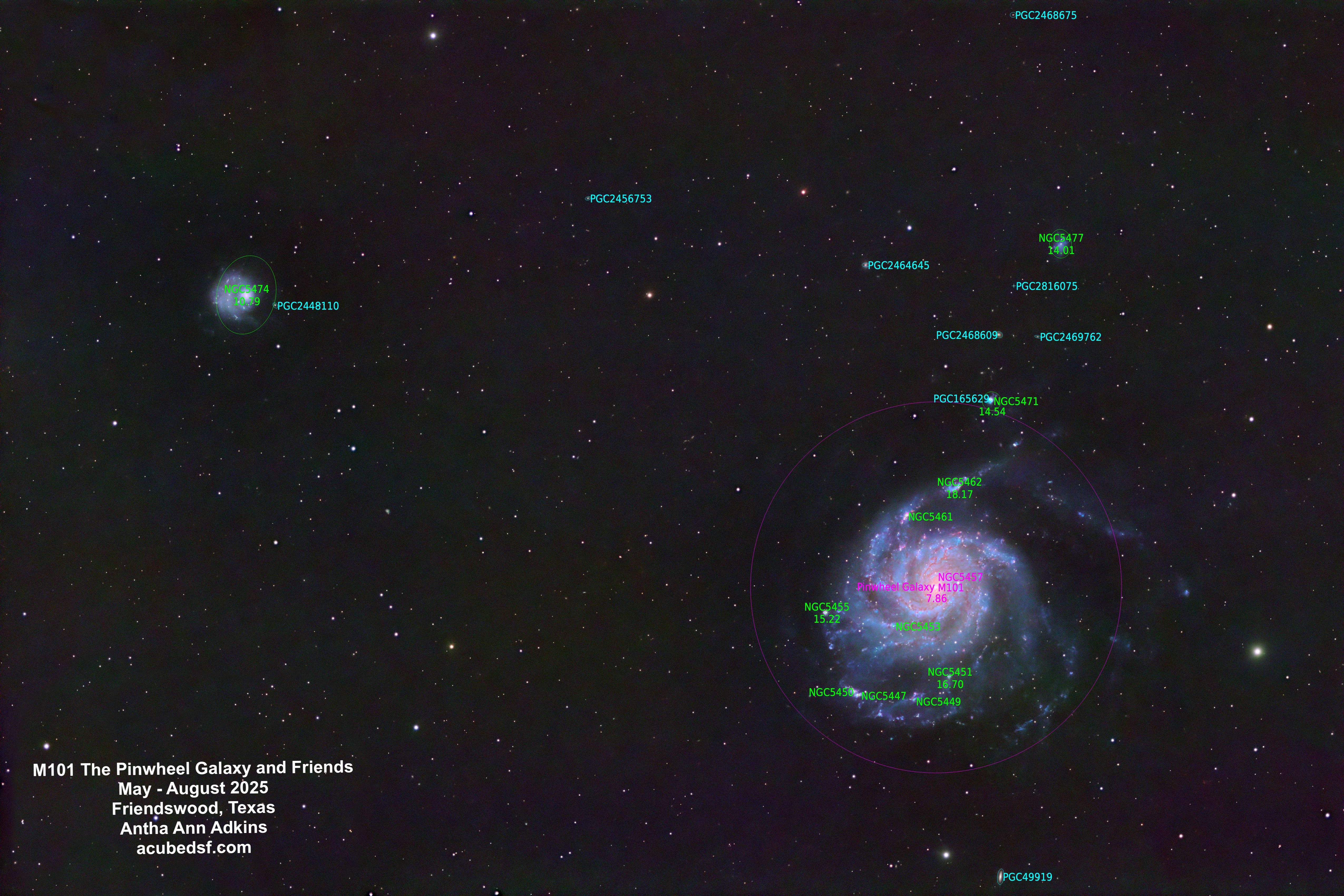
What surprised me with in the final image was the sheer number of tiny galaxies in the background. In addition to NGC5474, there was NGC5477, a dwarf galaxy which is 22.05 million light years away, with an apparent size of 1.7 arcminutes, making it 10.9 thousand light years across. PixInsight also labeled 8 other galaxies in the Principal Galaxies Catalog (PGC). And when I looked in detail at the image, there are a ton more tiny distant galaxies in the background. WOW.
Now M101 is really too low in the sky to get any good data from my driveway, so I am moving on to other subjects. I look forward to coming back to this one in the future and capturing more of the amazing background galaxies.
Our universe is packed with cool stuff!
Camera geek info for final image:
- William Optics Pleiades 111 telescope
- ZWO 2” Electronic Filter Wheel
- Antila RGB filters
- Blue Fireball 360° Camera Angle Adjuster/Rotator
- ZWO ASI183MM-Pro-Mono camera
- William Optics Uniguide 32MM F/3.75
- ZWO ASI220MM-mini
- ZWO ASiair Plus
- iOptron CEM40
- Friendswood, Texas Bortle 7-8 suburban skies
Frames for final image:
- May 9, 2025
- 13 60 second Gain 150 Red lights
- 30 0.02 second Gain 150 Red flats
- May 23, 2025
- 29 60 second Gain 150 Red lights
- 30 0.02 second Gain 150 Red flats
- May 24, 2025
- 2 60 second Gain 150 Red lights
- 30 0.02 second Gain 150 Red flats
- 54 60 second Gain 150 Green lights
- 30 0.01 second Gain 150 Green flats
- 50 60 second Gain 150 Blue lights
- 30 0.01 second Gain 150 Blue flats
- June 6, 2025
- 84 60 second Gain 150 Red lights
- 30 0.02 second Gain 150 Red flats
- 72 60 second Gain 150 Green lights
- 30 0.01 second Gain 150 Green flats
- 63 60 second Gain 150 Blue lights
- 30 0.01 second Gain 150 Blue flats
- June 7, 2025
- 100 60 second Gain 150 Red lights
- 30 0.02 second Gain 150 Red flats
- 74 60 second Gain 150 Green lights
- 30 0.01 second Gain 150 Green flats
- 63 60 second Gain 150 Blue lights
- 30 0.01 second Gain 150 Blue flats
- July 10, 2025
- 57 60 second Gain 150 Red lights
- 30 0.02 second Gain 150 Red flats
- 46 60 second Gain 150 Green lights
- 30 0.01 second Gain 150 Green flats
- July 11, 2025
- 69 60 second Gain 150 Red lights
- 30 0.02 second Gain 150 Red flats
- 23 60 second Gain 150 Green lights
- 30 0.01 second Gain 150 Green flats
- 12 60 second Gain 150 Blue lights
- 30 0.01 second Gain 150 Blue flats
- July 22, 2025
- 93 60 second Gain 150 Blue lights
- 30 0.01 second Gain 150 Blue flats
- August 1, 2025
- 51 60 second Gain 150 Green lights
- 30 0.01 second Gain 150 Green flats
- 6 60 second Gain 150 Blue lights
- 30 0.01 second Gain 150 Blue flats
- Darks, Flat darks from library
 Space&Aliens