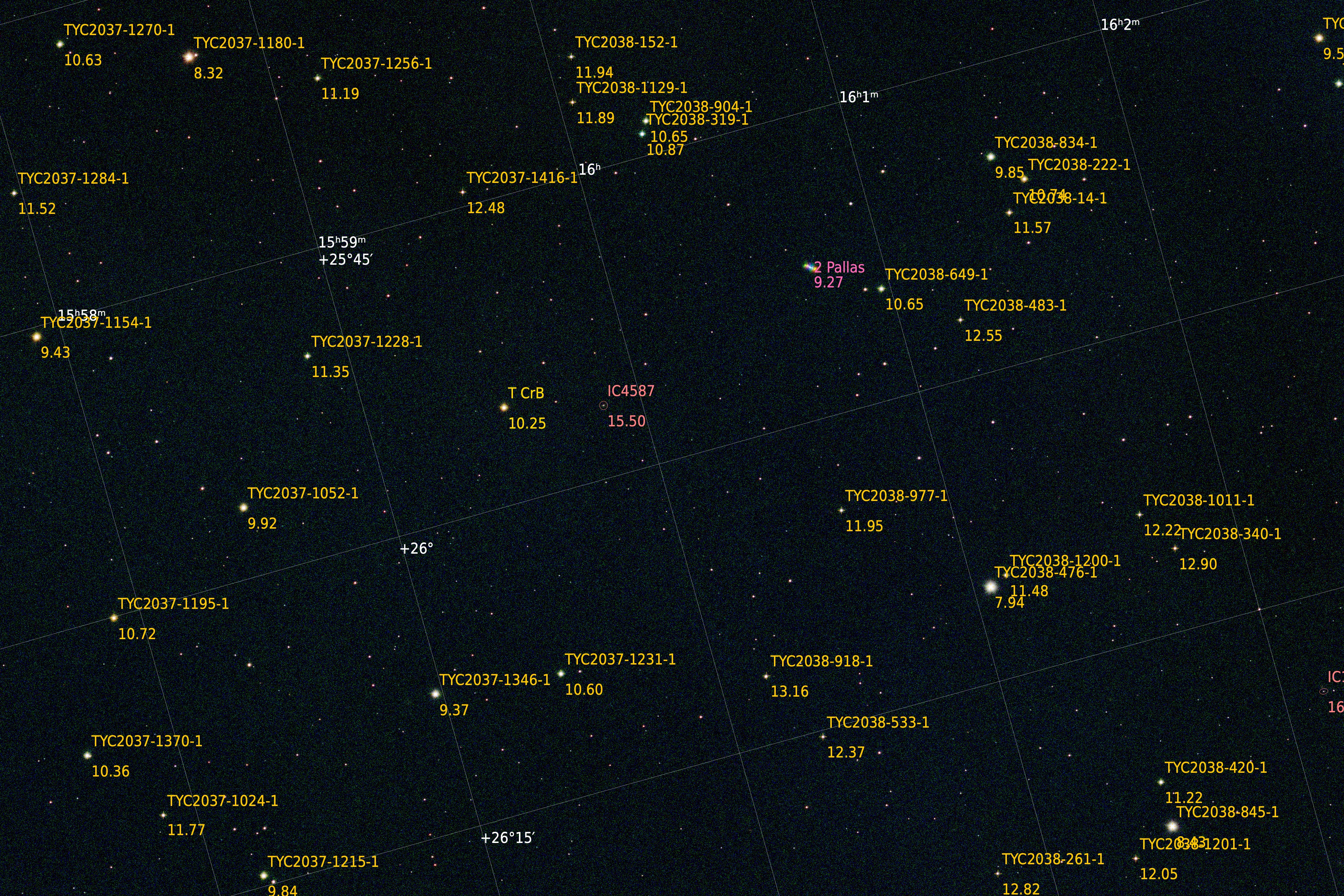
T Coronae Borealis (T CrB) (left of center in the image) is nicknamed “the Blaze Star” because it is a recurrent nova. It consists of two stars: a white dwarf and a red giant. Most of the time, the visible star is the red giant. However, over time, matter from the red giant is transferred to the atmosphere of the white dwarf, and, periodically, the white dwarf heats the matter hot enough to cause runaway fusion, rapidly making the white dwarf brighten, causing a nova event.
The last two times this star went nova were May 12, 1866 and February 9, 1946. It is expected to go nova again soon, possibly this summer.
T CrB is located in the Milky Way, approximately 2,630 light years away, so many cycles of novas may have occurred that we have not seen yet because the light hasn’t reached us! But it’s on the way!
My husband suggested that I should capture a “before” picture to compare with a picture during the nova.
I used PixInsight to annotate the image with the star magnitudes, so you can see that the magnitude for T CrB is consistent with its non-nova state (magnitude 10.25 vs its expected nova magnitude of 2 – 4).
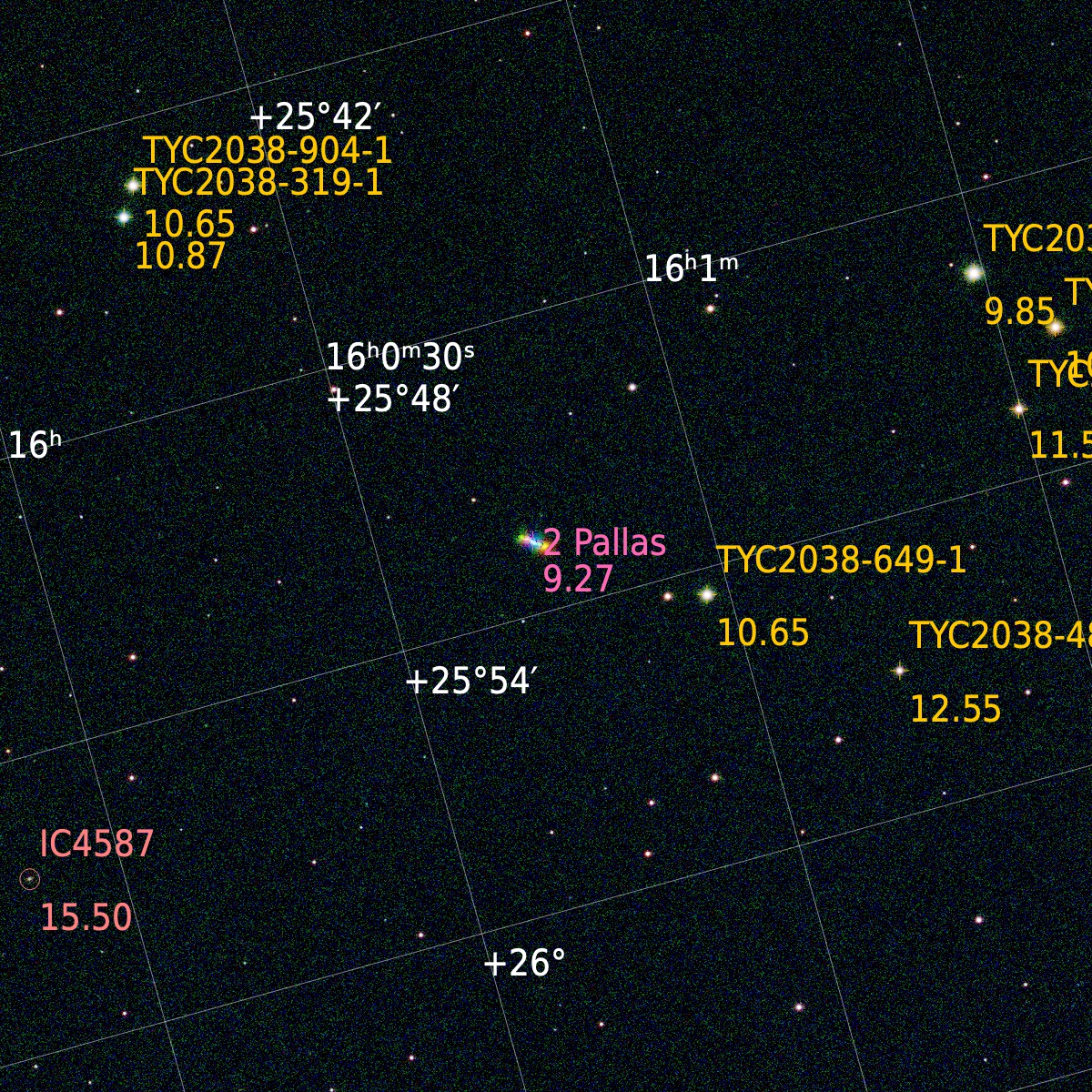
When I annotated the image, I noticed that there was a bright visible line that was not marked. I suspected, given it was a line, indicating something moving slowly across the frame, that it was an asteroid, so I added annotation for asteroids to discover that it is the asteroid 2 Pallas. The “2” in its name means it was the second asteroid to be discovered. 2 Pallas is a main belt asteroid, orbiting between Mars and Jupiter, in an unusually highly inclined (angle of orbital plane relative to the invariable plane) (Pallas’s inclination is 34.43 degrees; Vesta’s is 5.58 degrees; Earth’s is 1.58 degrees) and highly eccentric (more elliptical) orbit (Pallas’ eccentricity is 0.28; Vesta’s is 0.089; Earth’s is 0.017; 0 eccentricity is a circular orbit).
Because I am now using a monochrome camera, I have to cycle between filters to get color. I was cycling in 20 minute intervals, so the color of 2 Pallas looks like a rainbow, shifting between colors. This is not a feature of the asteroid but rather a feature of my processing, but I think it is rather fetching.
This is the first time I’ve captured an asteroid! How cool is that?
Are you looking forward to spotting the nova when it comes?
Camera geek info:
- Williams Optics Zenith Star 73 III APO telescope
- Williams Optics Flat 73A
- ZWO 2” Electronic Filter Wheel
- Antila RGB filters
- ZWO ASI183MM-Pro-Mono camera
- ZWO ASiair Plus
- iOptron CEM40
- Friendswood, Texas Bortle 7-8 suburban skies
Frames:
- June 23, 2024
- Lights
- 37 60 second Gain 150 R lights
- 28 60 second Gain 150 G lights
- 19 60 second Gain 150 B lights
- 30 0.05 second R flats
- 30 0.05 second darks
- 30 60 second darks
- Lights
Processing geek info:
- PixInsight
- BlurXterminator
 Space&Aliens