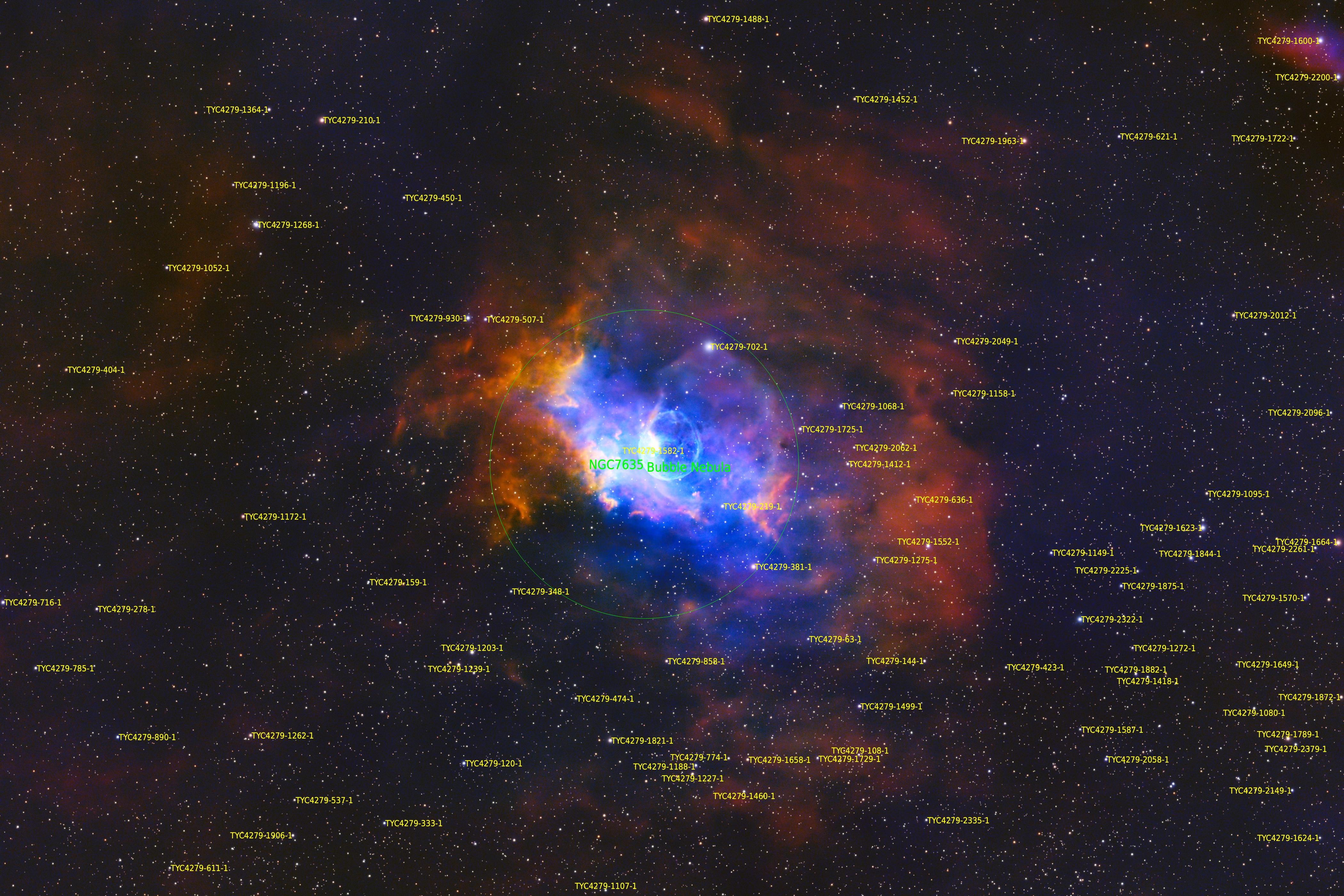
NGC7635 The Bubble Nebula

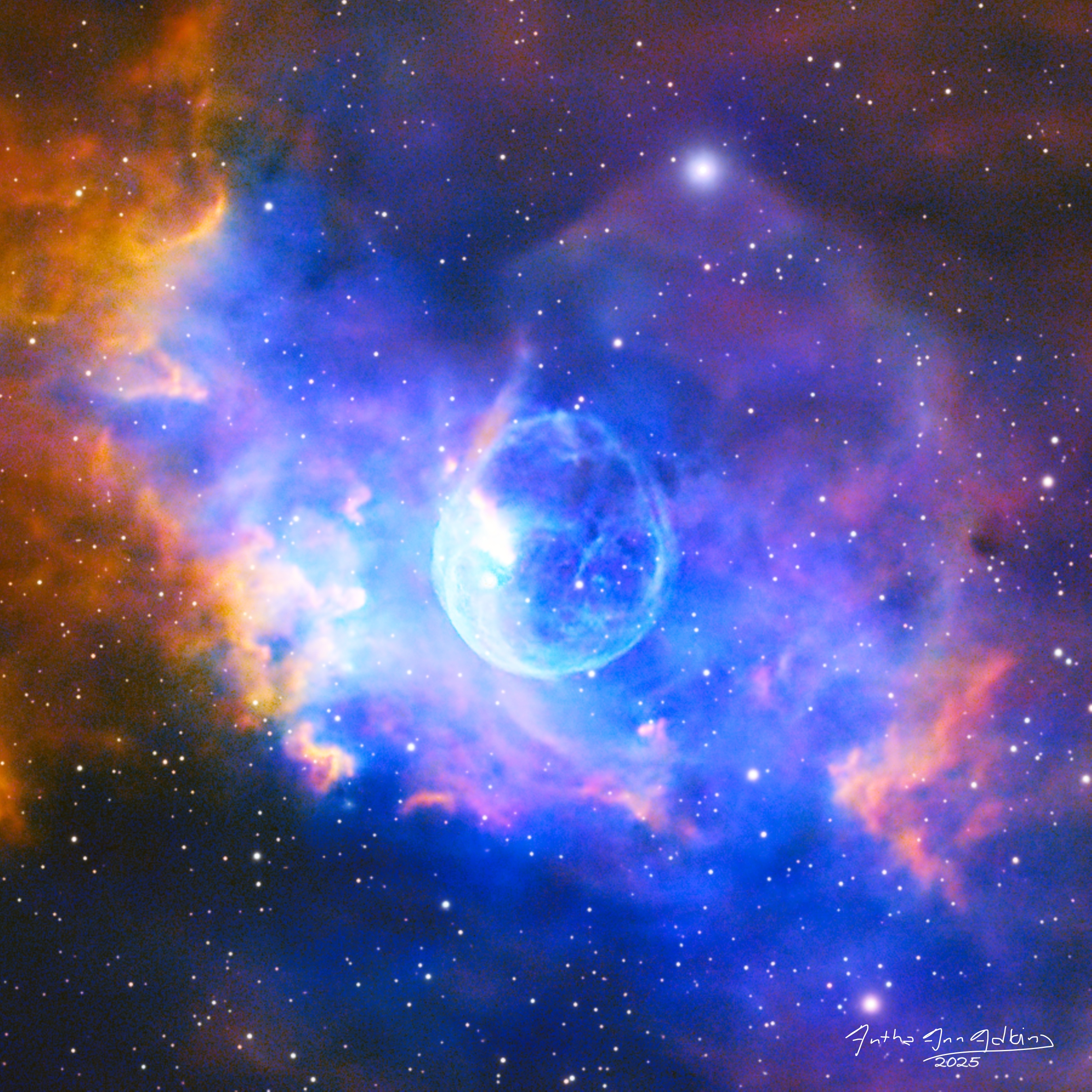
NGC7635, or the Bubble Nebula, consists of an emission nebula numbered Sharpless Sh2-162 surrounding a bubble surrounding a massive young type O star.  The emission nebula Sh2-162 is part of a molecular cloud, an interstellar cloud of gas molecules, whose density allows the formation of molecules such as molecular hydrogen (H2) and carbon monoxide (CO).  The source of energy creating the bubble and lighting up the emission nebula is the young, hot, type O star BD+60 2522.  The star is about 27 +/- 7 times the mass of the sun and 2 million years old.  The bubble is estimated to only be about 50,000 years old and is striking for appearing nearly spherical and for its star not being near its geometric center (in this image, the star is the bright white circle to the left underneath the bright white arc on the bubble’s surface).  The bubble was created by the solar wind from the star pushing the material around it into a thin, dense shell.  I found a paper from 2019 that argues that because the star is moving at a relatively high velocity and the bubble is relatively young, the star is creating a bow shock.  If the bow shock is the case, the bubble is probably closer to us than the emission nebula and moving towards it.  The bubble and nebula being significantly brighter on one side (the left side in this image) could be explained either by the bow shock or by the interstellar matter on that side being denser.  
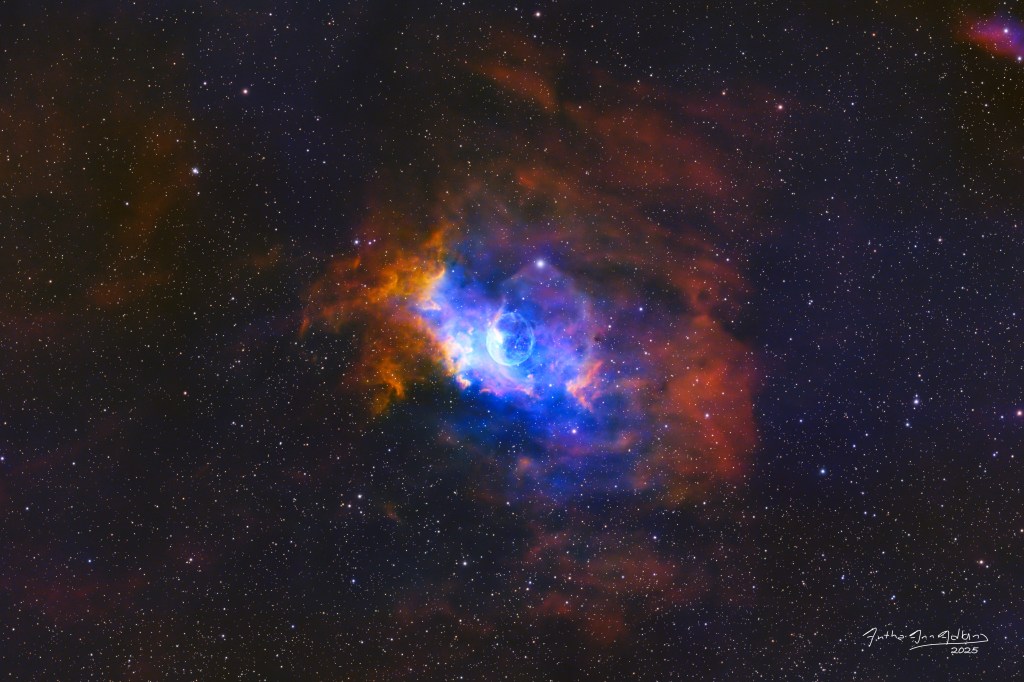
The Bubble Nebula is located in the Milky Way, approximately 8155 light years away.  The nebula has an apparent size of 0.69 degrees, so it is approximately 99 light years across.  The bubble itself is about 3 arc-minutes in diameter, so it is approximately 7 light years across.
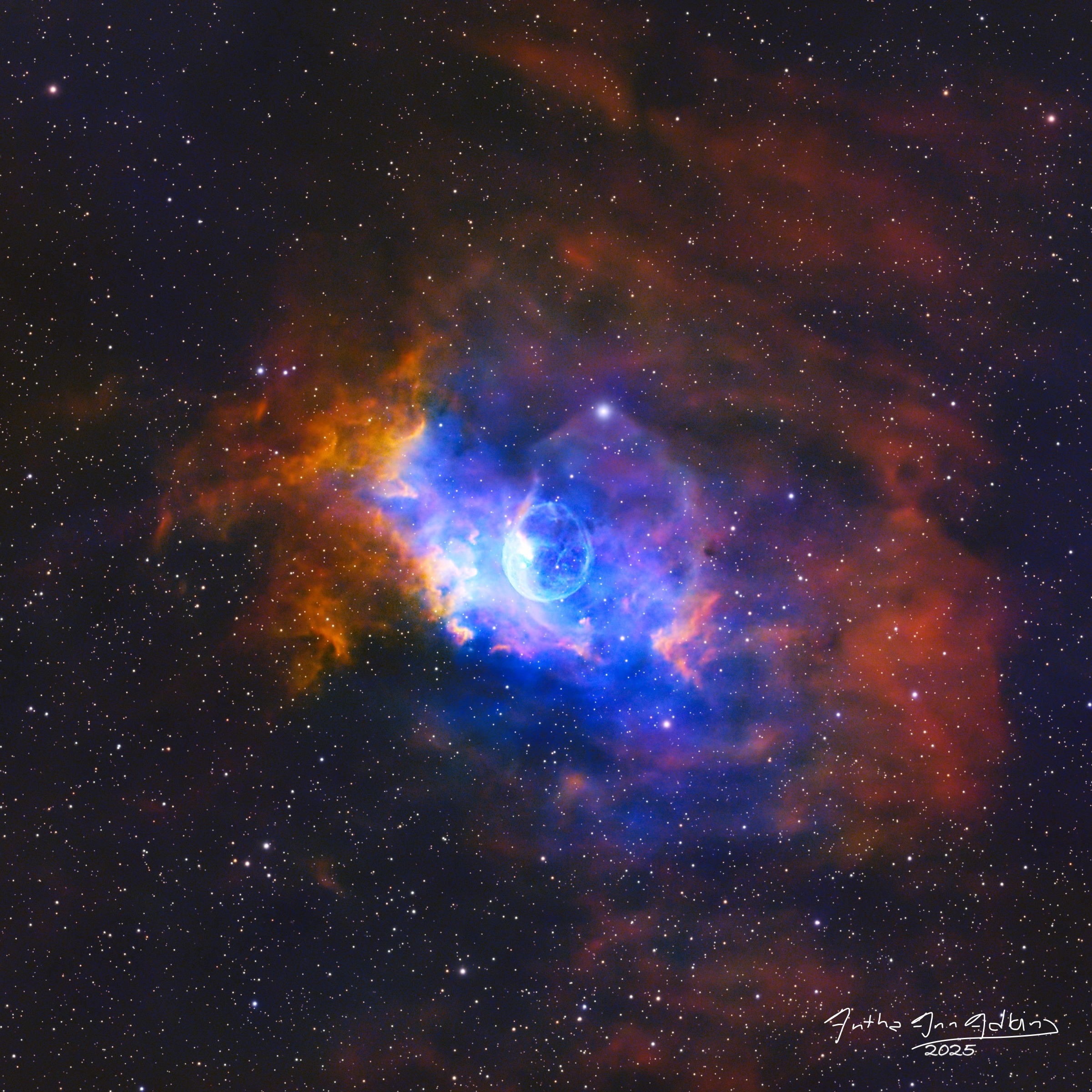
In this image, the stars came from images using red-green-blue filters with 12 to 33 minutes of data each, and the nebula came from images using Sulfer ii (7.4 hours of data mapped to red), Hydrogen alpha (2.8 hours of data mapped to green) and Oxygen iii (8.1 hours of data mapped to blue) filters, the standard SHO mapping.  But after doing that mapping, I used Narrowband Normalization to shift the colors so that it wasn’t overly green and to enhance the reds and blues.  This tool made getting the colors in this nebula look good a lot easier!  The nebula was processed separately from the stars to maximally enhance it.

I think this nebula is stunning!  We live in a universe filled with wonders.

Camera geek info – Narrowband:

  • William Optics Pleiades 111 telescope
  • ZWO 2” Electronic Filter Wheel
  • Antila SHO and RGB filters
  • Blue Fireball 360° Camera Angle Adjuster/Rotator
  • ZWO ASI183MM-Pro-Mono camera
  • William Optics Uniguide 32MM F/3.75
  • ZWO ASI220MM-mini
  • ZWO ASiair Plus
  • iOptron CEM40
  • Friendswood, Texas Bortle 7-8 suburban skies

Frames:

  • August 7, 2025
    • 56 180 second Gain 150 Ha lights
    • 30 0.5 second Gain 150 Ha flats
  • August 8, 2025
    • 4 180 second Gain 150 Oiii lights
    • 30 0.2 second Gain 150 Oiii flats
  • August 14, 2025
    • 31 180 second Gain 150 Oiii lights
    • 30 0.2 second Gain 150 Oiii flats
  • August 16, 2025
    • 42 180 second Gain 150 Oiii lights
    • 30 0.2 second Gain 150 Oiii flats
  • September 4, 2025
    • 50 180 second Gain 150 Sii lights
    • 30 0.5 second Gain 150 Sii flats
  • September 11, 2025
    • 55 180 second Gain 150 Oiii lights
    • 30 0.2 second Gain 150 Oiii flats
  • September 12, 2025
    • 65 180 second Gain 150 Sii lights
    • 30 0.5 second Gain 150 Sii flats
  • September 13, 2025
    • 100 20 second Gain 150 Red lights
    • 30 0.02 second Gain 150 Red flats
    • 35 20 second Gain 150 Green lights
    • 30 0.01 second Gain 150 Green flats
    • 51 20 second Gain 150 Blue lights
    • 30 0.01 second Gain 150 Blue flats
  • October 25, 2025
    • 30 180 second Gain 150 Oiii lights
    • 30 0.2 second Gain 150 Oiii flats
    • 33 180 second Gain 150 Sii lights
    • 30 0.5 second Gain 150 Sii flats
  • 30 Flat Darks matching flat durations from library
  • 30 Darks matching light durations from library

Processing geek info:

  • PixInsight
  • BlurXterminator
  • NoiseXterminator
  • StarXTerminator
  • Narrowband Normalization

Capturing a new supernova in another galaxy: NGC7331 and SN2025rbs

Usually I don’t image on work nights so I get enough sleep.

However, the new telescope cloud curse has been strong, and I’ve only had a few clear nights since I bought my new William Optics Pleiades 111 telescope “Blue” earlier this year.  So when it was finally clear on Tuesday, I couldn’t resist taking my new telescope outside.  I continued to collect data on M101, but I had learned through a Facebook post that there was a new supernova in the galaxy NGC7331.  So after M101 set, I spent the rest of the night imaging NGC7331.

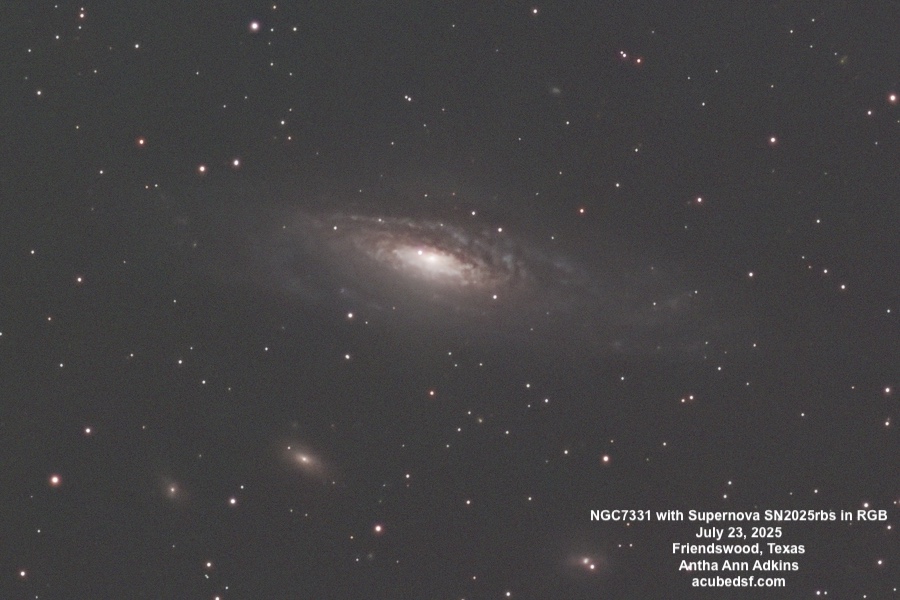
NGC7331 is an unbarred spiral galaxy.  It’s located approximately 47 million light years away, and it has an apparent size of 10.47 arcminutes, making it about 144 thousand light years across.  One paper on this galaxy argues that its central bulge rotates in the opposite direction of its outer disk – weird!  Another argues that the stars in the central bulge are old – 13 billion years old, while the stars in the disk are young – possibly 0.2 billion years old.  (This may not be unusual; our own galaxy is still making stars in its outer arms right now, which I also think is really cool.)  

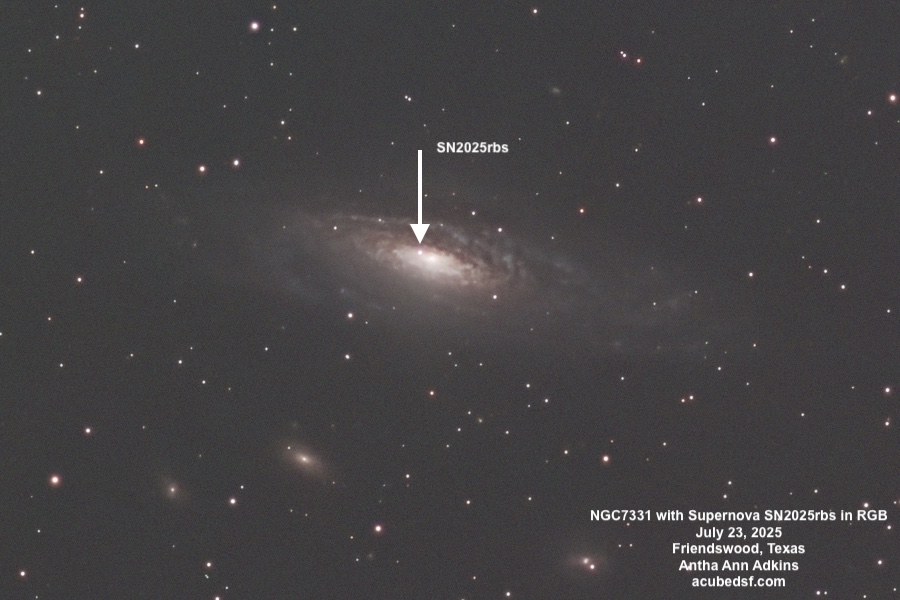
Supernova 2025rbs is a Type 1A supernova, which occurs when a white dwarf star collects material from a companion star, almost reaches the Chandrasekar mass, starts fusing carbon, experiences a runaway reaction, and explodes, releasing an enormous, but predictable, amount of energy.  Type 1A supernovas can be used as standard candles to measure the distance to the supernova (and in cases like SN2025rbs the distance to the home galaxy) because the energy they release and thus their brightness is predictable.  SN2025rbs was discovered by the Gravitational-wave Optical Transient Observer (GOTO) on July 14, 2025.

You can clearly see SN2025rbs as a bright spot near the galaxy center.  In fact, it appears to outshine the galaxy center, which I find amazing.  

When I imaged this, I deliberately used short capture times (15 seconds) so that the bright supernova would not “blow out” and clip to pure white or cause “pixel bloom” where the light overwhelms the pixel capturing it and so bleeds into the nearby pixels.  

I spent a fair bit of time thinking about how this image “should” be processed.  On the one hand, I wanted to preserve the relative amount of light and color for the supernova relative to both the star field and NGC7331, its host galaxy.  On the other hand, astroimages are inherently low-light and high dynamic range, which means that the data has to be non-linearly stretched to show both the relatively bright supernova and stars and the relatively dim galaxy.  

My standard PinInsight processing flow includes using BlurXTerminator (BXT) to sharpen the stars and non-stellar objects, NoiseXTerminator (NXT) to remove noise, and then StarXTerminator (SXT) to separate the stars from the non-stellar objects so they can be stretched separately.

I considered whether I should skip the BXT processing step.  BXT sharpens the stars and makes them smaller, and it did the same to the supernova but not the NGC7331 galactic core.  The BXT documentation says, “BlurXTerminator is trained to conserve flux, the total amount of light associated with a feature such as a star. When a blurred star is made less blurry, the light from some number of pixels is concentrated into a smaller number of pixels. Those pixels must get brighter for the total amount of flux to be the same.”  Based on that statement, I think since BXT preserves the amount of light in each star, it also preserves the relative amount of light between the stars and between the stars and the supernova (assuming none of them are clipped because they exceed the max brightness level, which did not happen in this case).  Further, since stars (and supernovae) are point sources of light and with perfect seeing and optics would only be “seen” in one pixel, using BXT to sharpen the stars and the supernova should be making them more like their “true” amount of light relative to the galaxy as well.  So I left the BXT step in my processing flow.

I also considered whether I should skip the SXT step and stretch the stars, supernova, and galaxies together or use SXT and stretch them separately.  Either way, there is no longer a linear relationship between the brightness of the objects.  If I processed this as a single image, the brightness ordering – what is brighter than what – would be maintained.  If I used SXT so I could stretch the galaxies separately, I could end up making the galaxy core brighter than the supernova, even though it was not in the raw data.  On the other hand, I could show more detail in the galaxy if I processed it separately.  I ended up deciding that, in this case, what was most important to me was to maintain the brightness order and show that the supernova was brighter than the galactic core.  So I processed it as a single image.

My final PixInsight processing flow was:

  • WBPP to calibrate, normalize, and integrate three channels of RGB data
  • ChannelCombination to combine the RGB channels into a single image
  • DBE to remove the excess blue in the background
  • SPCC to calibrate the color
  • BXT to sharpen the stars and the galaxy
  • NXT to to remove some noise since this is only a few hours worth of data from my Bortle 7-8 light polluted skies
  • Histogram Transformation to stretch the image

At some point, I’d like to collect more data on this galaxy and make a nicer picture of it.  But the clouds are back now.  The curse continues …   

Camera geek info:

  • William Optics Pleiades 111 telescope
  • ZWO 2” Electronic Filter Wheel
  • Antila RGB filters
  • Blue Fireball 360° Camera Angle Adjuster/Rotator
  • ZWO ASI183MM-Pro-Mono camera
  • William Optics Uniguide 32MM F/3.75
  • ZWO ASI220MM-mini
  • ZWO ASiair Plus
  • iOptron CEM40
  • Friendswood, Texas Bortle 7-8 suburban skies

Frames:

  • Lights
    • 248 15 second Gain 150 Red lights  (62 minutes)
    • 182 15 second Gain 150 Green lights (45.5 minutes)
    • 168 15 second Gain 150 Blue lights (42 minutes)
    • 30 0.2 second Gain 150 Red flats
    • 30 0.1 second Gain 150 Green flats
    • 30 0.1 second Gain 150 Blue flats
  • Darks, Flat darks from library

NGC 2237: Rosette Nebula: Natural Palette vs SHO Palette

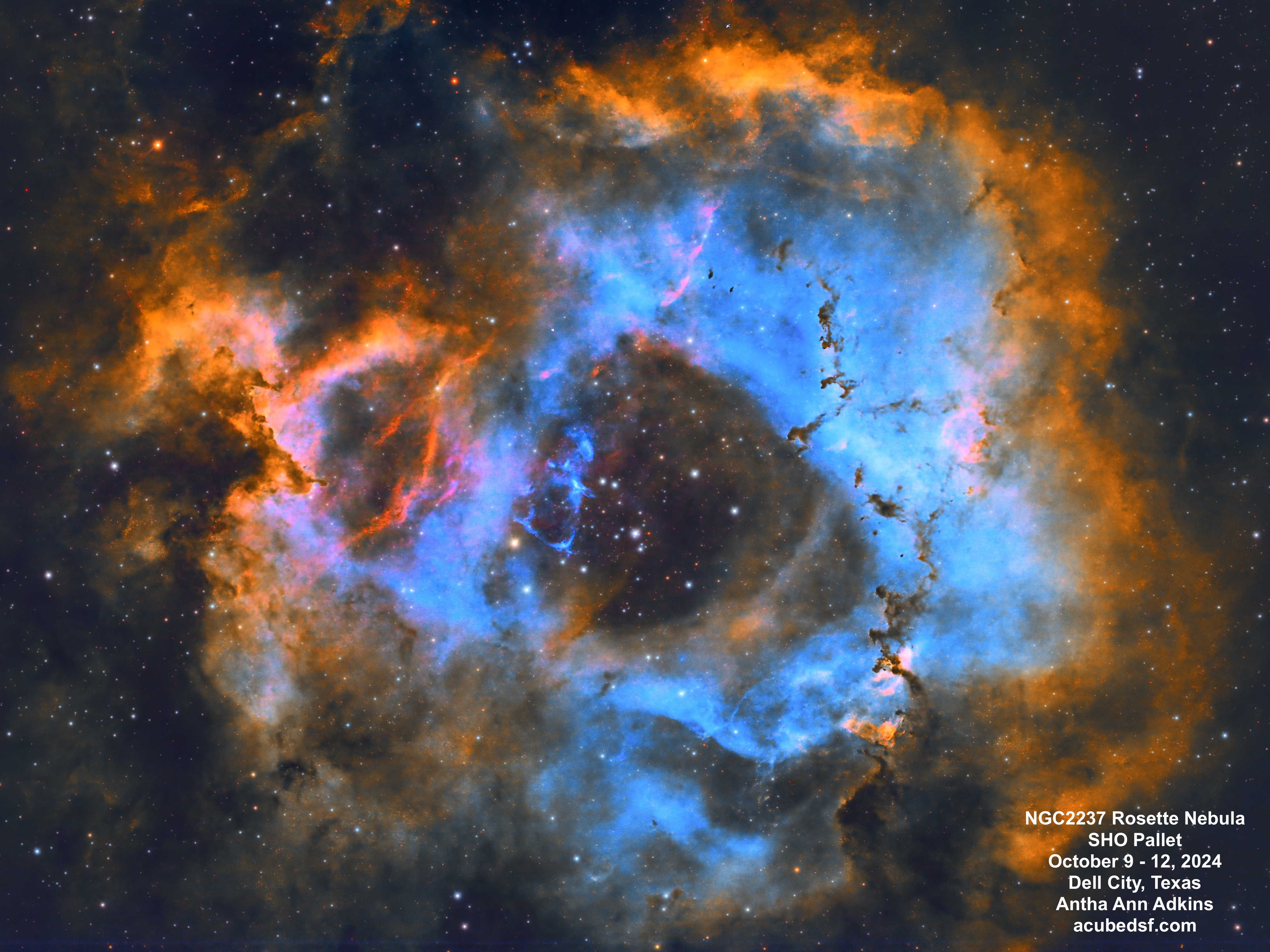
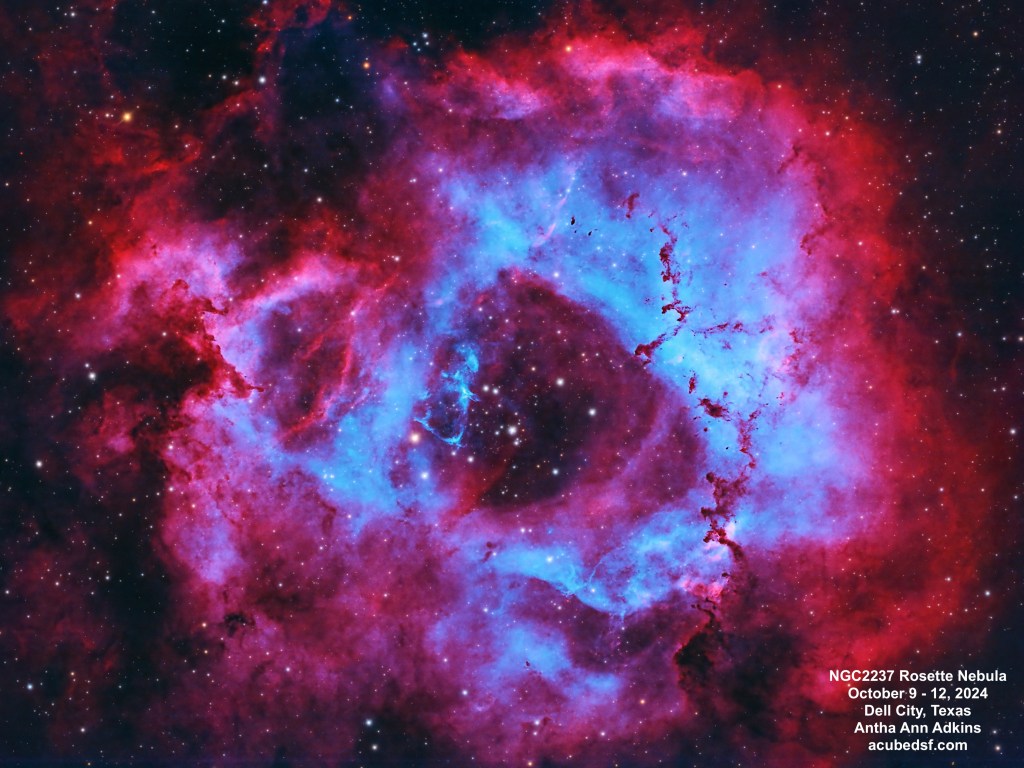
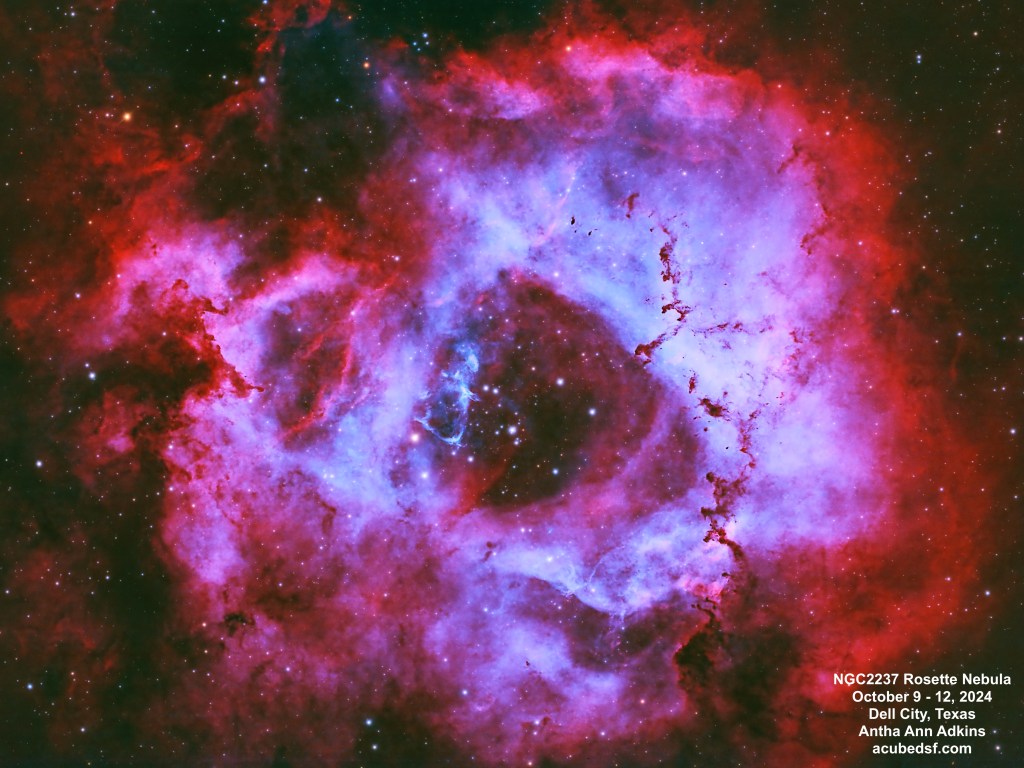
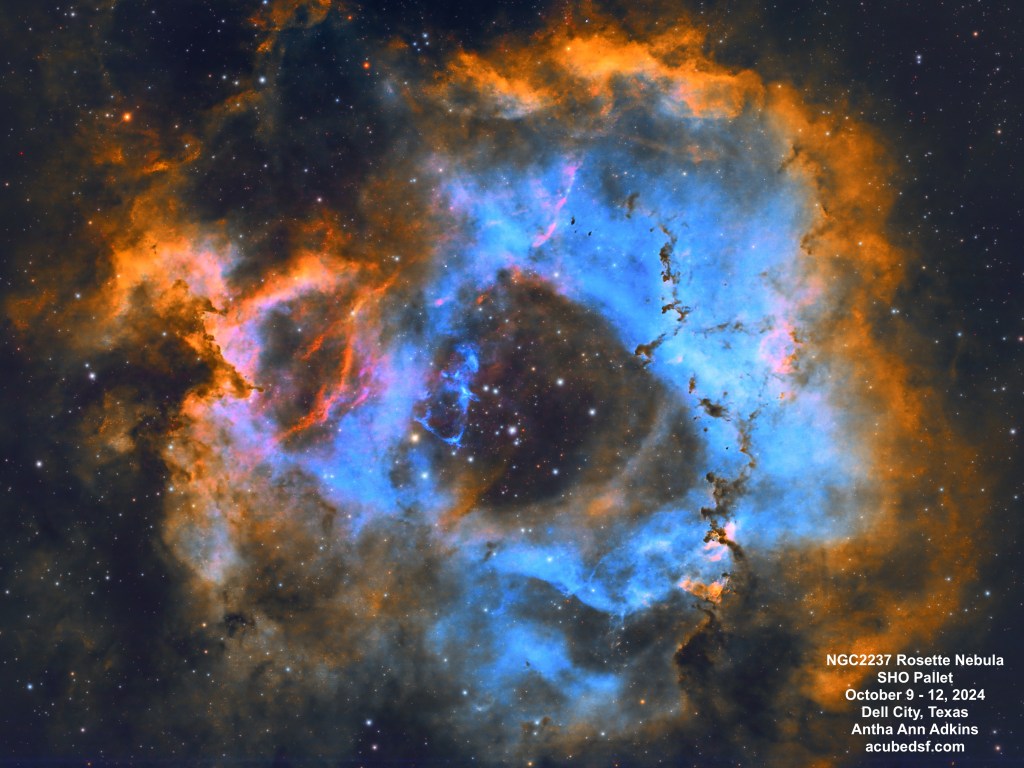
The Rosette Nebula, also numbered New General Catalogue (NGC) 2237 or Caldwell 49, is an emission nebula.  It is a large star-forming region containing the NGC2244 (Caldwell 50) star cluster in its center.  The star cluster was made from the gases in the nebula and contains some massive type O stars, which in turn produce radiation and stellar wind that blow away and light up the nebula around them.  The stars in this cluster are young, less than 5 million years old.  The Rosette Nebula is located in the Milky Way, approximately 5200 light years away, and it has an apparent size of 1.3 degrees, so it is approximately 120 light years across.    

When we visit the lovely dark skies of Dell City, Texas, I try to collect data on some challenging objects that I don’t think I can do from my light-polluted driveway.  I’m not always successful in meeting the challenge (super dim objects take a lot of hours of data to image), so I also try to collect data on some brighter objects so I know I’ll come home with some nice images.  The Rosette Nebula was my choice for one of my “sure it will be nice” images from our last trip. 

I think it is a stunning nebula.  I processed the data using two different palettes, ending up with three different versions.  The first palette, a “natural” palette, maps H-alpha (which is red) to red, Sii (which is also red) to a more pink color, and Oiii (which is blue) to purple/blue.  I tried different weightings/emphasis of the colors and ended up with one version where the nebula center is more blue and one version where the nebula center is more purple.  The second palette, the “Hubble” palette or SHO palette, maps Sii to red, H-alpha to green, and Oiii to blue (and then cuts out most of the green).  I also tried different weightings/emphasis of the colors, and I ended up with one version I liked the best.  I like the colors in the “natural” palette, but I think the Hubble palette does a better job of showing off the details of the nebula.

Which version do you like the best?

Camera geek info – Narrowband:

  • Williams Optics Zenith Star 73 III APO telescope
  • Williams Optics Flat 73A
  • ZWO 2” Electronic Filter Wheel
  • Antila SHO and RGB filters
  • ZWO ASI183MM-Pro-Mono camera
  • ZWO ASiair Plus
  • iOptron CEM40
  • Dell City, Texas Bortle 2-3 dark skies

Frames:

  • October 9, 2024
    • 135 60 second Gain 150 Oiii lights
    • 30 0.5 second Gain 150 Oiii flats
  • October 10, 2024
    • 129 60 second Gain 150 Ha lights
    • 30 0.2 second Gain 150 Ha flats
  • October 11, 2024
    • 27 60 second Gain 150 Red lights
    • 30 0.05 second Gain 150 Red flats
    • 26 60 second Gain 150 Green lights
    • 30 0.02 second Gain 150 Green flats
    • 25 60 second Gain 150 Blue lights
    • 30 0.02 second Gain 150 Blue flats
  • October 12, 2024
    • 129 60 second Gain 150 Sii lights
    • 30 1 second Gain 150 Sii flats
  • 30 Flat Darks from library
  • 30 Darks from library

Processing geek info:

  • PixInsight
  • BlurXterminator
  • NoiseXterminator
  • StarXTerminator
  • Generalized Hyperbolic Stretch

NGC6357 The Lobster Nebula or the Bug-Eyed Monster Nebula

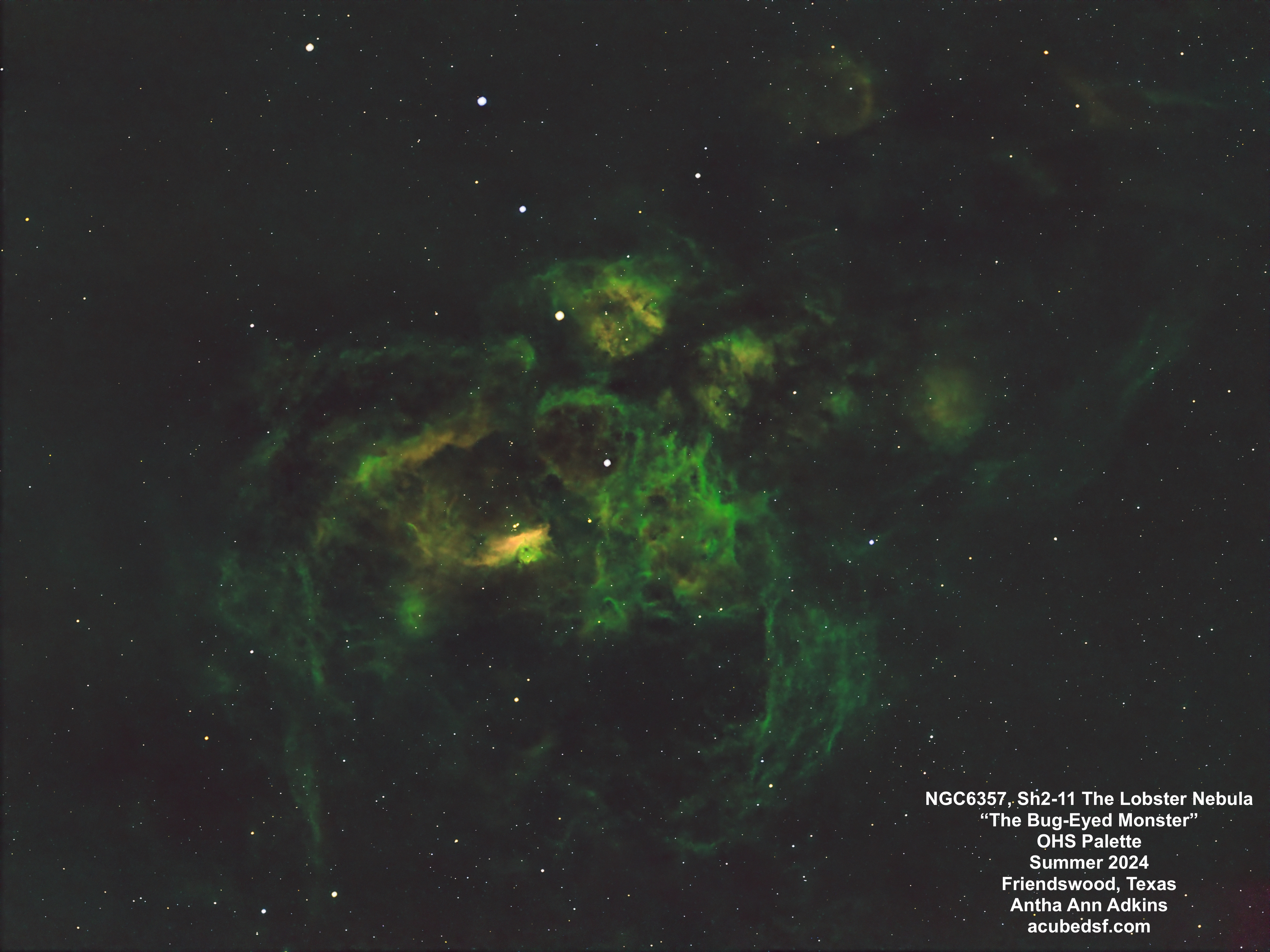
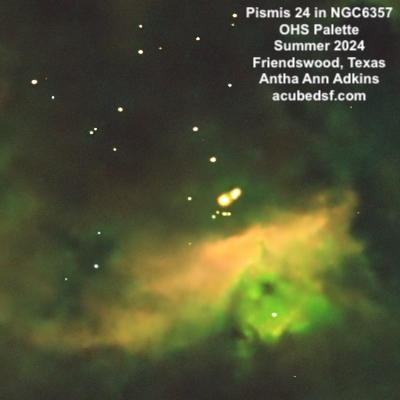
NGC6357, the Lobster Nebula, is an emission nebula.  It is a large star-forming region containing three star clusters, many young stars, and some massive stars.  One cluster is Pismis 24, located just above the bright blue core in this picture.  The stars in this cluster are about 1 million years old and four are massive – 40 – 120x the mass of our sun, among the most massive stars in our galaxy.  The Lobster Nebula is located in the Milky Way, approximately 5550 light years away, and it has an apparent size of 60 x 45 arc min, so it is approximately 97 x 73 light years across.    

From my driveway, the Lobster Nebula is low to the South and is only visible for a short time from when it rises above my house to when it goes behind the pine tree.  So it took many nights of data collection to get enough data to make this image – 12.2 hours of data collected over 13 nights.  And it would still benefit from more!  I may collect more data the next time we visit the dark skies of Dell City, Texas, where I have an unimpeded view to the South.  But, until then, I have declared the end of Lobster season!

Although NGC6357 is traditionally named the Lobster Nebula, I think it looks like a bug-eyed monster.  And a bug-eyed monster should be green with a red core and have red eyes.  So in addition to the traditional Hubble SHO (Sii mapped to red, Ha to green, and Oiii to blue), I also made a version using a OHS (Oiii mapped to red, Ha to green, and Sii to blue) palette.  I thought this version produced a nice contrast in the pillar in the core near the Pismis 24 cluster.

Which color palette do you like better?

Camera geek info – Narrowband:

  • Williams Optics Zenith Star 73 III APO telescope
  • Williams Optics Flat 73A
  • ZWO 2” Electronic Filter Wheel
  • Antila SHO filters
  • ZWO ASI183MM-Pro-Mono camera
  • ZWO ASiair Plus
  • iOptron CEM40
  • Friendswood, Texas Bortle 7-8 suburban skies

Frames:

  • June 7, 2024
    • 106 60 second Gain 150 Ha lights
    • 30 0.05 second Gain 150 Ha flats
  • June 8, 2024
    • 51 60 second Gain 150 Oiii lights
    • 30 0.05 second Gain 150 Oiii flats
  • June 13, 2024
    • 73 60 second Gain 150 Sii lights
    • 30 0.05 second Gain 150 Sii flats
  • June 14, 2024
    • 82 60 second Gain 150 Sii lights
    • 30 0.05 second Gain 150 Sii flats
  • June 15, 2024
    • 81 60 second Gain 150 Oiii lights
    • 30 0.05 second Gain 150 Oiii flats
  • June 28, 2024
    • 69 60 second Gain 150 Oiii lights
    • 30 0.05 second Gain 150 Oiii flats
  • June 29, 2024
    • 37 60 second Gain 150 Sii lights
    • 30 0.05 second Gain 150 Sii flats
  • July 3, 2024
    • 51 60 second Gain 150 Ha lights
    • 30 0.05 second Gain 150 Ha flats
  • August 6, 2024
    • 13 60 second Gain 150 Oiii lights
    • 30 0.05 second Gain 150 Oiii flats
  • August 8, 2024
    • 61 60 second Gain 150 Oiii lights
    • 30 0.05 second Gain 150 Oiii flats
  • August 6, 2024
    • 37 60 second Gain 150 Oiii lights
    • 30 0.05 second Gain 150 Oiii flats
  • August 6, 2024
    • 34 60 second Gain 150 Oiii lights
    • 30 0.05 second Gain 150 Oiii flats
  • August 6, 2024
    • 36 60 second Gain 150 Oiii lights
    • 30 0.05 second Gain 150 Oiii flats
  • 30 Flat Darks from library
  • 30 Darks from library

Processing geek info:

  • PixInsight
  • BlurXterminator
  • NoiseXterminator
  • StarXTerminator
  • Generalized Hyperbolic Stretch
  • NBColourMapper

NGC 2359 Thor’s Helmet: New Narrowband and Reprocessed RGB Images

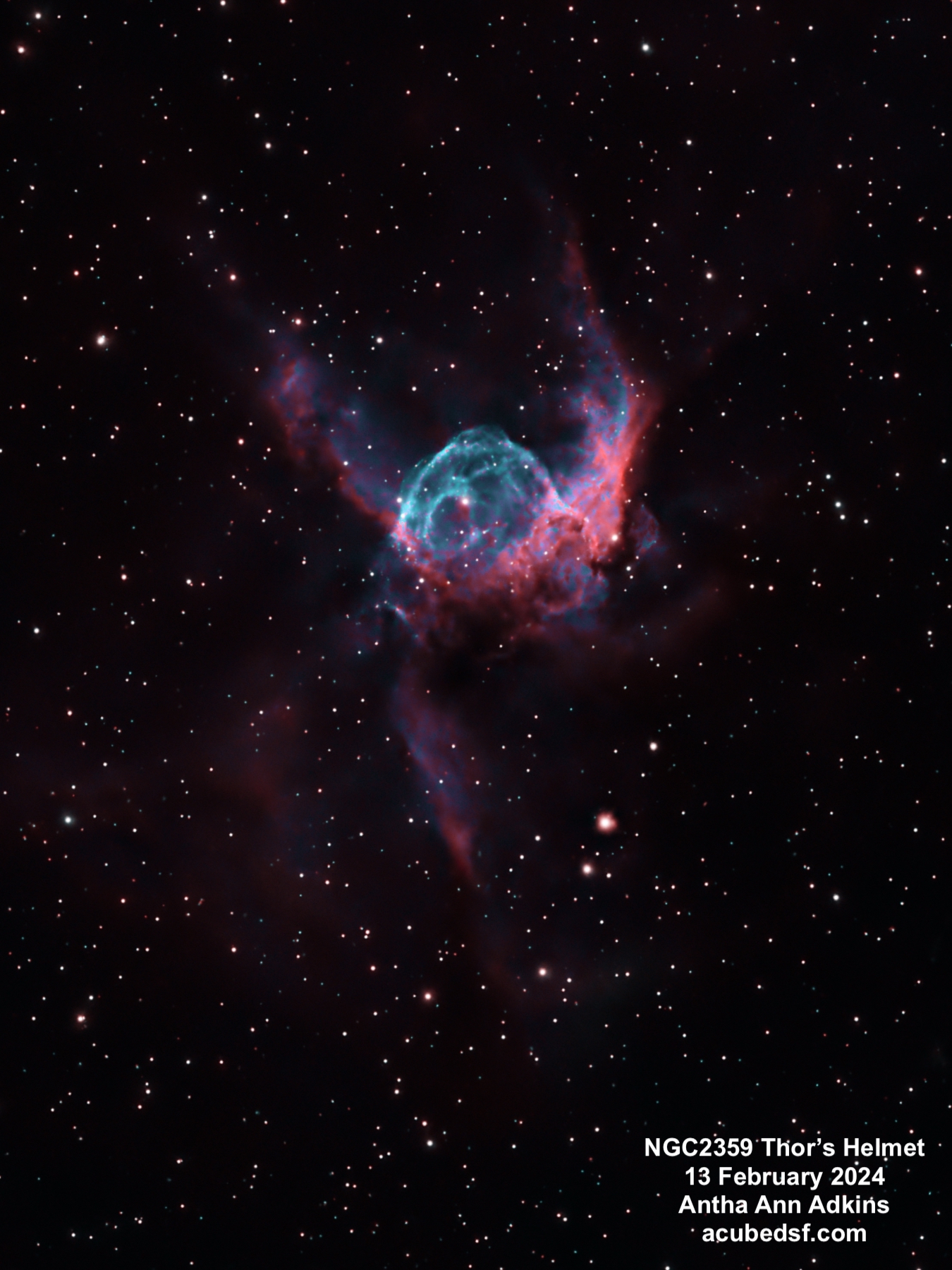
NGC 2359, also called Thor’s Helmet, is an emission nebula – in this case a planetary nebula of ionized gas around a hot central star, Wolf-Rayet WR7.  WR7 is a massive star which has shed matter, and then its stellar wind has blown and compressed that matter into a bubble, and its UV radiation has ionized it to make the beautiful nebula we see.  This planetary nebula has a very complex shape, likely due to interactions with a nearby molecular cloud.  It’s located in the Milky Way, approximately 12,900 light years away, and it’s approximately 30 light years across, giving it an apparent size of 16 x 8 arc min.

In our early 2024 trip to the fantastic dark skies of Dell City, Texas, I took the images used to make the picture above using two narrow band filters – H-alpha (assigned to red) and Oiii (assigned to blue).  These color assignments are close to, but not exactly, true to color.

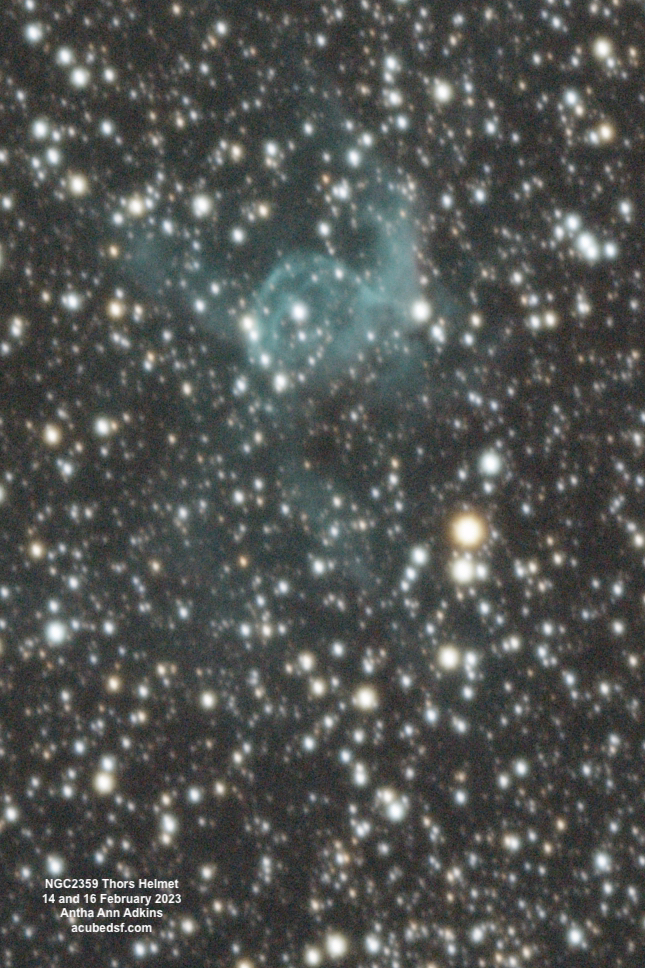
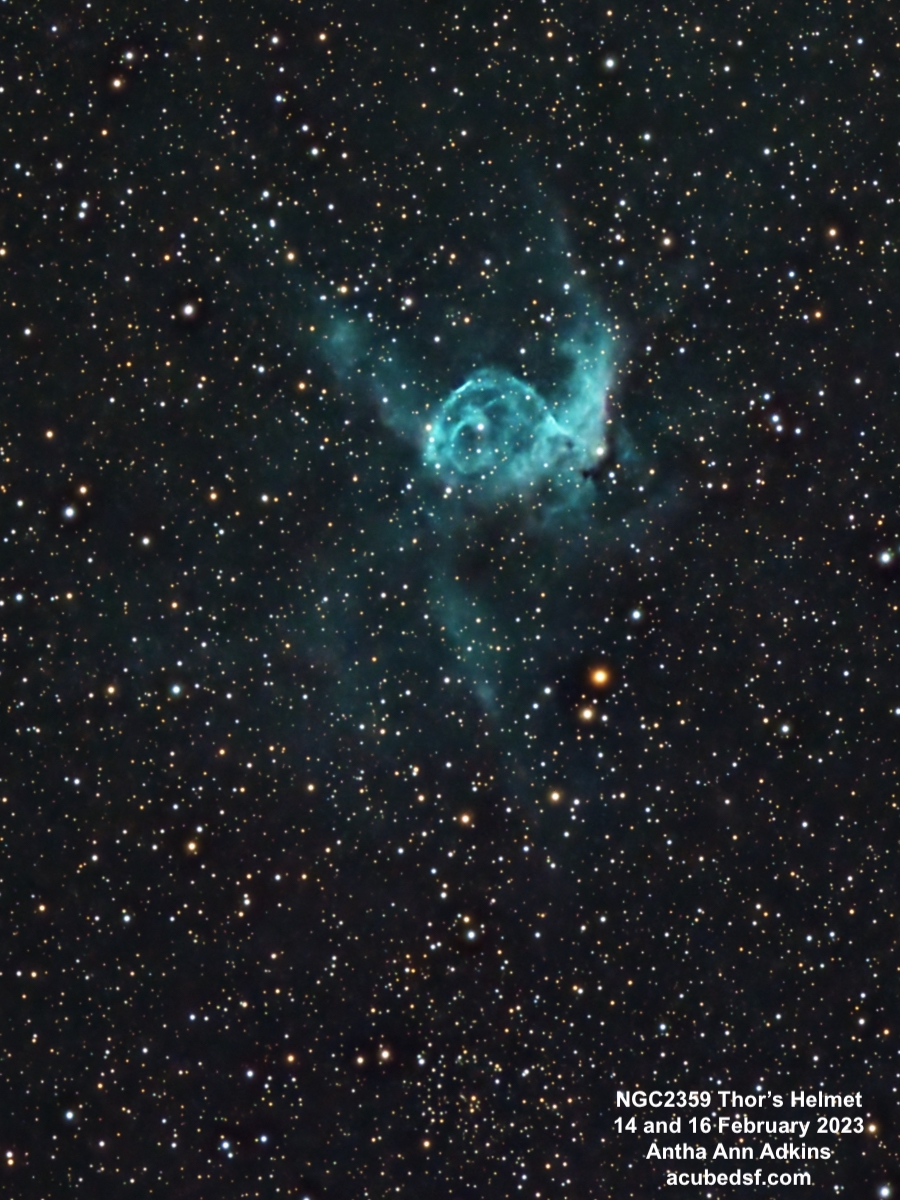
In our early 2023 trip to the fantastic dark skies of Dell City, Texas, I used a DSLR to make an RGB image of the nebula.  When I processed it last year, I hadn’t learned many of the processing techniques I use today, so I decided to reprocess it.  I was absolutely amazed at the difference processing can make (try the slider bar to see the difference!).  

I love both the narrowband version and the new RGB version.  Which do you like better?

Camera geek info – Narrowband:

  • Williams Optics Zenith Star 73 III APO telescope
  • Williams Optics Flat 73A
  • ZWO 2” Electronic Filter Wheel
  • Antila SHO filters
  • ZWO ASI183MM-Pro-Mono camera
  • ZWO ASiair Plus
  • iOptron CEM40
  • Dell City, Texas Bortle 2-3 dark skies

Frames:

  • February 13, 2024
    • HO lights
      • 45 120 second Gain 150 Ha lights
      • 35 120 second Gain 150 Oiii lights
    • 30 0.05 second Gain 150 H flats
    • 29 0.05 second Gain 150 O flats
    • 30 0.05 second flat darks
    • 30 120 second darks

Processing geek info:

  • PixInsight
  • BlurXterminator
  • NoiseXterminator
  • StarXTerminator
  • Generalized Hyperbolic Stretch
  • NBColourMapper

Camera geek info – RGB:

  • Canon EOS 60D in manual mode, 179 second exposure, ISO 2000, custom white balance 3500K
  • Williams Optics Zenith Star 73 III APO telescope
  • Williams Optics Flat 73A
  • iOptron CEM40
  • Dell City, Texas Bortle 2-3 dark skies

Frames:

  • 64 3 minute lights
  • 20 3 minute darks
  • 40 0.1 second flats
  • 40 0.1 second flat darks

Processing geek info – RGB:

  • PixInsight
  • BlurXterminator
  • NoiseXterminator
  • StarXTerminator
  • Generalized Hyperbolic Stretch