M42 The Orion Nebula and M101 the Pinwheel Galaxy: First Light with New Astrophotography Equipment

Back at the end of November, I bought some new astrophotography tools/toys: 

  • ZWO 2” Electronic Filter Wheel
  • Antila LRGBSHO filters
  • ZWO ASI183MM-Pro-Mono camera
  • ZWO ASiair Plus

Of course, as the old astrophotography joke goes, buying new tools meant we had seemingly months of cloudy skies.

Happily, this time of year meant I got to have first light with one of my favorite Deep Space Objects: M42 the Orion Nebula.

I finally got an opportunity for first light with the new equipment December 29, 2023, but the filter wheel was jammed by one of the connecting tubes (I ordered a better one) so I didn’t get any good data.  

I got a second opportunity on December 30, 2023 but I had to resort to swapping in the filters by hand, which meant bringing the telescope back inside to change out filters and restarting ASiair every time.  The resulting images ended up rotated relative to one another in such a way that I couldn’t crop out all the sections that weren’t covered by all three filters.  This wasn’t surprising since I had to unscrew all the parts to swap out filters.  I also think I may have mislabeled which set of images was which color since the result came out an odd purple color.  Rotating the color assignments seemed to fix that.  The experience gave me a real appreciation for the filter wheel! 

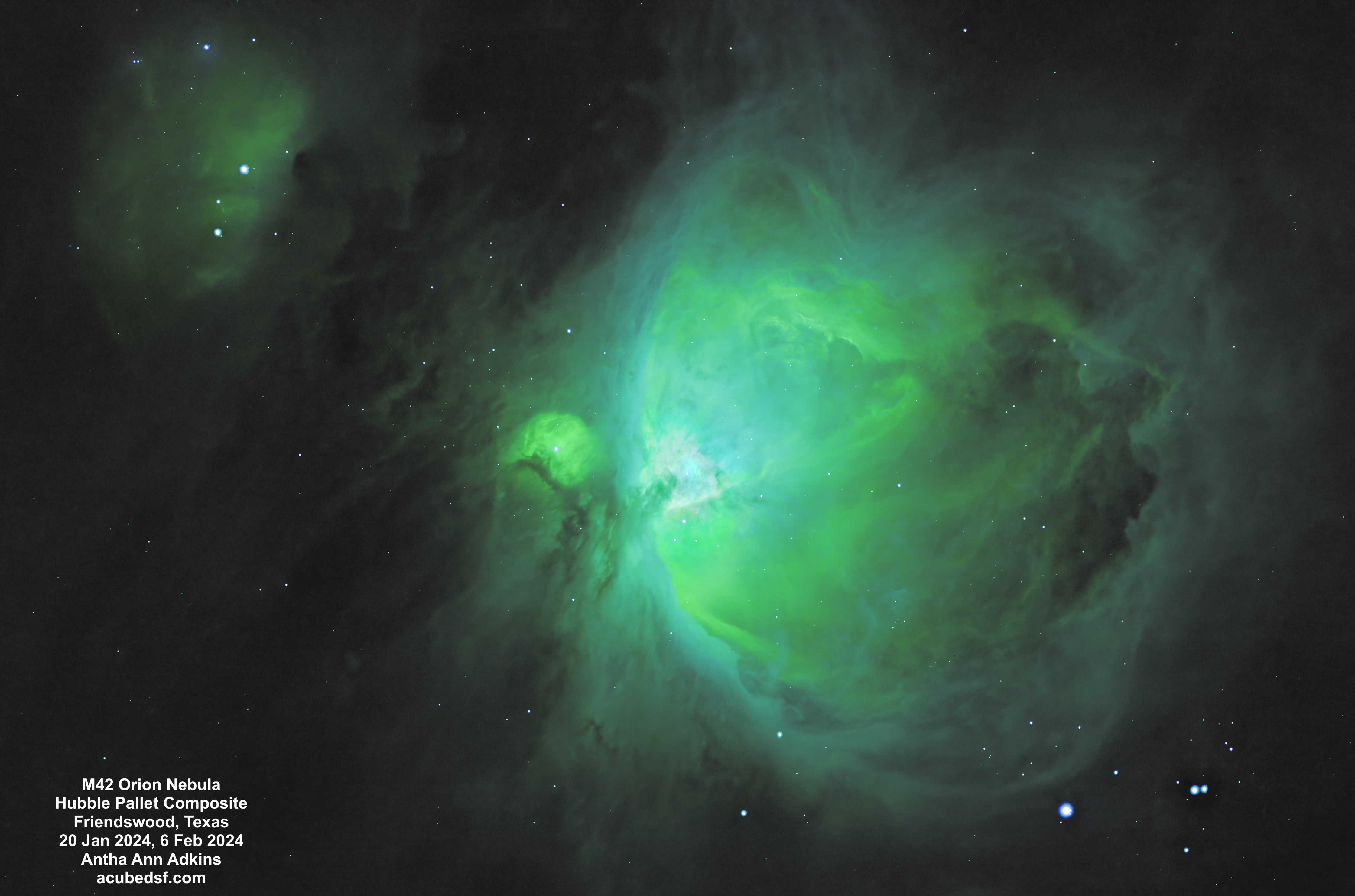
Here is the processed image:

Camera geek info:

  • Williams Optics Zenith Star 73 III APO telescope
  • Williams Optics Flat 73A
  • Antila RGB filters
  • ZWO ASI183MM-Pro-Mono camera
  • ZWO ASiair Plus
  • iOptron CEM40
  • Friendswood, Texas Bortle 7-8 suburban skies

Frames:

  • December 30, 2023
    • RGB lights
      • 52 60 second Gain 50 R lights
      • 30 60 second Gain 50 G lights 
      • 54 60 second Gain 50 B lights 
    • 30 0.05 second Gain 50 RGB flats
    • 30 0.05 second Gain 50 flat darks
    • 30 60 second Gain 50 darks

Processing geek info:

  • PixInsight
  • BlurXterminator
  • NoiseXterminator
  • StarXTerminator
  • Generalized Hyperbolic Stretch

I got a new ring to connect the filter wheel and got first light on the whole new setup, try 3, on January 20, 2024, and I got data for both M42 the Orion Nebula and M101 the Pinwheel Galaxy which I could compare to previous images taken with my Canon 60D DSLR.  I appreciated the ASiair being able to configure a whole run including switching filters and have it automatically run.  I also appreciated the ASiair connecting to my iPad so I could see each image on my iPad from inside my house where it was warm!  I did still go outside to watch the telescope meridian flip to make sure no wires were caught. 

Here is the processed M42 Orion Nebula RGB image (dated 20 January 2024) with a previous DSLR image in the slideshow. The differences are hard to see and may be related to processing.

Camera geek info:

  • Williams Optics Zenith Star 73 III APO telescope
  • Williams Optics Flat 73A
  • ZWO 2” Electronic Filter Wheel
  • Antila RGB filters
  • ZWO ASI183MM-Pro-Mono camera
  • ZWO ASiair Plus
  • iOptron CEM40
  • Friendswood, Texas Bortle 7-8 suburban skies

Frames:

  • January 20, 2024
    • RGB lights
      • 59 60 second Gain 50 R lights 
      • 60 60 second Gain 50 G lights 
      • 57 60 second Gain 50 B lights
    • 30 0.0417 second Gain 50 G flats (a setting goof)
    • 30 0.0417 second Gain 50 B flats (a setting goof)
    • 28 0.05 second Gain 50 R flats
    • 30 0.05 second flat darks
    • 6 60 second darks

Processing geek info:

  • PixInsight
  • BlurXterminator
  • NoiseXterminator
  • StarXTerminator
  • Generalized Hyperbolic Stretch

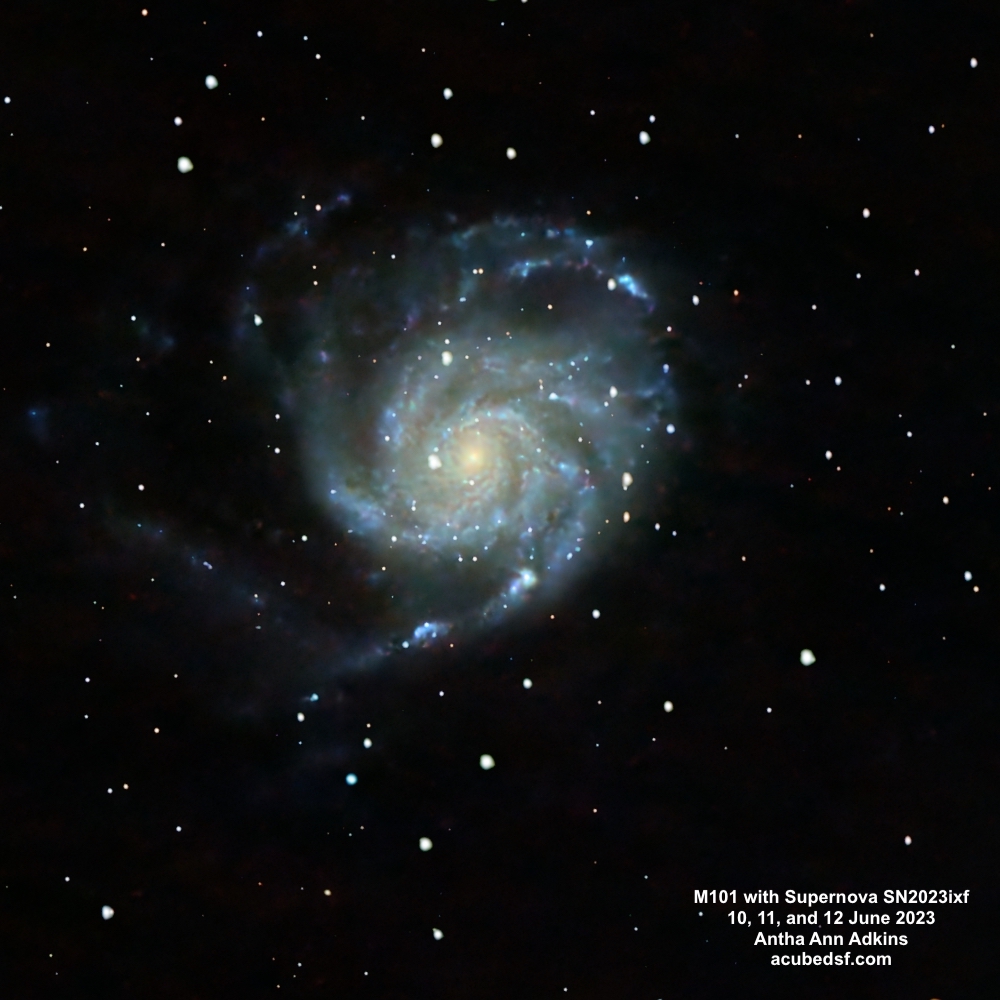
Here is the processed M101 the Pinwheel Galaxy RGB image (dated 20 January 2024) with previous DSLR images in the slideshow. Here, the improvement is obvious, with significantly more detail in the galaxy with the new camera.  It even compares well to images taken from the much darker Dell City skies (February 2023 and June 2023).

Camera geek info:

  • Williams Optics Zenith Star 73 III APO telescope
  • Williams Optics Flat 73A
  • ZWO 2” Electronic Filter Wheel
  • Antila RGB filters
  • ZWO ASI183MM-Pro-Mono camera
  • ZWO ASiair Plus
  • iOptron CEM40
  • Friendswood, Texas Bortle 7-8 suburban skies

Frames:

  • January 20, 2024
    • RGB lights
      • 59 60 second Gain 50 R lights 
      • 60 60 second Gain 50 G lights 
      • 57 60 second Gain 50 B lights
    • 18 0.05 second Gain 50 R flats
    • 24 0.05 second Gain 50 G flats 
    • 17 0.05 second Gain 50 B flats
    • 30 0.05 second flat darks
    • 6 60 second darks

Processing geek info:

  • PixInsight
  • BlurXterminator
  • NoiseXterminator
  • StarXTerminator
  • Generalized Hyperbolic Stretch

I’m really pleased with this new equipment, and I’m looking forward to seeing what I can do with it!

M42 The Orion Nebula and Astrophotography Learning Curve

I’ve bought some new astrophotography gear, so it’s been cloudy for a month (LOL), and I’ve had the opportunity to go back and process some old data of a favorite Deep Space Object (DSO), M42, The Orion Nebula.

The Orion Nebula is an emission nebula of ionized hydrogen gas where star formation is taking place.  It’s located in the Milky Way, approximately 1344 light years away, and it’s approximately 24 light years across, giving it an apparent size of 1 degree.

The Orion Nebula is one of my favorite DSOs because it is bright and can be enjoyed so many ways.  It is visible to the naked eye as the middle “star” in Orion’s sword.  It can be seen to be a fuzzy object with binoculars.  The trapezium of stars in the core can be seen even with a small telescope like mine.  And astrophotography brings out its full size and color.  

The nebula to the left of the Orion Nebula is called the Running Man nebula.  Can you see the dark running man?  The Running Man nebula is a reflection nebula, reflecting the light of local stars.  It is approximately 1500 light years away, and approximately 15 light years across, giving it an apparent size of 34 arc-minutes.  

The image above was made from 66 minutes of data (22 3 minute images) from the fabulous dark skies of Dell City, Texas.

Camera geek info:

  • Canon EOS 60D in manual mode, 3 minute exposure, ISO 1600
  • Intervalometer
  • Williams Optics Zenith Star 73 III APO telescope
  • Williams Optics Flat 73A
  • iOptron CEM40
  • Dell City, Texas Bortle 2-3 dark skies

Frames:

  • October 28, 2022
    • 22 3 minute lights (66 minutes total)
    • 10 6 second darks

Processing geek info:

  • PixInsight
  • BlurXterminator
  • NoiseXterminator
  • StarXTerminator
  • Generalized Hyperbolic Stretch

The Orion Nebula shows my own astrophotography learning curve.  I imaged it in 2019 with just a DSLR, telephoto lens, and a sky tracker.  And I processed a single image from the 2022 set used above before I learned how to use PixInsight.  This set, you’ll notice, did not include the flat and flat dark calibration frames I use now.  

Not having all the calibration frames worked out OK in Dell City … but no such much from my light-polluted skies in suburban Friendswood, Texas.  Here is what I get with no flat calibration frames (note all the dark spots not calibrated out), no light pollution filter, and my current knowledge of PixInsight.  Yes, I could have lost some of the nebula detail and hidden the dark spots, but that’s a cost to not having good calibration frames.  Since it’s fast and easy to take flats, they’re totally worth it.

Camera geek info:

  • Canon EOS 60D in manual mode, 119 second exposure, ISO 200
  • Intervalometer
  • Williams Optics Zenith Star 73 III APO telescope
  • Williams Optics Flat 73A
  • iOptron CEM40
  • Friendswood, Texas Bortle 7-8 suburban skies

Frames:

  • November 26, 2022
    • 27 119 second lights (53.55 minutes total)
    • 6 119 second darks

Processing geek info:

  • PixInsight
  • BlurXterminator
  • NoiseXterminator
  • StarXTerminator
  • Generalized Hyperbolic Stretch

A couple of months after I took the previous image, I learned what calibration frames I needed.  Here is what I got with data taken from my suburban driveway with calibration frames, a light pollution filter, and my current knowledge of PixInsight.

Camera geek info:

  • Canon EOS 60D in manual mode, 19 second exposure, ISO 800
  • Intervalometer
  • Williams Optics Zenith Star 73 III APO telescope
  • Williams Optics Flat 73A
  • SkyTech 2” LPRO-MAX CCD Filter
  • iOptron CEM40
  • Friendswood, Texas Bortle 7-8 suburban skies

Frames:

  • January 26, 2023
    • 143 19 second lights (45.3 minutes total)
    • 25 0.02 second flats
    • 21 0.02 second flat darks
    • 47 20 second darks

Processing geek info:

  • PixInsight
  • BlurXterminator
  • NoiseXterminator
  • StarXTerminator
  • Generalized Hyperbolic Stretch

These three images had similar total exposure lengths.  The Dell City image, with the longest total exposure time, highest ISO, and darkest skies, is the best of the three.  The slightly shorter November 2022 image from Friendswood is flawed due to the lack of calibration frames.  The even shorter January 2023 image from Friendswood is starting to show noise in the background.  But the nebulae themselves are beautiful!

As I said, I’ve recently gotten some new astrophotography gear, and first light on it was the Orion Nebula.  Stay tuned for the results!!

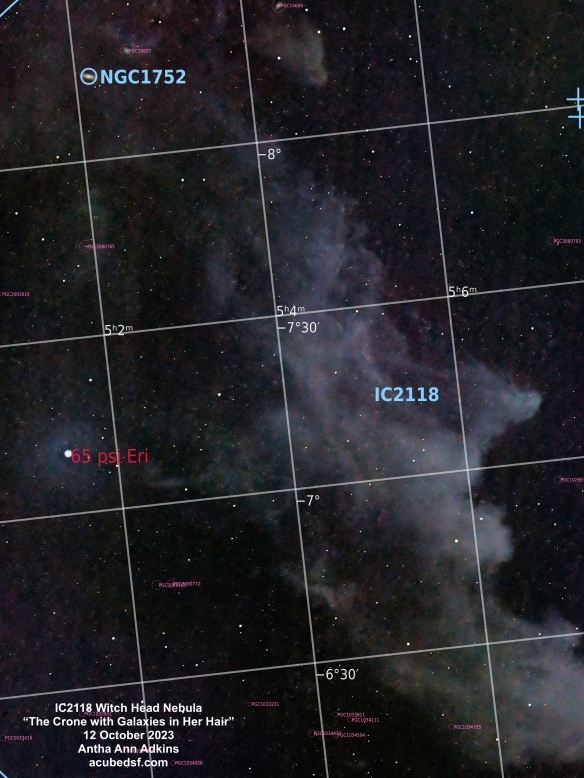
IC2118 The Crone with Galaxies in Her Hair

IC2118 is one of the dimmer objects I imaged while we were enjoying the dark skies in Dell City, Texas.  

This image used only 1.9 hours of data.  I’ve started having trouble with my tracking mount glitching, so I had to toss a bunch of data.  I’ve been researching how to fix that.

IC2118, also called the Witch Head Nebula, is a reflection nebula – an interstellar cloud of dust that is lit up by a nearby star, in this case Rigel (which is not in this image).  It’s located in the Milky Way, approximately 900 light years away, and it’s approximately 50 light years long, giving it an apparent size of 1 degree by 3 degrees (not all in this image).  

The ”witch” is facing towards the upper right corner, with her nose around the vertical center of the image.  

One thing that surprised me was that I can see multiple galaxies in her hair – NGC1752, PGC16607, and PGC16669.  NGC1752 is a spiral galaxy about 143.5 Mega light years away.  PGC16607 is a galaxy about 179 Mega light years away.  PGC16669 is a galaxy about 500 Mega light years away.  I find the idea of being able to image galaxies so far away … awe-inspiring.

I find the idea of a crone with galaxies in her hair … poetic and inspirational.  And I think she should have a companion: the man with a galaxy under his hat.  Deserving of a story!

Camera geek info:

  • Canon EOS 60D in manual mode, 2 minute exposure, ISO 1600
  • Intervalometer
  • Williams Optics Zenith Star 73 III APO telescope
  • Williams Optics Flat 73A
  • iOptron CEM40
  • Dell City, Texas Bortle 2-3 dark skies

Frames:

  • October 12, 2023 
    • Run 1
      • 57 2 minute lights 
      • 30 0.01 second flats
      • 30 0.01 second flat darks
    • 35 2 minute darks

Processing geek info:

  • PixInsight
  • BlurXterminator
  • NoiseXterminator
  • StarXTerminator
  • Generalized Hyperbolic Stretch

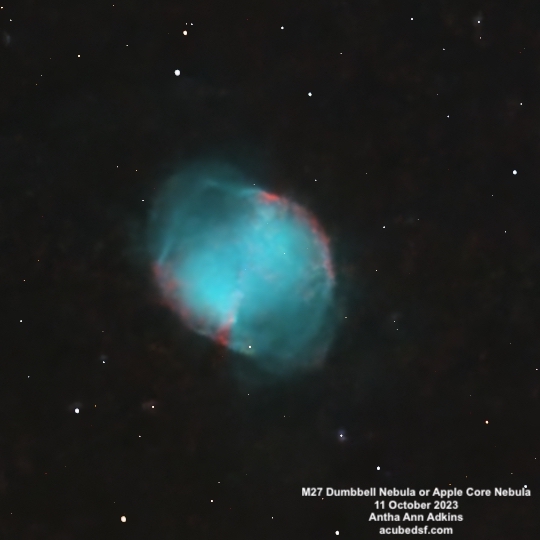
M27 Dumbbell Nebula

M27 is one of the brighter objects I imaged while we were enjoying the dark skies in Dell City, Texas.  This object was a brilliant blue in a single frame, and it was nice not to have to rely on faith that something was there.  

This image used only 1.8 hours of data. 

M27, also called the Dumbbell Nebula or Apple Core Nebula, is a planetary nebula – the gases expelled from a star before it becomes a white dwarf, lit up by that star.  It’s located in the Milky Way, approximately 1250 light years away, and it’s approximately 2.9 light years across, giving it an apparent size of 8 arcminutes.  It’s estimated to be 12,700 years old.

Planetary nebulae do not last long on an astronomy time scale because the expelled gases grow dimmer as they expand away from the central star.  I am glad I live in a time when we can observe them and they can be observed!

Isn’t our galaxy beautiful?

Camera geek info:

  • Canon EOS 60D in manual mode, 2 minute exposure, ISO 1600
  • Intervalometer
  • Williams Optics Zenith Star 73 III APO telescope
  • Williams Optics Flat 73A
  • iOptron CEM40
  • Dell City, Texas Bortle 2-3 dark skies

Frames:

  • October 11, 2023 
    • Run 1
      • 54 2 minute lights 
      • 30 0.01 second flats
      • 30 0.01 second flat darks
    • 35 2 minute darks

Processing geek info:

  • PixInsight
  • BlurXterminator
  • NoiseXterminator
  • StarXTerminator
  • Generalized Hyperbolic Stretch

Sh2-188 Dolphin Nebula or Shrimp Nebula

Sh2-188 is one of the dimmer objects that I imaged during our recent trip to the dark skies at Dell City, Texas.  

Sh2-188, also called the Dolphin Nebula or Shrimp Nebula, is a planetary nebula – the gases expelled from a star before it becomes a white dwarf, lit up by that star.  It’s located in the Milky Way, approximately 2770 light years away, and it’s approximately 8.2 light-years across, giving it an apparent size of 10 arcminutes.  It’s estimated to be 22,500 years old.  

The nebula’s bow shape (as opposed to a circular shape) is theorized to be due to its relatively high velocity interaction with the interstellar medium.

The objects in our galaxy never cease to amaze me!

Camera geek info:

  • Canon EOS 60D in manual mode, 3 minute exposure, ISO 2000
  • Intervalometer
  • Williams Optics Zenith Star 73 III APO telescope
  • Williams Optics Flat 73A
  • iOptron CEM40
  • Dell City, Texas Bortle 2-3 dark skies

Frames:

  • October 9, 2023 
    • Run 1
      • 59 3 minute lights 
      • 30 0.01 second flats
      • 30 0.01 second flat darks
    • Run 2
      • 76 3 minute lights 
      • 30 1/400 second flats
      • 30 1/400 second flat darks
    • 17 3 minute darks

Processing geek info:

  • PixInsight
  • BlurXterminator
  • NoiseXterminator
  • StarXTerminator
  • Generalized Hyperbolic Stretch

NGC 7293 Helix Nebula 2023

On our recent trip to the fabulous dark skies of Dell City, Texas, I mostly tried to image things that would be difficult to capture from my light-polluted driveway at home.  However, a couple of those objects weren’t visible at sunset, so I snuck in some brighter objects as well.

NGC 7293 also called the Helix Nebula or Eye of God Nebula is a planetary nebula – the gases expelled from a star before it becomes a white dwarf, lit up by that star.  It’s located in the Milky Way, approximately 655 light years away, and it’s approximately 2.5 light-years across.  It’s estimated to be 10,600 years old.  Its apparent size is 25 arcminutes, and it has an apparent magnitude of 7.6.  

I’d imaged NGC 7293 last year, and I’d even posted a single 3 minute shot, but I’d never gone back and really processed it.

I processed the data from this year, and then went back and added in the data from last year.  Which version do you like better? I think I actually like the 2023 only version better.

Either way, this shows that less than an hour and a half of data was sufficient time to generate a decent image of this neat object with dark skies.

This is a particularly spectacular planetary nebula, and even last year it made me want to try to image more. Isn’t our galaxy amazing?  

Camera geek info:

  • Canon EOS 60D in manual mode, 3 minute exposure, ISO 1600
  • Intervalometer
  • Williams Optics Zenith Star 73 III APO telescope
  • Williams Optics Flat 73A
  • iOptron CEM40
  • Dell City, Texas Bortle 2-3 dark skies

Frames:

  • October 28, 2022
    • Run 1
      • 10 3 minute lights
  • October 11, 2023
    • Run 2
      • 17 3 minute lights 
      • 30 0.01 second flats
      • 30 0.01 second flat darks

Processing geek info:

  • PixInsight
  • BlurXterminator
  • NoiseXterminator
  • StarXTerminator
  • Generalized Hyperbolic Stretch

The Eastern Veil Nebula: A Giant Space Comma and a Space Cow

I call this picture The Giant Space Comma.  It’s generally called the Eastern Veil Nebula and cataloged as Caldwell 33.  It is one side of a supernova remnant called the Cygnus Loop.  The supernova occurred 10,000 – 20,000 years ago, and our distant ancestors would have been able to see it in the daytime.  It is 2400 light years away from us, and the whole loop has a radius of 65 light years and is expanding.  

Part of the nebula looks like a cow’s head to me.  Can you see it?  I call it the Space Cow.

The images above show what happened as I added data to the image.  The first one is my favorite version, with 3 nights and 12.1 hours of data, followed by the results from 1 night and 3.2 hours of data, the results from 2 nights and 7.45 hours of data, and 4 nights and 16.1 hours of data.  Which do you like best?

I think of all the astroimages I have made so far, this one is the most amazing.  

I’m looking forward to finding more cool things in the sky!

Camera geek info:

  • Canon EOS 60D in manual mode, 1 minute exposure, ISO 800
  • Intervalometer
  • Williams Optics Zenith Star 73 III APO telescope
  • Williams Optics Flat 73A
  • SkyTech 2” LPRO-MAX CCD Filter
  • iOptron CEM40
  • Friendswood, Texas Bortle 7-8 suburban skies

Frames:

  • August 17, 2023
    • Run 1 
      • 194 1 minute lights
      • 30 0.03 second flats
      • 30 0.03 second flat darks
  • August 18, 2023 
    • Run 2
      • 86 1 minute lights
      • 30 0.03 second flats
      • 30 0.03 second flat darks
    • Run 3
      • 167 1 minute lights
      • 30 0.03 second flats
      • 31 0.03 second flat darks
  • August 26, 2023
    • Run 4
      • 278 1 minute lights
      • 30 0.03 second flats
      • 30 0.03 second flat darks
  • August 30, 2023 
    • Run 5
      • 103 1 minute lights
      • 32 0.03 second flats
      • 30 0.03 second flat darks
    • Run 6
      • 137 1 minute lights
      • 30 0.03 second flats
      • 30 0.03 second flat darks

Processing geek info:

  • PixInsight
  • BlurXterminator
  • NoiseXterminator
  • StarXTerminator
  • Generalized Hyperbolic Stretch

IC1318 Gamma Cygni Nebula – Butterfly Nebula

This is a portion of IC1318 the Gamma Cygni Nebula nicknamed the Butterfly Nebula.  It’s in the constellation Cygnus beyond the star Gamma Cygni from which it gets its name.  IC1318 is an emission nebula and consists of three bright areas labeled A, B, and C – the butterfly is formed by B and C (A is not in this picture). It is 3700 light years away from us and has apparent dimensions of 50 (B) and 40 (C) arcmin. 

In the lower right corner of the picture is NGC6910, a cluster of stars made in this nebula.  The cluster is 13 million years old.

This is 13.7 hours of data take over three nights.

As you may note from my run numbers starting at 3, my first two runs did not align well with the rest or with the nebula, so I ended up not using them.  This is a tricky bit about imaging objects that are large compared to the total imaging area – the orientation of the camera and how well the imaging runs align with one another makes a difference.

For this particular image, I tried processing the nebula and stars separately, but I was not happy with the results, so I ended up processing them together.  

I think the Butterfly Nebula really looks like a butterfly.  How about you?  But I also think I see … a dark chicken?  What do you think?

Camera geek info:

  • Canon EOS 60D in manual mode, 1 minute exposure, ISO 800
  • Williams Optics Zenith Star 73 III APO telescope
  • Williams Optics Flat 73A
  • SkyTech 2” LPRO-MAX CCD Filter
  • iOptron CEM40
  • Friendswood, Texas Bortle 7-8 suburban skies

Frames:

  • September 21, 2023
    • Run 3 
      • 320 1 minute lights
      • 30 0.03 second flats
      • 30 0.03 second flat darks
  • September 22, 2023
    • Run 4
      • 240 1 minute lights
      • 30 0.03 second flats
      • 30 0.03 second flat darks
  • September 23, 2023 
    • Run 5
      • 28 1 minute lights
      • 30 0.03 second flats
      • 30 0.03 second flat darks
    • Run 6
      • 235 1 minute lights
      • 29 0.03 second flats
      • 30 0.03 second flat darks
  • 30 1 minute darks

Processing geek info:

  • PixInsight
  • BlurXterminator
  • NoiseXterminator
  • Generalized Hyperbolic Stretch

Rising Phoenix, Curious Robin

I call this image “Rising Phoenix, Curious Robin.”  The bright nebula to the right of the image looks to me like a phoenix opening up its wings to take flight.  The bright red nebula to the left looks to me like a red bird flying over to see what’s up. 

These two nebulae are parts of the larger NGC 7000/C20 North America Nebula in the constellation Cygnus.  Generally, it’s shown rotated clockwise from this image, with the dark nebula on the top of this image forming the Gulf of Mexico.  The nebula I see as a phoenix is also called the Cygnus Wall.  

Here is another view, rotated to look more like North America.

Nebulae, like clouds, are a great place to let your imagination run free.  What do you see in this image?

The North America Nebula is an emission nebula of ionized hydrogen gas where star formation is taking place.  It is lit up by a hot star that is hidden by the dark nebula next to it.  It is 2590 light years away from us, and it has apparent dimensions of 2.5 degrees by 3.3 degrees.  

Its large size makes it a fitting subject for my small telescope with its relatively wide field of view.  But it’s quite dim and I can’t see it at all in a single frame.  I made an early attempt to image it on a trip to the fabulous Bortle 2-3 dark skies of Dell City, Texas about two years ago, but I hadn’t realized then the huge effect of image processing stacks of images.  Even after learning that lesson, it is still a leap of faith to collect hours of images when you can’t see the real subject you’re trying to capture!  It’s also a challenge to keep the framing consistent so that everything overlays and can stack up.  I used the asterism of the upside-down “T” shape in the upper left corner and the bright star ksi Cygnus (cropped out of the first image, visible in the second) to make sure I stayed in alignment.

I collected the data for this image from my driveway in Friendswood, Texas, under Bortle 7-8 skies.  In order to separate the signal (the nebula) from the noise (our light pollution), I ended up taking data over eight nights, then had to throw out the data from one night (the first one) because it didn’t overlay well with the rest.  And I had to throw out other data because I had a dust spot move between the data and the calibration frames on one night, and I had to throw out more data on another night because I hadn’t set up my tracking mount well enough so it drifted.  But I ended up using a whopping 27.8 hours of data to make this one image.  

We’ve been under a high pressure heat dome here in Texas for over a month, which means it’s been meltingly hot and lawn-destroyingly dry, but the silver lining is I’ve gotten to enjoy a lot of cloud-free telescope nights.  Even in the middle of the night, though, it has been hot – around 80 deg F – which means I sweat setting up/adjusting/checking on the telescope.  And it’s the Gulf Coast, which means it’s still muggy and I have to put a heater on the telescope so dew doesn’t collect.  How crazy is that?

Camera geek info:

  • Canon EOS 60D in manual mode, 1 minute exposure, ISO 800
  • Williams Optics Zenith Star 73 III APO telescope
  • Williams Optics Flat 73A
  • SkyTech 2” LPRO-MAX CCD Filter
  • iOptron CEM40
  • Friendswood, Texas Bortle 7-8 suburban skies

Frames:

  • July 21, 2023
    • Run 3 
      • 35 1 minute lights
      • 30 0.03 second flats
      • 31 0.03 second flat darks
    • Run 4
      • 180 1 minute lights
      • 30 0.03 second flats
      • 30 0.03 second flat darks
  • July 27, 2023 
    • Run 5
      • 219 1 minute lights
      • 31 0.03 second flats
      • 30 0.03 second flat darks
    • Run 6
      • 111 1 minute lights
      • 31 0.03 second flats
      • 31 0.03 second flat darks
  • July 28, 2023
    • Run 7
      • 221 1 minute lights
      • 30 0.03 second flats
      • 30 0.03 second flat darks
  • July 29, 2023
    • Run 9
      • 165 1 minute lights
      • 30 0.03 second flats
      • 30 0.03 second flat darks
  • August 4, 2023 
    • Run 10
      • 160 1 minute lights
      • 30 0.03 second flats
      • 30 0.03 second flat darks
    • Run 11
      • 240 1 minute lights
      • 30 0.03 second flats
      • 30 0.03 second flat darks
  • August 5, 2023 
    • Run 12
      • 97 1 minute lights
      • 30 0.03 second flats
      • 30 0.03 second flat darks
    • Run 13
      • 93 1 minute lights
      • 30 0.03 second flats
      • 30 0.03 second flat darks
  • August 11, 2023
    • Run 14
      • 149 1 minute lights
      • 30 0.03 second flats
      • 30 0.03 second flat darks

Processing geek info:

  • PixInsight
  • BlurXterminator
  • NoiseXterminator
  • StarXTerminator
  • Generalized Hyperbolic Stretch

M8 and M20 with BlurXterminator

On the advice of the kind folks over at Astrobin, I have been learning about the fantastic tool BlurXterminator (BXT).  It is an amazing AI tool that can sharpen up the stars and bring out details in nebulas and galaxies.  

I used BXT on my M8 and M20 image (in the slideshow above), and I think the new version is stunning and really brings out the nebulae.  It is my first published Astrobin image!

Now I want to go back and reprocess all my prior images …