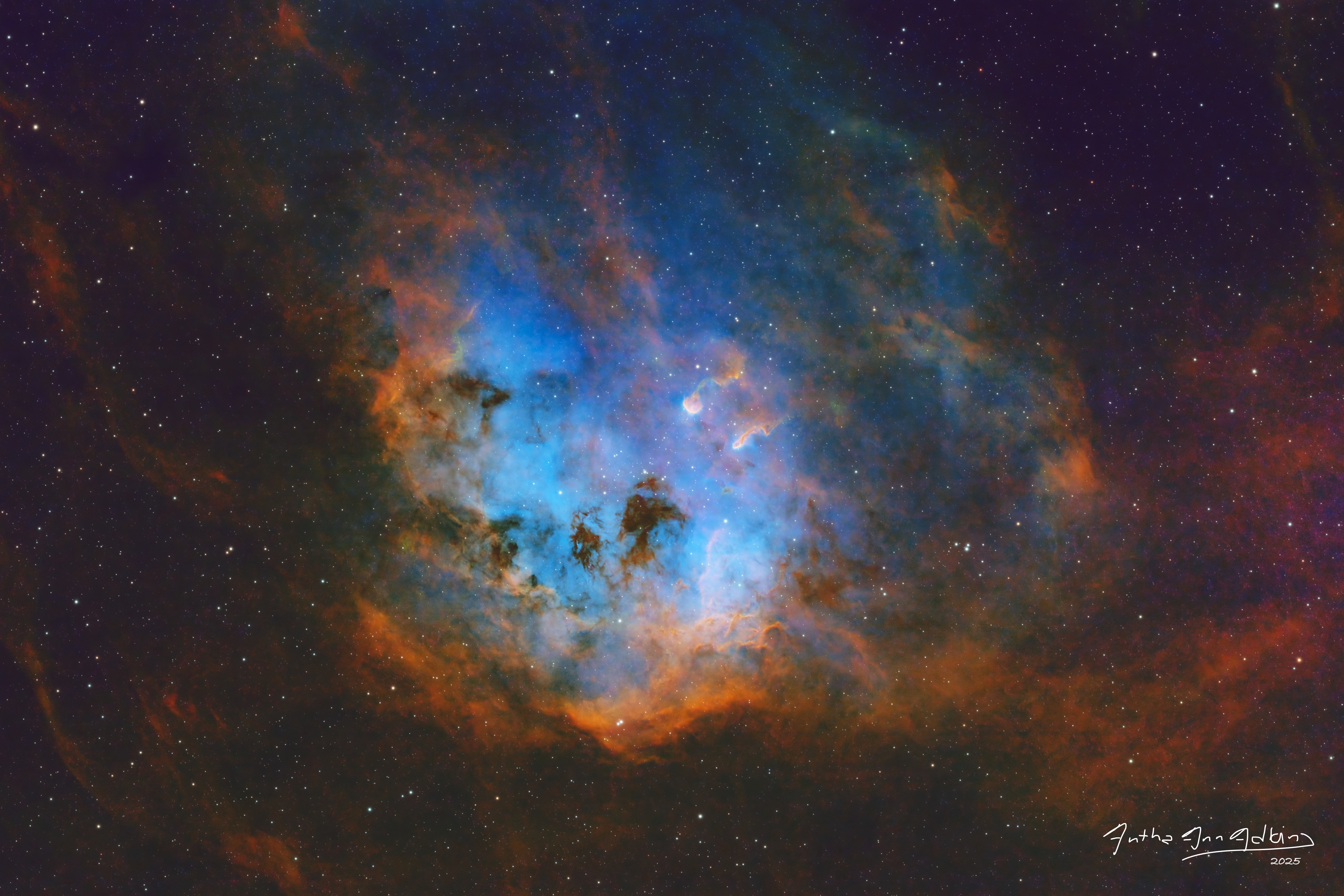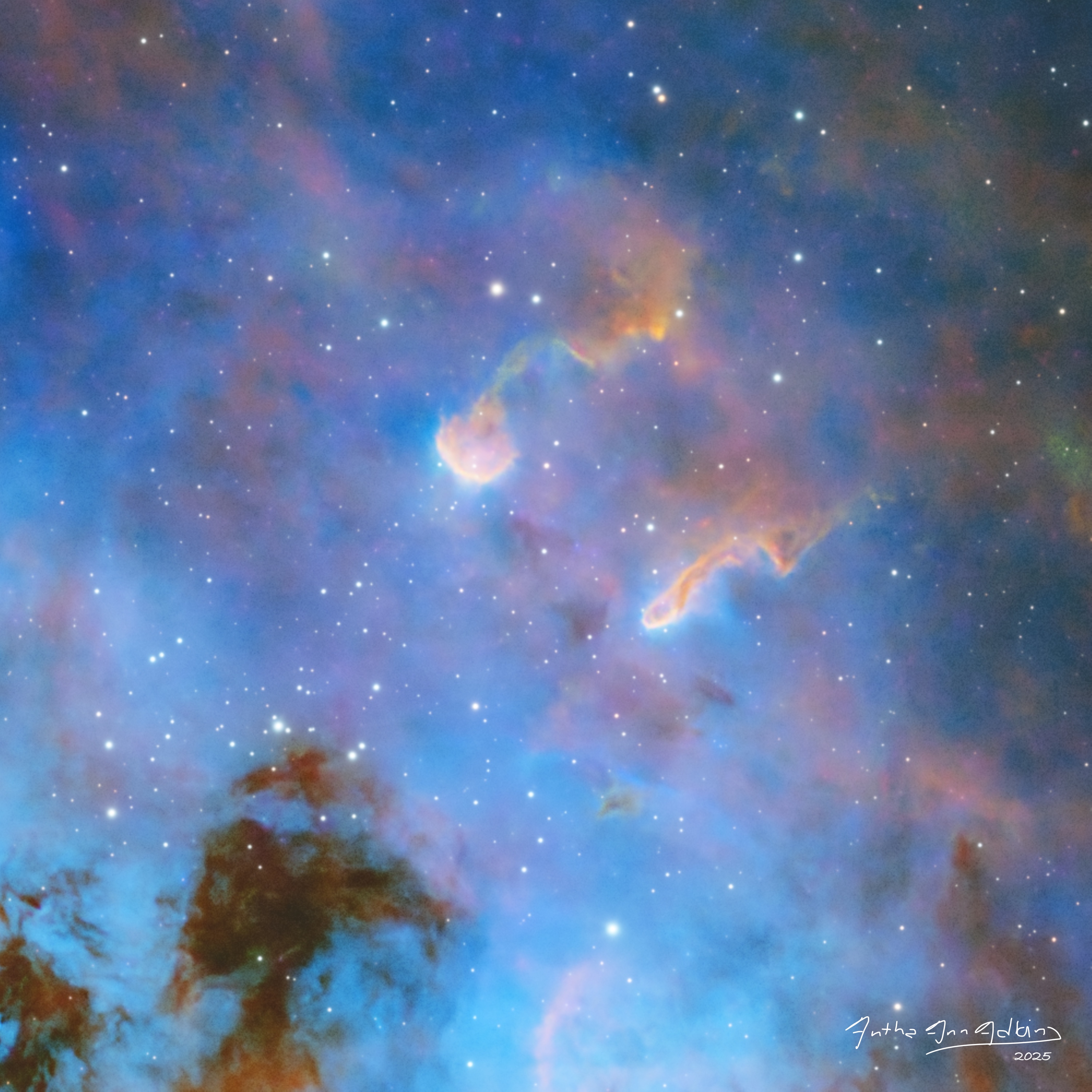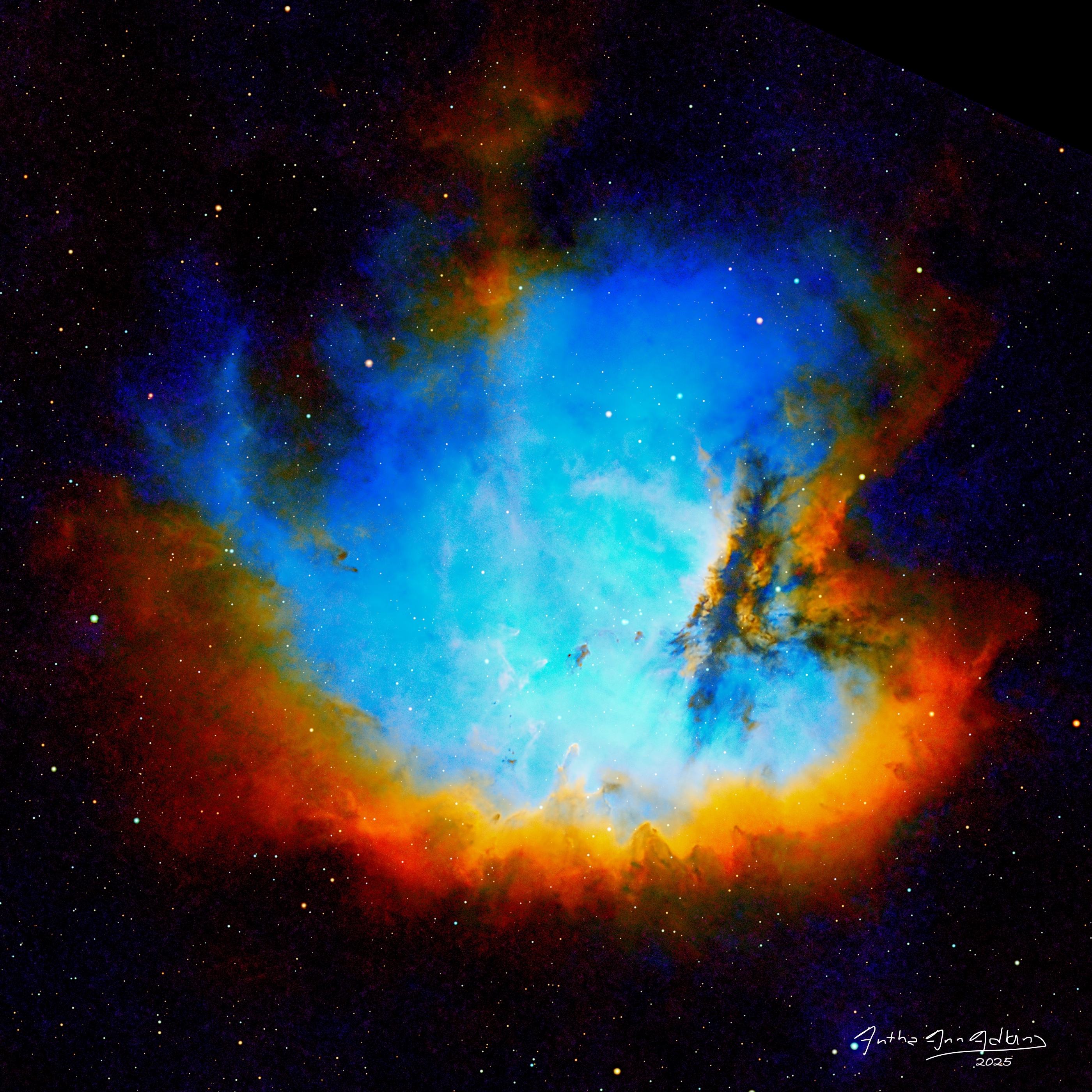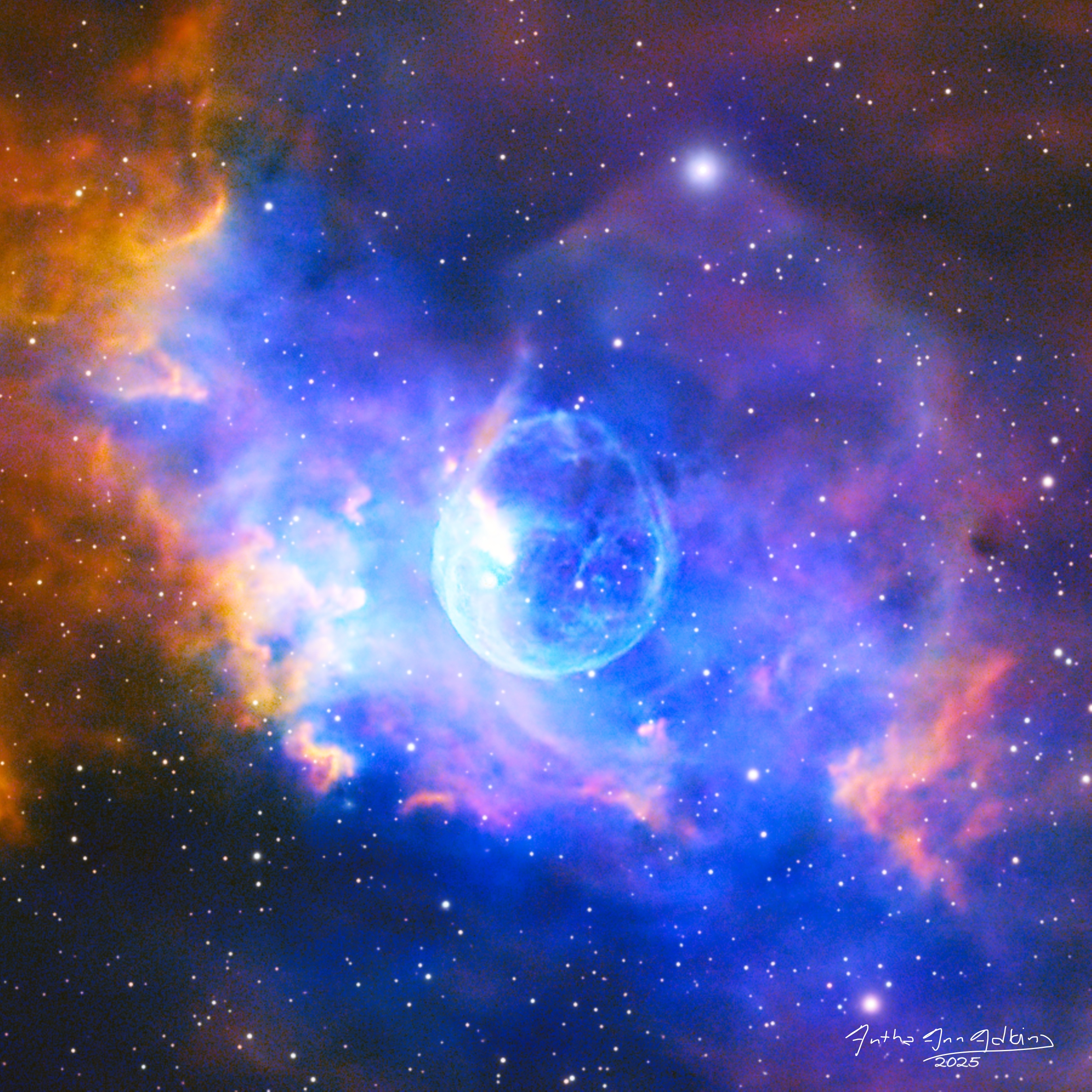
NGC7635 The Bubble Nebula

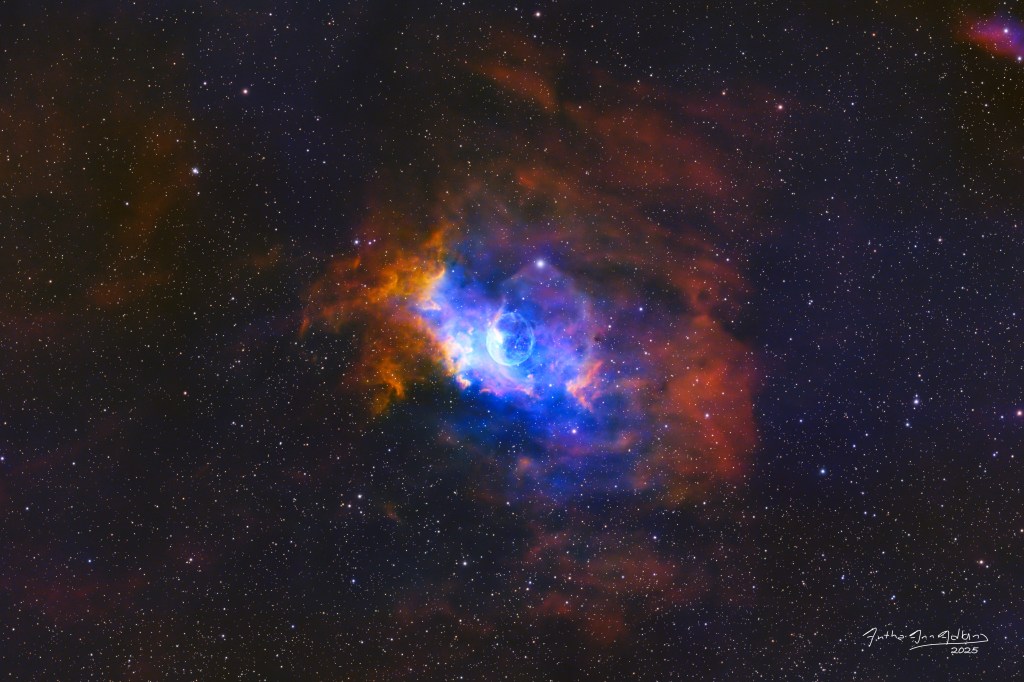
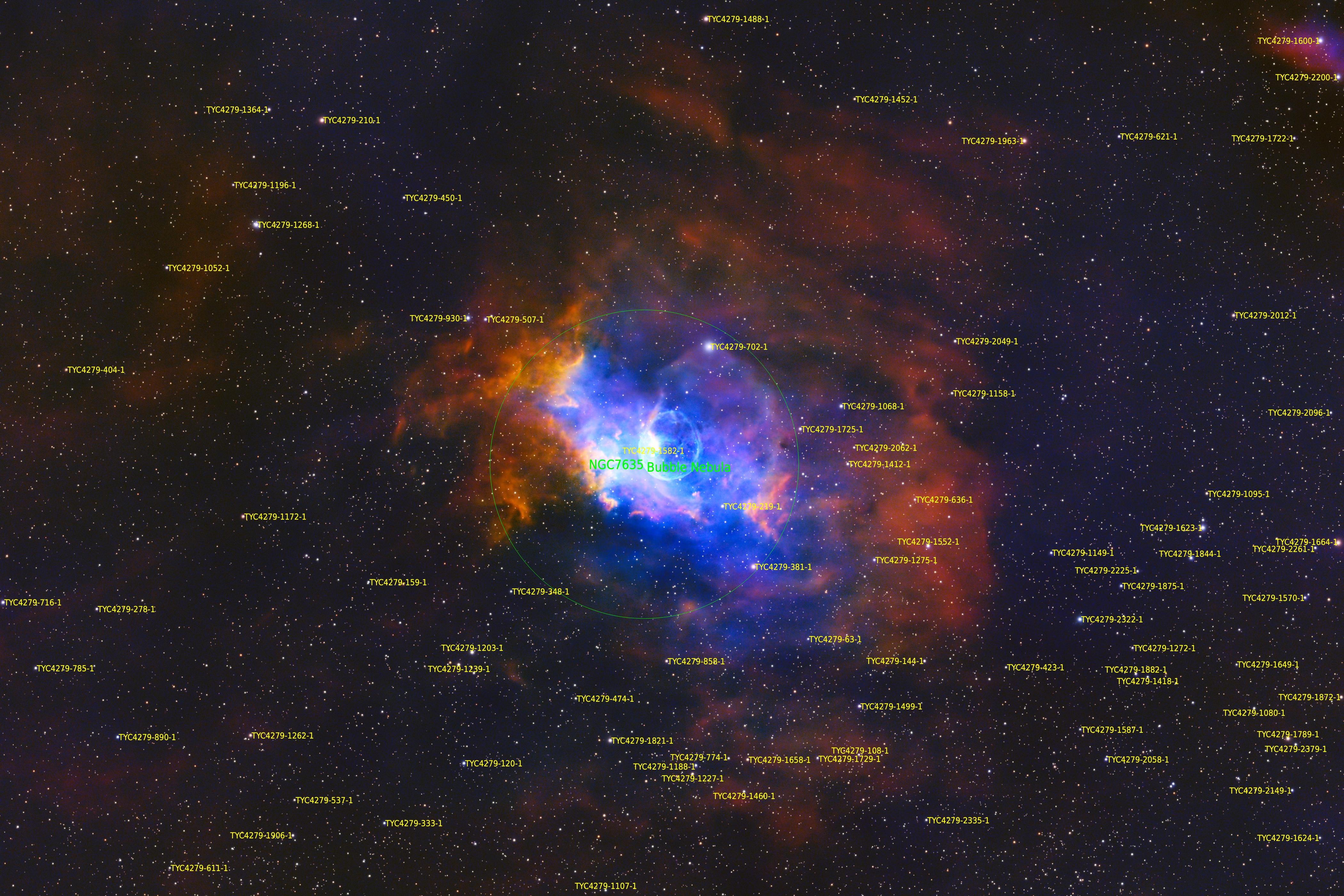
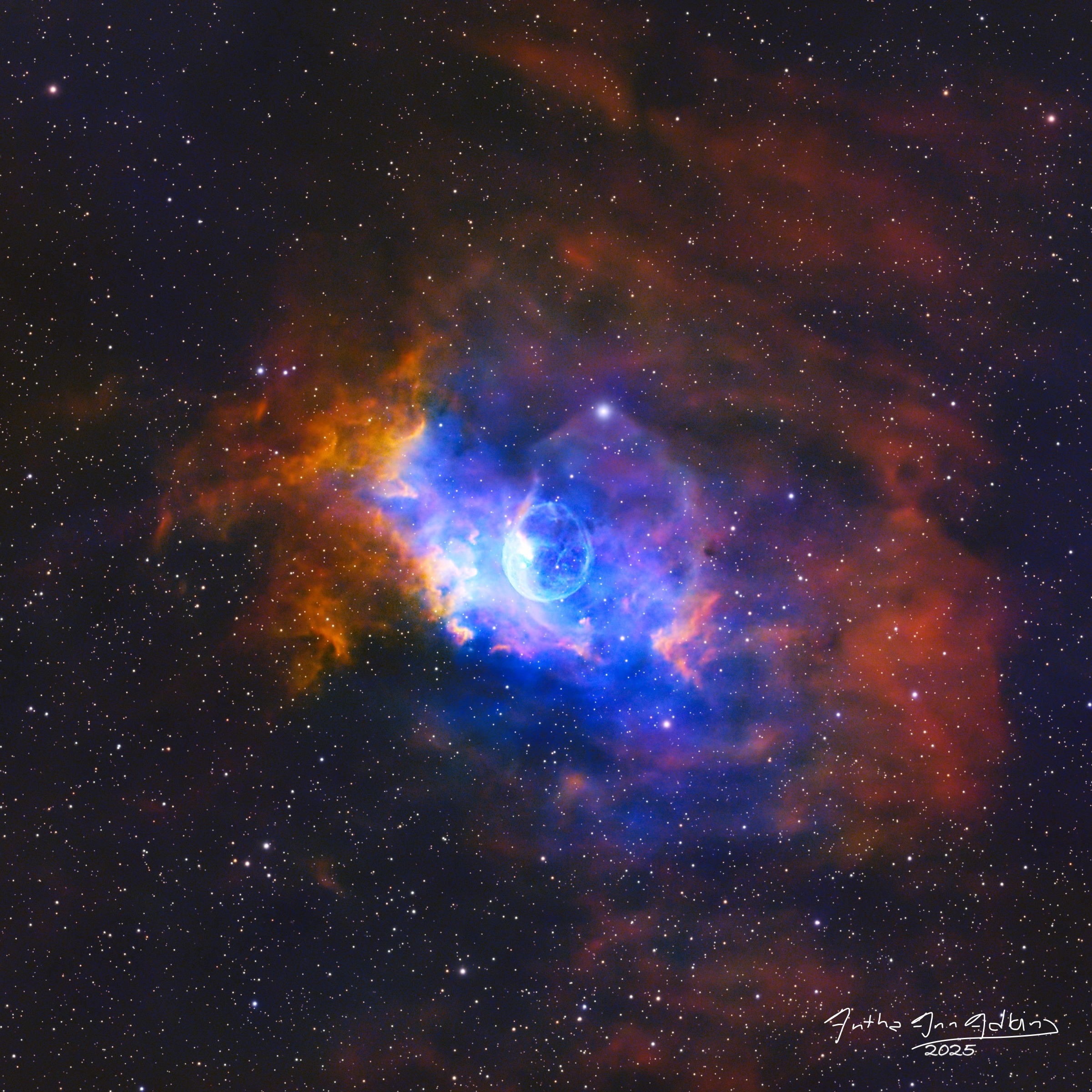
NGC7635, or the Bubble Nebula, consists of an emission nebula numbered Sharpless Sh2-162 surrounding a bubble surrounding a massive young type O star.  The emission nebula Sh2-162 is part of a molecular cloud, an interstellar cloud of gas molecules, whose density allows the formation of molecules such as molecular hydrogen (H2) and carbon monoxide (CO).  The source of energy creating the bubble and lighting up the emission nebula is the young, hot, type O star BD+60 2522.  The star is about 27 +/- 7 times the mass of the sun and 2 million years old.  The bubble is estimated to only be about 50,000 years old and is striking for appearing nearly spherical and for its star not being near its geometric center (in this image, the star is the bright white circle to the left underneath the bright white arc on the bubble’s surface).  The bubble was created by the solar wind from the star pushing the material around it into a thin, dense shell.  I found a paper from 2019 that argues that because the star is moving at a relatively high velocity and the bubble is relatively young, the star is creating a bow shock.  If the bow shock is the case, the bubble is probably closer to us than the emission nebula and moving towards it.  The bubble and nebula being significantly brighter on one side (the left side in this image) could be explained either by the bow shock or by the interstellar matter on that side being denser.  

The Bubble Nebula is located in the Milky Way, approximately 8155 light years away.  The nebula has an apparent size of 0.69 degrees, so it is approximately 99 light years across.  The bubble itself is about 3 arc-minutes in diameter, so it is approximately 7 light years across.

In this image, the stars came from images using red-green-blue filters with 12 to 33 minutes of data each, and the nebula came from images using Sulfer ii (7.4 hours of data mapped to red), Hydrogen alpha (2.8 hours of data mapped to green) and Oxygen iii (8.1 hours of data mapped to blue) filters, the standard SHO mapping.  But after doing that mapping, I used Narrowband Normalization to shift the colors so that it wasn’t overly green and to enhance the reds and blues.  This tool made getting the colors in this nebula look good a lot easier!  The nebula was processed separately from the stars to maximally enhance it.

I think this nebula is stunning!  We live in a universe filled with wonders.

Camera geek info – Narrowband:

  • William Optics Pleiades 111 telescope
  • ZWO 2” Electronic Filter Wheel
  • Antila SHO and RGB filters
  • Blue Fireball 360° Camera Angle Adjuster/Rotator
  • ZWO ASI183MM-Pro-Mono camera
  • William Optics Uniguide 32MM F/3.75
  • ZWO ASI220MM-mini
  • ZWO ASiair Plus
  • iOptron CEM40
  • Friendswood, Texas Bortle 7-8 suburban skies

Frames:

  • August 7, 2025
    • 56 180 second Gain 150 Ha lights
    • 30 0.5 second Gain 150 Ha flats
  • August 8, 2025
    • 4 180 second Gain 150 Oiii lights
    • 30 0.2 second Gain 150 Oiii flats
  • August 14, 2025
    • 31 180 second Gain 150 Oiii lights
    • 30 0.2 second Gain 150 Oiii flats
  • August 16, 2025
    • 42 180 second Gain 150 Oiii lights
    • 30 0.2 second Gain 150 Oiii flats
  • September 4, 2025
    • 50 180 second Gain 150 Sii lights
    • 30 0.5 second Gain 150 Sii flats
  • September 11, 2025
    • 55 180 second Gain 150 Oiii lights
    • 30 0.2 second Gain 150 Oiii flats
  • September 12, 2025
    • 65 180 second Gain 150 Sii lights
    • 30 0.5 second Gain 150 Sii flats
  • September 13, 2025
    • 100 20 second Gain 150 Red lights
    • 30 0.02 second Gain 150 Red flats
    • 35 20 second Gain 150 Green lights
    • 30 0.01 second Gain 150 Green flats
    • 51 20 second Gain 150 Blue lights
    • 30 0.01 second Gain 150 Blue flats
  • October 25, 2025
    • 30 180 second Gain 150 Oiii lights
    • 30 0.2 second Gain 150 Oiii flats
    • 33 180 second Gain 150 Sii lights
    • 30 0.5 second Gain 150 Sii flats
  • 30 Flat Darks matching flat durations from library
  • 30 Darks matching light durations from library

Processing geek info:

  • PixInsight
  • BlurXterminator
  • NoiseXterminator
  • StarXTerminator
  • Narrowband Normalization

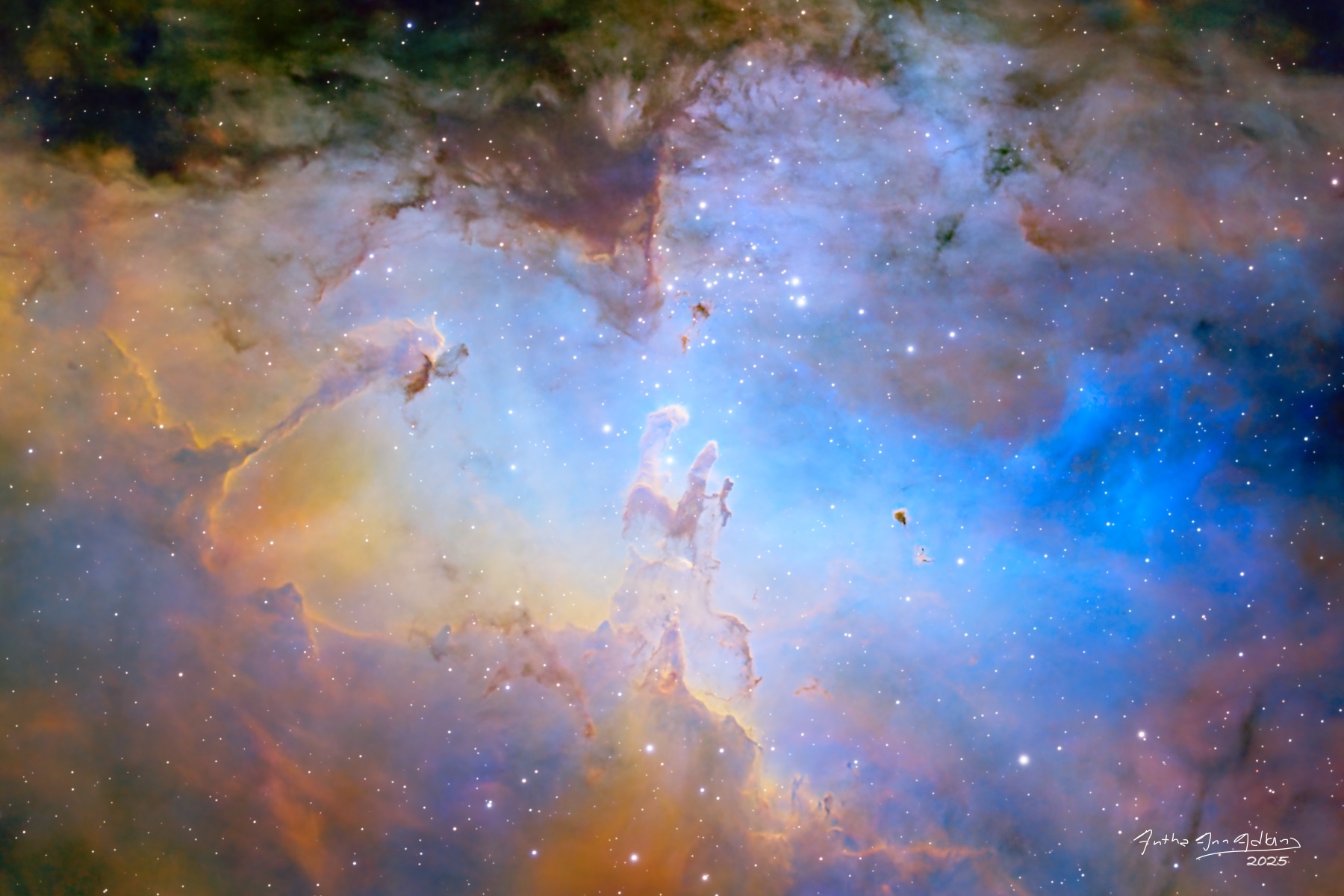
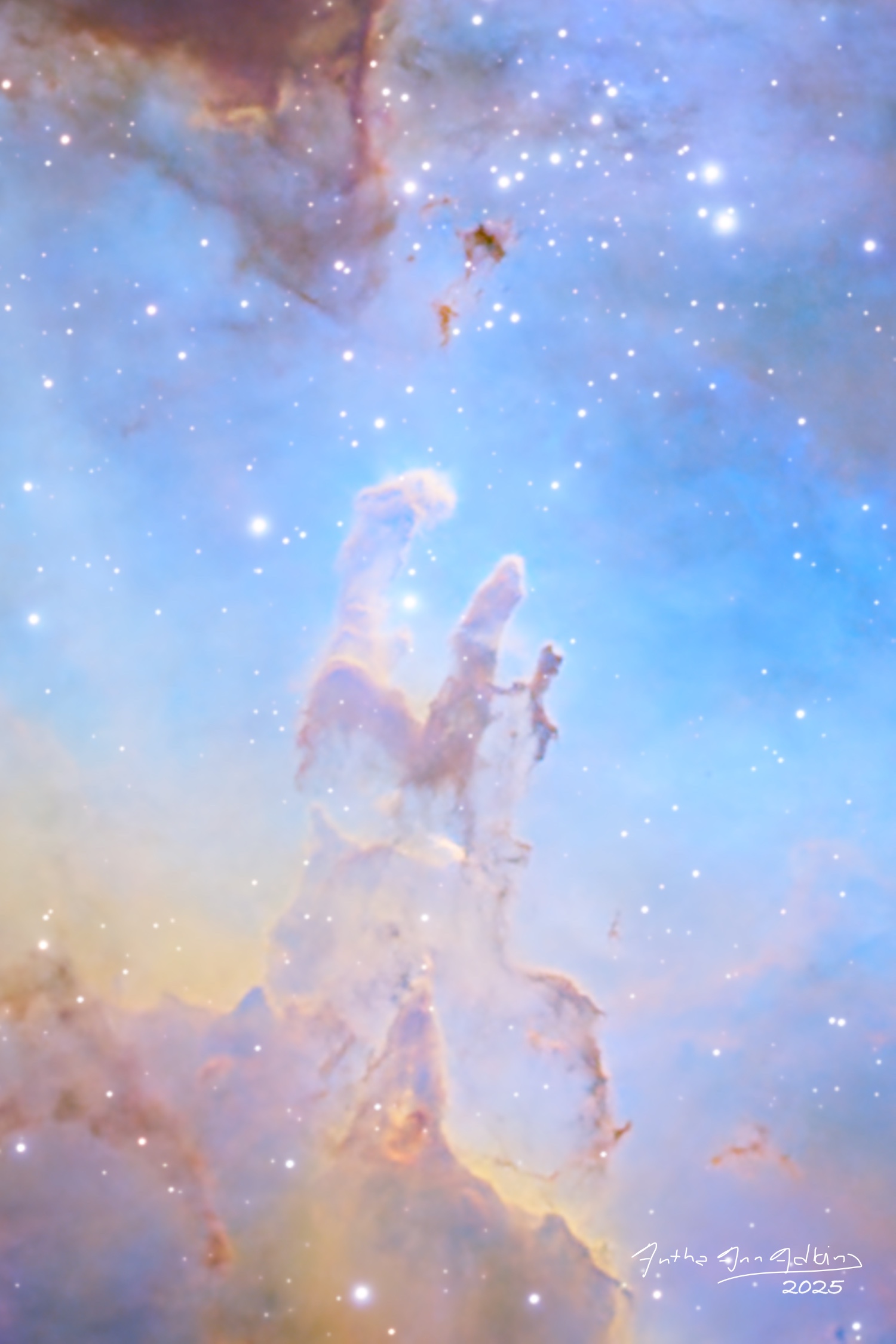
M16 The Jewel Box of Creation (or the Eagle Nebula)

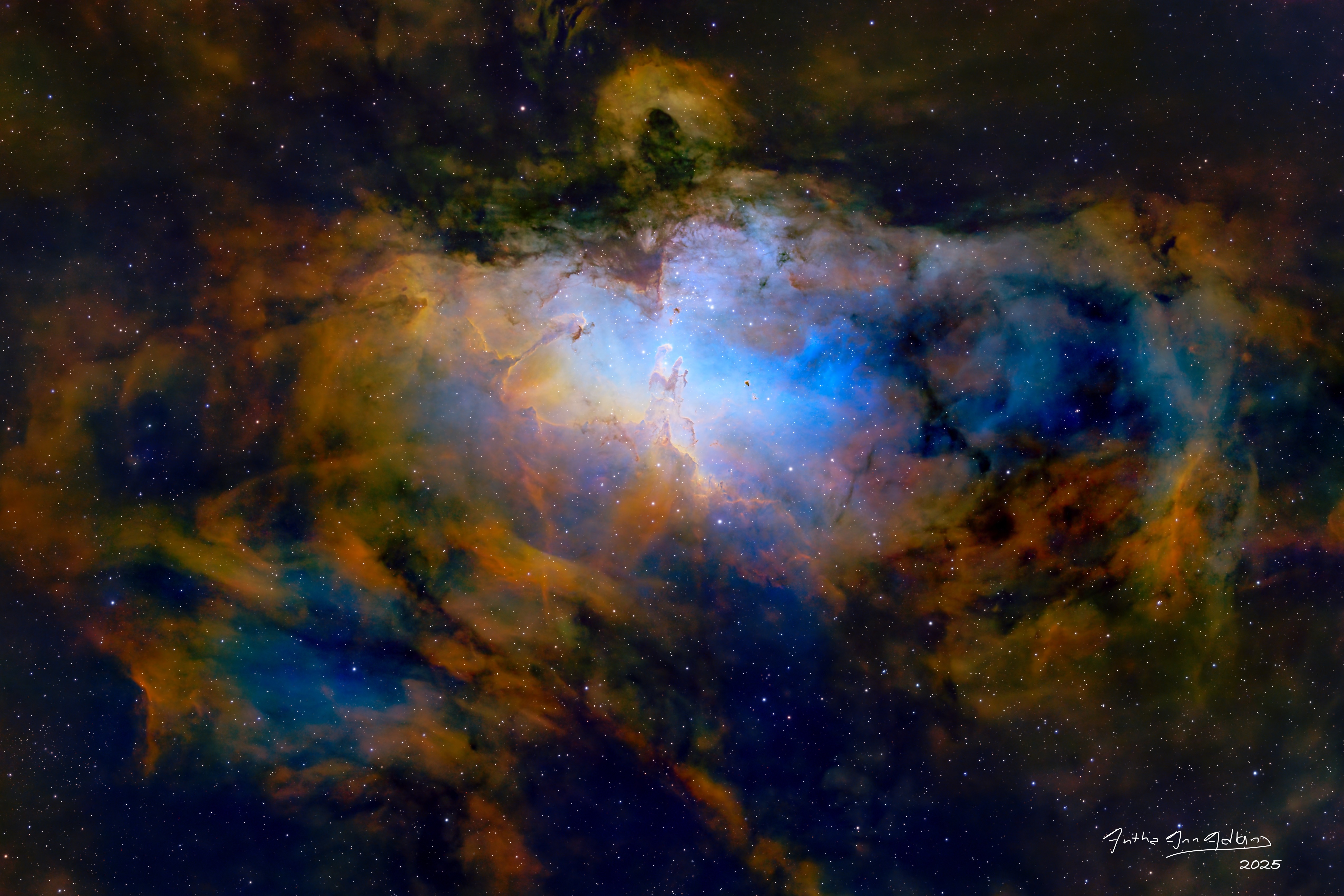
The traditional name for Messier 16 (M16) is the Eagle Nebula or the Star Queen Nebula.  However, when I saw the first Hydrogen alpha narrowband images that went into this image, I did not think it looked like a bird. I thought the round nebula on the top looked like the knob on top of the cover of a jewel box (or perfume bottle).  The bright inner center of the nebula with its young stars looked like jewels (so I picked the jewel box analogy).  And the pillars in this nebula are the famous Pillars of Creation imaged by the Hubble Space Telescope.  So I think the name the “Jewel Box of Creation” is also a lovely description of this beautiful Deep Space Object (DSO).  What do you think it looks like?

M16 contains two related things: an emission nebula numbered IC4703 or Sharpless Sh2-49 and an open cluster numbered New General Catalogue (NGC) 6611.  The emission nebula is part of Giant Molecular Cloud W37, an interstellar cloud of gas molecules, primarily molecular hydrogen (H2) and carbon monoxide (CO), the mass of which is calculated to be 170,000 times the mass of the Sun.  The nebula is a large star-forming region ionized by the stars it generated.  The open cluster of stars has an inferred population of 8100 stars including at least 137 visible young stars in the Gaia Early Data Release 3 (EDR3) with good data and magnitudes greater than G=17.5 in two populations: one older (7.5 +/- 0.4 million years old) and more spread out and one younger (1.3 +/- 0.2 million years old) and more concentrated.  (As a point of reference, our own star, the Sun, is 4.6 billion years old – 3500 times older than the younger stars!  What are you 3500 times older than?). The young population includes 19 type O stars which are high mass, hot, blue stars with short lives due to their high mass.  One binary pair of these type O stars, HD168076, is the brightest star in the cluster visually, has a mass of 75 to 80 times the mass of the Sun, and is the primary source ionizing the nebula.  

M16 is located in the Milky Way, approximately 5513 light years away, and it has an apparent size of 1.3 degrees, so it is approximately 125 light years across.    

In this image, the stars came from images using red-green-blue filters with about 30 minutes of data each, and the nebula came from images using Sulfur ii (4.15 hours of data mapped to red), Hydrogen alpha (1.75 hours of data mapped to green) and Oxygen iii (2.25 hours of data mapped to blue) filters, the standard SHO mapping.  But after doing that mapping, I used Narrowband Normalization to shift the colors so that it wasn’t overly green and to enhance the reds and blues.  This tool made getting the colors in this nebula look right a lot easier!  Even so, I ended up making multiple attempts to try to show it well and got some excellent advice on astrobin on how to improve the image. The nebula was processed separately from the stars to maximally enhance it.

I think this nebula and star cluster are absolutely gorgeous!  We live in a universe filled with wonders.

Camera geek info – Narrowband:

  • William Optics Pleiades 111 telescope
  • ZWO 2” Electronic Filter Wheel
  • Antila SHO and RGB filters
  • Blue Fireball 360° Camera Angle Adjuster/Rotator
  • ZWO ASI183MM-Pro-Mono camera
  • William Optics Uniguide 32MM F/3.75
  • ZWO ASI220MM-mini
  • ZWO ASiair Plus
  • iOptron CEM40
  • Friendswood, Texas Bortle 7-8 suburban skies

Frames:

  • August 28, 2025
    • 96 20 second Gain 150 Red lights
    • 30 0.02 second Gain 150 Red flats
    • 91 20 second Gain 150 Green lights
    • 30 0.01 second Gain 150 Green flats
    • 92 20 second Gain 150 Blue lights
    • 30 0.01 second Gain 150 Blue flats
    • 24 180 second Gain 150 Sii lights
    • 30 0.5 second Gain 150 Sii flats
  • September 9, 2025
    • 35 180 second Gain 150 Ha lights
    • 30 0.5 second Gain 150 Ha flats
  • September 11, 2025
    • 45 180 second Gain 150 Oiii lights
    • 30 0.2 second Gain 150 Oiii flats
  • September 12, 2025
    • 59 60 second Gain 150 Sii lights
    • 30 0.5 second Gain 150 Sii flats
  • 30 Flat Darks matching flat durations from library
  • 30 Darks matching light durations from library

Processing geek info:

  • PixInsight
  • BlurXterminator
  • NoiseXterminator
  • StarXTerminator
  • Narrowband Normalization

Sh2-274 Abell 21 Medusa Nebula

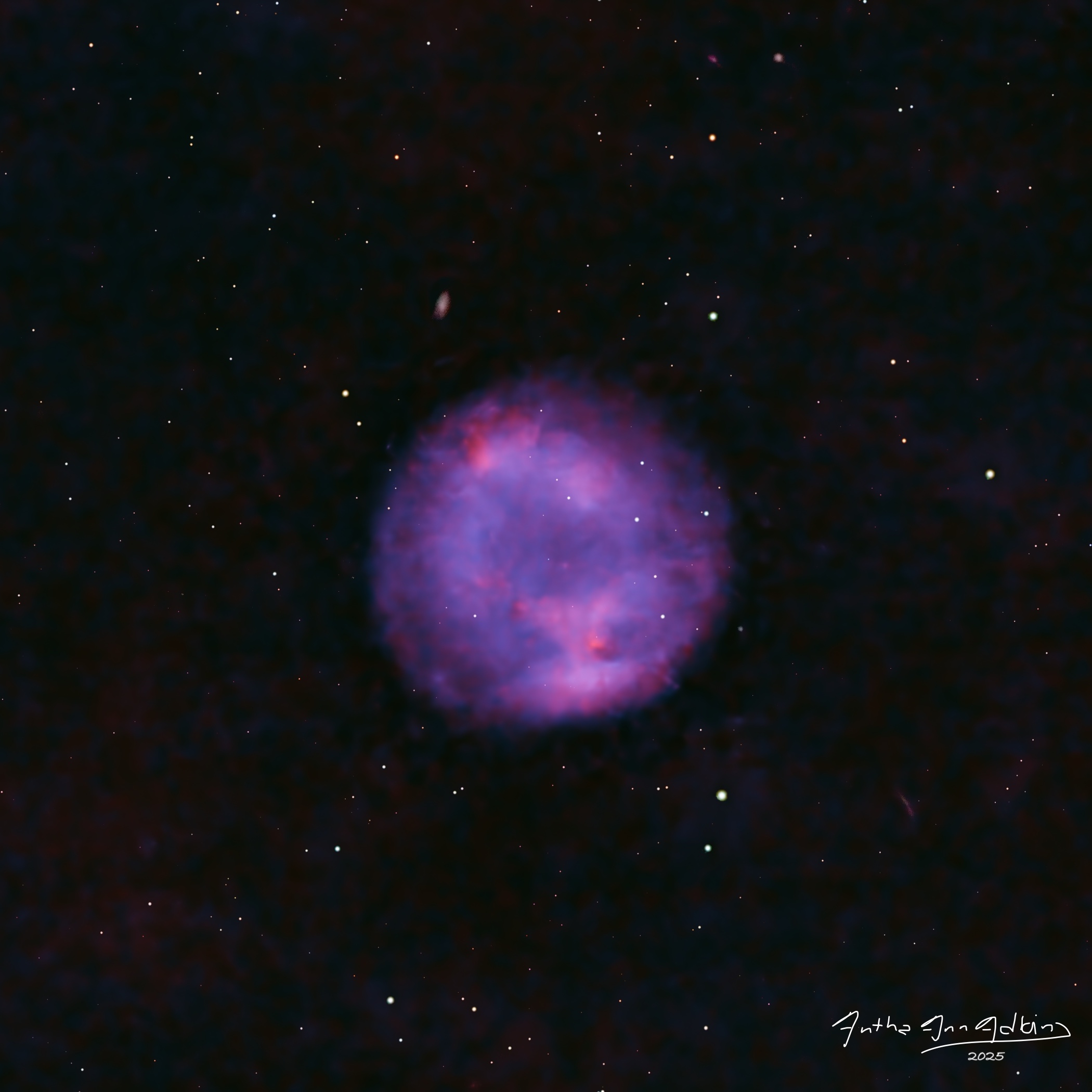
Sh2-274 or Abell 21 or the Medusa Nebula is a planetary nebula – the gases expelled from a red giant star before it becomes a white dwarf, lit up by that star.  It’s located in the Milky Way, approximately 1930 light years away, and it has an apparent size of 10.25 arcminutes, making it 5.75 light years across.  Given the amount of time it would take to reach that size, it is considered to be an “ancient” planetary nebula.  

I find these small nebulae beautiful and fascinating. Each has its own unique structure.  This one has a Ha rim and an Oiii interior and has filaments (the filaments are probably the source of its nickname, the Medusa nebula).

In this image, the stars came from images using red-green-blue filters, and the nebula came from images using Hydrogen alpha (mapped to red) and Oxygen iii (mapped to blue) filters.  The nebula was processed separately from the stars to maximally enhance it.

I had hoped to get enough data on this one the last time we enjoyed the dark skies in Dell City, Texas, but there were a lot of high clouds that limited the amount of data I collected there.  So I collected more data from my driveway at home until I had almost 7 hours of Ha data and 6.7 hours of Oiii data.  

Camera geek info – Narrowband:

  • William Optics Zenith Star 73 III APO telescope
  • William Optics Flat 73A
  • ZWO 2” Electronic Filter Wheel
  • Antila HO and RGB filters
  • ZWO ASI183MM-Pro-Mono camera
  • ZWO ASiair Plus
  • iOptron CEM40
  • Friendswood, Texas Bortle 7-8 suburban skies
  • Dell City, Texas Bortle 2-3 dark skies

Frames:

  • January 24, 2025
    • 14 60 second Gain 150 Ha lights
    • 30 0.5 second Gain 150 Ha flats
  • February 15, 2025
    • 100 30 second Gain 150 Red lights
    • 30 0.05 second Gain 150 Red flats
    • 98 30 second Gain 150 Green lights
    • 30 0.02 second Gain 150 Green flats
    • 60 30 second Gain 150 Blue lights
    • 30 0.02 second Gain 150 Blue flats
  • February 20, 2025
    • 19 60 second Gain 150 Ha lights
    • 30 0.5 second Gain 150 Ha flats
    • 5 60 second Gain 150 Oiii lights
    • 30 0.2 second Gain 150 Oiii flats
  • February 21, 2025
    • 68 60 second Gain 150 Ha lights
    • 30 0.5 second Gain 150 Ha flats
    • 30 60 second Gain 150 Oiii lights
    • 30 0.2 second Gain 150 Oiii flats
  • February 22, 2025
    • 48 60 second Gain 150 Ha lights
    • 30 0.5 second Gain 150 Ha flats
    • 32 60 second Gain 150 Oiii lights
    • 30 0.2 second Gain 150 Oiii flats
  • April 7, 2025
    • 131 60 second Gain 150 Oiii lights
    • 30 0.2 second Gain 150 Oiii flats
  • April 8, 2025
    • 130 60 second Gain 150 Oiii lights
    • 30 0.2 second Gain 150 Oiii flats
  • April 10, 2025
    • 72 60 second Gain 150 Oiii lights
    • 30 0.2 second Gain 150 Oiii flats
  • April 11, 2025
    • 133 60 second Gain 150 Ha lights
    • 30 0.5 second Gain 150 Ha flats
  • April 12, 2025
    • 137 60 second Gain 150 Ha lights
    • 30 0.5 second Gain 150 Ha flats
  • 30 Flat Darks from library
  • 30 Darks from library

Processing geek info:

  • PixInsight
  • BlurXterminator
  • NoiseXterminator
  • StarXTerminator
  • NBColourMapper
  • Generalized Hyperbolic Stretch
M46, two Planetary Nebulas, and the Joy of Discovery

Messier 46, also numbered New General Catalogue (NGC) 2437, is an open cluster, a cluster of about 500 stars that formed from the same molecular cloud and are similar in age, estimated to be 251.2 million years old.  M46 is located in the Milky Way, approximately 4930 light years away, and it has an apparent size of 25.3 arcmin, so it is approximately 36 light years across.  

I chose to photograph this open cluster not only because it is a Messier object I haven’t imaged yet but because there is a planetary nebula in front of it, so I was getting to image two objects at the same time. 

But when I processed the image and removed the stars, I got a surprise.  There wasn’t just one planetary nebula – there were two!  I was delighted and felt the joy of discovery.  I hadn’t known there was a second planetary nebula there, and yet there it was!  I immediately used PixInsight to annotate the image to see if the small planetary nebula was known, and of course it had already been discovered.  But it was still super fun to find something unexpected in my image.

The planetary nebula I had been intending to image, NGC 2438 or PK 231+04.2, is located in the Milky Way, approximately 1377 light years away, and it has an apparent size of 1.173 arc min, so it is approximately 0.5 light years across.  Because it had a different relative motion relative to us than M46, it is not considered to be part of the open cluster.  Before I learned that, I had thought it would be cool if it were part of the cluster and that possibly (since cluster stars are generally of similar age) multiple stars in the cluster could generate visible planetary nebula at the same time.  Wouldn’t that be a sight to see?

My surprise planetary nebula, Minkowski M1-18 or PK231+0.41, is located in the Milky way, approximately 14500 light years away, and it has an apparent size of 0.507 arcminutes, so it is approximately 2.1 light years across.  So further away and larger than NGC2438.

In this image, the stars came from images using red-green-blue filters, and the two nebulas came from images using Hydrogen alpha (mapped to red) and Oxygen iii (mapped to turquoise) filters.  The two nebulas were processed separately to maximally enhance each, which means that they are more equal in brightness in the image than they are in reality (M1-18 is much dimmer).

Have you felt the joy of discovery lately?

Camera geek info – Narrowband:

  • Williams Optics Zenith Star 73 III APO telescope
  • Williams Optics Flat 73A
  • ZWO 2” Electronic Filter Wheel
  • Antila SHO and RGB filters
  • ZWO ASI183MM-Pro-Mono camera
  • ZWO ASiair Plus
  • iOptron CEM40
  • Friendswood, Texas Bortle 7-8 suburban skies

Frames:

  • November 23, 2024
    • 135 60 second Gain 150 Ha lights
    • 30 1 second Gain 150 Ha flats
  • December 19, 2024
    • 97 60 second Gain 150 Oiii lights
    • 30 0.5 second Gain 150 Oiii flats
  • December 20, 2024
    • 89 60 second Gain 150 Ha lights
    • 30 1 second Gain 150 Ha flats
  • December 31, 2024
    • 100 30 second Gain 150 Green lights
    • 30 0.02 second Gain 150 Green flats
    • 100 30 second Gain 150 Blue lights
    • 30 0.02 second Gain 150 Blue flats
    • 100 30 second Gain 150 Red lights
    • 30 0.05 second Gain 150 Red flats
  • 30 Flat Darks from library
  • 30 Darks from library

Processing geek info:

  • PixInsight
  • BlurXterminator
  • NoiseXterminator
  • StarXTerminator
  • NBColourMapper
  • Generalized Hyperbolic Stretch
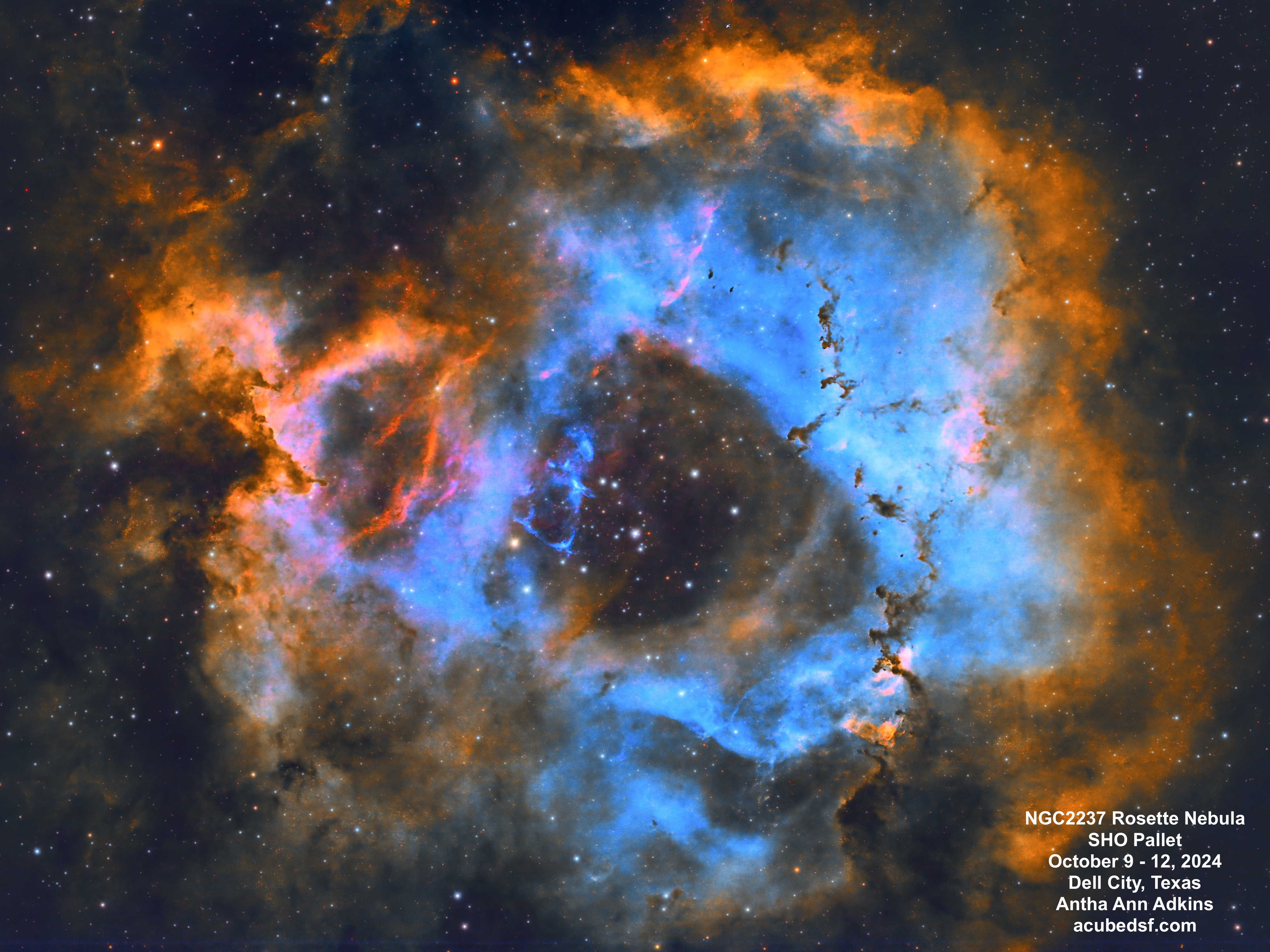
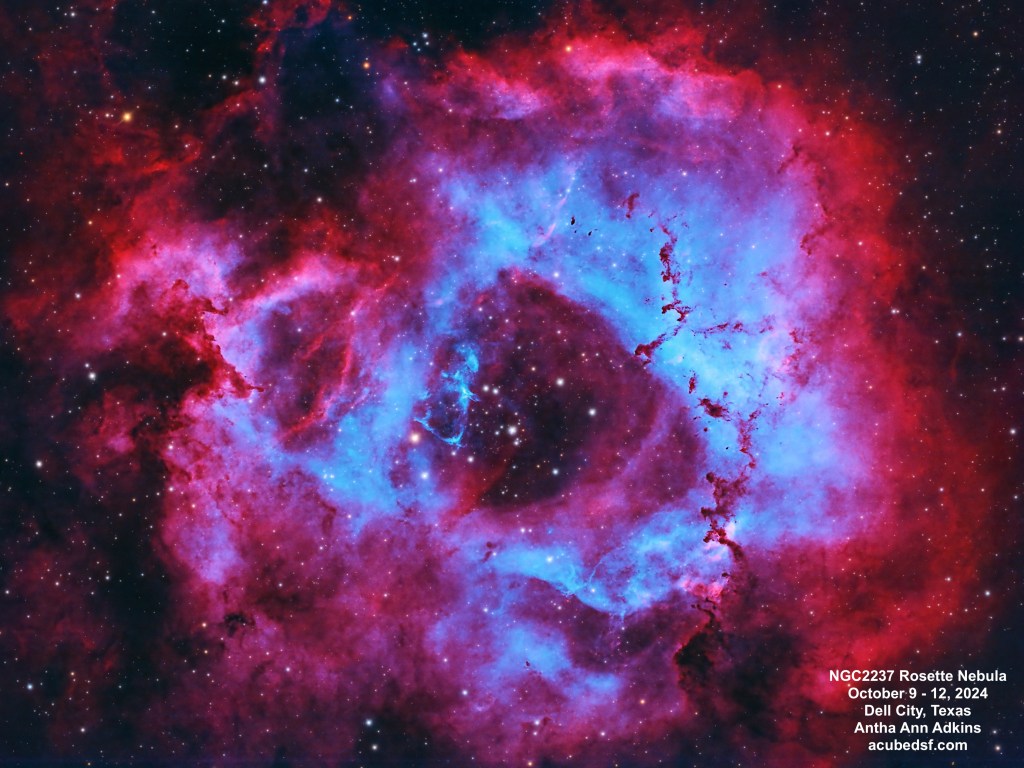
NGC 2237: Rosette Nebula: Natural Palette vs SHO Palette

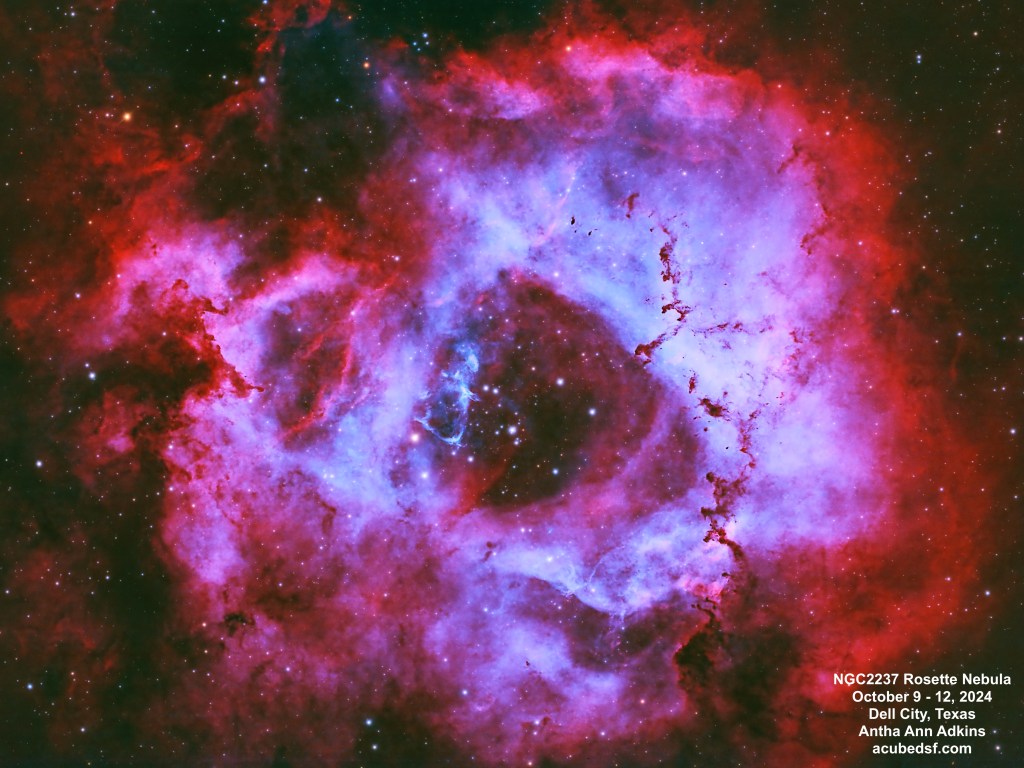
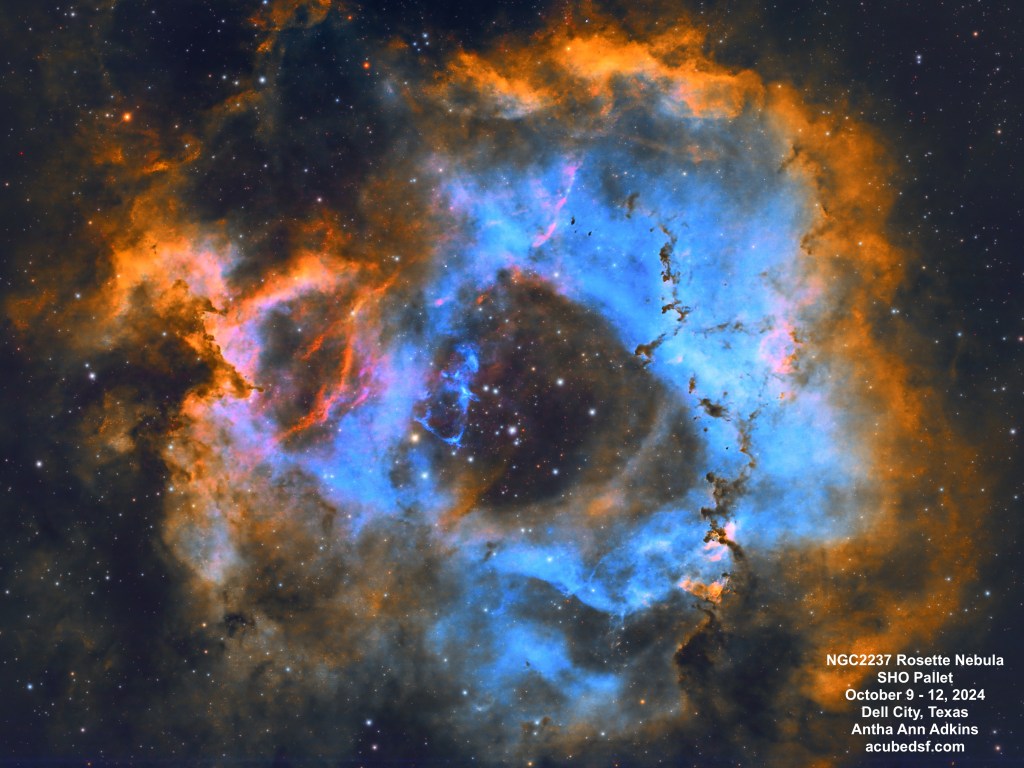
The Rosette Nebula, also numbered New General Catalogue (NGC) 2237 or Caldwell 49, is an emission nebula.  It is a large star-forming region containing the NGC2244 (Caldwell 50) star cluster in its center.  The star cluster was made from the gases in the nebula and contains some massive type O stars, which in turn produce radiation and stellar wind that blow away and light up the nebula around them.  The stars in this cluster are young, less than 5 million years old.  The Rosette Nebula is located in the Milky Way, approximately 5200 light years away, and it has an apparent size of 1.3 degrees, so it is approximately 120 light years across.    

When we visit the lovely dark skies of Dell City, Texas, I try to collect data on some challenging objects that I don’t think I can do from my light-polluted driveway.  I’m not always successful in meeting the challenge (super dim objects take a lot of hours of data to image), so I also try to collect data on some brighter objects so I know I’ll come home with some nice images.  The Rosette Nebula was my choice for one of my “sure it will be nice” images from our last trip. 

I think it is a stunning nebula.  I processed the data using two different palettes, ending up with three different versions.  The first palette, a “natural” palette, maps H-alpha (which is red) to red, Sii (which is also red) to a more pink color, and Oiii (which is blue) to purple/blue.  I tried different weightings/emphasis of the colors and ended up with one version where the nebula center is more blue and one version where the nebula center is more purple.  The second palette, the “Hubble” palette or SHO palette, maps Sii to red, H-alpha to green, and Oiii to blue (and then cuts out most of the green).  I also tried different weightings/emphasis of the colors, and I ended up with one version I liked the best.  I like the colors in the “natural” palette, but I think the Hubble palette does a better job of showing off the details of the nebula.

Which version do you like the best?

Camera geek info – Narrowband:

  • Williams Optics Zenith Star 73 III APO telescope
  • Williams Optics Flat 73A
  • ZWO 2” Electronic Filter Wheel
  • Antila SHO and RGB filters
  • ZWO ASI183MM-Pro-Mono camera
  • ZWO ASiair Plus
  • iOptron CEM40
  • Dell City, Texas Bortle 2-3 dark skies

Frames:

  • October 9, 2024
    • 135 60 second Gain 150 Oiii lights
    • 30 0.5 second Gain 150 Oiii flats
  • October 10, 2024
    • 129 60 second Gain 150 Ha lights
    • 30 0.2 second Gain 150 Ha flats
  • October 11, 2024
    • 27 60 second Gain 150 Red lights
    • 30 0.05 second Gain 150 Red flats
    • 26 60 second Gain 150 Green lights
    • 30 0.02 second Gain 150 Green flats
    • 25 60 second Gain 150 Blue lights
    • 30 0.02 second Gain 150 Blue flats
  • October 12, 2024
    • 129 60 second Gain 150 Sii lights
    • 30 1 second Gain 150 Sii flats
  • 30 Flat Darks from library
  • 30 Darks from library

Processing geek info:

  • PixInsight
  • BlurXterminator
  • NoiseXterminator
  • StarXTerminator
  • Generalized Hyperbolic Stretch
The Creation of NGC6888 the Crescent Nebula

NGC6888, also called the Crescent Nebula, is an emission nebula around a Wolf-Rayet Star, WR136.  It’s located in the Milky Way, approximately 5000 light years away, and it has an apparent size of 18 x 12 arcminutes, making it 26 x 17.5 light years across.  It’s estimated to be 30,000 years old.

Although it may seem similar since it is a nebula around a star, the Crescent Nebula is not a planetary nebula, and its ultimate ending will be very different from a planetary nebula.  Planetary nebulae occur when an intermediate mass star, 1 to 8 solar masses, expands into a red giant, sheds its outer layer, and shrinks to a white dwarf.  The high temperature and wind from the white dwarf ionizes the shed outer layer, making the beautiful nebulae.  The Crescent Nebula was made by a massive star, estimated to initially be <= 50 solar masses.  When it was a main sequence star, fusing hydrogen early in its life, its solar wind blew a bubble in the gasses surrounding it.  When it became a Red Super Giant, its slow solar wind filled the bubble with its outer layer, estimated to be 25 solar masses worth of material. And when the star collapsed into a super hot Wolf-Rayet star, now about 21 solar masses in size, its fast solar wind compressed the red super giant and Wolf-Rayet material into ionized filaments and clumps.  Eventually, the Wolf-Rayet star will fuse its matter creating heavier and heavier elements until it reaches iron, when it will implode and create a supernova.  

Visually, the nebula appears to have an outer Oiii “skin” and a “clumpy” Ha interior.  The Oiii skin is the boundary between the main sequence bubble and the Wolf Rayet shell, and the clumpy Ha interior is the red super giant material compressed by the Wolf Rayet shell.  A “blowout” in the Oiii skin can be seen in the lower right in the blue Oiii in this image.  The Interstellar Medium (ISM) – the cold low density gas between stars – may have been less dense in this direction, allowing the Oiii skin to blow out in this direction and not in other directions where the ISM is denser.   

I used data from my driveway in Friendswood, Texas with suburban Bortle 7 – 8 brightness skies (lots of light pollution) to make this image.  In order to capture the detail in this nebula and the outer Oiii shell, I needed a lot of data: 12.4 hours of Ha data and 15 hours of Oiii data, plus an hour of RGB data for the stars, taken over ten nights.

This is a narrowband image, mapping Oiii to blue and Ha to red.  My goal was to capture both the details in the Ha and the outer Oiii shell. 

Some people think this looks like a cosmic “brain.”  What do you think?  Isn’t our galaxy beautiful?

Camera geek info – Narrowband:

  • Williams Optics Zenith Star 73 III APO telescope
  • Williams Optics Flat 73A
  • ZWO 2” Electronic Filter Wheel
  • Antila HO and RGB filters
  • ZWO ASI183MM-Pro-Mono camera
  • ZWO ASIair Plus
  • iOptron CEM40
  • Friendswood, Texas Bortle 7-8 suburban skies

Frames:

  • July 4, 2024
    • 104 60 second Gain 150 Ha lights
    • 30 1.0 second Gain 150 Ha flats
  • August 2, 2024
    • 95 60 second Gain 150 Oiii lights
    • 30 0.5 second Gain 150 Oiii flats
  • August 8, 2024
    • 215 60 second Gain 150 Oiii lights
    • 30 0.5 second Gain 150 Oiii flats
  • September 7, 2024
    • 247 60 second Gain 150 Oiii lights
    • 30 0.5 second Gain 150 Oiii flats
  • September 12, 2024
    • 237 60 second Gain 150 Ha lights
    • 30 1.0 second Gain 150 Ha flats
  • September 13, 2024
    • 198 60 second Gain 150 Oiii lights
    • 30 0.5 second Gain 150 Oiii flats
  • September 17, 2024
    • 133 60 second Gain 150 Ha lights
    • 30 1.0 second Gain 150 Ha flats
  • September 19, 2024
    • 271 60 second Gain 150 Ha lights
    • 30 1.0 second Gain 150 Ha flats
  • September 20, 2024
    • 143 60 second Gain 150 Oiii lights
    • 30 0.5 second Gain 150 Oiii flats
  • September 21, 2024
    • 17 60 second Gain 150 red lights
    • 20 60 second Gain 150 green lights
    • 20 60 second Gain 150 blue lights
    • 30 0.05 second Gain 150 red flats
    • 30 0.02 second Gain 150 green flats
    • 30 0.02 second Gain 150 blue flats
  • 30 Flat Darks from library
  • 30 Darks from library

Processing geek info:

  • PixInsight
  • BlurXterminator
  • NoiseXterminator
  • StarXTerminator
  • Generalized Hyperbolic Stretch
  • NBColourMapper

M27 NGC6853 The Dumbbell Nebula or The Apple Core Nebula

M27, also called the Dumbbell Nebula or Apple Core Nebula, is a planetary nebula – the gases expelled from a red giant star before it becomes a white dwarf, lit up by that star.  It’s located in the Milky Way, approximately 1250 light years away, and it has an apparent size of 8 arcmintues, making it 2.9 light years across.  It’s estimated to be 12,700 years old.

Planetary nebulae do not last long on an astronomy time scale because the expelled gases grow dimmer as they expand away from the central star.  I am glad I live in a time when we can observe them and they can be observed!

Planetary nebulae were originally called that because they looked like a round (like a planet) ball of fuzz by visual observers.  However, now we know they have nothing to do with planets and are actually shell(s) of gas expelled from a red giant star.  With astrophotography, we can pick up so much more detail than a fuzzball, and so we end up with interesting names.  For this nebula, some thought the inner core of this nebula looked like a dumbbell; others thought it looked like an apple core.  With the outer fringe, what do you think it looks like?

I used data from my driveway in Friendswood, Texas with suburban Bortle 7 – 8 brightness skies (lots of light pollution) to make this image.  In order to capture the outer fringe I needed a lot of data: 12.2 hours of Ha data and 10.65 hours of Oiii data, taken over nine nights.

This is a narrowband image, mapping Oiii to blue and Ha to red.  My goal was to capture both the details in the core and the outer fringe.  It took three processing tries, but I think I was ultimately successful.

Isn’t our galaxy beautiful?

Camera geek info – Narrowband:

  • Williams Optics Zenith Star 73 III APO telescope
  • Williams Optics Flat 73A
  • ZWO 2” Electronic Filter Wheel
  • Antila HO filters
  • ZWO ASI183MM-Pro-Mono camera
  • ZWO ASiair Plus
  • iOptron CEM40
  • Friendswood, Texas Bortle 7-8 suburban skies

Frames:

  • June 22, 2024
    • 20 60 second Gain 150 Ha lights
    • 30 0.05 second Gain 150 Ha flats
  • June 28, 2024
    • 47 60 second Gain 150 Oiii lights
    • 30 0.05 second Gain 150 Oiii flats
  • July 3, 2024
    • 100 60 second Gain 150 Ha lights
    • 30 0.05 second Gain 150 Ha flats
  • August 15, 2024
    • 256 60 second Gain 150 Oiii lights
    • 30 0.05 second Gain 150 Oiii flats
  • August 16, 2024
    • 283 60 second Gain 150 Ha lights
    • 30 0.05 second Gain 150 Ha flats
  • August 20, 2024
    • 45 60 second Gain 150 Oiii lights
    • 30 0.05 second Gain 150 Oiii flats
  • August 22, 2024
    • 136 60 second Gain 150 Oiii lights
    • 30 0.05 second Gain 150 Oiii flats
  • August 23, 2024
    • 155 60 second Gain 150 Oiii lights
    • 30 0.05 second Gain 150 Oiii flats
  • August 24, 2024
    • 327 60 second Gain 150 Ha lights
    • 30 0.05 second Gain 150 Ha flats
  • 30 Flat Darks from library
  • 30 Darks from library

Processing geek info:

  • PixInsight
  • BlurXterminator
  • NoiseXterminator
  • StarXTerminator
  • Generalized Hyperbolic Stretch
  • NBColourMapper

NGC6357 The Lobster Nebula or the Bug-Eyed Monster Nebula

NGC6357, the Lobster Nebula, is an emission nebula.  It is a large star-forming region containing three star clusters, many young stars, and some massive stars.  One cluster is Pismis 24, located just above the bright blue core in this picture.  The stars in this cluster are about 1 million years old and four are massive – 40 – 120x the mass of our sun, among the most massive stars in our galaxy.  The Lobster Nebula is located in the Milky Way, approximately 5550 light years away, and it has an apparent size of 60 x 45 arc min, so it is approximately 97 x 73 light years across.    

From my driveway, the Lobster Nebula is low to the South and is only visible for a short time from when it rises above my house to when it goes behind the pine tree.  So it took many nights of data collection to get enough data to make this image – 12.2 hours of data collected over 13 nights.  And it would still benefit from more!  I may collect more data the next time we visit the dark skies of Dell City, Texas, where I have an unimpeded view to the South.  But, until then, I have declared the end of Lobster season!

Although NGC6357 is traditionally named the Lobster Nebula, I think it looks like a bug-eyed monster.  And a bug-eyed monster should be green with a red core and have red eyes.  So in addition to the traditional Hubble SHO (Sii mapped to red, Ha to green, and Oiii to blue), I also made a version using a OHS (Oiii mapped to red, Ha to green, and Sii to blue) palette.  I thought this version produced a nice contrast in the pillar in the core near the Pismis 24 cluster.

Which color palette do you like better?

Camera geek info – Narrowband:

  • Williams Optics Zenith Star 73 III APO telescope
  • Williams Optics Flat 73A
  • ZWO 2” Electronic Filter Wheel
  • Antila SHO filters
  • ZWO ASI183MM-Pro-Mono camera
  • ZWO ASiair Plus
  • iOptron CEM40
  • Friendswood, Texas Bortle 7-8 suburban skies

Frames:

  • June 7, 2024
    • 106 60 second Gain 150 Ha lights
    • 30 0.05 second Gain 150 Ha flats
  • June 8, 2024
    • 51 60 second Gain 150 Oiii lights
    • 30 0.05 second Gain 150 Oiii flats
  • June 13, 2024
    • 73 60 second Gain 150 Sii lights
    • 30 0.05 second Gain 150 Sii flats
  • June 14, 2024
    • 82 60 second Gain 150 Sii lights
    • 30 0.05 second Gain 150 Sii flats
  • June 15, 2024
    • 81 60 second Gain 150 Oiii lights
    • 30 0.05 second Gain 150 Oiii flats
  • June 28, 2024
    • 69 60 second Gain 150 Oiii lights
    • 30 0.05 second Gain 150 Oiii flats
  • June 29, 2024
    • 37 60 second Gain 150 Sii lights
    • 30 0.05 second Gain 150 Sii flats
  • July 3, 2024
    • 51 60 second Gain 150 Ha lights
    • 30 0.05 second Gain 150 Ha flats
  • August 6, 2024
    • 13 60 second Gain 150 Oiii lights
    • 30 0.05 second Gain 150 Oiii flats
  • August 8, 2024
    • 61 60 second Gain 150 Oiii lights
    • 30 0.05 second Gain 150 Oiii flats
  • August 6, 2024
    • 37 60 second Gain 150 Oiii lights
    • 30 0.05 second Gain 150 Oiii flats
  • August 6, 2024
    • 34 60 second Gain 150 Oiii lights
    • 30 0.05 second Gain 150 Oiii flats
  • August 6, 2024
    • 36 60 second Gain 150 Oiii lights
    • 30 0.05 second Gain 150 Oiii flats
  • 30 Flat Darks from library
  • 30 Darks from library

Processing geek info:

  • PixInsight
  • BlurXterminator
  • NoiseXterminator
  • StarXTerminator
  • Generalized Hyperbolic Stretch
  • NBColourMapper

NGC 2359 Thor’s Helmet: New Narrowband and Reprocessed RGB Images

NGC 2359, also called Thor’s Helmet, is an emission nebula – in this case a planetary nebula of ionized gas around a hot central star, Wolf-Rayet WR7.  WR7 is a massive star which has shed matter, and then its stellar wind has blown and compressed that matter into a bubble, and its UV radiation has ionized it to make the beautiful nebula we see.  This planetary nebula has a very complex shape, likely due to interactions with a nearby molecular cloud.  It’s located in the Milky Way, approximately 12,900 light years away, and it’s approximately 30 light years across, giving it an apparent size of 16 x 8 arc min.

In our early 2024 trip to the fantastic dark skies of Dell City, Texas, I took the images used to make the picture above using two narrow band filters – H-alpha (assigned to red) and Oiii (assigned to blue).  These color assignments are close to, but not exactly, true to color.

In our early 2023 trip to the fantastic dark skies of Dell City, Texas, I used a DSLR to make an RGB image of the nebula.  When I processed it last year, I hadn’t learned many of the processing techniques I use today, so I decided to reprocess it.  I was absolutely amazed at the difference processing can make (try the slider bar to see the difference!).  

I love both the narrowband version and the new RGB version.  Which do you like better?

Camera geek info – Narrowband:

  • Williams Optics Zenith Star 73 III APO telescope
  • Williams Optics Flat 73A
  • ZWO 2” Electronic Filter Wheel
  • Antila SHO filters
  • ZWO ASI183MM-Pro-Mono camera
  • ZWO ASiair Plus
  • iOptron CEM40
  • Dell City, Texas Bortle 2-3 dark skies

Frames:

  • February 13, 2024
    • HO lights
      • 45 120 second Gain 150 Ha lights
      • 35 120 second Gain 150 Oiii lights
    • 30 0.05 second Gain 150 H flats
    • 29 0.05 second Gain 150 O flats
    • 30 0.05 second flat darks
    • 30 120 second darks

Processing geek info:

  • PixInsight
  • BlurXterminator
  • NoiseXterminator
  • StarXTerminator
  • Generalized Hyperbolic Stretch
  • NBColourMapper

Camera geek info – RGB:

  • Canon EOS 60D in manual mode, 179 second exposure, ISO 2000, custom white balance 3500K
  • Williams Optics Zenith Star 73 III APO telescope
  • Williams Optics Flat 73A
  • iOptron CEM40
  • Dell City, Texas Bortle 2-3 dark skies

Frames:

  • 64 3 minute lights
  • 20 3 minute darks
  • 40 0.1 second flats
  • 40 0.1 second flat darks

Processing geek info – RGB:

  • PixInsight
  • BlurXterminator
  • NoiseXterminator
  • StarXTerminator
  • Generalized Hyperbolic Stretch
M42 Orion Nebula: Exploring Narrowband and Composite Imagery

Just as I used M42 the Orion Nebula as the target for first light with my new RGB filters, I also used M42 the Orion Nebula as the target for first light with my new narrowband filters.

I used the standard set of narrowband filters: H-alpha, Oiii, and Sii.

Not only did generating these images involve learning how to use my new hardware, but it also involved learning new processing, both processing narrowband data and making a composite image.

For narrowband imaging, each filter needs to be assigned a color to map it to an RGB image.  The figure below shows how colors map to wavelengths, and the table below shows what colors the three narrowband filters map to.  If a natural mapping is used, the final image will use red and turquoise only.  So a false color mapping is often used to better bring out details.  One common pallet is the Hubble pallet, where Hα is assigned to green, Oiii is assigned to blue, and Sii is assigned to red.  PixInsight has a new tool, NBColourMapper, which can make these color mappings – or any other assignment.  For these images, I only had a limited amount of Sii data, so they are limited in the color that Sii is mapped to.  For these images, I tried both a “natural” mapping and a “Hubble” mapping.  Which do you like better?

Visible-spectrum-400-700-nm
ElementEmission lineWavelengthColor
Hydrogen656.3 nmRed
OxygenOiii500.7 nmTurquoise
SulfurSii671.6 nmRed

The Orion Nebula has an enormous amount of dynamic range – more than can be captured in a single setting.  If the image is exposed to bring out the detail in the core of the nebula, the edges are too faint.  If the image is exposed to bring out the edges of the nebula, the core is blown out.  For these images, I made three versions of the image from two different sets of exposures: a version optimized for the core from the 60 second data, a version optimized for the middle zone from the 180 second data, and a version optimized for the outer edges from the 180 second data.

I tried a number of different processing flows to try to make a good composite from the three images using the new PixInsight tool BlendImage.  What I thought ended up working was the following process:

  • Make mask for core area from bright area of mid version
  • Apply core mask to core image as protecting
  • Use core image as base image in ImageBlend
  • Use mid image as blend image in ImageBlend
  • Blend using lighten/mask
  • Set opacity so edges look good
  • Make mid mask for mid area from bright area of outer version
  • Apply mid mask to mid_core image as protecting
  • Use mid_core image as base image in ImageBlend
  • Use outer image as blend image in ImageBlend
  • Blend using lighten/mask
  • Set opacity so edges look good

Astrophotography often extends what the human eye can see by taking (or integrating to) long exposure times, much longer than the human eye and brain can combine.  To me, narrowband mapping and composite imagery (as long as it’s labeled as such), is just another extension.  What do you think?

Camera geek info:

  • Williams Optics Zenith Star 73 III APO telescope
  • Williams Optics Flat 73A
  • ZWO 2” Electronic Filter Wheel
  • Antila SHO filters
  • ZWO ASI183MM-Pro-Mono camera
  • ZWO ASiair Plus
  • iOptron CEM40
  • Friendswood, Texas Bortle 7-8 suburban skies

Frames:

  • January 20, 2024
    • SHO lights
      • 47 60 second Gain 50 Ha lights
      • 60 60 second Gain 50 Oiii lights
      • 54 60 second Gain 50 Sii lights
    • 30 0.05 second Gain 50 H flats
    • 30 0.05 second Gain 50 O flats
    • 30 0.05 second Gain 50 S flats
    • 30 0.05 second flat darks
    • 30 60 second darks
  • February 6, 2024
    • SHO lights
      • 15 180 second Gain 50 Ha lights
      • 49 180 second Gain 50 Oiii lights
    • 30 0.05 second Gain 50 H flats
    • 30 0.05 second Gain 50 O flats
    • 30 0.05 second flat darks
    • 14 180 second darks

Processing geek info:

  • PixInsight
  • BlurXterminator
  • NoiseXterminator
  • StarXTerminator
  • Generalized Hyperbolic Stretch
  • NBColourMapper
  • ImageBlend