William Optics Pleiades 111 First Light and More Nights with M101 the Pinwheel Galaxy

I chose M101 as my “first light” object for my new William Optics Pleiades 111 telescope, “Blue,” because it was galaxy season when I started imaging back in May and I had imaged it before so I could compare the results with my smaller telescope setup.
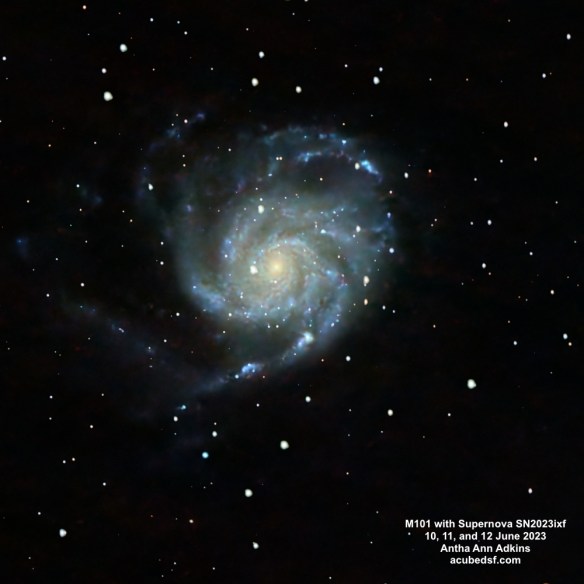
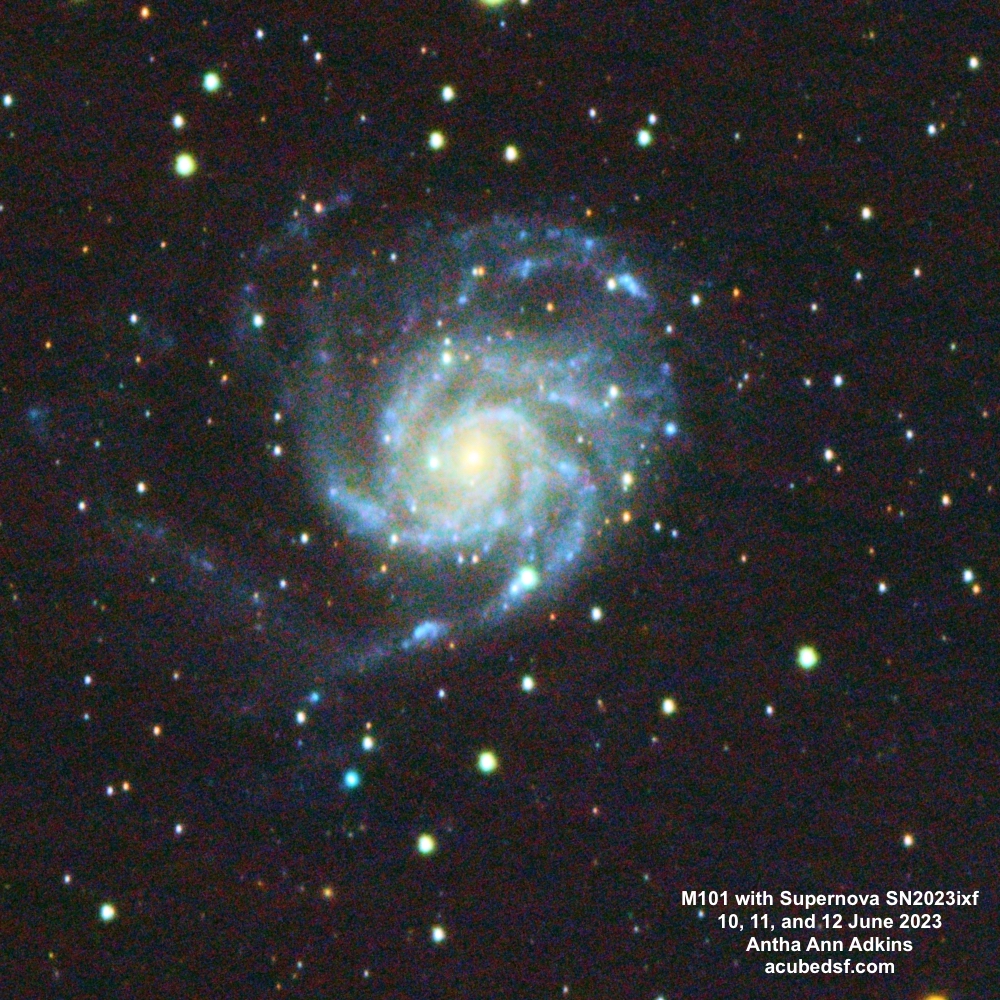
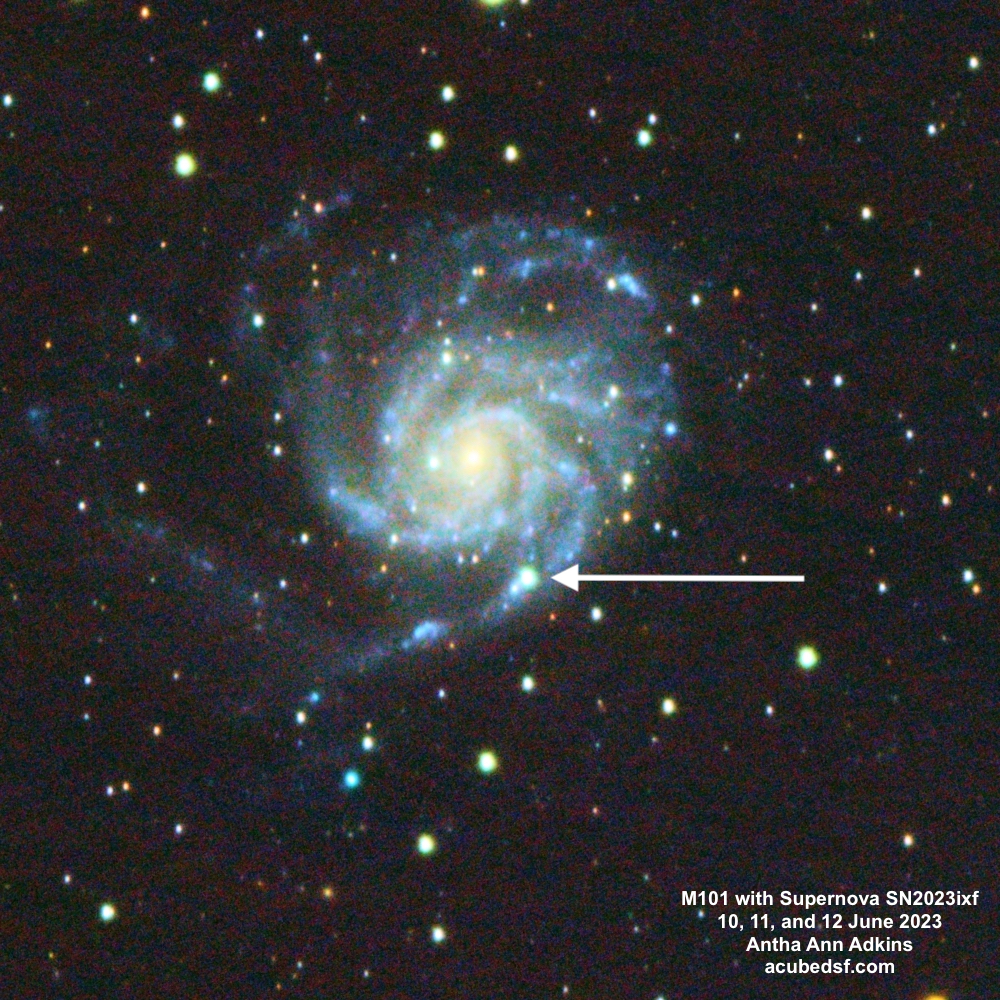
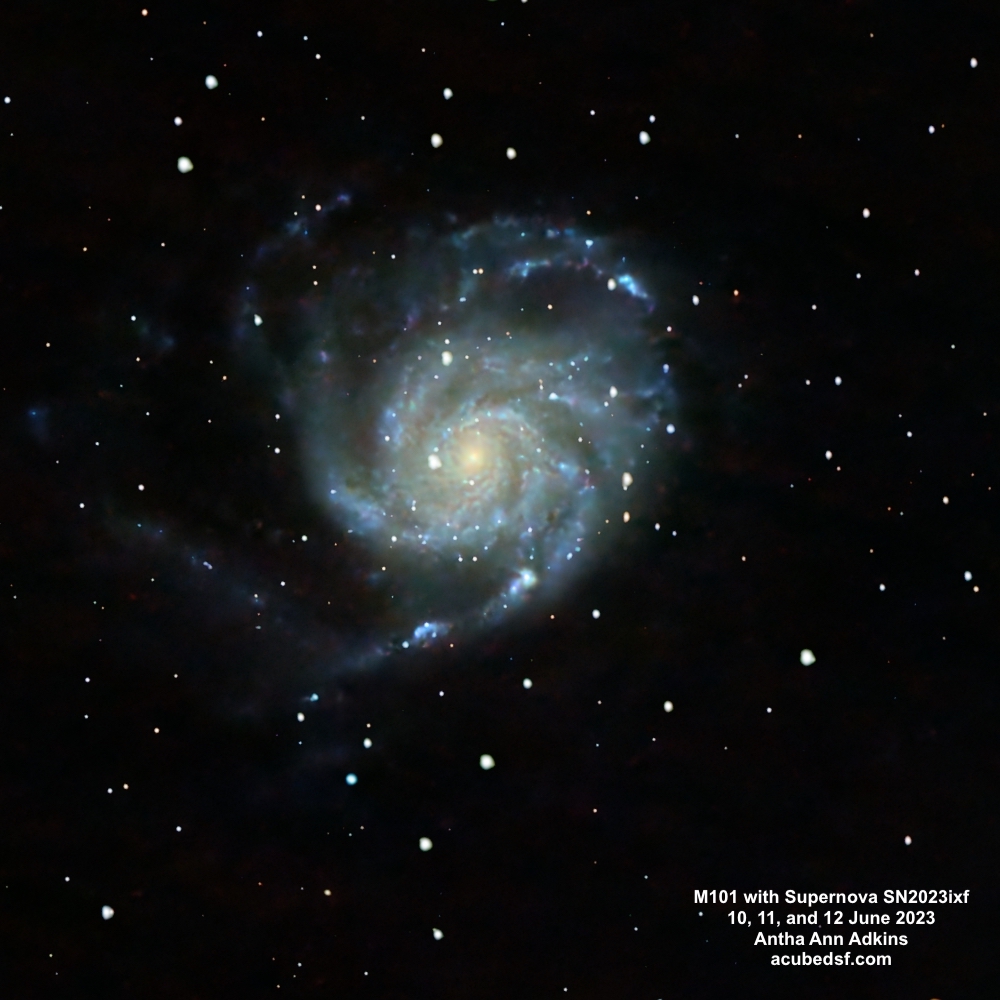
My oldest comparison image is from June 2023, when there was a supernova in the galaxy.  I collected the data from the fabulous dark skies in Dell City, Texas, using my William Optics Zenith Star 73 III APO telescope and a Canon 60D camera.  The image was made from 10.6 hours of data.

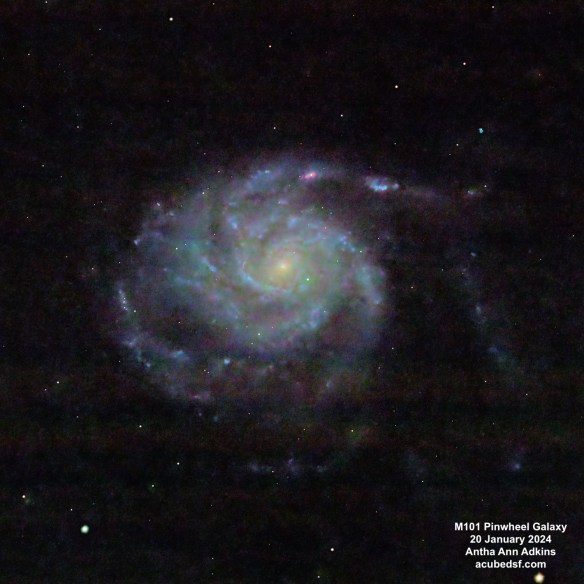
My next comparison image is from January 2024.  I collected the data from Friendswood, Texas with suburban light pollution using my William Optics Zenith Star 73 III APO telescope and my at-the-time new ZWO ASI183MM-Pro-Mono camera and ZWO filter wheel. The image was made using 59 minutes of red data, 60 minutes of green data, and 57 minutes of blue data. 

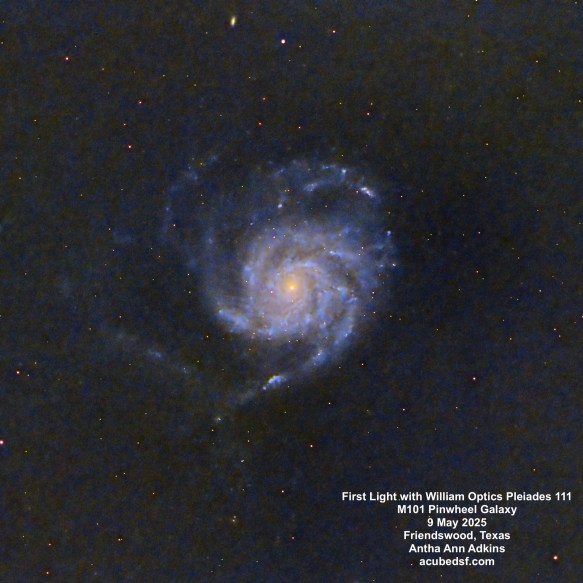
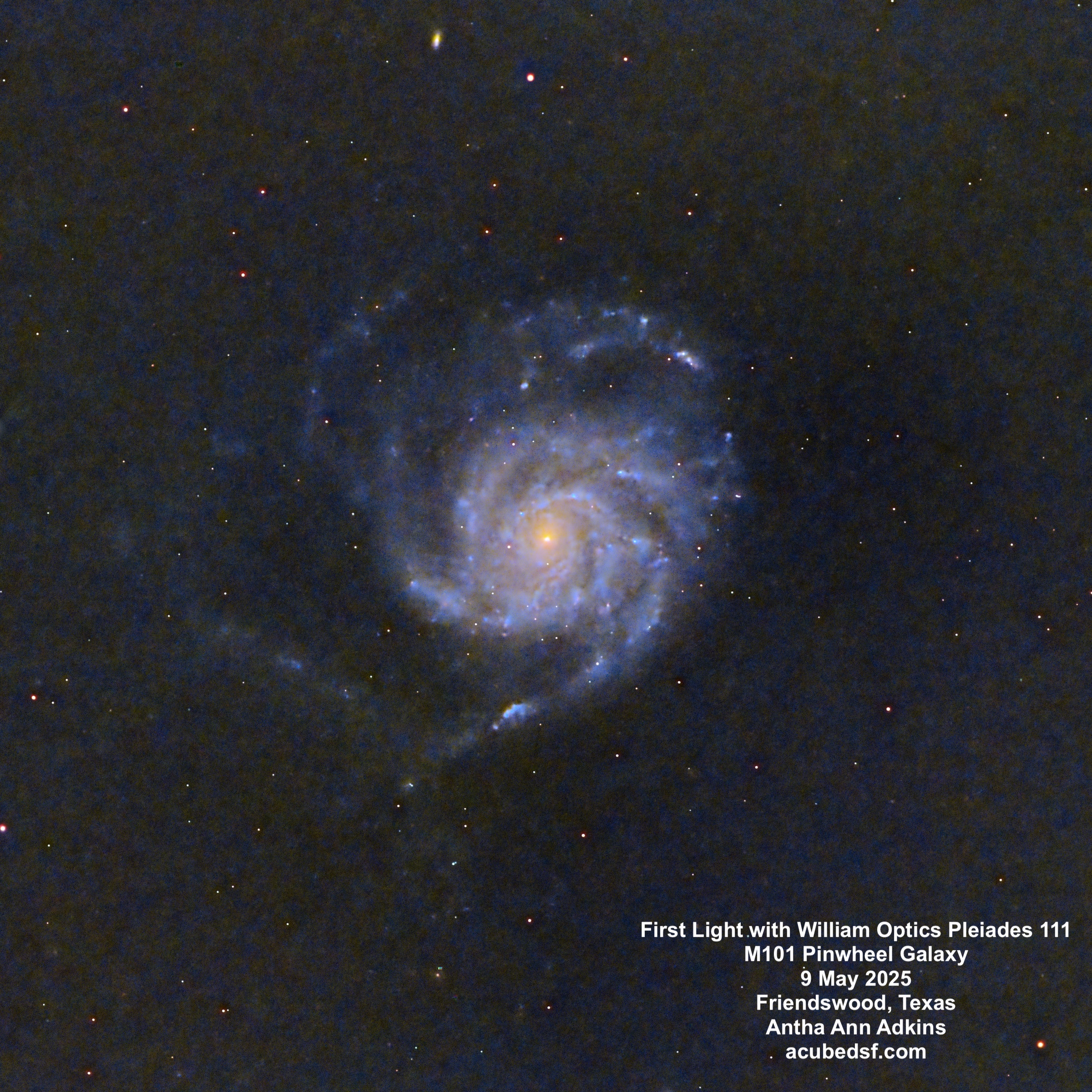
My next image is from May 2025 in Friendswood, Texas, and it was the first light on my William Optics Pleiades 111 telescope “Blue” using a new guide camera and using my existing ZWO ASI183MM-Pro-Mono camera.   The image used only 52 minutes of red data, 66 minutes of green data, and 86 seconds of blue data, and I had to adjust some of the local normalization parameters to accept lower quality data to get it to process.  I had been excited to have a semi-clear night, so I had gotten the telescope out even though seeing wasn’t great.

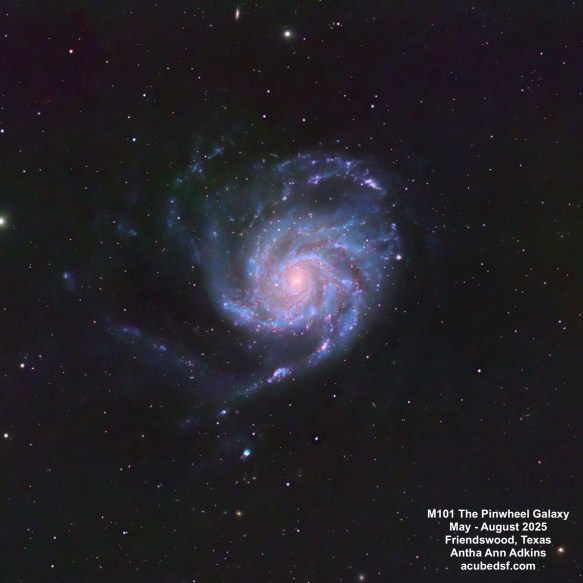
My final (for now) image is from May – August 2025 in Friendswood, Texas.  The new telescope cloud curse has been particularly strong with this telescope, and when there weren’t clouds, there was dust or a full Moon. Nevertheless, I persevered over 8 nights to produce the final image, ending up using 5.9 hours of red data, 5.3 hours of green data, and 4.8 hours of blue data.

There was a huge improvement in the detail (most obvious with the stars) when I switched to the astrocamera, and another huge improvement in the detail (most obvious in the galaxy and in the background galaxies) when I switched to the larger telescope and guiding capability.

My main subject, M101, the Pinwheel Galaxy, is an intermediate spiral galaxy, between a barred and an unbarred spiral galaxy.  It’s located approximately 23.2 million light years away, and it has an apparent size of 24 arcminutes, making it about 162 thousand light years across. 
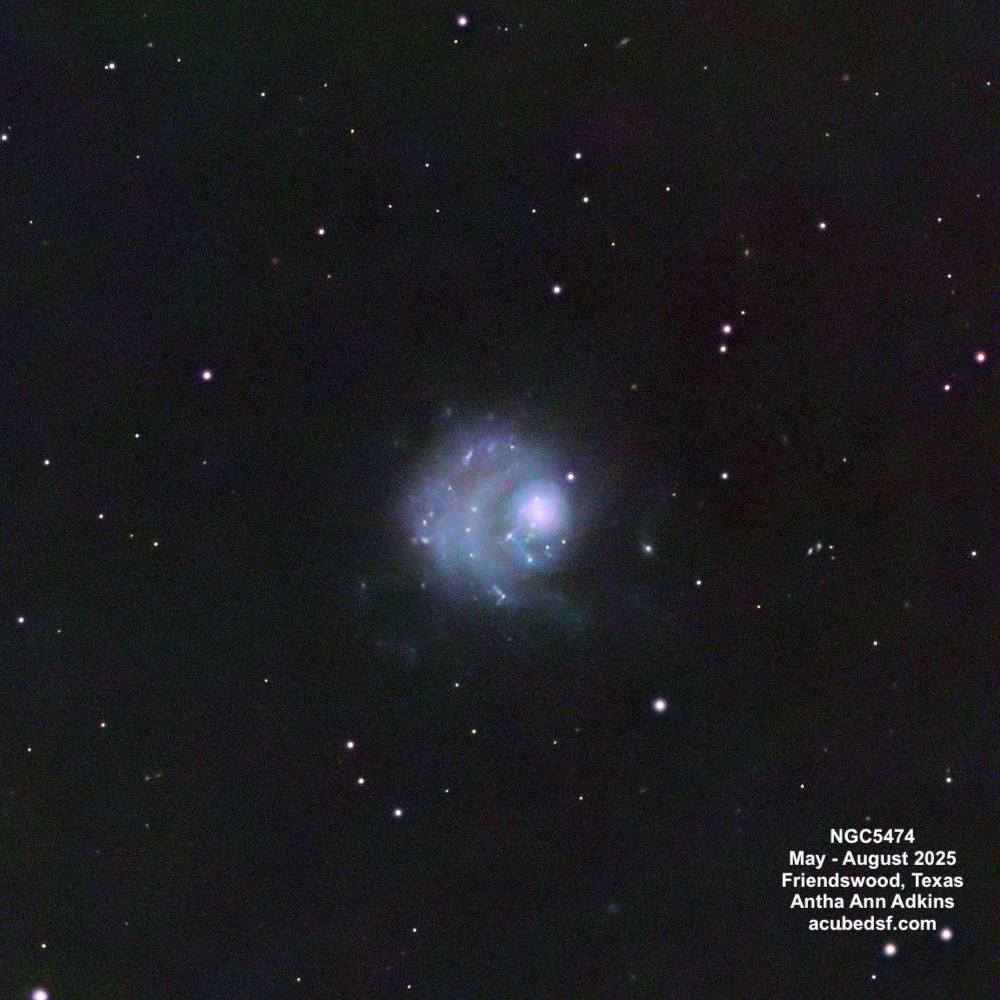
Also obvious during imaging was NGC5474, which is a peculiar dwarf galaxy that is a companion to M101.  Its interaction with M101 has distorted it.  It also appears to have a spiral structure, making it a dwarf spiral galaxy.  It’s located approximately 22.4 million light years away, and it has an apparent size of 4.68 arcminutes, making it about 30.4 thousand light years across.
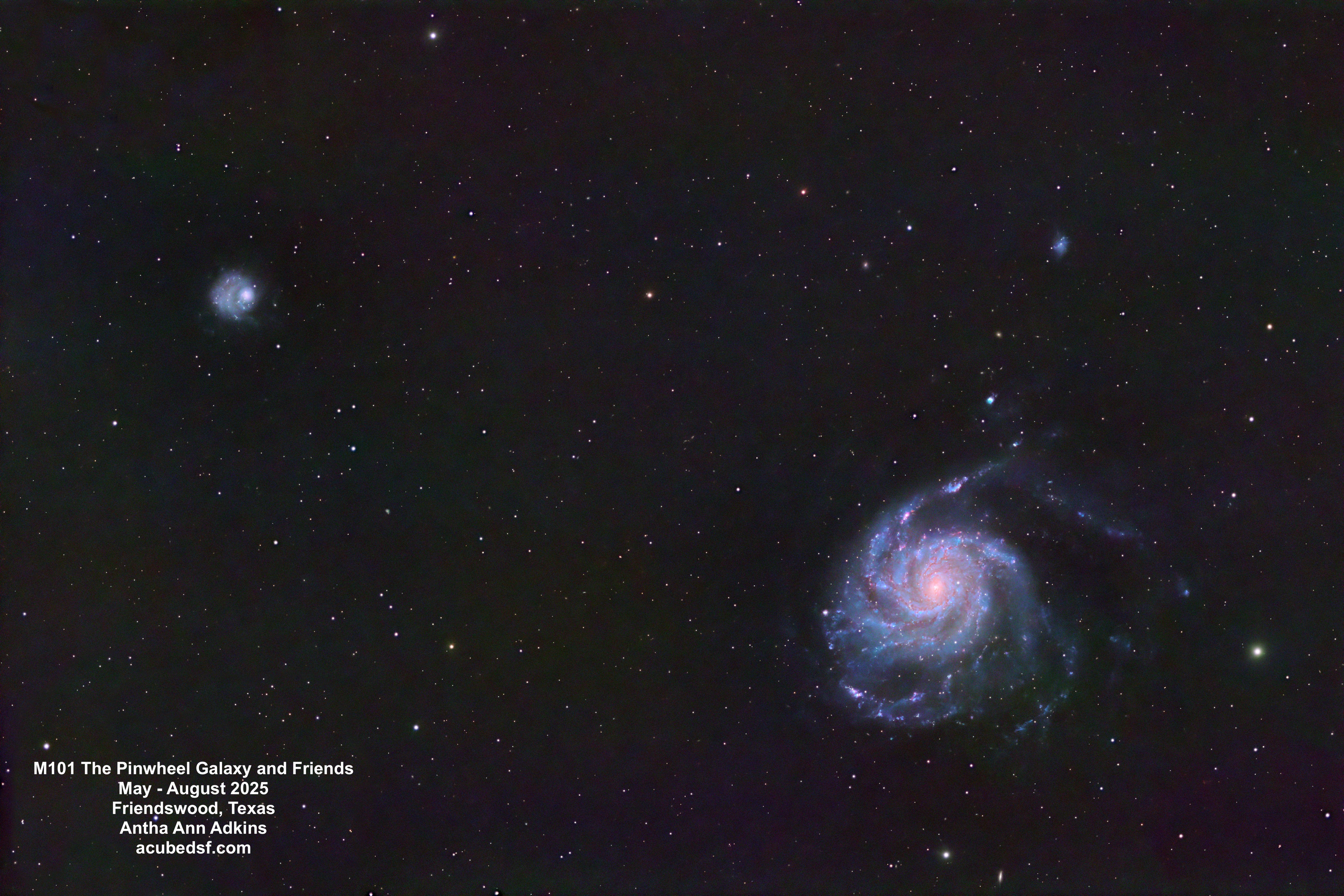
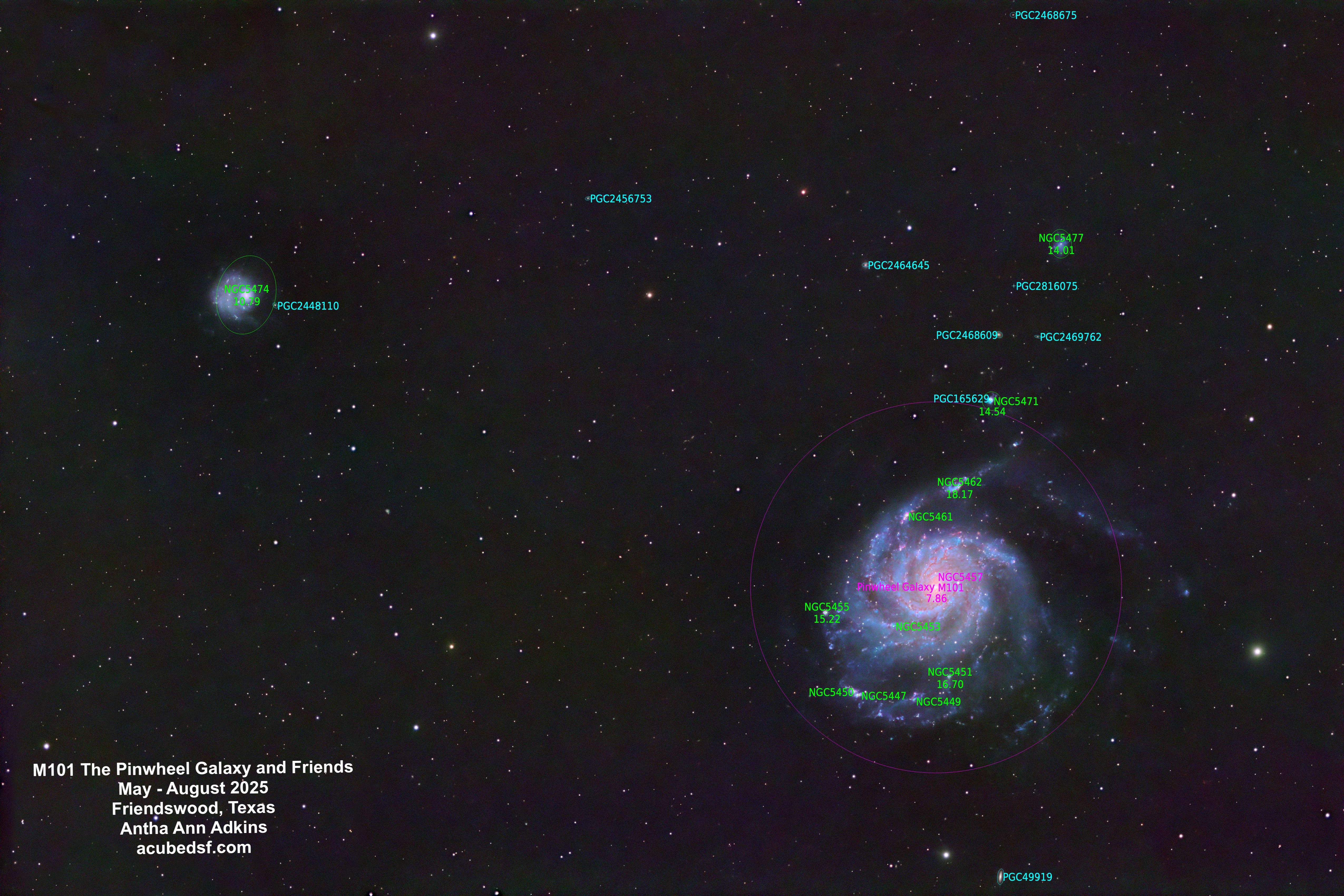
What surprised me with in the final image was the sheer number of tiny galaxies in the background.  In addition to NGC5474, there was NGC5477, a dwarf galaxy which is 22.05 million light years away, with an apparent size of 1.7 arcminutes, making it 10.9 thousand light years across.  PixInsight also labeled 8 other galaxies in the Principal Galaxies Catalog (PGC).  And when I looked in detail at the image, there are a ton more tiny distant galaxies in the background.  WOW. 

Now M101 is really too low in the sky to get any good data from my driveway, so I am moving on to other subjects.  I look forward to coming back to this one in the future and capturing more of the amazing background galaxies. 

Our universe is packed with cool stuff!  

Camera geek info for final image:

  • William Optics Pleiades 111 telescope
  • ZWO 2” Electronic Filter Wheel
  • Antila RGB filters
  • Blue Fireball 360° Camera Angle Adjuster/Rotator
  • ZWO ASI183MM-Pro-Mono camera
  • William Optics Uniguide 32MM F/3.75
  • ZWO ASI220MM-mini
  • ZWO ASiair Plus
  • iOptron CEM40
  • Friendswood, Texas Bortle 7-8 suburban skies

Frames for final image:

  • May 9, 2025
    • 13 60 second Gain 150 Red lights
    • 30 0.02 second Gain 150 Red flats
  • May 23, 2025
    • 29 60 second Gain 150 Red lights
    • 30 0.02 second Gain 150 Red flats
  • May 24, 2025
    • 2 60 second Gain 150 Red lights
    • 30 0.02 second Gain 150 Red flats
    • 54 60 second Gain 150 Green lights
    • 30 0.01 second Gain 150 Green flats
    • 50 60 second Gain 150 Blue lights
    • 30 0.01 second Gain 150 Blue flats
  • June 6, 2025
    • 84 60 second Gain 150 Red lights
    • 30 0.02 second Gain 150 Red flats
    • 72 60 second Gain 150 Green lights
    • 30 0.01 second Gain 150 Green flats
    • 63 60 second Gain 150 Blue lights
    • 30 0.01 second Gain 150 Blue flats
  • June 7, 2025
    • 100 60 second Gain 150 Red lights
    • 30 0.02 second Gain 150 Red flats
    • 74 60 second Gain 150 Green lights
    • 30 0.01 second Gain 150 Green flats
    • 63 60 second Gain 150 Blue lights
    • 30 0.01 second Gain 150 Blue flats
  • July 10, 2025
    • 57 60 second Gain 150 Red lights
    • 30 0.02 second Gain 150 Red flats
    • 46 60 second Gain 150 Green lights
    • 30 0.01 second Gain 150 Green flats
  • July 11, 2025
    • 69 60 second Gain 150 Red lights
    • 30 0.02 second Gain 150 Red flats
    • 23 60 second Gain 150 Green lights
    • 30 0.01 second Gain 150 Green flats
    • 12 60 second Gain 150 Blue lights
    • 30 0.01 second Gain 150 Blue flats
  • July 22, 2025
    • 93 60 second Gain 150 Blue lights
    • 30 0.01 second Gain 150 Blue flats
  • August 1, 2025
    • 51 60 second Gain 150 Green lights
    • 30 0.01 second Gain 150 Green flats
    • 6 60 second Gain 150 Blue lights
    • 30 0.01 second Gain 150 Blue flats
  • Darks, Flat darks from library
M101: First Light with William Optics Pleiades 111 Telescope “Blue”

It’s a well-known astrophotography curse that buying new equipment means weeks, if not months, worth of cloudy skies.  My new telescope, a William Optics Pleiades 111, a 11.1 cm/4.37 inch diameter refractor that I’ve nicknamed “Blue”, was no exception.  It took about a month after I got the telescope (and the additional two counter weights I needed to balance it) for the skies to at least somewhat clear.  I got everything set up, just to watch the clouds roll in.  Happily, they then rolled back out.  And then rolled back in.  And out.

I ended up with enough data to make a first light picture, but I’ll need to collect more data for a final image.

I had contemplated what to image for first light.  Since the telescope name is Pleiades, the Pleiades would have been a good target, except they’re currently barely above the horizon at sunset.  My favorite nebula, the Orion nebula, would have been a good target, except it’s also currently barely above the horizon at sunset.  It’s “galaxy season,” so I decided to image a galaxy.  I’ve imaged M101 before because it hosted a supernova in 2023, so it gave me a good point of comparison.  

The comparison isn’t entirely a fair one.  On the one hand, this is an entirely new setup, with a much larger diameter telescope, an astro camera instead of a consumer camera, and a guide scope and guide camera to better control the tracking mount.  Additionally, I’ve picked up a lot of processing skill in the last two years, such as using shorter images for the stars so they don’t “bloat.”  On the other hand, this was 3.4 hours of galaxy data from my Bortle 7-8 light polluted driveway instead of 10.6 hours from the Bortle 2-3 dark skies of Dell City.

Because of the light pollution and limited imaging time, there is a lot more background noise in the new image.  But the stars are enormously improved from the old image.  And there is more detail in the new image.  I can’t wait to see how an image with more data turns out!

Once the clouds roll away again ….

Camera geek info May 9, 2025 (new image):

  • William Optics Pleiades 111 telescope
  • ZWO 2” Electronic Filter Wheel
  • Antila RGB filters
  • Blue Fireball 360° Camera Angle Adjuster/Rotator
  • ZWO ASI183MM-Pro-Mono camera
  • William Optics Uniguide 32MM F/3.75
  • ZWO ASI220MM-mini
  • ZWO ASiair Plus
  • iOptron CEM40
  • Friendswood, Texas Bortle 7-8 suburban skies

Frames (new image):

  • May 9, 2025
    • 32 30 second Gain 150 Red lights for stars
    • 24 30 second Gain 150 Green lights for stars
    • 22 30 second Gain 150 Blue lights for stars
    • 53 60 second Gain 150 Red lights for galaxy
    • 66 60 second Gain 150 Green lights for galaxy
    • 86 60 second Gain 150 Blue lights for galaxy
    • 30 0.2 second Gain 150 Red flats
    • 30 0.1 second Gain 150 Green flats
    • 30 0.1 second Gain 150 Blue flats
  • Darks, Flat darks from library
Camera geek info (old image):

  • William Optics Zenith Star 73 III APO telescope
  • William Optics Flat 73A
  • Canon EOS 60D in manual mode, 2 minute exposure, ISO 1600 and ISO 2000, custom white balance 3500K
  • iOptron CEM40
  • Dell City, Texas Bortle 2-3 dark skies

Frames (old image):

  • June 10, 2023
    • Run 1 1600 ISO
      • 99 2 minute lights
      • 31 0.01 second flats
      • 20 0.01 second flat darks
    • Run 2 1600 ISO
      • 39 2 minute lights
      • 31 0.02 second flats
      • 30 0.02 second flat darks
      • 71 2 minute darks
  • June 11, 2023 2000 ISO
    • 151 2 minute lights
    • 31 0.02 second flats
    • 20 0.02 second flat darks
    • 31 2 minute darks
  • June 12, 2023 2000 ISO
    • 30 2 minute lights
    • 31 0.02 second flats
    • 30 0.02 second flat darks
    • 32 2 minute darks

Processing geek info:

  • PixInsight
  • BlurXterminator
  • NoiseXterminator
  • StarXTerminator
  • Generalized Hyperbolic Stretch

M42 The Orion Nebula and M101 the Pinwheel Galaxy: First Light with New Astrophotography Equipment

Back at the end of November, I bought some new astrophotography tools/toys: 

  • ZWO 2” Electronic Filter Wheel
  • Antila LRGBSHO filters
  • ZWO ASI183MM-Pro-Mono camera
  • ZWO ASiair Plus

Of course, as the old astrophotography joke goes, buying new tools meant we had seemingly months of cloudy skies.

Happily, this time of year meant I got to have first light with one of my favorite Deep Space Objects: M42 the Orion Nebula.

I finally got an opportunity for first light with the new equipment December 29, 2023, but the filter wheel was jammed by one of the connecting tubes (I ordered a better one) so I didn’t get any good data.  

I got a second opportunity on December 30, 2023 but I had to resort to swapping in the filters by hand, which meant bringing the telescope back inside to change out filters and restarting ASiair every time.  The resulting images ended up rotated relative to one another in such a way that I couldn’t crop out all the sections that weren’t covered by all three filters.  This wasn’t surprising since I had to unscrew all the parts to swap out filters.  I also think I may have mislabeled which set of images was which color since the result came out an odd purple color.  Rotating the color assignments seemed to fix that.  The experience gave me a real appreciation for the filter wheel! 

Here is the processed image:

Camera geek info:

  • Williams Optics Zenith Star 73 III APO telescope
  • Williams Optics Flat 73A
  • Antila RGB filters
  • ZWO ASI183MM-Pro-Mono camera
  • ZWO ASiair Plus
  • iOptron CEM40
  • Friendswood, Texas Bortle 7-8 suburban skies

Frames:

  • December 30, 2023
    • RGB lights
      • 52 60 second Gain 50 R lights
      • 30 60 second Gain 50 G lights 
      • 54 60 second Gain 50 B lights 
    • 30 0.05 second Gain 50 RGB flats
    • 30 0.05 second Gain 50 flat darks
    • 30 60 second Gain 50 darks

Processing geek info:

  • PixInsight
  • BlurXterminator
  • NoiseXterminator
  • StarXTerminator
  • Generalized Hyperbolic Stretch

I got a new ring to connect the filter wheel and got first light on the whole new setup, try 3, on January 20, 2024, and I got data for both M42 the Orion Nebula and M101 the Pinwheel Galaxy which I could compare to previous images taken with my Canon 60D DSLR.  I appreciated the ASiair being able to configure a whole run including switching filters and have it automatically run.  I also appreciated the ASiair connecting to my iPad so I could see each image on my iPad from inside my house where it was warm!  I did still go outside to watch the telescope meridian flip to make sure no wires were caught. 

Here is the processed M42 Orion Nebula RGB image (dated 20 January 2024) with a previous DSLR image in the slideshow. The differences are hard to see and may be related to processing.

Camera geek info:

  • Williams Optics Zenith Star 73 III APO telescope
  • Williams Optics Flat 73A
  • ZWO 2” Electronic Filter Wheel
  • Antila RGB filters
  • ZWO ASI183MM-Pro-Mono camera
  • ZWO ASiair Plus
  • iOptron CEM40
  • Friendswood, Texas Bortle 7-8 suburban skies

Frames:

  • January 20, 2024
    • RGB lights
      • 59 60 second Gain 50 R lights 
      • 60 60 second Gain 50 G lights 
      • 57 60 second Gain 50 B lights
    • 30 0.0417 second Gain 50 G flats (a setting goof)
    • 30 0.0417 second Gain 50 B flats (a setting goof)
    • 28 0.05 second Gain 50 R flats
    • 30 0.05 second flat darks
    • 6 60 second darks

Processing geek info:

  • PixInsight
  • BlurXterminator
  • NoiseXterminator
  • StarXTerminator
  • Generalized Hyperbolic Stretch

Here is the processed M101 the Pinwheel Galaxy RGB image (dated 20 January 2024) with previous DSLR images in the slideshow. Here, the improvement is obvious, with significantly more detail in the galaxy with the new camera.  It even compares well to images taken from the much darker Dell City skies (February 2023 and June 2023).

Camera geek info:

  • Williams Optics Zenith Star 73 III APO telescope
  • Williams Optics Flat 73A
  • ZWO 2” Electronic Filter Wheel
  • Antila RGB filters
  • ZWO ASI183MM-Pro-Mono camera
  • ZWO ASiair Plus
  • iOptron CEM40
  • Friendswood, Texas Bortle 7-8 suburban skies

Frames:

  • January 20, 2024
    • RGB lights
      • 59 60 second Gain 50 R lights 
      • 60 60 second Gain 50 G lights 
      • 57 60 second Gain 50 B lights
    • 18 0.05 second Gain 50 R flats
    • 24 0.05 second Gain 50 G flats 
    • 17 0.05 second Gain 50 B flats
    • 30 0.05 second flat darks
    • 6 60 second darks

Processing geek info:

  • PixInsight
  • BlurXterminator
  • NoiseXterminator
  • StarXTerminator
  • Generalized Hyperbolic Stretch

I’m really pleased with this new equipment, and I’m looking forward to seeing what I can do with it!

Astrophotography Makeover: M101 and M16

M101 with Supernova 2023xif – with and without BXT and NTX

M16 Eagle Nebula – with and without BXT and NXT

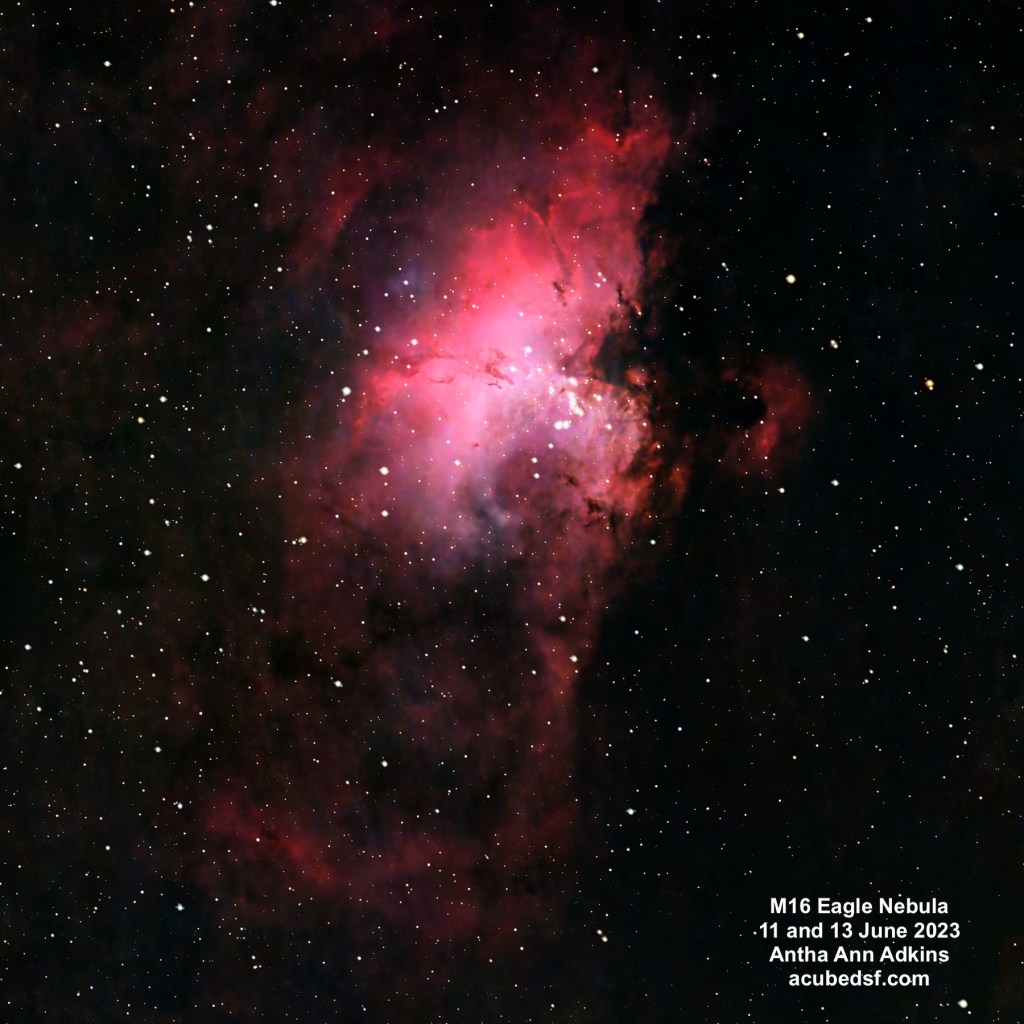
After learning about the powerful BlurXterminator (BXT) and NoiseXterminator (NXT) tools, I reprocessed my M101 and supernova and M16 images that I took from the glorious dark skies of Dell City, Texas earlier this summer.  I was amazed that so much detail can be found in images of objects thousands to millions of light years away taken by my small telescope.  

M16:

Camera geek info:

  • Canon EOS 60D in manual mode, 2 minute exposure, ISO 2000
  • Williams Optics Zenith Star 73 III APO telescope
  • Williams Optics Flat 73A
  • iOptron CEM40
  • Dell City, Texas Bortle 2-3 dark skies

Frames:

  • June 11, 2023
    • Run 1 
      • 6 2 minute lights
      • 31 0.02 second flats
      • 30 0.02 second flat darks
      • 31 2 minute darks
  • June 13, 2023 
    • Run 2
      • 88 2 minute lights
      • 30 0.02 second flats
      • 31 0.02 second flat darks
    • Run 3
      • 83 2 minute lights
      • 31 0.02 second flats
      • 30 0.02 second flat darks
      • 31 2 minute darks
  • 17 frames rejected for a total of 5 hours and 20 minutes of data

Processing geek info:

  • PixInsight
  • BlurXterminator
  • NoiseXterminator
  • StarXTerminator
  • Generalized Hyperbolic Stretch

M101:

Camera geek info:

  • Canon EOS 60D in manual mode, 2 minute exposure, ISO 1600 and ISO 2000
  • Williams Optics Zenith Star 73 III APO telescope
  • Williams Optics Flat 73A
  • iOptron CEM40
  • Dell City, Texas Bortle 2-3 dark skies

Frames:

  • June 10, 2023
    • Run 1 1600 ISO
      • 99 2 minute lights
      • 31 0.01 second flats
      • 20 0.01 second flat darks
    • Run 2 1600 ISO
      • 39 2 minute lights
      • 31 0.02 second flats
      • 30 0.02 second flat darks
      • 71 2 minute darks
  • June 11, 2023 2000 ISO
    • 151 2 minute lights
    • 31 0.02 second flats
    • 20 0.02 second flat darks
    • 31 2 minute darks
  • June 12, 2023 2000 ISO
    • 30 2 minute lights
    • 31 0.02 second flats
    • 30 0.02 second flat darks
    • 32 2 minute darks

Processing geek info:

  • PixInsight
  • BlurXterminator
  • NoiseXterminator
  • StarXterminator
  • Generalized Hyperbolic Stretch

M101 Supernova from Bortle 2 Skies

We recently went out to visit our favorite dark skies spot, Dell City, Texas, and we enjoyed 5.5 cloud-free nights and I collected over 30 hours of data.  I spent most of that time on M101 and the supernova (arrow points to the supernova).  

One of the things I’ve taken to doing is taking flats and dark flats before doing a meridian flip so each run is processed with its own calibration frames.  That way if I bump the camera or reorient it, the flats will match the lights.

Now that I’m home, I’m processing the data.  I didn’t use StarXterminator to separate the stars from the galaxy because I wanted the galaxy and the supernova to be processed the same way.

A couple of the light frames were thrown out by PixInsight, so this image ended up using 306 2-minute lights for a total of 10.2 hours of data.  Compared to what I could get from my driveway, I think it was worth it!

Camera geek info:

  • Canon EOS 60D in manual mode, 2 minute exposure, ISO 1600 and ISO 2000, custom white balance 3500K
  • Williams Optics Zenith Star 73 III APO telescope
  • Williams Optics Flat 73A
  • iOptron CEM40
  • Dell City, Texas Bortle 2-3 dark skies

Frames:

  • June 10, 2023
    • Run 1 1600 ISO
      • 99 2 minute lights
      • 31 0.01 second flats
      • 20 0.01 second flat darks
    • Run 2 1600 ISO
      • 39 2 minute lights
      • 31 0.02 second flats
      • 30 0.02 second flat darks
      • 71 2 minute darks
  • June 11, 2023 2000 ISO
    • 151 2 minute lights
    • 31 0.02 second flats
    • 20 0.02 second flat darks
    • 31 2 minute darks
  • June 12, 2023 2000 ISO
    • 30 2 minute lights
    • 31 0.02 second flats
    • 30 0.02 second flat darks
    • 32 2 minute darks

Processing geek info:

  • PixInsight
  • Generalized Hyperbolic Stretch

M101 Supernova in Haiku

Cloudless skies last night.
Supernova shining bright.
A delightful sight.

Antha Ann Adkins

Thursday night we had clear skies (though a near-full Moon) and I was able to take another set of M101 and supernova images.  Comparing to my previous images, you can see that more time from my driveway gave me more galaxy details, but that they don’t compare to what I can get from darker skies.

Camera geek info:

  • Canon EOS 60D in manual mode, ISO 800, 1 minute exposures
  • Williams Optics Zenith Star 73 III APO telescope
  • Williams Optics Flat 73A
  • SkyTech 2” LPRO-MAX CCD Filter
  • iOptron CEM40
  • Friendswood, Texas Bortle 7-8 suburban skies

Frames:

  • 318 1 minute lights
  • 31 0.05 second flats
  • 20 0.05 second flat darks
  • 49 1 minute darks

Processing geek info:

  • PixInsight
  • Generalized Hyperbolic Stretch

M101 Supernova

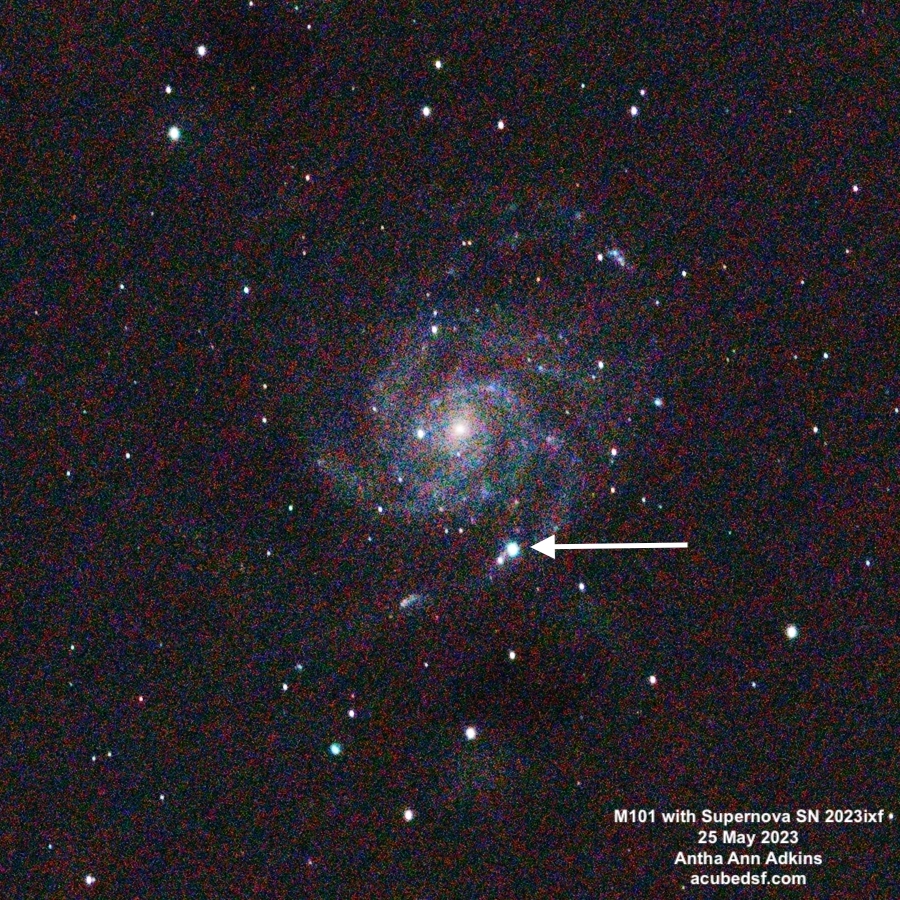
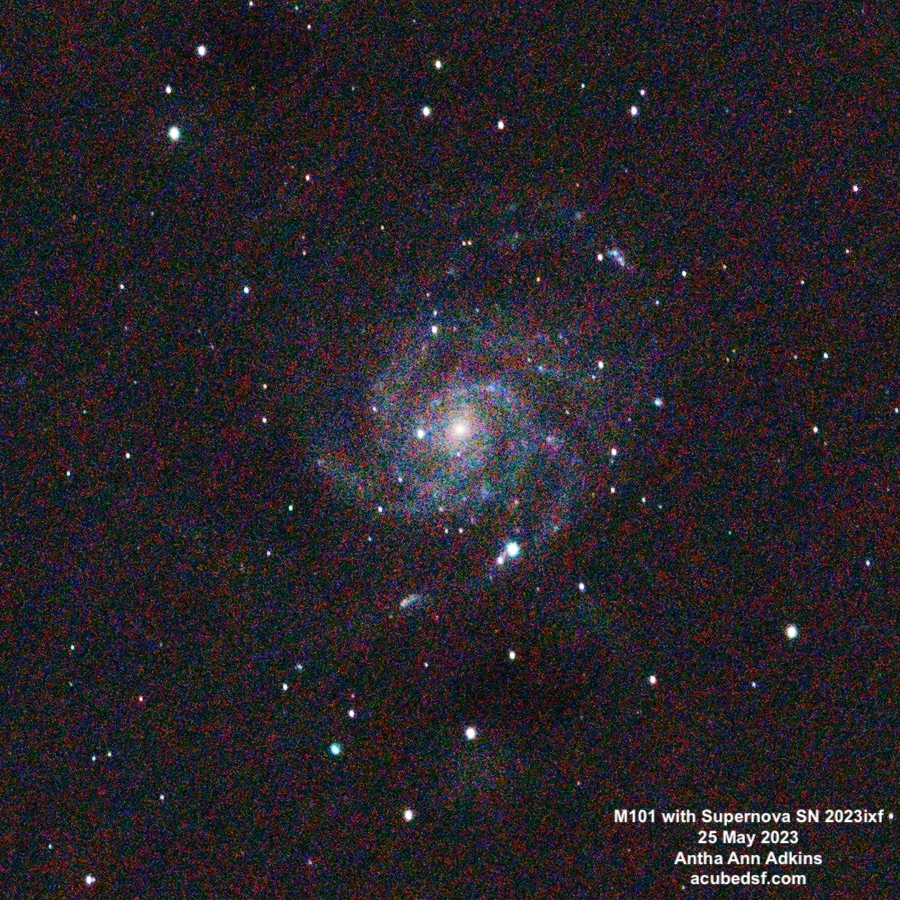
One of these things is not like the others … I got an image of M101 the Pinwheel Galaxy in February from the lovely dark skies of Dell City, Texas. Since then, light from a supernova in one of its arms has reached us … from 20+ million light years away. And I was able to image that from my driveway!  The driveway picture is noisier and dimmer due to light pollution, but you can tell there’s something new there! I’m looking forward to going back out to the dark skies and imaging it again.

Interestingly, the total imaging times of 66×3=198 minutes on 2/16 and 218 minutes on 5/25 are pretty similar, but due to the light pollution, the 5/25 image has less detail, is noisier, and is grainier.  On the other hand, the tracking wasn’t as good on 2/16, emphasized by the longer image times, so the stars aren’t circles and the image isn’t as sharp as I would like.

Camera geek info (February 16 pre supernova):

  • Canon EOS 60D in manual mode
  • Williams Optics Zenith Star 73 III APO telescope
  • Williams Optics Flat 73A
  • iOptron CEM40
  • Dell City, Texas Bortle 2-3 dark skies

Frames:

  • Feb 16 3 minute exposure ISO 1600
    • 66 3 minute lights
    • 21 0.05 second flats
    • 20 0.05 second flat darks
    • 20 1 minute darks

Processing geek info:

  • PixInsight

Camera geek info (May 25 with supernova):

  • Canon EOS 60D in manual mode
  • Williams Optics Zenith Star 73 III APO telescope
  • Williams Optics Flat 73A
  • SkyTech 2” LPRO-MAX CCD Filter
  • iOptron CEM40
  • Friendswood, Texas Bortle 7-8 suburban skies

Frames:

  • May 25 1 minute exposure ISO 800
    • 218 1 minute lights
    • 31 0.05 second flats
    • 30 0.05 second flat darks
    • 49 1 minute darks

Processing geek info:

  • PixInsight