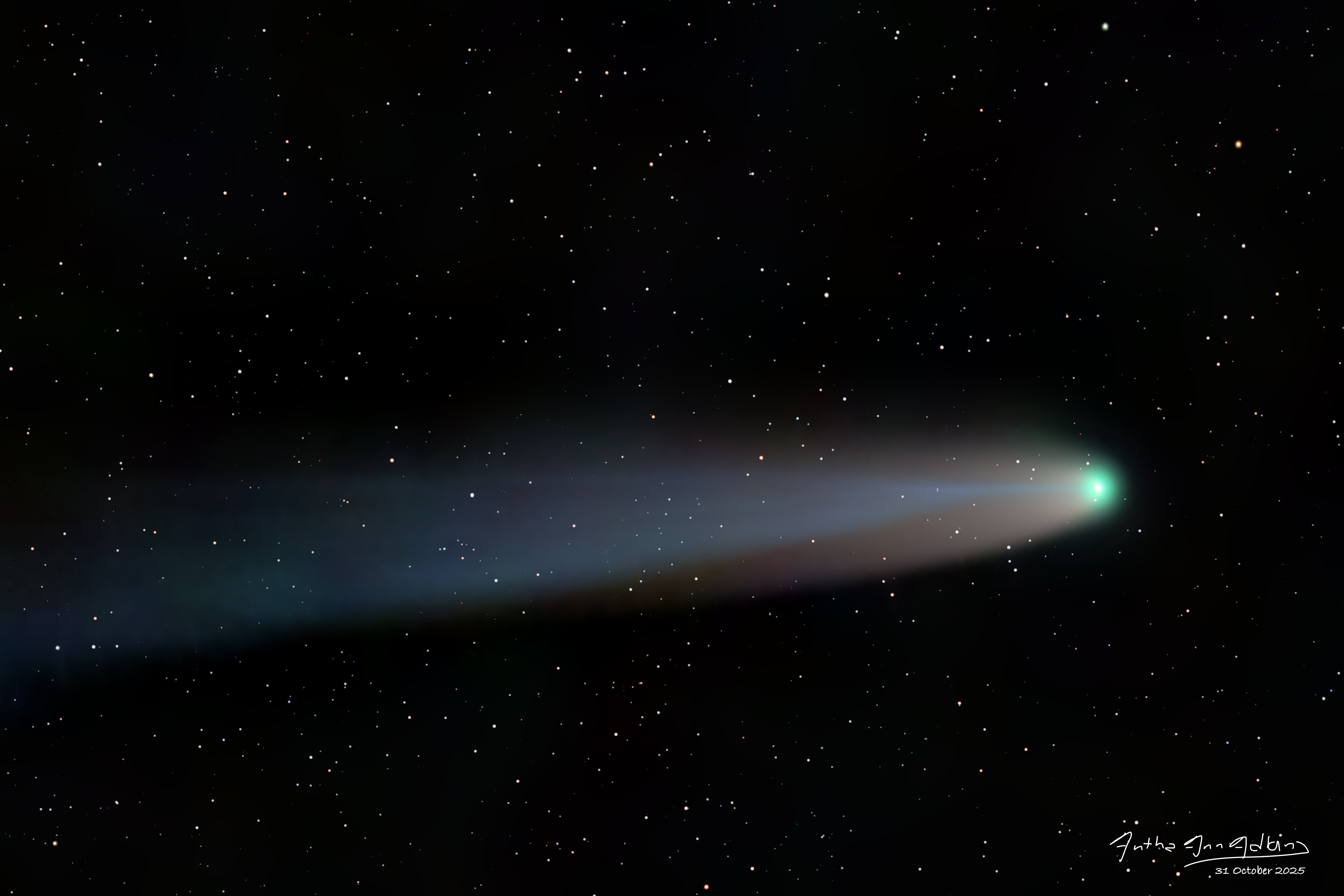
On October 31, 2025, my husband and I returned to Sargent, Texas for another opportunity to view and image Comet C/2025 A6 Lemmon.
I use an iPad to set up and watch the images from my telescope, and I was absolutely amazed to see the comet tail changing from frame to frame. When I processed the comet into a single image, the changes in the tail smeared out. So I made a movie.
This movie was made with 14 frames of data using 1 minute each of red, green, and blue data, so 42 minutes worth of data. The data was taken over about 45 minutes, so the faster sections of the movie are sped up by a factor of 970, and the slower sections of the movie are sped up by a factor of 388.
In the movie, you can see knots in the comet’s tail near the comet’s head moving towards the left away from the comet’s head, but you can also see the further-out tail moving up to consolidate. I think it’s absolutely amazing you can see so much change in the comet’s tail over this short a period of time.
On October 31, 2025, my husband and I returned to Sargent, Texas for another opportunity to view and image Comet C/2025 A6 Lemmon.
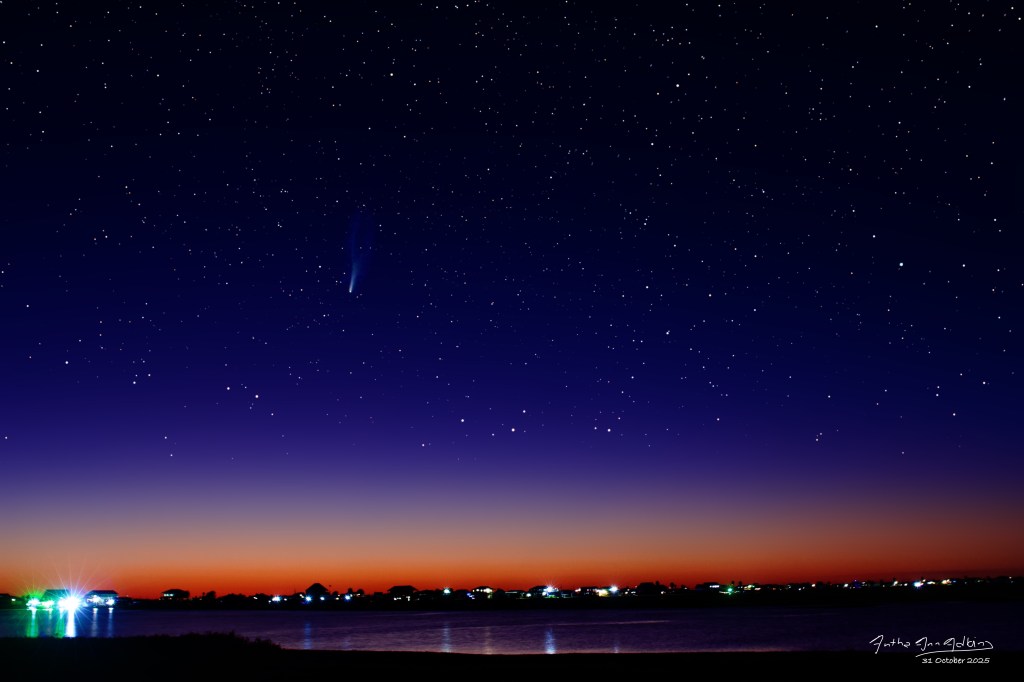
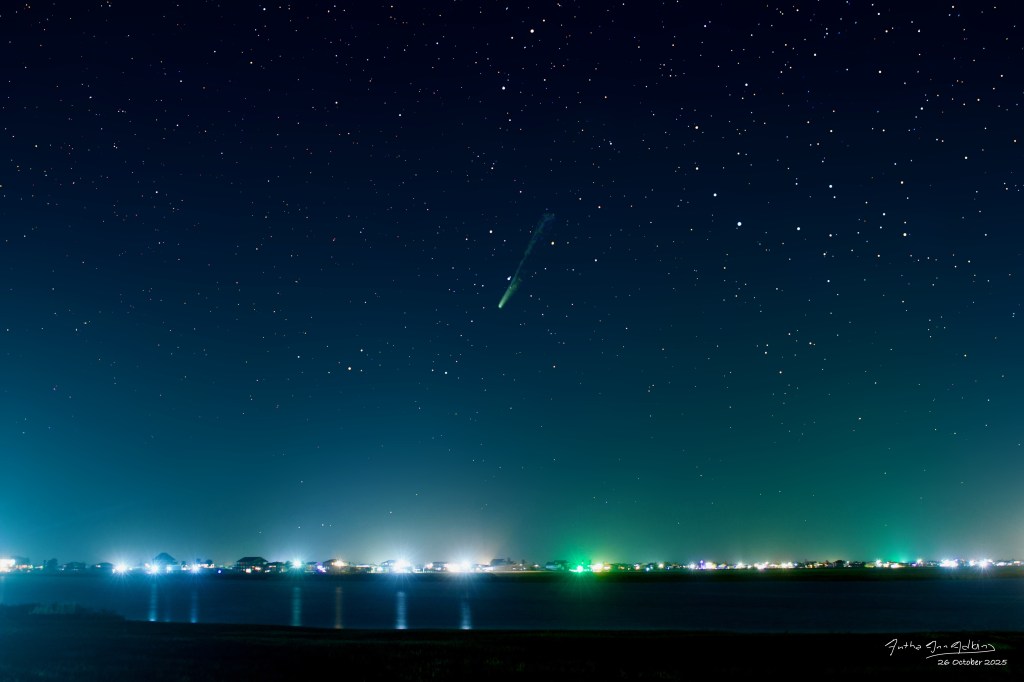
I initially set up my camera with a 24 mm lens (very wide field, 53 deg by 35 deg) looking towards the sunset to capture the color gradient (I love these deep colors!). Then, after it got dark, I took a series of images (about 29.47 minutes worth) to capture the stars and the comet. By October 31, the comet was moving further away from us, and if you compare the October 31 picture with the October 26 picture, you can see that the comet appears smaller, dimmer, and further to the left (west) relative to the stars. It also appears to have a hook in its tail.
I took additional data with an 85 mm lens (15 deg by 10 deg field of view), about 7.6 minutes worth. I cropped this image, so it is an even smaller field of view, and again the tail appears to have a hook in it.
All of the pictures with the camera were taken using just a tripod (no tracking mount), so I had to do a fair bit of processing to remove the star trails in the data (BlurXterminator is a great tool for this), and I had to process the comet separately from the stars to keep it from smearing since is moving relative to the stars.
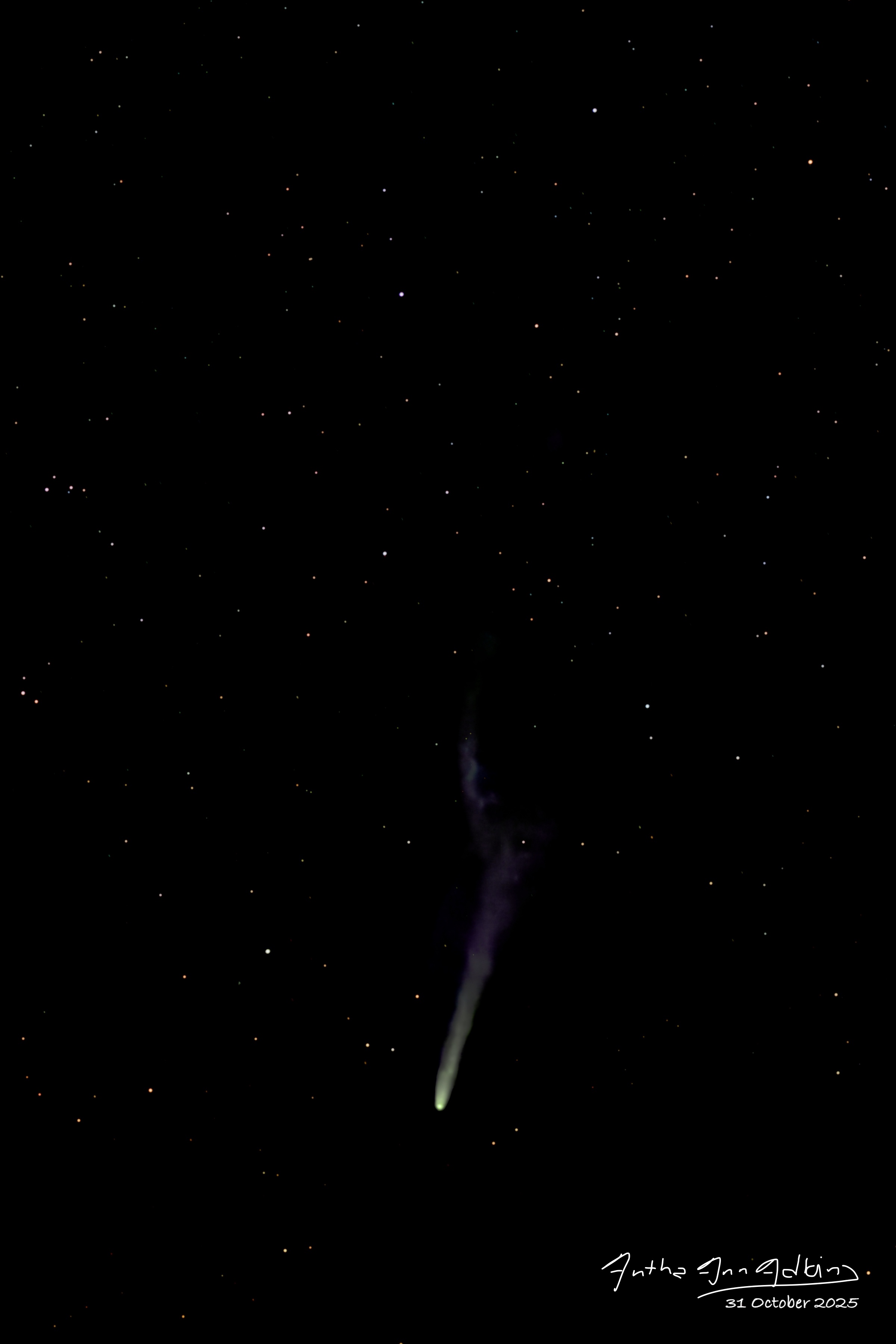
Finally, while I was taking pictures with the camera on a tripod, I was also taking pictures with my small telescope with a 430 mm focal length and a 1.8 by 1.2 degree field of view, about 42 minutes worth. Of course the comet and the tail are obvious here, and the field of view is too small to see any further out hook in the tail. What is not obvious in this integrated image is that there was a knot in the comet’s tail that was obviously moving between frames, which I find amazing. It’ll take a movie to show that, which is my next project.
Which version do you like the best?
Camera geek info – 24 mm sunset image:
Canon EOS 60D in manual mode set 8 second exposure, ISO 800
Sigma 24-70 mm f/2.8EX lens, set at f/3.5, 24 mm, manual focus
Tripod
Intervalometer
Frames – 24 mm sunset image:
October 31, 2025
221 8 second lights
30 1/2500 second flats
Matching darks and dark flats from library
Camera geek info – 85 mm night image:
Canon EOS 60D in manual mode set at 8 second exposure, ISO 800
Canon EF 85 mm f/1.8 lens at f/2.8 manual focus at infinity
One of the things that really impressed me when I was imaging Comet C/2025 A6 Lemmon on October 26, 2025 was that the tail changed from frame to frame. There appeared to be a “knot” that moved along the tail away from the comet head.
It’s taken me a while to figure out how to make a movie of this motion. One challenge was that since it was just after sunset and the comet was near the horizon, the background level changed from frame to frame. I realized that I could use Local Normalization and generate normalized files that helped with the varying background a lot. I also started with separate red, green, blue data that had to be aligned using CometAlignment to make RGB images and then re-aligned with CometAlignment with the original green positions to show the comet motion with respect to the stars. I ended up making two sets of images: one aligned to the green frames at each time step to show the comet motion relative to the stars, and one with all the frames aligned to the comet to show the comet tail changes.
This movie was made with 15 frames of data using 1 minute each of red, green, and blue data. The comet showed this much motion over about 45 minutes!
I finally had some time over my Christmas break to process (some of) my comet data, including the wide field images I took on Sunday, October 26, 2025 from the darker (Bortle 4) skies of Sargent, Texas.
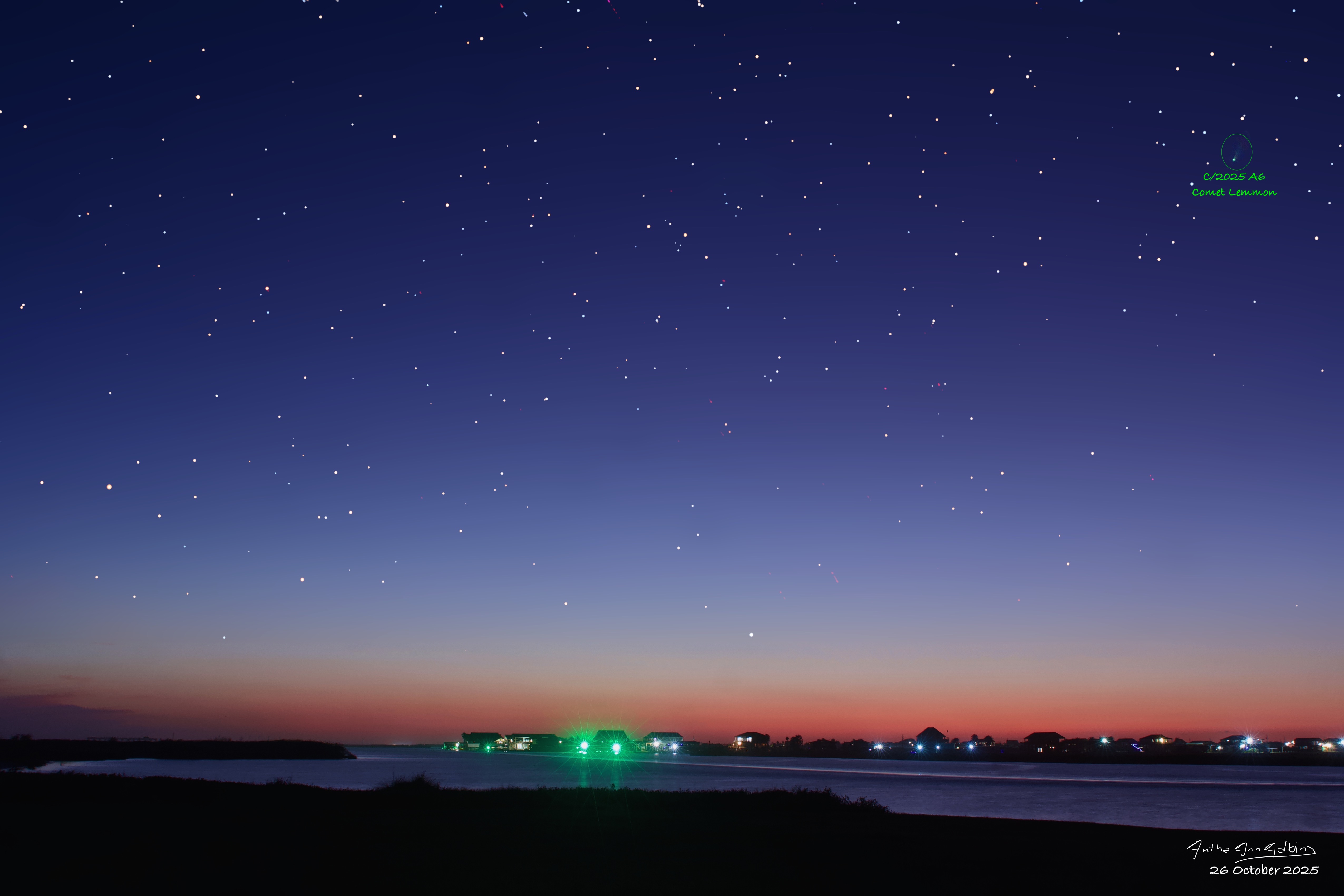
I miscalculated the direction of the comet motion and initially set up the camera with a 24 mm lens (very wide field, 53 deg by 35 deg) looking towards the sunset to get a lovely gradient of color. Then, after it got dark, I took a series of images of the stars, about 13 minutes worth. I didn’t take more data because I decided to move the camera to get a better framing. The comet is in this image, but I had to circle it because it is so dim and doesn’t have an obvious tail. You can see that it is below a triangle of stars, the Serpent’s head in the Serpens Caput (Serpent Head) constellation.
I took additional data with the 24 mm lens with a better framing, about 33 minutes worth. I didn’t take more data because I wanted to switch to a different lens. Happily, the comet is clearly visible in this image; no circling needed! And the triangle of stars is still visible as well.
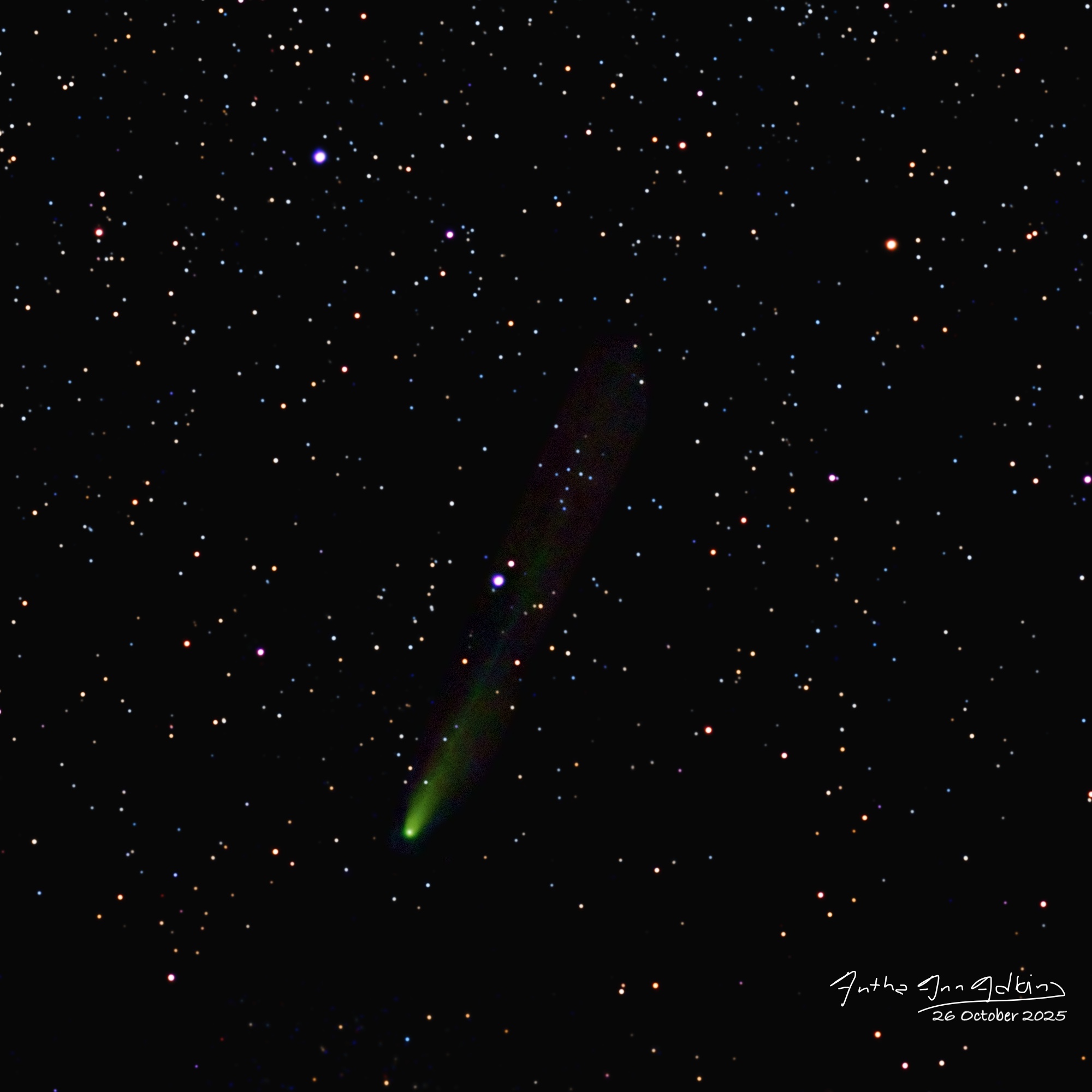
I took additional data with an 85 mm lens (15 deg by 10 deg field of view), about 11 minutes worth. I cropped this image, so it is an even smaller field of view, again with the comet clearly visible along with the triangle of stars above it.
All of the pictures with the camera were taken using just a tripod (no tracking mount), so I had to do a fair bit of processing to remove the star trails in the data (BlurXterminator is a great tool for this), and I had to process the comet separately from the stars to keep it from smearing since is moving relative to the stars.
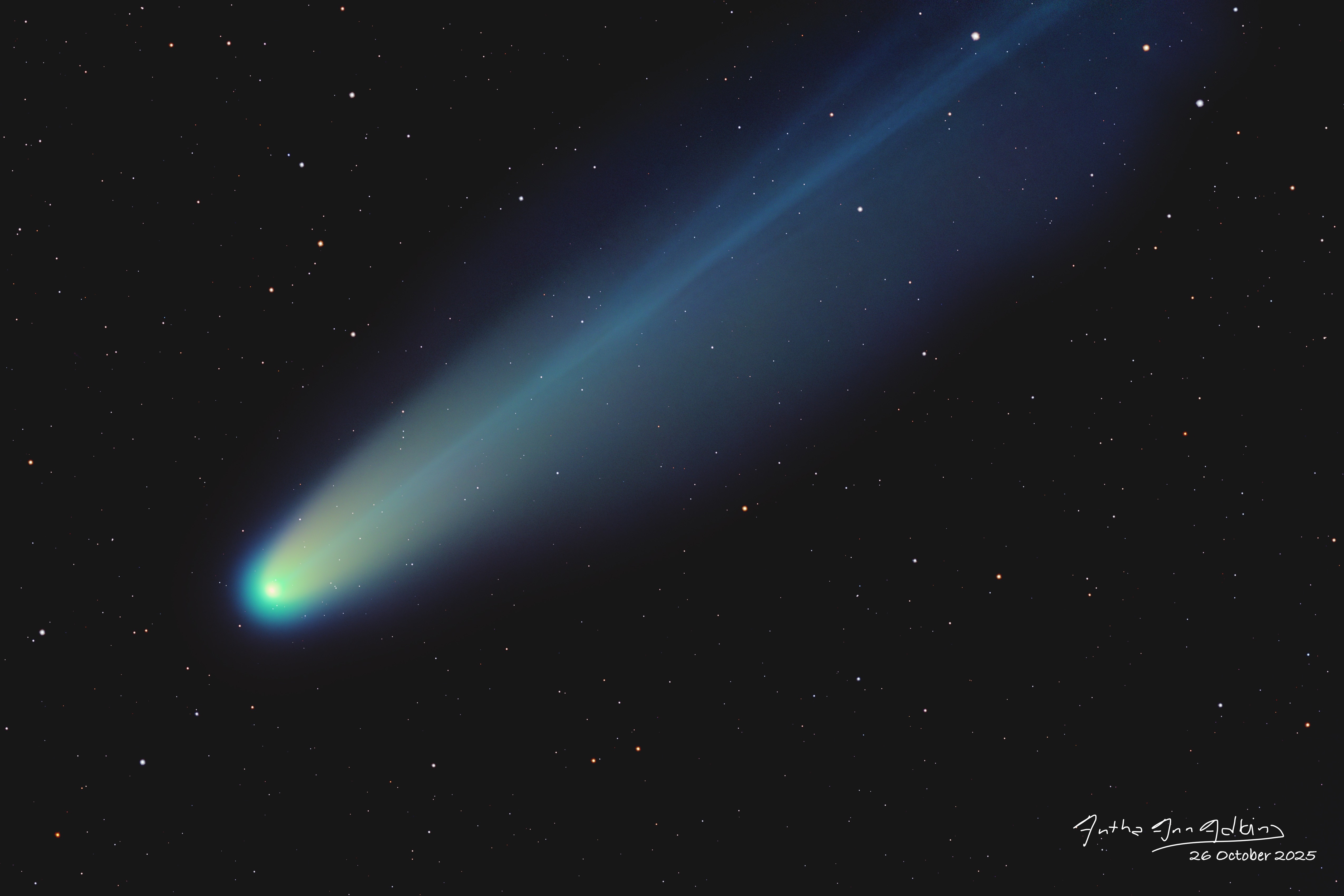
Finally, while I was taking pictures with the camera on a tripod, I was also taking pictures with my small telescope with a 430 mm focal length and a 1.8 by 1.2 degree field of view, about 45 minutes worth. Of course the comet and its tail is amazingly obvious here, and I could see its tail changing over the course of the evening. I’m working on making a movie of that, stay tuned!
Which version do you like the best?
Camera geek info – 24 mm sunset image:
Canon EOS 60D in manual mode set at f/8, 10 second exposure, ISO 400
Sigma 24-70 mm f/2.8EX lens, set at 24 mm, manual focus
Tripod
Intervalometer
Frames – 24 mm sunset image:
October 26, 2025
80 10 second lights
30 1/2500 second flats
Matching darks and dark flats from library
Camera geek info – 24 mm night image:
Canon EOS 60D in manual mode set at f/2.8, 20 second exposure, ISO 400
Sigma 24-70 mm f/2.8EX lens, set at 24 mm, manual focus
Tripod
Intervalometer
Frames – 24 mm night image:
October 26, 2025
100 20 second lights
30 1/2500 second flats
Matching darks and dark flats from library
Camera geek info – 85 mm night image:
Canon EOS 60D in manual mode set at f/2.5, 6 second exposure, ISO 800
Canon EF 85 mm f/1.8 lens at f/2.5 manual focus at infinity
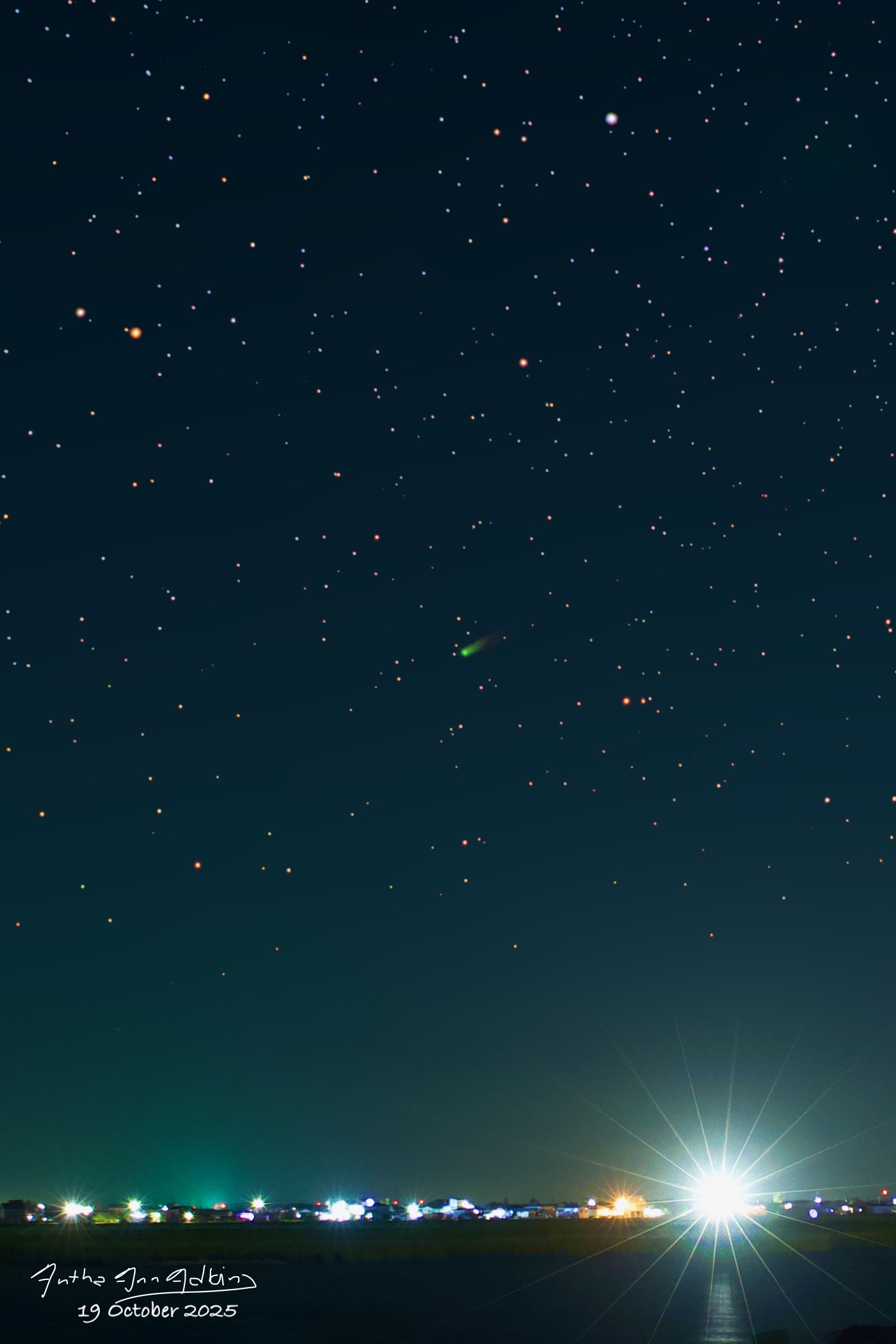
On Sunday, October 19, 2025, my husband I drove to Sargent, Texas for darker skies (Bortle 4) and another try at Comet C/2025 A6 Lemmon. In addition to capturing the comet with my telescope and seeing it with binoculars, I tried to capture it with my camera on a tripod. I didn’t think the comet was going to end up being visible in the widefield image, but it turned out that it was!
These widefield images require more processing than comet and star field images or deep space object images for a number of reasons. First, because the camera is on a tripod instead of a tracking mount, the stars and comet “trail” even with these short 10 second subframes. In this case, I fixed that by using BlurXterminator (BXT) correction only prior to registering and comet aligning the subframes (which takes a lot of computer time), by running BXT a second time after integrating the star sub-frames into a single image, and by running a small size convolution on the stars. This gave me bigger, but rounder stars, which for a widefield image is what I wanted. Second, because the comet is moving relative to the stars, it needed to be aligned separately; this is a common step with comet processing that is unnecessary for deep space objects. Third, because the images included the foreground and a sky gradient, I had to make sure the foreground didn’t throw off any of the astroimage processing. I did this by removing the foreground from all the subframes, processing the comet and stars, picking one foreground to use and processing it, and then combining them back together. So this is a composite image with the stars, comet, and foreground processed separately.
This image was made from 74 10 second subframes, for a total integration time of 12.33 minutes of time.
Imagine what you could see if your eyes could collect data for 12 minutes!
I have really enjoyed photographing this comet; there are more images to come!
Camera geek info – camera:
Canon EOS 60D in manual mode set at f/3.2, 10 second exposure, ISO 800
Sigma 24-70 mm f/2.8EX lens, set at 24 mm, manual focus

 Space&Aliens