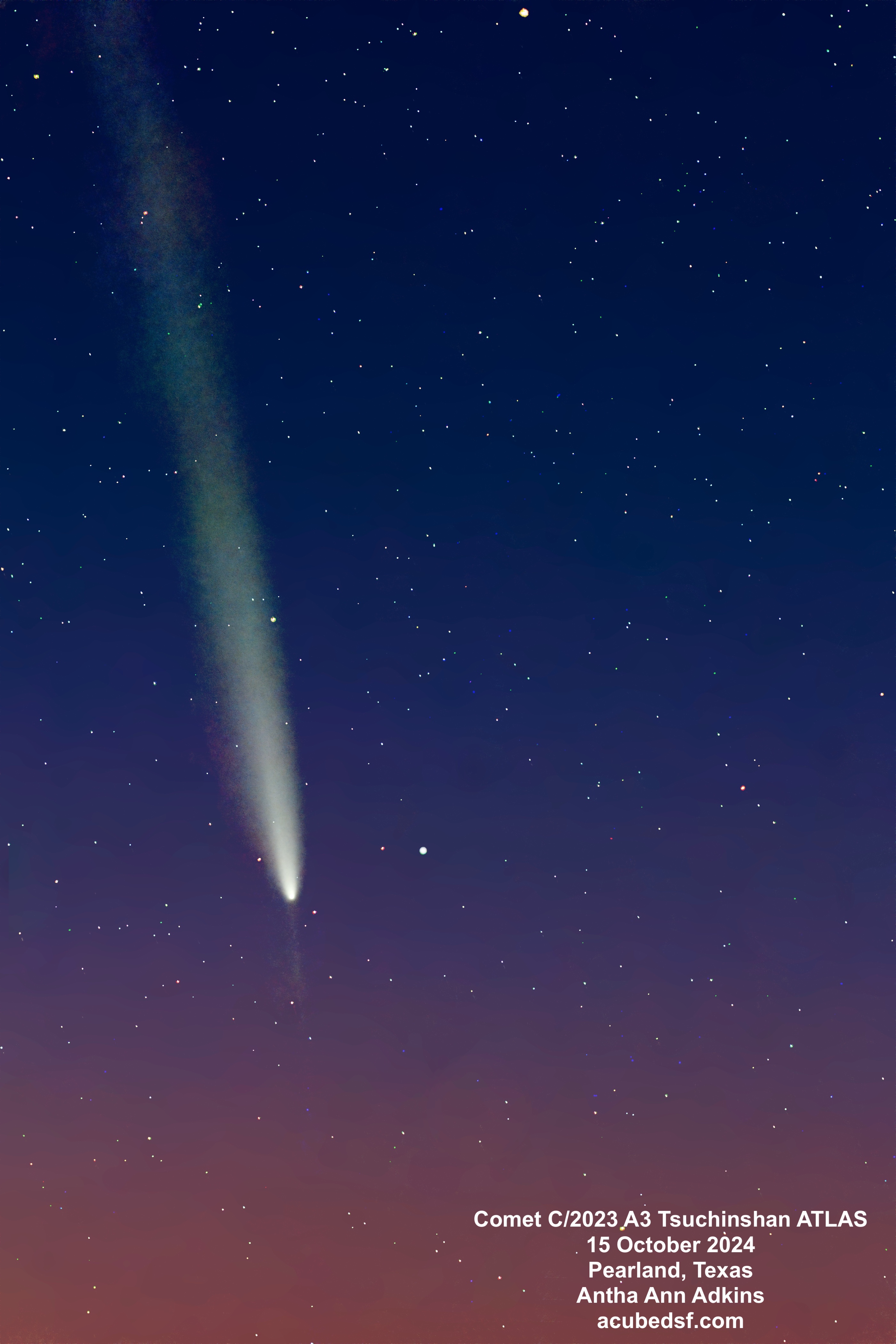
Comet C/2023 A3 Tsuchinshan ATLAS put on quite a show after it rounded the sun and passed by the Earth on its way likely out of our solar system. With an orbital eccentricity greater than 1, its orbit appears to be hyperbolic, meaning it’s not coming back unless something perturbs its orbit.
In this picture, you can see the comet’s bright nucleus and coma, its long dust tail, and its anti-tail, but not a separate ion tail.
When comets travel close to the sun, solar radiation heats up the comet nucleus, and it outgasses. Outgassing delivers both gas and dust to the region around the nucleus, forming a coma, a (temporary) atmosphere around the comet. The solar radiation and solar wind act on this coma to push the gas and dust away from the sun to form a tail. Three separate tails can be visible: the ion tail, the dust tail, and the anti-tail. The ion tail, also called the gas tail or type I tail, is the tail formed by the ionized gasses pushed away from the comet, and it points away from the sun. The dust tail, also called the type II tail, is the tail formed by the dust pushed away from the comet, and it stays more in the comet’s orbit and appears to curve away from the gas tail. The anti-tail consists of the larger dust particles that were not pushed as much and remained in the comet’s orbit. The anti-tail appears to point towards the sun, and it is only visible when the Earth passes through the comet’s orbital plane near the time when the comet passed by the sun. Because of these special conditions to see the anti-tail, it is not observed with most comets.
Another item visible in the image is M5, a globular cluster in our galaxy. It is the large bright “star” to the right of the comet nucleus. Because this image was taken with an 85 mm lens, and M5 was sorted to the “stars” image in my processing, it just appears to be a large bright star. I suspect with some additional processing, I could have made it look fuzzier, though there aren’t a lot of pixels at this scale. The Messier objects are “fuzzy” objects that comet-hunter Charles Messier made a list of because they weren’t comets – so it’s fun to see one next to a comet. M5 is 24,500 light years away from Earth and has an angular size of 23 arc-minutes, making it about 165 light years across. It’s thought to be one of our galaxy’s older globular clusters, at 13 billion years old.
Processing this image was tricky for several reasons: 1) it was made from images taken with a camera on a tripod, so the sky was moving in each frame, 2) the comet was moving relative to the sky, and 3) the images were taken at dusk, when the sky gradient is also changing in every image. I benefited greatly from following the methods and advice in Adam Block’s Comet Academy. One additional trick I used was to run BlurXterminator in correction only mode on all the registered images as my first step since the 4 second tripod images had visible star trails.
Getting to this image has taken almost a month of watching videos, learning new tools, and trying various tool combinations and settings. Some of these steps had to be run on each individual image – all 233 of them – meaning some processing steps took many hours. After all that work, I am happy with the results.
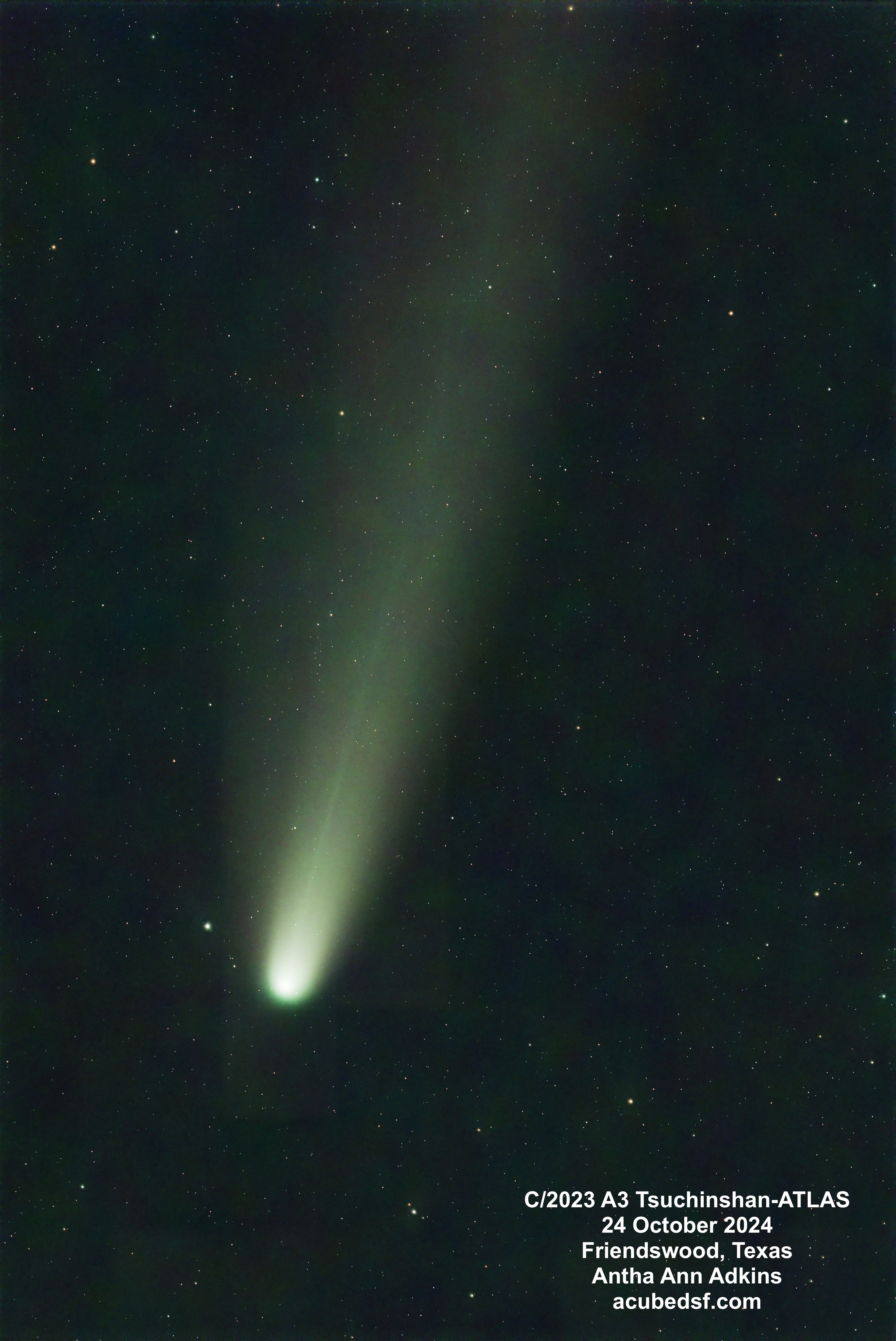
I started with this image because I thought it would be the easiest of my set of C2023A3 comet images to process … the other images are from darker skies in terms of light pollution but closer to dusk and include a foreground. But the comet was brighter! I’m really looking forward to processing them and sharing the result! Hopefully they won’t take a month each to process!
Camera geek info:
- Canon EOS 60D in manual mode, 4 second exposures, ISO 1600
- Canon EF 85 mm f/1.8 lens, manual focus at infinity
- Intervalometer
- Tripod
- Pearland, Texas Bortle 7-8 dark skies
Frames:
- October 15, 2024
- 233 4 second lights
- 30 0.0025 second flats
- 30 0.0025 second darks
Processing geek info:
- PixInsight
- BlurXterminator
- NoiseXterminator
- StarXterminator
- StarNet2
- NormalizedScaleGradient
 Space&Aliens