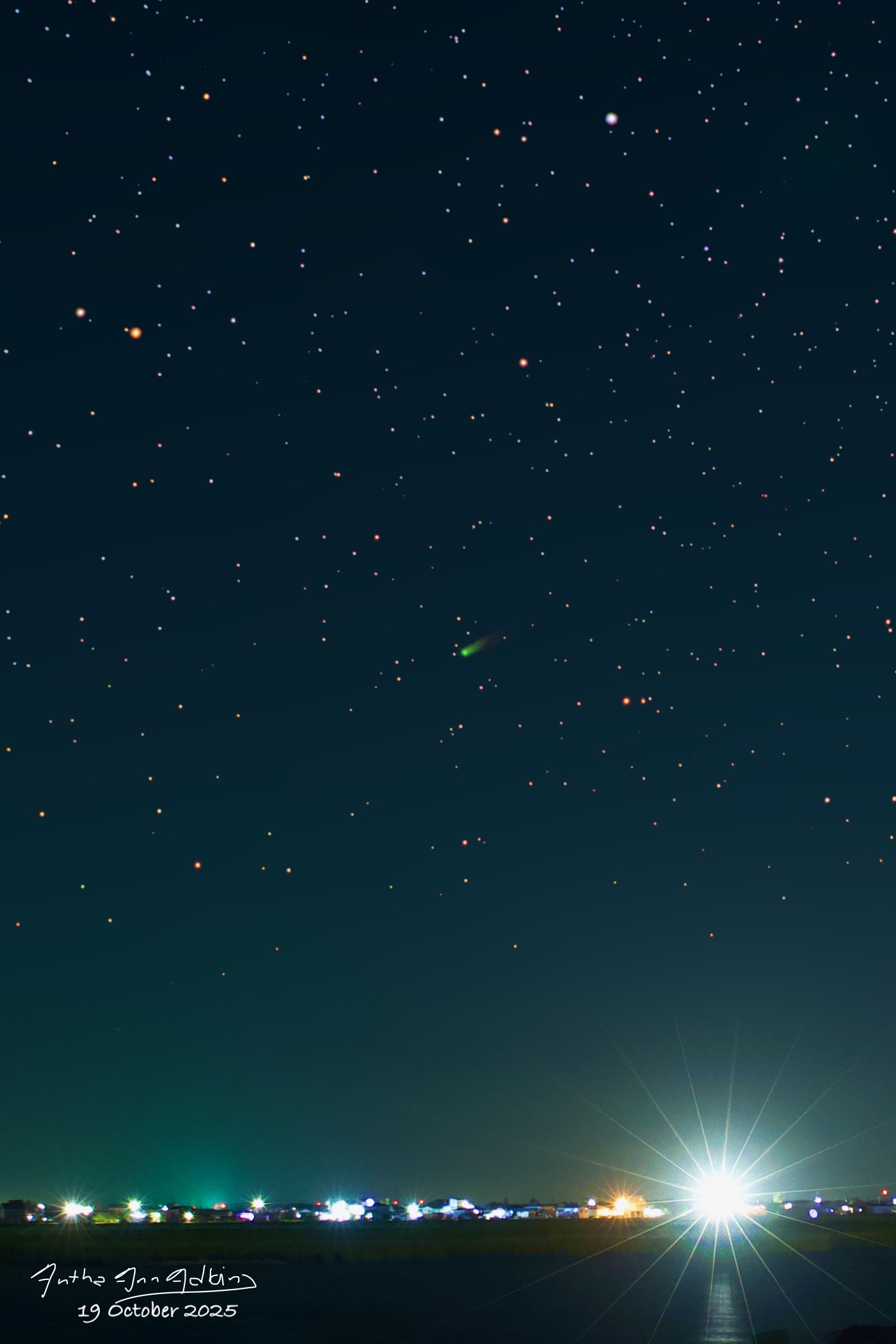
Comet C/2025 A6 Lemmon Widefield on 19 October 2025

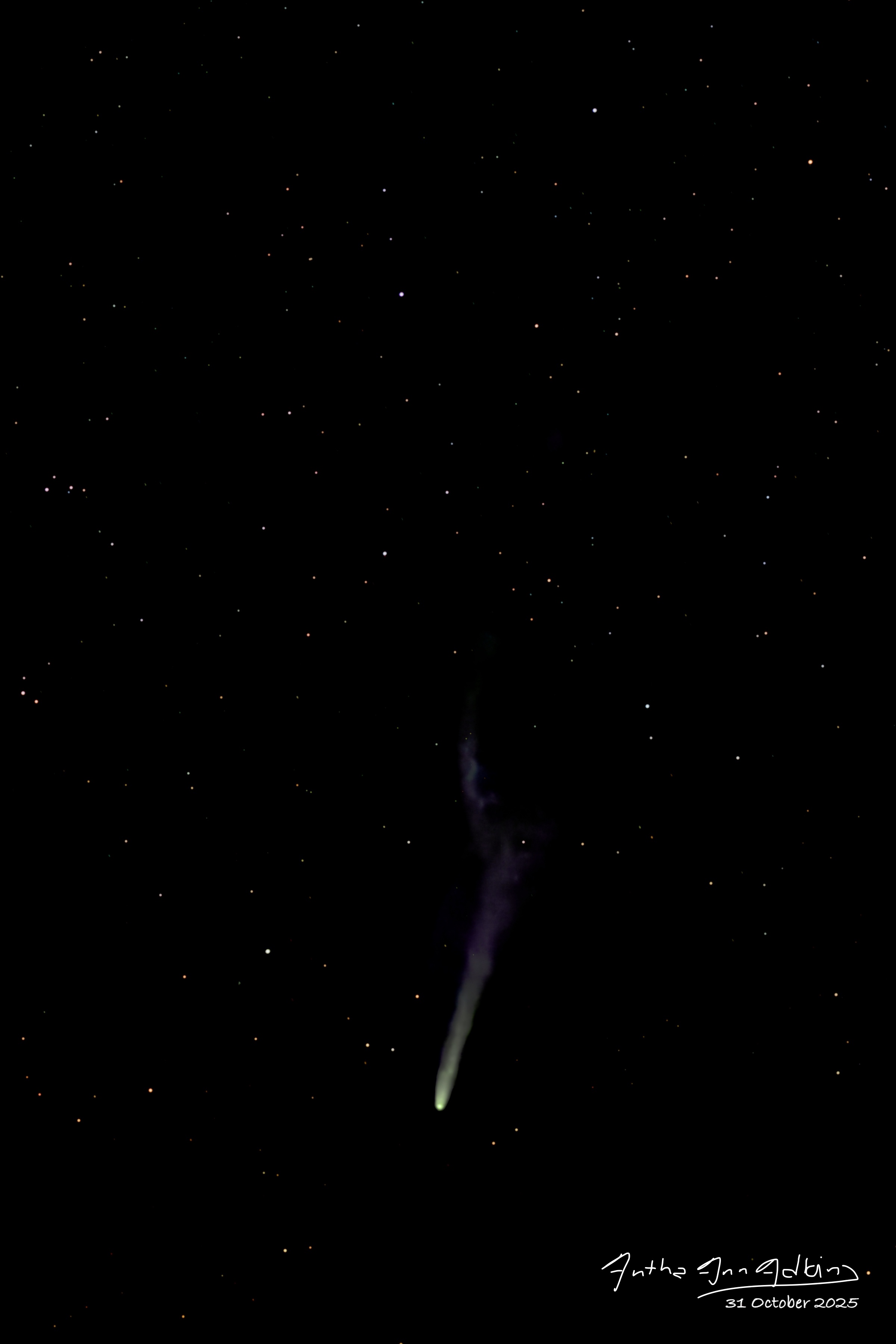
On Sunday, October 19, 2025, my husband I drove to Sargent, Texas for darker skies (Bortle 4) and another try at Comet C/2025 A6 Lemmon.  In addition to capturing the comet with my telescope and seeing it with binoculars, I tried to capture it with my camera on a tripod.  I didn’t think the comet was going to end up being visible in the widefield image, but it turned out that it was!  

These widefield images require more processing than comet and star field images or deep space object images for a number of reasons.  First, because the camera is on a tripod instead of a tracking mount, the stars and comet “trail” even with these short 10 second subframes.  In this case, I fixed that by using BlurXterminator (BXT) correction only prior to registering and comet aligning the subframes (which takes a lot of computer time), by running BXT a second time after integrating the star sub-frames into a single image, and by running a small size convolution on the stars.  This gave me bigger, but rounder stars, which for a widefield image is what I wanted.  Second, because the comet is moving relative to the stars, it needed to be aligned separately; this is a common step with comet processing that is unnecessary for deep space objects.  Third, because the images included the foreground and a sky gradient, I had to make sure the foreground didn’t throw off any of the astroimage processing.  I did this by removing the foreground from all the subframes, processing the comet and stars, picking one foreground to use and processing it, and then combining them back together.  So this is a composite image with the stars, comet, and foreground processed separately.

This image was made from 74 10 second subframes, for a total integration time of 12.33 minutes of time.  

Imagine what you could see if your eyes could collect data for 12 minutes!

I have really enjoyed photographing this comet; there are more images to come!

Camera geek info – camera:

  • Canon EOS 60D in manual mode set at f/3.2, 10 second exposure, ISO 800
  • Sigma 24-70 mm f/2.8EX lens, set at 24 mm, manual focus
  • Tripod
  • Intervalometer 

Frames – camera:

  • October 19, 2025
    • 74 10 second lights
    • 30 1/1250 second flats
    • Matching darks and dark flats from library

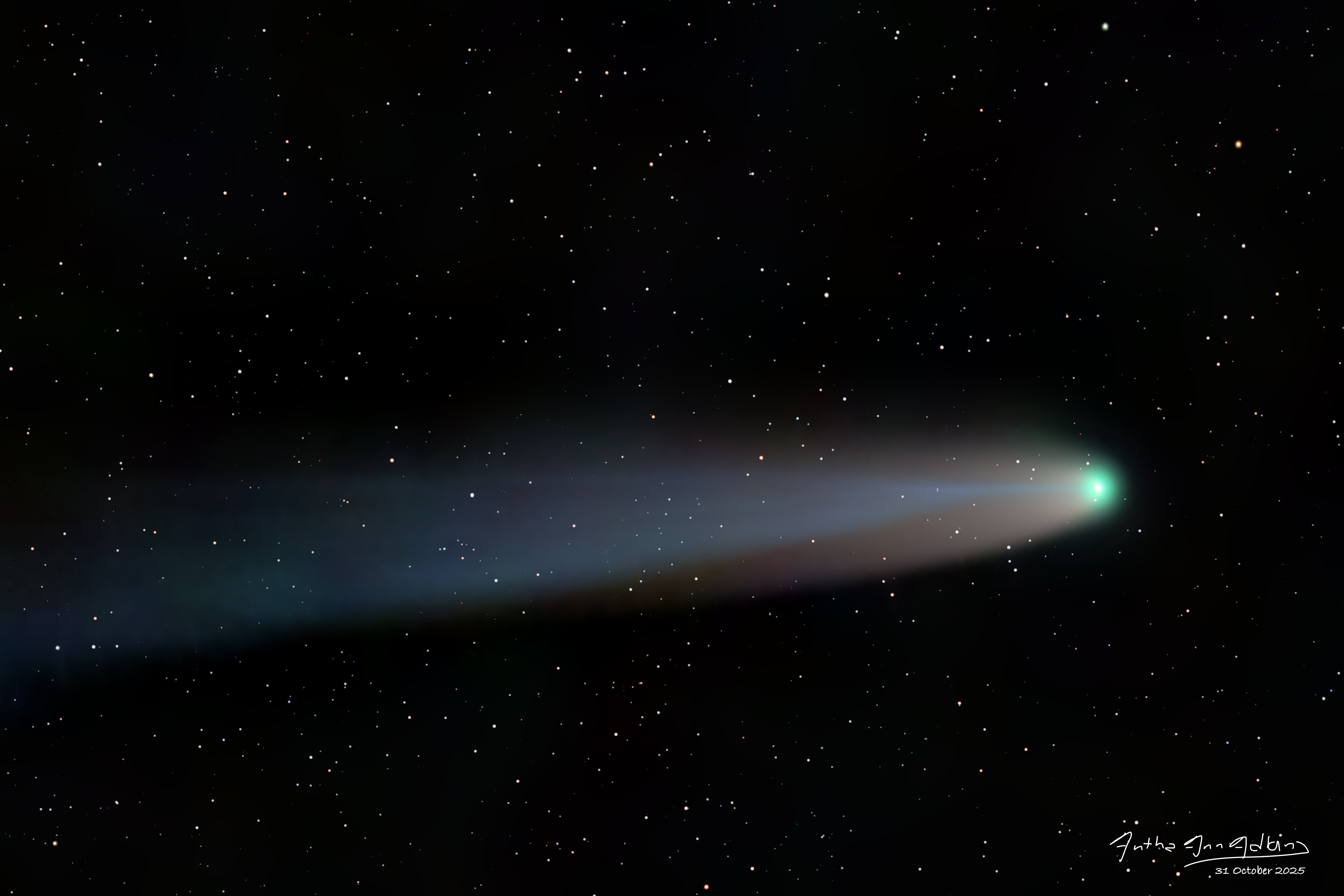
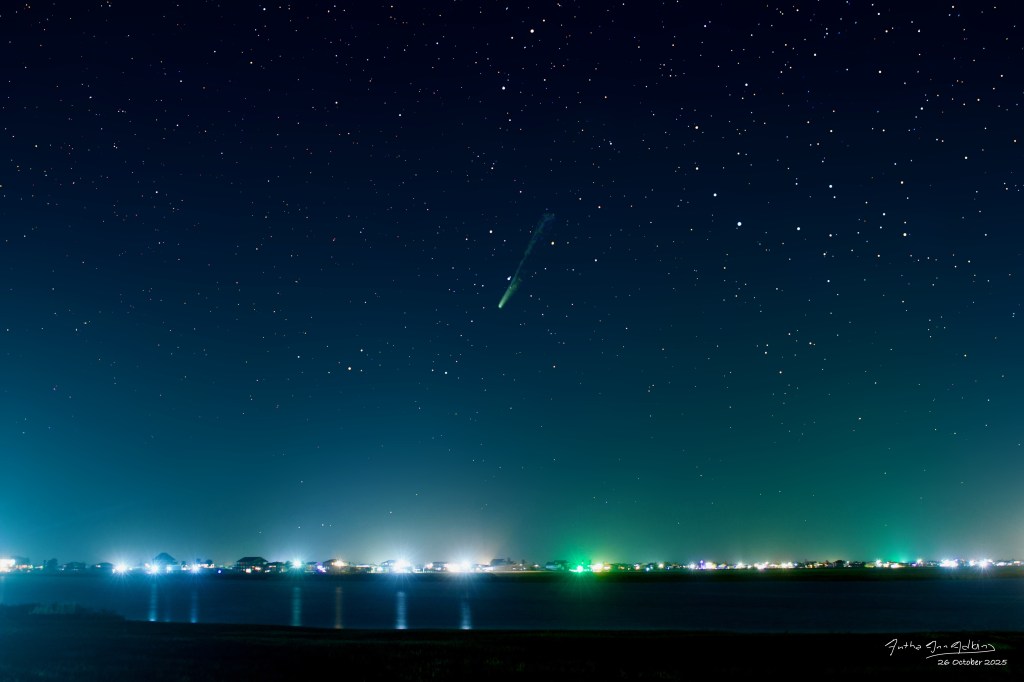
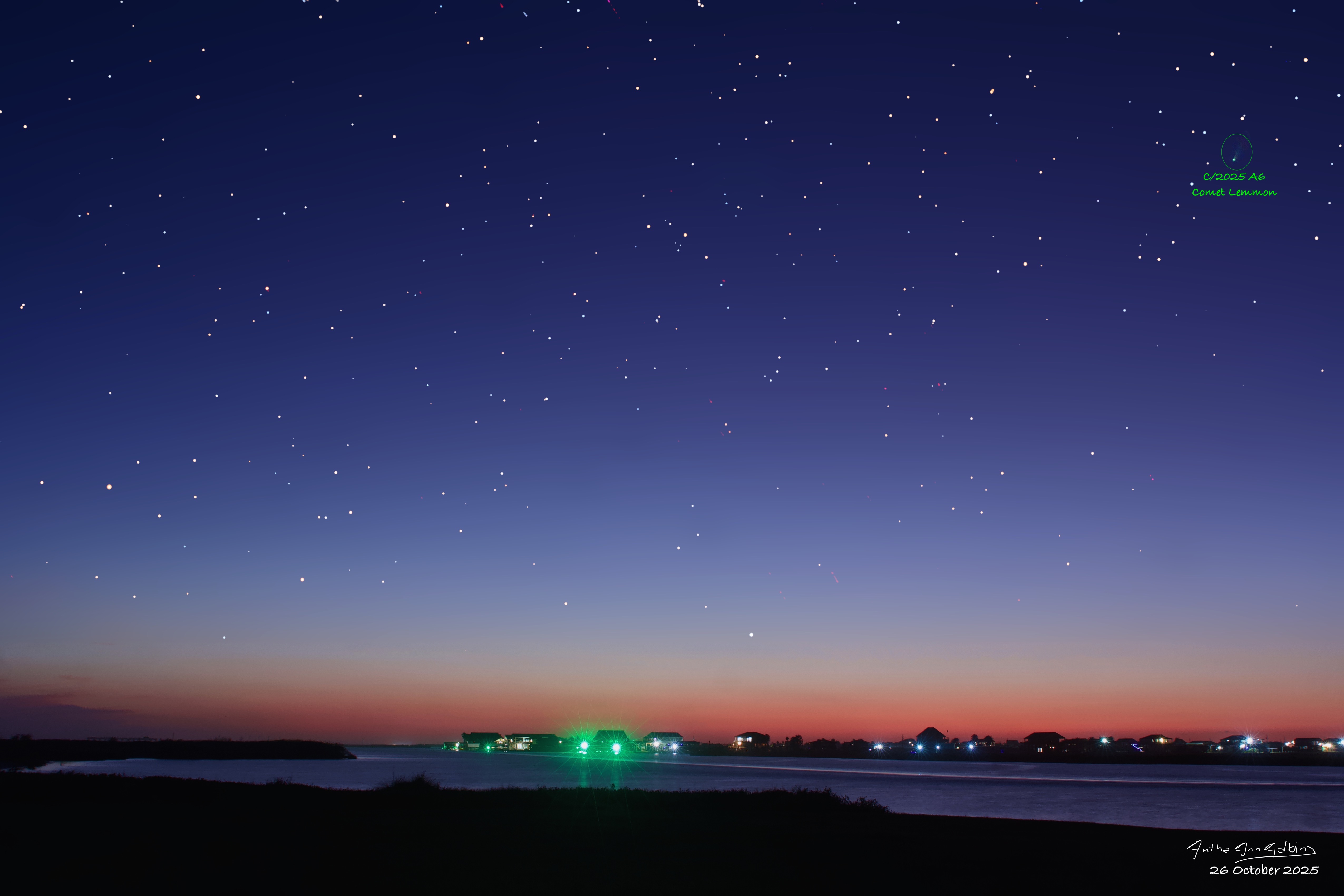
Comet C/2025 A6 Lemmon on 26 October 2025

On Sunday, October 26, 2025, my husband I drove back to Sargent, Texas for darker skies (Bortle 4) and another try at Comet C/2025 A6 Lemmon.  Happily, this time the sky was clear and I successfully captured the comet with my small telescope.  I was also successful in seeing it with a tail with binoculars. And I managed to capture some wide field images with my camera on a tripod.

This time I decided to go with longer frames to try the capture the comet’s ion tail, and I was delighted with what I saw even in single frames.  I can even see motion in the tail between frames, which I think is really cool.  I’m working on a movie of that, but it’s the equivalent of processing multiple comets, so it’s taking a while.  I’ve also got some wide angle shots to process.  And at least one more set of telescope images.

Camera geek info – telescope:

  • William Optics Zenith Star 73 III APO telescope
  • William Optics Flat 73A
  • ZWO 2” Electronic Filter Wheel
  • Antila RGB filters
  • ZWO ASI183MM-Pro-Mono camera
  • William Optics Uniguide 32MM F/3.75
  • ZWO ASI220MM-mini
  • ZWO ASiair Plus
  • iOptron CEM40
  • Sargent, Texas Bortle 4 skies

Frames – telescope:

  • October 19, 2025
    • 16 60 second Gain 150 R lights 
    • 30 0.05 second Gain 150 R flats
    • 15 60 second Gain 150 G lights 
    • 30 0.02 second Gain 150 G flats
    • 17 60 second Gain 150 B lights (16 for stars)
    • 30 0.02 second Gain 150 B flats
    • Matching darks and flat darks from library
Comet C/2025 A6 Lemmon on 19 October 2025

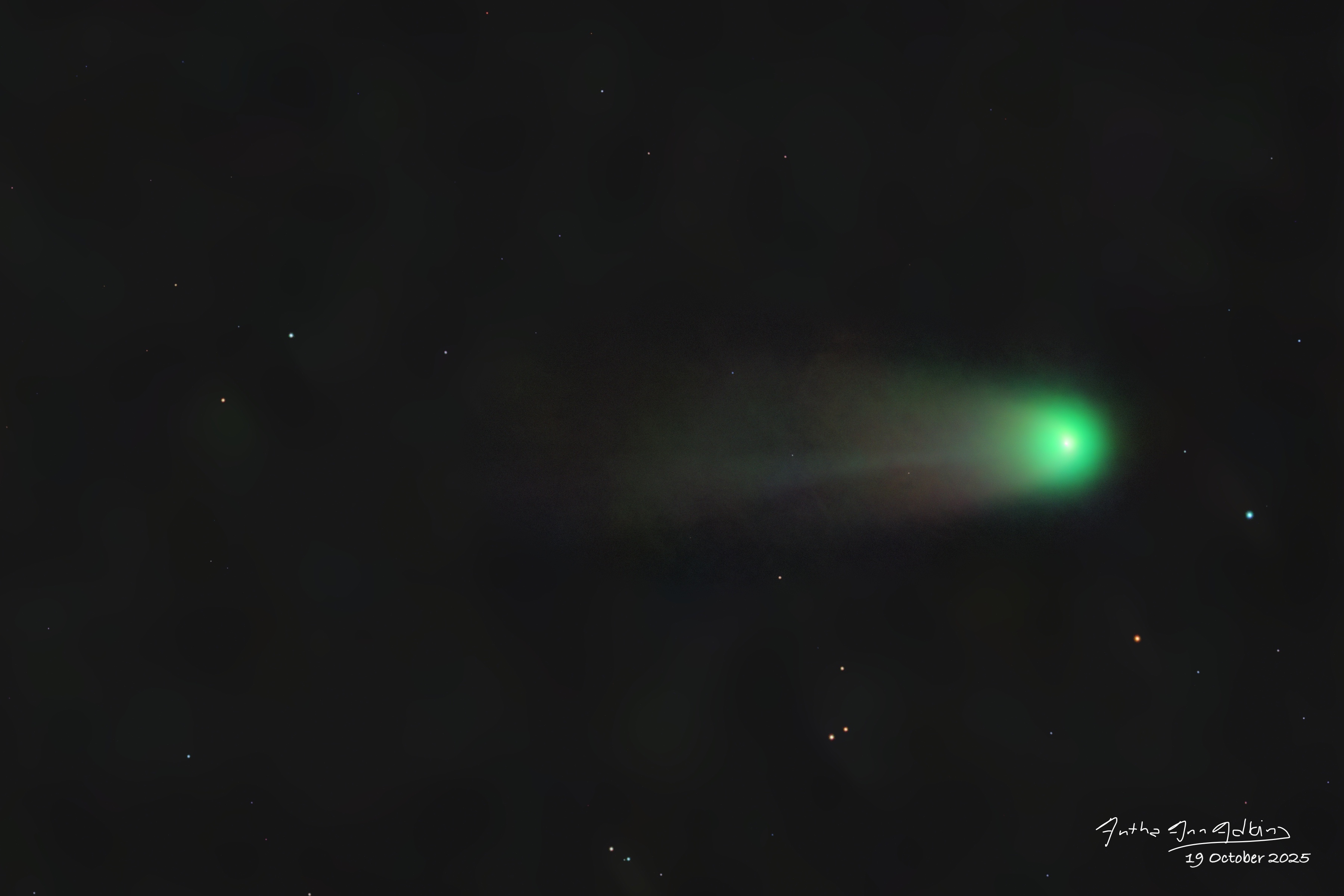
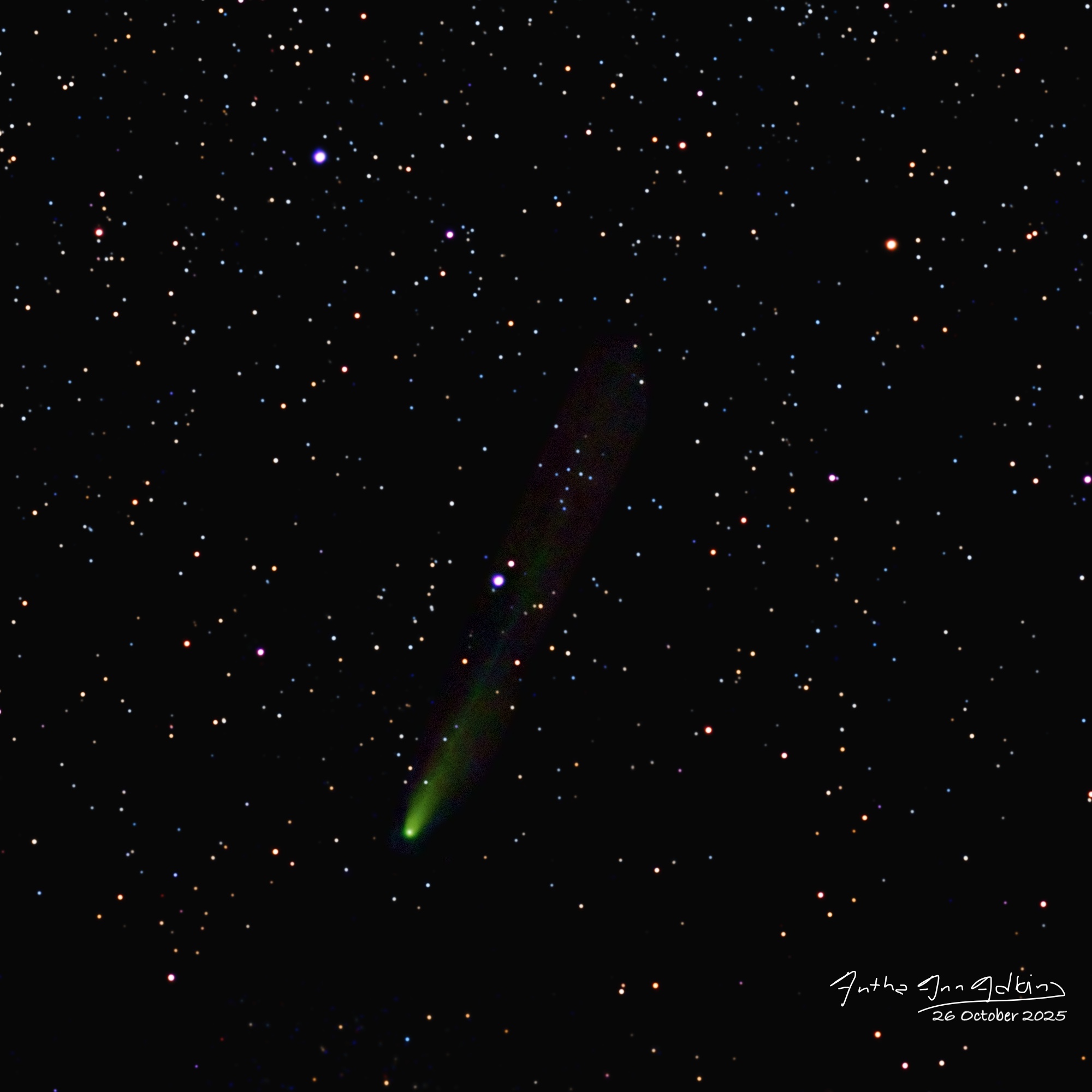
On Sunday, October 19, 2025, my husband I drove back to Sargent, Texas for darker skies (Bortle 4) and another try at Comet C/2025 A6 Lemmon.  Happily, this time the sky was clear and I successfully captured the comet with my small telescope.  I was also successful in seeing it with binoculars.  I was less successful with a wide angle shot with my camera on a tripod – the comet was not obvious and I was fooled by internal reflections of some bright green lights on the horizon.  I’m going to spend some more time with those images, but I’m not hopeful of pulling out a nice comet picture from them.

Based on this experience, I was pretty sure the comet would not be naked eye visible even from Bortle 4 skies at its closest approach to Earth on October 21. 

As the comet got closer to Earth, its relative angular motion increased.  I didn’t want the comet to “smear” in the pictures, so I was taking shorter frames based on the comet only moving a half pixel per frame.  There’s a trade-off, though, between completely freezing the comet’s motion in a frame and capturing enough light to separate the comet’s tail from the background noise.  In this case, I think the frames were too short – the comet’s coma and tail are many pixels wide, and I probably should have accepted some motion in exchange for collecting more data.  This also wasn’t much data: 6.25 minutes of red data, 6.4 minutes of green data, and 5.75 minutes of blue data.  

The comet still got better from here … but it’s taking a while to get these images processed.  More to come!

Camera geek info – telescope:

  • William Optics Zenith Star 73 III APO telescope
  • William Optics Flat 73A
  • ZWO 2” Electronic Filter Wheel
  • Antila RGB filters
  • ZWO ASI183MM-Pro-Mono camera
  • William Optics Uniguide 32MM F/3.75
  • ZWO ASI220MM-mini
  • ZWO ASiair Plus
  • iOptron CEM40
  • Sargent, Texas Bortle 4 skies

Frames – telescope:

  • October 19, 2025
    • 75 5 second Gain 150 R lights (56 for stars)
    • 30 0.05 second Gain 150 R flats
    • 77 5 second Gain 150 G lights (48 for stars)
    • 30 0.02 second Gain 150 G flats
    • 69 5 second Gain 150 B lights (34 for stars)
    • 30 0.02 second Gain 150 B flats
    • Matching darks and flat darks from library

Comet C/2025 A6 Lemmon on 13 October 2025

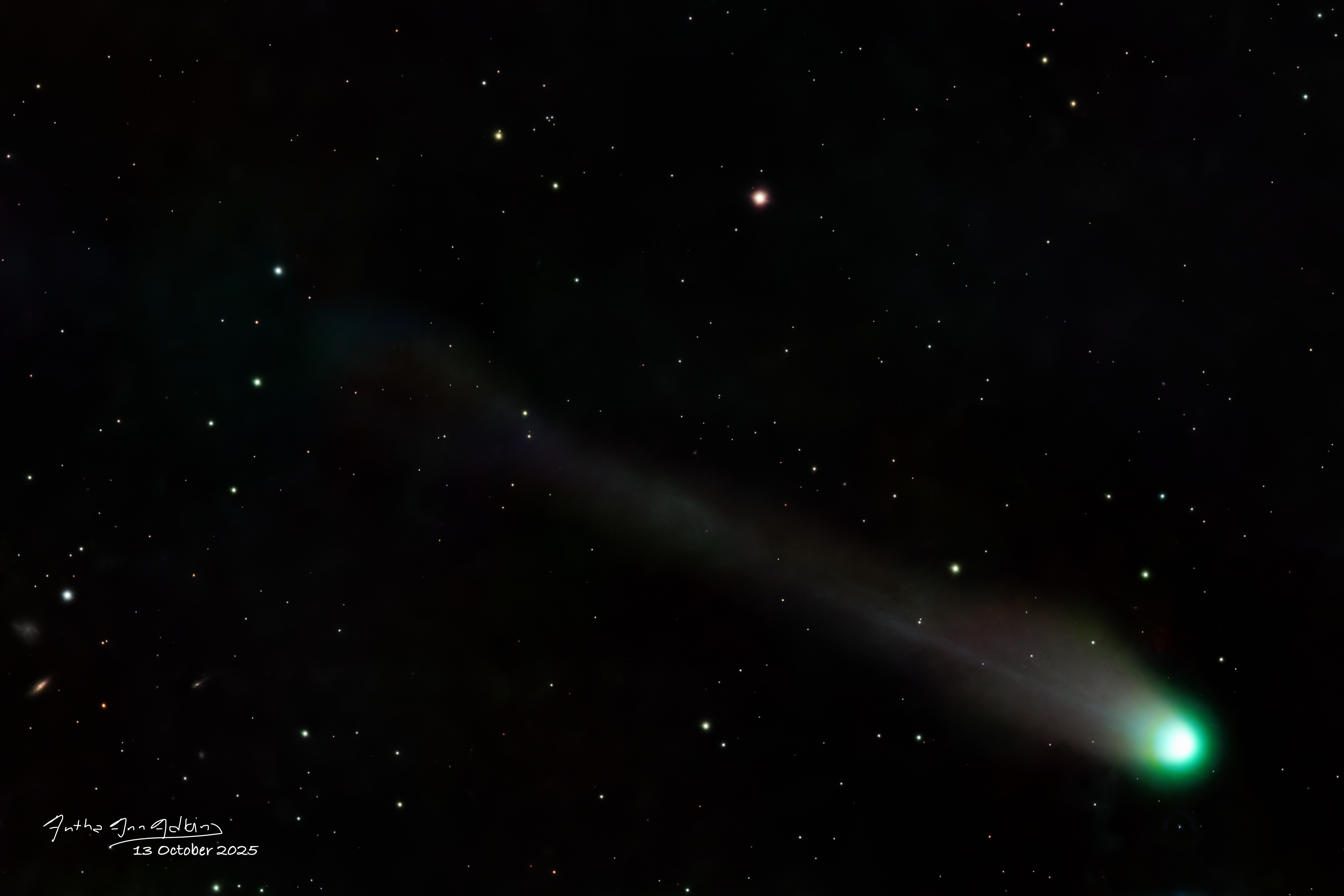
Monday, October 13, was my fourth morning in a row trying to capture Comet C/2025 A6 Lemmon.  This time, my husband and I drove back to darker skies with a clear horizon looking out over the water in Bacliff, Texas.  

From Bortle 6 skies, the comet was lovely in my smaller telescope.  The processed image used 25.75 minutes of red frames, 26.5 minutes of green frames, and 24.5 minutes of blue frames for the stars.  It used 16.5 minutes of red frames, 16.5 minutes of green frames, and 15 minutes of blue frames for the comet.  There are less frames for the comet because I removed the late ones where the comet had reached the edge of the image and the early ones where the comet’s tail was not yet visible.  I’ve added a new step to my processing where I mask out the comet and set the blotchy background to a neutral level.  This doesn’t affect the comet data at all but allows me to “stretch” the comet data more without bringing out blotches in the background.

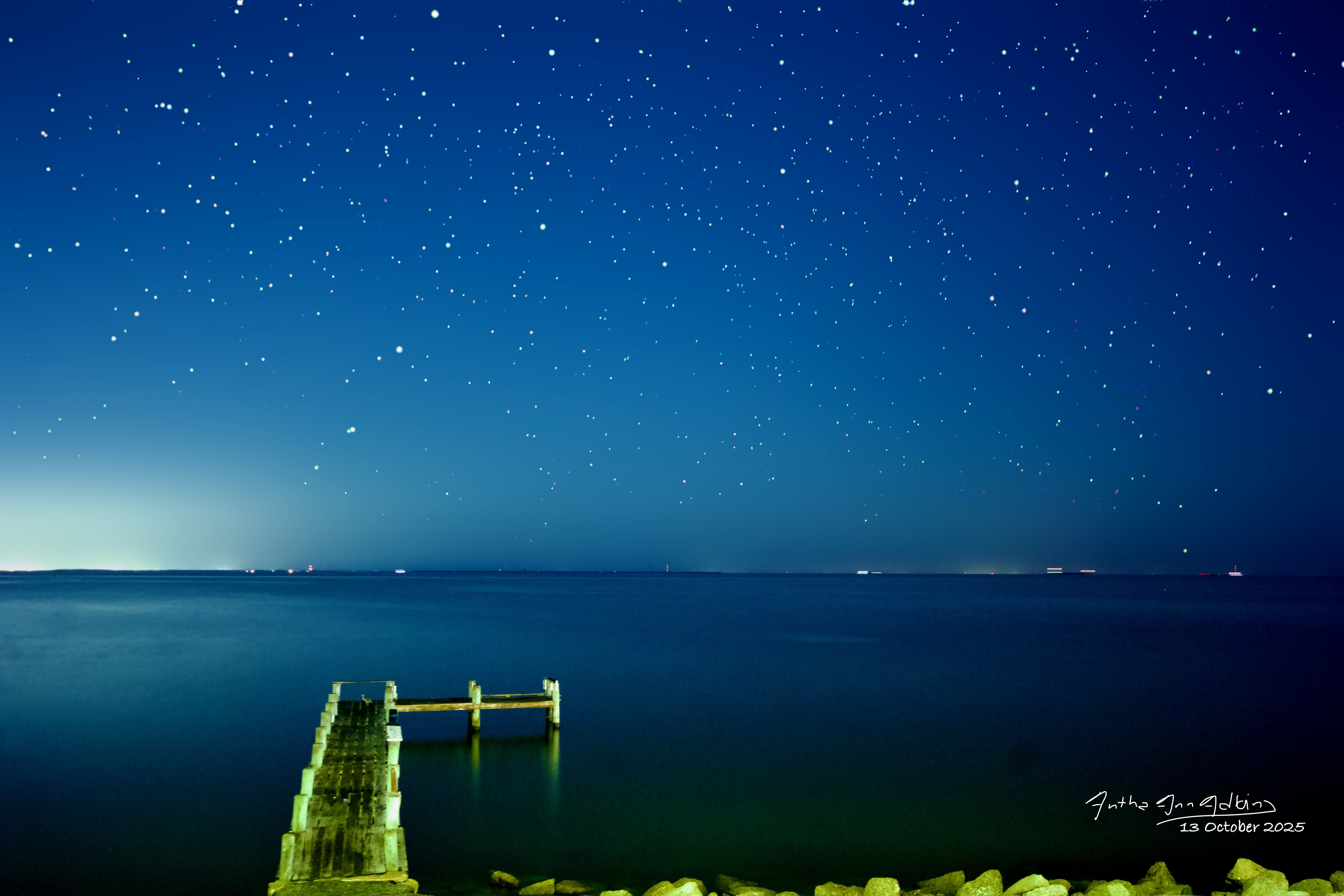
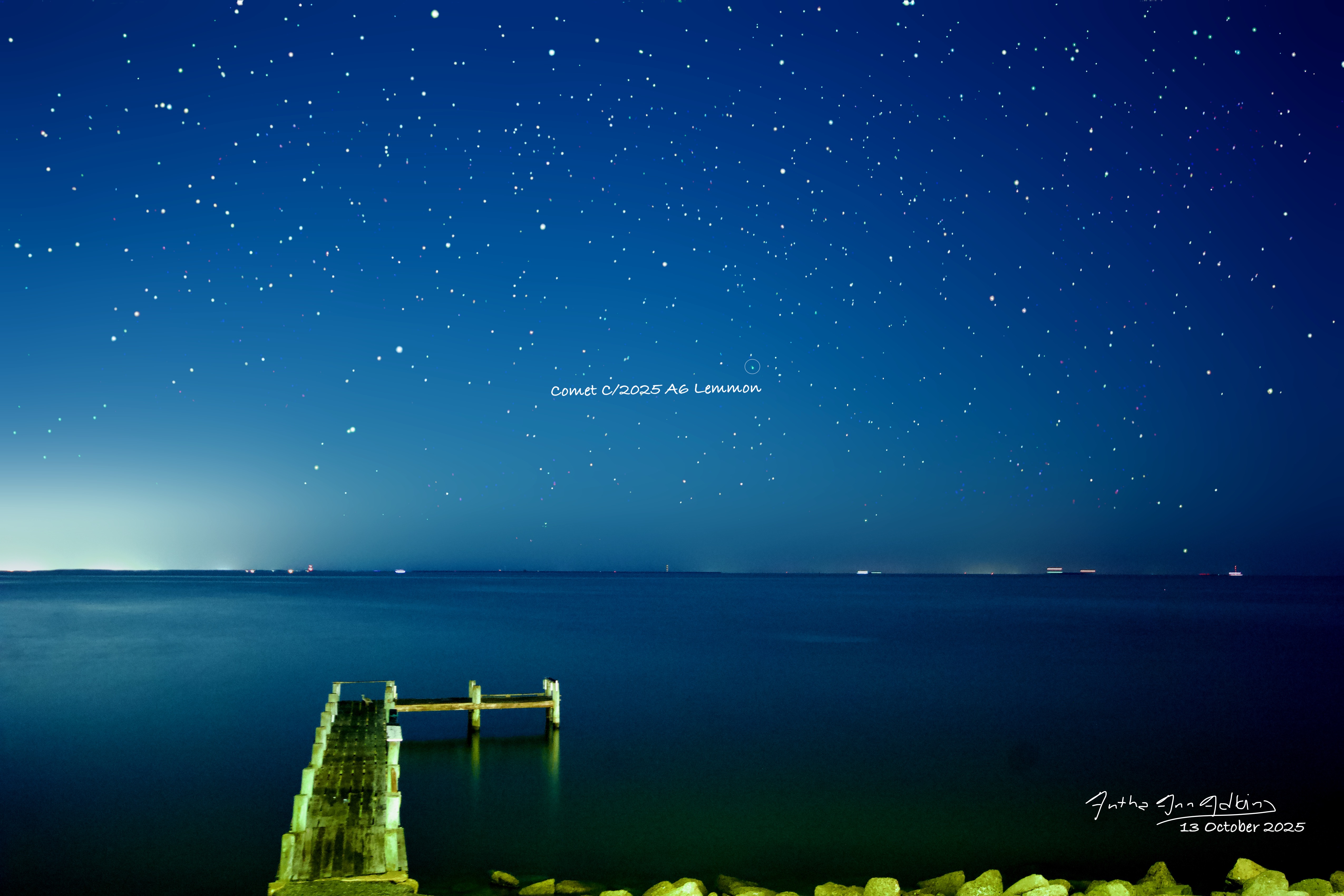
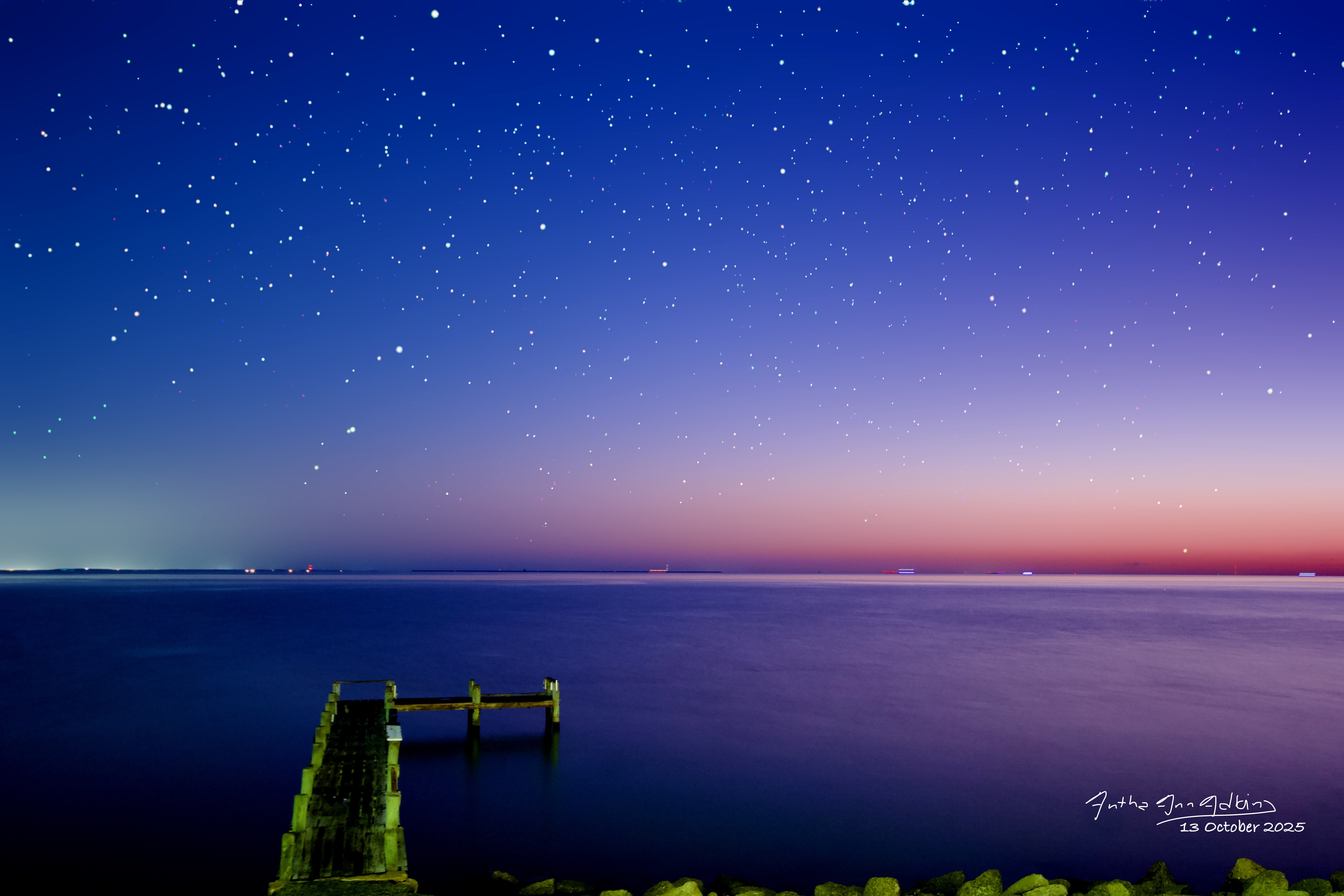
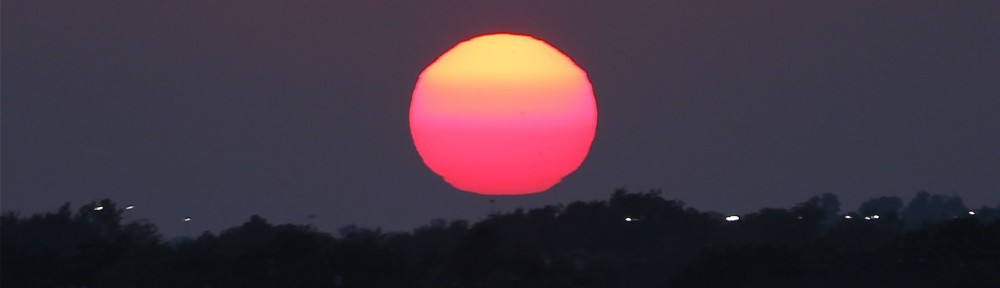
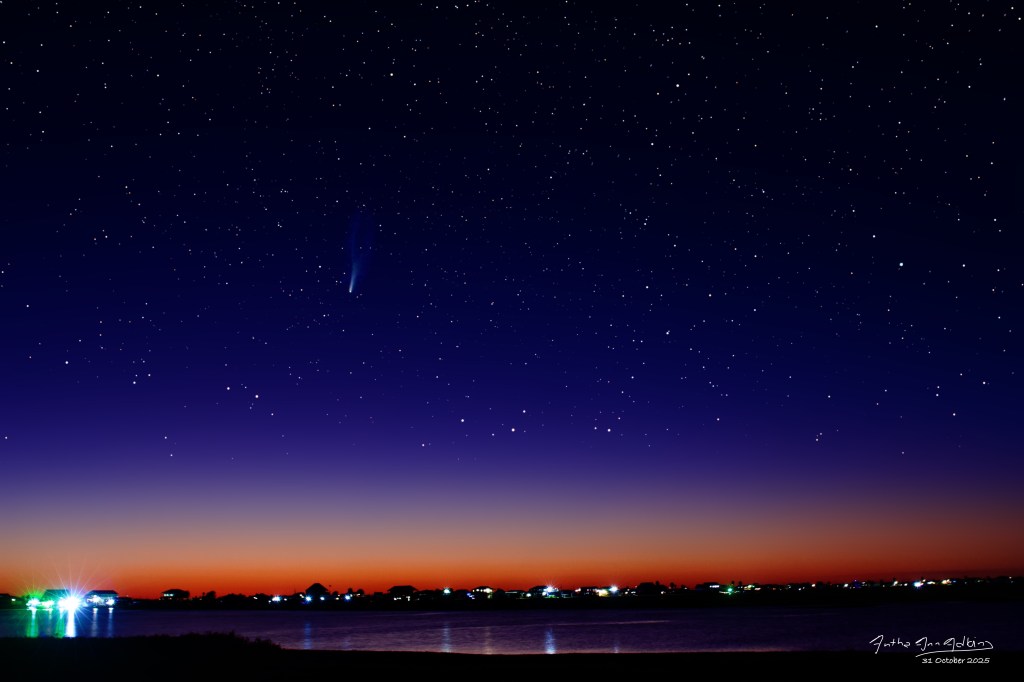
I set up my camera for a wide field image, and the comet is in the picture, but it does not stand out as a comet, even with extra processing to enhance it.  The processed image used 17.7 minutes of data but only 13.7 minutes for the comet because the pre-processing tossed a bunch of frames.  I combined the widefield stars image with foreground and sky images taken from the same place with the same setup (no combining different focal lengths or locations).  The “night” version really captures what it was like – peaceful and calm.  (Can you spot the bird on the dock?)  The “sunrise” picture is a bit of a stretch, since the starfield is from earlier in the morning than the sunrise light, and the stars were fading at that point.  However, it is pretty!

I was finally able to spot a small fuzzy spot with the binoculars, so I was able to declare victory on spotting the comet with binoculars.

We stayed for the sunrise, and my husband saw the green flash effect!  Alas, I did not capture it with my camera.

The comet only got better from here … but it’s taking a while to get these images processed.  More to come!

Camera geek info – telescope:

  • William Optics Zenith Star 73 III APO telescope
  • William Optics Flat 73A
  • ZWO 2” Electronic Filter Wheel
  • Antila RGB filters
  • ZWO ASI183MM-Pro-Mono camera
  • William Optics Uniguide 32MM F/3.75
  • ZWO ASI220MM-mini
  • ZWO ASiair Plus
  • iOptron CEM40
  • Bacliff, Texas Bortle 6 suburban skies

Frames – telescope:

  • October 13, 2025
    • 103 15 second Gain 150 R lights (66 for comet)
    • 30 0.05 second Gain 150 R flats
    • 106 15 second Gain 150 G lights (66 for comet)
    • 30 0.02 second Gain 150 G flats
    • 98 15 second Gain 150 B lights (60 for comet)
    • 30 0.02 second Gain 150 B flats
    • Matching darks and flat darks from library
Camera geek info – camera:

  • Canon EOS 60D in manual mode set at f/5.6, 20 second exposure, ISO 800
  • Sigma 10-20 mm f/4-5.6 lens, set at 20 mm, manual focus
  • Tripod
  • Intervalometer 

Frames – camera:

  • October 13, 2025
    • 53 20 second lights (41 for comet)
    • 30 1/125 second flats
    • Matching darks and flat darks from library
Comet C/2025 A6 Lemmon on 12 October 2025

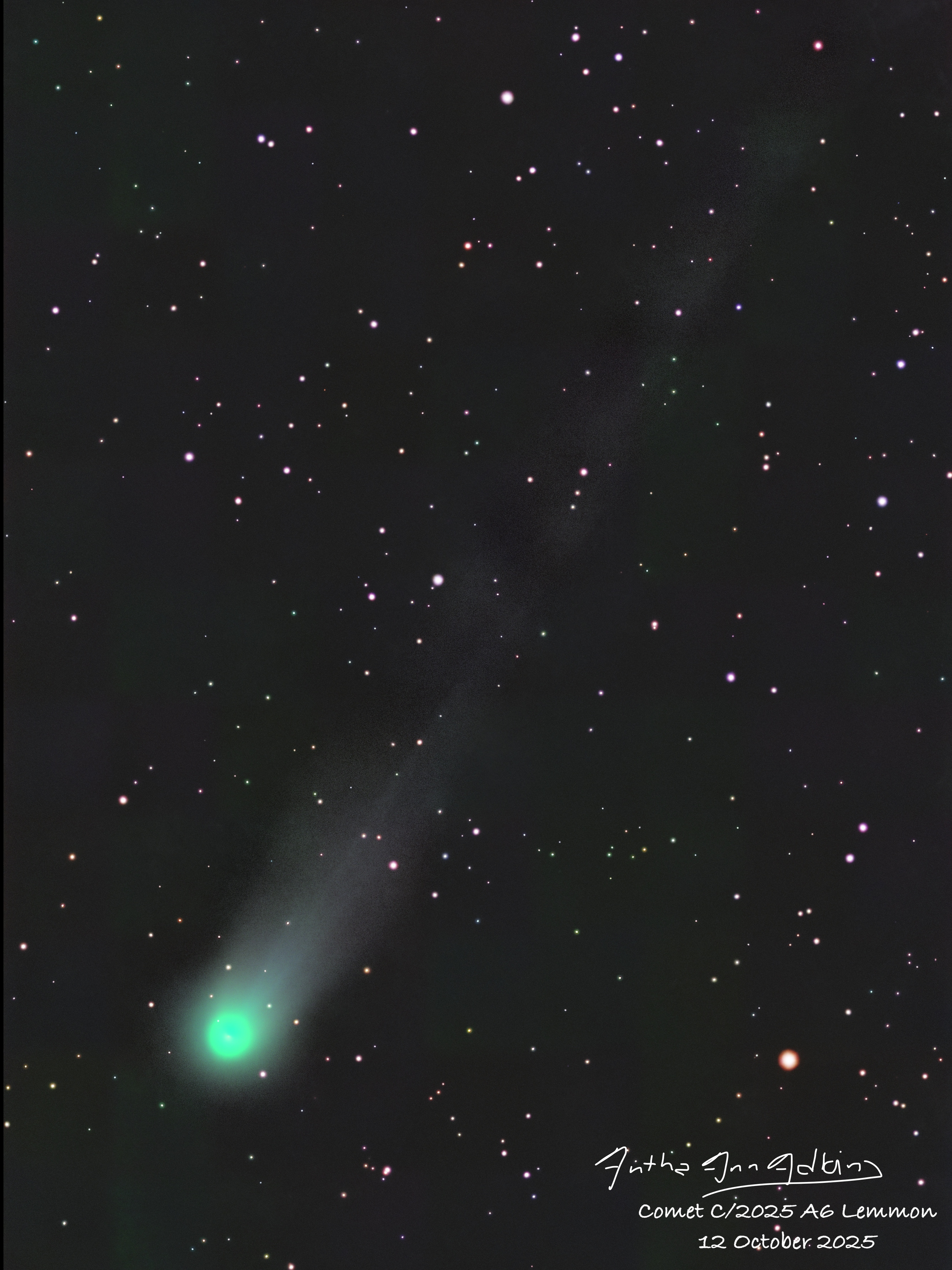
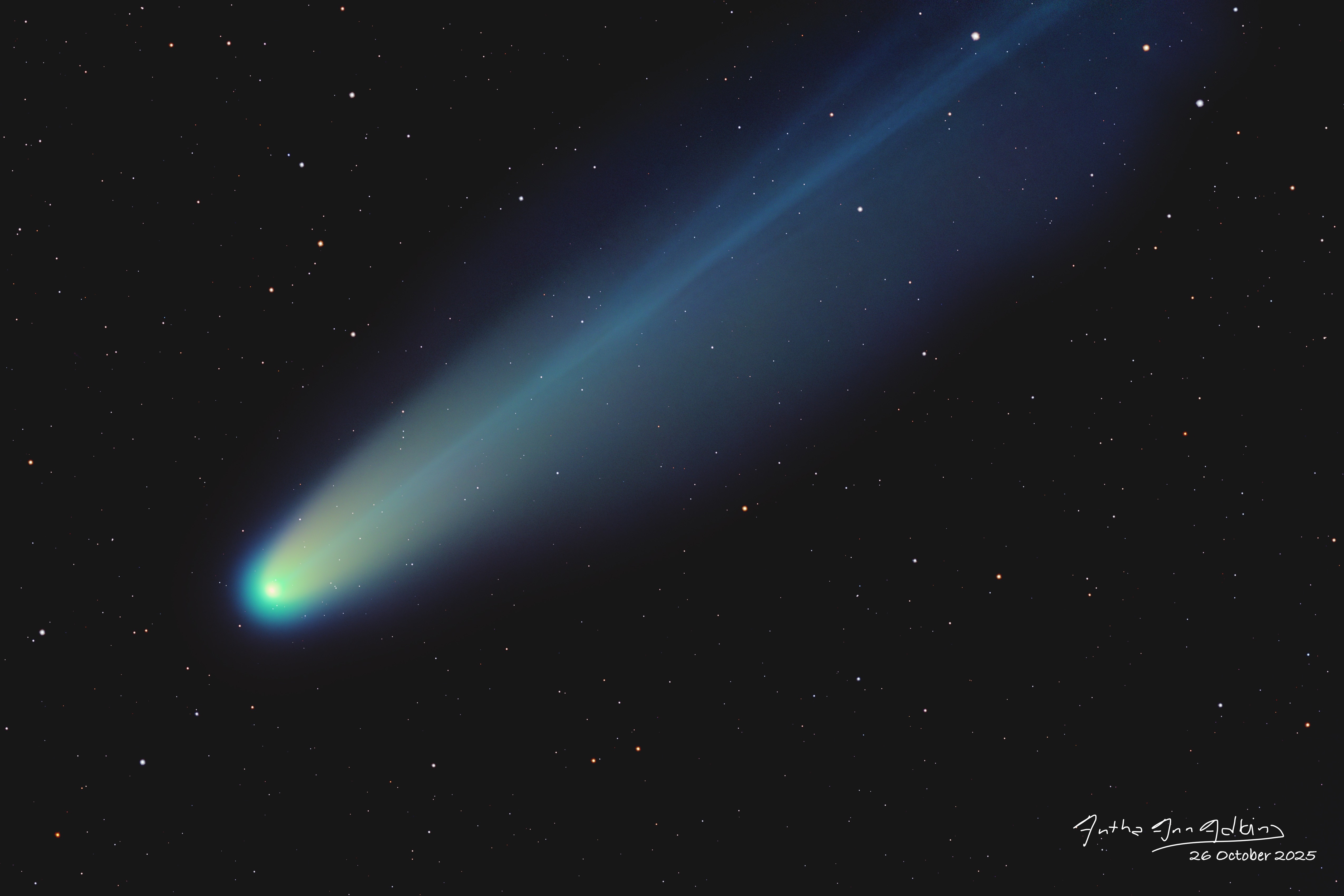
Sunday, October 12, was my third morning in a row trying to capture Comet C/2025 A6 Lemmon.  This time, I used my bigger telescope, Blue, from my driveway.

From my Bortle 8 driveway, I still could not spot the comet with binoculars.

My larger telescope with about 1.2 hours worth of data certainly picked up more details in the comet and more stars than my smaller telescope did two nights earlier.  

Comet processing takes a long time, and I’ve had some good luck as far as weather, more pictures to come …

Camera geek info:

  • William Optics Pleiades 111 telescope
  • ZWO 2” Electronic Filter Wheel
  • Antila RGB filters
  • Blue Fireball 360° Camera Angle Adjuster/Rotator
  • ZWO ASI183MM-Pro-Mono camera
  • William Optics Uniguide 32MM F/3.75
  • ZWO ASI220MM-mini
  • ZWO ASiair Plus
  • iOptron CEM40
  • Friendswood, Texas Bortle 7-8 suburban skies

Frames:

  • October 12, 2025
    • 100 15 second Gain 150 Red lights
    • 30 0.02 second Gain 150 Red flats
    • 99 15 second Gain 150 Green lights
    • 30 0.01 second Gain 150 Green flats
    • 92 15 second Gain 150 Blue lights
    • 30 0.01 second Gain 150 Blue flats
    • Matching darks and flat darks from library
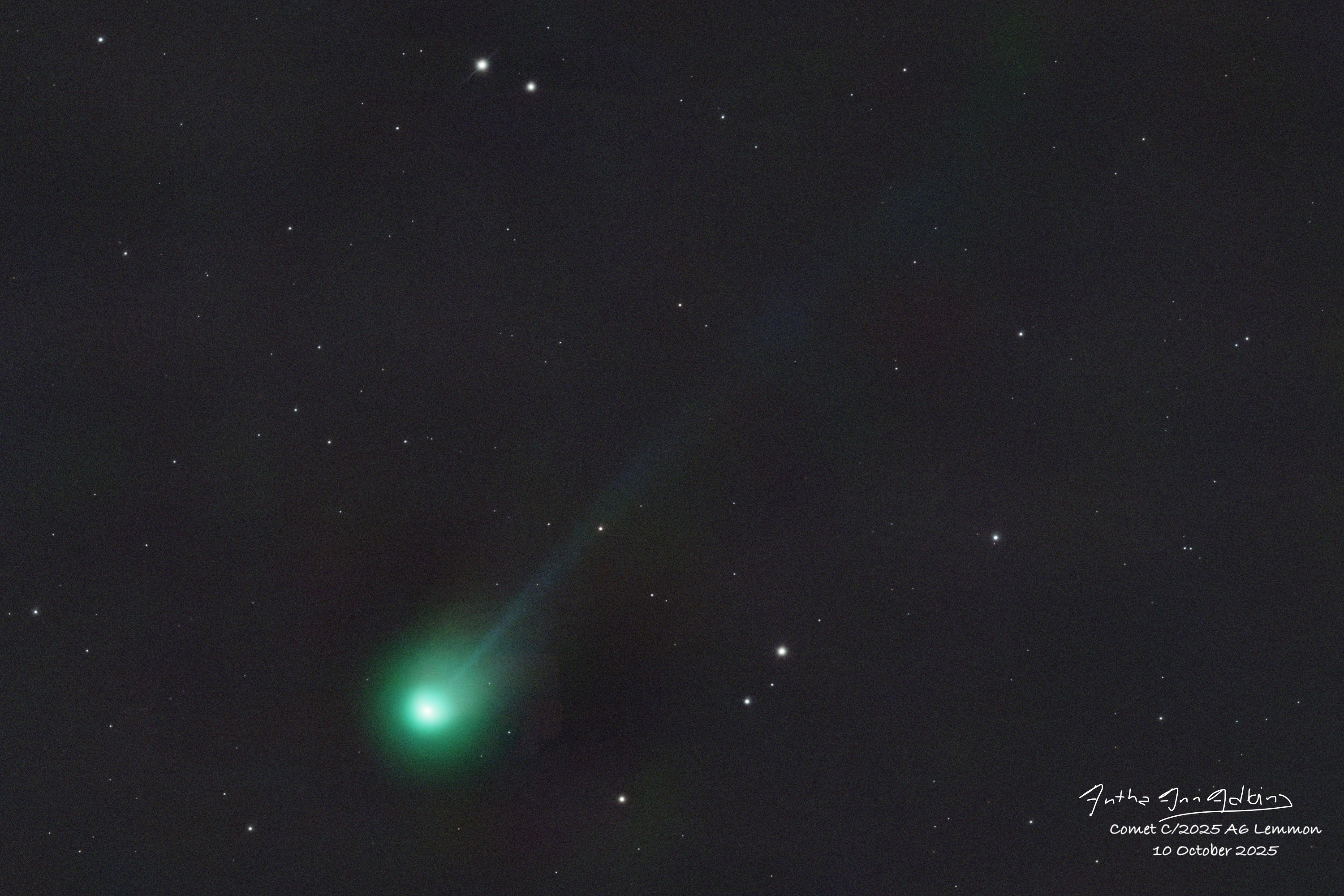
Comet C/2025 A6 Lemmon on 10 October 2025

Comet C/2025 A6 Lemmon has the potential to become brighter and naked eye visible when it is closest to the Earth in the early evening on October 21, 2025.  

But it can be seen now before sunrise with the right tools.  I picked my smaller telescope “Z” in case the tail was long (next time I’m going to try my bigger telescope).  I calculated the amount of time that the comet would move across a half pixel to set the exposure length of 30 seconds so the comet wouldn’t blur.  

On Friday morning from my Bortle 7 – 8 driveway, the comet was lovely in my smaller telescope, but I could not spot it in single images with my camera with an 85 mm lens or with the binoculars.

Happily, this is a holiday weekend with clear skies, so I am going to have several chances to image it. 

What are you enjoying this weekend?

Camera geek info:

  • William Optics Zenith Star 73 III APO telescope
  • William Optics Flat 73A
  • ZWO 2” Electronic Filter Wheel
  • Antila RGB filters
  • ZWO ASI183MM-Pro-Mono camera
  • William Optics Uniguide 32MM F/3.75
  • ZWO ASI220MM-mini
  • ZWO ASiair Plus
  • iOptron CEM40
  • Friendswood, Texas Bortle 7-8 suburban skies

Frames:

  • October 10, 2025
    • 64 30 second Gain 150 R lights
    • 30 0.05 second Gain 150 R flats
    • 64 30 second Gain 150 G lights
    • 30 0.02 second Gain 150 G flats
    • 60 30 second Gain 150 B lights
    • 30 0.05 second Gain 150 B flats
    • Matching darks and flat darks from library