Red and Blue in the Sky for the 4th of July

Red and blue in the sky seems right for the 4th of July!

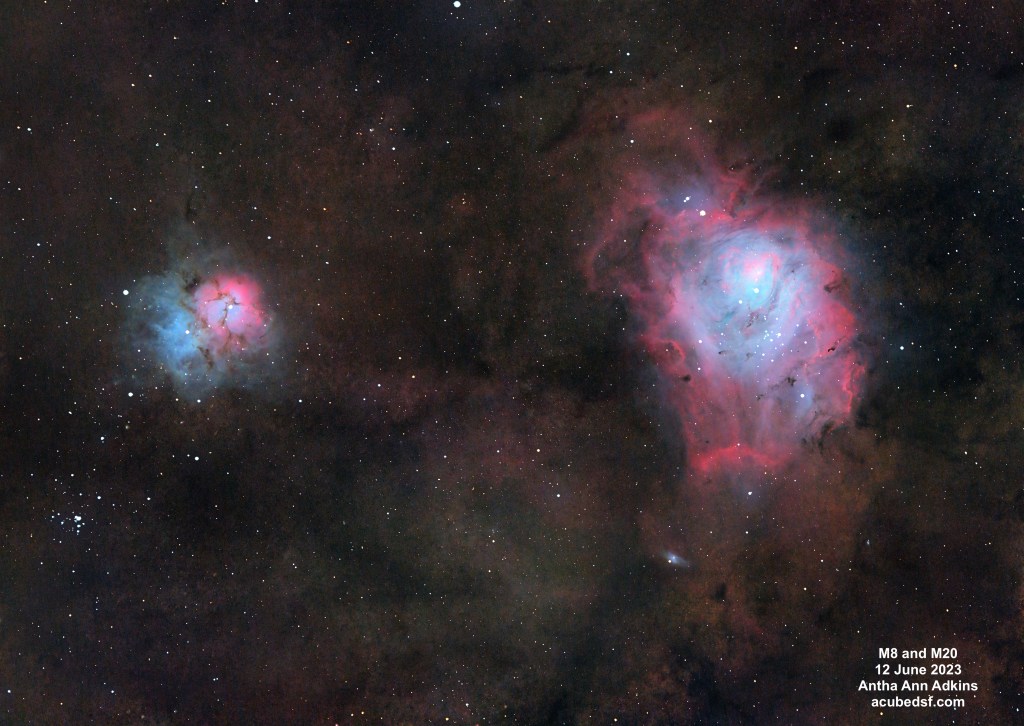
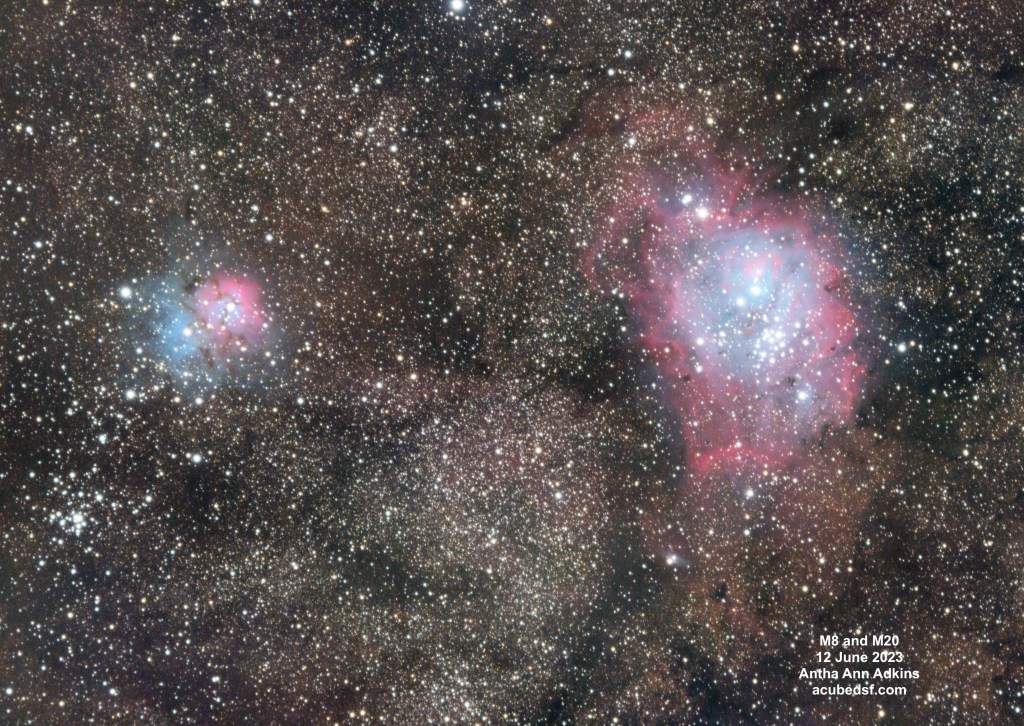
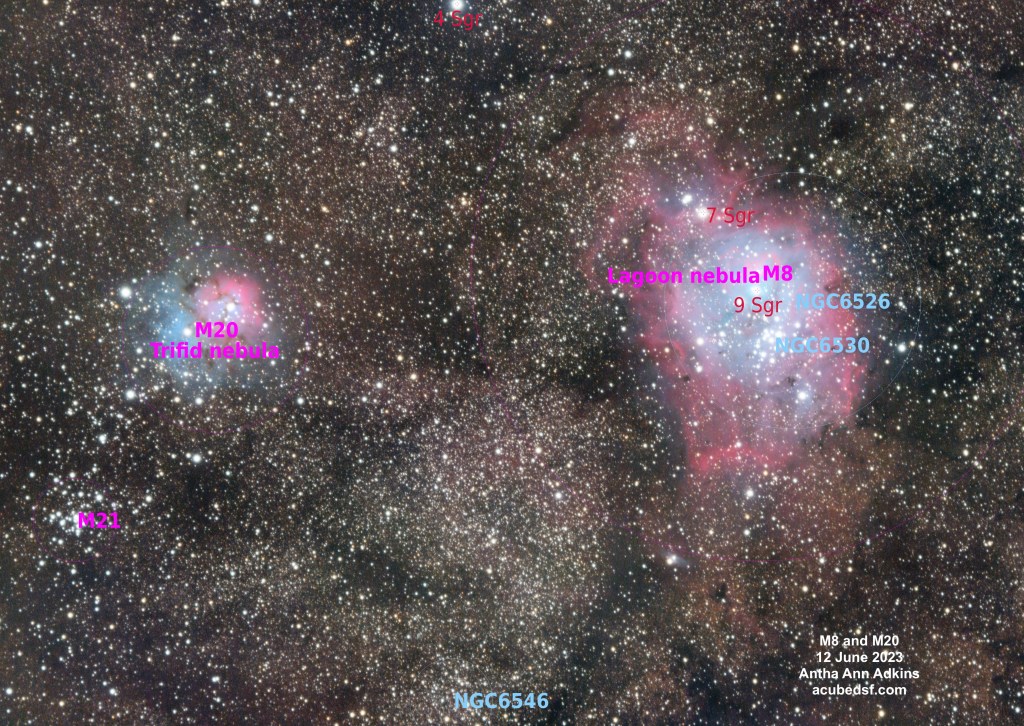
This is another image from the fabulous dark skies of Dell City, Texas. This is two nebulae – M8 Lagoon and M20 Trifid – from the constellation Sagittarius.  M8 is an emission nebula of ionized hydrogen gas where star formation is taking place.  It is 5200 light years away from us, has apparent dimensions of 90 x 40 arcmin, and has an apparent magnitude of 4.6.  M20 is a combination of three types of nebulas: the red side is an emission nebula of ionized hydrogen gas where star formation is taking place, the blue side is a reflection nebula of a cloud of dust reflecting light from a nearby star, and the black lines are a dark nebula of an interstellar cloud dense enough to block the light from behind it.  It is 4100 light years away from us, has an apparent dimension of 28 arcmin, and an apparent magnitude of 6.3.  

Although they’re in the same direction from us, imagine living at the midpoint between them!  They’d be much larger and brighter since they’d only be 550 light years away, but they’d be in opposite directions in the sky.

Given their size, brightness, and proximity to one another, this pair is a great target for a small telescope.

This image was generated from about 3.8 hours of data.

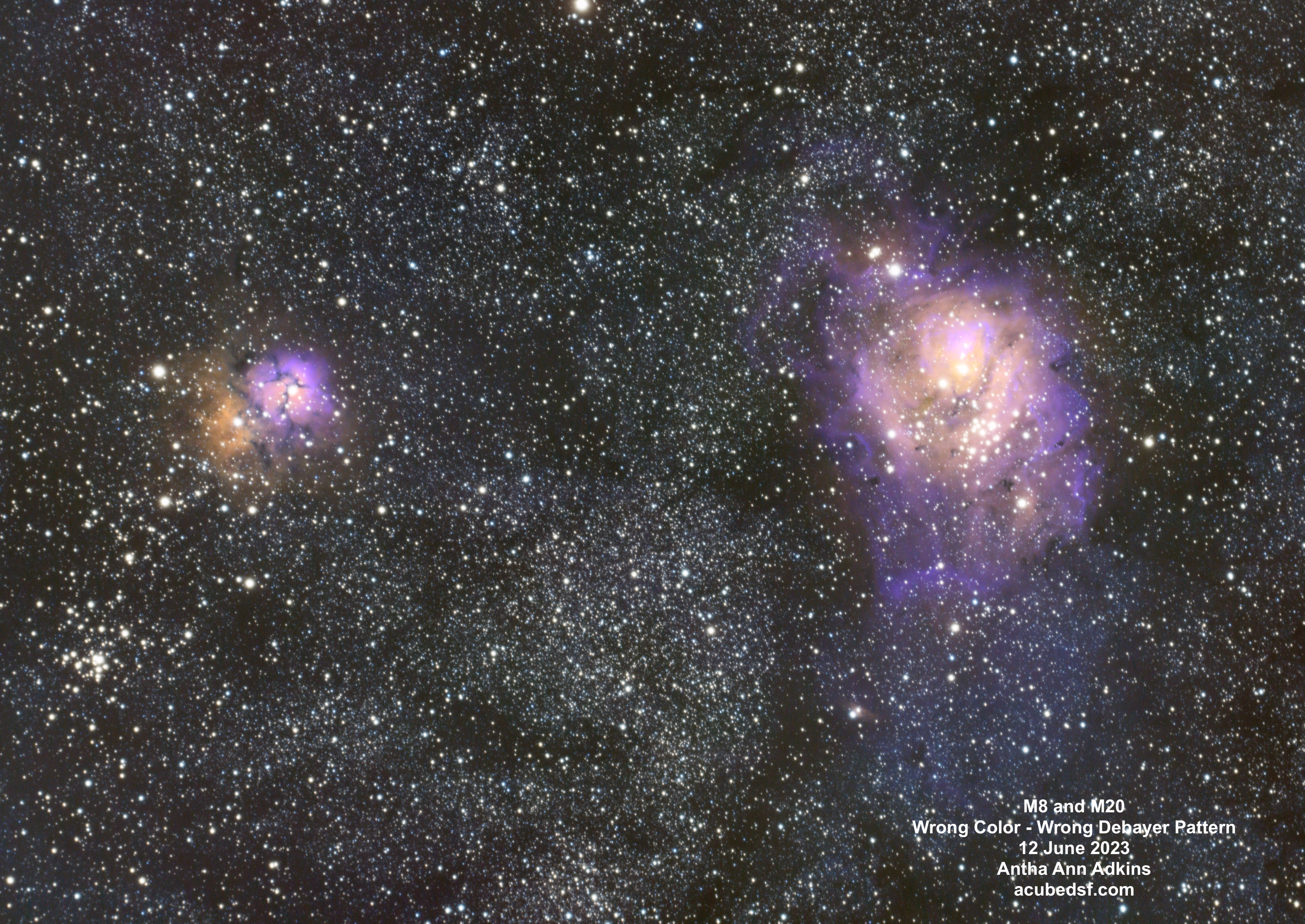
On my first round of processing, I messed up the color processing and switched colors, making everything look purple instead of red and blue. An interesting effect, even if “wrong”. Isn’t the universe beautiful?

Happy 4th of July!

Camera geek info:

  • Canon EOS 60D in manual mode, 2 minute exposure, ISO 2000, custom white balance 3500K
  • Williams Optics Zenith Star 73 III APO telescope
  • Williams Optics Flat 73A
  • iOptron CEM40
  • Dell City, Texas Bortle 2-3 dark skies

Frames:

  • June 12, 2023
    • Run 1 
      • 34 2 minute lights
      • 30 0.02 second flats
      • 30 0.02 second flat darks
    • Run 2 
      • 82 2 minute lights
      • 30 0.02 second flats
      • 30 0.02 second flat darks
      • 31 2 minute darks

Processing geek info:

  • PixInsight
  • StarXterminator
  • Generalized Hyperbolic Stretch

M101 Supernova from Bortle 2 Skies

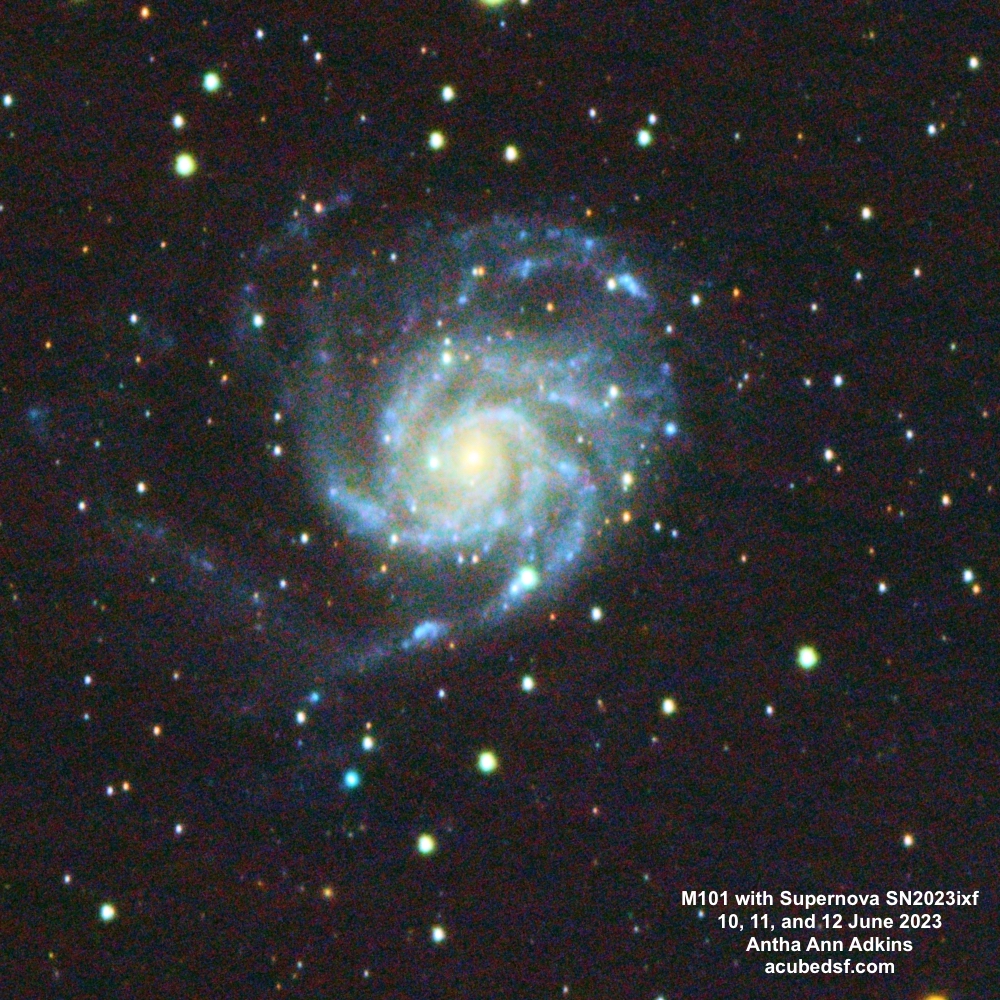
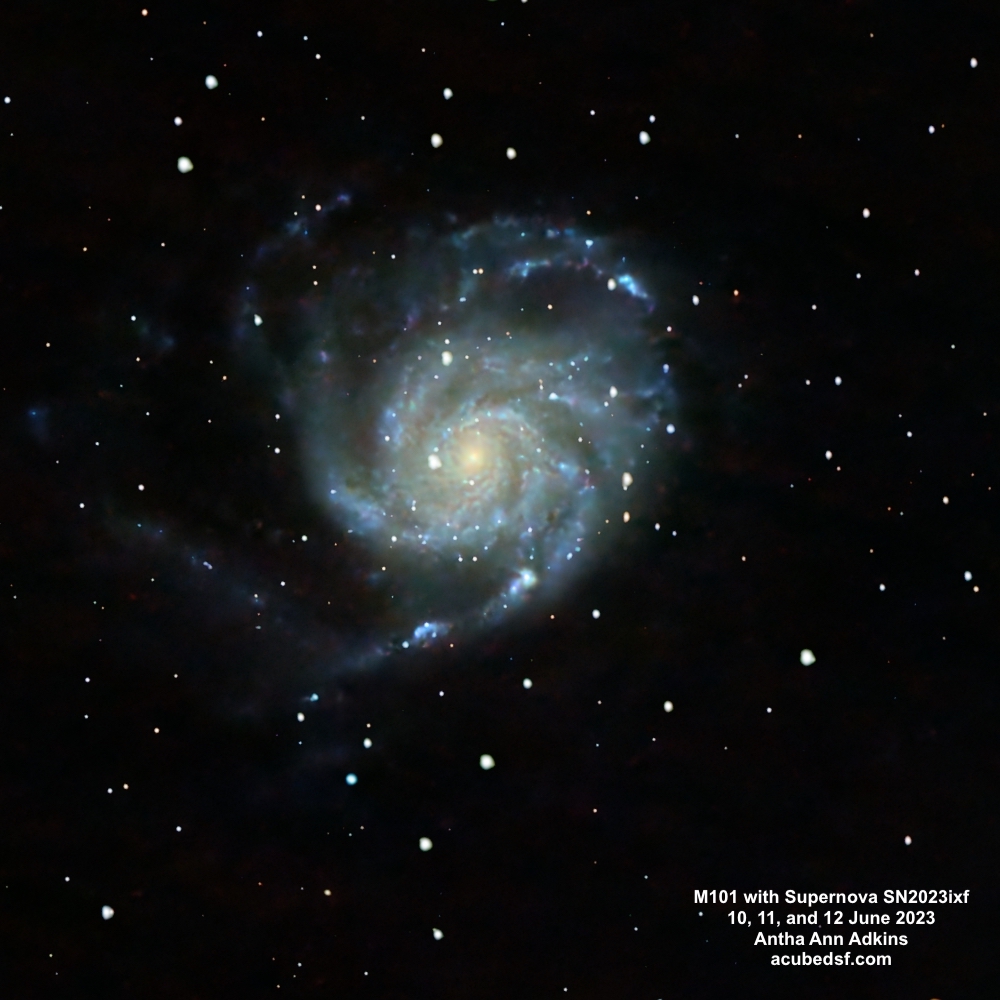
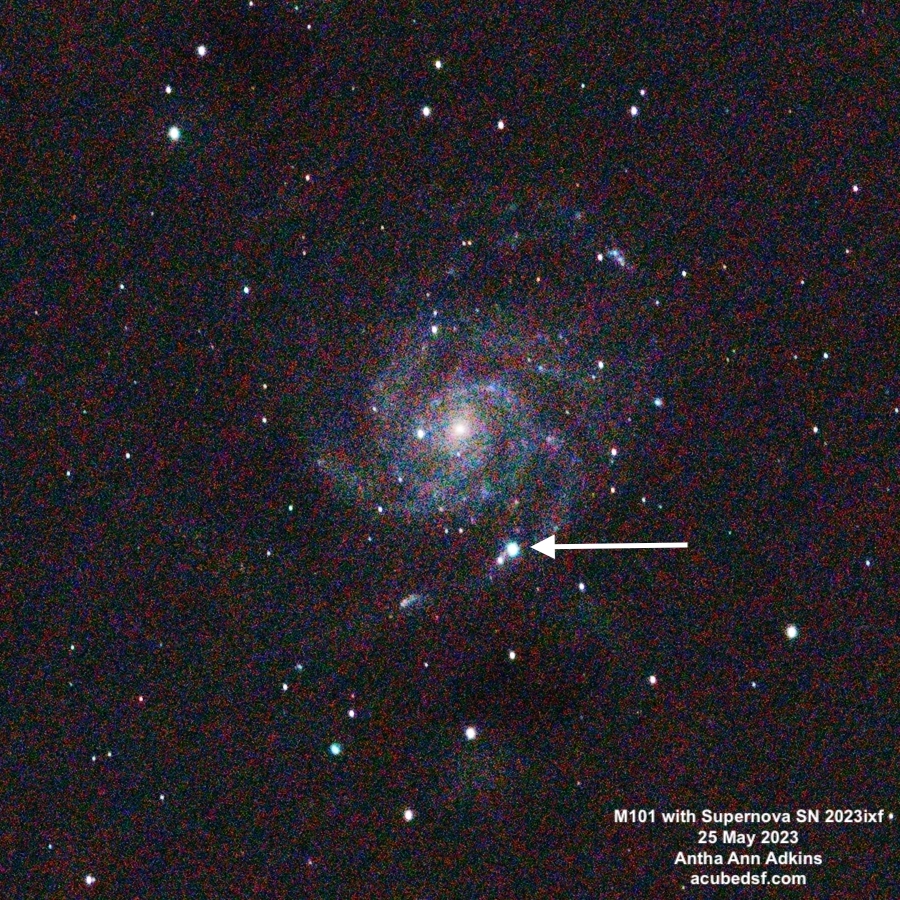
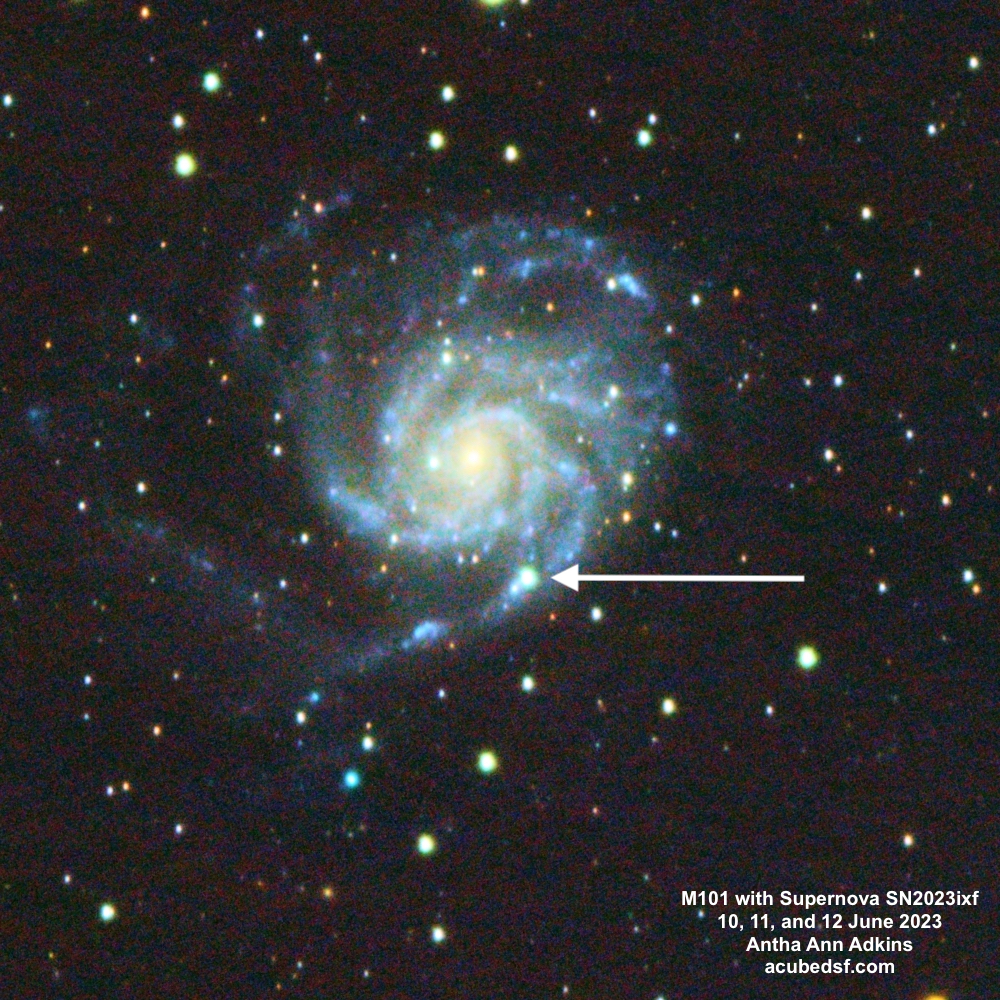
We recently went out to visit our favorite dark skies spot, Dell City, Texas, and we enjoyed 5.5 cloud-free nights and I collected over 30 hours of data.  I spent most of that time on M101 and the supernova (arrow points to the supernova).  

One of the things I’ve taken to doing is taking flats and dark flats before doing a meridian flip so each run is processed with its own calibration frames.  That way if I bump the camera or reorient it, the flats will match the lights.

Now that I’m home, I’m processing the data.  I didn’t use StarXterminator to separate the stars from the galaxy because I wanted the galaxy and the supernova to be processed the same way.

A couple of the light frames were thrown out by PixInsight, so this image ended up using 306 2-minute lights for a total of 10.2 hours of data.  Compared to what I could get from my driveway, I think it was worth it!

Camera geek info:

  • Canon EOS 60D in manual mode, 2 minute exposure, ISO 1600 and ISO 2000, custom white balance 3500K
  • Williams Optics Zenith Star 73 III APO telescope
  • Williams Optics Flat 73A
  • iOptron CEM40
  • Dell City, Texas Bortle 2-3 dark skies

Frames:

  • June 10, 2023
    • Run 1 1600 ISO
      • 99 2 minute lights
      • 31 0.01 second flats
      • 20 0.01 second flat darks
    • Run 2 1600 ISO
      • 39 2 minute lights
      • 31 0.02 second flats
      • 30 0.02 second flat darks
      • 71 2 minute darks
  • June 11, 2023 2000 ISO
    • 151 2 minute lights
    • 31 0.02 second flats
    • 20 0.02 second flat darks
    • 31 2 minute darks
  • June 12, 2023 2000 ISO
    • 30 2 minute lights
    • 31 0.02 second flats
    • 30 0.02 second flat darks
    • 32 2 minute darks

Processing geek info:

  • PixInsight
  • Generalized Hyperbolic Stretch
Horsehead Nebula Exposure Time Comparison

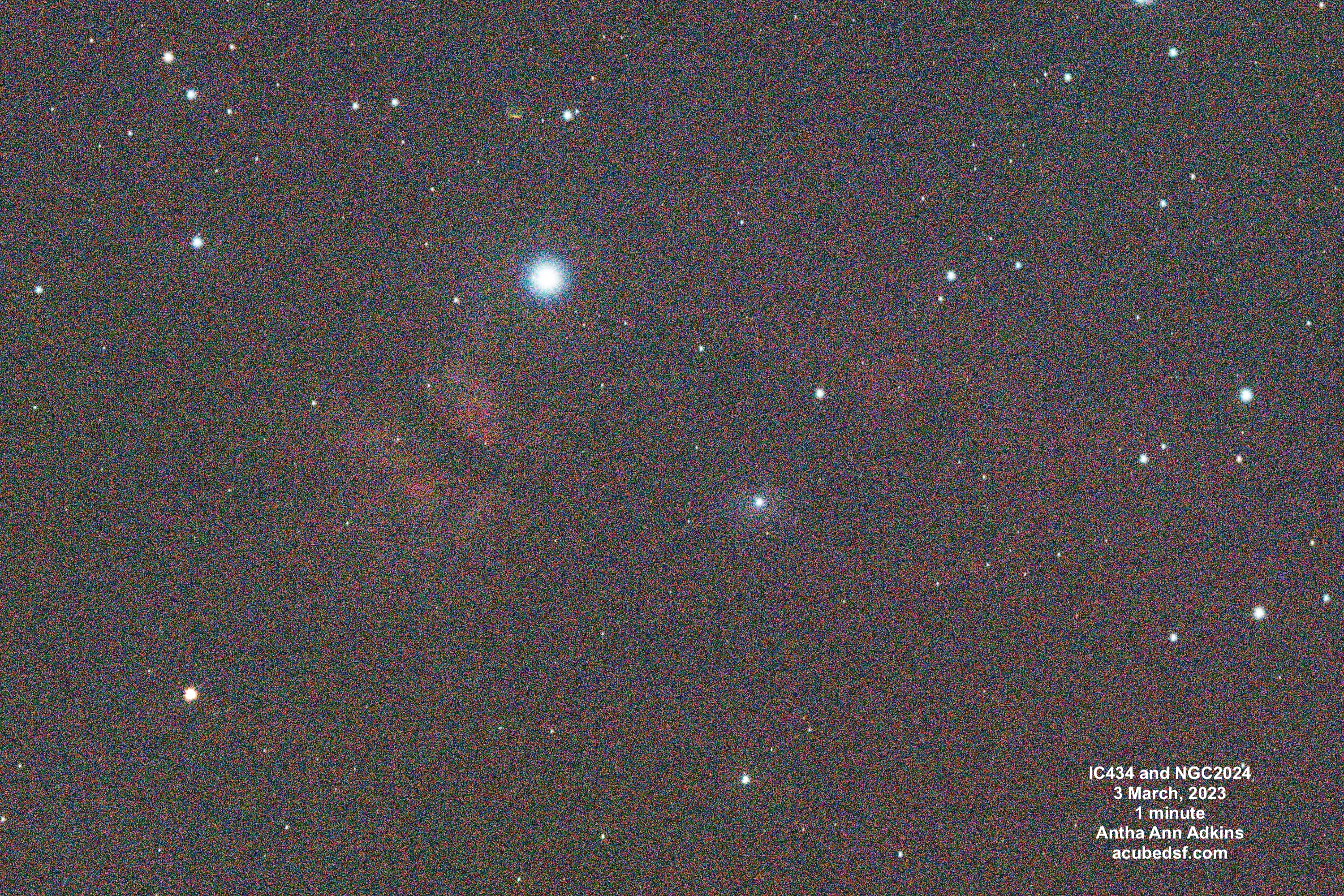
I am working on figuring out how much exposure time I need for astrophotography.  The answer from my Bortle 7-8 driveway is generally: More.  

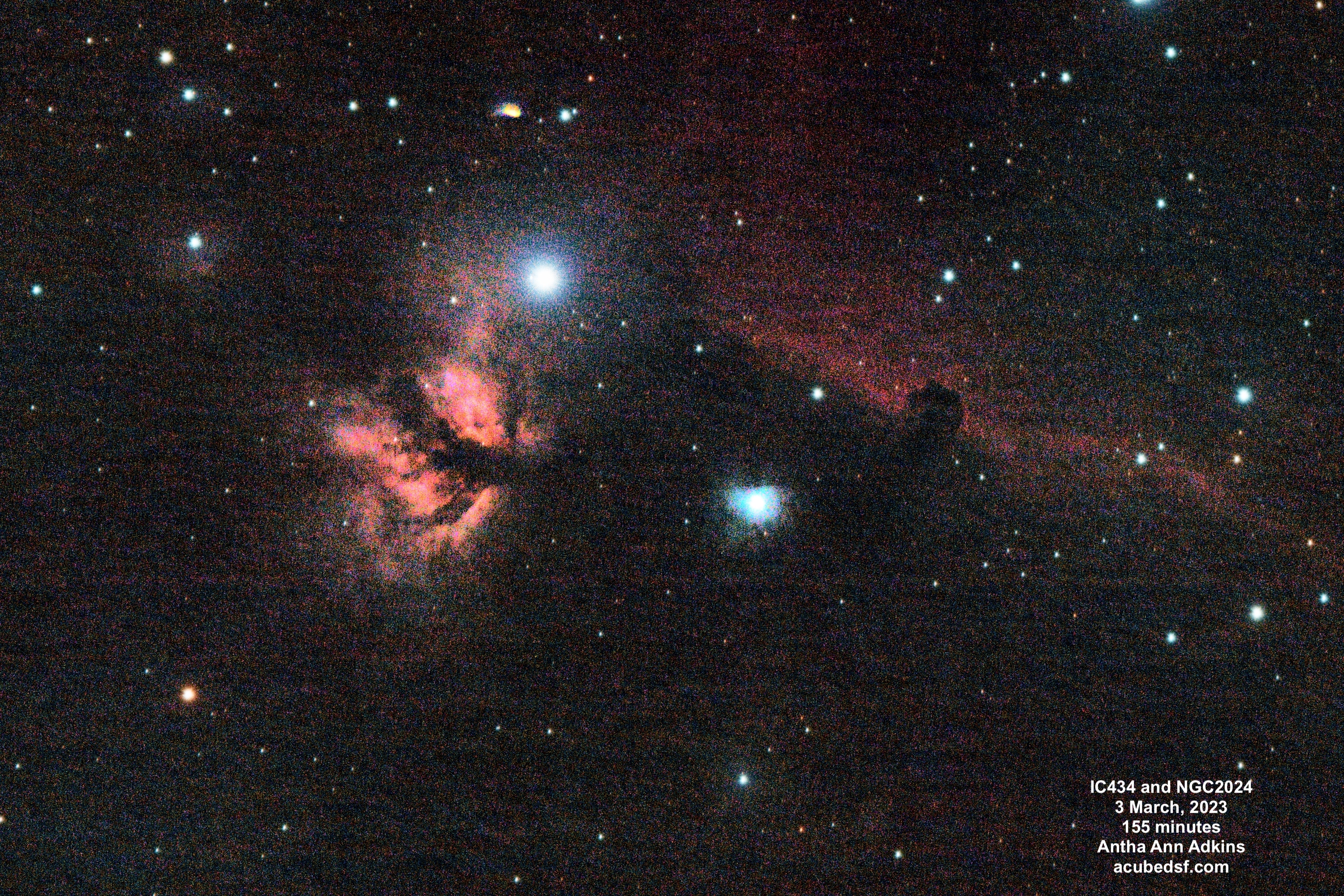
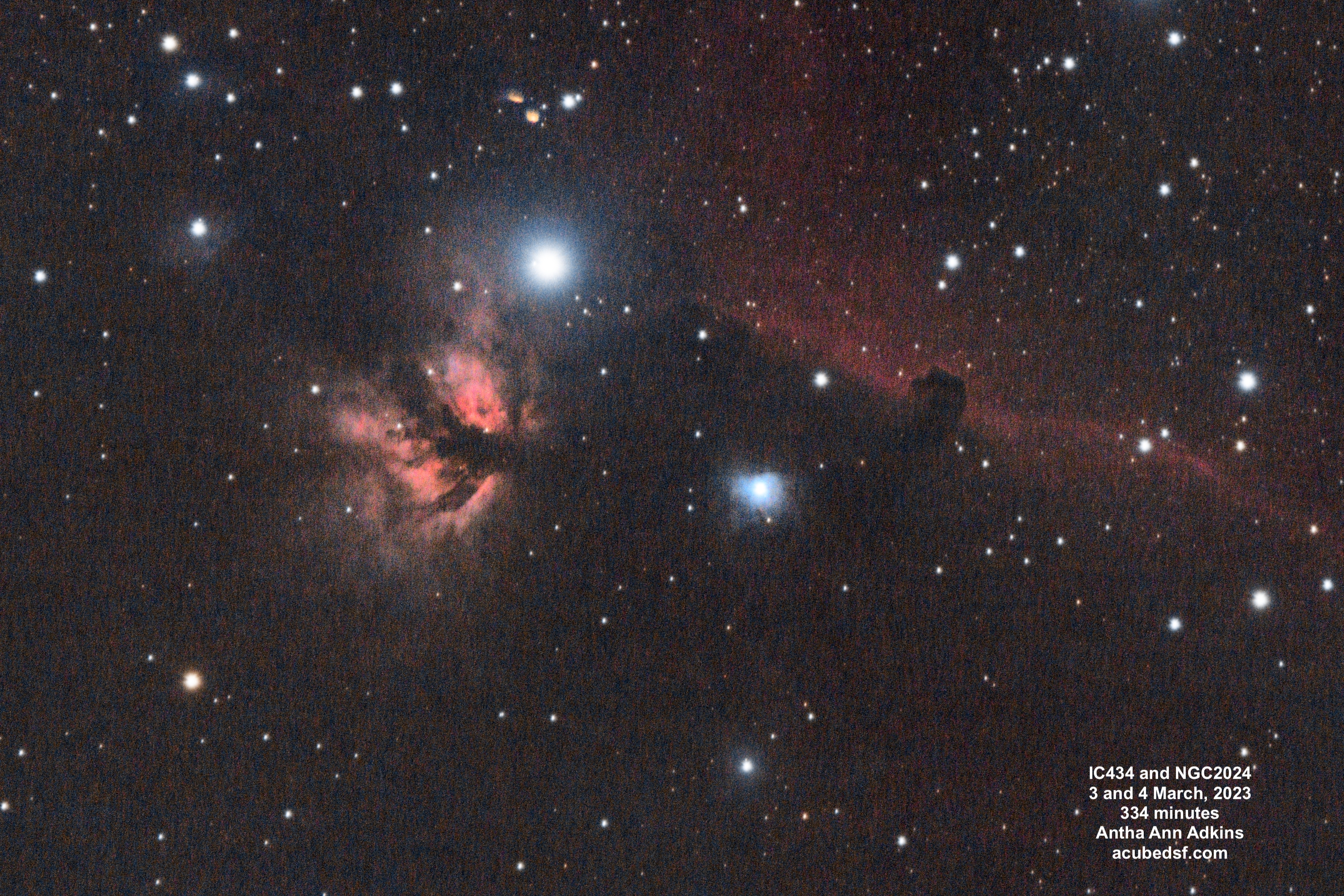
Here I’ve got three example to show how adding time adds detail to the images.  In one minute, with a lot of processing, I can get the flame nebula to be barely visible, but the horsehead nebula … might be there, maybe, if you squint and know where to look.  With 155 minutes … like magic … you can see both, but they’re grainy.  Going up to 334 minutes, and the image is getting less grainy.  But more time is still needed to get a really nice picture.

Camera geek info:

  • Canon EOS 60D in manual mode, ISO 400, 1 minute exposure
  • Williams Optics Zenith Star 73 III APO telescope
  • Williams Optics Flat 73A
  • SkyTech 2” LPRO-MAX CCD Filter
  • iOptron CEM40
  • Friendswood, Texas Bortle 7-8 suburban skies

Frames:

  • March 3, 2023
    • 155 1 minute lights
    • 20 0.2 second flats
    • 20 0.2 second flat darks
    • 28 1 minute darks
  • March 4, 2023
    • 179 1 minute lights
    • 21 0.5 second flats
    • 21 0.5 second flat darks
    • 26 1 minute darks

Processing geek info:

  • PixInsight
  • StarXterminator
  • Generalized Hyperbolic Stretch
M101 Supernova in Haiku

Cloudless skies last night.
Supernova shining bright.
A delightful sight.

Antha Ann Adkins

Thursday night we had clear skies (though a near-full Moon) and I was able to take another set of M101 and supernova images.  Comparing to my previous images, you can see that more time from my driveway gave me more galaxy details, but that they don’t compare to what I can get from darker skies.

Camera geek info:

  • Canon EOS 60D in manual mode, ISO 800, 1 minute exposures
  • Williams Optics Zenith Star 73 III APO telescope
  • Williams Optics Flat 73A
  • SkyTech 2” LPRO-MAX CCD Filter
  • iOptron CEM40
  • Friendswood, Texas Bortle 7-8 suburban skies

Frames:

  • 318 1 minute lights
  • 31 0.05 second flats
  • 20 0.05 second flat darks
  • 49 1 minute darks

Processing geek info:

  • PixInsight
  • Generalized Hyperbolic Stretch
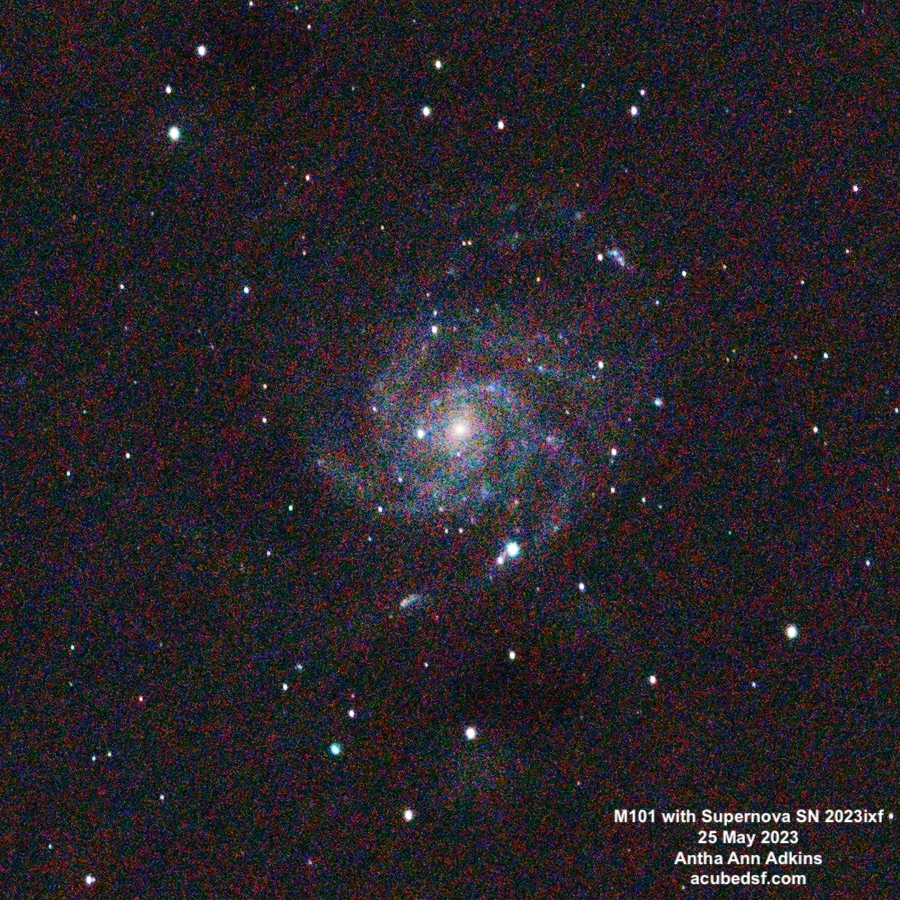
M101 Supernova

One of these things is not like the others … I got an image of M101 the Pinwheel Galaxy in February from the lovely dark skies of Dell City, Texas. Since then, light from a supernova in one of its arms has reached us … from 20+ million light years away. And I was able to image that from my driveway!  The driveway picture is noisier and dimmer due to light pollution, but you can tell there’s something new there! I’m looking forward to going back out to the dark skies and imaging it again.

Interestingly, the total imaging times of 66×3=198 minutes on 2/16 and 218 minutes on 5/25 are pretty similar, but due to the light pollution, the 5/25 image has less detail, is noisier, and is grainier.  On the other hand, the tracking wasn’t as good on 2/16, emphasized by the longer image times, so the stars aren’t circles and the image isn’t as sharp as I would like.

Camera geek info (February 16 pre supernova):

  • Canon EOS 60D in manual mode
  • Williams Optics Zenith Star 73 III APO telescope
  • Williams Optics Flat 73A
  • iOptron CEM40
  • Dell City, Texas Bortle 2-3 dark skies

Frames:

  • Feb 16 3 minute exposure ISO 1600
    • 66 3 minute lights
    • 21 0.05 second flats
    • 20 0.05 second flat darks
    • 20 1 minute darks

Processing geek info:

  • PixInsight

Camera geek info (May 25 with supernova):

  • Canon EOS 60D in manual mode
  • Williams Optics Zenith Star 73 III APO telescope
  • Williams Optics Flat 73A
  • SkyTech 2” LPRO-MAX CCD Filter
  • iOptron CEM40
  • Friendswood, Texas Bortle 7-8 suburban skies

Frames:

  • May 25 1 minute exposure ISO 800
    • 218 1 minute lights
    • 31 0.05 second flats
    • 30 0.05 second flat darks
    • 49 1 minute darks

Processing geek info:

  • PixInsight

M106

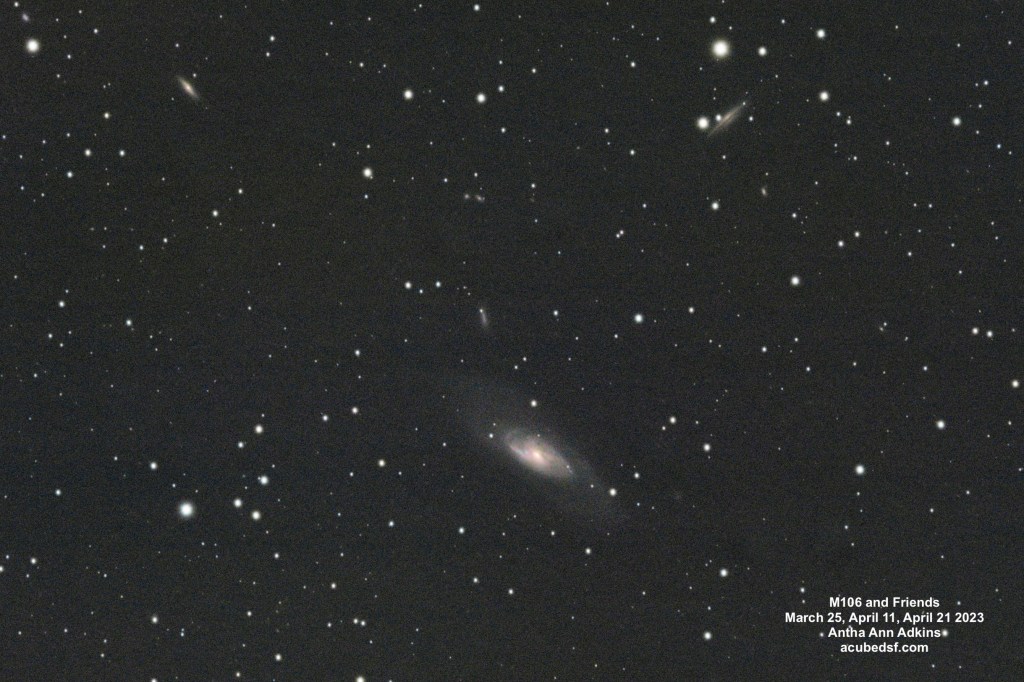
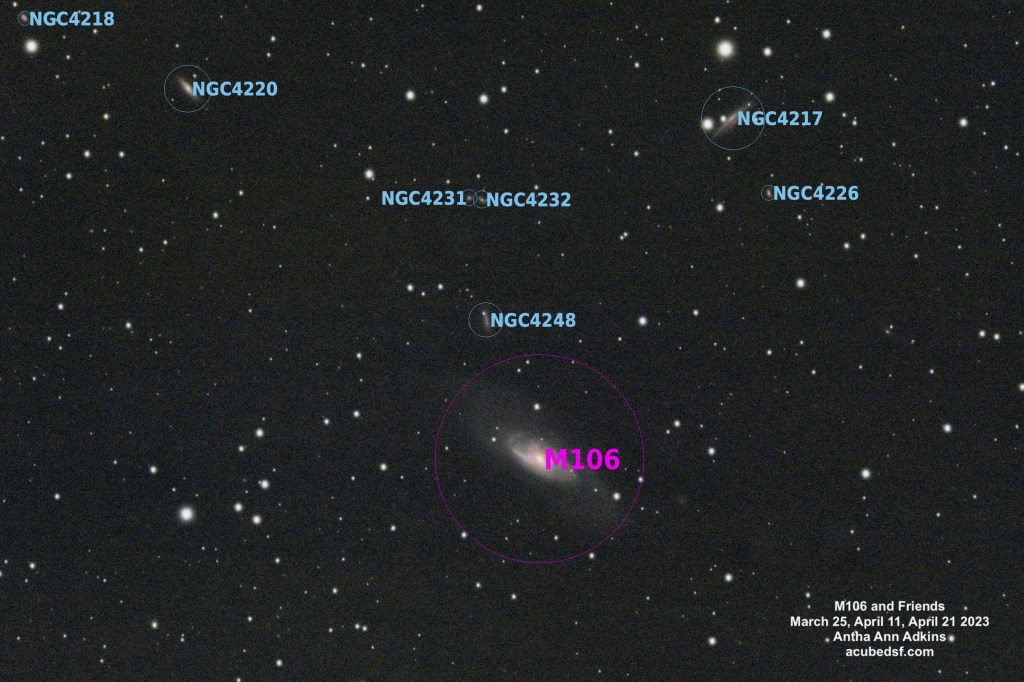
We haven’t had good telescope weather for a while, so I’ve been working on learning more processing techniques.  This is my latest effort: M106, a spiral galaxy containing a supermassive black hole in the center.  It’s got some nearby friends.  How many galaxies can you find?

This is the image where I learned that it’s better to fix the physical alignment of the tracking mount rather than take shorter images to reduce the star trailing – the same amount of time in 30 second images vs 1 minute images takes, well, twice as long to process.  

Camera geek info:

  • Canon EOS 60D in manual mode
  • Williams Optics Zenith Star 73 III APO telescope
  • Williams Optics Flat 73A
  • SkyTech 2” LPRO-MAX CCD Filter
  • iOptron CEM40
  • Friendswood, Texas Bortle 7-8 suburban skies

Frames:

  • March 25 1 minute exposure ISO 800
    • 108 1 minute lights
    • 25 0.03 second flats
    • 27 0.03 second flat darks
    • 40 1 minute darks
  • April 11 1 minute exposure ISO 800
    • 80 1 minute lights
    • 20 0.1 second flats
    • 20 0.1 second flat darks
    • 40 1 minute darks
  • April 21 30 second exposure ISO 1600
    • 471 30 second lights
    • 30 0.03 second flats
    • 30 0.03 second dark flats
    • 42 30 second darks

Processing geek info:

  • PixInsight

Globular Clusters

I’m still working on learning the PixInsight processing software, and I have discovered through the Adam Block videos the Generalized Hyperbolic Stretch process, and now I want to go re-process all the galaxies I’ve been working on.
Imaging galaxies and nebulae from my Bortle 8 skies takes hours of data collection and then more hours of computer crunching.  I have learned that it’s better to fix the physical alignment of the tracking mount rather than take shorter images to reduce the star trailing – the same amount of time in 30 second images vs 1 minutes takes, well, twice as long to process.  

Globular clusters, though, don’t need as much data.  So I don’t need to image as long and the processing is faster.

This is M4 and NGC6144, both globular clusters in our Milky Way.  Globular clusters contain hundreds of thousands to millions of stars that are gravitationally bound together.  What would it be like to live in one?  What would the sky look like?

In M4 you can see a “bar” of stars across the middle.  This is apparently a characteristic feature.  

I have imaged M4 before, but with simpler equipment, and without using stacking and other image processing techniques.  I think this version is a vast improvement. 

Camera geek info:

  • Canon EOS 60D in manual mode, 1 minute exposure, ISO 800, custom white balance 3500K
  • Williams Optics Zenith Star 73 III APO telescope
  • Williams Optics Flat 73A
  • SkyTech 2” LPRO-MAX CCD Filter
  • iOptron CEM40
  • Friendswood, Texas Bortle 7-8 suburban skies

Processing geek info:

  • PixInsight
  • 122 1 minute lights
  • 38 1 minute darks
  • 31 0.2 second flats
  • 30 0.2 second flat darks

In our rare cloud-free skies this weekend, I also imaged M13, the Hercules Cluster.  

Camera geek info:

  • Canon EOS 60D in manual mode, 1 minute exposure, ISO 800, custom white balance 3500K
  • Williams Optics Zenith Star 73 III APO telescope
  • Williams Optics Flat 73A
  • SkyTech 2” LPRO-MAX CCD Filter
  • iOptron CEM40
  • Friendswood, Texas Bortle 7-8 suburban skies

Processing geek info:

  • PixInsight
  • 113 1 minute lights
  • 40 1 minute darks
  • 23 0.2 second flats
  • 31 0.2 second flat darks

Do you have a favorite globular cluster?

NGC2359 Thor’s Helmet

NGC 2359, also called Thor’s Helmet, is an emission nebula that is 15,000 light years away.  It is a bubble of ionized gas around a hot central star, Wolf-Rayet WR7.  It is 16 x 8 arc min in size, and I was pleasantly surprised that I could capture it with my small telescope.  These pictures were made by stacking 64 3 minute images (and cropping).

I’ve been learning PixInsight, and I had some fun with playing with CurvesTransformation on this one.  So, in addition to a standard view of the nebula, I created one I call “Thor in a Snowstorm”.  

Which do you like better?

Camera geek info:

  • Canon EOS 60D in manual mode, 179 second exposure, ISO 2000, custom white balance 3500K
  • Williams Optics Zenith Star 73 III APO telescope
  • Williams Optics Flat 73A
  • iOptron CEM40
  • Dell City, Texas Bortle 2-3 dark skies

Processing geek info:

  • PixInsight
  • 64 3 minute lights
  • 20 3 minute darks
  • 40 0.1 second flats
  • 40 0.1 second flat darks

Making the Invisible Visible – IC434 Horsehead Nebula and NGC2024 Flame Nebula

Last weekend I did magic with my camera.  In a single one minute image, I could only see stars.  No signs of nebulosity at all, even zoomed in and brightened on my laptop.  But when I stacked 334 images together (5 hours and 34 minutes, taken over two nights), viola!  IC434 the Horsehead Nebula and NGC2024 the Flame Nebula were both visible.  How cool is that?

Camera geek info:

  • Canon EOS 60D in manual mode, 60 second exposure, ISO 400, custom white balance 3500K
  • Williams Optics Zenith Star 73 III APO telescope
  • Williams Optics Flat 73A
  • iOptron CEM40
  • Friendswood, Texas Bortle 7-8 suburban skies

Processing geek info:

  • PixInsight
  • 344 1 minute lights
  • 28 1 minute darks day 1, 26 1 minute darks day 2
  • 21 0.5 sec flat darks day 1, 20 0.2 sec flat darks day 2
  • 21 0.5 sec flats day 1, 20 0.2 sec flats day 2

Comet C2022/E3 ZTF – First View

There’s a new comet in the morning skies that hasn’t been in the inner solar system for 50K years and may not return.  I got up at 4 AM on Saturday morning to try to catch it.  You know I love this hobby since I got up early in the cold!  It was an obvious fuzzball in a single 1 minute telescope image, but I couldn’t spot it with image stabilized binoculars.  I’m hoping for more clear days as it gets closer and brighter!  Have you tried to spot it?

I spent about 8 hours learning how to process comets in PixInsight and trying to get rid of the residual star trails.  I’m happy with this image, but look forward to learning some more tricks to improve it!

Camera geek info:

  • Canon EOS 60D in manual mode, 60 second exposure, ISO 800, custom white balance 3500K
  • Williams Optics Zenith Star 73 III APO telescope
  • Williams Optics Flat 73A
  • iOptron CEM40
  • Friendswood, Texas Bortle 7-8 suburban skies

Processing geek info:

  • PixInsight
  • 51 1 minute lights
  • 60 1 minute darks
  • 40 bias frames
  • 20 flats