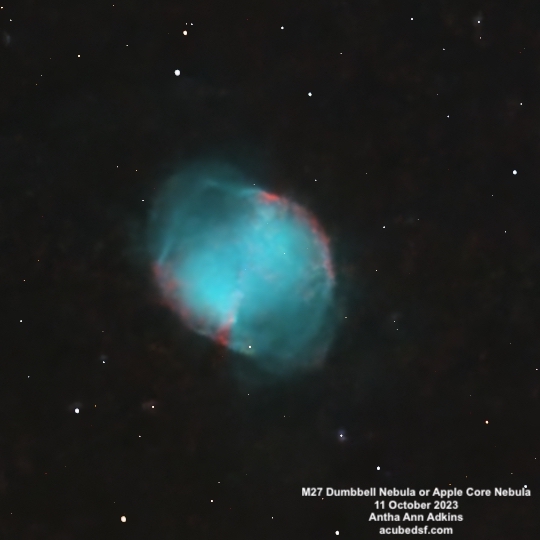
M27 is one of the brighter objects I imaged while we were enjoying the dark skies in Dell City, Texas. This object was a brilliant blue in a single frame, and it was nice not to have to rely on faith that something was there.
This image used only 1.8 hours of data.
M27, also called the Dumbbell Nebula or Apple Core Nebula, is a planetary nebula – the gases expelled from a star before it becomes a white dwarf, lit up by that star. It’s located in the Milky Way, approximately 1250 light years away, and it’s approximately 2.9 light years across, giving it an apparent size of 8 arcminutes. It’s estimated to be 12,700 years old.
Planetary nebulae do not last long on an astronomy time scale because the expelled gases grow dimmer as they expand away from the central star. I am glad I live in a time when we can observe them and they can be observed!
Isn’t our galaxy beautiful?
Camera geek info:
Canon EOS 60D in manual mode, 2 minute exposure, ISO 1600
Sh2-188 is one of the dimmer objects that I imaged during our recent trip to the dark skies at Dell City, Texas.
Sh2-188, also called the Dolphin Nebula or Shrimp Nebula, is a planetary nebula – the gases expelled from a star before it becomes a white dwarf, lit up by that star. It’s located in the Milky Way, approximately 2770 light years away, and it’s approximately 8.2 light-years across, giving it an apparent size of 10 arcminutes. It’s estimated to be 22,500 years old.
The nebula’s bow shape (as opposed to a circular shape) is theorized to be due to its relatively high velocity interaction with the interstellar medium.
The objects in our galaxy never cease to amaze me!
Camera geek info:
Canon EOS 60D in manual mode, 3 minute exposure, ISO 2000
On our recent trip to the fabulous dark skies of Dell City, Texas, I mostly tried to image things that would be difficult to capture from my light-polluted driveway at home. However, a couple of those objects weren’t visible at sunset, so I snuck in some brighter objects as well.
NGC 7293 also called the Helix Nebula or Eye of God Nebula is a planetary nebula – the gases expelled from a star before it becomes a white dwarf, lit up by that star. It’s located in the Milky Way, approximately 655 light years away, and it’s approximately 2.5 light-years across. It’s estimated to be 10,600 years old. Its apparent size is 25 arcminutes, and it has an apparent magnitude of 7.6.
I’d imaged NGC 7293 last year, and I’d even posted a single 3 minute shot, but I’d never gone back and really processed it.
I processed the data from this year, and then went back and added in the data from last year. Which version do you like better? I think I actually like the 2023 only version better.
Either way, this shows that less than an hour and a half of data was sufficient time to generate a decent image of this neat object with dark skies.
This is a particularly spectacular planetary nebula, and even last year it made me want to try to image more. Isn’t our galaxy amazing?
Camera geek info:
Canon EOS 60D in manual mode, 3 minute exposure, ISO 1600
Time lapse movie of the eclipse, with some extra dwell time for annularity.
When I planned our trip to see the October 14, 2023 annual solar eclipse months ago, I planned to see it from Roswell, New Mexico. As much as I would have liked to have seen it in my home state of Texas, the cloud probabilities were significantly better in Roswell. And, since the last time we tried to see a total solar eclipse it rained on us, having better cloud odds was the dominant factor in my decision making.
But, on Friday October 13, the cloud cover predictions for Roswell were not looking great. I made a spreadsheet of the cloud cover predictions for various cities using Astropheric, and my husband calculated how long it would take to drive to each one, and we decided to get up early and drive to Seminole, Texas instead. We couldn’t find any events planned there, but we did find a nice park.
We got up early and drove to Seminole. Although we did remember to account for the time zone change for driving back into Texas, we ended up running later than planned, and I eventually had to make a decision as to whether I wanted a complete time lapse movie or a good ring of fire picture – the choice was pretty obvious, and we kept driving to Seminole.
Seminole is in oil territory, and there were pumpjacks in the park, and we could smell the oil – giving us the true Texas eclipse viewing experience! Alas, there were no longhorns or bluebonnets to make it more iconic. Maybe in April?
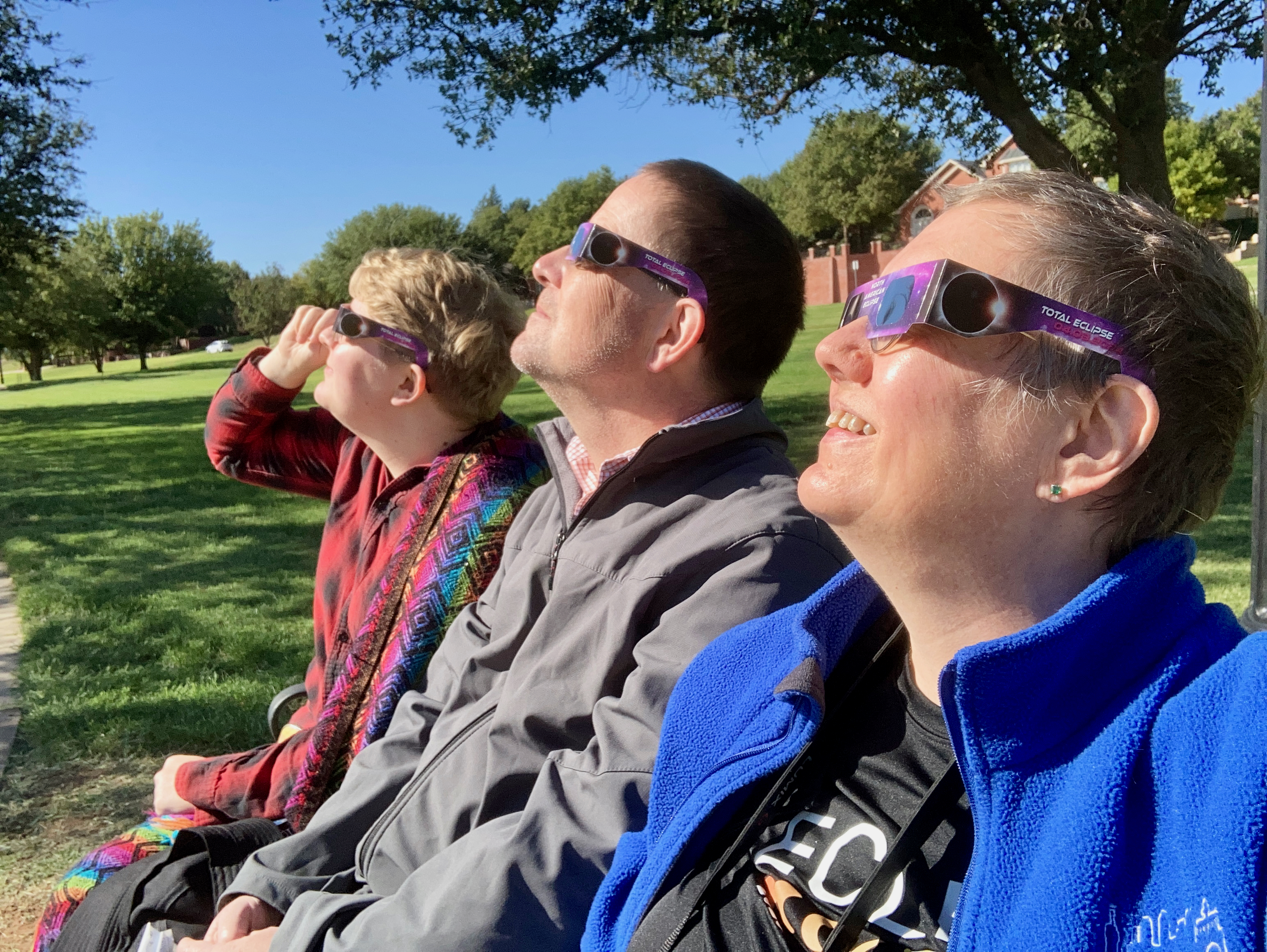
I set up my telescope on my solar tracking mount, set up the intervalometer to take a picture every minute, and let it run. It worked great, which meant I could enjoy the experience with my husband and daughter: looking at cool shadows and viewing the eclipse through our eclipse glasses.
We noticed that it felt cooler than we would have expected on a sunny day – the sun wasn’t warming us like we’d expect. And it was dimmer than we would have expected as well.
It was really cool to see the sun change from a u shape to a c shape.
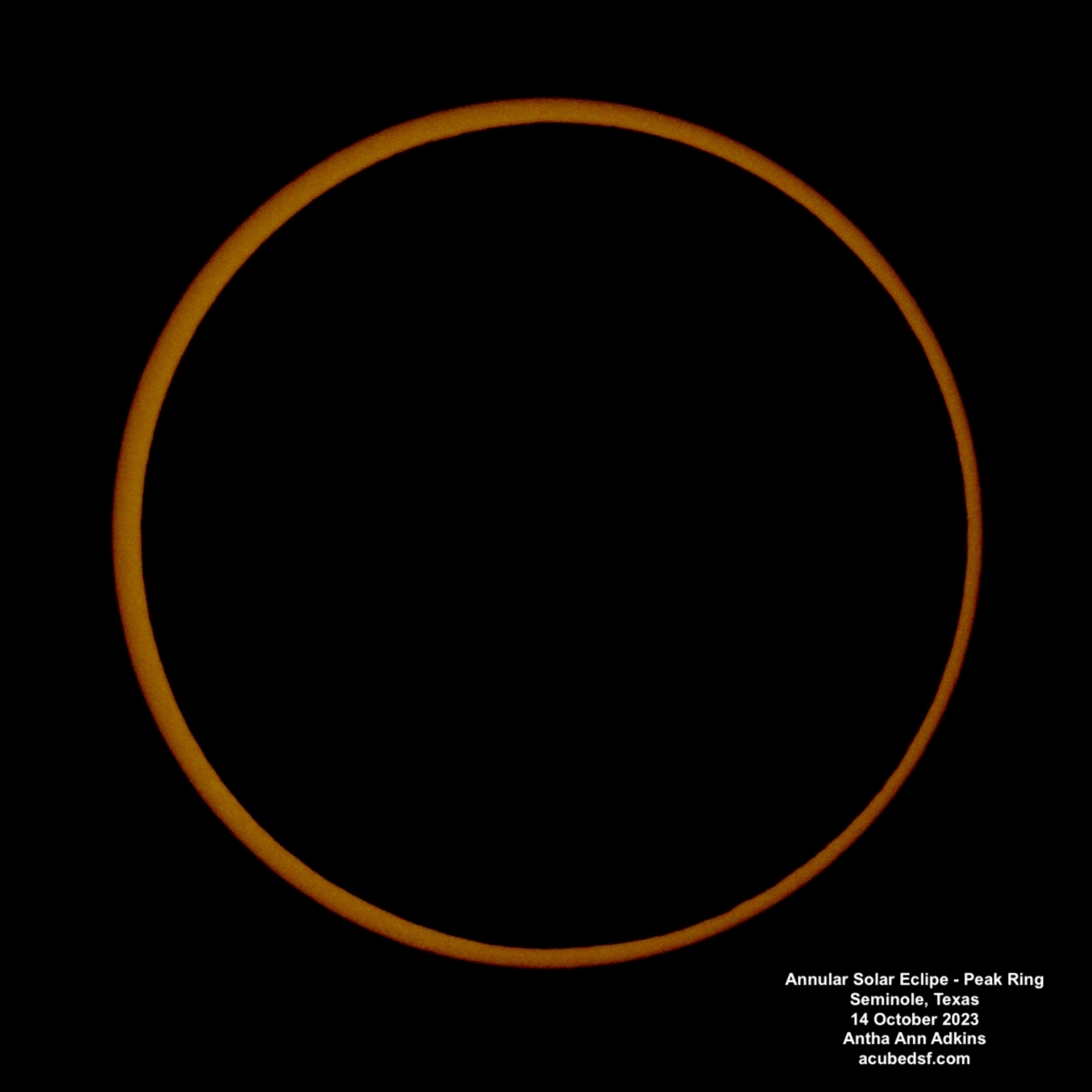
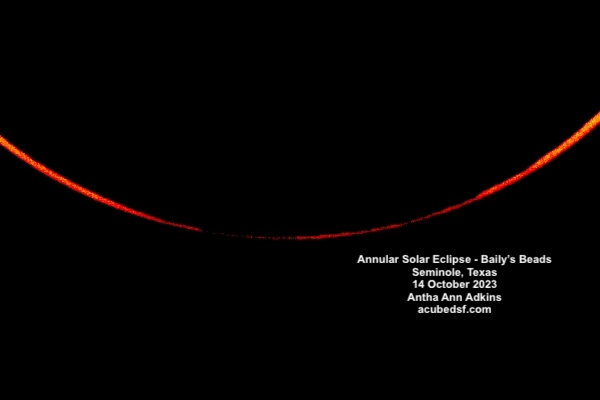
When we neared annularity, I took a bunch of extra pictures, trying to capture the Baily’s Beads effect where the Moon’s terrain breaks up the light of the sun into segments as the terrain blocks the light in some directions but not others. When we reached annularity, I also tried to get a good ring of fire picture.
With a long time for annularity (over four and a half minutes), I also spent some time looking at cool shadows and just looking (with my eclipse glasses) at the sun as an o shape. An amazing sight!
After annularity, we enjoyed seeing the sun come back out and feeling it get warm.
What a spectacular day!
Did you get to see the eclipse this year? Are you planning on seeing the total eclipse that also crosses Texas next year?
Camera geek info for solar pictures:
Canon EOS 60D in manual mode, 1/200 second exposure, ISO 100
Intervalometer
Williams Optics Zenith Star 73 III APO telescope
Williams Optics Flat 73A
Thousand Oaks optical solar filter
Sky-Watcher SolarQuest HelioFind tracking mount and tripod
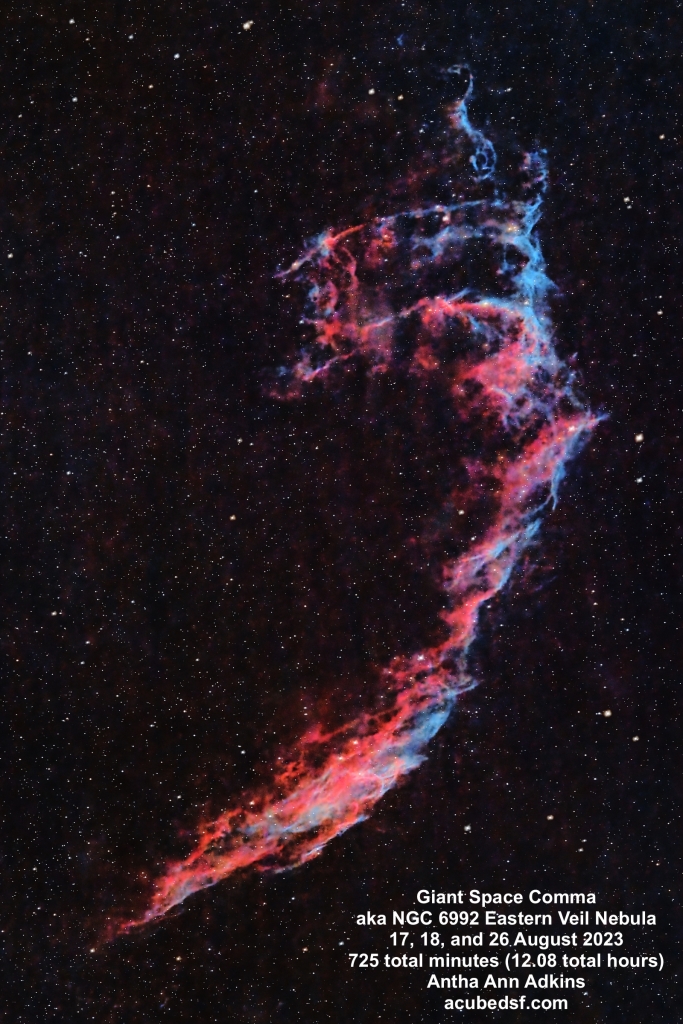
I call this picture The Giant Space Comma. It’s generally called the Eastern Veil Nebula and cataloged as Caldwell 33. It is one side of a supernova remnant called the Cygnus Loop. The supernova occurred 10,000 – 20,000 years ago, and our distant ancestors would have been able to see it in the daytime. It is 2400 light years away from us, and the whole loop has a radius of 65 light years and is expanding.
Part of the nebula looks like a cow’s head to me. Can you see it? I call it the Space Cow.
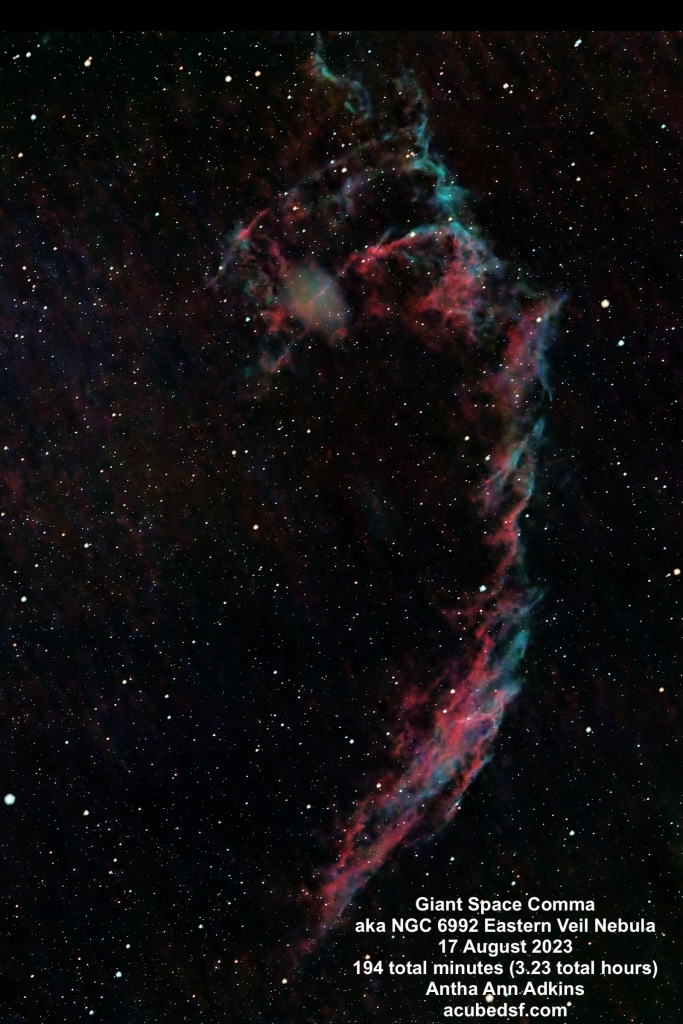
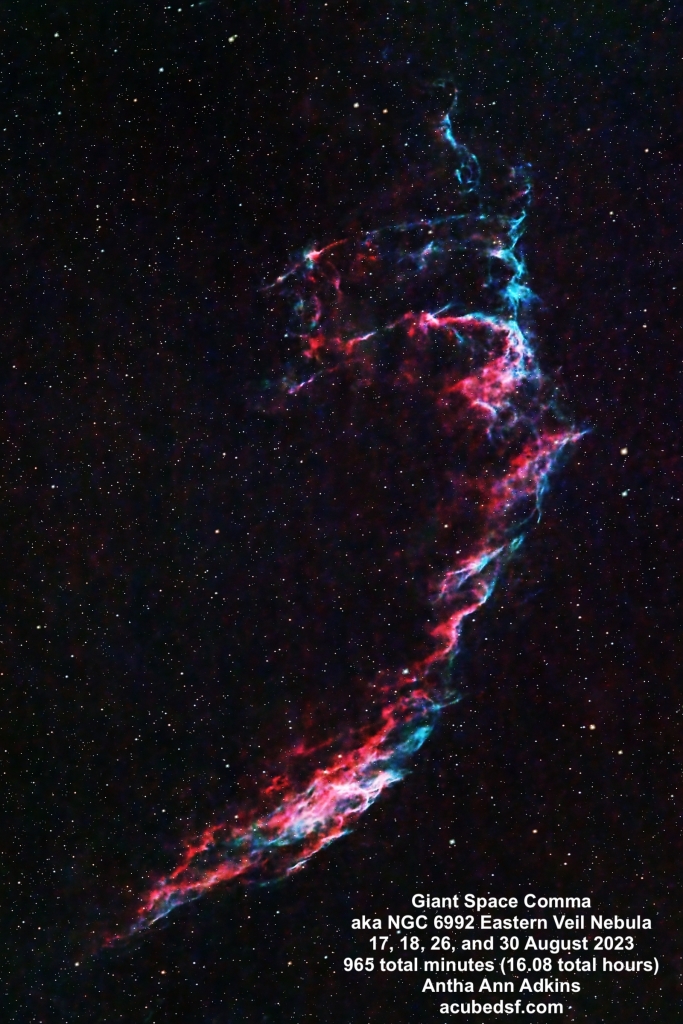
The images above show what happened as I added data to the image. The first one is my favorite version, with 3 nights and 12.1 hours of data, followed by the results from 1 night and 3.2 hours of data, the results from 2 nights and 7.45 hours of data, and 4 nights and 16.1 hours of data. Which do you like best?
I think of all the astroimages I have made so far, this one is the most amazing.
I’m looking forward to finding more cool things in the sky!
Camera geek info:
Canon EOS 60D in manual mode, 1 minute exposure, ISO 800
This is a portion of IC1318 the Gamma Cygni Nebula nicknamed the Butterfly Nebula. It’s in the constellation Cygnus beyond the star Gamma Cygni from which it gets its name. IC1318 is an emission nebula and consists of three bright areas labeled A, B, and C – the butterfly is formed by B and C (A is not in this picture). It is 3700 light years away from us and has apparent dimensions of 50 (B) and 40 (C) arcmin.
In the lower right corner of the picture is NGC6910, a cluster of stars made in this nebula. The cluster is 13 million years old.
This is 13.7 hours of data take over three nights.
As you may note from my run numbers starting at 3, my first two runs did not align well with the rest or with the nebula, so I ended up not using them. This is a tricky bit about imaging objects that are large compared to the total imaging area – the orientation of the camera and how well the imaging runs align with one another makes a difference.
For this particular image, I tried processing the nebula and stars separately, but I was not happy with the results, so I ended up processing them together.
I think the Butterfly Nebula really looks like a butterfly. How about you? But I also think I see … a dark chicken? What do you think?
Camera geek info:
Canon EOS 60D in manual mode, 1 minute exposure, ISO 800
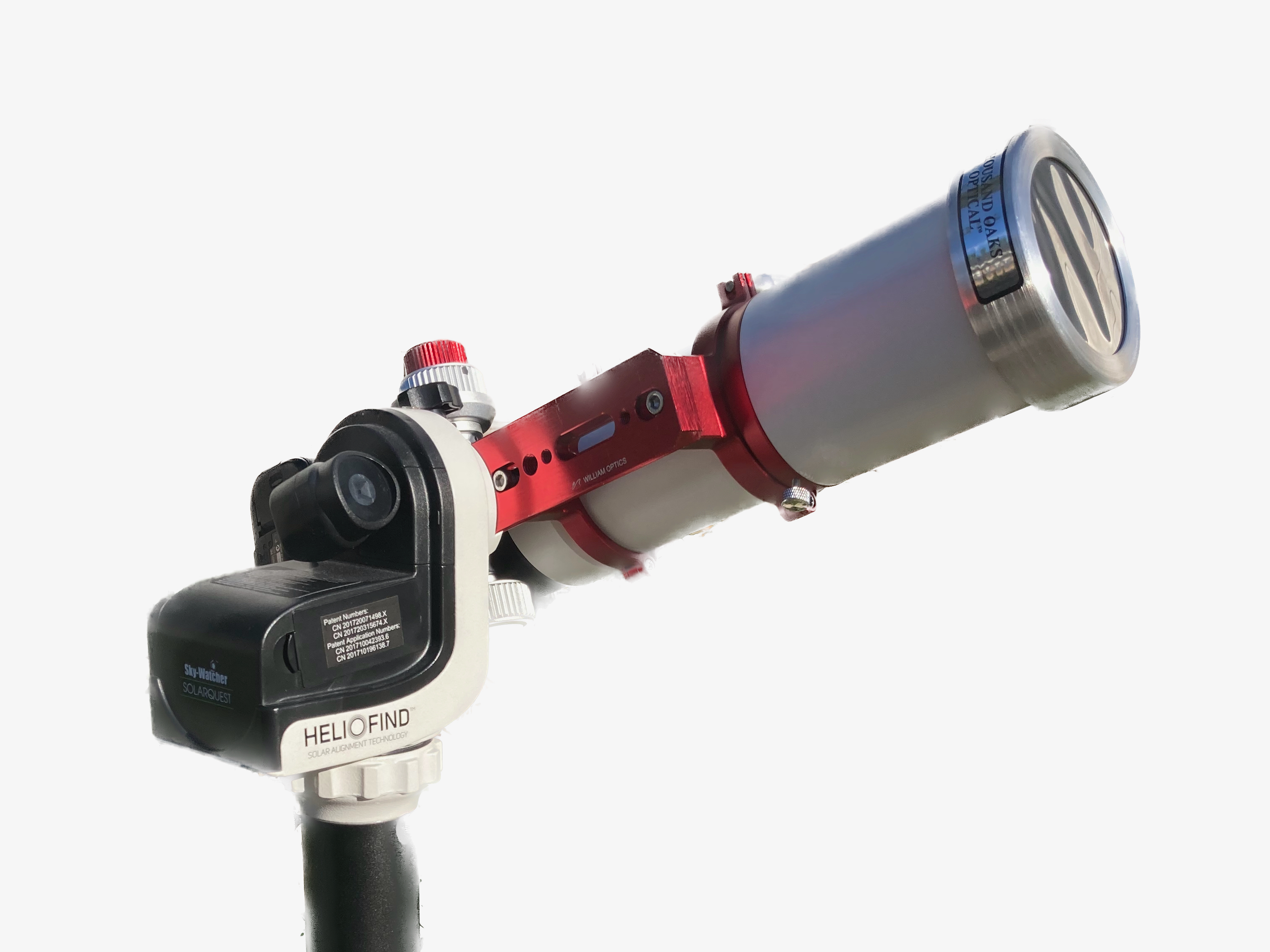
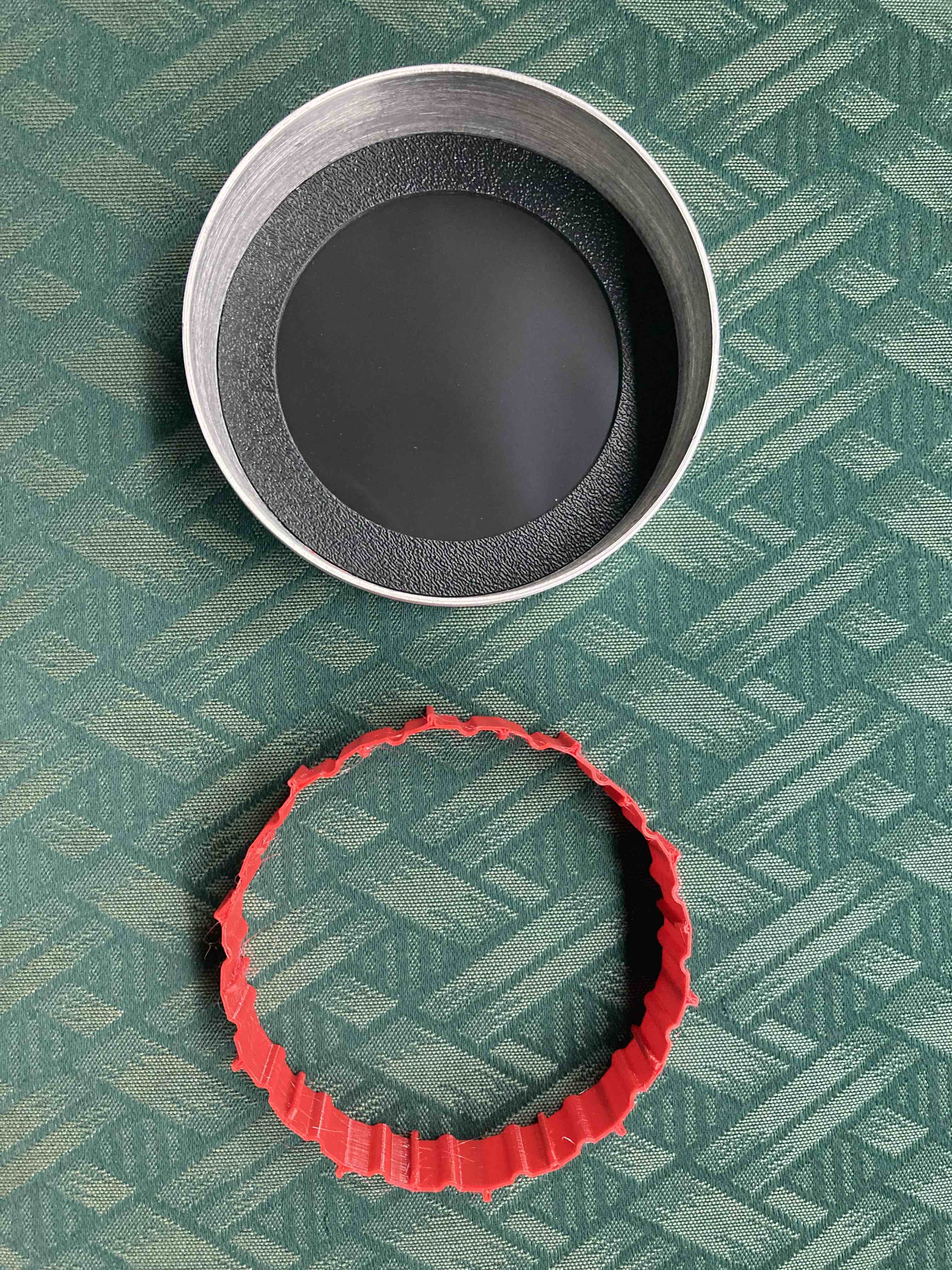
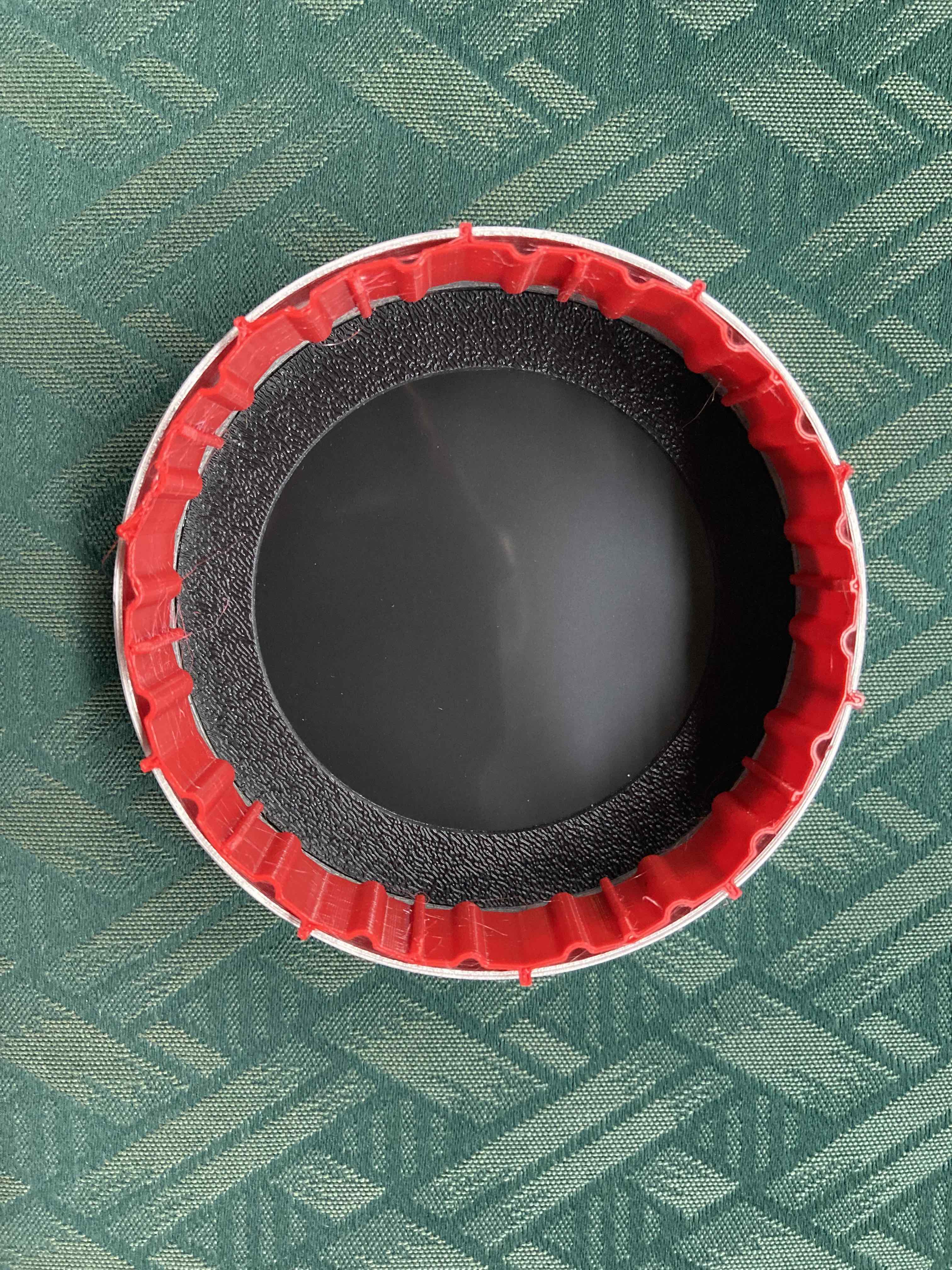
In preparation for the upcoming solar eclipse, I’ve gotten some new tools (toys). I got a solar tracking mount that tracks the sun so I don’t have to try to set up my tracking mount (which needs a view of the stars to align) in the daytime. And I got a solar filter for my telescope (this is not optional – eyeballs and optics can be destroyed without a proper solar filter). Solar filters have been hard to come by – I’ve had one the correct size on order for months – and this one was too big. But my awesome husband and his 3D printer came to the rescue! He made me a spacer to go between the solar filter and the telescope. It worked perfectly!
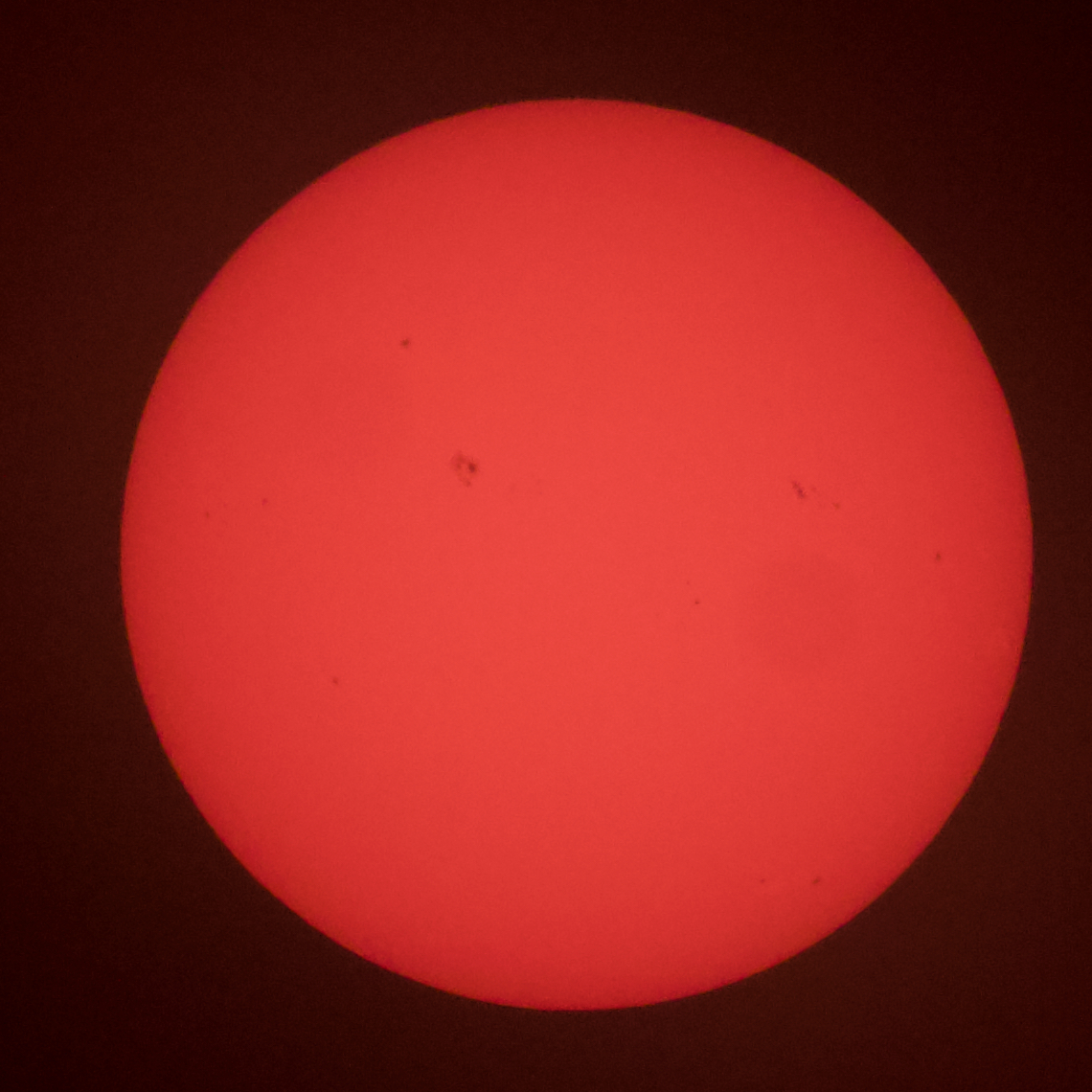
I tried a variety of settings for ISO and exposure length. This particular shot at ISO 800 with a 1/400 second exposure had the best sun spots on this particular day. It seemed like settings where ISO * exposure >= 1 worked the best.
Camera geek info:
Canon EOS 60D in manual mode, 1/400 second exposure, ISO 800
Intervalometer
Williams Optics Zenith Star 73 III APO telescope
Williams Optics Flat 73A
Thousand Oaks optical solar filter
Sky-Watcher SolarQuest HelioFind tracking mount and tripod
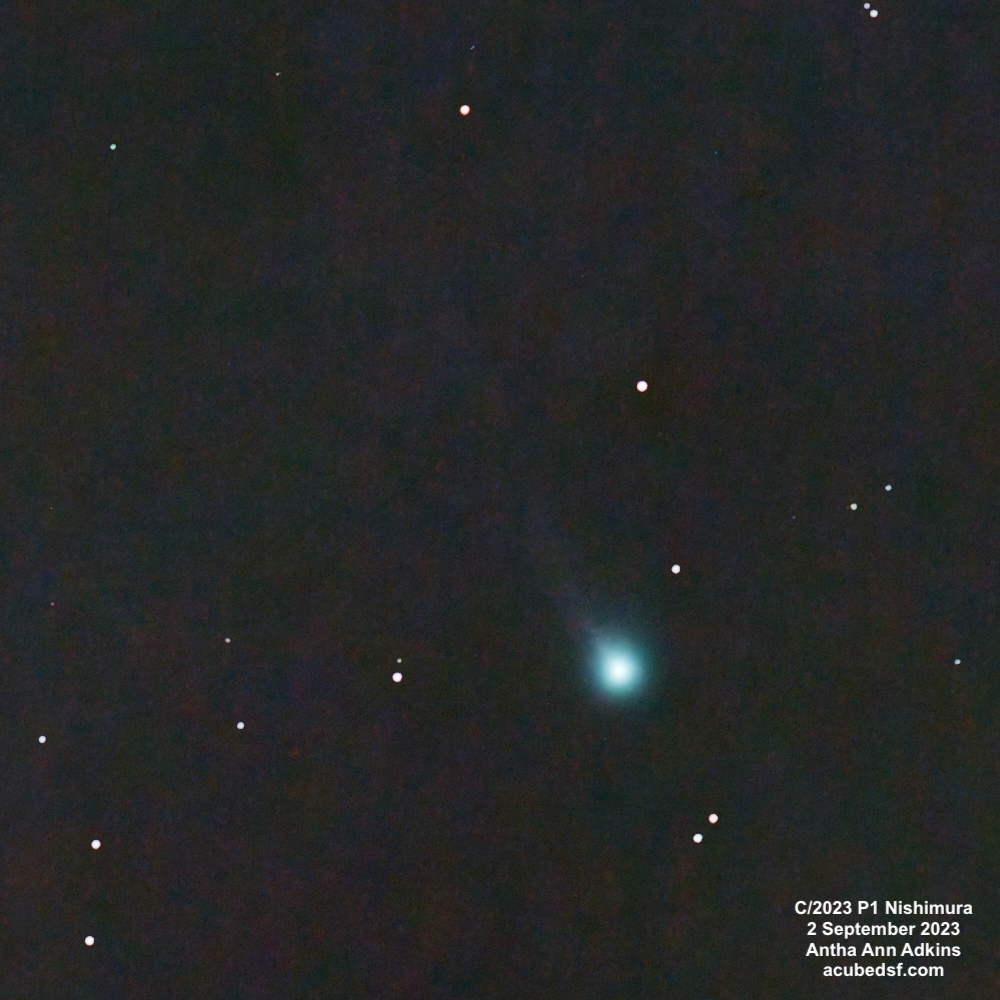
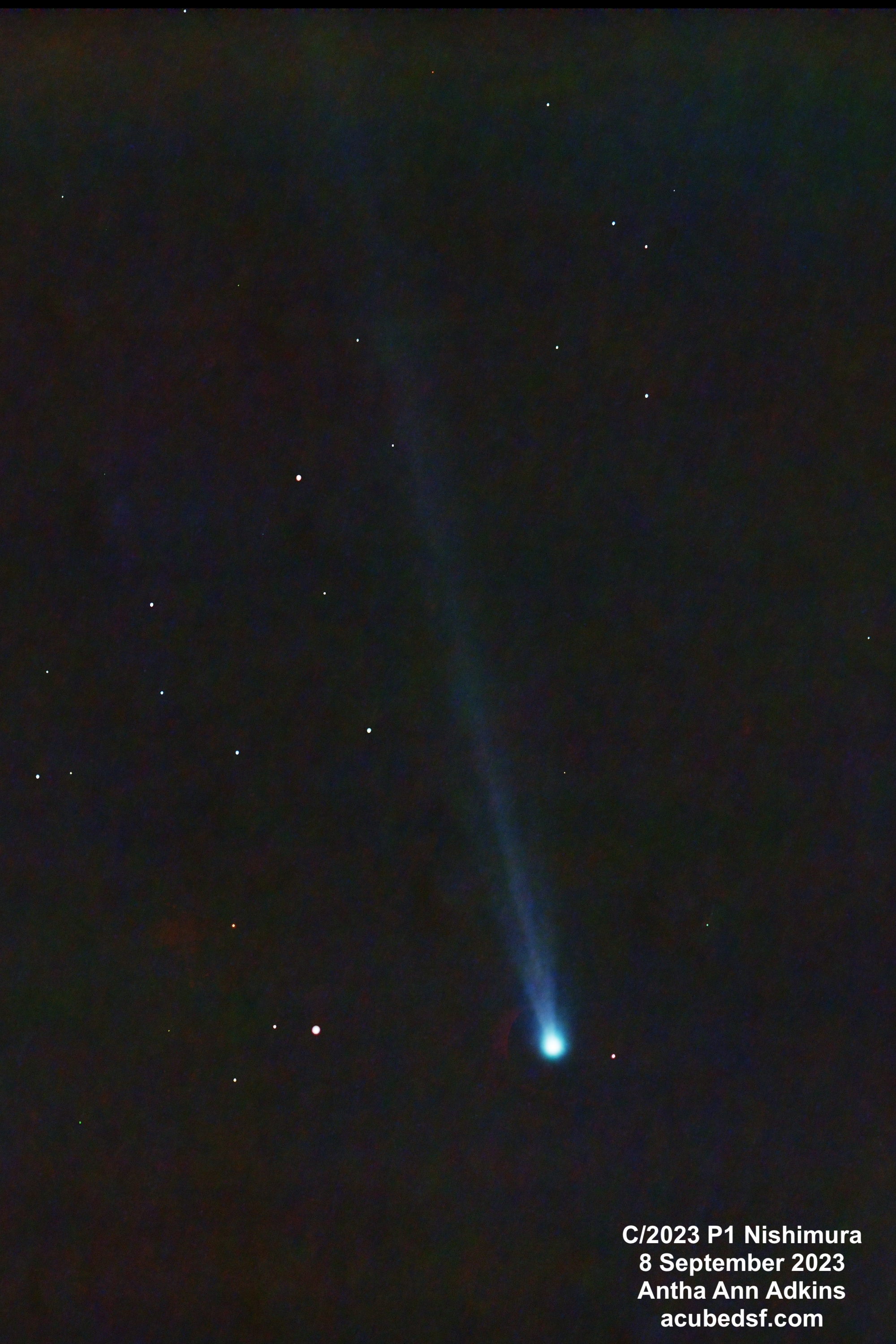
Unfortunately, I was only able to get to see Comet Nishimura twice before it got too close to the sun. But I thought it was interesting to see how much its tail had grown over a week!
Having learned how to process comets thanks to the excellent videos by Adam Block, I went back and finished processing my first image of Comet Nishimura from September 2, 2023. That morning we got up at 3:30 AM and drove over to Bacliff, Texas to get a good view to the East, and got set up. I found the comet, started taking pictures, and enjoyed watching the sunrise. As the sun rose over the flat water, we saw dolphins arcing out of the water – one of my favorite sights on the Texas Gulf Coast.
Because the September 2 images involved a compact comet with not much tail and a short range of locations and a rapidly brightening background, I modified the excellent instructions from Adam Block as follows:
Register and process images as normal (noting the reference image), then removing the comet using a circular mask that covered the first and last locations and PixelMath. I could get away with this because the comet didn’t have a large tail and hadn’t moved very far and there were no visible stars in the masked-out region. In this case, I integrated unweighted; if I were doing it again, I would use the weighting I determined below.
Run SubframeSelector to determine what parameter to weight the images with – PSF SNR seemed to best reflect the lower quality due to the sky brightening in the last images.
Run CometAlignment on the debayerd data to get comet-aligned images. Use PixelMath to make a mask to mask the comet core. Run StarXterminator to generate comet-only images. Integrate the images using PSF SNR weighting. Then post-process as normal. I could barely see the comet tail in these images and I tried a variety of stretches to try to pull it out. I ended up using STF and Histogram Transfer plus Curves.
Finally, put the stars image and the comet image back together using PixelMath.
Whew! Comet processing is a lot more complicated than galaxies and nebulae. Fun to see something new in the sky, though.
Camera geek info:
Canon EOS 60D in manual mode, 60 second exposures, ISO 800
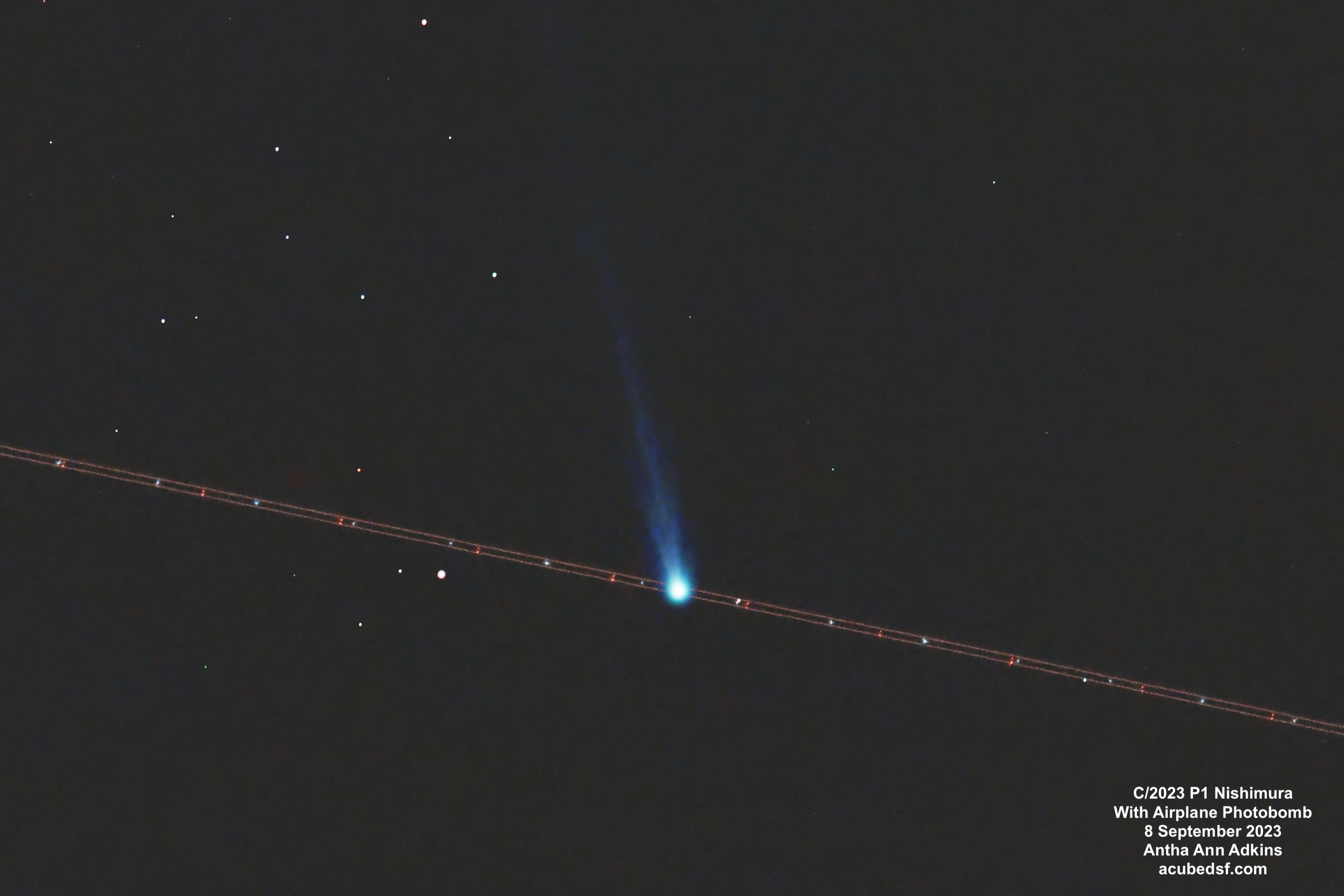
Comet C/2023 P1 Nishimura with Airplane Photobomber on September 8, 2023
For the past two weekends, we’ve gotten up at 3:30 AM to drive to a spot with a long view to the East to go comet hunting. I had setup issues with my tracking mount both times – the GoTo tracking did not want to three star align. On both days, I managed to overcome that obstacle in time to capture some images of the comet. On September 8, the time frame between when the comet cleared the haze on the horizon and the time that the sky got bright pre-dawn was surprisingly short (about 20 minutes). Also on September 8, I had a funny picture where an airplane had photobombed my comet image and flew right in front of the comet.
Astrophotography is really two hobbies: capturing the images and processing them.
And I still haven’t mastered processing comets.
But thanks to the excellent videos from Adam Block and a software update on Russ Croman’s extremely useful StarXterminator program (where my Comet Nishimura data from September 2 appears in the releasenotes), I have finally managed to produce some decent comet pictures. I registered all the images with the one with the airplane photobomb so I could combine the final comet image with the airplane lights to make a photobomb picture.
It’s fun to find surprises in the night sky!
Camera geek info:
Canon EOS 60D in manual mode, 30 second exposures, ISO 800 for 4 frames, ISO 400 for the remainder










 Space&Aliens