Moon and Venus

MoonAndVenus20180615

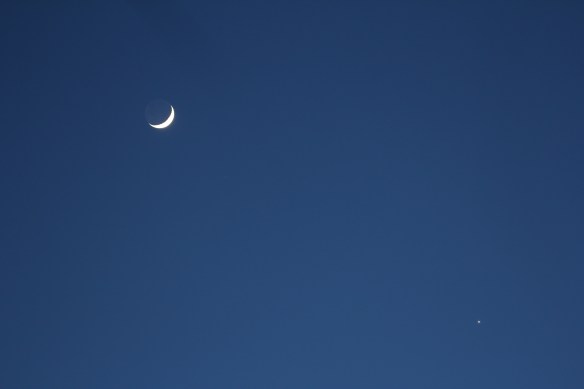
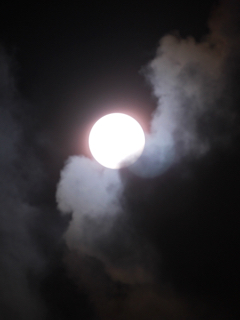
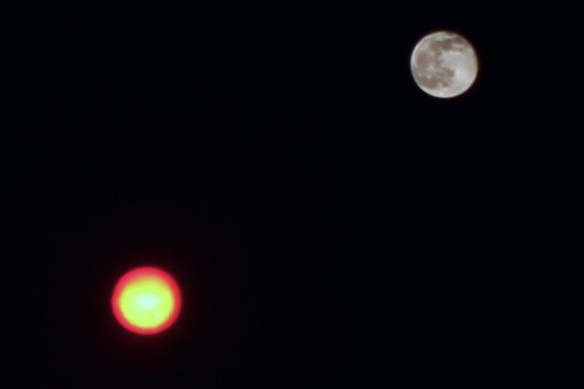
Last night, as we exited the movie theater, we saw a beautiful conjunction of the Moon and Venus, with a bright Venus floating above a crescent moon.  The cell phone pictures did not do it justice, nor did my hastily set up picture shot from the car window.

MoonAndVenus20180616

So I prepared to take pictures tonight.  The Moon had moved!  Still a beautiful conjunction, yes?

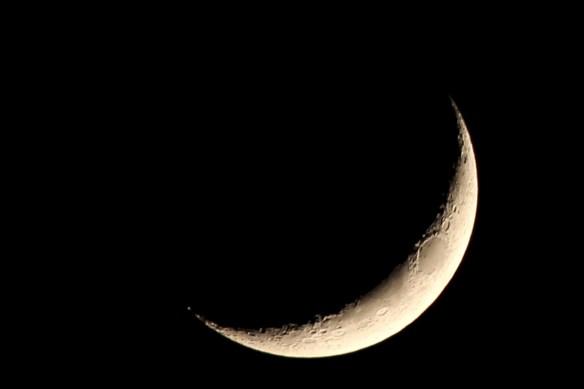
Moon20180616

And since I had the tripod set up, I captured a picture of the Moon as well.  It would be fun to explore its cratered surface.

Camera geek info:

Moon and Venus 6/15/18

  •             Canon EOS 60D in manual mode set at f/4, 1/25 second exposure, ISO 800
  •             Canon EF 70-300mm f/4-5.6L IS USM lens, set at 70 mm, autofocus on moon

Moon and Venus 6/16/18

  •             Canon EOS 60D in manual mode set at f/4.5, 1/5 second exposure, ISO 320
  •             Canon EF 70-300mm f/4-5.6L IS USM lens, set at 112 mm, manual focus on moon
  •             Tripod

Moon 6/16/18

  •             Canon EOS 60D in manual mode set at f/5.6, 1/60 second exposure, ISO 320
  •             Canon EF 70-300mm f/4-5.6L IS USM lens, set at 300 mm, manual focus on moon, IS off
  •             Tripod

Northern Lights, Inverness, Scotland, 3 AM

Whenever I am north, I always check two things: what is the geomagnetic activity and is the sky dark and clear?

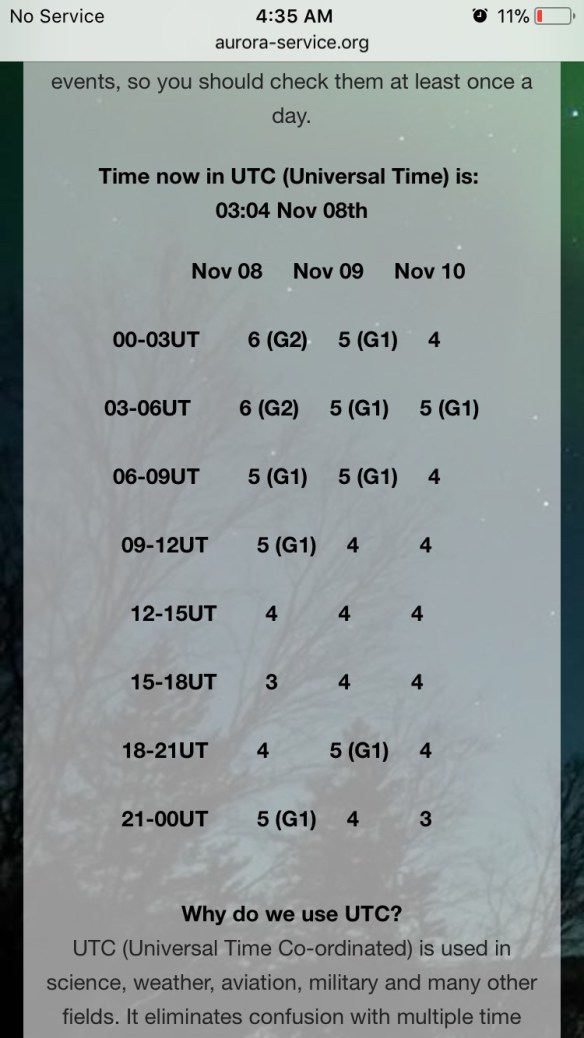
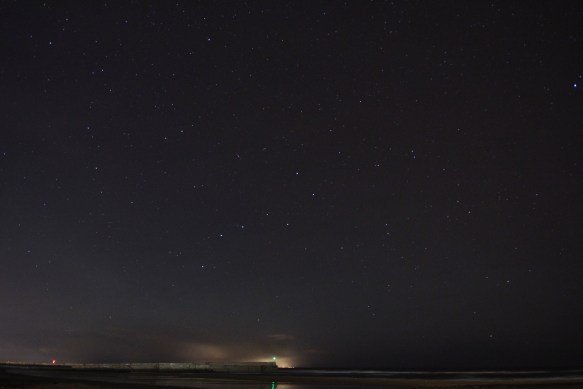
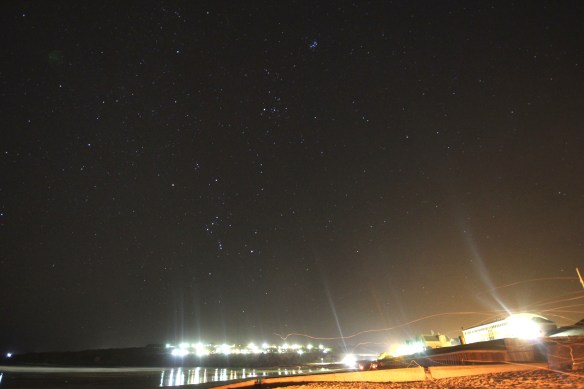
We were in Scotland last week visiting our son and travelled to Inverness to see the sights up there. We scouted out a good aurora viewing spot (on the 5th floor of a parking garage) just in case. The sky was clear. I knew the geomagnetic activity would need to be at least kp 5 to have a chance of seeing anything, especially from the city. I set my alarm for 3 AM because that was when the predictions said we might have enough activity. I checked the aurora web site and saw this:

AuroraPredict20171108

Geomagnetic activity above kp 6! A G2 geomagnetic storm!

It was cold, but we went outside. It looked like there was a green glow around the moon.

I had my tiny travel tripod, and it did not reach high enough to see the horizon over the parking garage walls. But there was a handy grit container that I could put the tripod over to see over the wall.

I had read that unless you are very far north, the lights are not overhead but on the horizon, so I aimed my camera at the northern horizon.

Originally, the light was dim, but then it got brighter and it was green and it moved! What a treat! Then it went away, and it was time to get out of the cold and get a little more sleep before our tour in the morning.

Unfortunately, we did not get to see the Northern Lights again on this trip.  I hope to see them again sometime in the future!

Camera geek info:

Canon EOS 60D in manual mode set at f/5.6, 8 second exposure, ISO 1250

Sigma 10-20mm f/4-5.6 lens, set at 10 mm, manual focus at infinity

Tripod

Cable release

Movie geek info:

Pictures cropped to use lower right quarter

Title screen 2 sec, other pictures 0.5 sec


Total Solar Eclipse – St. Joseph, MO

Our original plan was to drive to Missouri, visit family, and see the total solar eclipse from Rosecrans Memorial Airport in St. Joseph, MO. When we left home, the weather was predicted to be clear, but that grew worse as we travelled north. By the night before the eclipse, the weather was predicted to be partly cloudy at best, thunderstorms at worst. However, since none of the other local weather looked to be any better, we decided to stick to our original plan.

As we drove to the site, the clouds grew worse, but the traffic was not the expected carpocalypse.

The site had everyone parked in a field in a giant astronomy tailgate party. It was cloudy, but we were hopeful.

Here I am, ready to look at the sun.
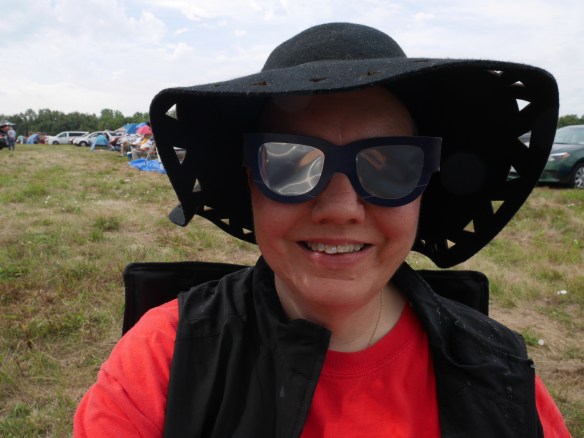
EclipseSelfie

Camera geek info:

  •             Panasonic DMC-GF7 set at f/11, 1/125 second exposure, ISO 200
  •             LUMIX G VARIO 12-32/F3.5-5.6, set at 12 mm

Here’s what the site looked like.
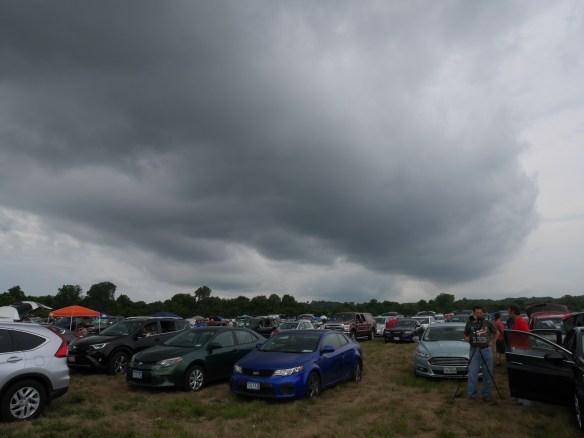
EclipseClouds20170821-1108

Camera geek info:

  •             Panasonic DMC-GF7 set at f/11, 1/320 second exposure, ISO 200
  •             LUMIX G VARIO 12-32/F3.5-5.6, set at 12 mm

I set up my camera and tried to get a picture of the sun through the clouds. With the solar glasses on, I could see the sun, but not the camera. I tried to use live view to find the sun and focus so I wouldn’t be looking at the sun through the lens. Turns out, it was difficult to aim the camera with the telephoto lens at the sun with the solar filter on it using live view. I ended up using my wider angle lens to find the sun with live view and then switching.

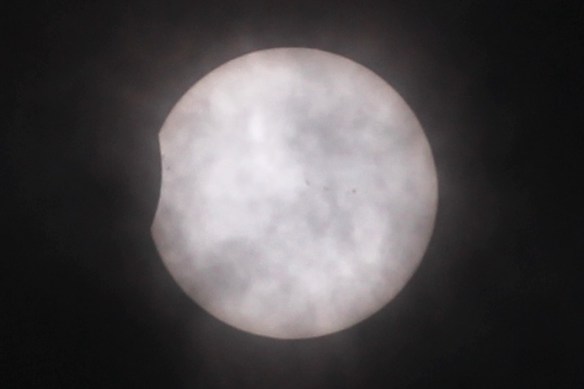
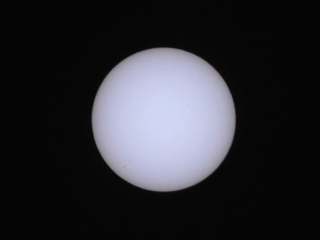
Before the eclipse started, I was able to get a picture of the sun with its sunspots.
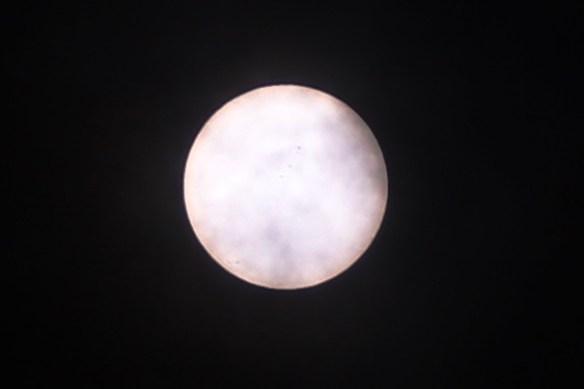
TotalEclipse20170821-1124

Time: 11:24

Camera geek info:

  •             Canon EOS 60D in manual mode set at f/4, 1/250 second exposure, ISO 100
  •             Canon EF 70 – 200 mm f/4L lens, set at 98 mm, manual focus at infinity
  •             Tripod
  •             Cable release
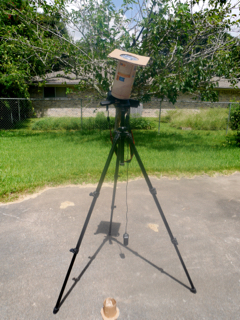
  •             Homemade Baader Solar Film solar filter

Then it rained. The camera gear and I sheltered in the car.

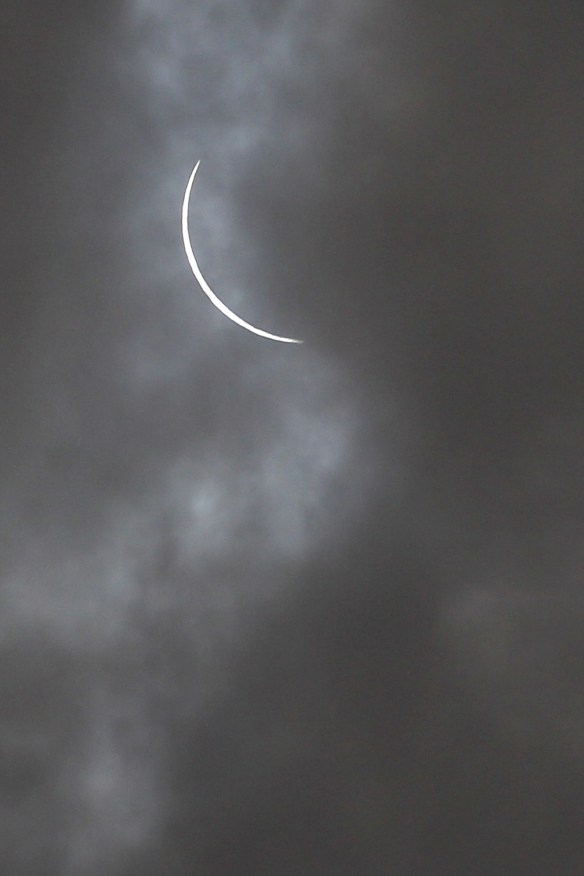
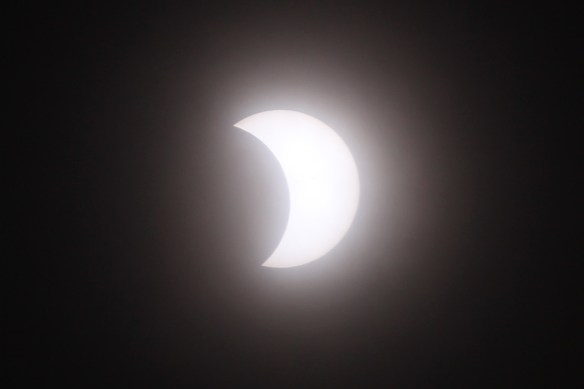
As the eclipse started, I was able to get another set of pictures of the sun as it went in and out of the clouds.
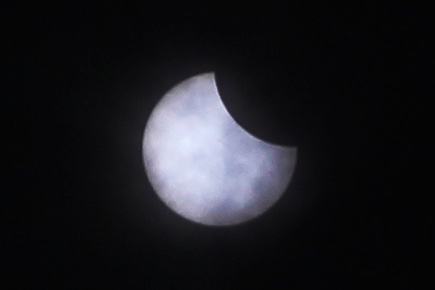
TotalEclipse20170821-1205

Time: 12:05

Camera geek info:

  •             Canon EOS 60D in manual mode set at f/4, 1/250 second exposure, ISO 100
  •             Canon EF 70 – 200 mm f/4L lens, set at 70 mm, manual focus at infinity
  •             Tripod
  •             Cable release
  •             Homemade Baader Solar Film solar filter

Then it rained.

The clouds looked angry, like aliens swarming in the sky.

Camera geek info:

  •             Canon EOS 60D in manual mode set at f/4, 1/160 second exposure, ISO 100
  •             Sigma 24-70mm f/2.8 EX lens, set at 24 mm, autofocus

Then it rained again, harder, with thunder. A lot of people started leaving. With totality a half hour away, I thought they’d just end up sitting in traffic and wouldn’t get anywhere better. We stayed. I hoped that the rain would clear enough of the cloud cover that we’d get another view of the sun.

When it stopped raining, I got out of the car.

An exclamation rose up from the crowd around me. Up in the sky, a tiny sliver of sun was visible through the clouds.
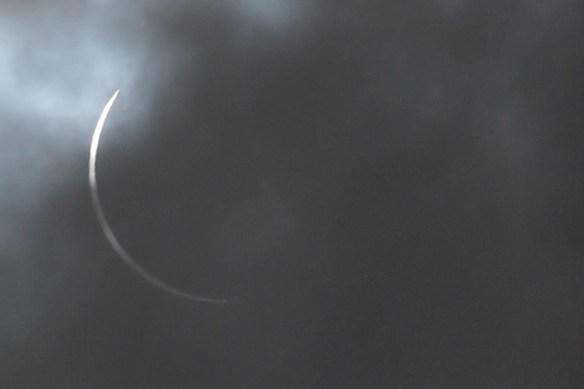
TotalEclipse20170821-1303

Time: 13:03

TotalEclipse20170821-1304

Time: 13:04

Camera geek info:

  •             Canon EOS 60D in manual mode set at f/4, 1/160 second exposure, ISO 100
  •             Canon EF 70 – 200 mm f/4L lens, set at 200 mm, autofocus

The sliver went in and out of the clouds.

Then it got dark. And I said, “whoa!” Then it got darker. “Wow!” Then it got as dark as night. “Amazing!!!!!”

For over two and a half minutes, we had darkness in the daytime. But the horizon was a sunset in every direction. In one direction I could see a pink and orange cloud with rain streaking down from it in the sunset, with black overhead and black below. Where we were, it was dark.

I spent some time with my mouth gaping open, admiring the sight.

My pictures of the sunset do not do it justice, as the camera was still set for taking pictures of the sun.
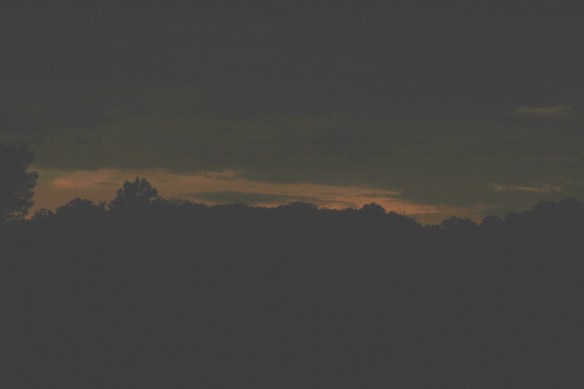
EclipseSunset

Camera geek info:

  •             Canon EOS 60D in manual mode set at f/4, 1/160 second exposure, ISO 100
  •             Canon EF 70 – 200 mm f/4L lens, set at 188 mm, autofocus

Then, after two and a half minutes of darkness, the sun returned. People on the field cheered. People on the bluff set off fireworks.
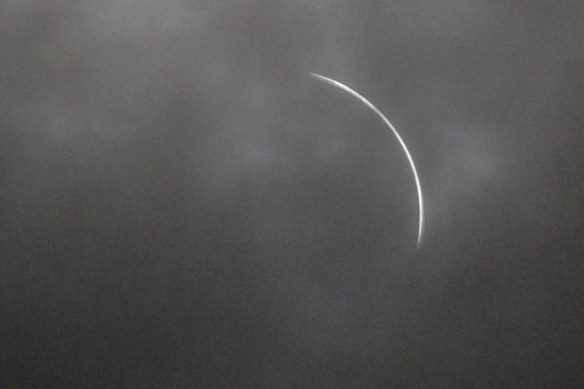
TotalEclipse20170821-1309

Time: 13:09

Camera geek info:

  •             Canon EOS 60D in manual mode set at f/4, 1/25 second exposure, ISO 100
  •             Canon EF 70 – 200 mm f/4L lens, set at 200 mm, autofocus
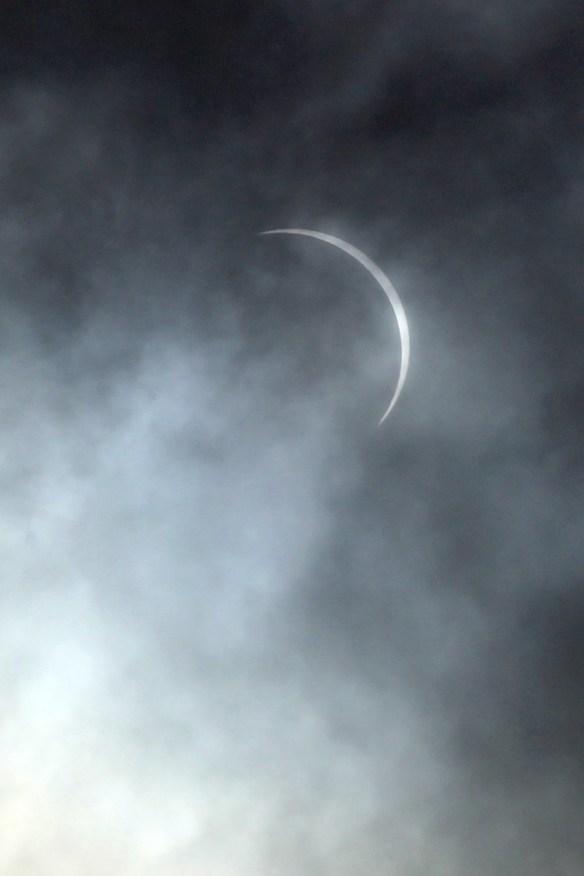
TotalEclipse20170821-1312

Time: 13:12

Camera geek info:

  •             Canon EOS 60D in manual mode set at f/4, 1/400 second exposure, ISO 100
  •             Canon EF 70 – 200 mm f/4L lens, set at 172 mm, autofocus

As the moon slowly uncovered the sun, the clouds drifted away.
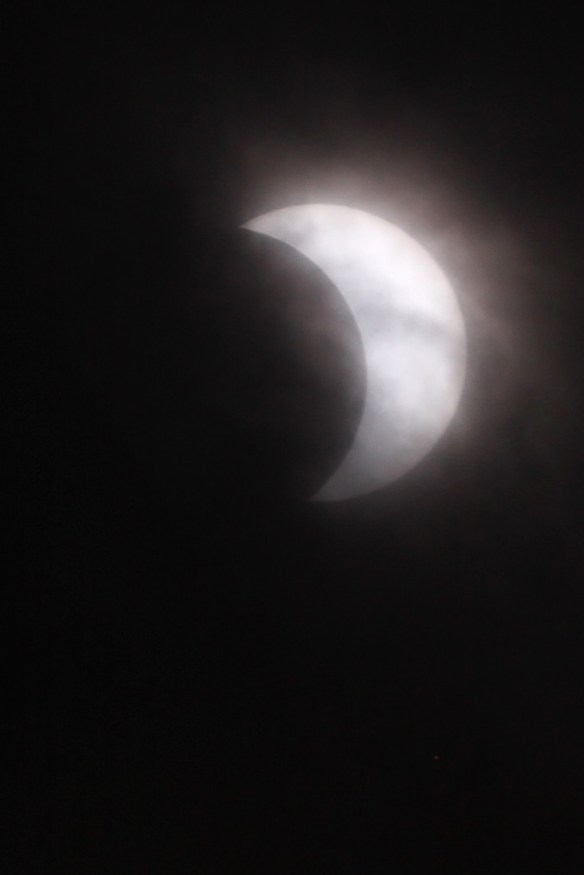
TotalEclipse20170821-1338

Time: 13:38

TotalEclipse20170821-1347

Time: 13:47

Camera geek info:

  •             Canon EOS 60D in manual mode set at f/4, 1/100 second exposure, ISO 100
  •             Canon EF 70 – 200 mm f/4L lens, set at 163 mm, manual focus at infinity
  •             Tripod
  •             Cable release
  •             Homemade Baader Solar Film solar filter
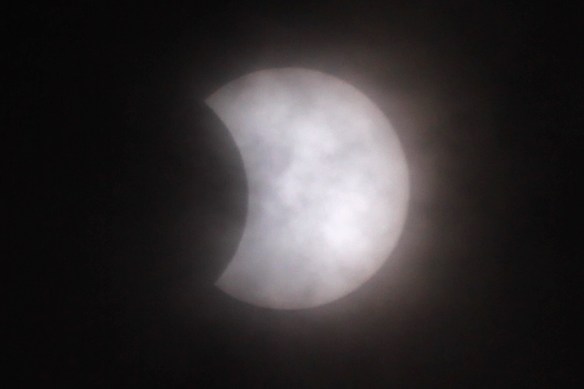
TotalEclipse20170821-1405

Time: 14:05

Camera geek info:

  •             Canon EOS 60D in manual mode set at f/4, 1/200 second exposure, ISO 100
  •             Canon EF 70 – 200 mm f/4L lens, set at 163 mm, manual focus at infinity
  •             Tripod
  •             Cable release
  •             Homemade Baader Solar Film solar filter
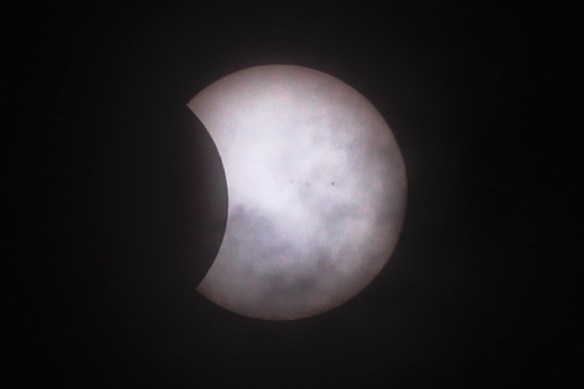
TotalEclipse20170821-1408

Time: 14:08

Note that the sunspots have rotated from their position before the eclipse!

Camera geek info:

  •             Canon EOS 60D in manual mode set at f/8, 1/200 second exposure, ISO 100
  •             Canon EF 70 – 200 mm f/4L lens, set at 163 mm, manual focus at infinity
  •             Tripod
  •             Cable release
  •             Homemade Baader Solar Film solar filter
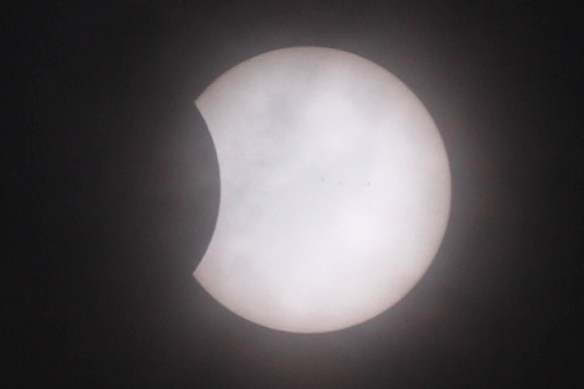
TotalEclipse20170821-1417

Time: 14:17

TotalEclipse20170821-1429

Time: 14:29

Camera geek info:

  •             Canon EOS 60D in manual mode set at f/5, 1/200 second exposure, ISO 100
  •             Canon EF 70 – 200 mm f/4L lens, set at 163 mm, manual focus at infinity
  •             Tripod
  •             Cable release
  •             Homemade Baader Solar Film solar filter

I have enough pictures of the second half of the eclipse that I may try to make a time-lapse movie of it.

Note that all of these pictures were taken through clouds, and even with that, the pictures at the end were overexposed, and I could not see the sunspots. For a cloudless day, I’d want to use a much faster shutter speed. And remember to zoom the telephoto lens all the way out. LOL.

In spite of the clouds, experiencing totality was nothing short of amazing. I would not trade my cloudy totality for someone else’s sunny 98%. I look forward to trying this again when the next US total solar eclipse occurs over my home state of Texas!
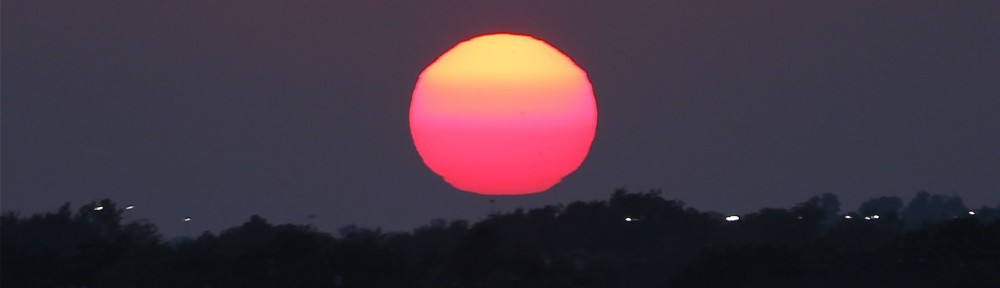
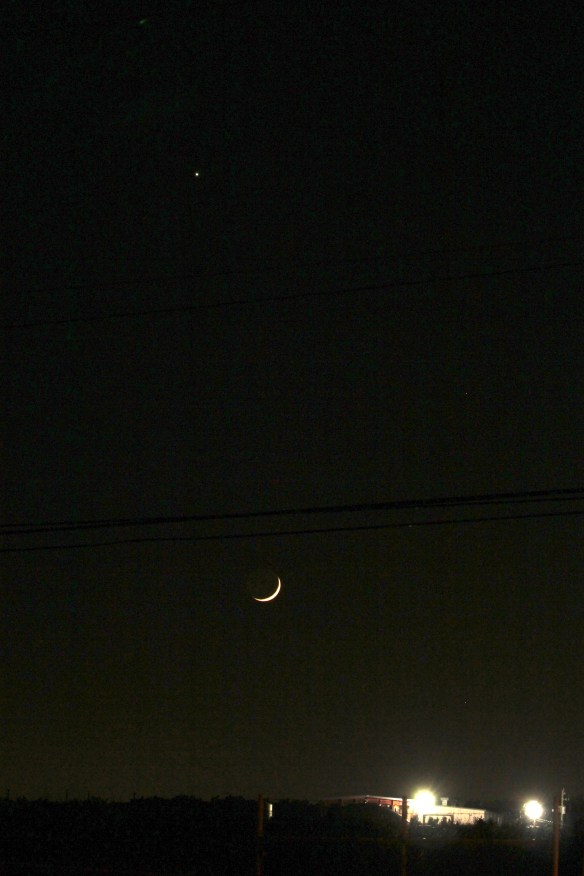
Scorpio with Planets

Scorpio20160808

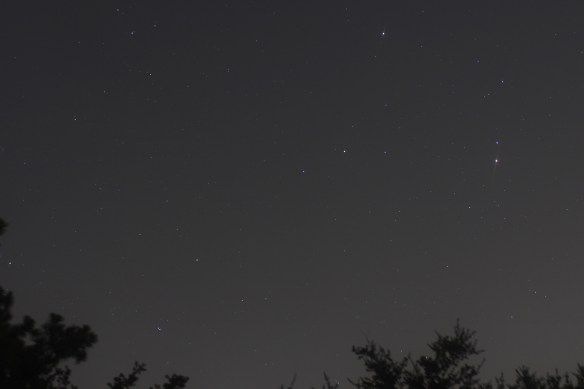
Well, it’s hotter ‘n hell and the tree frogs are singing, so it must be time for … goin’ outside and doin’ some astrophotography! Because, seriously, this view of Scorpio with Mars and Saturn is beautiful. Go out and take a look!

Camera geek info:

Canon EOS 60D in manual mode set at f/2.8, 30 second exposure, ISO 100
Sigma 24-70mm f/2.8 EX lens, set at 34 mm, manual focus at infinity
iOptron SkyTracker with ballhead
Tripod

Driving Home From My Daughter’s Graduation

MoonAndStoplight20160522

I was happily driving home from my daughter’s high school graduation, loaded with camera gear, and I spotted this interesting juxtaposition of the Moon and a stoplight. Of course, I took a picture. And, for the first time in years, I decided to write a poem.

Driving Home From My Daughter’s Graduation

Stopped at a red light
I think of daughter’s future
Brighter than the moon

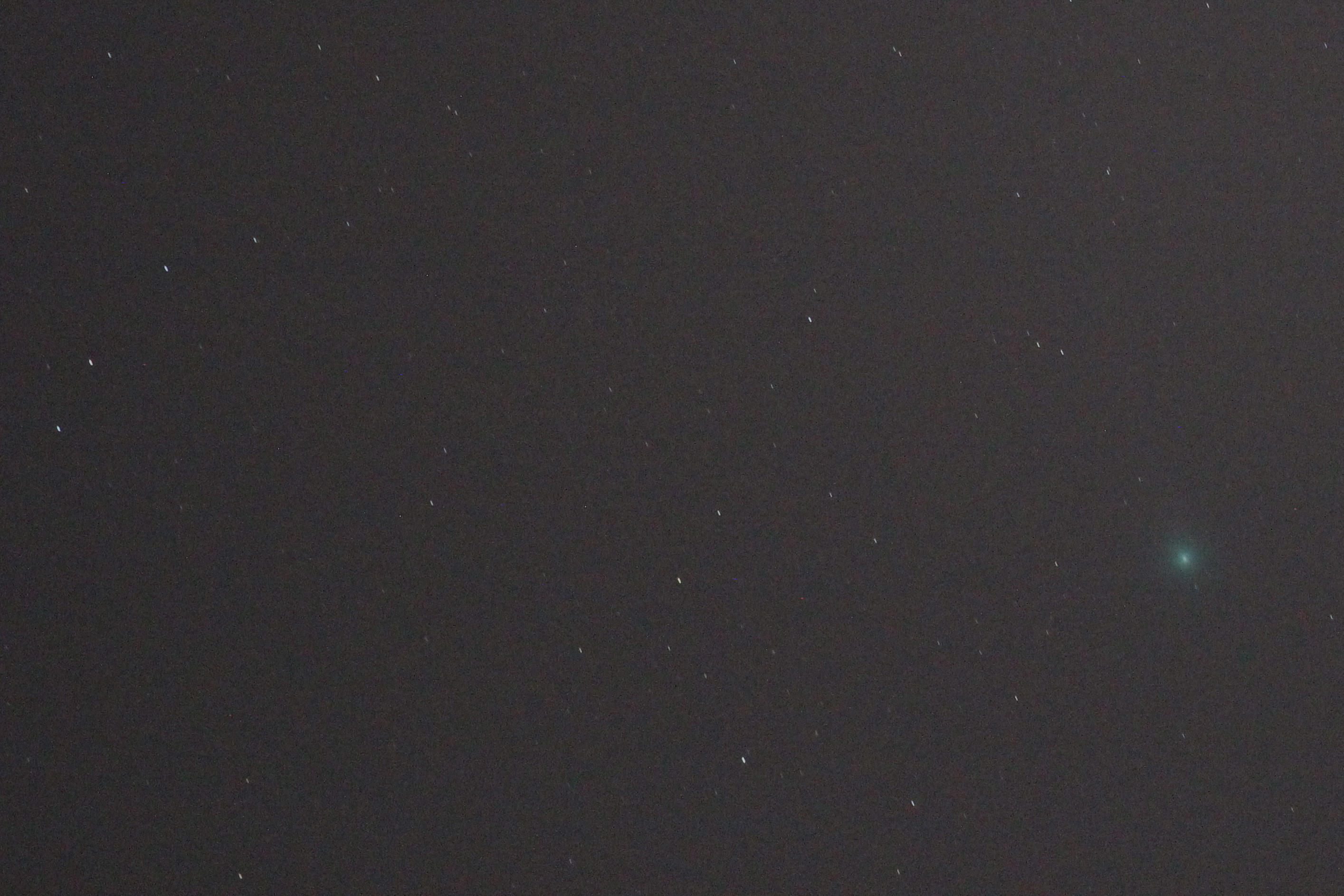
Comet Catalina

CometCatalina20160118

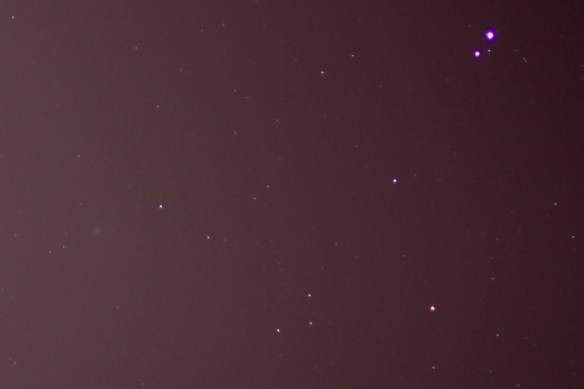
Can you spot the comet?  (Hint: it’s kinda green.  And kinda fuzzy.)

I braved the cold last night to play with a new toy: an iOptron SkyTracker. It’s a camera mount that tracks the rotation of the sky so you can take longer exposure pictures. Neat!

I have a sky-tracking telescope, but I rarely get it out because it is so heavy and hard to move. The SkyTracker is extremely portable and I expect I’ll be getting it out a lot more.

This was my first night out with it, and I must admit I hadn’t practiced using it, so I don’t think I had it set up as well as I could. Even with my poor setup, I could take 30 second exposures with no star trails. And with a low ISO, I got some nice colors.

I’m hoping for clear skies tonight so I can get it out again.

Camera geek info:

Canon EOS 60D in manual mode set at f/1.8, 30 second exposure, ISO 100

Canon EF 85 mm f/1.8 lens, manual focus at infinity

iOptron SkyTracker with ballhead

Tripod

Comet Lovejoy and the Pleiades

Comet Lovejoy and the Pleiades

CometLovejoyPleiades20150118

Comet Lovejoy – Change in Position in One Day

CometLovejoy20150118

CometLovejoy20150119

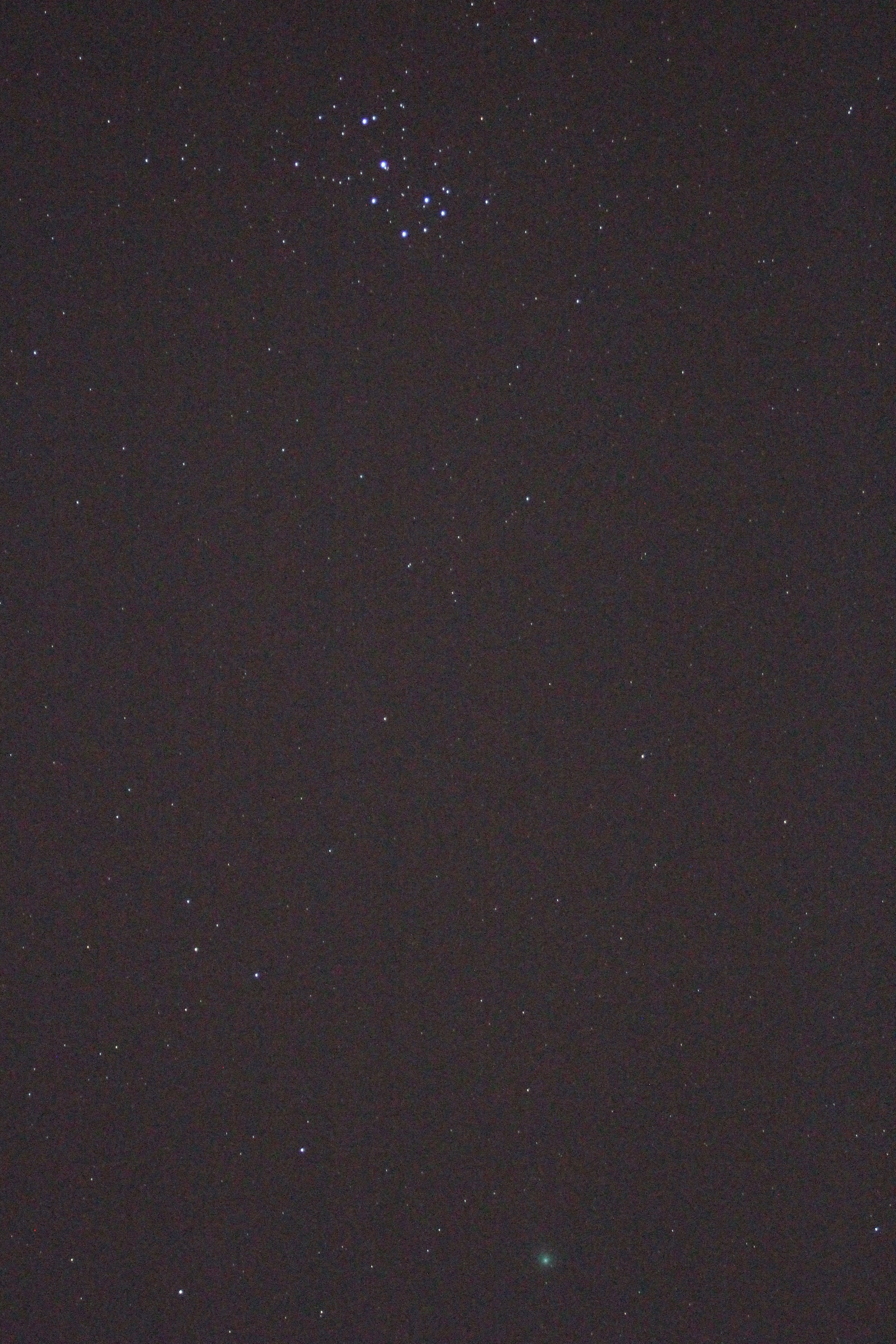
Sunday and Monday evening it was clear, so it was time to find Comet Lovejoy again. This time it was near the beautiful Pleiades. Of course, that is worth a picture.

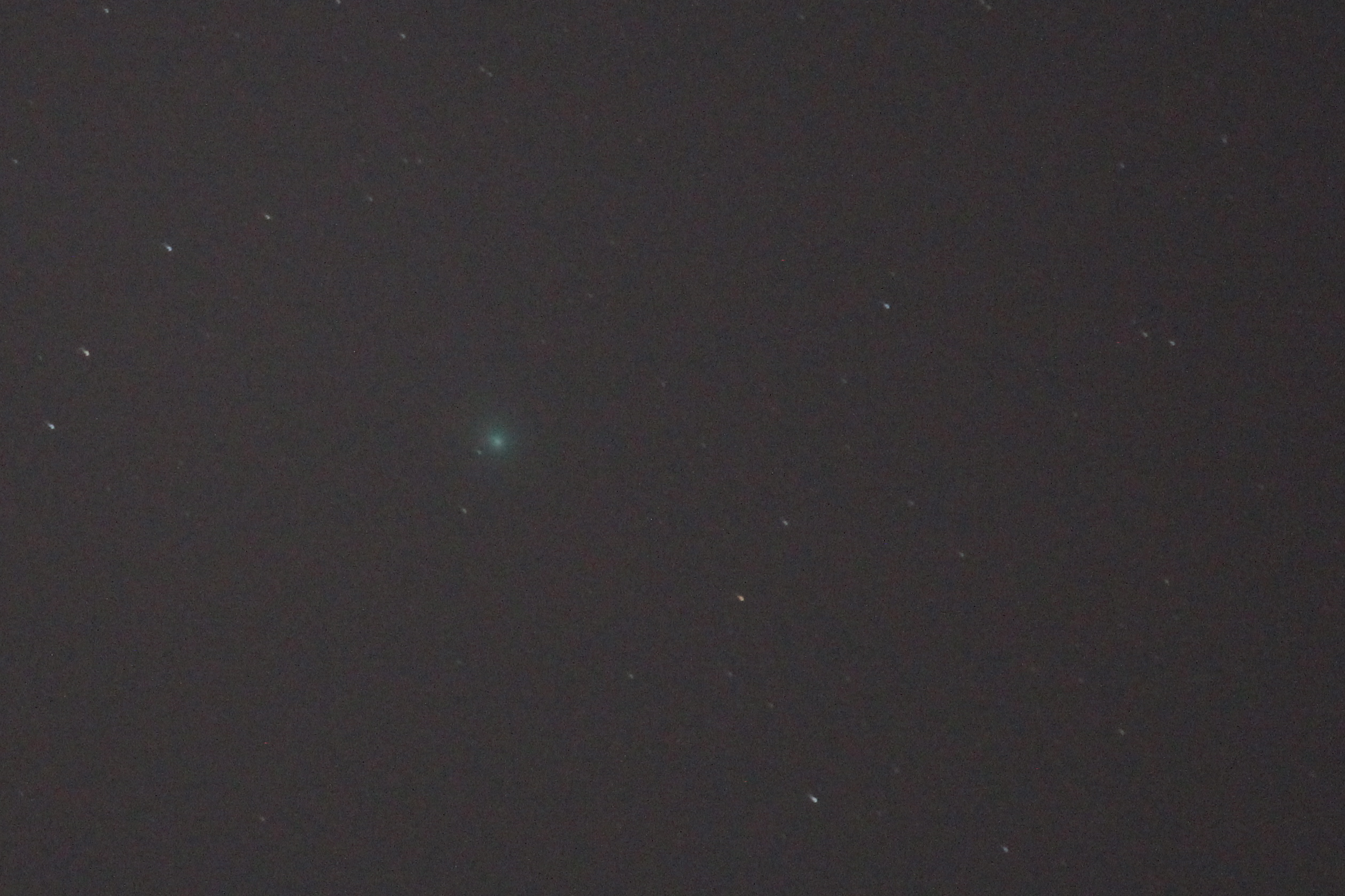
I thought it would also be fun to see how much the comet had moved over one day – the change is quite visible. I was hoping to go for a three-day comparison, but now it’s cloudy again.

Camera geek info:

  •            Canon EOS 60D in manual mode set at f/4.0, 3.2 second exposure, ISO 6400
  •            Canon EF 70 – 200 mm f/4L lens, set at 94 mm for Pleiades and comet and 200 mm for comet, manual focus at infinity
  •            Tripod
  •            Cable release

In choosing which picture is the best, I find that I am using the following criteria: good focus (automatic toss for out of focus picture unless happen upon cool “artistic” effect), no visible star trails (stars should look like a point, not a line), visibility of comet, color of objects, color of sky, and noise of sky. While I have pictures with darker, less noisy sky, they don’t show the comet as well.

I am also finding that the image quality is far better when I zoom to my desired field of view instead of cropping in post-processing to get there.

Astrophotography – Planets

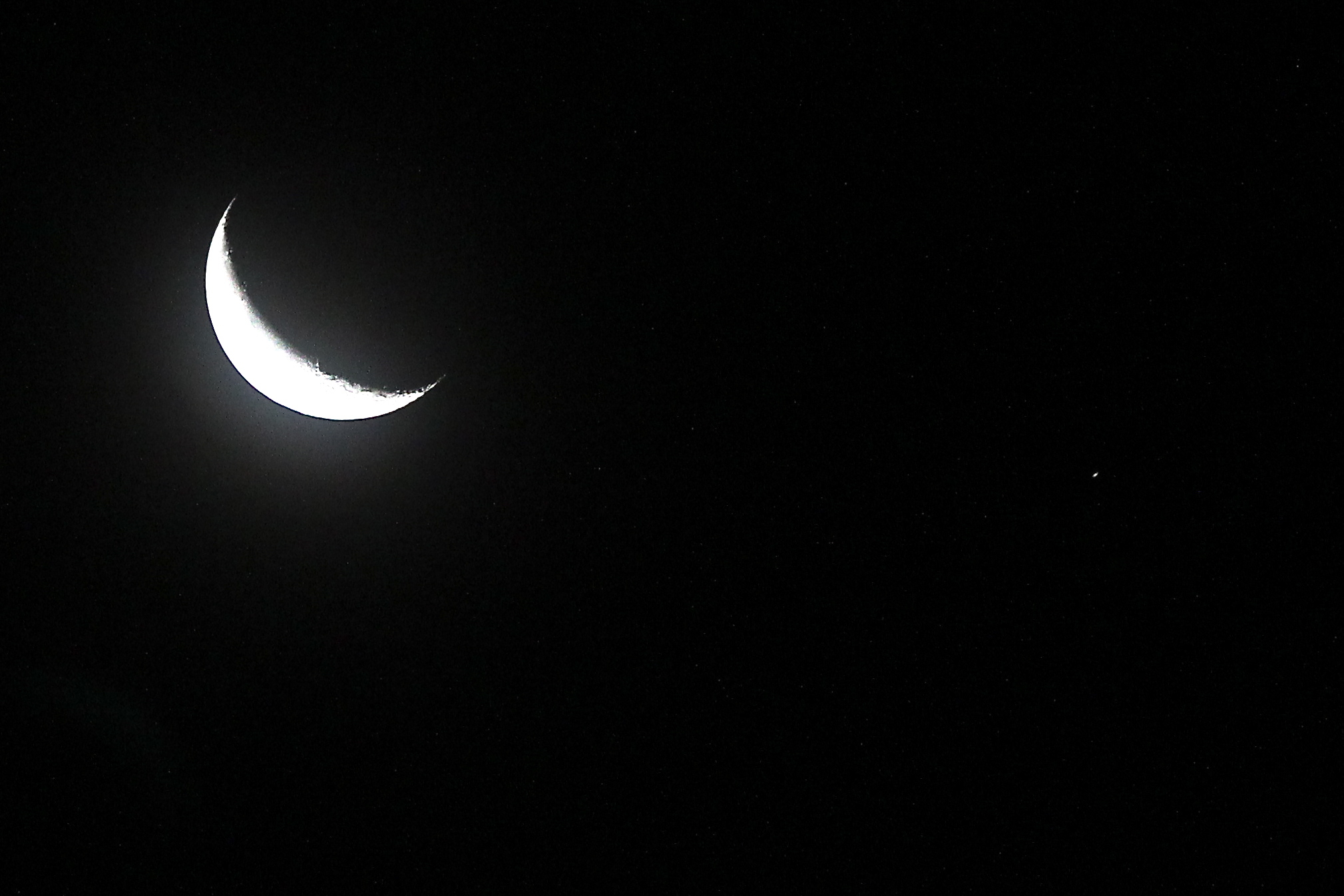
Conjunction of Moon and Saturn
MoonAndSaturn20150116

Saturn (“One of the These Things is Not Like the Others”)
Saturn20150116

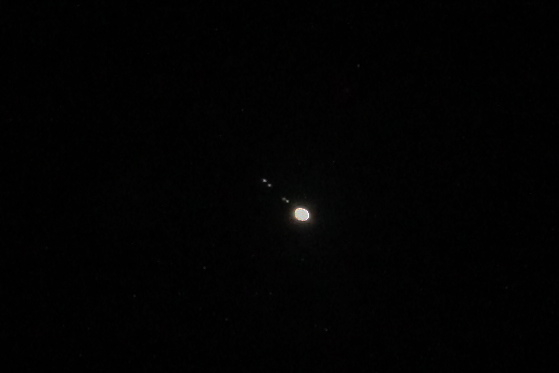
Jupiter and four Galilean Moons
JupiterAndMoons20150116

You know you enjoy a hobby when you get up early and go out into the dark cold for it. This morning there was a conjunction of the Moon and Saturn, so I got up and went out. And while I was at it, I took some pictures of Jupiter and its moons, too. I checked – yes all four moons were on the same side of Jupiter this morning. I think it would be fun to make a time lapse of their motion. Might have to try it.

I learned a new astrophotography trick last night. I knew I needed to manually focus for star pictures, but it’s hard to do with dim sources and a camera designed for autofocus. But my camera has a nifty real-time view on the LCD screen with a 10x view … so I could zoom in on the moon or a planet and use the real-time view to help me manually focus. Neat! And *much* sharper pictures.

The real-time view also showed me that, in spite of the solid tripod, the 200 mm is actually quite shaky if I want to crop further in. So I get out my cable release so I could watch the image settle down on the 10x screen and then trigger the camera without actually touching it.

I also already knew that although I could easily see both the Moon and Saturn, Saturn would disappear or the Moon would wash out without some filtering. Graduated neutral density filters to the rescue! I used two (wish I had more and stronger ones) to dim down the Moon so you can see both bodies in the same photo.

Camera geek info:

  •            Canon EOS 60D in manual mode set at f/4.0, 1/60 second exposure for Moon and Saturn, 1/13 second exposure for Jupiter, ISO 2000
  •             Canon EF 70 – 200 mm f/4L lens, set at 200 mm, manual focus at infinity
  •             Singh-Ray Galen Rowell Filter ND-1G-SS + ND-2G-SS for Moon
  •             Tripod
  •             Cable release