T Coronae Borealis Pre-Nova and photobomber 2 Pallas

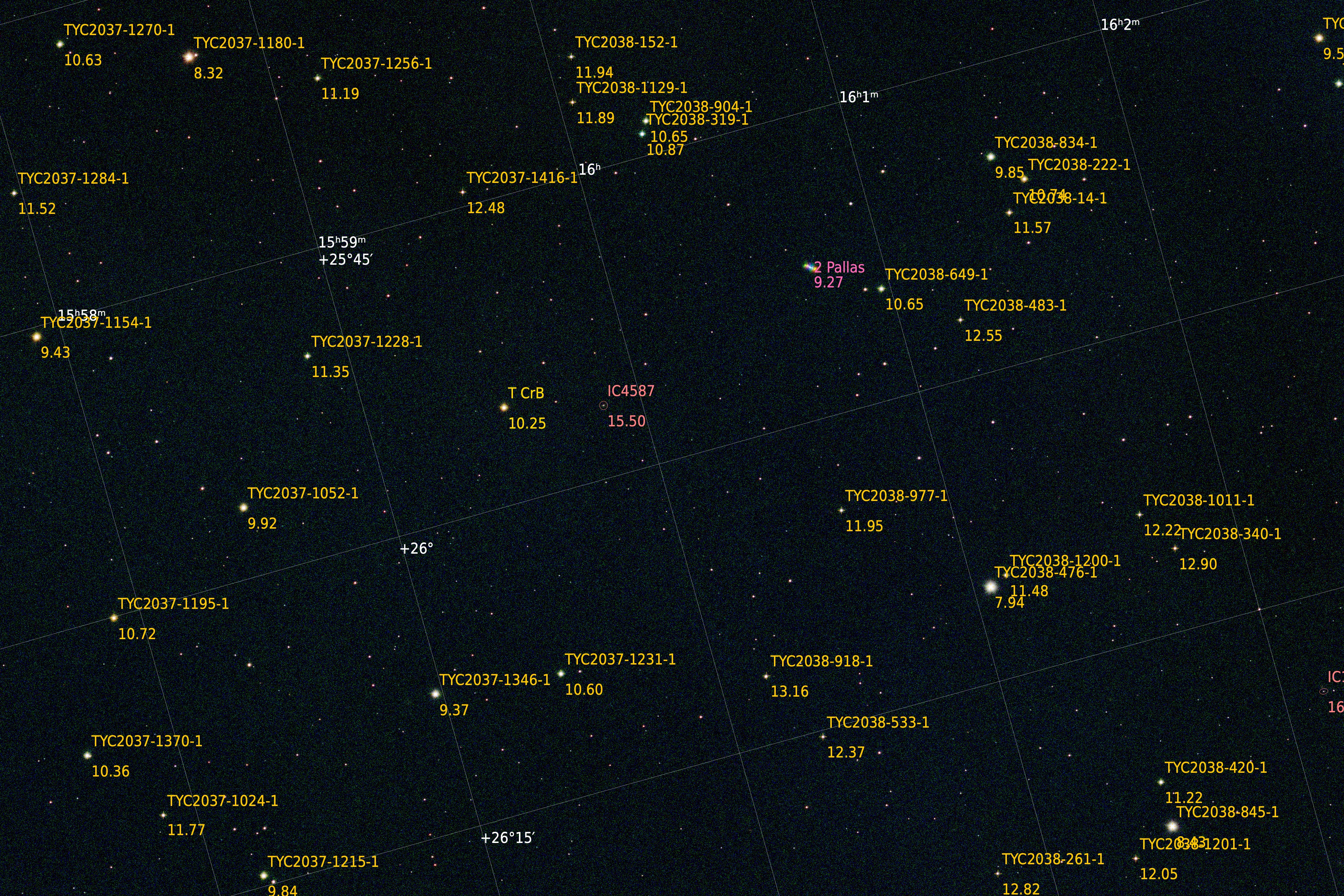
T Coronae Borealis (T CrB) (left of center in the image) is nicknamed “the Blaze Star” because it is a recurrent nova.  It consists of two stars: a white dwarf and a red giant.  Most of the time, the visible star is the red giant.  However, over time, matter from the red giant is transferred to the atmosphere of the white dwarf, and, periodically, the white dwarf heats the matter hot enough to cause runaway fusion, rapidly making the white dwarf brighten, causing a nova event.

The last two times this star went nova were May 12, 1866 and February 9, 1946.  It is expected to go nova again soon, possibly this summer.

T CrB is located in the Milky Way, approximately 2,630 light years away, so many cycles of novas may have occurred that we have not seen yet because the light hasn’t reached us!  But it’s on the way!

My husband suggested that I should capture a “before” picture to compare with a picture during the nova.  

I used PixInsight to annotate the image with the star magnitudes, so you can see that the magnitude for T CrB is consistent with its non-nova state (magnitude 10.25 vs its expected nova magnitude of 2 – 4).  
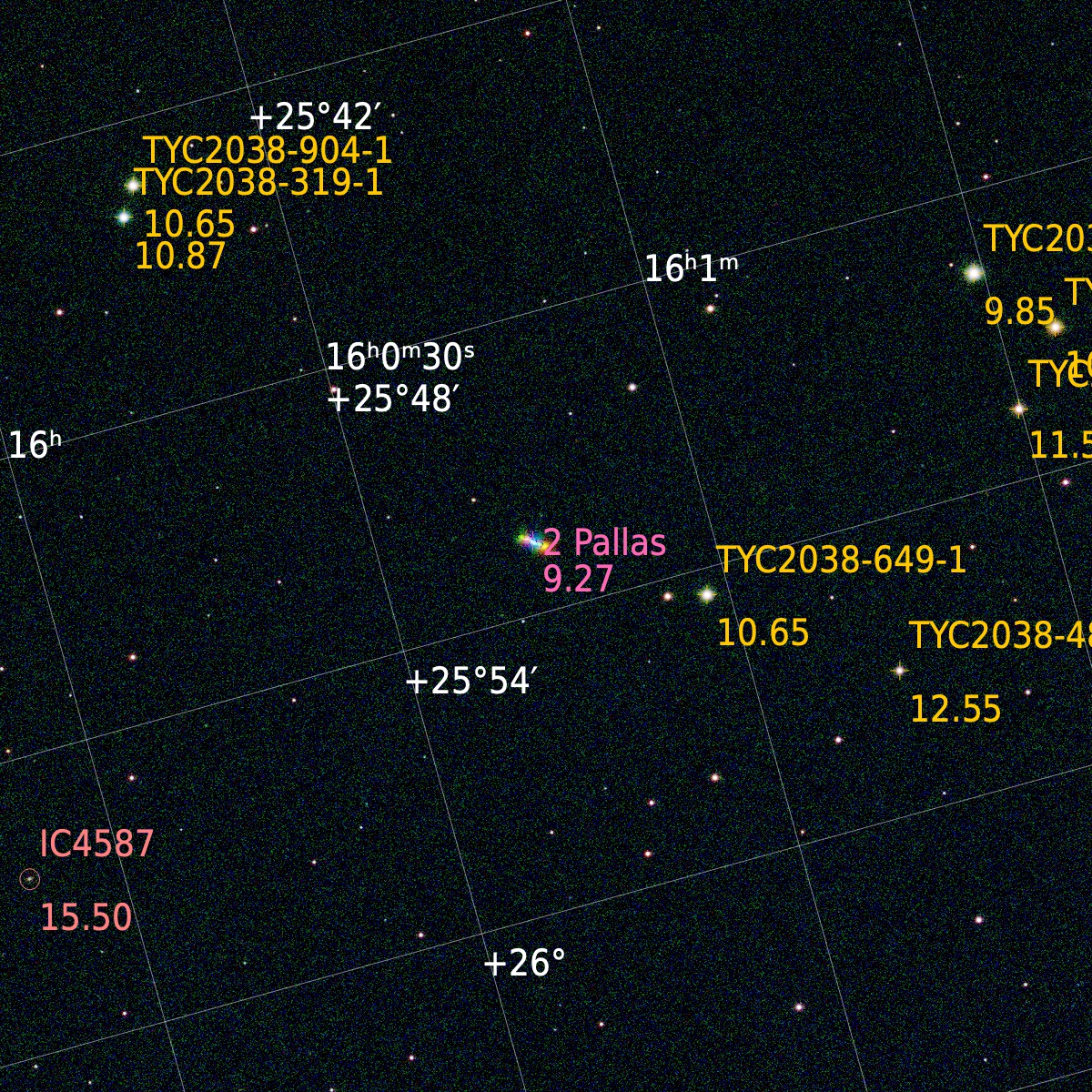
When I annotated the image, I noticed that there was a bright visible line that was not marked.  I suspected, given it was a line, indicating something moving slowly across the frame, that it was an asteroid, so I added annotation for asteroids to discover that it is the asteroid 2 Pallas.  The “2” in its name means it was the second asteroid to be discovered.  2 Pallas is a main belt asteroid, orbiting between Mars and Jupiter, in an unusually highly inclined (angle of orbital plane relative to the invariable plane) (Pallas’s inclination is 34.43 degrees; Vesta’s is 5.58 degrees; Earth’s is 1.58 degrees) and highly eccentric (more elliptical) orbit (Pallas’ eccentricity is 0.28; Vesta’s is 0.089; Earth’s is 0.017; 0 eccentricity is a circular orbit). 

Because I am now using a monochrome camera, I have to cycle between filters to get color.  I was cycling in 20 minute intervals, so the color of 2 Pallas looks like a rainbow, shifting between colors.  This is not a feature of the asteroid but rather a feature of my processing, but I think it is rather fetching.

This is the first time I’ve captured an asteroid!  How cool is that?

Are you looking forward to spotting the nova when it comes?

Camera geek info:

  • Williams Optics Zenith Star 73 III APO telescope
  • Williams Optics Flat 73A
  • ZWO 2” Electronic Filter Wheel
  • Antila RGB filters
  • ZWO ASI183MM-Pro-Mono camera
  • ZWO ASiair Plus
  • iOptron CEM40
  • Friendswood, Texas Bortle 7-8 suburban skies

Frames:

  • June 23, 2024
    • Lights
      • 37 60 second Gain 150 R lights
      • 28 60 second Gain 150 G lights
      • 19 60 second Gain 150 B lights
    • 30 0.05 second R flats
    • 30 0.05 second darks
    • 30 60 second darks

Processing geek info:

  • PixInsight
  • BlurXterminator

Asteroid Research – Orbits

One of the fun things about writing science fiction is learning about science!  My current work in progress is set in the asteroid belt, so I’ve had fun studying it. 

In my story, the aliens travel from the asteroid they live on to visit several asteroids humans live on before returning to their own asteroid.  I wanted to find a set of real asteroids where this made sense.  

In order to find a real set of asteroids, I had to answer two questions: 1) which asteroids would it make sense for humans and aliens to live on?  And 2) how do asteroids move relative to one another and what would it take to travel between them?

For the first question, I thought that humans (and aliens) would establish bases on asteroids big enough to support them.  I thought the most important resources for an asteroid to have are water and organics.  I discovered that many asteroids are members of families, groups of asteroids that have similar orbits (semi-major axis [maximum distance from the sun], inclination [angle from the ecliptic plane], and eccentricity [a measure of how circular the orbit is]).  Asteroid families can be created by collisions, so most of the asteroids in the family were once part of the same parent body and would likely be composed of similar materials.  One such family is the Themis family.  I found multiple papers arguing there is evidence that the Themis asteroids contain water ice and organics (among them: 1, 2, 3, 4).  So, if I use members of the Themis family for the asteroids that my story humans and aliens live on, I can assume they have water, organics, and metal resources to be extracted.  

For the second question, I hoped that having asteroids in the same family might mean the asteroids travel together.  Over the long term (months and longer), orbital dynamics does not work that way (unless the asteroids happen to be at different points in the same orbit and one “follows” the other).  Asteroids closer to the sun have a shorter “year” than asteroids further away, so even with a small difference in semimajor axis, the closer-to-the-sun asteroids will eventually “lap” the further out ones.  So they will be close, and then far away, and then close again.  Plotting a course in the asteroid belt is going to be a challenge!  Happily for me, my story takes place within a short period of time, and I can put my asteroid bases wherever is convenient, so I just needed to find a handful of Themis-family asteroids that are “near” each other at a point in time.  

I found a really cool asteroid simulator on line (Catalina Sky Survey (CSS) Orbit View) where you can enter the asteroids and date of your choice and see where they are and how they move relative to one another. The pictures in this blog post were generated by this awesome tool. It’s really fun just to watch the asteroids move around!

I filtered the Minor Planet Center Orbit (MPCORB) database for Themis family asteroids, put the top 60 into the simulator, let it run starting at 2150, and followed 24 Themis.  In 2243, I found what I was looking for: 6 Themis family asteroids “reasonably” close to one another.  

Note: I am well aware that “reasonably” close together at 3.14 AU is still really far apart.  However, my alien spacecraft does not need to break the laws of physics and exceed the speed of light to get from one to another, which is enough for me.

My next step will be to determine what we know about these asteroids, so I can make these tiny worlds more realistic.