IC1318 Gamma Cygni Nebula – Butterfly Nebula

This is a portion of IC1318 the Gamma Cygni Nebula nicknamed the Butterfly Nebula.  It’s in the constellation Cygnus beyond the star Gamma Cygni from which it gets its name.  IC1318 is an emission nebula and consists of three bright areas labeled A, B, and C – the butterfly is formed by B and C (A is not in this picture). It is 3700 light years away from us and has apparent dimensions of 50 (B) and 40 (C) arcmin. 

In the lower right corner of the picture is NGC6910, a cluster of stars made in this nebula.  The cluster is 13 million years old.

This is 13.7 hours of data take over three nights.

As you may note from my run numbers starting at 3, my first two runs did not align well with the rest or with the nebula, so I ended up not using them.  This is a tricky bit about imaging objects that are large compared to the total imaging area – the orientation of the camera and how well the imaging runs align with one another makes a difference.

For this particular image, I tried processing the nebula and stars separately, but I was not happy with the results, so I ended up processing them together.  

I think the Butterfly Nebula really looks like a butterfly.  How about you?  But I also think I see … a dark chicken?  What do you think?

Camera geek info:

  • Canon EOS 60D in manual mode, 1 minute exposure, ISO 800
  • Williams Optics Zenith Star 73 III APO telescope
  • Williams Optics Flat 73A
  • SkyTech 2” LPRO-MAX CCD Filter
  • iOptron CEM40
  • Friendswood, Texas Bortle 7-8 suburban skies

Frames:

  • September 21, 2023
    • Run 3 
      • 320 1 minute lights
      • 30 0.03 second flats
      • 30 0.03 second flat darks
  • September 22, 2023
    • Run 4
      • 240 1 minute lights
      • 30 0.03 second flats
      • 30 0.03 second flat darks
  • September 23, 2023 
    • Run 5
      • 28 1 minute lights
      • 30 0.03 second flats
      • 30 0.03 second flat darks
    • Run 6
      • 235 1 minute lights
      • 29 0.03 second flats
      • 30 0.03 second flat darks
  • 30 1 minute darks

Processing geek info:

  • PixInsight
  • BlurXterminator
  • NoiseXterminator
  • Generalized Hyperbolic Stretch

Solar Photography and Preparing for the Eclipse

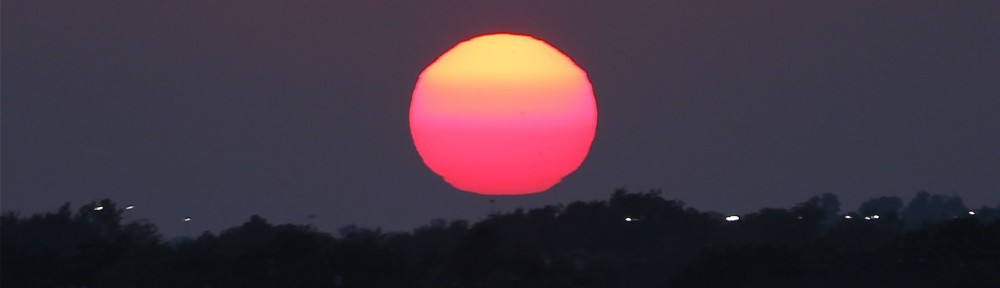
In preparation for the upcoming solar eclipse, I’ve gotten some new tools (toys).  I got a solar tracking mount that tracks the sun so I don’t have to try to set up my tracking mount (which needs a view of the stars to align) in the daytime.  And I got a solar filter for my telescope (this is not optional – eyeballs and optics can be destroyed without a proper solar filter).  Solar filters have been hard to come by – I’ve had one the correct size on order for months – and this one was too big.  But my awesome husband and his 3D printer came to the rescue!  He made me a spacer to go between the solar filter and the telescope.  It worked perfectly!

I tried a variety of settings for ISO and exposure length.  This particular shot at ISO 800 with a 1/400 second exposure had the best sun spots on this particular day. It seemed like settings where ISO * exposure >= 1 worked the best.

Camera geek info:

  • Canon EOS 60D in manual mode, 1/400 second exposure, ISO 800
  • Intervalometer
  • Williams Optics Zenith Star 73 III APO telescope
  • Williams Optics Flat 73A
  • Thousand Oaks optical solar filter
  • Sky-Watcher SolarQuest HelioFind tracking mount and tripod

Comet Nishimura September 2

Comet Nishimura on September 2, 2023

Having learned how to process comets thanks to the excellent videos by Adam Block, I went back and finished processing my first image of Comet Nishimura from September 2, 2023.  That morning we got up at 3:30 AM and drove over to Bacliff, Texas to get a good view to the East, and got set up.  I found the comet, started taking pictures, and enjoyed watching the sunrise.  As the sun rose over the flat water, we saw dolphins arcing out of the water – one of my favorite sights on the Texas Gulf Coast.  

Because the September 2 images involved a compact comet with not much tail and a short range of locations and a rapidly brightening background, I modified the excellent instructions from Adam Block as follows:

Register and process images as normal (noting the reference image), then removing the comet using a circular mask that covered the first and last locations and PixelMath.  I could get away with this because the comet didn’t have a large tail and hadn’t moved very far and there were no visible stars in the masked-out region.  In this case, I integrated unweighted; if I were doing it again, I would use the weighting I determined below.

Run SubframeSelector to determine what parameter to weight the images with – PSF SNR seemed to best reflect the lower quality due to the sky brightening in the last images.

Run CometAlignment on the debayerd data to get comet-aligned images.  Use PixelMath to make a mask to mask the comet core.  Run StarXterminator to generate comet-only images.  Integrate the images using PSF SNR weighting.  Then post-process as normal.  I could barely see the comet tail in these images and I tried a variety of stretches to try to pull it out.  I ended up using STF and Histogram Transfer plus Curves.  

Finally, put the stars image and the comet image back together using PixelMath.

Whew!  Comet processing is a lot more complicated than galaxies and nebulae.  Fun to see something new in the sky, though.

Camera geek info:

  • Canon EOS 60D in manual mode, 60 second exposures, ISO 800 
  • Williams Optics Zenith Star 73 III APO telescope
  • Williams Optics Flat 73A
  • SkyTech 2” LPRO-MAX CCD Filter
  • iOptron CEM40
  • Bacliff, Texas Bortle 6 suburban skies

Frames:

  • 24 60 second lights
  • 30 0.03 second flats
  • 30 0.03 second flat darks
  • 30 60 second darks

Processing geek info:

  • PixInsight
  • NoiseXterminator
  • StarXTerminator

Comet Nishimura with Photobomber

Comet C/2023 P1 Nishimura on September 8, 2023

Comet C/2023 P1 Nishimura with Airplane Photobomber on September 8, 2023

For the past two weekends, we’ve gotten up at 3:30 AM to drive to a spot with a long view to the East to go comet hunting.  I had setup issues with my tracking mount both times – the GoTo tracking did not want to three star align.  On both days, I managed to overcome that obstacle in time to capture some images of the comet.  On September 8, the time frame between when the comet cleared the haze on the horizon and the time that the sky got bright pre-dawn was surprisingly short (about 20 minutes).  Also on September 8, I had a funny picture where an airplane had photobombed my comet image and flew right in front of the comet.  

Astrophotography is really two hobbies: capturing the images and processing them.

And I still haven’t mastered processing comets.  

But thanks to the excellent videos from Adam Block and a software update on Russ Croman’s extremely useful StarXterminator program (where my Comet Nishimura data from September 2 appears in the release notes), I have finally managed to produce some decent comet pictures.  I registered all the images with the one with the airplane photobomb so I could combine the final comet image with the airplane lights to make a photobomb picture.

It’s fun to find surprises in the night sky!

Camera geek info:

  • Canon EOS 60D in manual mode, 30 second exposures, ISO 800 for 4 frames, ISO 400 for the remainder
  • Williams Optics Zenith Star 73 III APO telescope
  • Williams Optics Flat 73A
  • SkyTech 2” LPRO-MAX CCD Filter
  • iOptron CEM40
  • Bacliff, Texas Bortle 6 suburban skies

Frames:

  • 38 30 second lights, 24 used for stars
  • 31 0.02 second flats
  • 30 0.02 second flat darks
  • 34 30 second darks

Processing geek info:

  • PixInsight
  • NoiseXterminator
  • StarXTerminator
  • Generalized Hyperbolic Stretch

Rising Phoenix, Curious Robin

I call this image “Rising Phoenix, Curious Robin.”  The bright nebula to the right of the image looks to me like a phoenix opening up its wings to take flight.  The bright red nebula to the left looks to me like a red bird flying over to see what’s up. 

These two nebulae are parts of the larger NGC 7000/C20 North America Nebula in the constellation Cygnus.  Generally, it’s shown rotated clockwise from this image, with the dark nebula on the top of this image forming the Gulf of Mexico.  The nebula I see as a phoenix is also called the Cygnus Wall.  

Here is another view, rotated to look more like North America.

Nebulae, like clouds, are a great place to let your imagination run free.  What do you see in this image?

The North America Nebula is an emission nebula of ionized hydrogen gas where star formation is taking place.  It is lit up by a hot star that is hidden by the dark nebula next to it.  It is 2590 light years away from us, and it has apparent dimensions of 2.5 degrees by 3.3 degrees.  

Its large size makes it a fitting subject for my small telescope with its relatively wide field of view.  But it’s quite dim and I can’t see it at all in a single frame.  I made an early attempt to image it on a trip to the fabulous Bortle 2-3 dark skies of Dell City, Texas about two years ago, but I hadn’t realized then the huge effect of image processing stacks of images.  Even after learning that lesson, it is still a leap of faith to collect hours of images when you can’t see the real subject you’re trying to capture!  It’s also a challenge to keep the framing consistent so that everything overlays and can stack up.  I used the asterism of the upside-down “T” shape in the upper left corner and the bright star ksi Cygnus (cropped out of the first image, visible in the second) to make sure I stayed in alignment.

I collected the data for this image from my driveway in Friendswood, Texas, under Bortle 7-8 skies.  In order to separate the signal (the nebula) from the noise (our light pollution), I ended up taking data over eight nights, then had to throw out the data from one night (the first one) because it didn’t overlay well with the rest.  And I had to throw out other data because I had a dust spot move between the data and the calibration frames on one night, and I had to throw out more data on another night because I hadn’t set up my tracking mount well enough so it drifted.  But I ended up using a whopping 27.8 hours of data to make this one image.  

We’ve been under a high pressure heat dome here in Texas for over a month, which means it’s been meltingly hot and lawn-destroyingly dry, but the silver lining is I’ve gotten to enjoy a lot of cloud-free telescope nights.  Even in the middle of the night, though, it has been hot – around 80 deg F – which means I sweat setting up/adjusting/checking on the telescope.  And it’s the Gulf Coast, which means it’s still muggy and I have to put a heater on the telescope so dew doesn’t collect.  How crazy is that?

Camera geek info:

  • Canon EOS 60D in manual mode, 1 minute exposure, ISO 800
  • Williams Optics Zenith Star 73 III APO telescope
  • Williams Optics Flat 73A
  • SkyTech 2” LPRO-MAX CCD Filter
  • iOptron CEM40
  • Friendswood, Texas Bortle 7-8 suburban skies

Frames:

  • July 21, 2023
    • Run 3 
      • 35 1 minute lights
      • 30 0.03 second flats
      • 31 0.03 second flat darks
    • Run 4
      • 180 1 minute lights
      • 30 0.03 second flats
      • 30 0.03 second flat darks
  • July 27, 2023 
    • Run 5
      • 219 1 minute lights
      • 31 0.03 second flats
      • 30 0.03 second flat darks
    • Run 6
      • 111 1 minute lights
      • 31 0.03 second flats
      • 31 0.03 second flat darks
  • July 28, 2023
    • Run 7
      • 221 1 minute lights
      • 30 0.03 second flats
      • 30 0.03 second flat darks
  • July 29, 2023
    • Run 9
      • 165 1 minute lights
      • 30 0.03 second flats
      • 30 0.03 second flat darks
  • August 4, 2023 
    • Run 10
      • 160 1 minute lights
      • 30 0.03 second flats
      • 30 0.03 second flat darks
    • Run 11
      • 240 1 minute lights
      • 30 0.03 second flats
      • 30 0.03 second flat darks
  • August 5, 2023 
    • Run 12
      • 97 1 minute lights
      • 30 0.03 second flats
      • 30 0.03 second flat darks
    • Run 13
      • 93 1 minute lights
      • 30 0.03 second flats
      • 30 0.03 second flat darks
  • August 11, 2023
    • Run 14
      • 149 1 minute lights
      • 30 0.03 second flats
      • 30 0.03 second flat darks

Processing geek info:

  • PixInsight
  • BlurXterminator
  • NoiseXterminator
  • StarXTerminator
  • Generalized Hyperbolic Stretch

Astrophotography Makeover: M101 and M16

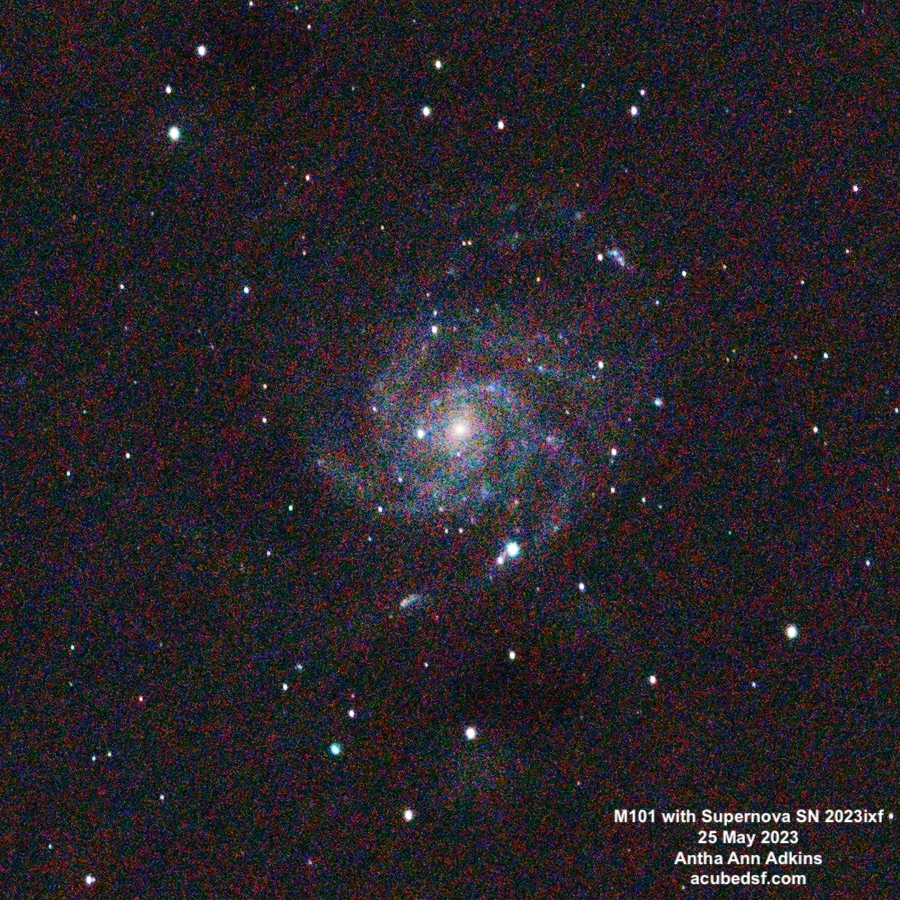
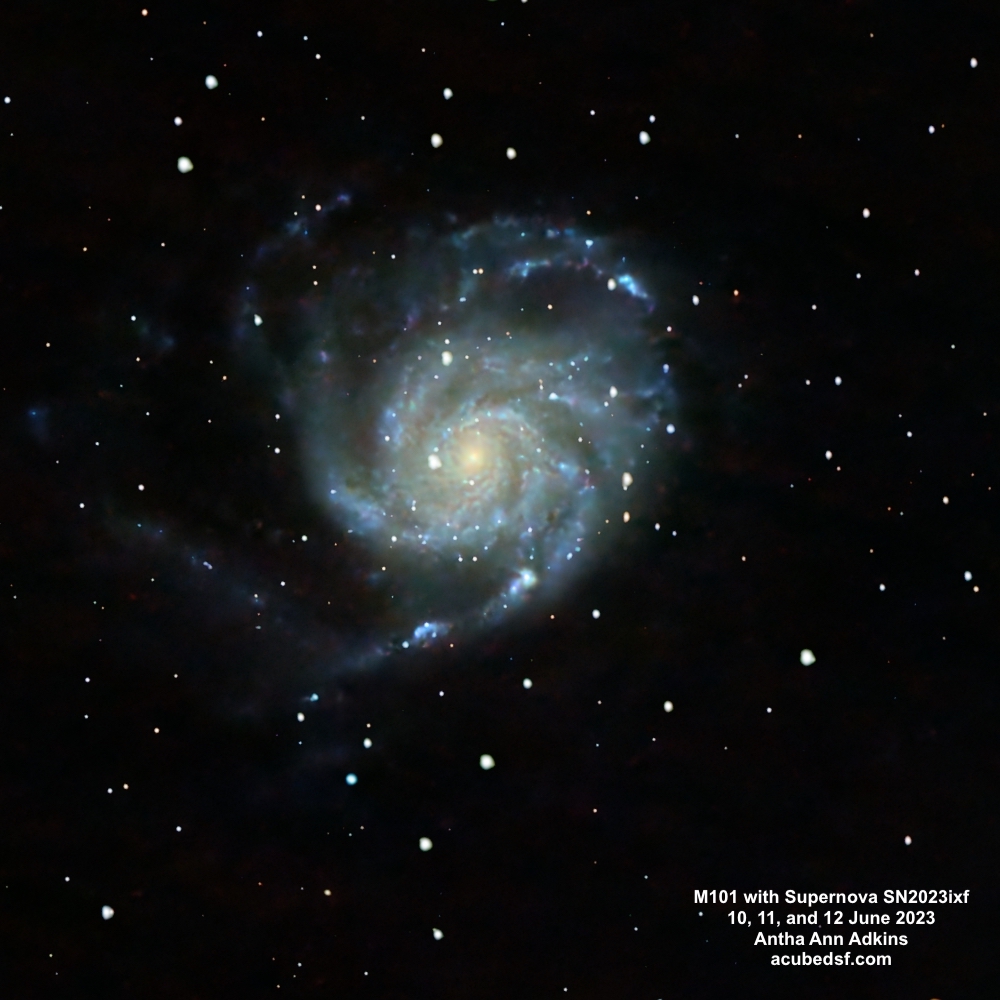
M101 with Supernova 2023xif – with and without BXT and NTX

M16 Eagle Nebula – with and without BXT and NXT

After learning about the powerful BlurXterminator (BXT) and NoiseXterminator (NXT) tools, I reprocessed my M101 and supernova and M16 images that I took from the glorious dark skies of Dell City, Texas earlier this summer.  I was amazed that so much detail can be found in images of objects thousands to millions of light years away taken by my small telescope.  

M16:

Camera geek info:

  • Canon EOS 60D in manual mode, 2 minute exposure, ISO 2000
  • Williams Optics Zenith Star 73 III APO telescope
  • Williams Optics Flat 73A
  • iOptron CEM40
  • Dell City, Texas Bortle 2-3 dark skies

Frames:

  • June 11, 2023
    • Run 1 
      • 6 2 minute lights
      • 31 0.02 second flats
      • 30 0.02 second flat darks
      • 31 2 minute darks
  • June 13, 2023 
    • Run 2
      • 88 2 minute lights
      • 30 0.02 second flats
      • 31 0.02 second flat darks
    • Run 3
      • 83 2 minute lights
      • 31 0.02 second flats
      • 30 0.02 second flat darks
      • 31 2 minute darks
  • 17 frames rejected for a total of 5 hours and 20 minutes of data

Processing geek info:

  • PixInsight
  • BlurXterminator
  • NoiseXterminator
  • StarXTerminator
  • Generalized Hyperbolic Stretch

M101:

Camera geek info:

  • Canon EOS 60D in manual mode, 2 minute exposure, ISO 1600 and ISO 2000
  • Williams Optics Zenith Star 73 III APO telescope
  • Williams Optics Flat 73A
  • iOptron CEM40
  • Dell City, Texas Bortle 2-3 dark skies

Frames:

  • June 10, 2023
    • Run 1 1600 ISO
      • 99 2 minute lights
      • 31 0.01 second flats
      • 20 0.01 second flat darks
    • Run 2 1600 ISO
      • 39 2 minute lights
      • 31 0.02 second flats
      • 30 0.02 second flat darks
      • 71 2 minute darks
  • June 11, 2023 2000 ISO
    • 151 2 minute lights
    • 31 0.02 second flats
    • 20 0.02 second flat darks
    • 31 2 minute darks
  • June 12, 2023 2000 ISO
    • 30 2 minute lights
    • 31 0.02 second flats
    • 30 0.02 second flat darks
    • 32 2 minute darks

Processing geek info:

  • PixInsight
  • BlurXterminator
  • NoiseXterminator
  • StarXterminator
  • Generalized Hyperbolic Stretch

Perseid Meteor Shower: Antha 6, Cameras 0

I saw a long, bright meteor – without my glasses – while I was setting up my telescope at 9 PM last night.  I hoped this was a good sign for things to come.  I sat outside from 2 AM to 3 AM and only saw 5 more meteors.  I had two cameras set up, and neither of them caught any at all.  Not a good showing. Next time, I’m driving away from my Bortle 7-8 skies and neighbors’ security lighting to get a better view.

M8 and M20 with BlurXterminator

On the advice of the kind folks over at Astrobin, I have been learning about the fantastic tool BlurXterminator (BXT).  It is an amazing AI tool that can sharpen up the stars and bring out details in nebulas and galaxies.  

I used BXT on my M8 and M20 image (in the slideshow above), and I think the new version is stunning and really brings out the nebulae.  It is my first published Astrobin image!

Now I want to go back and reprocess all my prior images … 

Galaxy Under Construction: M16 Eagle Nebula and the Pillars of Creation

This is M16 the Eagle Nebula from the constellation Serpens. It’s the home of the famous “Pillars of Creation” picture from the Hubble Space Telescope. If you zoom in … you can see the Pillars of Creation in this image. Pretty cool I could capture it with my small telescope with a little over 5 hours of data. Pretty amazing to think that these star forming regions are all around us … our galaxy is still under construction! And so, so beautiful.

M16 is an emission nebula of ionized hydrogen gas where star formation is taking place.  It is 5700 light years away from us, has apparent dimensions of 70 x 50 arcmin, and has an apparent magnitude of 6.4.  It’s a great target for a small telescope!

Camera geek info:

  • Canon EOS 60D in manual mode, 2 minute exposure, ISO 2000, custom white balance 3500K
  • Williams Optics Zenith Star 73 III APO telescope
  • Williams Optics Flat 73A
  • iOptron CEM40
  • Dell City, Texas Bortle 2-3 dark skies

Frames:

  • June 11, 2023
    • Run 1 
      • 6 2 minute lights
      • 31 0.02 second flats
      • 30 0.02 second flat darks
      • 31 2 minute darks
  • June 11, 2023 
    • Run 2
      • 88 2 minute lights
      • 30 0.02 second flats
      • 31 0.02 second flat darks
    • Run 3
      • 83 2 minute lights
      • 31 0.02 second flats
      • 30 0.02 second flat darks
      • 31 2 minute darks
  • 17 frames rejected for a total of 5 hours and 20 minutes of data

Processing geek info:

  • PixInsight
  • StarXTerminator
  • Generalized Hyperbolic Stretch