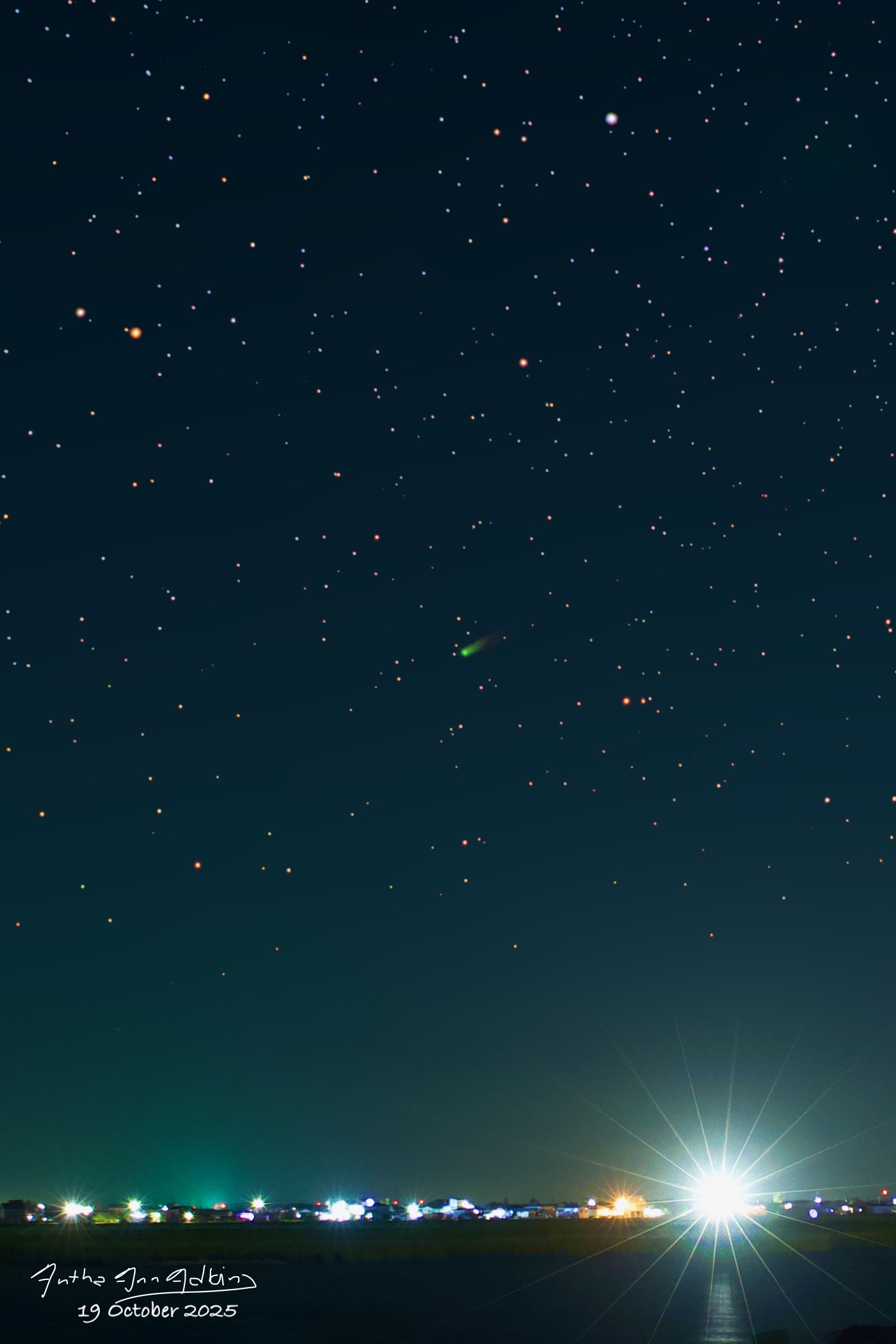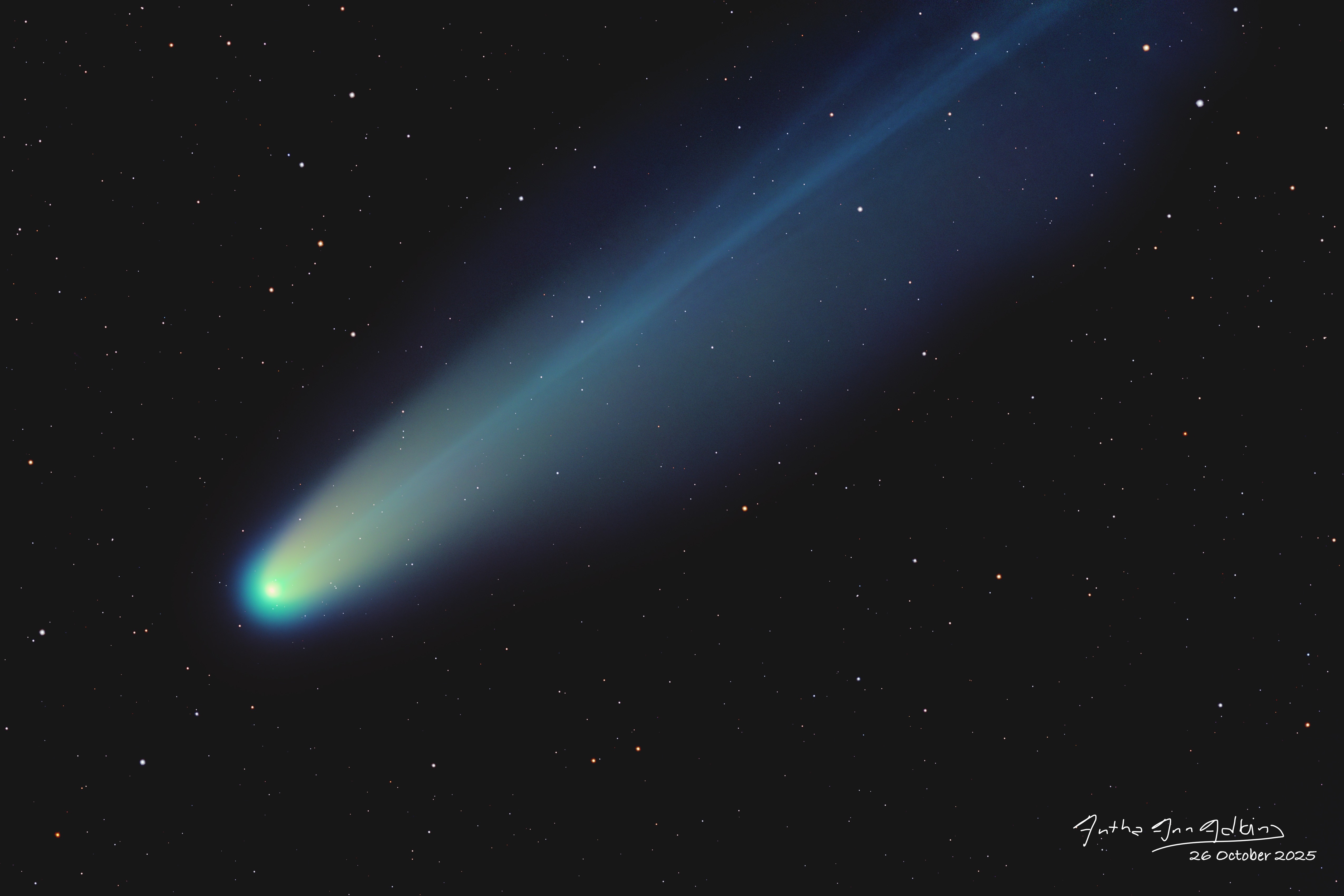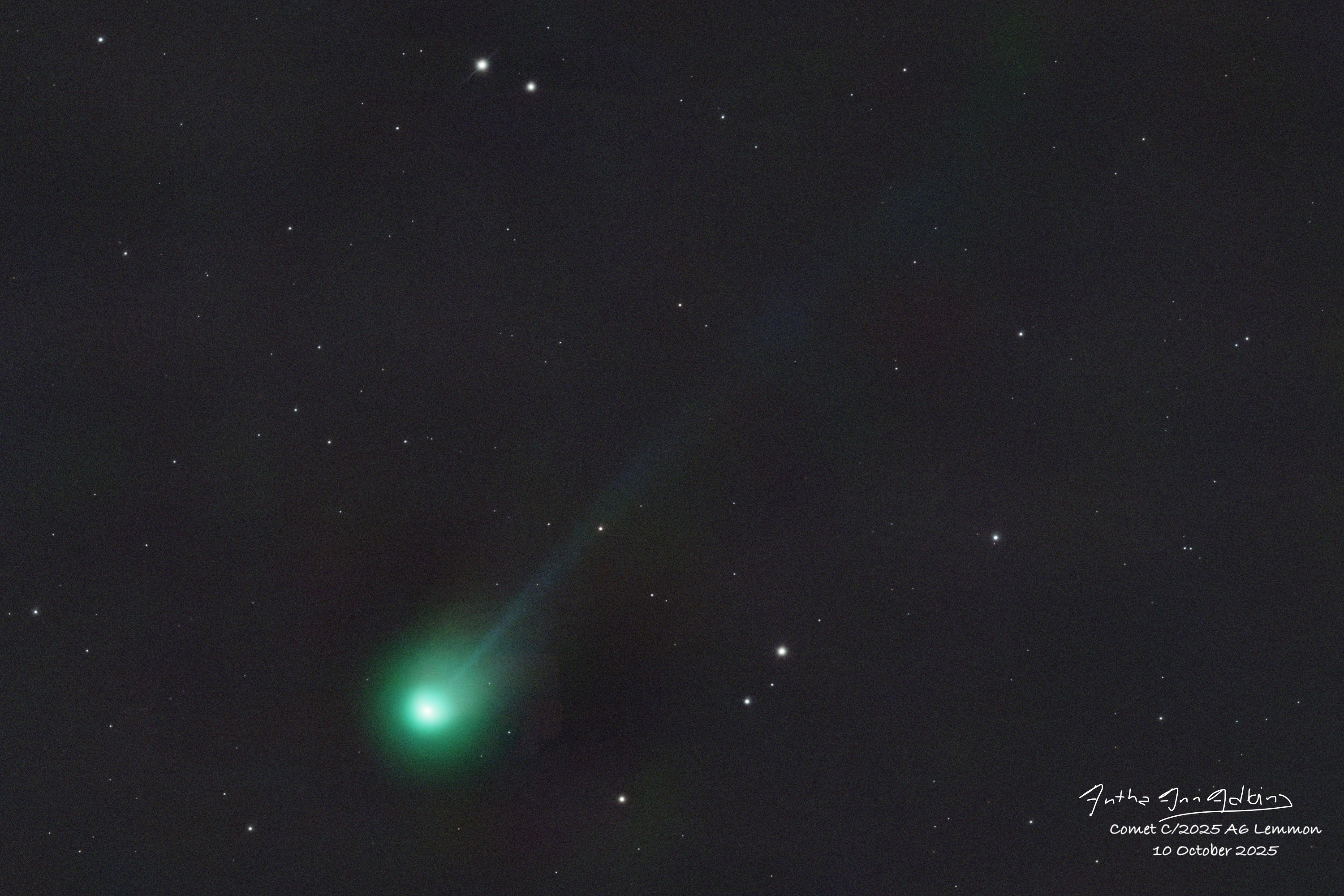
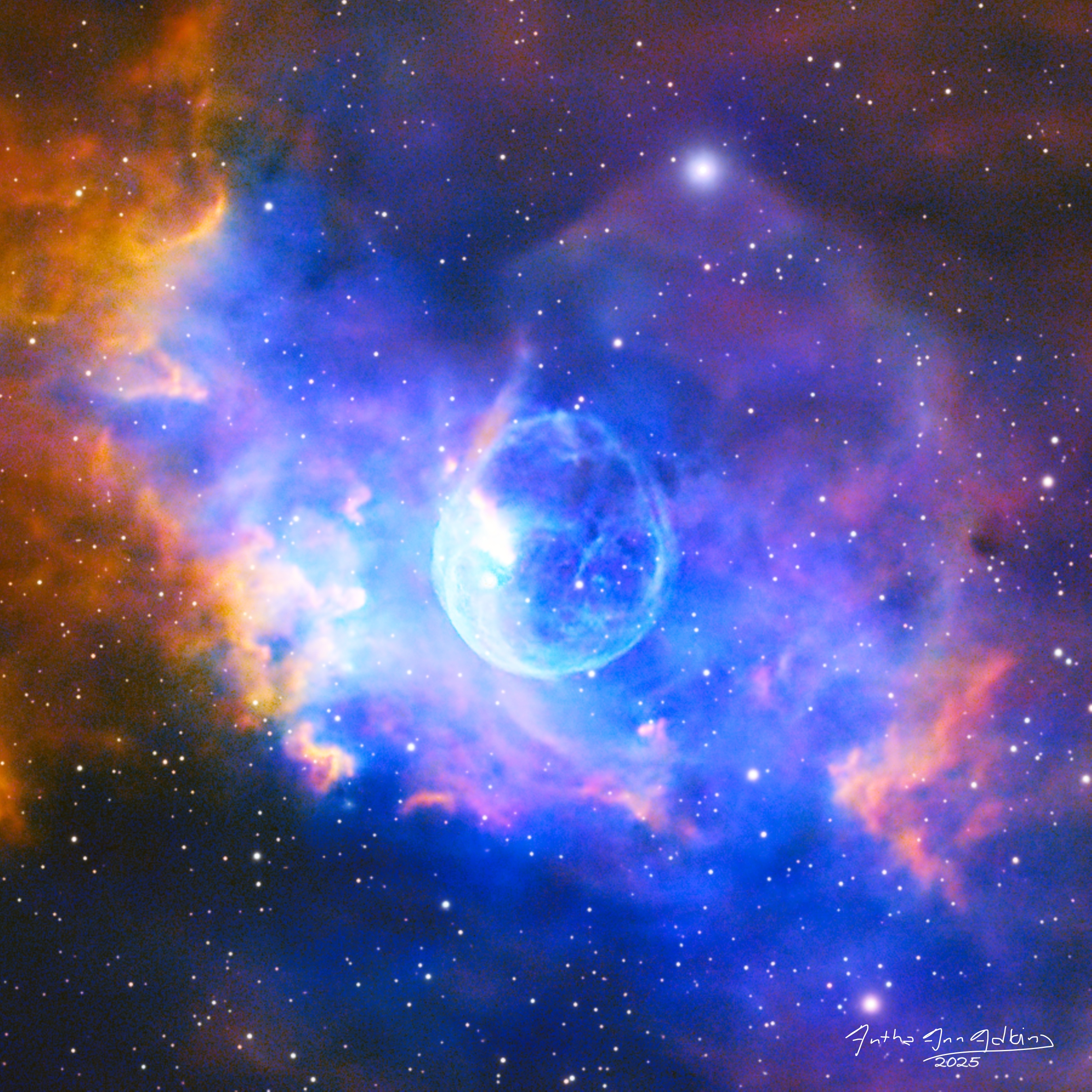
On Sunday, October 26, 2025, my husband I drove back to Sargent, Texas for darker skies (Bortle 4) and another try at Comet C/2025 A6 Lemmon. Happily, this time the sky was clear and I successfully captured the comet with my small telescope. I was also successful in seeing it with a tail with binoculars. And I managed to capture some wide field images with my camera on a tripod.
This time I decided to go with longer frames to try the capture the comet’s ion tail, and I was delighted with what I saw even in single frames. I can even see motion in the tail between frames, which I think is really cool. I’m working on a movie of that, but it’s the equivalent of processing multiple comets, so it’s taking a while. I’ve also got some wide angle shots to process. And at least one more set of telescope images.
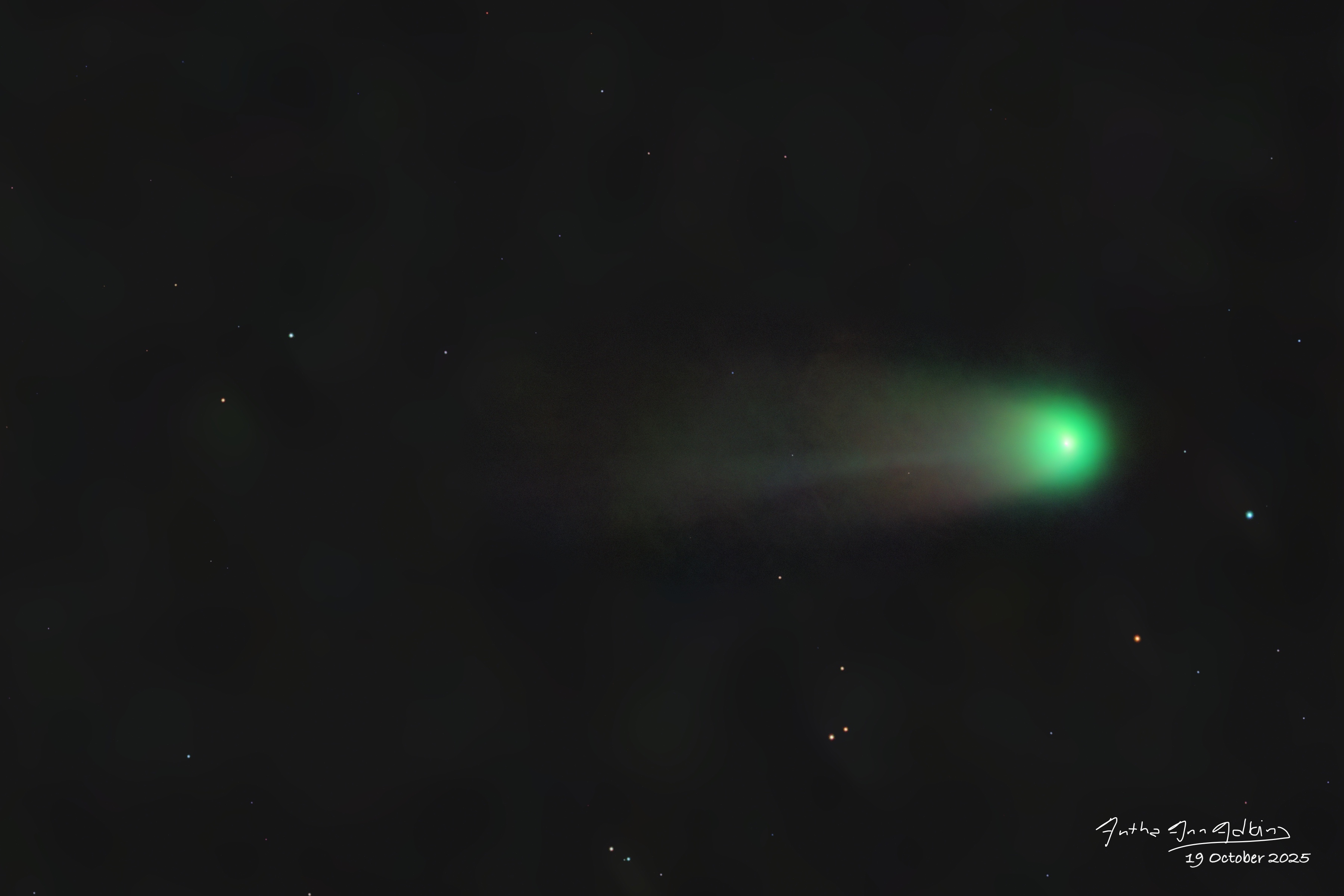
On Sunday, October 19, 2025, my husband I drove back to Sargent, Texas for darker skies (Bortle 4) and another try at Comet C/2025 A6 Lemmon. Happily, this time the sky was clear and I successfully captured the comet with my small telescope. I was also successful in seeing it with binoculars. I was less successful with a wide angle shot with my camera on a tripod – the comet was not obvious and I was fooled by internal reflections of some bright green lights on the horizon. I’m going to spend some more time with those images, but I’m not hopeful of pulling out a nice comet picture from them.
Based on this experience, I was pretty sure the comet would not be naked eye visible even from Bortle 4 skies at its closest approach to Earth on October 21.
As the comet got closer to Earth, its relative angular motion increased. I didn’t want the comet to “smear” in the pictures, so I was taking shorter frames based on the comet only moving a half pixel per frame. There’s a trade-off, though, between completely freezing the comet’s motion in a frame and capturing enough light to separate the comet’s tail from the background noise. In this case, I think the frames were too short – the comet’s coma and tail are many pixels wide, and I probably should have accepted some motion in exchange for collecting more data. This also wasn’t much data: 6.25 minutes of red data, 6.4 minutes of green data, and 5.75 minutes of blue data.
The comet still got better from here … but it’s taking a while to get these images processed. More to come!
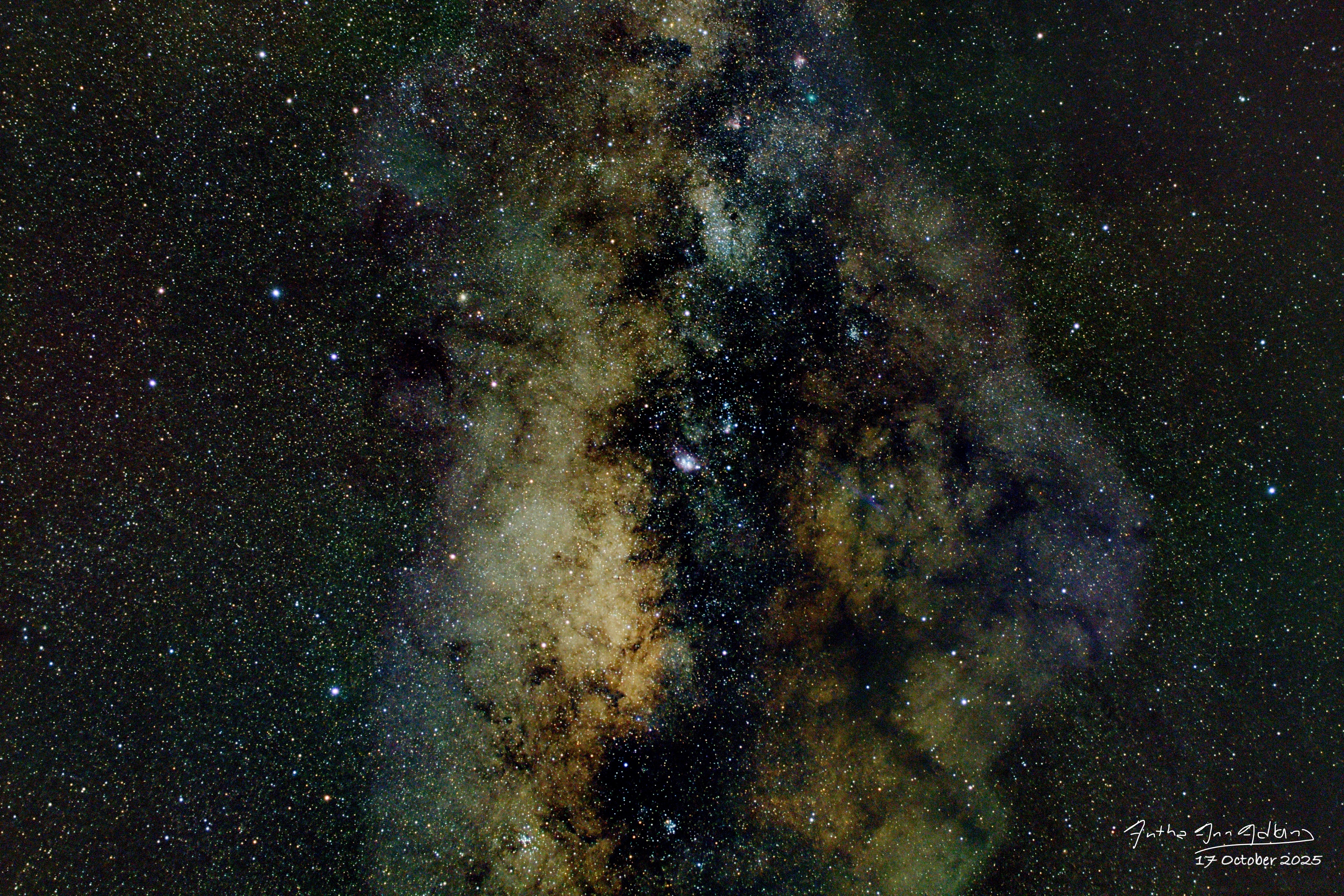
By Friday October 17, 2025, Comet C/2025 A6 Lemmon had become an evening object, so my husband and I drove to Sargent, Texas for darker skies (Bortle 4). Unfortunately, the clouds stayed near the horizon and hid Comet Lemmon. It was quite windy out, so I didn’t want to get out my telescope.
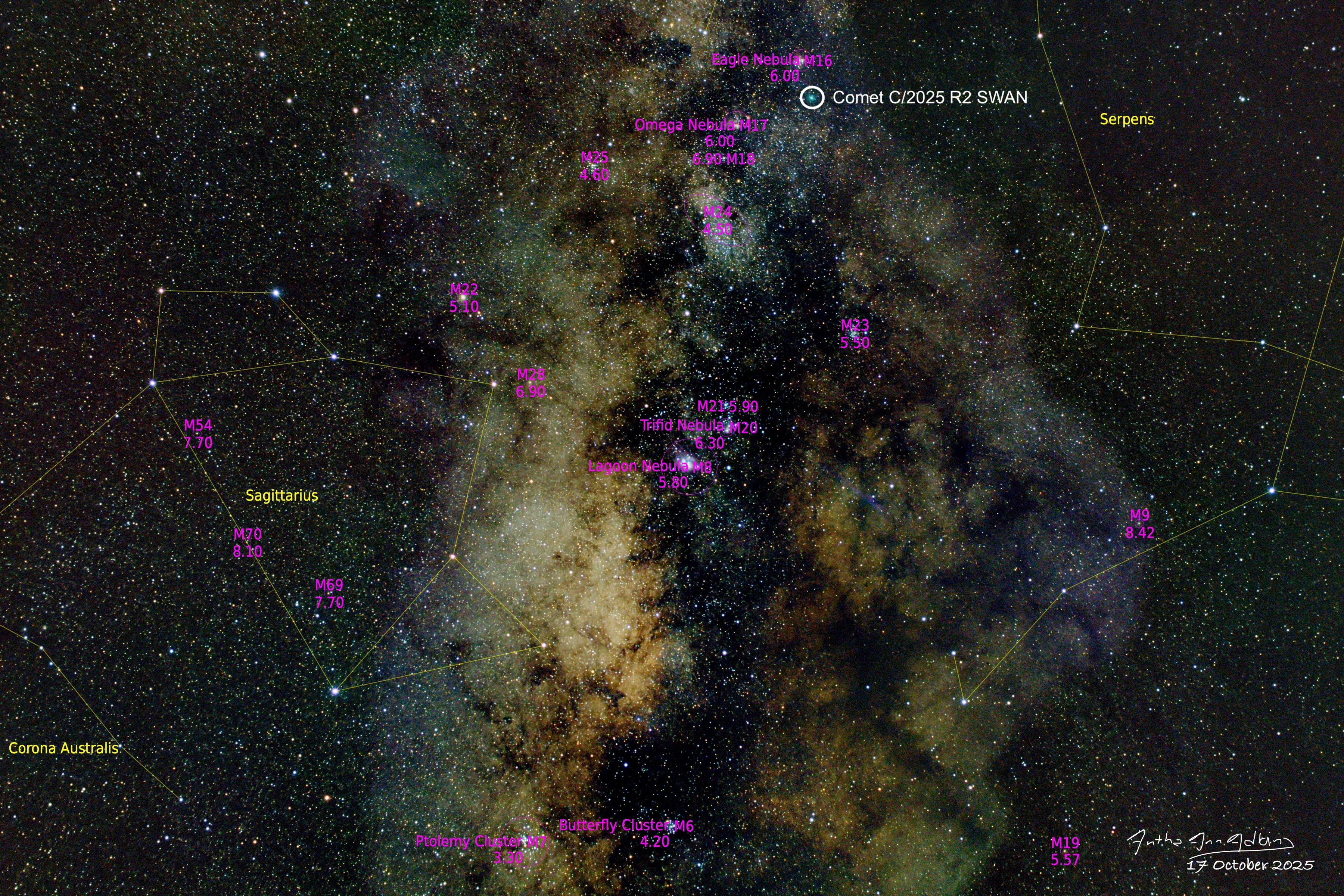
However, there was another bright comet in the sky, C/2025 R2 SWAN, and I also had my camera to try to capture a wide field image, so I set the camera up to capture a wide field with Comet C/2025 R2 Swan. I didn’t have much time to capture it before it was obscured by clouds and only got 7 minutes of data.
The comet was above the constellation Sagittarius which is in the direction of the center of the Milky Way, so it is a particularly bright section of the Milky Way and contains multiple Messier Objects, marked in magenta. Messier Objects are Deep Space Objects that comet hunter Charles Messier put on a list of “not-comets.” There are 17 Messier Objects in this image, four of which I have imaged before in more detail. It’s fun to compare them to an actual comet here. While the comet stands out with its greenness in the image, visually it would be a fuzzy spot like the others … except that it very slowly moves across the field of view.
Apparently I forgot to take flat frames for this image, so I used a synthetic flat.
Camera geek info – camera:
Canon EOS 60D in manual mode set at f/2.8, 10 second exposure, ISO 4000
Sigma 24-70 mm f/2.8EX lens, set at 24 mm, manual focus
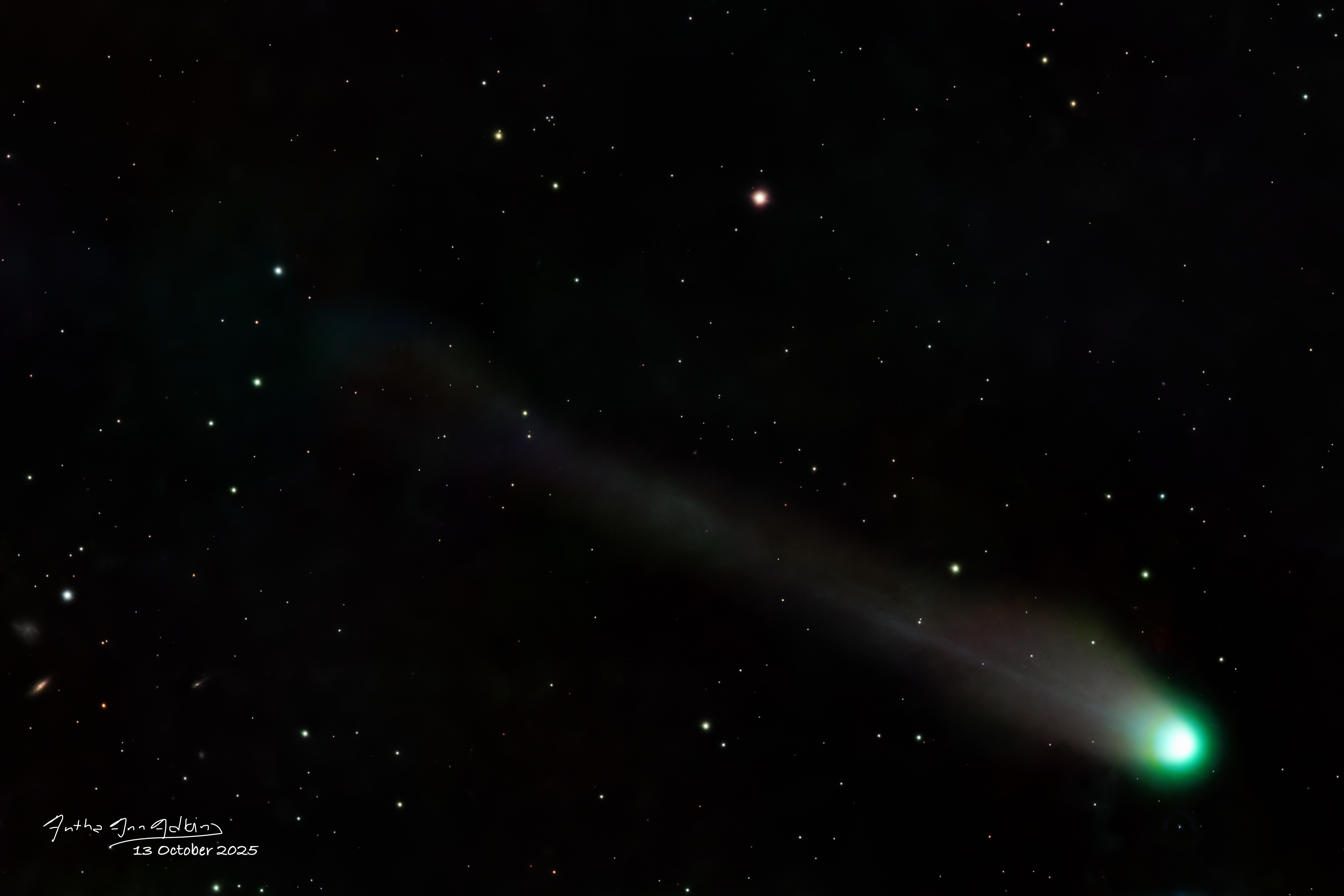
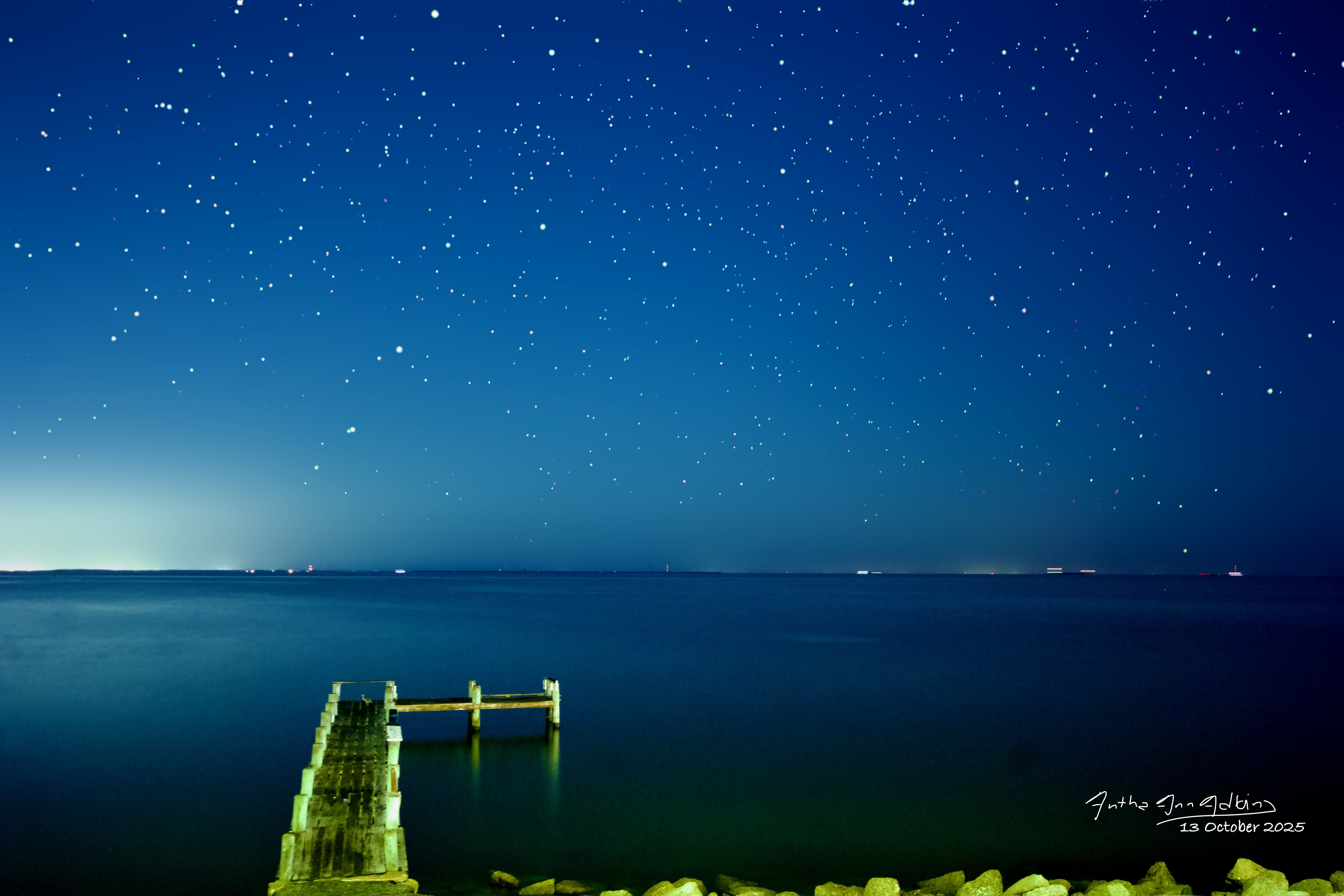
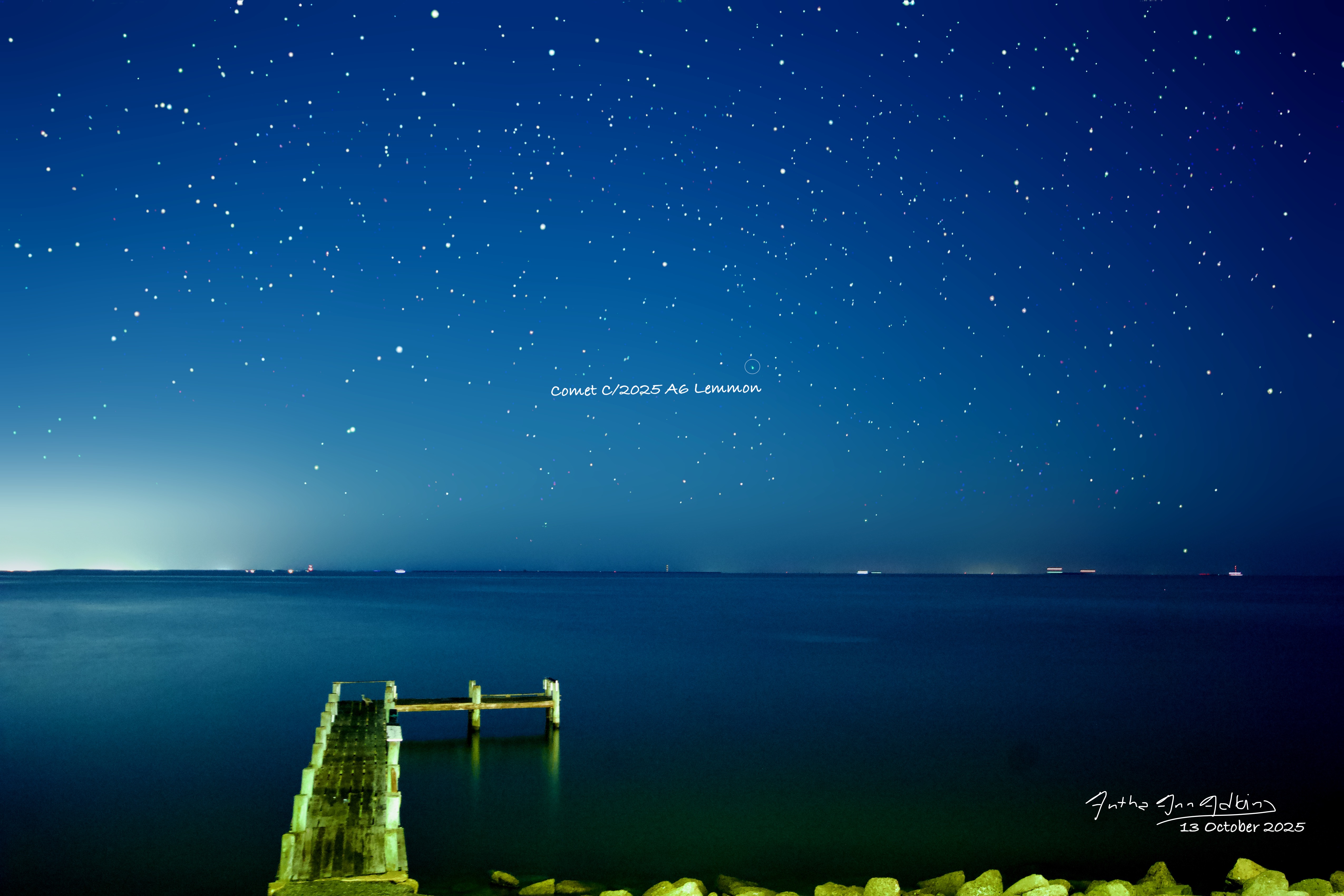
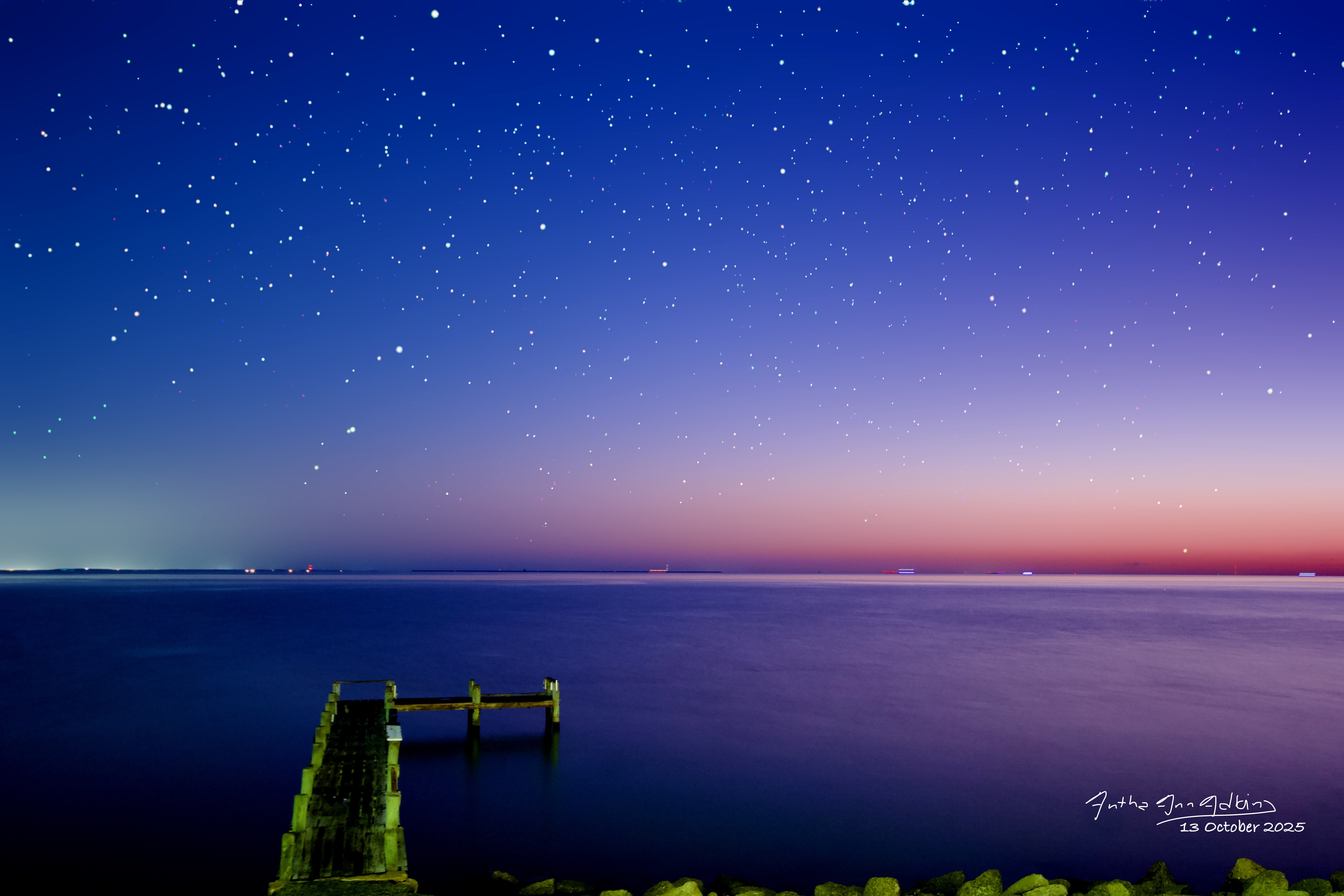
Monday, October 13, was my fourth morning in a row trying to capture Comet C/2025 A6 Lemmon. This time, my husband and I drove back to darker skies with a clear horizon looking out over the water in Bacliff, Texas.
From Bortle 6 skies, the comet was lovely in my smaller telescope. The processed image used 25.75 minutes of red frames, 26.5 minutes of green frames, and 24.5 minutes of blue frames for the stars. It used 16.5 minutes of red frames, 16.5 minutes of green frames, and 15 minutes of blue frames for the comet. There are less frames for the comet because I removed the late ones where the comet had reached the edge of the image and the early ones where the comet’s tail was not yet visible. I’ve added a new step to my processing where I mask out the comet and set the blotchy background to a neutral level. This doesn’t affect the comet data at all but allows me to “stretch” the comet data more without bringing out blotches in the background.
I set up my camera for a wide field image, and the comet is in the picture, but it does not stand out as a comet, even with extra processing to enhance it. The processed image used 17.7 minutes of data but only 13.7 minutes for the comet because the pre-processing tossed a bunch of frames. I combined the widefield stars image with foreground and sky images taken from the same place with the same setup (no combining different focal lengths or locations). The “night” version really captures what it was like – peaceful and calm. (Can you spot the bird on the dock?) The “sunrise” picture is a bit of a stretch, since the starfield is from earlier in the morning than the sunrise light, and the stars were fading at that point. However, it is pretty!
I was finally able to spot a small fuzzy spot with the binoculars, so I was able to declare victory on spotting the comet with binoculars.
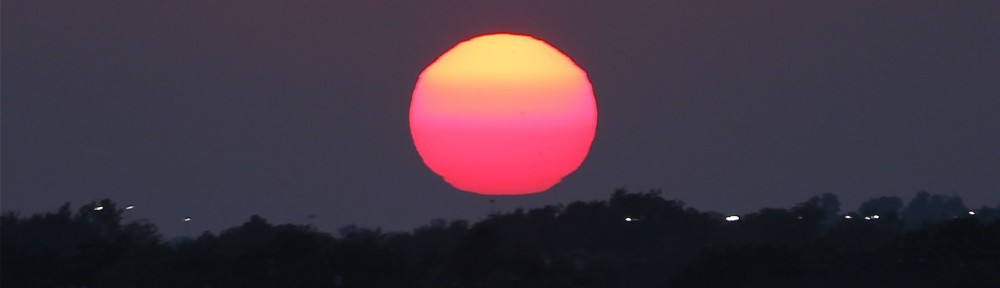
We stayed for the sunrise, and my husband saw the green flash effect! Alas, I did not capture it with my camera.
The comet only got better from here … but it’s taking a while to get these images processed. More to come!
Camera geek info – telescope:
William Optics Zenith Star 73 III APO telescope
William Optics Flat 73A
ZWO 2” Electronic Filter Wheel
Antila RGB filters
ZWO ASI183MM-Pro-Mono camera
William Optics Uniguide 32MM F/3.75
ZWO ASI220MM-mini
ZWO ASiair Plus
iOptron CEM40
Bacliff, Texas Bortle 6 suburban skies
Frames – telescope:
October 13, 2025
103 15 second Gain 150 R lights (66 for comet)
30 0.05 second Gain 150 R flats
106 15 second Gain 150 G lights (66 for comet)
30 0.02 second Gain 150 G flats
98 15 second Gain 150 B lights (60 for comet)
30 0.02 second Gain 150 B flats
Matching darks and flat darks from library
Camera geek info – camera:
Canon EOS 60D in manual mode set at f/5.6, 20 second exposure, ISO 800
Sigma 10-20 mm f/4-5.6 lens, set at 20 mm, manual focus
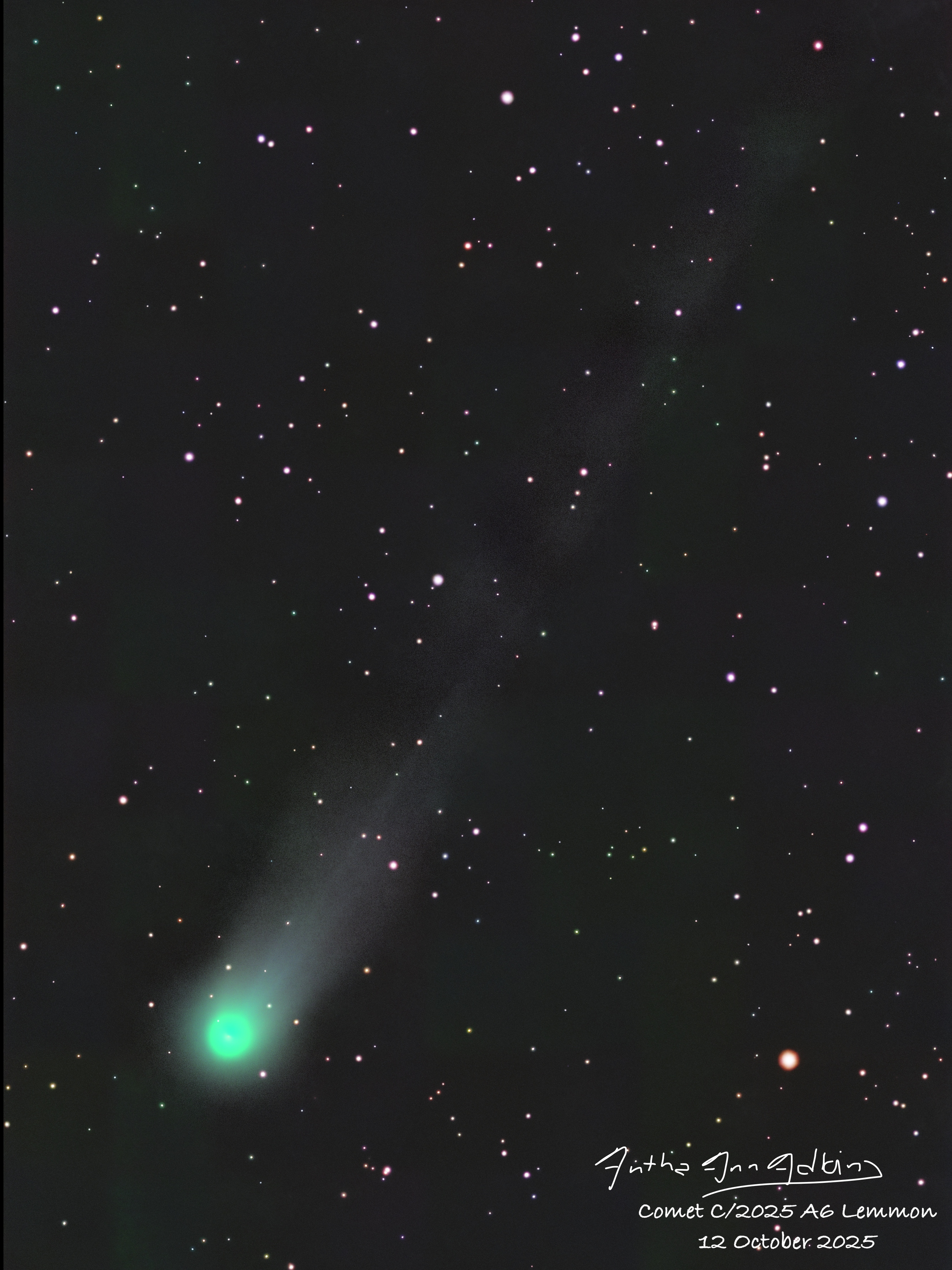
Sunday, October 12, was my third morning in a row trying to capture Comet C/2025 A6 Lemmon. This time, I used my bigger telescope, Blue, from my driveway.
From my Bortle 8 driveway, I still could not spot the comet with binoculars.
My larger telescope with about 1.2 hours worth of data certainly picked up more details in the comet and more stars than my smaller telescope did two nights earlier.
Comet processing takes a long time, and I’ve had some good luck as far as weather, more pictures to come …
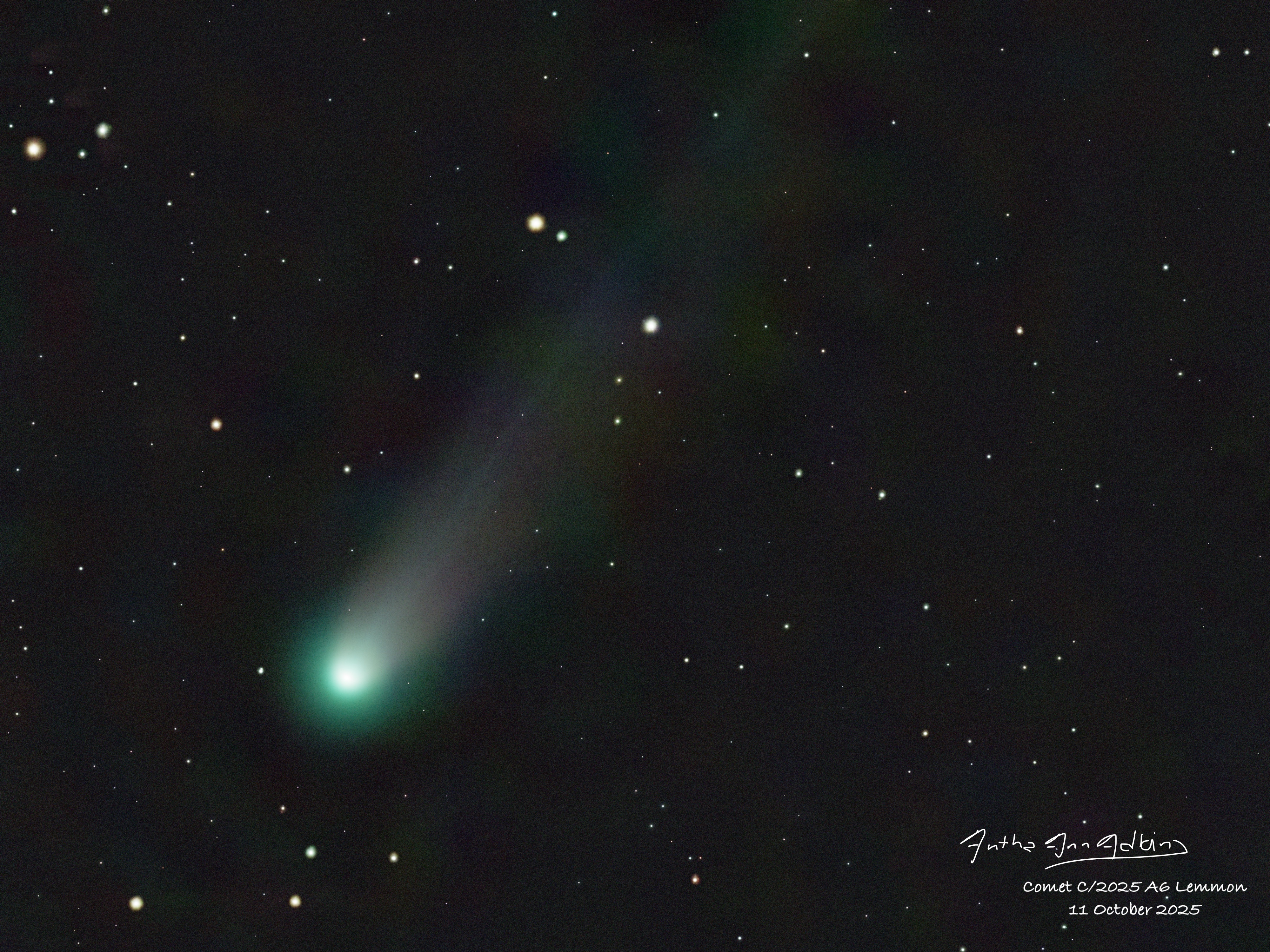
Saturday, October 11, was my second morning in a row trying to capture Comet C/2025 A6 Lemmon. This time, my husband and I drove to darker skies with a clear horizon looking out over the water in Bacliff, Texas.
From Bortle 6 skies, the comet was lovely in my smaller telescope, but I could not spot it in single images with my camera with an 85 mm lens or with the binoculars.
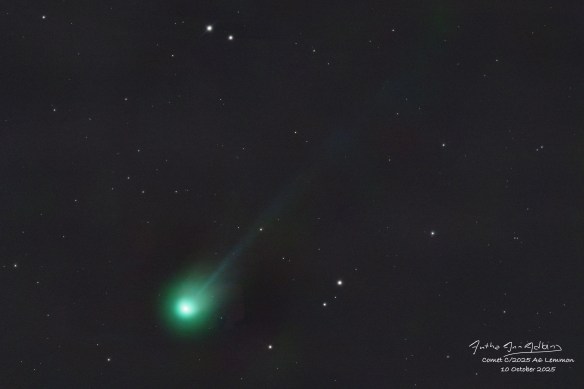
Comparing this image, which uses less data, to the image I got the day before from my driveway with brighter skies, I think you can see that the drive to even slightly darker skies was worth it.
Comet C/2025 A6 Lemmon has the potential to become brighter and naked eye visible when it is closest to the Earth in the early evening on October 21, 2025.
But it can be seen now before sunrise with the right tools. I picked my smaller telescope “Z” in case the tail was long (next time I’m going to try my bigger telescope). I calculated the amount of time that the comet would move across a half pixel to set the exposure length of 30 seconds so the comet wouldn’t blur.
On Friday morning from my Bortle 7 – 8 driveway, the comet was lovely in my smaller telescope, but I could not spot it in single images with my camera with an 85 mm lens or with the binoculars.
Happily, this is a holiday weekend with clear skies, so I am going to have several chances to image it.
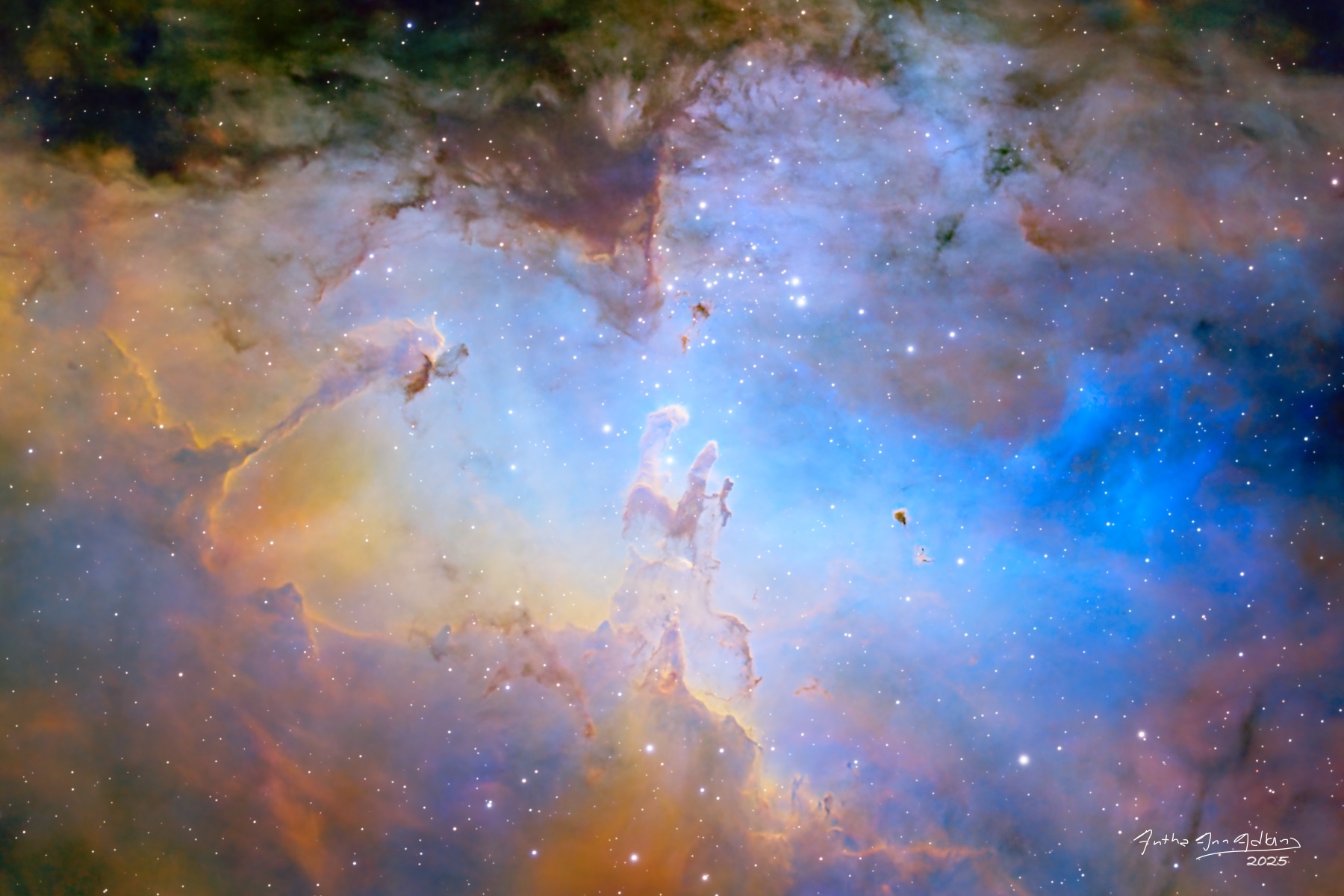
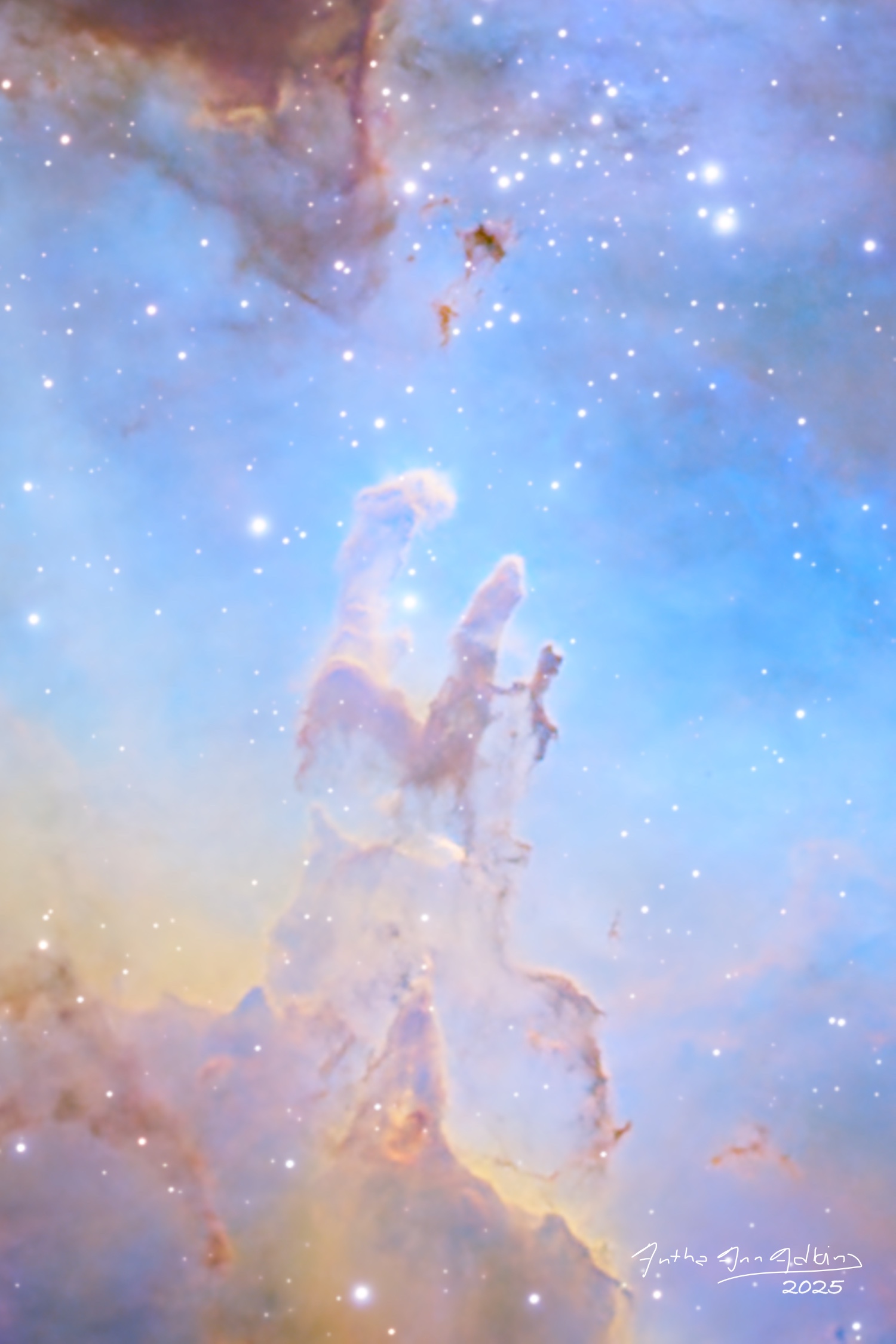
The traditional name for Messier 16 (M16) is the Eagle Nebula or the Star Queen Nebula. However, when I saw the first Hydrogen alpha narrowband images that went into this image, I did not think it looked like a bird. I thought the round nebula on the top looked like the knob on top of the cover of a jewel box (or perfume bottle). The bright inner center of the nebula with its young stars looked like jewels (so I picked the jewel box analogy). And the pillars in this nebula are the famous Pillars of Creation imaged by the Hubble Space Telescope. So I think the name the “Jewel Box of Creation” is also a lovely description of this beautiful Deep Space Object (DSO). What do you think it looks like?
M16 contains two related things: an emission nebula numbered IC4703 or Sharpless Sh2-49 and an open cluster numbered New General Catalogue (NGC) 6611. The emission nebula is part of Giant Molecular Cloud W37, an interstellar cloud of gas molecules, primarily molecular hydrogen (H2) and carbon monoxide (CO), the mass of which is calculated to be 170,000 times the mass of the Sun. The nebula is a large star-forming region ionized by the stars it generated. The open cluster of stars has an inferred population of 8100 stars including at least 137 visible young stars in the Gaia Early Data Release 3 (EDR3) with good data and magnitudes greater than G=17.5 in two populations: one older (7.5 +/- 0.4 million years old) and more spread out and one younger (1.3 +/- 0.2 million years old) and more concentrated. (As a point of reference, our own star, the Sun, is 4.6 billion years old – 3500 times older than the younger stars! What are you 3500 times older than?). The young population includes 19 type O stars which are high mass, hot, blue stars with short lives due to their high mass. One binary pair of these type O stars, HD168076, is the brightest star in the cluster visually, has a mass of 75 to 80 times the mass of the Sun, and is the primary source ionizing the nebula.
M16 is located in the Milky Way, approximately 5513 light years away, and it has an apparent size of 1.3 degrees, so it is approximately 125 light years across.
In this image, the stars came from images using red-green-blue filters with about 30 minutes of data each, and the nebula came from images using Sulfur ii (4.15 hours of data mapped to red), Hydrogen alpha (1.75 hours of data mapped to green) and Oxygen iii (2.25 hours of data mapped to blue) filters, the standard SHO mapping. But after doing that mapping, I used Narrowband Normalization to shift the colors so that it wasn’t overly green and to enhance the reds and blues. This tool made getting the colors in this nebula look right a lot easier! Even so, I ended up making multiple attempts to try to show it well and got some excellent advice on astrobin on how to improve the image. The nebula was processed separately from the stars to maximally enhance it.
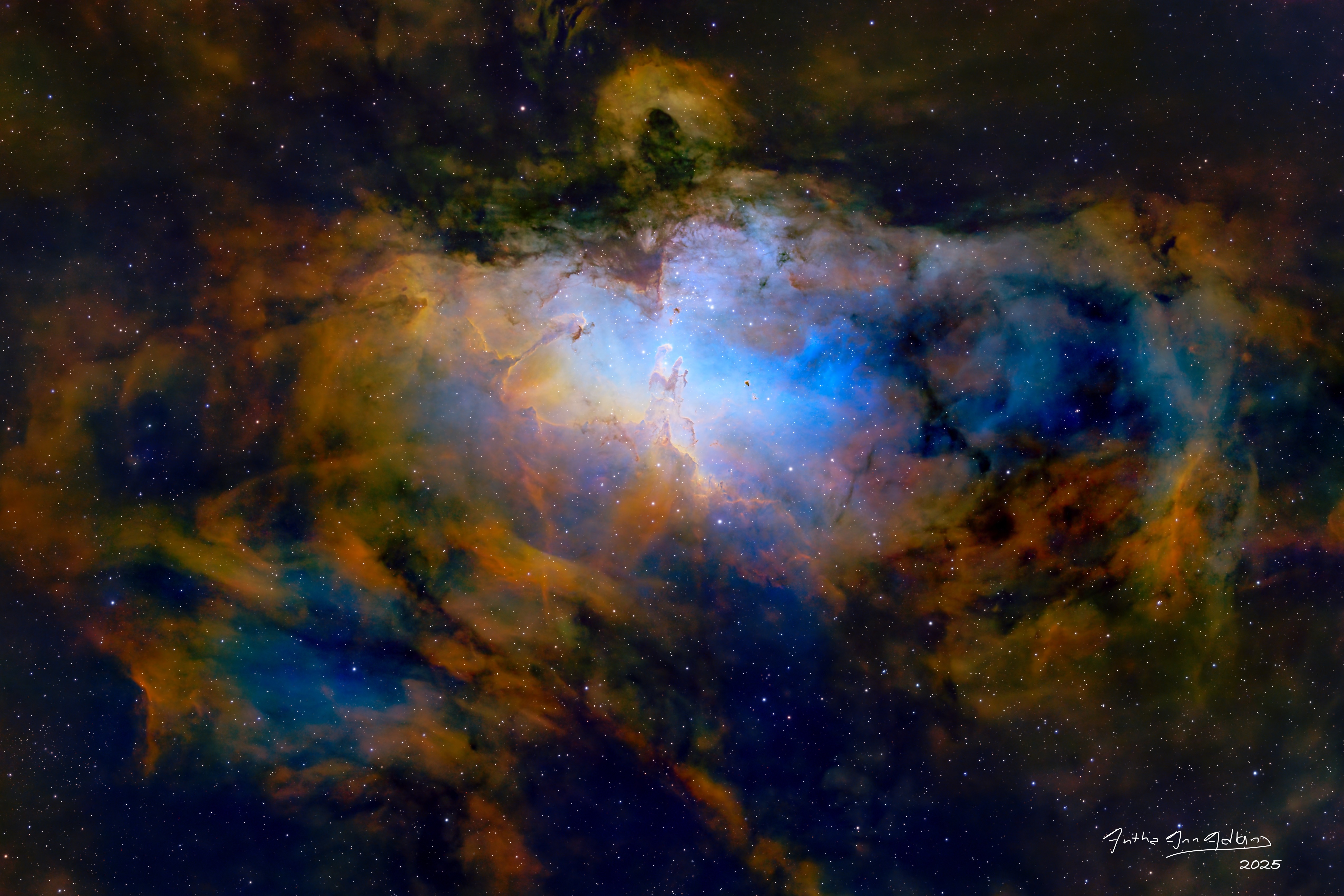
I think this nebula and star cluster are absolutely gorgeous! We live in a universe filled with wonders.
Camera geek info – Narrowband:
William Optics Pleiades 111 telescope
ZWO 2” Electronic Filter Wheel
Antila SHO and RGB filters
Blue Fireball 360° Camera Angle Adjuster/Rotator
ZWO ASI183MM-Pro-Mono camera
William Optics Uniguide 32MM F/3.75
ZWO ASI220MM-mini
ZWO ASiair Plus
iOptron CEM40
Friendswood, Texas Bortle 7-8 suburban skies
Frames:
August 28, 2025
96 20 second Gain 150 Red lights
30 0.02 second Gain 150 Red flats
91 20 second Gain 150 Green lights
30 0.01 second Gain 150 Green flats
92 20 second Gain 150 Blue lights
30 0.01 second Gain 150 Blue flats
24 180 second Gain 150 Sii lights
30 0.5 second Gain 150 Sii flats
September 9, 2025
35 180 second Gain 150 Ha lights
30 0.5 second Gain 150 Ha flats
September 11, 2025
45 180 second Gain 150 Oiii lights
30 0.2 second Gain 150 Oiii flats
September 12, 2025
59 60 second Gain 150 Sii lights
30 0.5 second Gain 150 Sii flats
30 Flat Darks matching flat durations from library
My tracking mount is now in the shop, so I thought I’d have to go without taking astrophotos for a while … but when I woke up early yesterday morning, my husband recommended I go outside and check out the conjunction of the crescent Moon, Venus, and the star Regulus. It was beautiful!
I got my old setup – my trusty Canon 60D and tripod and intervalometer/cable release and set up to take some pictures.
As I was focusing on the Moon and looking at camera view screen, I saw a satellite moving across the dark face of the Moon! How cool! Then I saw a second satellite moving across the dark face of the Moon in the same direction, which made me suspect I was seeing Starlink satellites.
I processed the best image I took in PixInsight and discovered there was a bright spot on the face of the Moon. So I used the GoSatWatch app on my phone, set to 0 degrees horizon and no limit on magnitude to get all the satellites, and figured out which satellites crossed the face of the Moon when my picture was taken. There were a ton of Starlinks which made them the very high probability source. My time stamps are only good to the minute, and I don’t have the exact time the Starlinks crossed the moon although when they were high in the East was a good stand-in, but it looks like there were two potential Starlinks crossing the Moon around the time of my photo!
It was a pretty neat thing to see, and I think it would be fun to try to capture a bigger satellite (eg the International Space Station) crossing the Moon with my telescope after I get my tracking mount back. Something to look forward to!
Camera geek info:
Canon EOS 60D in manual mode set at f/4, 1/60 second exposure, ISO 1250
Canon EF 70-200mm f/4L USM lens, set at 200 mm, manual focus on lunar craters
The Vela Supernova Remnant (SNR) or G263.9-03.3 is the material expelled from the explosion of a star in a supernova. In this case, the original star was estimated to be 8.1 – 10.3 times the mass of the sun, and the final star, PSR J0834-4511 is a pulsar, a magnetized rotating neutron star. The supernova was estimated to occur 18000 +/-9000 years ago based on its motion away from the SNR. The Vela SNR located in the Milky Way, approximately 815.5 light years away, and it has an apparent size of 4.25 degrees, making it 60.5 light years across.
This image is only a portion of the whole nebula. In this image, the stars came from images using red, green, and blue filters, and the nebula came from images using Hydrogen alpha (mapped to red) and Oxygen iii (mapped to blue) filters. The nebula was processed separately from the stars to maximally enhance it. I didn’t really have enough data – only 41 minutes of Oxygen iii data and 185 minutes (3.1 hours) of Hydrogen alpha data, so it took some very careful processing to get even this much of the SNR remnant visible.
I’m looking forward to returning to the fabulous dark skies of Dell City, Texas to collect more data on this beautiful object and also to collecting data from more parts of it.
While researching this object, I learned that pulsars were first discovered by a woman – Dame Jocelyn Bell Burnett, a Northern Irish astrophysicist. She discovered a radio signal, determined that it had a regular pulse, and then found three other similar signals. The physicists had to convince themselves that these were not man-made signals or alien transmissions. Bell Burnell is listed as the second author on the paper announcing its discovery. Yet, possibly because she was a graduate student at the time (or because she was a woman), she wasn’t recognized by the Nobel committee when they awarded the prize for this discovery. She attributed not being recognized to her having been a research student at the time and noted that she was in good company. Her speech on the discovery is funny and well worth reading. She stayed active in astrophysics and has received a number of other prestigious awards.
The other thing I noticed in the data I collected about this object is that when this supernova occurred (even with the longest ago estimate), people would have seen it. This would have been before recorded history though (even with the shortest ago estimate). I wonder what they thought? What do you think they thought?
Camera geek info:
William Optics Zenith Star 73 III APO telescope
William Optics Flat 73A
ZWO 2” Electronic Filter Wheel
Antila HO and RGB filters
ZWO ASI183MM-Pro-Mono camera
ZWO ASiair Plus
iOptron CEM40
Dell City, Texas Bortle 2-3 dark skies
Frames:
February 15, 2025
51 60 second Gain 150 Ha lights
30 1 second Gain 150 Ha flats
February 17, 2025
37 30 second Gain 150 Red lights
30 0.05 second Gain 150 Red flats
8 30 second Gain 150 Green lights
30 0.02 second Gain 150 Green flats
February 18, 2025
30 30 second Gain 150 Red lights
30 0.05 second Gain 150 Red flats
40 30 second Gain 150 Green lights
30 0.02 second Gain 150 Green flats
39 30 second Gain 150 Blue lights
30 0.02 second Gain 150 Blue flats
9 60 second Gain 150 Ha lights
30 1 second Gain 150 Ha flats
February 19, 2025
96 60 second Gain 150 Ha lights
30 0.5 second Gain 150 Ha flats
41 60 second Gain 150 Oiii lights
30 0.2 second Gain 150 Oiii flats
February 21, 2025
29 60 second Gain 150 Ha lights
30 0.5 second Gain 150 Ha flats
30 Flat Darks matching flat durations from library