Unknown's avatar

About acubedsf

SFF Author * Engineer * Mom

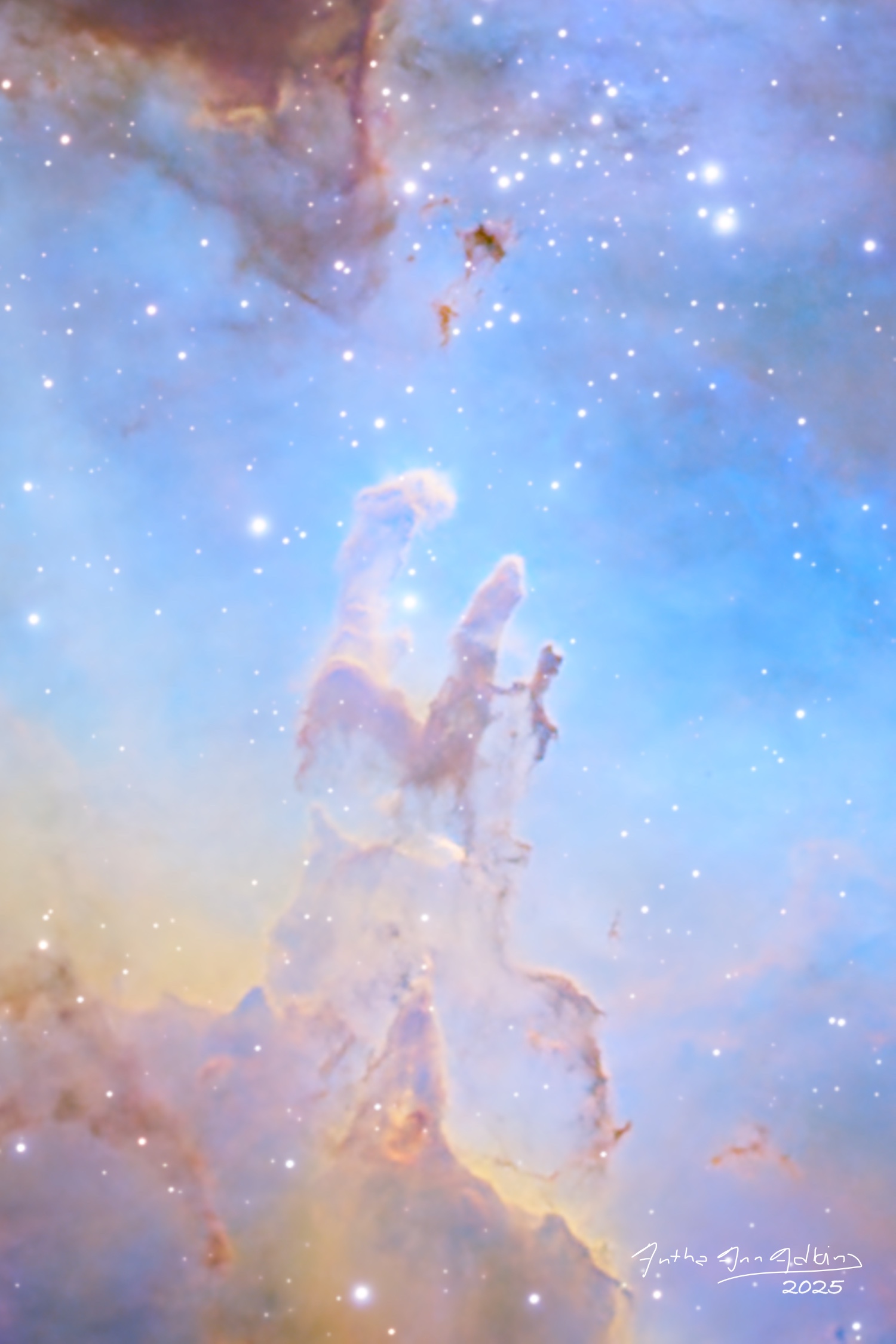
M16 The Jewel Box of Creation (or the Eagle Nebula)

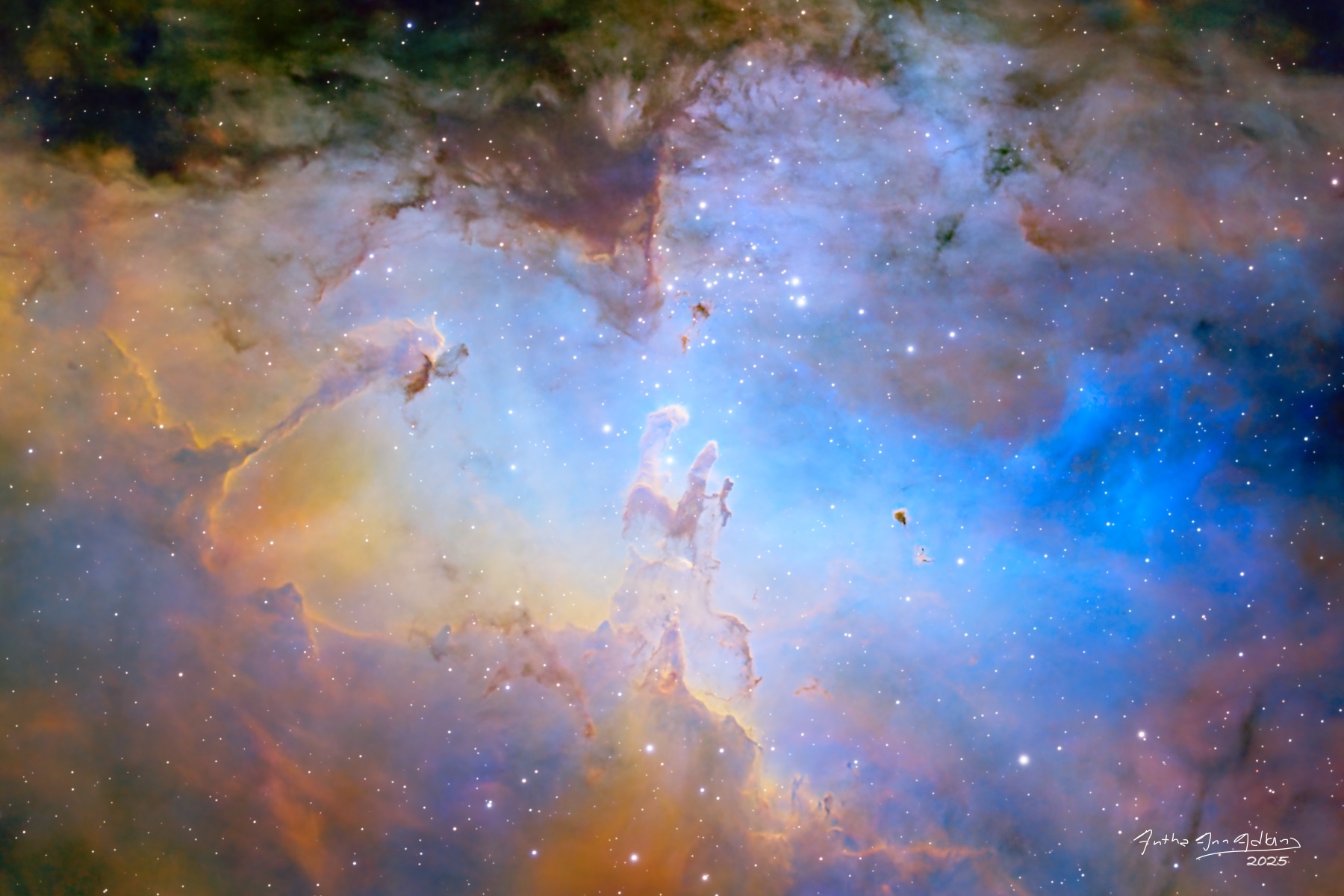
The traditional name for Messier 16 (M16) is the Eagle Nebula or the Star Queen Nebula.  However, when I saw the first Hydrogen alpha narrowband images that went into this image, I did not think it looked like a bird. I thought the round nebula on the top looked like the knob on top of the cover of a jewel box (or perfume bottle).  The bright inner center of the nebula with its young stars looked like jewels (so I picked the jewel box analogy).  And the pillars in this nebula are the famous Pillars of Creation imaged by the Hubble Space Telescope.  So I think the name the “Jewel Box of Creation” is also a lovely description of this beautiful Deep Space Object (DSO).  What do you think it looks like?

M16 contains two related things: an emission nebula numbered IC4703 or Sharpless Sh2-49 and an open cluster numbered New General Catalogue (NGC) 6611.  The emission nebula is part of Giant Molecular Cloud W37, an interstellar cloud of gas molecules, primarily molecular hydrogen (H2) and carbon monoxide (CO), the mass of which is calculated to be 170,000 times the mass of the Sun.  The nebula is a large star-forming region ionized by the stars it generated.  The open cluster of stars has an inferred population of 8100 stars including at least 137 visible young stars in the Gaia Early Data Release 3 (EDR3) with good data and magnitudes greater than G=17.5 in two populations: one older (7.5 +/- 0.4 million years old) and more spread out and one younger (1.3 +/- 0.2 million years old) and more concentrated.  (As a point of reference, our own star, the Sun, is 4.6 billion years old – 3500 times older than the younger stars!  What are you 3500 times older than?). The young population includes 19 type O stars which are high mass, hot, blue stars with short lives due to their high mass.  One binary pair of these type O stars, HD168076, is the brightest star in the cluster visually, has a mass of 75 to 80 times the mass of the Sun, and is the primary source ionizing the nebula.  

M16 is located in the Milky Way, approximately 5513 light years away, and it has an apparent size of 1.3 degrees, so it is approximately 125 light years across.    

In this image, the stars came from images using red-green-blue filters with about 30 minutes of data each, and the nebula came from images using Sulfur ii (4.15 hours of data mapped to red), Hydrogen alpha (1.75 hours of data mapped to green) and Oxygen iii (2.25 hours of data mapped to blue) filters, the standard SHO mapping.  But after doing that mapping, I used Narrowband Normalization to shift the colors so that it wasn’t overly green and to enhance the reds and blues.  This tool made getting the colors in this nebula look right a lot easier!  Even so, I ended up making multiple attempts to try to show it well and got some excellent advice on astrobin on how to improve the image. The nebula was processed separately from the stars to maximally enhance it.
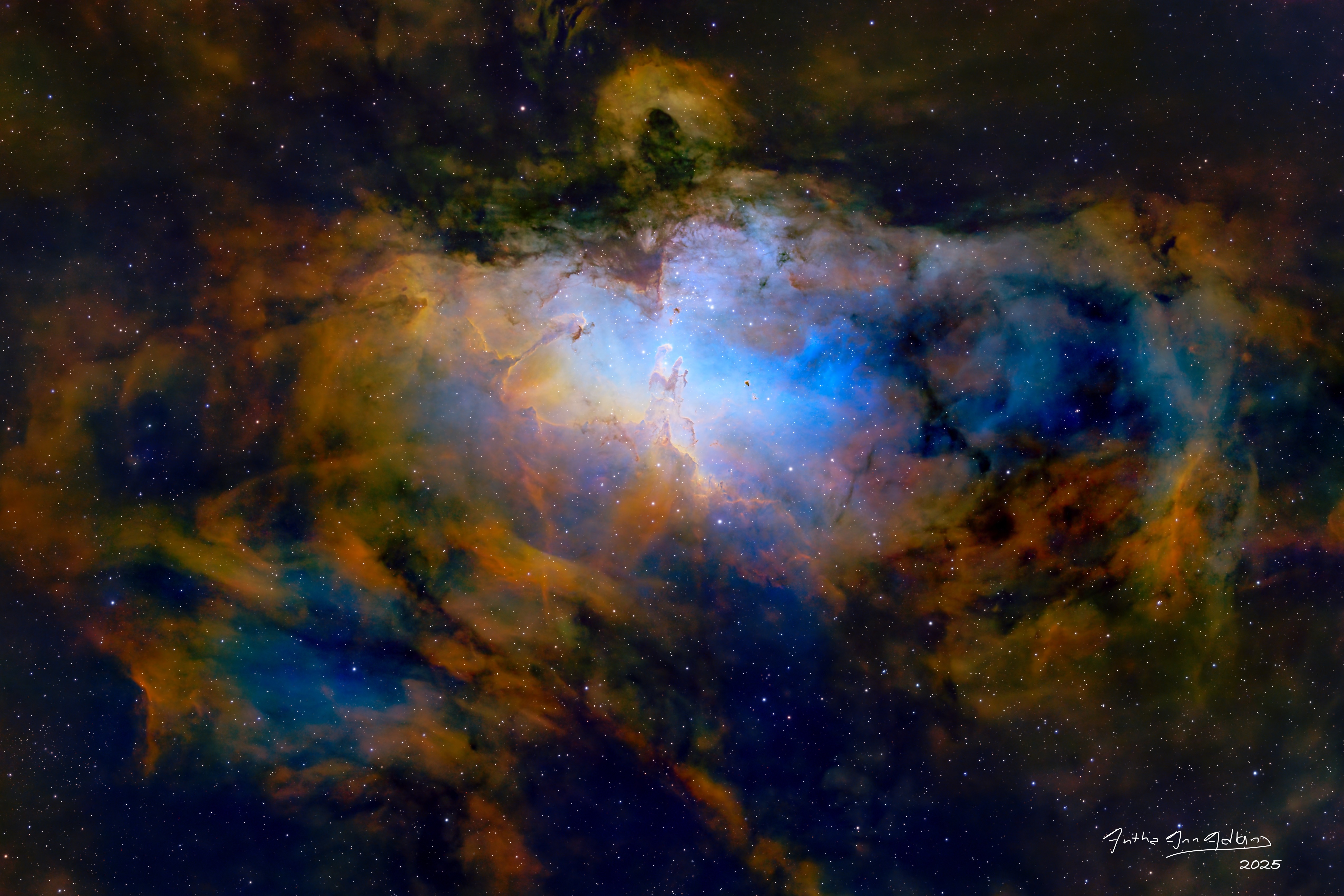
I think this nebula and star cluster are absolutely gorgeous!  We live in a universe filled with wonders.

Camera geek info – Narrowband:

  • William Optics Pleiades 111 telescope
  • ZWO 2” Electronic Filter Wheel
  • Antila SHO and RGB filters
  • Blue Fireball 360° Camera Angle Adjuster/Rotator
  • ZWO ASI183MM-Pro-Mono camera
  • William Optics Uniguide 32MM F/3.75
  • ZWO ASI220MM-mini
  • ZWO ASiair Plus
  • iOptron CEM40
  • Friendswood, Texas Bortle 7-8 suburban skies

Frames:

  • August 28, 2025
    • 96 20 second Gain 150 Red lights
    • 30 0.02 second Gain 150 Red flats
    • 91 20 second Gain 150 Green lights
    • 30 0.01 second Gain 150 Green flats
    • 92 20 second Gain 150 Blue lights
    • 30 0.01 second Gain 150 Blue flats
    • 24 180 second Gain 150 Sii lights
    • 30 0.5 second Gain 150 Sii flats
  • September 9, 2025
    • 35 180 second Gain 150 Ha lights
    • 30 0.5 second Gain 150 Ha flats
  • September 11, 2025
    • 45 180 second Gain 150 Oiii lights
    • 30 0.2 second Gain 150 Oiii flats
  • September 12, 2025
    • 59 60 second Gain 150 Sii lights
    • 30 0.5 second Gain 150 Sii flats
  • 30 Flat Darks matching flat durations from library
  • 30 Darks matching light durations from library

Processing geek info:

  • PixInsight
  • BlurXterminator
  • NoiseXterminator
  • StarXTerminator
  • Narrowband Normalization
A Beautiful Conjunction: the Moon, Venus, Regulus … and Starlink?

My tracking mount is now in the shop, so I thought I’d have to go without taking astrophotos for a while … but when I woke up early yesterday morning, my husband recommended I go outside and check out the conjunction of the crescent Moon, Venus, and the star Regulus.  It was beautiful!

I got my old setup – my trusty Canon 60D and tripod and intervalometer/cable release and set up to take some pictures.

As I was focusing on the Moon and looking at camera view screen, I saw a satellite moving across the dark face of the Moon!  How cool!  Then I saw a second satellite moving across the dark face of the Moon in the same direction, which made me suspect I was seeing Starlink satellites.  

I processed the best image I took in PixInsight and discovered there was a bright spot on the face of the Moon.  So I used the GoSatWatch app on my phone, set to 0 degrees horizon and no limit on magnitude to get all the satellites, and figured out which satellites crossed the face of the Moon when my picture was taken.  There were a ton of Starlinks which made them the very high probability source.  My time stamps are only good to the minute, and I don’t have the exact time the Starlinks crossed the moon although when they were high in the East was a good stand-in, but it looks like there were two potential Starlinks crossing the Moon around the time of my photo!  

It was a pretty neat thing to see, and I think it would be fun to try to capture a bigger satellite (eg the International Space Station) crossing the Moon with my telescope after I get my tracking mount back.  Something to look forward to!

Camera geek info:

  •             Canon EOS 60D in manual mode set at f/4, 1/60 second exposure, ISO 1250
  •             Canon EF 70-200mm f/4L USM lens, set at 200 mm, manual focus on lunar craters
  •             Tripod
  •             Intervalometer used as cable release

Vela Supernova Remnant and the Discovery of Pulsars

The Vela Supernova Remnant (SNR) or G263.9-03.3 is the material expelled from the explosion of a star in a supernova.  In this case, the original star was estimated to be 8.1 – 10.3 times the mass of the sun, and the final star, PSR J0834-4511 is a pulsar, a magnetized rotating neutron star.  The supernova was estimated to occur 18000 +/-9000 years ago based on its motion away from the SNR.  The Vela SNR located in the Milky Way, approximately 815.5 light years away, and it has an apparent size of 4.25 degrees, making it 60.5 light years across.   

This image is only a portion of the whole nebula.  In this image, the stars came from images using red, green, and blue filters, and the nebula came from images using Hydrogen alpha (mapped to red) and Oxygen iii (mapped to blue) filters.  The nebula was processed separately from the stars to maximally enhance it.  I didn’t really have enough data – only 41 minutes of Oxygen iii data and 185 minutes (3.1 hours) of Hydrogen alpha data, so it took some very careful processing to get even this much of the SNR remnant visible.

I’m looking forward to returning to the fabulous dark skies of Dell City, Texas to collect more data on this beautiful object and also to collecting data from more parts of it.  

While researching this object, I learned that pulsars were first discovered by a woman – Dame Jocelyn Bell Burnett, a Northern Irish astrophysicist.  She discovered a radio signal, determined that it had a regular pulse, and then found three other similar signals.  The physicists had to convince themselves that these were not man-made signals or alien transmissions.  Bell Burnell is listed as the second author on the paper announcing its discovery.  Yet, possibly because she was a graduate student at the time (or because she was a woman), she wasn’t recognized by the Nobel committee when they awarded the prize for this discovery.  She attributed not being recognized to her having been a research student at the time and noted that she was in good company.  Her speech on the discovery is funny and well worth reading.  She stayed active in astrophysics and has received a number of other prestigious awards.  

The other thing I noticed in the data I collected about this object is that when this supernova occurred (even with the longest ago estimate), people would have seen it.  This would have been before recorded history though (even with the shortest ago estimate).  I wonder what they thought?  What do you think they thought?

Camera geek info:

  • William Optics Zenith Star 73 III APO telescope
  • William Optics Flat 73A
  • ZWO 2” Electronic Filter Wheel
  • Antila HO and RGB filters
  • ZWO ASI183MM-Pro-Mono camera
  • ZWO ASiair Plus
  • iOptron CEM40
  • Dell City, Texas Bortle 2-3 dark skies

Frames:

  • February 15, 2025
    • 51 60 second Gain 150 Ha lights
    • 30 1 second Gain 150 Ha flats
  • February 17, 2025
    • 37 30 second Gain 150 Red lights
    • 30 0.05 second Gain 150 Red flats
    • 8 30 second Gain 150 Green lights
    • 30 0.02 second Gain 150 Green flats
  • February 18, 2025
    • 30 30 second Gain 150 Red lights
    • 30 0.05 second Gain 150 Red flats
    • 40 30 second Gain 150 Green lights
    • 30 0.02 second Gain 150 Green flats
    • 39 30 second Gain 150 Blue lights
    • 30 0.02 second Gain 150 Blue flats
    • 9 60 second Gain 150 Ha lights
    • 30 1 second Gain 150 Ha flats
  • February 19, 2025
    • 96 60 second Gain 150 Ha lights
    • 30 0.5 second Gain 150 Ha flats
    • 41 60 second Gain 150 Oiii lights
    • 30 0.2 second Gain 150 Oiii flats
  • February 21, 2025
    • 29 60 second Gain 150 Ha lights
    • 30 0.5 second Gain 150 Ha flats
  • 30 Flat Darks matching flat durations from library
  • 30 Darks from library

Processing geek info:

  • PixInsight
  • BlurXterminator
  • NoiseXterminator
  • StarXTerminator
  • Generalized Hyperbolic Stretch
  • ImageBlend

William Optics Pleiades 111 First Light and More Nights with M101 the Pinwheel Galaxy

I chose M101 as my “first light” object for my new William Optics Pleiades 111 telescope, “Blue,” because it was galaxy season when I started imaging back in May and I had imaged it before so I could compare the results with my smaller telescope setup.

My oldest comparison image is from June 2023, when there was a supernova in the galaxy.  I collected the data from the fabulous dark skies in Dell City, Texas, using my William Optics Zenith Star 73 III APO telescope and a Canon 60D camera.  The image was made from 10.6 hours of data.

My next comparison image is from January 2024.  I collected the data from Friendswood, Texas with suburban light pollution using my William Optics Zenith Star 73 III APO telescope and my at-the-time new ZWO ASI183MM-Pro-Mono camera and ZWO filter wheel. The image was made using 59 minutes of red data, 60 minutes of green data, and 57 minutes of blue data. 

My next image is from May 2025 in Friendswood, Texas, and it was the first light on my William Optics Pleiades 111 telescope “Blue” using a new guide camera and using my existing ZWO ASI183MM-Pro-Mono camera.   The image used only 52 minutes of red data, 66 minutes of green data, and 86 seconds of blue data, and I had to adjust some of the local normalization parameters to accept lower quality data to get it to process.  I had been excited to have a semi-clear night, so I had gotten the telescope out even though seeing wasn’t great.

My final (for now) image is from May – August 2025 in Friendswood, Texas.  The new telescope cloud curse has been particularly strong with this telescope, and when there weren’t clouds, there was dust or a full Moon. Nevertheless, I persevered over 8 nights to produce the final image, ending up using 5.9 hours of red data, 5.3 hours of green data, and 4.8 hours of blue data.

There was a huge improvement in the detail (most obvious with the stars) when I switched to the astrocamera, and another huge improvement in the detail (most obvious in the galaxy and in the background galaxies) when I switched to the larger telescope and guiding capability.

My main subject, M101, the Pinwheel Galaxy, is an intermediate spiral galaxy, between a barred and an unbarred spiral galaxy.  It’s located approximately 23.2 million light years away, and it has an apparent size of 24 arcminutes, making it about 162 thousand light years across. 

Also obvious during imaging was NGC5474, which is a peculiar dwarf galaxy that is a companion to M101.  Its interaction with M101 has distorted it.  It also appears to have a spiral structure, making it a dwarf spiral galaxy.  It’s located approximately 22.4 million light years away, and it has an apparent size of 4.68 arcminutes, making it about 30.4 thousand light years across.

What surprised me with in the final image was the sheer number of tiny galaxies in the background.  In addition to NGC5474, there was NGC5477, a dwarf galaxy which is 22.05 million light years away, with an apparent size of 1.7 arcminutes, making it 10.9 thousand light years across.  PixInsight also labeled 8 other galaxies in the Principal Galaxies Catalog (PGC).  And when I looked in detail at the image, there are a ton more tiny distant galaxies in the background.  WOW. 

Now M101 is really too low in the sky to get any good data from my driveway, so I am moving on to other subjects.  I look forward to coming back to this one in the future and capturing more of the amazing background galaxies. 

Our universe is packed with cool stuff!  

Camera geek info for final image:

  • William Optics Pleiades 111 telescope
  • ZWO 2” Electronic Filter Wheel
  • Antila RGB filters
  • Blue Fireball 360° Camera Angle Adjuster/Rotator
  • ZWO ASI183MM-Pro-Mono camera
  • William Optics Uniguide 32MM F/3.75
  • ZWO ASI220MM-mini
  • ZWO ASiair Plus
  • iOptron CEM40
  • Friendswood, Texas Bortle 7-8 suburban skies

Frames for final image:

  • May 9, 2025
    • 13 60 second Gain 150 Red lights
    • 30 0.02 second Gain 150 Red flats
  • May 23, 2025
    • 29 60 second Gain 150 Red lights
    • 30 0.02 second Gain 150 Red flats
  • May 24, 2025
    • 2 60 second Gain 150 Red lights
    • 30 0.02 second Gain 150 Red flats
    • 54 60 second Gain 150 Green lights
    • 30 0.01 second Gain 150 Green flats
    • 50 60 second Gain 150 Blue lights
    • 30 0.01 second Gain 150 Blue flats
  • June 6, 2025
    • 84 60 second Gain 150 Red lights
    • 30 0.02 second Gain 150 Red flats
    • 72 60 second Gain 150 Green lights
    • 30 0.01 second Gain 150 Green flats
    • 63 60 second Gain 150 Blue lights
    • 30 0.01 second Gain 150 Blue flats
  • June 7, 2025
    • 100 60 second Gain 150 Red lights
    • 30 0.02 second Gain 150 Red flats
    • 74 60 second Gain 150 Green lights
    • 30 0.01 second Gain 150 Green flats
    • 63 60 second Gain 150 Blue lights
    • 30 0.01 second Gain 150 Blue flats
  • July 10, 2025
    • 57 60 second Gain 150 Red lights
    • 30 0.02 second Gain 150 Red flats
    • 46 60 second Gain 150 Green lights
    • 30 0.01 second Gain 150 Green flats
  • July 11, 2025
    • 69 60 second Gain 150 Red lights
    • 30 0.02 second Gain 150 Red flats
    • 23 60 second Gain 150 Green lights
    • 30 0.01 second Gain 150 Green flats
    • 12 60 second Gain 150 Blue lights
    • 30 0.01 second Gain 150 Blue flats
  • July 22, 2025
    • 93 60 second Gain 150 Blue lights
    • 30 0.01 second Gain 150 Blue flats
  • August 1, 2025
    • 51 60 second Gain 150 Green lights
    • 30 0.01 second Gain 150 Green flats
    • 6 60 second Gain 150 Blue lights
    • 30 0.01 second Gain 150 Blue flats
  • Darks, Flat darks from library

Capturing a new supernova in another galaxy: NGC7331 and SN2025rbs

Usually I don’t image on work nights so I get enough sleep.

However, the new telescope cloud curse has been strong, and I’ve only had a few clear nights since I bought my new William Optics Pleiades 111 telescope â€śBlue” earlier this year.  So when it was finally clear on Tuesday, I couldn’t resist taking my new telescope outside.  I continued to collect data on M101, but I had learned through a Facebook post that there was a new supernova in the galaxy NGC7331.  So after M101 set, I spent the rest of the night imaging NGC7331.

NGC7331 is an unbarred spiral galaxy.  It’s located approximately 47 million light years away, and it has an apparent size of 10.47 arcminutes, making it about 144 thousand light years across.  One paper on this galaxy argues that its central bulge rotates in the opposite direction of its outer disk – weird!  Another argues that the stars in the central bulge are old – 13 billion years old, while the stars in the disk are young – possibly 0.2 billion years old.  (This may not be unusual; our own galaxy is still making stars in its outer arms right now, which I also think is really cool.)  

Supernova 2025rbs is a Type 1A supernova, which occurs when a white dwarf star collects material from a companion star, almost reaches the Chandrasekar mass, starts fusing carbon, experiences a runaway reaction, and explodes, releasing an enormous, but predictable, amount of energy.  Type 1A supernovas can be used as standard candles to measure the distance to the supernova (and in cases like SN2025rbs the distance to the home galaxy) because the energy they release and thus their brightness is predictable.  SN2025rbs was discovered by the Gravitational-wave Optical Transient Observer (GOTO) on July 14, 2025.

You can clearly see SN2025rbs as a bright spot near the galaxy center.  In fact, it appears to outshine the galaxy center, which I find amazing.  

When I imaged this, I deliberately used short capture times (15 seconds) so that the bright supernova would not “blow out” and clip to pure white or cause “pixel bloom” where the light overwhelms the pixel capturing it and so bleeds into the nearby pixels.  

I spent a fair bit of time thinking about how this image “should” be processed.  On the one hand, I wanted to preserve the relative amount of light and color for the supernova relative to both the star field and NGC7331, its host galaxy.  On the other hand, astroimages are inherently low-light and high dynamic range, which means that the data has to be non-linearly stretched to show both the relatively bright supernova and stars and the relatively dim galaxy.  

My standard PinInsight processing flow includes using BlurXTerminator (BXT) to sharpen the stars and non-stellar objects, NoiseXTerminator (NXT) to remove noise, and then StarXTerminator (SXT) to separate the stars from the non-stellar objects so they can be stretched separately.

I considered whether I should skip the BXT processing step.  BXT sharpens the stars and makes them smaller, and it did the same to the supernova but not the NGC7331 galactic core.  The BXT documentation says, “BlurXTerminator is trained to conserve flux, the total amount of light associated with a feature such as a star. When a blurred star is made less blurry, the light from some number of pixels is concentrated into a smaller number of pixels. Those pixels must get brighter for the total amount of flux to be the same.”  Based on that statement, I think since BXT preserves the amount of light in each star, it also preserves the relative amount of light between the stars and between the stars and the supernova (assuming none of them are clipped because they exceed the max brightness level, which did not happen in this case).  Further, since stars (and supernovae) are point sources of light and with perfect seeing and optics would only be “seen” in one pixel, using BXT to sharpen the stars and the supernova should be making them more like their “true” amount of light relative to the galaxy as well.  So I left the BXT step in my processing flow.

I also considered whether I should skip the SXT step and stretch the stars, supernova, and galaxies together or use SXT and stretch them separately.  Either way, there is no longer a linear relationship between the brightness of the objects.  If I processed this as a single image, the brightness ordering – what is brighter than what – would be maintained.  If I used SXT so I could stretch the galaxies separately, I could end up making the galaxy core brighter than the supernova, even though it was not in the raw data.  On the other hand, I could show more detail in the galaxy if I processed it separately.  I ended up deciding that, in this case, what was most important to me was to maintain the brightness order and show that the supernova was brighter than the galactic core.  So I processed it as a single image.

My final PixInsight processing flow was:

  • WBPP to calibrate, normalize, and integrate three channels of RGB data
  • ChannelCombination to combine the RGB channels into a single image
  • DBE to remove the excess blue in the background
  • SPCC to calibrate the color
  • BXT to sharpen the stars and the galaxy
  • NXT to to remove some noise since this is only a few hours worth of data from my Bortle 7-8 light polluted skies
  • Histogram Transformation to stretch the image

At some point, I’d like to collect more data on this galaxy and make a nicer picture of it.  But the clouds are back now.  The curse continues …   

Camera geek info:

  • William Optics Pleiades 111 telescope
  • ZWO 2” Electronic Filter Wheel
  • Antila RGB filters
  • Blue Fireball 360° Camera Angle Adjuster/Rotator
  • ZWO ASI183MM-Pro-Mono camera
  • William Optics Uniguide 32MM F/3.75
  • ZWO ASI220MM-mini
  • ZWO ASiair Plus
  • iOptron CEM40
  • Friendswood, Texas Bortle 7-8 suburban skies

Frames:

  • Lights
    • 248 15 second Gain 150 Red lights  (62 minutes)
    • 182 15 second Gain 150 Green lights (45.5 minutes)
    • 168 15 second Gain 150 Blue lights (42 minutes)
    • 30 0.2 second Gain 150 Red flats
    • 30 0.1 second Gain 150 Green flats
    • 30 0.1 second Gain 150 Blue flats
  • Darks, Flat darks from library

M101: First Light with William Optics Pleiades 111 Telescope â€śBlue”

It’s a well-known astrophotography curse that buying new equipment means weeks, if not months, worth of cloudy skies.  My new telescope, a William Optics Pleiades 111, a 11.1 cm/4.37 inch diameter refractor that I’ve nicknamed “Blue”, was no exception.  It took about a month after I got the telescope (and the additional two counter weights I needed to balance it) for the skies to at least somewhat clear.  I got everything set up, just to watch the clouds roll in.  Happily, they then rolled back out.  And then rolled back in.  And out.

I ended up with enough data to make a first light picture, but I’ll need to collect more data for a final image.

I had contemplated what to image for first light.  Since the telescope name is Pleiades, the Pleiades would have been a good target, except they’re currently barely above the horizon at sunset.  My favorite nebula, the Orion nebula, would have been a good target, except it’s also currently barely above the horizon at sunset.  It’s “galaxy season,” so I decided to image a galaxy.  I’ve imaged M101 before because it hosted a supernova in 2023, so it gave me a good point of comparison.  

The comparison isn’t entirely a fair one.  On the one hand, this is an entirely new setup, with a much larger diameter telescope, an astro camera instead of a consumer camera, and a guide scope and guide camera to better control the tracking mount.  Additionally, I’ve picked up a lot of processing skill in the last two years, such as using shorter images for the stars so they don’t “bloat.”  On the other hand, this was 3.4 hours of galaxy data from my Bortle 7-8 light polluted driveway instead of 10.6 hours from the Bortle 2-3 dark skies of Dell City.

Because of the light pollution and limited imaging time, there is a lot more background noise in the new image.  But the stars are enormously improved from the old image.  And there is more detail in the new image.  I can’t wait to see how an image with more data turns out!

Once the clouds roll away again ….

Camera geek info May 9, 2025 (new image):

  • William Optics Pleiades 111 telescope
  • ZWO 2” Electronic Filter Wheel
  • Antila RGB filters
  • Blue Fireball 360° Camera Angle Adjuster/Rotator
  • ZWO ASI183MM-Pro-Mono camera
  • William Optics Uniguide 32MM F/3.75
  • ZWO ASI220MM-mini
  • ZWO ASiair Plus
  • iOptron CEM40
  • Friendswood, Texas Bortle 7-8 suburban skies

Frames (new image):

  • May 9, 2025
    • 32 30 second Gain 150 Red lights for stars
    • 24 30 second Gain 150 Green lights for stars
    • 22 30 second Gain 150 Blue lights for stars
    • 53 60 second Gain 150 Red lights for galaxy
    • 66 60 second Gain 150 Green lights for galaxy
    • 86 60 second Gain 150 Blue lights for galaxy
    • 30 0.2 second Gain 150 Red flats
    • 30 0.1 second Gain 150 Green flats
    • 30 0.1 second Gain 150 Blue flats
  • Darks, Flat darks from library

Camera geek info (old image):

  • William Optics Zenith Star 73 III APO telescope
  • William Optics Flat 73A
  • Canon EOS 60D in manual mode, 2 minute exposure, ISO 1600 and ISO 2000, custom white balance 3500K
  • iOptron CEM40
  • Dell City, Texas Bortle 2-3 dark skies

Frames (old image):

  • June 10, 2023
    • Run 1 1600 ISO
      • 99 2 minute lights
      • 31 0.01 second flats
      • 20 0.01 second flat darks
    • Run 2 1600 ISO
      • 39 2 minute lights
      • 31 0.02 second flats
      • 30 0.02 second flat darks
      • 71 2 minute darks
  • June 11, 2023 2000 ISO
    • 151 2 minute lights
    • 31 0.02 second flats
    • 20 0.02 second flat darks
    • 31 2 minute darks
  • June 12, 2023 2000 ISO
    • 30 2 minute lights
    • 31 0.02 second flats
    • 30 0.02 second flat darks
    • 32 2 minute darks

Processing geek info:

  • PixInsight
  • BlurXterminator
  • NoiseXterminator
  • StarXTerminator
  • Generalized Hyperbolic Stretch

Spectacular Comet C/2023 A3 Tsuchinshan ATLAS Image Collection

Last fall, the spectacular Comet C/2023 A3 Tsuchinshan ATLAS looped around the sun and put on a show in the early evening sky.  I had a great time having a comet tailgate party with friends, seeking it naked eye, and capturing it with my camera and an 85 mm lens.  

As the days passed and the comet travelled away from the sun, it grew dimmer and its tail grew shorter, and I switched over to using my telescope.  In the left-most of the lower images, you can see some interesting structure in the comet’s tail.  

Processing comets is a challenge because the comet moves relative to the stars and so has to be aligned and processed separately.  They take longer to process than other Deep Space Objects, and I only just finished processing all my images.  I thought it would be fun to collect them all together and make the picture above.

Imaging this visitor from the outer solar system was a great treat.  I’m looking forward to the next one.

Sh2-274 Abell 21 Medusa Nebula

Sh2-274 or Abell 21 or the Medusa Nebula is a planetary nebula – the gases expelled from a red giant star before it becomes a white dwarf, lit up by that star.  It’s located in the Milky Way, approximately 1930 light years away, and it has an apparent size of 10.25 arcminutes, making it 5.75 light years across.  Given the amount of time it would take to reach that size, it is considered to be an “ancient” planetary nebula.  

I find these small nebulae beautiful and fascinating. Each has its own unique structure.  This one has a Ha rim and an Oiii interior and has filaments (the filaments are probably the source of its nickname, the Medusa nebula).

In this image, the stars came from images using red-green-blue filters, and the nebula came from images using Hydrogen alpha (mapped to red) and Oxygen iii (mapped to blue) filters.  The nebula was processed separately from the stars to maximally enhance it.

I had hoped to get enough data on this one the last time we enjoyed the dark skies in Dell City, Texas, but there were a lot of high clouds that limited the amount of data I collected there.  So I collected more data from my driveway at home until I had almost 7 hours of Ha data and 6.7 hours of Oiii data.  

Camera geek info – Narrowband:

  • William Optics Zenith Star 73 III APO telescope
  • William Optics Flat 73A
  • ZWO 2” Electronic Filter Wheel
  • Antila HO and RGB filters
  • ZWO ASI183MM-Pro-Mono camera
  • ZWO ASiair Plus
  • iOptron CEM40
  • Friendswood, Texas Bortle 7-8 suburban skies
  • Dell City, Texas Bortle 2-3 dark skies

Frames:

  • January 24, 2025
    • 14 60 second Gain 150 Ha lights
    • 30 0.5 second Gain 150 Ha flats
  • February 15, 2025
    • 100 30 second Gain 150 Red lights
    • 30 0.05 second Gain 150 Red flats
    • 98 30 second Gain 150 Green lights
    • 30 0.02 second Gain 150 Green flats
    • 60 30 second Gain 150 Blue lights
    • 30 0.02 second Gain 150 Blue flats
  • February 20, 2025
    • 19 60 second Gain 150 Ha lights
    • 30 0.5 second Gain 150 Ha flats
    • 5 60 second Gain 150 Oiii lights
    • 30 0.2 second Gain 150 Oiii flats
  • February 21, 2025
    • 68 60 second Gain 150 Ha lights
    • 30 0.5 second Gain 150 Ha flats
    • 30 60 second Gain 150 Oiii lights
    • 30 0.2 second Gain 150 Oiii flats
  • February 22, 2025
    • 48 60 second Gain 150 Ha lights
    • 30 0.5 second Gain 150 Ha flats
    • 32 60 second Gain 150 Oiii lights
    • 30 0.2 second Gain 150 Oiii flats
  • April 7, 2025
    • 131 60 second Gain 150 Oiii lights
    • 30 0.2 second Gain 150 Oiii flats
  • April 8, 2025
    • 130 60 second Gain 150 Oiii lights
    • 30 0.2 second Gain 150 Oiii flats
  • April 10, 2025
    • 72 60 second Gain 150 Oiii lights
    • 30 0.2 second Gain 150 Oiii flats
  • April 11, 2025
    • 133 60 second Gain 150 Ha lights
    • 30 0.5 second Gain 150 Ha flats
  • April 12, 2025
    • 137 60 second Gain 150 Ha lights
    • 30 0.5 second Gain 150 Ha flats
  • 30 Flat Darks from library
  • 30 Darks from library

Processing geek info:

  • PixInsight
  • BlurXterminator
  • NoiseXterminator
  • StarXTerminator
  • NBColourMapper
  • Generalized Hyperbolic Stretch

Capturing Comet C/2025 F2 SWAN

In late March 2025, a new comet, C/2025 F2, was found in imagery from the Solar Wind Anisotropies (SWAN) camera on the Solar and Heliospheric Observatory (SOHO). 

Orbit images Courtesy NASA/JPL-Caltech.

The Jet Propulsion Laboratory (JPL) has a great orbital dynamics viewer where you can see its orbit relative to the planets.  It’s quite fun to play with!  C/2025 F2’s orbit is very parabolic and nearly 90 degrees out of the ecliptic plane.  It is coming in from north of the ecliptic plane, will loop around the sun near Mercury’s orbit on May 1, 2025, and then head back out to the outer solar system south of the ecliptic plane.  So it’s visible from the Northern Hemisphere in the early morning now, but as it approaches the sun, it will get more and more difficult to spot, and it will be more visible from the Southern Hemisphere on its outgoing trajectory.

“Now” was the best time to see it from the Northern Hemisphere, and we have had a nice string of days with clear skies, so last weekend, it was time to go comet hunting!  

I used the JPL Horizons System to predict the comet location and motion so that I knew where to point my telescope and I knew how long the images could be without “smearing” the comet – 15 seconds for my telescope and camera combo.

I loaded up my gear, and my husband and I drove to our favorite early morning comet viewing site in Bacliff, Texas.  By the time I had everything set up, the comet was above the horizon.  My preprogrammed location contained a small, fuzzy object which looked like a comet on the first try!  I was really delighted that everything worked on the first try; this has not always been the case in the past.  I spent some (probably too much) time trying to get it positioned better in the frame and started imaging.  It was brighter in green than in red and blue which, with its fuzziness, confirmed to me that it was likely a comet.  I couldn’t see a tail in my single images.

I set up my regular camera to see if I could get some wider field images.  Given what I ended up with in the telescope images, I do not think the comet will be visible in the wider field images.

Both my husband and I tried to find the comet with binoculars, with no luck at all.  

We finished the morning with a lovely sunrise and breakfast.

Processing comets is still a big challenge for me, with more steps than processing a nebula.  I mostly follow the excellent process outlined by Adam Block in his Comet Academy.  Blinking through my frames, I could see the comet moving across the sky, another sure indicator that I had captured the right object!  After aligning, integrating, and stretching the comet images, I could see a faint tail that stretched all the way across the field of view (about 2 degrees with this telescope and camera combination), but the background noise was brighter than it was.  I tried several methods to make the tail visible, and the one that worked the best was to “murder the background” as Adam says in one of his videos.

I’m probably not going to get another chance to capture this one, but I enjoyed getting to see it at least once.  Has anyone else tried to go out and capture this one?

Camera geek info:

  • William Optics Zenith Star 73 III APO telescope
  • William Optics Flat 73A
  • ZWO 2” Electronic Filter Wheel
  • Antila RGB filters
  • ZWO ASI183MM-Pro-Mono camera
  • William Optics Uniguide 32MM F/3.75
  • ZWO ASI220MM-mini
  • ZWO ASiair Plus
  • iOptron CEM40
  • Bacliff, Texas Bortle 6 suburban skies

Frames:

  • April 12, 2025
    • 47 15 second Gain 150 Green lights
    • 30 0.02 second Gain 150 Green flats
    • 45 15 second Gain 150 Blue lights
    • 30 0.02 second Gain 150 Blue flats
    • 50 15 second Gain 150 Red lights
    • 30 0.05 second Gain 150 Red flats
  • 30 Flat Darks from library
  • 30 Darks 

Processing geek info:

  • PixInsight
  • BlurXterminator
  • NoiseXterminator
  • StarXTerminator
  • Generalized Hyperbolic Stretch

M46, two Planetary Nebulas, and the Joy of Discovery

Messier 46, also numbered New General Catalogue (NGC) 2437, is an open cluster, a cluster of about 500 stars that formed from the same molecular cloud and are similar in age, estimated to be 251.2 million years old.  M46 is located in the Milky Way, approximately 4930 light years away, and it has an apparent size of 25.3 arcmin, so it is approximately 36 light years across.  

I chose to photograph this open cluster not only because it is a Messier object I haven’t imaged yet but because there is a planetary nebula in front of it, so I was getting to image two objects at the same time. 

But when I processed the image and removed the stars, I got a surprise.  There wasn’t just one planetary nebula – there were two!  I was delighted and felt the joy of discovery.  I hadn’t known there was a second planetary nebula there, and yet there it was!  I immediately used PixInsight to annotate the image to see if the small planetary nebula was known, and of course it had already been discovered.  But it was still super fun to find something unexpected in my image.

The planetary nebula I had been intending to image, NGC 2438 or PK 231+04.2, is located in the Milky Way, approximately 1377 light years away, and it has an apparent size of 1.173 arc min, so it is approximately 0.5 light years across.  Because it had a different relative motion relative to us than M46, it is not considered to be part of the open cluster.  Before I learned that, I had thought it would be cool if it were part of the cluster and that possibly (since cluster stars are generally of similar age) multiple stars in the cluster could generate visible planetary nebula at the same time.  Wouldn’t that be a sight to see?

My surprise planetary nebula, Minkowski M1-18 or PK231+0.41, is located in the Milky way, approximately 14500 light years away, and it has an apparent size of 0.507 arcminutes, so it is approximately 2.1 light years across.  So further away and larger than NGC2438.

In this image, the stars came from images using red-green-blue filters, and the two nebulas came from images using Hydrogen alpha (mapped to red) and Oxygen iii (mapped to turquoise) filters.  The two nebulas were processed separately to maximally enhance each, which means that they are more equal in brightness in the image than they are in reality (M1-18 is much dimmer).

Have you felt the joy of discovery lately?

Camera geek info – Narrowband:

  • Williams Optics Zenith Star 73 III APO telescope
  • Williams Optics Flat 73A
  • ZWO 2” Electronic Filter Wheel
  • Antila SHO and RGB filters
  • ZWO ASI183MM-Pro-Mono camera
  • ZWO ASiair Plus
  • iOptron CEM40
  • Friendswood, Texas Bortle 7-8 suburban skies

Frames:

  • November 23, 2024
    • 135 60 second Gain 150 Ha lights
    • 30 1 second Gain 150 Ha flats
  • December 19, 2024
    • 97 60 second Gain 150 Oiii lights
    • 30 0.5 second Gain 150 Oiii flats
  • December 20, 2024
    • 89 60 second Gain 150 Ha lights
    • 30 1 second Gain 150 Ha flats
  • December 31, 2024
    • 100 30 second Gain 150 Green lights
    • 30 0.02 second Gain 150 Green flats
    • 100 30 second Gain 150 Blue lights
    • 30 0.02 second Gain 150 Blue flats
    • 100 30 second Gain 150 Red lights
    • 30 0.05 second Gain 150 Red flats
  • 30 Flat Darks from library
  • 30 Darks from library

Processing geek info:

  • PixInsight
  • BlurXterminator
  • NoiseXterminator
  • StarXTerminator
  • NBColourMapper
  • Generalized Hyperbolic Stretch