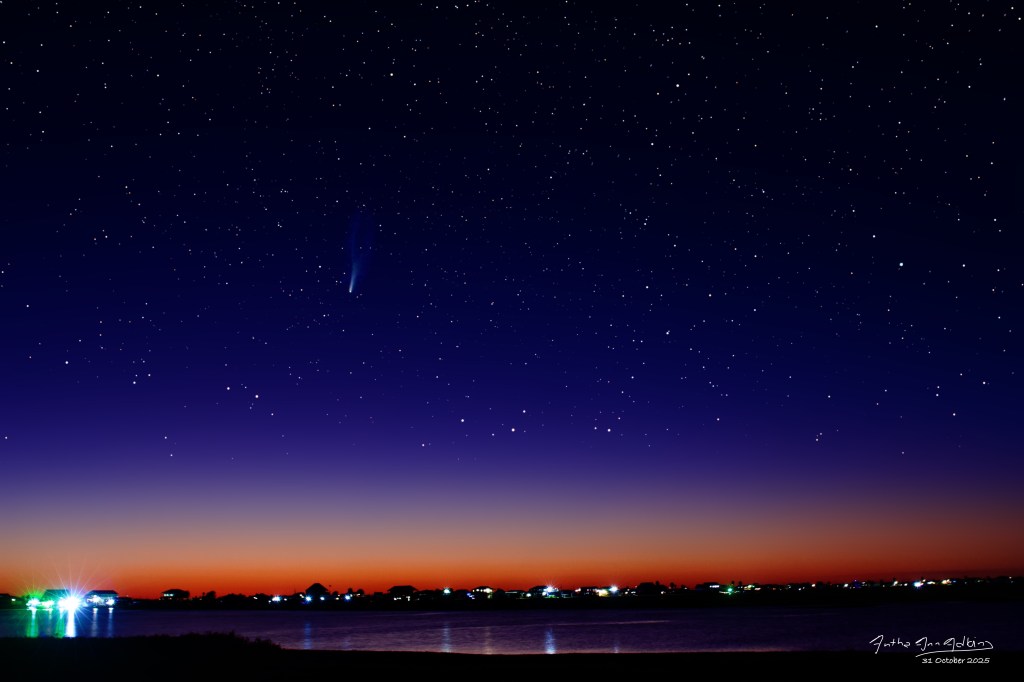
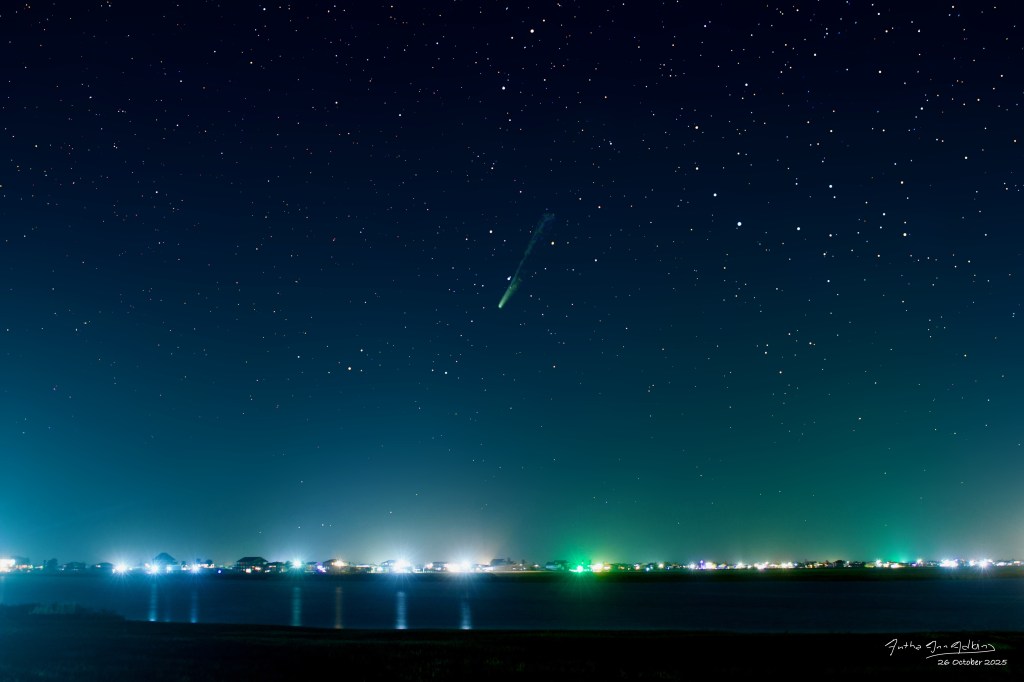
On October 31, 2025, my husband and I returned to Sargent, Texas for another opportunity to view and image Comet C/2025 A6 Lemmon.
I initially set up my camera with a 24 mm lens (very wide field, 53 deg by 35 deg) looking towards the sunset to capture the color gradient (I love these deep colors!). Then, after it got dark, I took a series of images (about 29.47 minutes worth) to capture the stars and the comet. By October 31, the comet was moving further away from us, and if you compare the October 31 picture with the October 26 picture, you can see that the comet appears smaller, dimmer, and further to the left (west) relative to the stars. It also appears to have a hook in its tail.
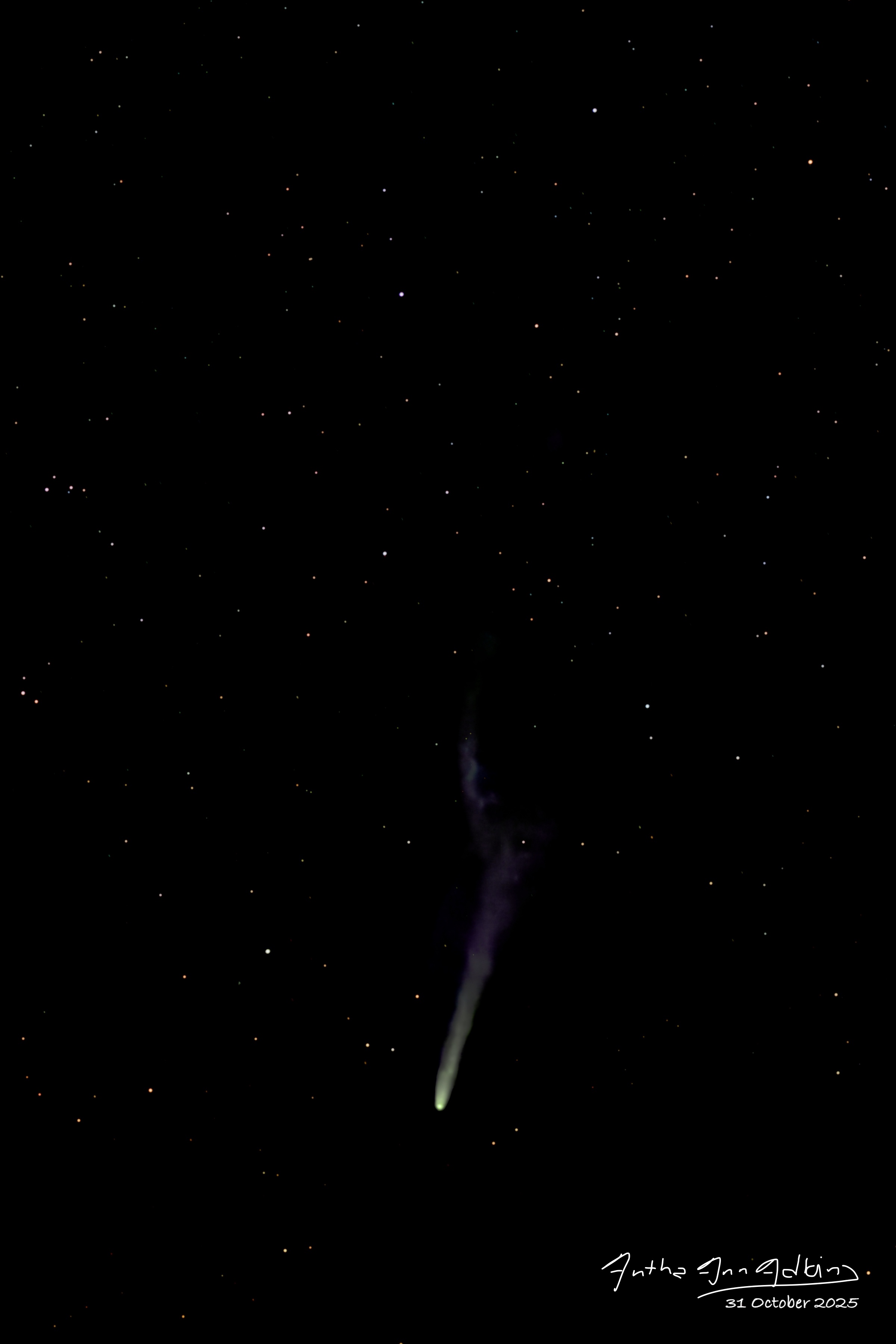
I took additional data with an 85 mm lens (15 deg by 10 deg field of view), about 7.6 minutes worth. I cropped this image, so it is an even smaller field of view, and again the tail appears to have a hook in it.
All of the pictures with the camera were taken using just a tripod (no tracking mount), so I had to do a fair bit of processing to remove the star trails in the data (BlurXterminator is a great tool for this), and I had to process the comet separately from the stars to keep it from smearing since is moving relative to the stars.
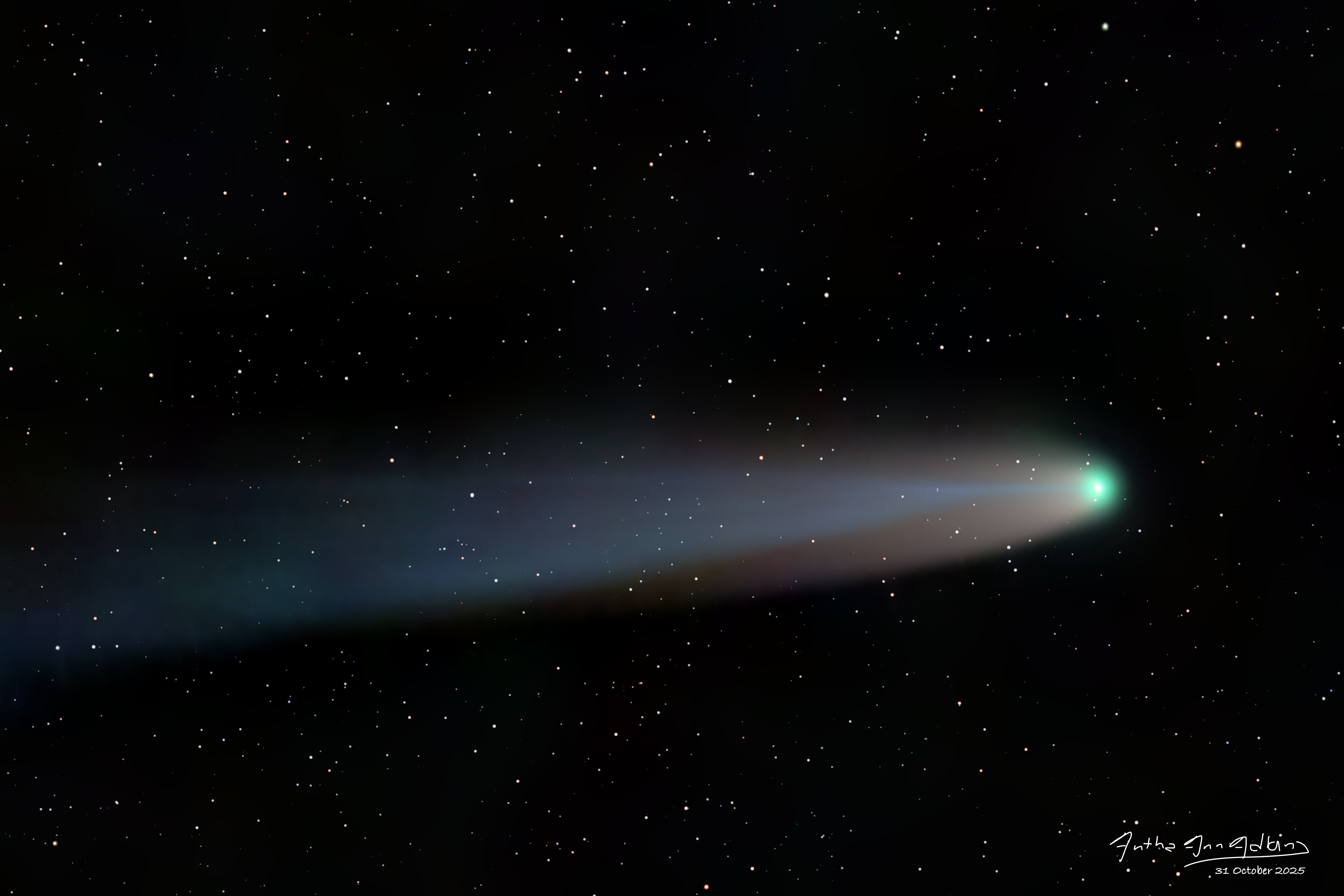
Finally, while I was taking pictures with the camera on a tripod, I was also taking pictures with my small telescope with a 430 mm focal length and a 1.8 by 1.2 degree field of view, about 42 minutes worth. Of course the comet and the tail are obvious here, and the field of view is too small to see any further out hook in the tail. What is not obvious in this integrated image is that there was a knot in the comet’s tail that was obviously moving between frames, which I find amazing. It’ll take a movie to show that, which is my next project.
Which version do you like the best?
Camera geek info – 24 mm sunset image:
- Canon EOS 60D in manual mode set 8 second exposure, ISO 800
- Sigma 24-70 mm f/2.8EX lens, set at f/3.5, 24 mm, manual focus
- Tripod
- Intervalometer
Frames – 24 mm sunset image:
- October 31, 2025
- 221 8 second lights
- 30 1/2500 second flats
- Matching darks and dark flats from library
Camera geek info – 85 mm night image:
- Canon EOS 60D in manual mode set at 8 second exposure, ISO 800
- Canon EF 85 mm f/1.8 lens at f/2.8 manual focus at infinity
- Tripod
- Intervalometer
Frames – 85 mm night image:
- October 31, 2025
- 57 8 second lights
- 31 1/2500 second flats
- Matching darks and dark flats from library
Camera geek info – telescope:
- William Optics Zenith Star 73 III APO telescope
- William Optics Flat 73A
- ZWO 2” Electronic Filter Wheel
- Antila RGB filters
- ZWO ASI183MM-Pro-Mono camera
- William Optics Uniguide 32MM F/3.75
- ZWO ASI220MM-mini
- ZWO ASiair Plus
- iOptron CEM40
- Sargent, Texas Bortle 4 skies
Frames – telescope:
- October 31, 2025
- 14 60 second Gain 150 R lights
- 30 0.05 second Gain 150 R flats
- 14 60 second Gain 150 G lights
- 30 0.02 second Gain 150 G flats
- 14 60 second Gain 150 B lights
- 30 0.02 second Gain 150 B flats
- Matching darks and flat darks from library
 Space&Aliens