Sh2-236 IC410 NGC1893 The Tadpole Nebula

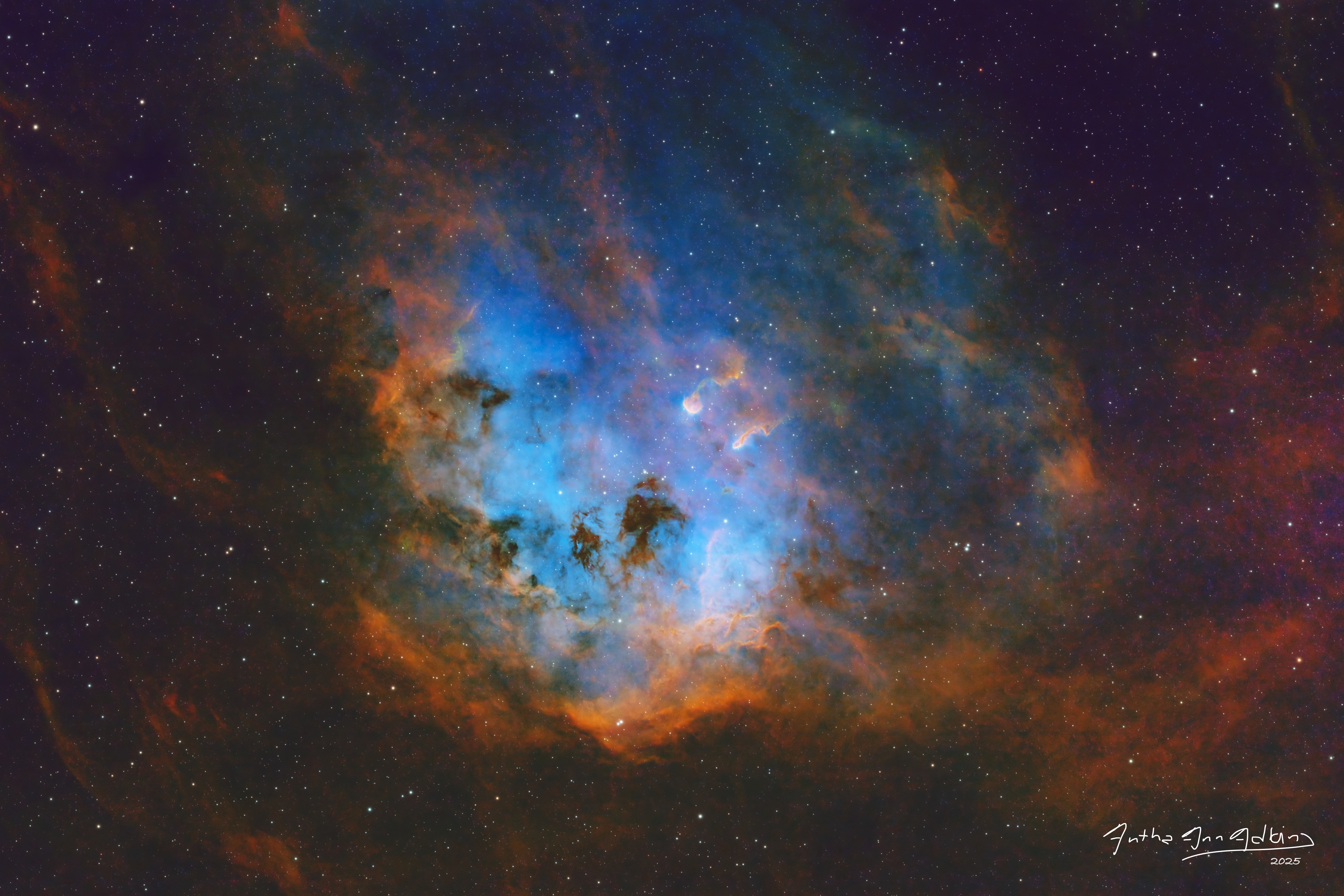
Sharpless Sh2-236 is commonly called the Tadpole Nebula since it appears to contain a tadpole (or two – depending on how you interpret the two white-pink objects near the center of this image).  How many tadpoles do you see? 

This image shows HII region Sharpless Sh2-236 (the whole image) (also cataloged in the Index Catalog of Nebulae as 410 (IC410)), the open cluster NG1893 (stars in the blue region), and the two “cometary globule” tadpole nebulae numbered Simeiz (Sim) 129 and 130.

Sh2-236 is an H II region emission nebula, a region of ionized atomic hydrogen.  The H II regions in the Sharpless 2 catalog were “defined not only in terms of the ionized gas but also in terms of the hot stars which are responsible for the ionization.”

The young open cluster NGC1893 contains five O type stars, short-lived, hot, massive stars that ionize the surrounding molecular cloud.  One of the stars is theorized to be 4 million years old; the others, 2 – 3 million years old.  Between these O-type stars and the two cometary globules are smaller, younger stars that are 1 – 2 million years old that appear to have an age gradient with older stars closer to the O-type stars and younger stars closer to the cometary globules.  The O-type stars are theorized to be causing triggered star formation in the globules – as the ionization and shock wave from the O-type stars hit the initial clumps of material that are the tadpoles, “radiation driven implosion” caused the clumps to form stars.
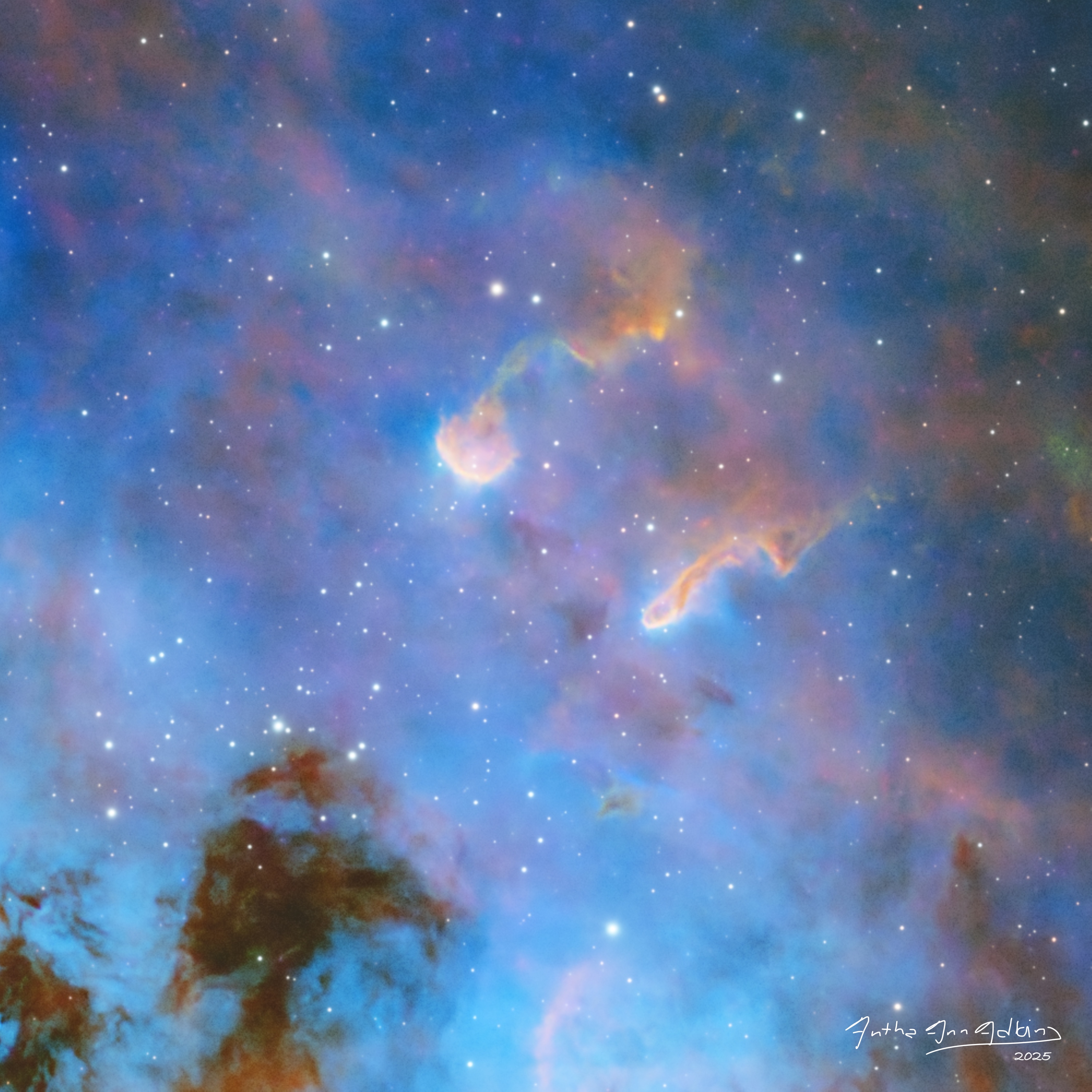
The tadpoles are believed to be denser clumps of material.  The tails are theorized to be formed from ionized gas from the edge of the tadpole closest to the O-type stars flowing along the magnetic field away from the O-type stars.  The more tadpole-like nebula, Sim 129, is on the far side of the nebula from us and is theorized to contain young stars.  Sim 130 is on the near side of the nebula closer to us and is theorized to contain “incipient stars” – the earliest stage of star formation, so the stellar evolutionary stage in the two tadpoles is different.  I am always amazed when I realize that our galaxy is still under construction!

Sh2-236 is located in the Milky Way, approximately 10500 light years away.  The square “box” of the nebula in the first image is 60 arc minutes across, so the nebula is approximately 183 light years across.  

I collected the frames for this image under the fantastic dark skies of Dell City, Texas.  When we go out there, I generally try for some easier targets and a more difficult target – this was one of the easier targets.  I need far less time than I do for images from my light-polluted driveway, but it was something of a guess to know whether I’d taken enough data to end up with a good image.  In this image, the stars came from images using red-green-blue filters with about 17 minutes of data each, and the nebula came from images using Sulfer ii (4.1 hours of data mapped to red), Hydrogen alpha (4.3 hours of data mapped to green) and Oxygen iii (4.25 hours of data mapped to blue) filters, the standard SHO mapping.  But after doing that mapping, I used Narrowband Normalization to shift the colors so that it wasn’t overly green and to enhance the reds and blues.  The nebula was processed separately from the stars to maximally enhance it.

Camera geek info:

  • William Optics Zenith Star 73 III APO telescope
  • William Optics Flat 73A
  • ZWO 2” Electronic Filter Wheel
  • Antila RGB and SHO filters
  • ZWO ASI183MM-Pro-Mono camera
  • William Optics Uniguide 32MM F/3.75
  • ZWO ASI220MM-mini
  • ZWO ASiair Plus
  • iOptron CEM40
  • Dell City, Texas Bortle 2 – 3 skies

Frames:

  • November 12, 2025
    • 17 300 second Gain 150 Ha lights
    • 30 1 second Gain 150 Ha flats
    • 14 300 second Gain 150 Oiii lights
    • 30 0.5 second Gain 150 Oiii flats
    • 15 300 second Gain 150 Sii lights
    • 30 1 second Gain 150 Sii flats
  • November 13, 2025
    • 17 300 second Gain 150 Ha lights
    • 30 1 second Gain 150 Ha flats
    • 18 300 second Gain 150 Oiii lights
    • 30 0.5 second Gain 150 Oiii flats
    • 15 300 second Gain 150 Sii lights
    • 30 1 second Gain 150 Sii flats
  • November 10, 2025
    • 18 300 second Gain 150 Ha lights
    • 30 1 second Gain 150 Ha flats
    • 19 300 second Gain 150 Oiii lights
    • 30 0.5 second Gain 150 Oiii flats
    • 19 300 second Gain 150 Sii lights
    • 30 1 second Gain 150 Sii flats
  • November 11, 2025
    • 34 30 second Gain 150 Red lights
    • 30 0.05 second Gain 150 Red flats
    • 35 30 second Gain 150 Green lights
    • 30 0.02 second Gain 150 Green flats
    • 35 30 second Gain 150 Blue lights
    • 30 0.02 second Gain 150 Blue flats
  • 30 Flat Darks matching flat durations from library
  • 30 Darks matching light durations from library

Processing geek info:

  • PixInsight
  • BlurXterminator
  • NoiseXterminator
  • StarXTerminator
  • Narrowband Normalization

C/2025 A6 Comet Lemmon on October 26, 2025 Tail Motion Movie

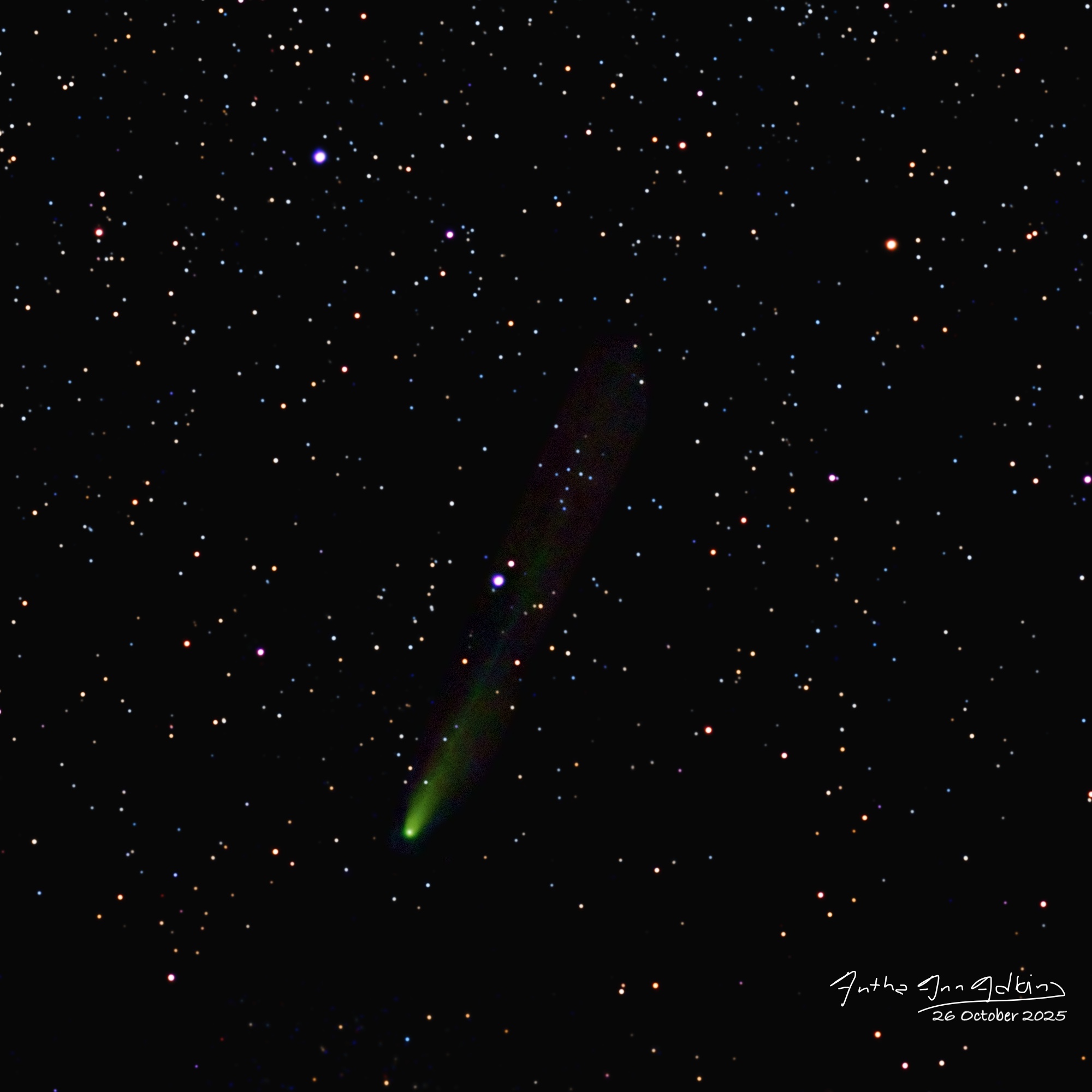
One of the things that really impressed me when I was imaging Comet C/2025 A6 Lemmon on October 26, 2025 was that the tail changed from frame to frame.  There appeared to be a “knot” that moved along the tail away from the comet head.

It’s taken me a while to figure out how to make a movie of this motion.  One challenge was that since it was just after sunset and the comet was near the horizon, the background level changed from frame to frame.  I realized that I could use Local Normalization and generate normalized files that helped with the varying background a lot.  I also started with separate red, green, blue data that had to be aligned using CometAlignment to make RGB images and then re-aligned with CometAlignment with the original green positions to show the comet motion with respect to the stars.  I ended up making two sets of images: one aligned to the green frames at each time step to show the comet motion relative to the stars, and one with all the frames aligned to the comet to show the comet tail changes. 

This movie was made with 15 frames of data using 1 minute each of red, green, and blue data.  The comet showed this much motion over about 45 minutes!  

Cool!

Camera geek info – telescope:

  • William Optics Zenith Star 73 III APO telescope
  • William Optics Flat 73A
  • ZWO 2” Electronic Filter Wheel
  • Antila RGB filters
  • ZWO ASI183MM-Pro-Mono camera
  • William Optics Uniguide 32MM F/3.75
  • ZWO ASI220MM-mini
  • ZWO ASiair Plus
  • iOptron CEM40
  • Sargent, Texas Bortle 4 skies

Frames – telescope:

  • October 26, 2025
    • 16 60 second Gain 150 R lights 
    • 30 0.05 second Gain 150 R flats
    • 15 60 second Gain 150 G lights 
    • 30 0.02 second Gain 150 G flats
    • 17 60 second Gain 150 B lights (16 for stars)
    • 30 0.02 second Gain 150 B flats
    • Matching darks and flat darks from library

C/2025 A6 Comet Lemmon on October 26, 2025 using three different focal lengths

I finally had some time over my Christmas break to process (some of) my comet data, including the wide field images I took on Sunday, October 26, 2025 from the darker (Bortle 4) skies of Sargent, Texas.  

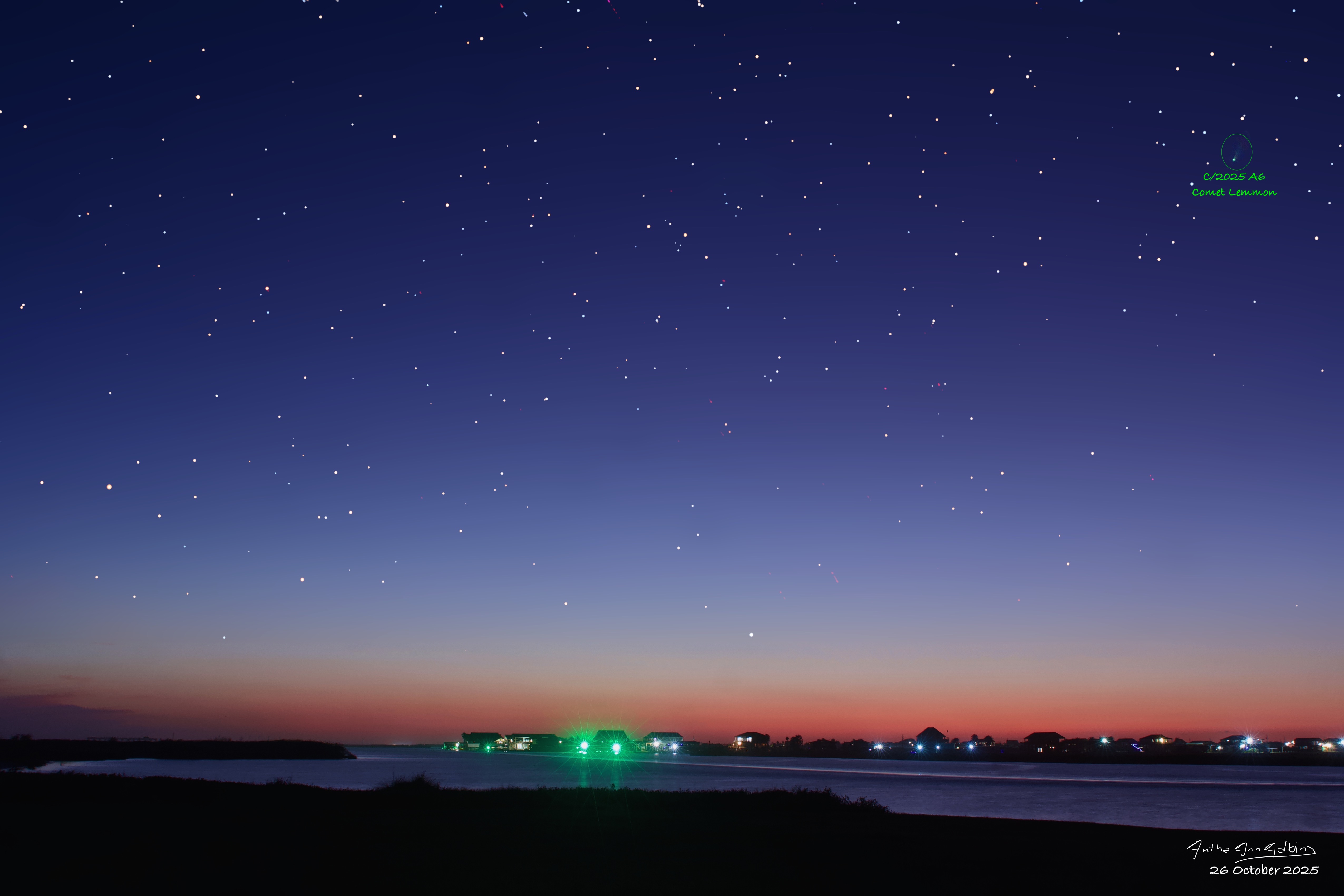
I miscalculated the direction of the comet motion and initially set up the camera with a 24 mm lens (very wide field, 53 deg by 35 deg) looking towards the sunset to get a lovely gradient of color.  Then, after it got dark, I took a series of images of the stars, about 13 minutes worth.  I didn’t take more data because I decided to move the camera to get a better framing.  The comet is in this image, but I had to circle it because it is so dim and doesn’t have an obvious tail.  You can see that it is below a triangle of stars, the Serpent’s head in the Serpens Caput (Serpent Head) constellation.

I took additional data with the 24 mm lens with a better framing, about 33 minutes worth.  I didn’t take more data because I wanted to switch to a different lens.  Happily, the comet is clearly visible in this image; no circling needed!  And the triangle of stars is still visible as well.

I took additional data with an 85 mm lens (15 deg by 10 deg field of view), about 11 minutes worth.  I cropped this image, so it is an even smaller field of view, again with the comet clearly visible along with the triangle of stars above it.

All of the pictures with the camera were taken using just a tripod (no tracking mount), so I had to do a fair bit of processing to remove the star trails in the data (BlurXterminator is a great tool for this), and I had to process the comet separately from the stars to keep it from smearing since is moving relative to the stars.

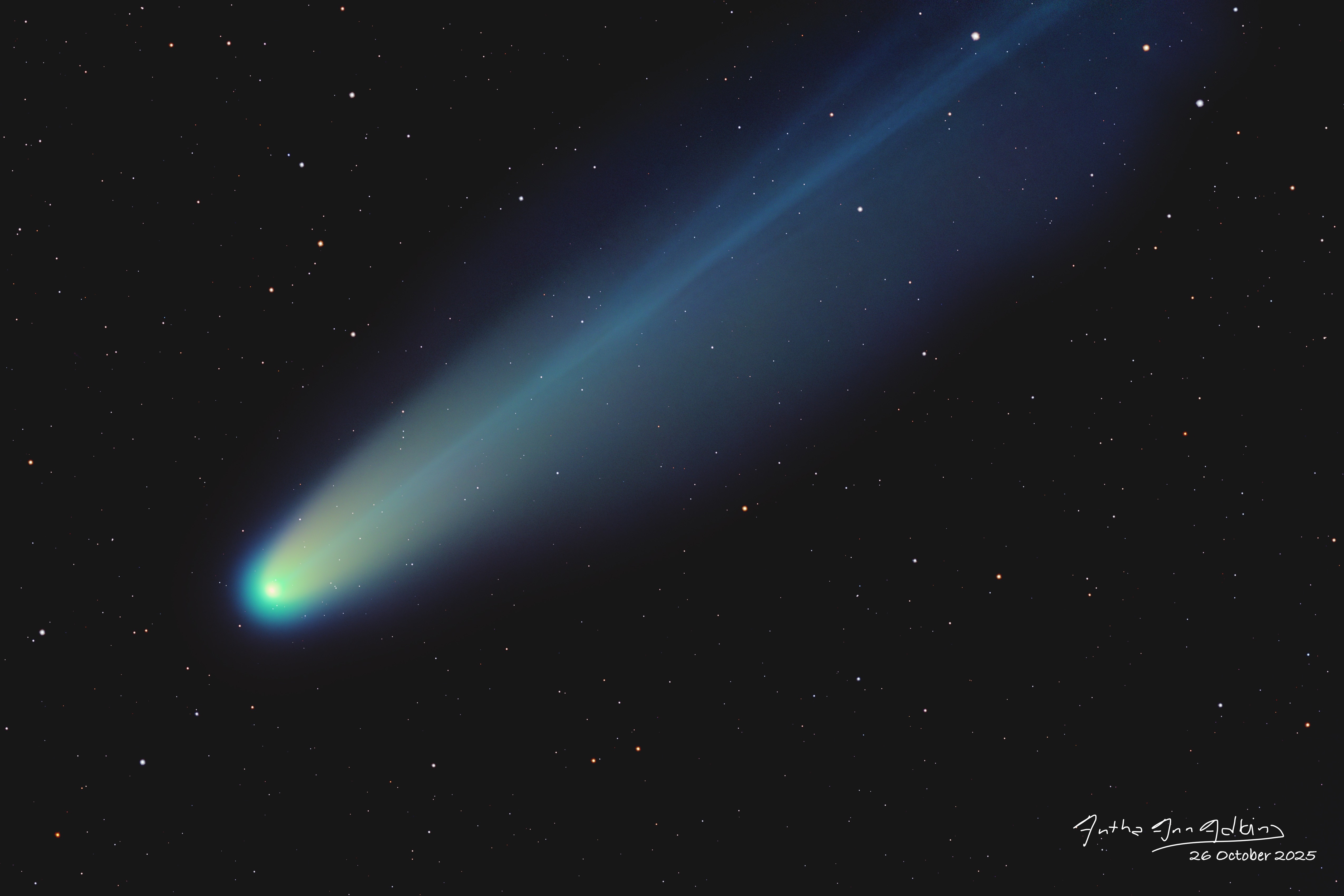
Finally, while I was taking pictures with the camera on a tripod, I was also taking pictures with my small telescope with a 430 mm focal length and a 1.8 by 1.2 degree field of view, about 45 minutes worth.  Of course the comet and its tail is amazingly obvious here, and I could see its tail changing over the course of the evening.  I’m working on making a movie of that, stay tuned!

Which version do you like the best?

Camera geek info – 24 mm sunset image:

  • Canon EOS 60D in manual mode set at f/8, 10 second exposure, ISO 400
  • Sigma 24-70 mm f/2.8EX lens, set at 24 mm, manual focus
  • Tripod
  • Intervalometer 

Frames – 24 mm sunset image:

  • October 26, 2025
    • 80 10 second lights
    • 30 1/2500 second flats
    • Matching darks and dark flats from library

Camera geek info – 24 mm night image:

  • Canon EOS 60D in manual mode set at f/2.8, 20 second exposure, ISO 400
  • Sigma 24-70 mm f/2.8EX lens, set at 24 mm, manual focus
  • Tripod
  • Intervalometer 

Frames – 24 mm night image:

  • October 26, 2025
    • 100 20 second lights
    • 30 1/2500 second flats
    • Matching darks and dark flats from library

Camera geek info – 85 mm night image:

  • Canon EOS 60D in manual mode set at f/2.5, 6 second exposure, ISO 800
  • Canon EF 85 mm f/1.8 lens at f/2.5 manual focus at infinity
  • Tripod
  • Intervalometer 

Frames – 85 mm night image:

  • October 26, 2025
    • 110 6 second lights
    • 30 1/2500 second flats
    • Matching darks and dark flats from library

Camera geek info – telescope:

  • William Optics Zenith Star 73 III APO telescope
  • William Optics Flat 73A
  • ZWO 2” Electronic Filter Wheel
  • Antila RGB filters
  • ZWO ASI183MM-Pro-Mono camera
  • William Optics Uniguide 32MM F/3.75
  • ZWO ASI220MM-mini
  • ZWO ASiair Plus
  • iOptron CEM40
  • Sargent, Texas Bortle 4 skies

Frames – telescope:

  • October 26, 2025
    • 16 60 second Gain 150 R lights 
    • 30 0.05 second Gain 150 R flats
    • 15 60 second Gain 150 G lights 
    • 30 0.02 second Gain 150 G flats
    • 17 60 second Gain 150 B lights (16 for stars)
    • 30 0.02 second Gain 150 B flats
    • Matching darks and flat darks from library

Sh2-184 NGC281 The Pac-Man Nebula (or, alternately, the Spouting Whale Nebula)

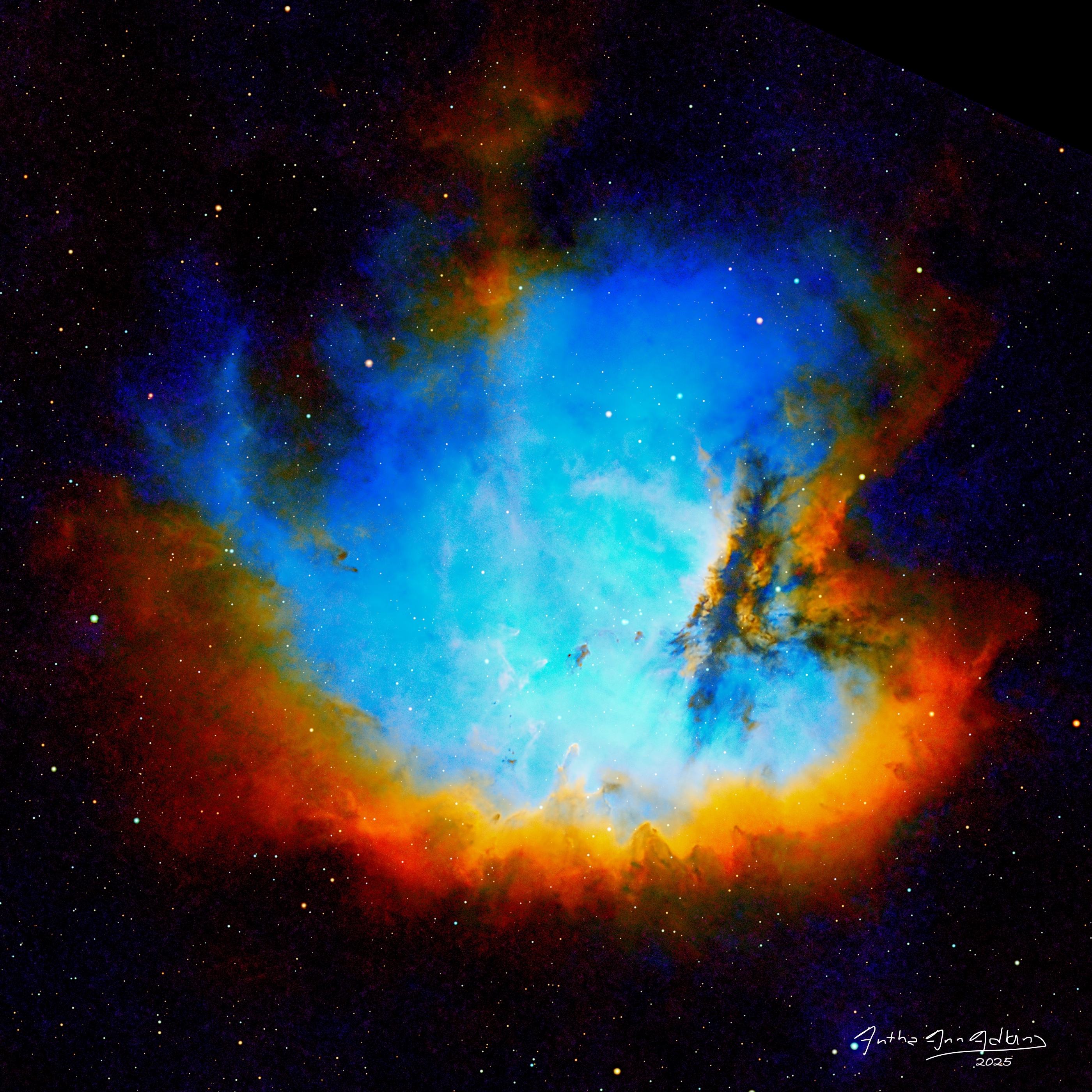
Sharpless Sh2-184 NGC281 is commonly called the Pac-Man Nebula for obvious reasons – it looks like the video game character Pac-Man with its round shape and open mouth.  Yet I also see a spouting whale – same big mouth but with a tail and spouting water out of its blowhole.  Can you see it?

I made two versions of this – one “square” with the frame that is missing the stars in the upper right corner, and one “surfing the waves” angled one that has a complete starfield.  Which version do you like better?

This image shows HII region Sharpless Sh2-184 (the whole image) and the open cluster IC1590 (stars in the blue region).  

Sh2-184 is an H II region emission nebula, a region of ionized atomic hydrogen.  The H II regions in the Sharpless 2 catalog were “defined not only in terms of the ionized gas but also in terms of the hot stars which are responsible for the ionization.”

The young open cluster IC1590 is about 3.5 – 4.4 million years old.  Among other stars, it contains four O type stars, short-lived, hot, massive stars that ionize the surrounding molecular cloud. 

The massive stars are believed to be triggering star formation in the surrounding H II region by ionizing, heating, and compressing gas in molecular cloud in which they formed.  In the periphery of the open cluster, Young Stellar Objects (YSOs), young, low-mass stars deeply embedded in parent molecular cloud, are found that are 1 – 2 million years old and 0.5 – 3.5 times the mass of our sun.  I am always amazed when I realize that our galaxy is still under construction!

Sh2-184 is located in the Milky Way, approximately 10110 light years away.  This image is 50 arc minutes across, so the image is approximately 150 light years across. 

I collected the frames for this image under the fantastic dark skies of Dell City, Texas.  When we go out there, I generally try for some easier targets and a more difficult target – this was one of the easier targets.  I need far less time than I do for images from my light-polluted driveway, but it was something of a guess to know whether I’d taken enough data to end up with a good image.  In this image, the stars came from images using red-green-blue filters with 30 minutes of data each, and the nebula came from images using Sulfer ii (3.33 hours of data mapped to red), Hydrogen alpha (3.5 hours of data mapped to green) and Oxygen iii (3 hours of data mapped to blue) filters, the standard SHO mapping.  But after doing that mapping, I used Narrowband Normalization to shift the colors so that it wasn’t overly green and to enhance the reds and blues.  The nebula was processed separately from the stars to maximally enhance it.  As always, I like color, so I leaned into the rich colors.

What do you think of the colors?  What do you think of the alternate name?

Camera geek info – Narrowband:

  • William Optics Zenith Star 73 III APO telescope
  • William Optics Flat 73A
  • ZWO 2” Electronic Filter Wheel
  • Antila RGB and SHO filters
  • ZWO ASI183MM-Pro-Mono camera
  • William Optics Uniguide 32MM F/3.75
  • ZWO ASI220MM-mini
  • ZWO ASiair Plus
  • iOptron CEM40
  • Dell City, Texas Bortle 2 – 3 skies

Frames:

  • November 8, 2025
    • 11 300 second Gain 150 Ha lights
    • 30 1 second Gain 150 Ha flats
    • 11 300 second Gain 150 Oiii lights
    • 30 0.5 second Gain 150 Oiii flats
    • 11 300 second Gain 150 Sii lights
    • 30 1 second Gain 150 Sii flats
  • November 9, 2025
    • 9 300 second Gain 150 Ha lights
    • 30 1 second Gain 150 Ha flats
    • 9 300 second Gain 150 Oiii lights
    • 30 0.5 second Gain 150 Oiii flats
    • 8 300 second Gain 150 Sii lights
    • 30 1 second Gain 150 Sii flats
  • November 10, 2025
    • 60 30 second Gain 150 Red lights
    • 30 0.05 second Gain 150 Red flats
    • 60 30 second Gain 150 Green lights
    • 30 0.02 second Gain 150 Green flats
    • 60 30 second Gain 150 Blue lights
    • 30 0.02 second Gain 150 Blue flats
  • November 11, 2025
    • 22 300 second Gain 150 Ha lights
    • 30 1 second Gain 150 Ha flats
    • 16 300 second Gain 150 Oiii lights
    • 30 0.5 second Gain 150 Oiii flats
    • 21 300 second Gain 150 Sii lights
    • 30 1 second Gain 150 Sii flats
  • 30 Flat Darks matching flat durations from library
  • 30 Darks matching light durations from library

Processing geek info:

  • PixInsight
  • BlurXterminator
  • NoiseXterminator
  • StarXTerminator
  • Narrowband Normalization

Happy New Year 2026!

We celebrated New Year’s Eve with our traditional time travel movies.  

This year’s first pick was a Filipino film, My Future You, an information time travel plot (two people from different years communicate via, in this case, a matchmaking site) movie.  We found it to be a sweet movie, exactly matching the mood we wanted.

Our second pick was the first two episodes of Doctor Who: The Three Doctors, where the first two doctors are pulled out of their own timestreams to help the Third Doctor, with the classic “I’m the REAL Doctor” banter.

Happy New Year!  I hope you enjoyed your New Year’s celebrations.