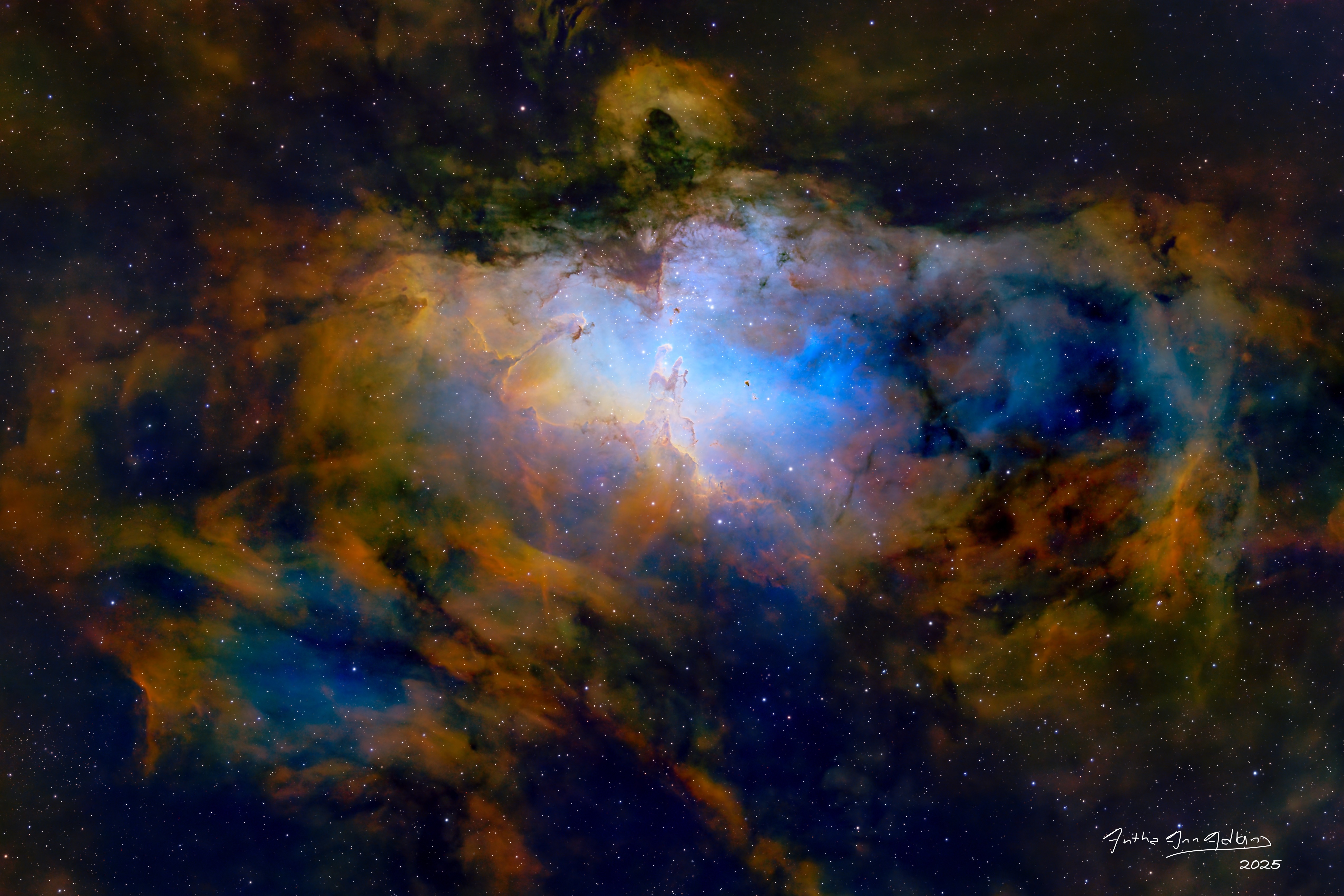
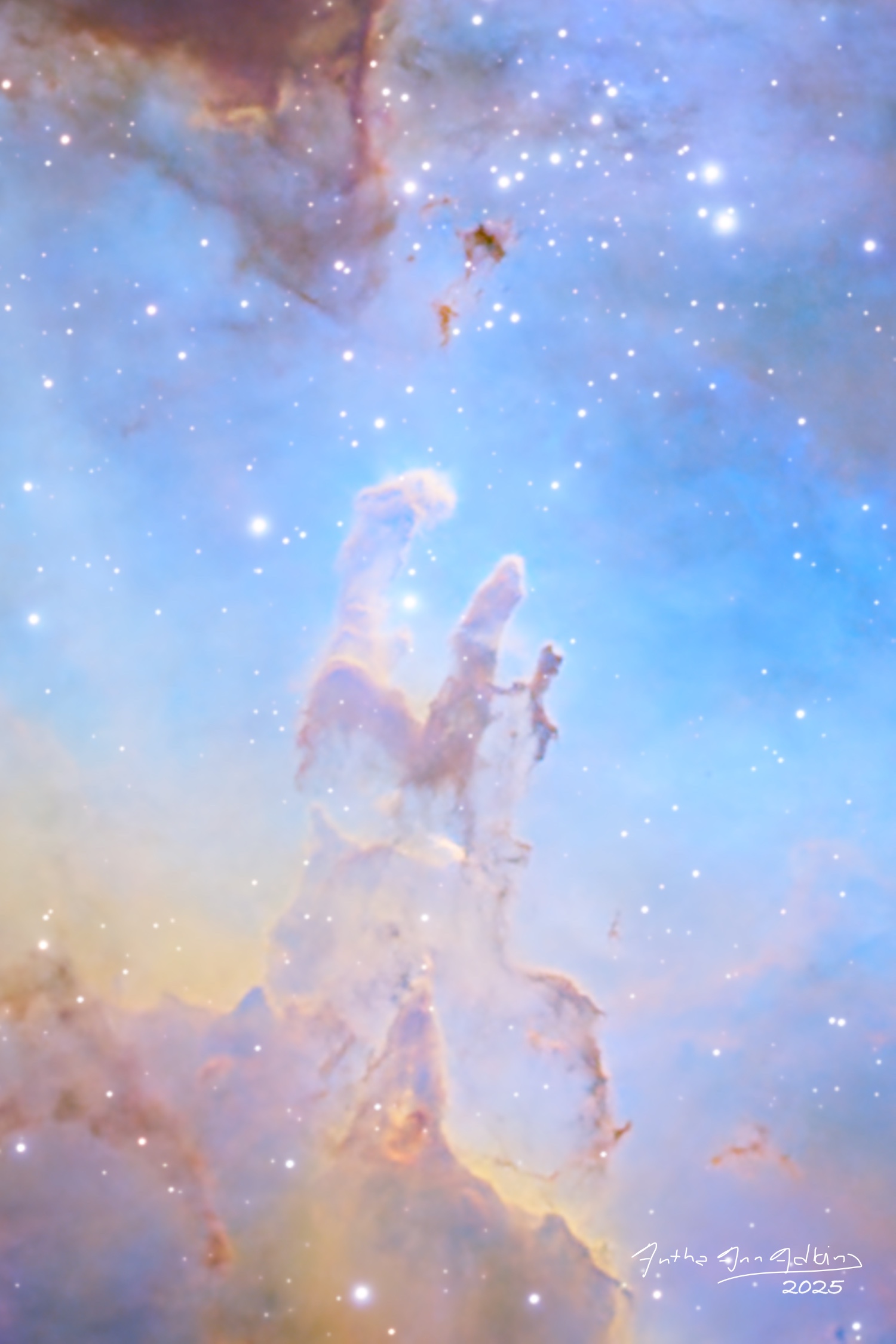
The traditional name for Messier 16 (M16) is the Eagle Nebula or the Star Queen Nebula. However, when I saw the first Hydrogen alpha narrowband images that went into this image, I did not think it looked like a bird. I thought the round nebula on the top looked like the knob on top of the cover of a jewel box (or perfume bottle). The bright inner center of the nebula with its young stars looked like jewels (so I picked the jewel box analogy). And the pillars in this nebula are the famous Pillars of Creation imaged by the Hubble Space Telescope. So I think the name the “Jewel Box of Creation” is also a lovely description of this beautiful Deep Space Object (DSO). What do you think it looks like?
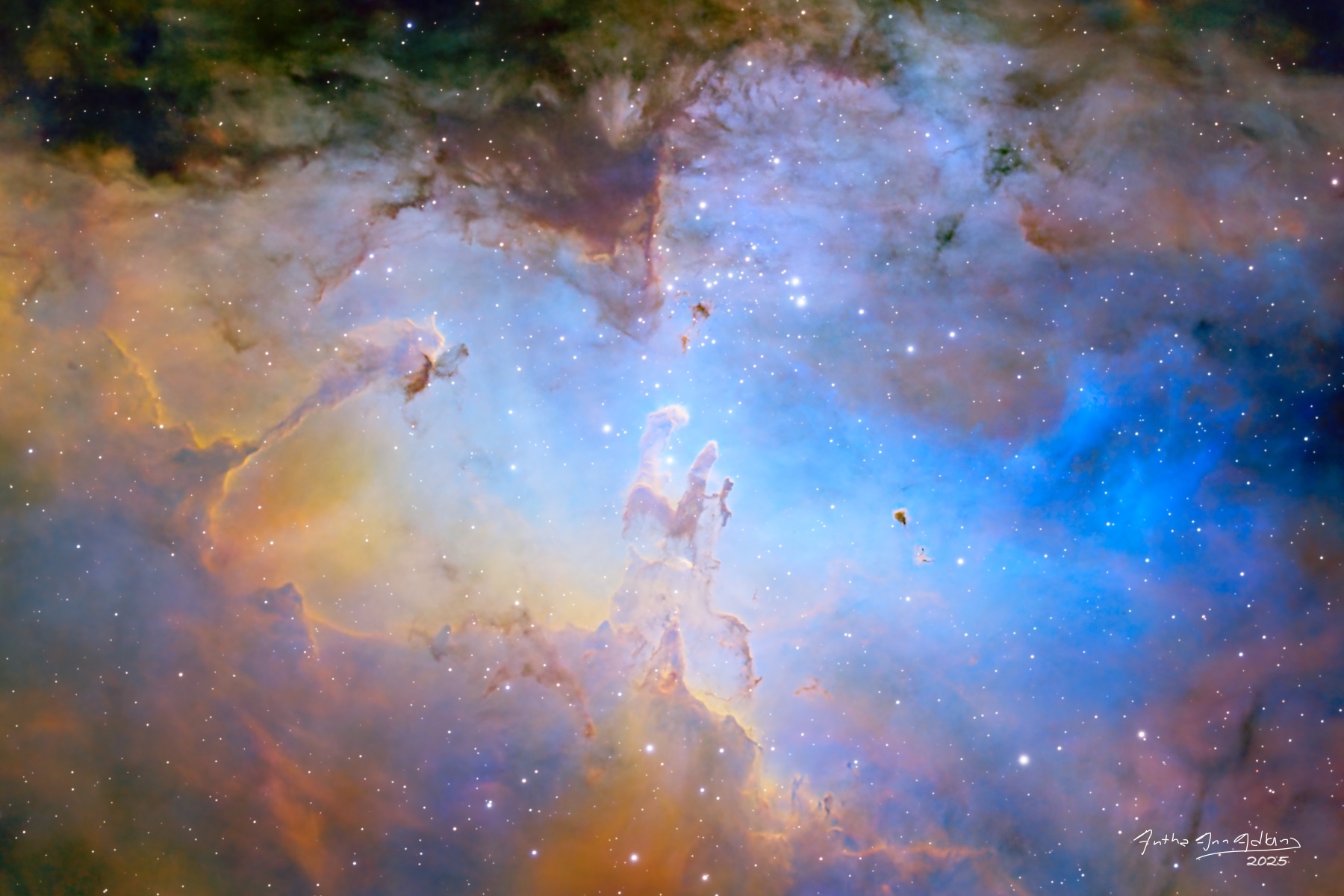
M16 contains two related things: an emission nebula numbered IC4703 or Sharpless Sh2-49 and an open cluster numbered New General Catalogue (NGC) 6611. The emission nebula is part of Giant Molecular Cloud W37, an interstellar cloud of gas molecules, primarily molecular hydrogen (H2) and carbon monoxide (CO), the mass of which is calculated to be 170,000 times the mass of the Sun. The nebula is a large star-forming region ionized by the stars it generated. The open cluster of stars has an inferred population of 8100 stars including at least 137 visible young stars in the Gaia Early Data Release 3 (EDR3) with good data and magnitudes greater than G=17.5 in two populations: one older (7.5 +/- 0.4 million years old) and more spread out and one younger (1.3 +/- 0.2 million years old) and more concentrated. (As a point of reference, our own star, the Sun, is 4.6 billion years old – 3500 times older than the younger stars! What are you 3500 times older than?). The young population includes 19 type O stars which are high mass, hot, blue stars with short lives due to their high mass. One binary pair of these type O stars, HD168076, is the brightest star in the cluster visually, has a mass of 75 to 80 times the mass of the Sun, and is the primary source ionizing the nebula.
M16 is located in the Milky Way, approximately 5513 light years away, and it has an apparent size of 1.3 degrees, so it is approximately 125 light years across.
In this image, the stars came from images using red-green-blue filters with about 30 minutes of data each, and the nebula came from images using Sulfur ii (4.15 hours of data mapped to red), Hydrogen alpha (1.75 hours of data mapped to green) and Oxygen iii (2.25 hours of data mapped to blue) filters, the standard SHO mapping. But after doing that mapping, I used Narrowband Normalization to shift the colors so that it wasn’t overly green and to enhance the reds and blues. This tool made getting the colors in this nebula look right a lot easier! Even so, I ended up making multiple attempts to try to show it well and got some excellent advice on astrobin on how to improve the image. The nebula was processed separately from the stars to maximally enhance it.
I think this nebula and star cluster are absolutely gorgeous! We live in a universe filled with wonders.
Camera geek info – Narrowband:
- William Optics Pleiades 111 telescope
- ZWO 2” Electronic Filter Wheel
- Antila SHO and RGB filters
- Blue Fireball 360° Camera Angle Adjuster/Rotator
- ZWO ASI183MM-Pro-Mono camera
- William Optics Uniguide 32MM F/3.75
- ZWO ASI220MM-mini
- ZWO ASiair Plus
- iOptron CEM40
- Friendswood, Texas Bortle 7-8 suburban skies
Frames:
- August 28, 2025
- 96 20 second Gain 150 Red lights
- 30 0.02 second Gain 150 Red flats
- 91 20 second Gain 150 Green lights
- 30 0.01 second Gain 150 Green flats
- 92 20 second Gain 150 Blue lights
- 30 0.01 second Gain 150 Blue flats
- 24 180 second Gain 150 Sii lights
- 30 0.5 second Gain 150 Sii flats
- September 9, 2025
- 35 180 second Gain 150 Ha lights
- 30 0.5 second Gain 150 Ha flats
- September 11, 2025
- 45 180 second Gain 150 Oiii lights
- 30 0.2 second Gain 150 Oiii flats
- September 12, 2025
- 59 60 second Gain 150 Sii lights
- 30 0.5 second Gain 150 Sii flats
- 30 Flat Darks matching flat durations from library
- 30 Darks matching light durations from library
Processing geek info:
- PixInsight
- BlurXterminator
- NoiseXterminator
- StarXTerminator
- Narrowband Normalization
 Space&Aliens