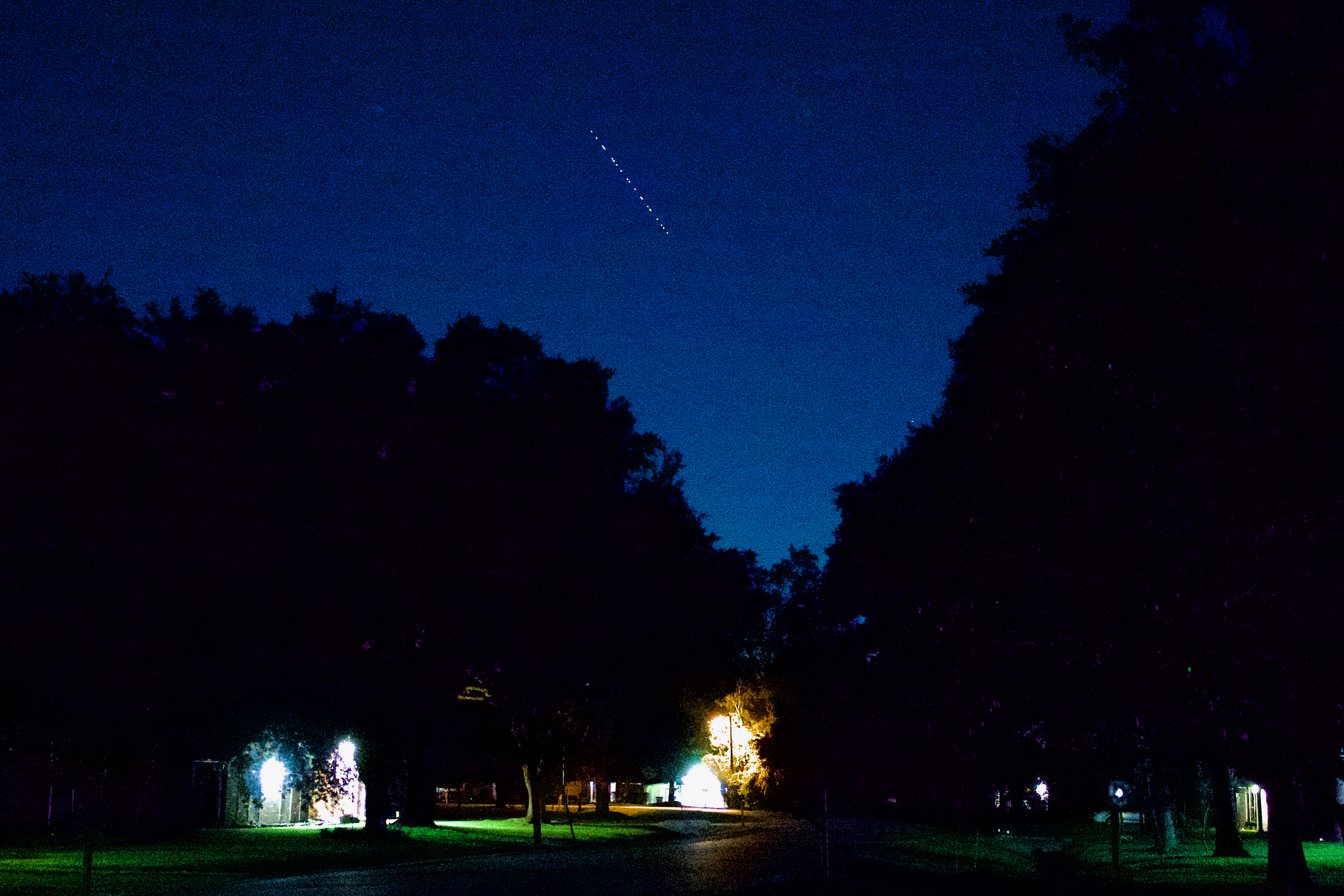
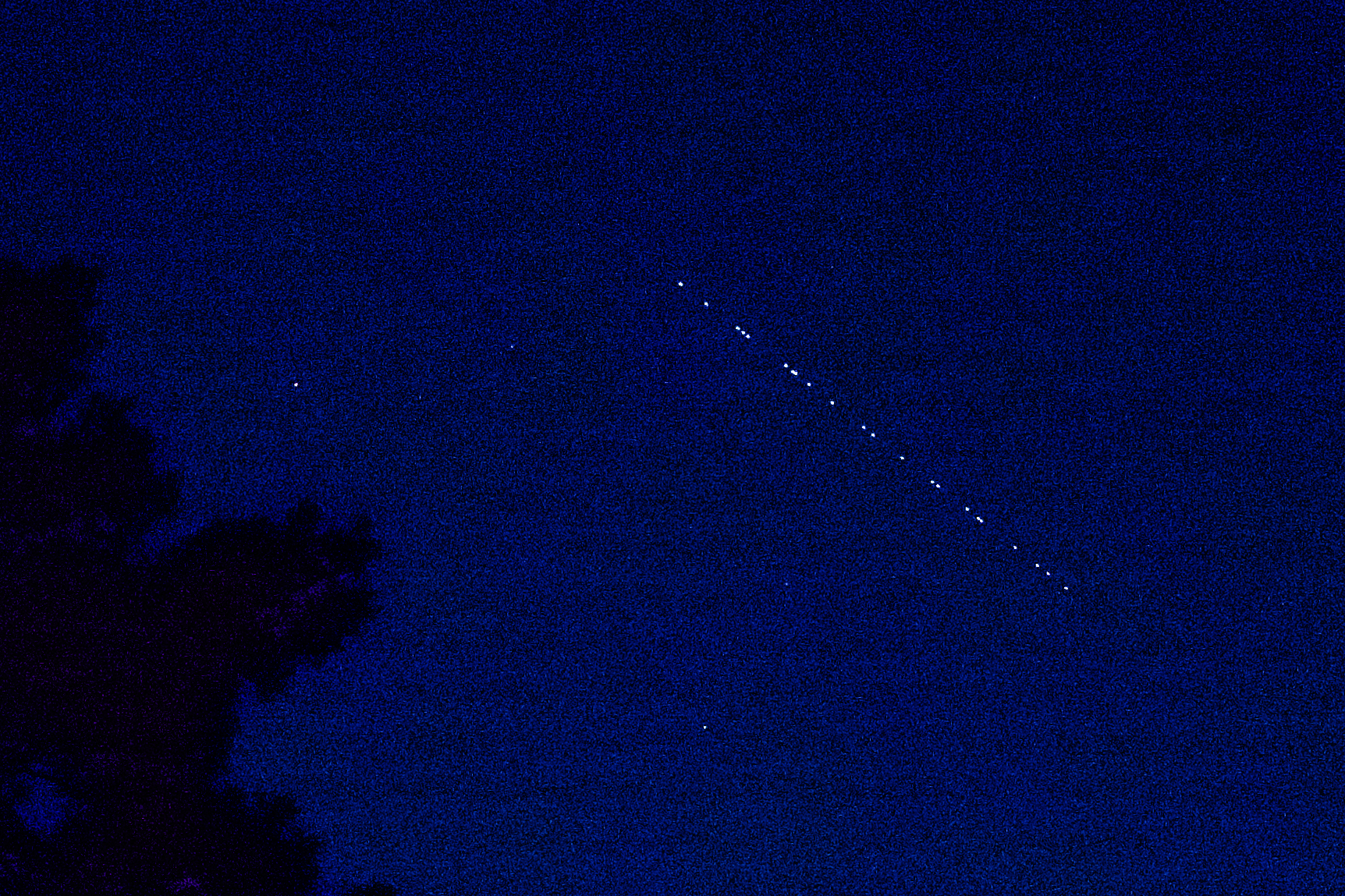
Starlink Train on June 23, 2024

Starlink is SpaceX’s megaconstellation of satellites, which provides global mobile broadband communication. It currently consists of over 6000 satellites.  The satellites have recently been launched in sets of 20 – 23 satellites on a single Falcon 9 rocket that are initially released one after another into the same orbit, so they appear to follow one another across the sky in a “train”.  

Starlink satellites are visible when the sky is dark but they are still sunlit, so just after sunset/before sunrise.  They are easiest to see within a couple of days of launch, when they are in the orbit raising phase and are closer together and lower.  Once they reach their final orbit, they are harder to see.  Because of concerns raised by astronomers over the effect of such a large number of satellites on astronomical observations (satellites create streaks of photobombing light on astrophotos), SpaceX has implemented two things to reduce their brightness: 1) made the satellites invisible to the naked eye within a week of launch by changing their attitude during orbit raising so the solar arrays won’t reflect sunlight down to the Earth and 2) made them less bright on orbit by deploying sun visors on the satellites so the chassis won’t reflect sunlight down to the Earth.  

On Monday, June 24, the FindStarlink app/website predicted we’d have good visibility for a Starlink train, so we went outside to check it out.  The “train” of satellites was really striking as it rose at the end of our street and traveled in a line across the sky, then went into the Earth’s shadow and disappeared just as the satellites “reached” a bright star (it could have been Pacmac gobbling up dots).  Given the date and that 22 satellites were visible in the train, I think this was Starlink Group 10-2 (the FindStarlink site says what train is visible, but I forgot to record that on Monday).

I thought they were a really cool thing to see, but I am also glad that SpaceX is working on making them less of a nuisance to astronomers.

Camera geek info:

  • Panasonic DC-GX9 set at f/2.5, 15 second exposure, ISO 3200
  • LUMIX G 14/F2.5 II, 14 mm fixed
  • Tripod

NGC 2359 Thor’s Helmet: New Narrowband and Reprocessed RGB Images

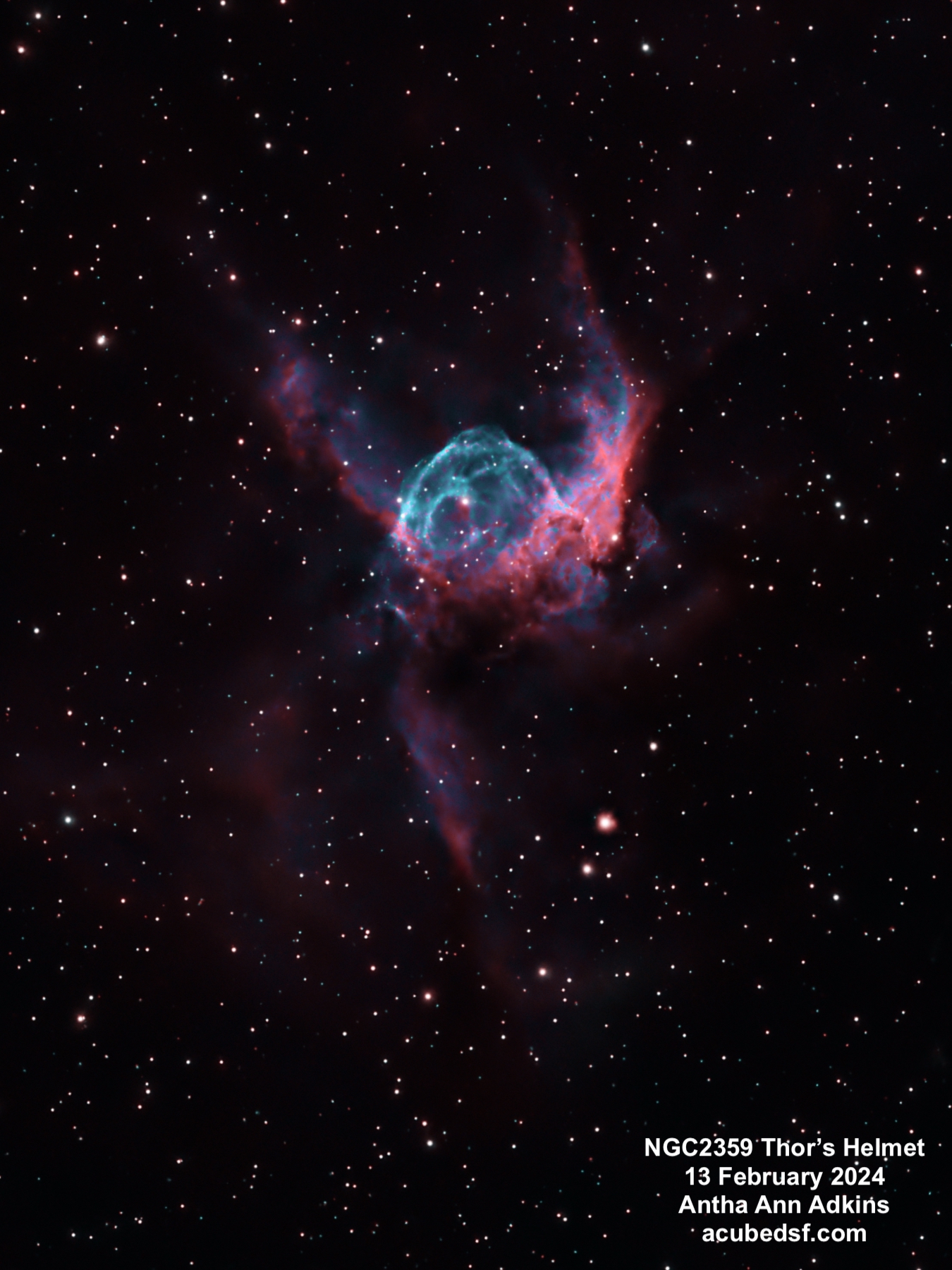
NGC 2359, also called Thor’s Helmet, is an emission nebula – in this case a planetary nebula of ionized gas around a hot central star, Wolf-Rayet WR7.  WR7 is a massive star which has shed matter, and then its stellar wind has blown and compressed that matter into a bubble, and its UV radiation has ionized it to make the beautiful nebula we see.  This planetary nebula has a very complex shape, likely due to interactions with a nearby molecular cloud.  It’s located in the Milky Way, approximately 12,900 light years away, and it’s approximately 30 light years across, giving it an apparent size of 16 x 8 arc min.

In our early 2024 trip to the fantastic dark skies of Dell City, Texas, I took the images used to make the picture above using two narrow band filters – H-alpha (assigned to red) and Oiii (assigned to blue).  These color assignments are close to, but not exactly, true to color.

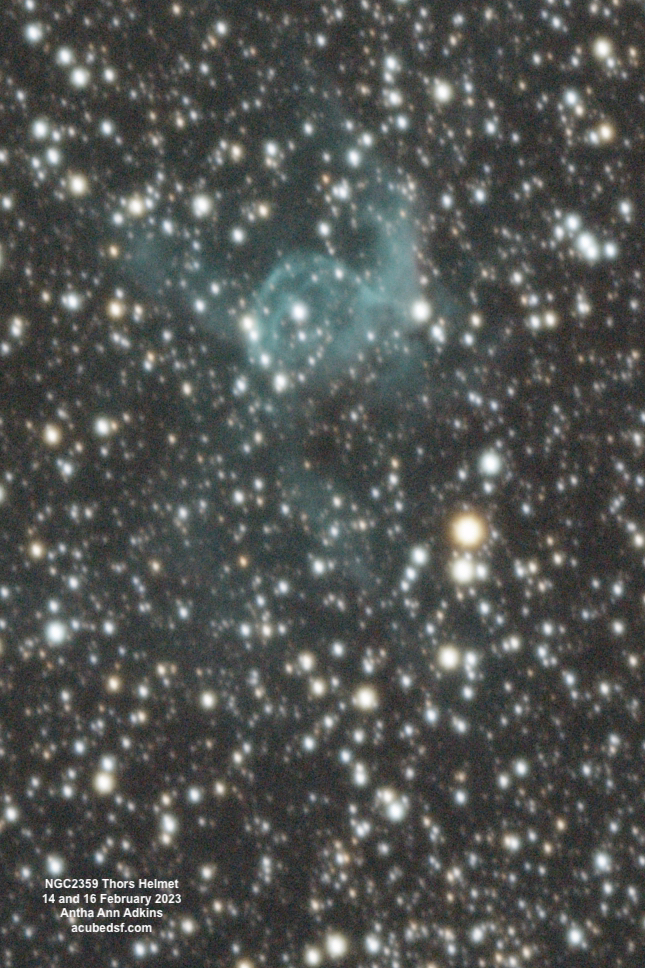
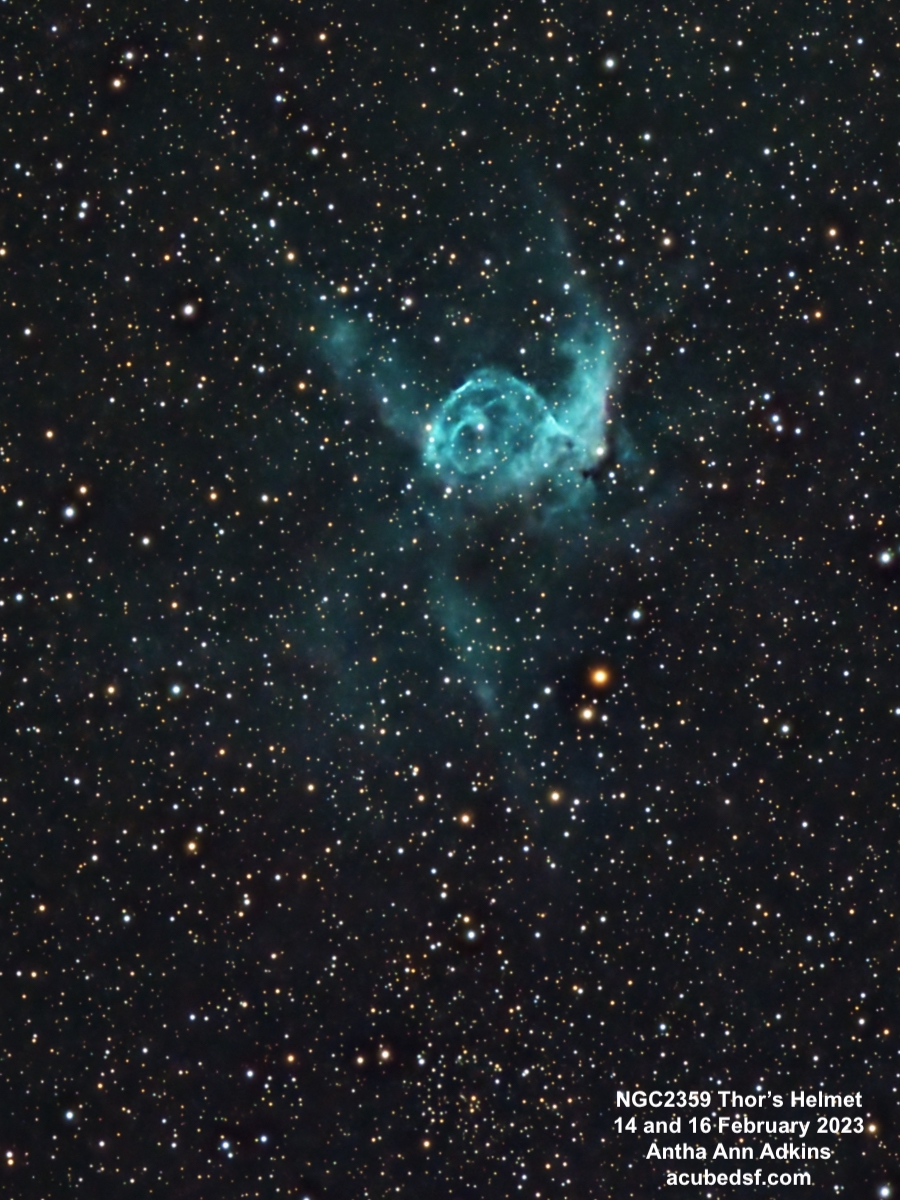
In our early 2023 trip to the fantastic dark skies of Dell City, Texas, I used a DSLR to make an RGB image of the nebula.  When I processed it last year, I hadn’t learned many of the processing techniques I use today, so I decided to reprocess it.  I was absolutely amazed at the difference processing can make (try the slider bar to see the difference!).  

I love both the narrowband version and the new RGB version.  Which do you like better?

Camera geek info – Narrowband:

  • Williams Optics Zenith Star 73 III APO telescope
  • Williams Optics Flat 73A
  • ZWO 2” Electronic Filter Wheel
  • Antila SHO filters
  • ZWO ASI183MM-Pro-Mono camera
  • ZWO ASiair Plus
  • iOptron CEM40
  • Dell City, Texas Bortle 2-3 dark skies

Frames:

  • February 13, 2024
    • HO lights
      • 45 120 second Gain 150 Ha lights
      • 35 120 second Gain 150 Oiii lights
    • 30 0.05 second Gain 150 H flats
    • 29 0.05 second Gain 150 O flats
    • 30 0.05 second flat darks
    • 30 120 second darks

Processing geek info:

  • PixInsight
  • BlurXterminator
  • NoiseXterminator
  • StarXTerminator
  • Generalized Hyperbolic Stretch
  • NBColourMapper

Camera geek info – RGB:

  • Canon EOS 60D in manual mode, 179 second exposure, ISO 2000, custom white balance 3500K
  • Williams Optics Zenith Star 73 III APO telescope
  • Williams Optics Flat 73A
  • iOptron CEM40
  • Dell City, Texas Bortle 2-3 dark skies

Frames:

  • 64 3 minute lights
  • 20 3 minute darks
  • 40 0.1 second flats
  • 40 0.1 second flat darks

Processing geek info – RGB:

  • PixInsight
  • BlurXterminator
  • NoiseXterminator
  • StarXTerminator
  • Generalized Hyperbolic Stretch