IC2118 The Crone with Galaxies in Her Hair

IC2118 is one of the dimmer objects I imaged while we were enjoying the dark skies in Dell City, Texas.  

This image used only 1.9 hours of data.  I’ve started having trouble with my tracking mount glitching, so I had to toss a bunch of data.  I’ve been researching how to fix that.

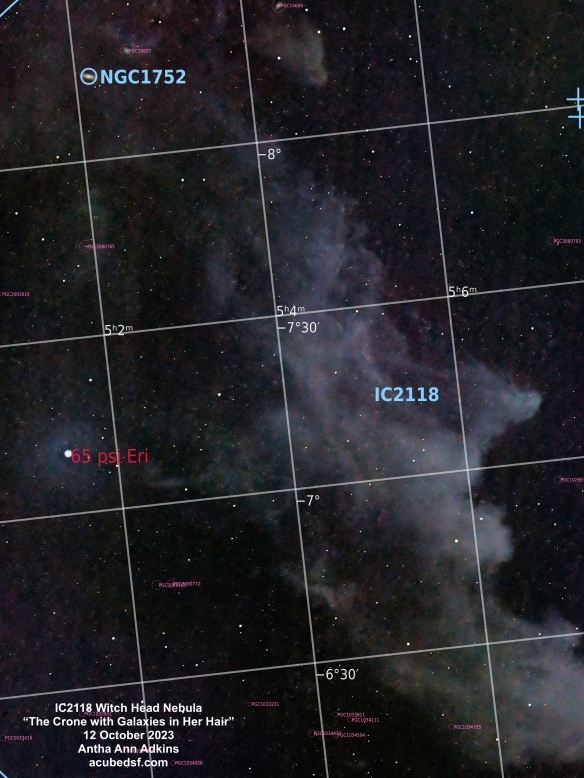
IC2118, also called the Witch Head Nebula, is a reflection nebula – an interstellar cloud of dust that is lit up by a nearby star, in this case Rigel (which is not in this image).  It’s located in the Milky Way, approximately 900 light years away, and it’s approximately 50 light years long, giving it an apparent size of 1 degree by 3 degrees (not all in this image).  

The ”witch” is facing towards the upper right corner, with her nose around the vertical center of the image.  

One thing that surprised me was that I can see multiple galaxies in her hair – NGC1752, PGC16607, and PGC16669.  NGC1752 is a spiral galaxy about 143.5 Mega light years away.  PGC16607 is a galaxy about 179 Mega light years away.  PGC16669 is a galaxy about 500 Mega light years away.  I find the idea of being able to image galaxies so far away … awe-inspiring.

I find the idea of a crone with galaxies in her hair … poetic and inspirational.  And I think she should have a companion: the man with a galaxy under his hat.  Deserving of a story!

Camera geek info:

  • Canon EOS 60D in manual mode, 2 minute exposure, ISO 1600
  • Intervalometer
  • Williams Optics Zenith Star 73 III APO telescope
  • Williams Optics Flat 73A
  • iOptron CEM40
  • Dell City, Texas Bortle 2-3 dark skies

Frames:

  • October 12, 2023 
    • Run 1
      • 57 2 minute lights 
      • 30 0.01 second flats
      • 30 0.01 second flat darks
    • 35 2 minute darks

Processing geek info:

  • PixInsight
  • BlurXterminator
  • NoiseXterminator
  • StarXTerminator
  • Generalized Hyperbolic Stretch

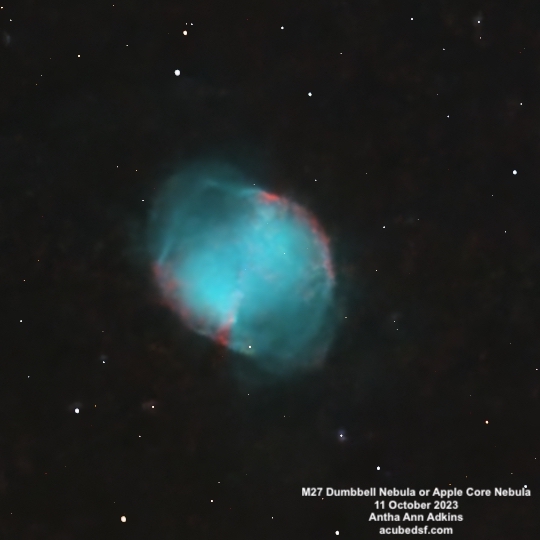
M27 Dumbbell Nebula

M27 is one of the brighter objects I imaged while we were enjoying the dark skies in Dell City, Texas.  This object was a brilliant blue in a single frame, and it was nice not to have to rely on faith that something was there.  

This image used only 1.8 hours of data. 

M27, also called the Dumbbell Nebula or Apple Core Nebula, is a planetary nebula – the gases expelled from a star before it becomes a white dwarf, lit up by that star.  It’s located in the Milky Way, approximately 1250 light years away, and it’s approximately 2.9 light years across, giving it an apparent size of 8 arcminutes.  It’s estimated to be 12,700 years old.

Planetary nebulae do not last long on an astronomy time scale because the expelled gases grow dimmer as they expand away from the central star.  I am glad I live in a time when we can observe them and they can be observed!

Isn’t our galaxy beautiful?

Camera geek info:

  • Canon EOS 60D in manual mode, 2 minute exposure, ISO 1600
  • Intervalometer
  • Williams Optics Zenith Star 73 III APO telescope
  • Williams Optics Flat 73A
  • iOptron CEM40
  • Dell City, Texas Bortle 2-3 dark skies

Frames:

  • October 11, 2023 
    • Run 1
      • 54 2 minute lights 
      • 30 0.01 second flats
      • 30 0.01 second flat darks
    • 35 2 minute darks

Processing geek info:

  • PixInsight
  • BlurXterminator
  • NoiseXterminator
  • StarXTerminator
  • Generalized Hyperbolic Stretch

Sh2-188 Dolphin Nebula or Shrimp Nebula

Sh2-188 is one of the dimmer objects that I imaged during our recent trip to the dark skies at Dell City, Texas.  

Sh2-188, also called the Dolphin Nebula or Shrimp Nebula, is a planetary nebula – the gases expelled from a star before it becomes a white dwarf, lit up by that star.  It’s located in the Milky Way, approximately 2770 light years away, and it’s approximately 8.2 light-years across, giving it an apparent size of 10 arcminutes.  It’s estimated to be 22,500 years old.  

The nebula’s bow shape (as opposed to a circular shape) is theorized to be due to its relatively high velocity interaction with the interstellar medium.

The objects in our galaxy never cease to amaze me!

Camera geek info:

  • Canon EOS 60D in manual mode, 3 minute exposure, ISO 2000
  • Intervalometer
  • Williams Optics Zenith Star 73 III APO telescope
  • Williams Optics Flat 73A
  • iOptron CEM40
  • Dell City, Texas Bortle 2-3 dark skies

Frames:

  • October 9, 2023 
    • Run 1
      • 59 3 minute lights 
      • 30 0.01 second flats
      • 30 0.01 second flat darks
    • Run 2
      • 76 3 minute lights 
      • 30 1/400 second flats
      • 30 1/400 second flat darks
    • 17 3 minute darks

Processing geek info:

  • PixInsight
  • BlurXterminator
  • NoiseXterminator
  • StarXTerminator
  • Generalized Hyperbolic Stretch

NGC 7293 Helix Nebula 2023

On our recent trip to the fabulous dark skies of Dell City, Texas, I mostly tried to image things that would be difficult to capture from my light-polluted driveway at home.  However, a couple of those objects weren’t visible at sunset, so I snuck in some brighter objects as well.

NGC 7293 also called the Helix Nebula or Eye of God Nebula is a planetary nebula – the gases expelled from a star before it becomes a white dwarf, lit up by that star.  It’s located in the Milky Way, approximately 655 light years away, and it’s approximately 2.5 light-years across.  It’s estimated to be 10,600 years old.  Its apparent size is 25 arcminutes, and it has an apparent magnitude of 7.6.  

I’d imaged NGC 7293 last year, and I’d even posted a single 3 minute shot, but I’d never gone back and really processed it.

I processed the data from this year, and then went back and added in the data from last year.  Which version do you like better? I think I actually like the 2023 only version better.

Either way, this shows that less than an hour and a half of data was sufficient time to generate a decent image of this neat object with dark skies.

This is a particularly spectacular planetary nebula, and even last year it made me want to try to image more. Isn’t our galaxy amazing?  

Camera geek info:

  • Canon EOS 60D in manual mode, 3 minute exposure, ISO 1600
  • Intervalometer
  • Williams Optics Zenith Star 73 III APO telescope
  • Williams Optics Flat 73A
  • iOptron CEM40
  • Dell City, Texas Bortle 2-3 dark skies

Frames:

  • October 28, 2022
    • Run 1
      • 10 3 minute lights
  • October 11, 2023
    • Run 2
      • 17 3 minute lights 
      • 30 0.01 second flats
      • 30 0.01 second flat darks

Processing geek info:

  • PixInsight
  • BlurXterminator
  • NoiseXterminator
  • StarXTerminator
  • Generalized Hyperbolic Stretch