
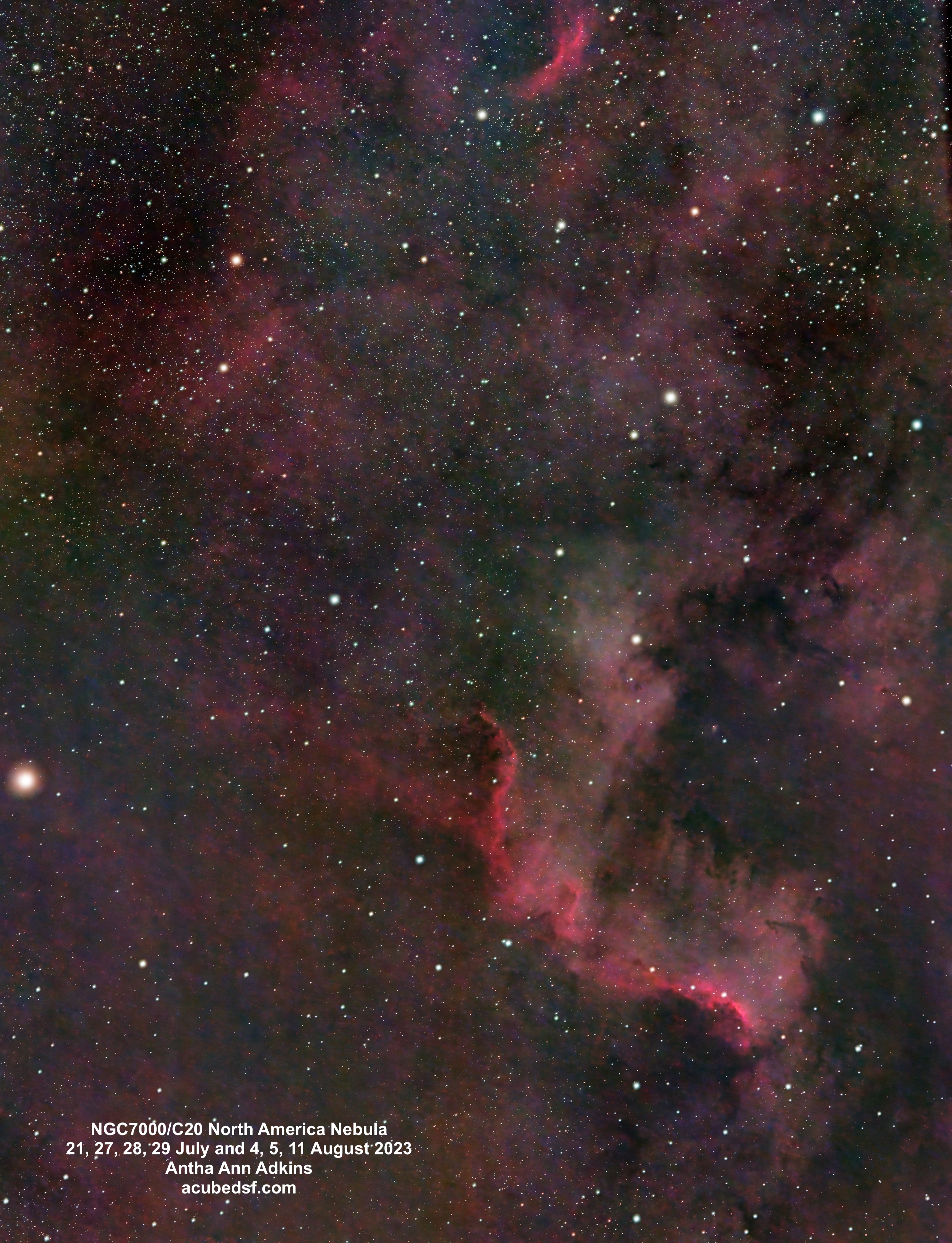
I call this image “Rising Phoenix, Curious Robin.” The bright nebula to the right of the image looks to me like a phoenix opening up its wings to take flight. The bright red nebula to the left looks to me like a red bird flying over to see what’s up.
These two nebulae are parts of the larger NGC 7000/C20 North America Nebula in the constellation Cygnus. Generally, it’s shown rotated clockwise from this image, with the dark nebula on the top of this image forming the Gulf of Mexico. The nebula I see as a phoenix is also called the Cygnus Wall.
Here is another view, rotated to look more like North America.
Nebulae, like clouds, are a great place to let your imagination run free. What do you see in this image?
The North America Nebula is an emission nebula of ionized hydrogen gas where star formation is taking place. It is lit up by a hot star that is hidden by the dark nebula next to it. It is 2590 light years away from us, and it has apparent dimensions of 2.5 degrees by 3.3 degrees.
Its large size makes it a fitting subject for my small telescope with its relatively wide field of view. But it’s quite dim and I can’t see it at all in a single frame. I made an early attempt to image it on a trip to the fabulous Bortle 2-3 dark skies of Dell City, Texas about two years ago, but I hadn’t realized then the huge effect of image processing stacks of images. Even after learning that lesson, it is still a leap of faith to collect hours of images when you can’t see the real subject you’re trying to capture! It’s also a challenge to keep the framing consistent so that everything overlays and can stack up. I used the asterism of the upside-down “T” shape in the upper left corner and the bright star ksi Cygnus (cropped out of the first image, visible in the second) to make sure I stayed in alignment.
I collected the data for this image from my driveway in Friendswood, Texas, under Bortle 7-8 skies. In order to separate the signal (the nebula) from the noise (our light pollution), I ended up taking data over eight nights, then had to throw out the data from one night (the first one) because it didn’t overlay well with the rest. And I had to throw out other data because I had a dust spot move between the data and the calibration frames on one night, and I had to throw out more data on another night because I hadn’t set up my tracking mount well enough so it drifted. But I ended up using a whopping 27.8 hours of data to make this one image.
We’ve been under a high pressure heat dome here in Texas for over a month, which means it’s been meltingly hot and lawn-destroyingly dry, but the silver lining is I’ve gotten to enjoy a lot of cloud-free telescope nights. Even in the middle of the night, though, it has been hot – around 80 deg F – which means I sweat setting up/adjusting/checking on the telescope. And it’s the Gulf Coast, which means it’s still muggy and I have to put a heater on the telescope so dew doesn’t collect. How crazy is that?
Camera geek info:
- Canon EOS 60D in manual mode, 1 minute exposure, ISO 800
- Williams Optics Zenith Star 73 III APO telescope
- Williams Optics Flat 73A
- SkyTech 2” LPRO-MAX CCD Filter
- iOptron CEM40
- Friendswood, Texas Bortle 7-8 suburban skies
Frames:
- July 21, 2023
- Run 3
- 35 1 minute lights
- 30 0.03 second flats
- 31 0.03 second flat darks
- Run 4
- 180 1 minute lights
- 30 0.03 second flats
- 30 0.03 second flat darks
- Run 3
- July 27, 2023
- Run 5
- 219 1 minute lights
- 31 0.03 second flats
- 30 0.03 second flat darks
- Run 6
- 111 1 minute lights
- 31 0.03 second flats
- 31 0.03 second flat darks
- Run 5
- July 28, 2023
- Run 7
- 221 1 minute lights
- 30 0.03 second flats
- 30 0.03 second flat darks
- Run 7
- July 29, 2023
- Run 9
- 165 1 minute lights
- 30 0.03 second flats
- 30 0.03 second flat darks
- Run 9
- August 4, 2023
- Run 10
- 160 1 minute lights
- 30 0.03 second flats
- 30 0.03 second flat darks
- Run 11
- 240 1 minute lights
- 30 0.03 second flats
- 30 0.03 second flat darks
- Run 10
- August 5, 2023
- Run 12
- 97 1 minute lights
- 30 0.03 second flats
- 30 0.03 second flat darks
- Run 13
- 93 1 minute lights
- 30 0.03 second flats
- 30 0.03 second flat darks
- Run 12
- August 11, 2023
- Run 14
- 149 1 minute lights
- 30 0.03 second flats
- 30 0.03 second flat darks
- Run 14
Processing geek info:
- PixInsight
- BlurXterminator
- NoiseXterminator
- StarXTerminator
- Generalized Hyperbolic Stretch

 Space&Aliens