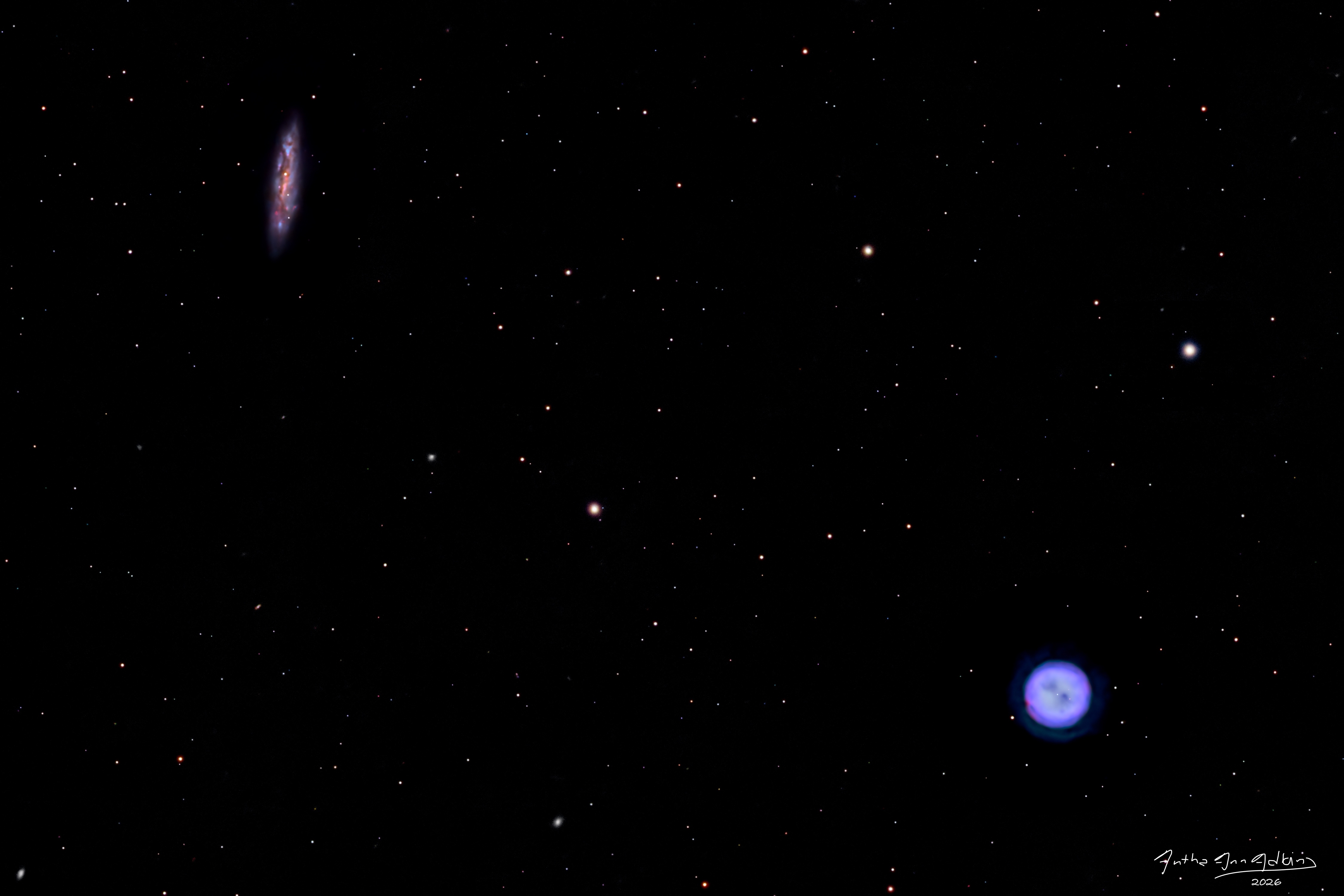
Messier 97, the Owl Nebula, and Messier 108, the Surfboard Galaxy, are about 50 arc minutes apart in the sky, so they are often imaged together. I think they make an interesting contrast, including needing different processing paths. I collected data using both Red Green Blue (RGB) filters and narrowband Hydrogen alpha (Ha) and Oxygen iii (Oiii) filters, but how I combined the narrowband data and RGB data differed.
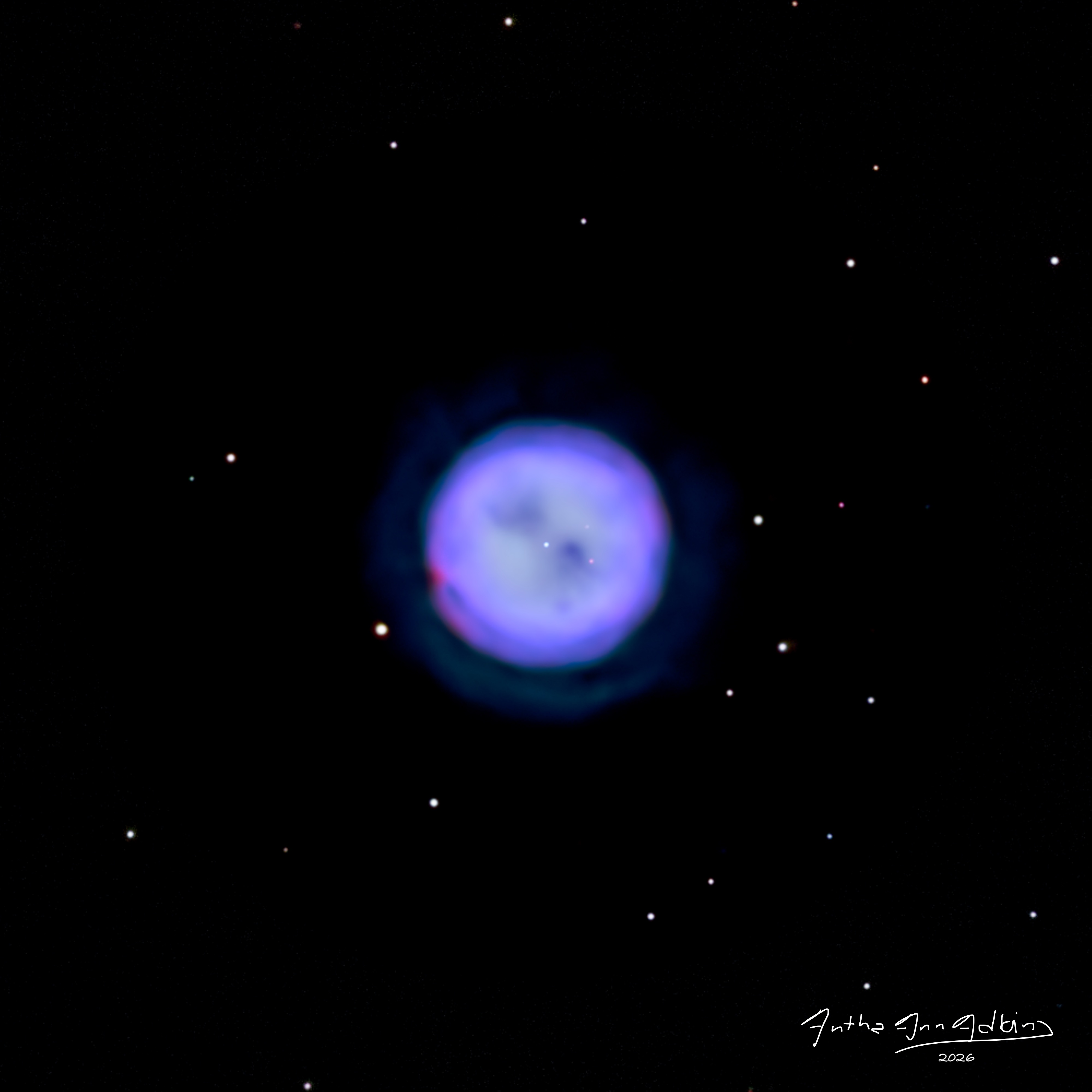
Messier 97, also called the Owl Nebula and numbered New General Catalogue (NGC) 3587, is a planetary nebula – the gases expelled from a low to intermediate mass (0.8 to 8 times the mass of the sun) red giant star before it becomes a white dwarf, lit up by that star. It’s located in the Milky Way, approximately 2640 light years away, and including the outer Oiii halo is about 4 arcminutes across in this image, making it 3 light years across. It’s estimated to be 8400 years old based on the expansion of the nebula.
The blue star in the center of the nebula is the white dwarf that is the remainder of the original star, which is estimated to be 5 billion years old and initially 1.5 to 2.5 times the mass of the sun before it created the planetary nebula and 0.58 to 0.62 times the mass of the sun after.
I find these small nebulae beautiful and fascinating. Each has its own unique structure. This one is spherical and has an outer Oiii halo, an Ha ring, and an inner filled section that appears to have two voids, or eyes, in it. The voids appear to have a more complicated structure that looks somewhat like fingers, or, sticking to the face analogy, eyelashes. Since there is no evidence for present-day stellar wind, the complex cavities may be relics from the time when the stellar wind was present.
M97 is bright enough that it showed up in the RGB filter data as well as in the narrowband Ha and Oiii data. In the RGB data, the red Ha ring was clearly visible, and I wanted to show that in the final image as well as the much dimmer outer Oiii halo. Because planetary nebulae are narrowband sources, the red I could see in the RGB data was from the Ha emissions and the blue/green I could see in the RGB data was from the Oiii emissions. So I used PixInsight’s CombineRGBAndNarrowband script to combine the RGB and Ha/Oiii data together.
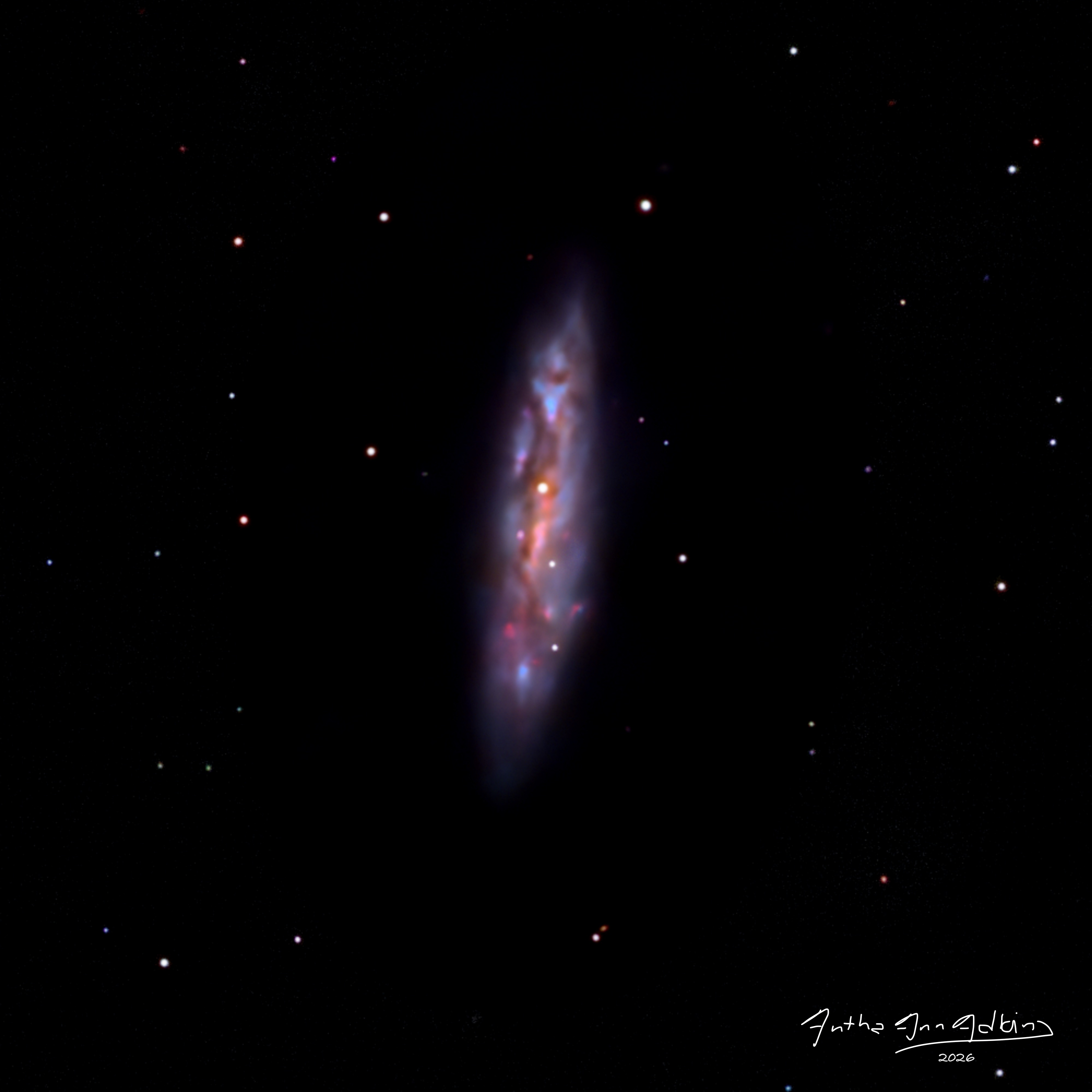
Messier 108, the Surfboard Galaxy and numbered NGC 3556, is a member of the Ursa Major group of galaxies within the Virgo supercluster of galaxies, of which our own Milky Way galaxy is a member. There’s a cool map of the Virgo supercluster here. Sources vary on the distance to M108, with recent values of 27.6 million +/- 6.2 million light years away based on a 2022 paper using the Tully-Fisher method or 32.3 million light years away based on a 2018 paper using the redshift method. In this image, it has an apparent visual size of 1 by 7 arcmin. Its size depends on its distance as well as its visual size, so depending upon the distance, it is 8 by 53 thousand light years across or 9.4 by 66 thousand light years across. Older measurements show it even further away, which would make it even bigger. It is classed as a barred spiral galaxy, and it contains a supermassive black hole 24 million times the mass of our sun.
Galaxies are wideband sources, so the narrowband Ha and Oiii data included light that was not from Ha or Oiii sources but just happened to be at that same wavelength. So before I added the Ha and Oiii data to the galaxy, I used the NBColourMapper tool to perform continuum subtraction, where I used the original red and green data as a reference to remove the wideband signal from the Ha and Oiii data, respectively. Then I used PixInsight’s CombineRGBAndNarrowband script to add the Ha and Oiii data to the RGB galaxy. The red Ha data is much more visible as the bright red spots in the final image.
In addition to M108, there are several background galaxies in this image. I stretched them separately from the stars to bring them out as much as I could, but I’d really need more data to show them well.
In this image, the stars and galaxies came from images using RGB filters (14 – 31 minutes per color), and the nebula and galaxy used additional images using 4.2 hours of Hydrogen alpha (mapped to red) and 3.5 hours of Oxygen iii (mapped to blue) filters. The M97 Nebula, M108 galaxy, background galaxies, and stars were processed separately to maximally enhance each.
Camera geek info:
- William Optics Pleiades 111 telescope
- ZWO 2” Electronic Filter Wheel
- Antila HO and RGB filters
- Blue Fireball 360° Camera Angle Adjuster/Rotator
- ZWO ASI183MM-Pro-Mono camera
- ZWO ASiair Plus
- William Optics Uniguide 32MM F/3.75
- ZWO ASI220MM-mini
- iOptron CEM40
- Friendswood, Texas Bortle 7-8 suburban skies
Frames:
- February 6, 2026
- 3 600 second Gain 150 Oiii lights
- 30 0.2 second Gain 150 Oiii flats
- February 7, 2026
- 4 600 second Gain 150 Ha lights
- 30 0.5 second Gain 150 Ha flats
- February 22, 2026
- 94 20 second Gain 150 Red lights
- 30 0.02 second Gain 150 Red flats
- 43 20 second Gain 150 Green lights
- 30 0.01 second Gain 150 Green flats
- 65 20 second Gain 150 Blue lights
- 30 0.01 second Gain 150 Blue flats
- March 13, 2026
- 2 600 second Gain 150 Oiii lights
- 30 0.2 second Gain 150 Oiii flats
- June 23, 2026
- 10 600 second Gain 150 Oiii lights
- 30 0.2 second Gain 150 Oiii flats
- June 24, 2026
- 14 600 second Gain 150 Ha lights
- 30 0.5 second Gain 150 Ha flats
- July 26, 2026
- 7 600 second Gain 150 Ha lights
- 30 0.5 second Gain 150 Ha flats
- July 31, 2026
- 10 600 second Gain 150 Oiii lights
- 30 0.2 second Gain 150 Oiii flats
- 30 Flat Darks from library to match flat time
- 30 Darks from library to match light time
Processing geek info:
- PixInsight
- BlurXterminator
- NoiseXterminator
- StarXTerminator
- NBColourMapper
- Generalized Hyperbolic Stretch
 Space&Aliens