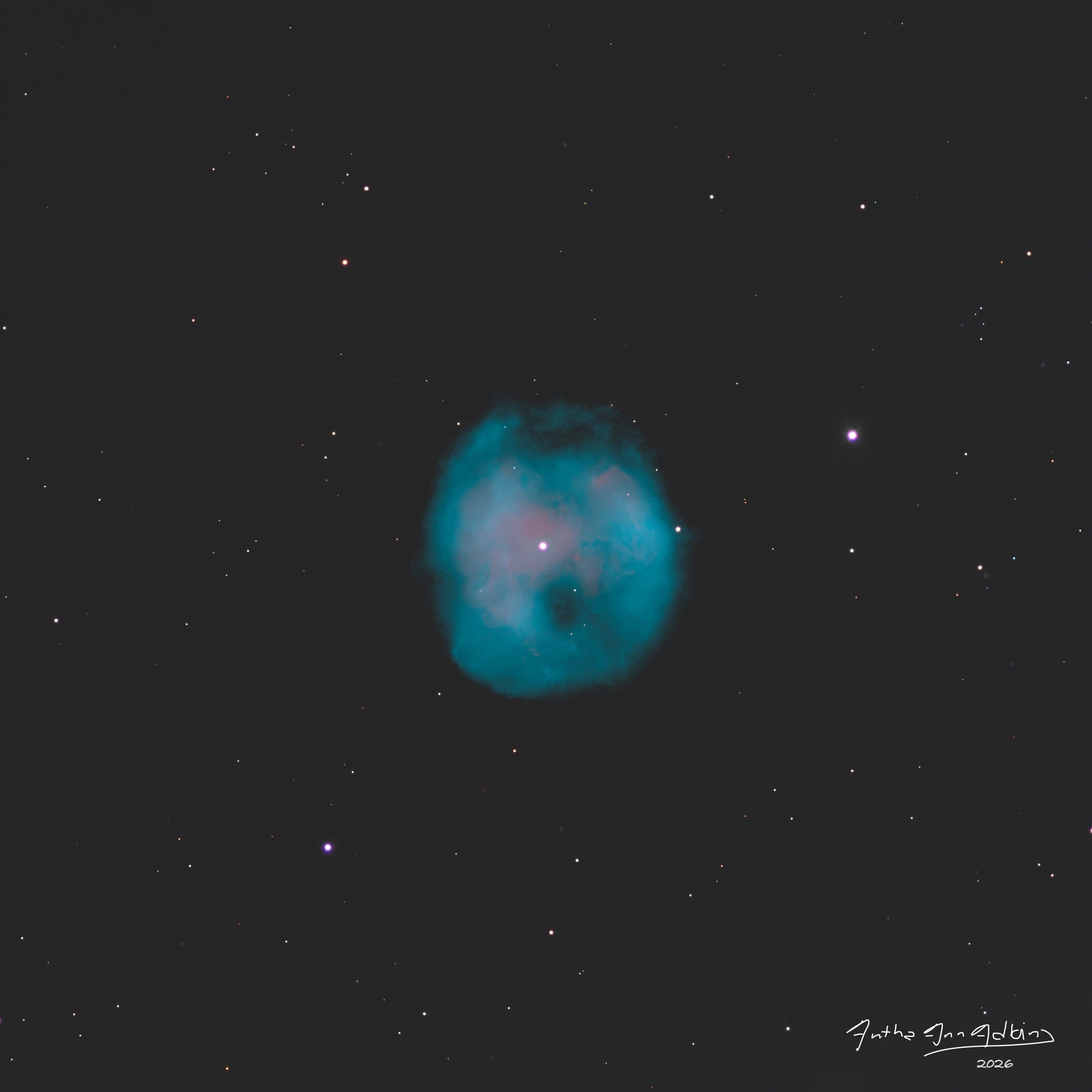
Longmore-Tritton 5 (LoTr5) is a planetary nebula – the gases expelled from a low to intermediate mass (0.8 to 8 times the mass of the sun) red giant star before it becomes a white dwarf, lit up by that star. It’s located in the Milky Way, approximately 1500 light years away, and is about 7.5 x 10 arcminutes in this image, making it approximately 3.3 x 4.4 light years across, which is big enough to be considered old as a planetary nebula.
This planetary nebula contains (at least – there’s some evidence for a third) two stars – the white dwarf that is the source of the planetary nebula and a companion G-type star (same kind of star as our sun). The two stars have a long orbital period, with one orbit taking approximately 2700 days. The G-type star rotates about every 5.95 days and is barium rich, both of which may indicate that the G-type star is capturing the matter ejected by its companion into the planetary nebula.
I find these small nebulae beautiful and fascinating. Each has its own unique structure. This one is spherical and appears to have two voids in it in both Oiii and Ha, similar to the Owl Nebula. It does not appear to have a rim or ring. It does appear to have three brighter spots in Oiii evenly spaced around the outer edge.
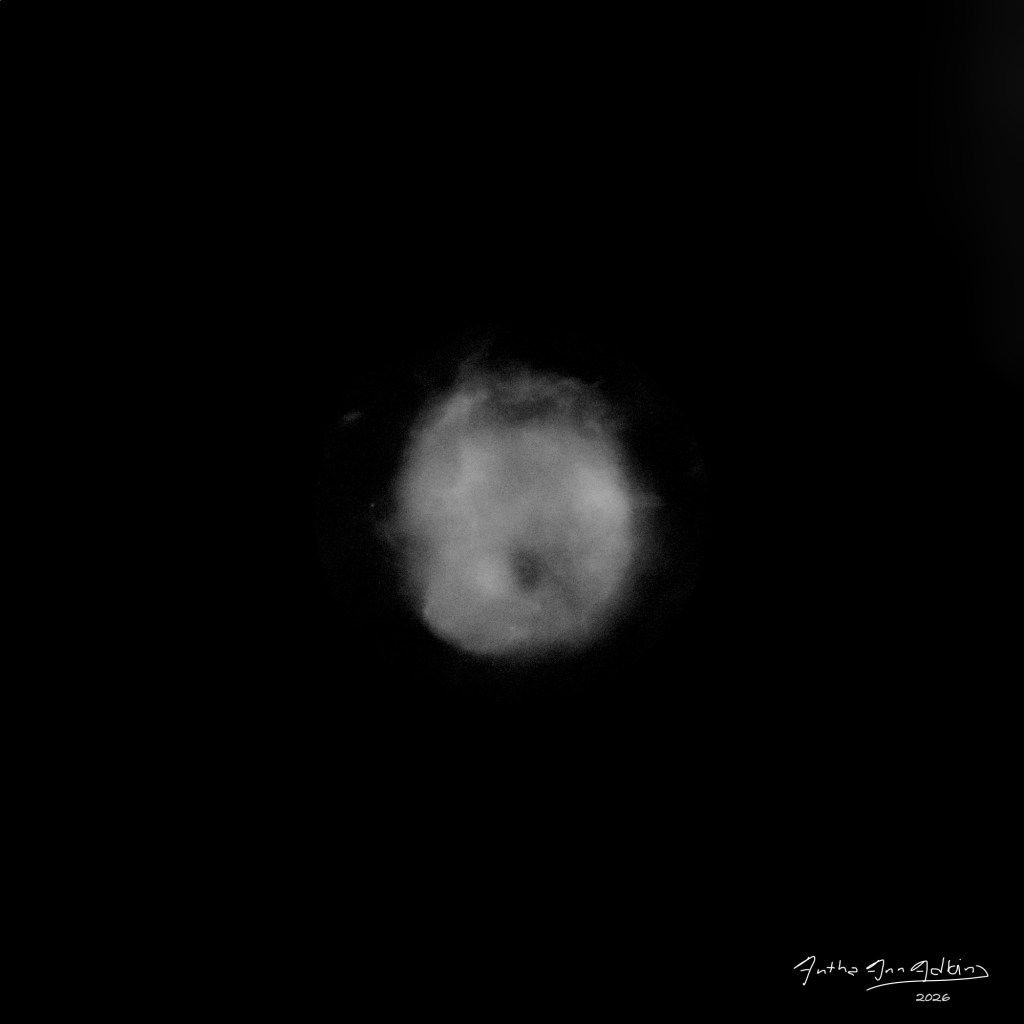
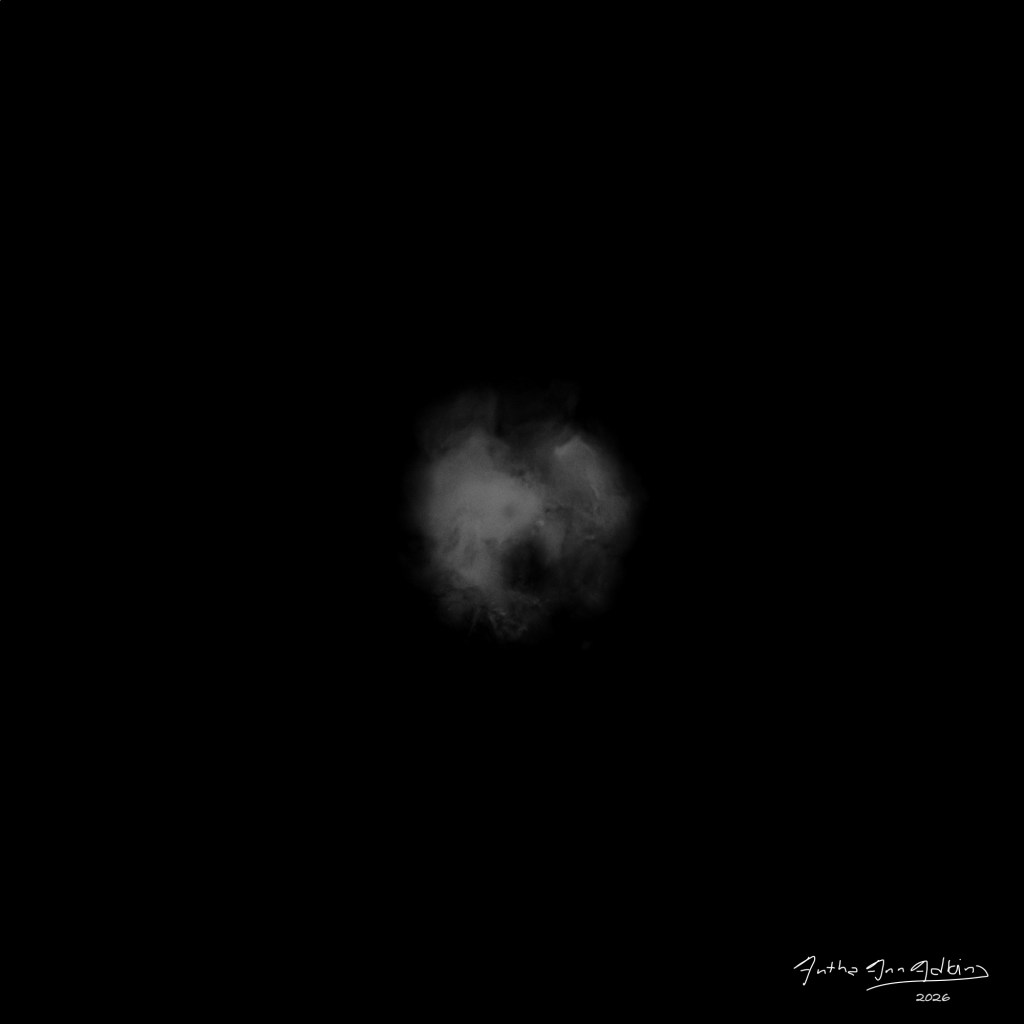
LoTr5 is quite dim, and wasn’t visible in the integrated Reg Green Blue (RGB) filter frames (30 minutes of total time in each) or in the single 10 minute Oxygen iii (Oiii) and Hydrogen alpha (Ha) filter frames. However, when 5.8 hours of Oiii data and 8.7 hours of Ha data are integrated, the nebula is visible in both, although it was much brighter in Oiii than Ha. I processed the Oiii and Ha data separately and then combined them with the RGB stars using PixInsight’s CombineRGBAndNarrowband script. I mapped Ha to red and Oiii to blue and green with levels such that the Ha was visible and the Oiii was a light blue color.
I wonder what it would have been like to be on a planet around the G-type star when the companion star became a red giant and then made a planetary nebula. What a weird change in the sky that would be (assuming the planet survived).
What do you think?
Camera geek info:
- William Optics Pleiades 111 telescope
- ZWO 2” Electronic Filter Wheel
- Antila HO and RGB filters
- Blue Fireball 360° Camera Angle Adjuster/Rotator
- ZWO ASI183MM-Pro-Mono camera
- ZWO ASiair Plus
- William Optics Uniguide 32MM F/3.75
- ZWO ASI220MM-mini
- iOptron CEM40
- Friendswood, Texas Bortle 7-8 suburban skies
Frames:
- May 2, 2026
- 88 20 second Gain 150 Red lights
- 30 0.02 second Gain 150 Red flats
- 89 20 second Gain 150 Green lights
- 30 0.01 second Gain 150 Green flats
- 89 20 second Gain 150 Blue lights
- 30 0.01 second Gain 150 Blue flats
- 17 600 second Gain 150 Oiii lights
- 30 0.2 second Gain 150 Oiii flats
- May 28, 2026
- 18 600 second Gain 150 Oiii lights
- 30 0.2 second Gain 150 Oiii flats
- June 30, 2026
- 18 600 second Gain 150 Ha lights
- 30 0.5 second Gain 150 Ha flats
- July 2, 2026
- 15 600 second Gain 150 Ha lights
- 30 0.5 second Gain 150 Ha flats
- July 3, 2026
- 16 600 second Gain 150 Ha lights
- 30 0.5 second Gain 150 Ha flats
- July 26, 2026
- 3 600 second Gain 150 Ha lights
- 30 0.5 second Gain 150 Ha flats
- 30 Flat Darks from library to match flat time
- 30 Darks from library to match light time
Processing geek info:
- PixInsight
- BlurXterminator
- NoiseXterminator
- StarXTerminator
- Generalized Hyperbolic Stretch

