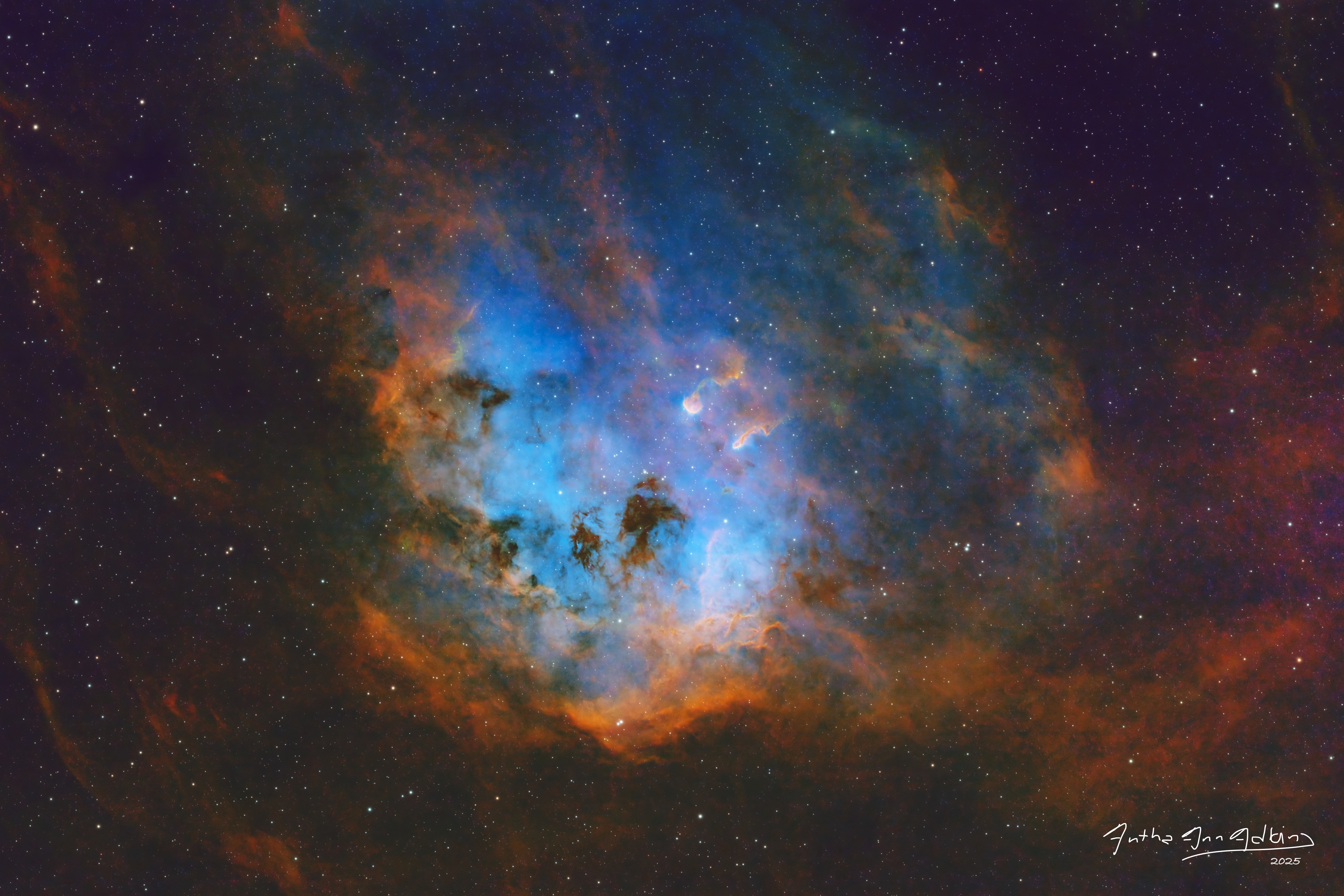
Sharpless Sh2-236 is commonly called the Tadpole Nebula since it appears to contain a tadpole (or two – depending on how you interpret the two white-pink objects near the center of this image). How many tadpoles do you see?
This image shows HII region Sharpless Sh2-236 (the whole image) (also cataloged in the Index Catalog of Nebulae as 410 (IC410)), the open cluster NG1893 (stars in the blue region), and the two “cometary globule” tadpole nebulae numbered Simeiz (Sim) 129 and 130.
Sh2-236 is an H II region emission nebula, a region of ionized atomic hydrogen. The H II regions in the Sharpless 2 catalog were “defined not only in terms of the ionized gas but also in terms of the hot stars which are responsible for the ionization.”
The young open cluster NGC1893 contains five O type stars, short-lived, hot, massive stars that ionize the surrounding molecular cloud. One of the stars is theorized to be 4 million years old; the others, 2 – 3 million years old. Between these O-type stars and the two cometary globules are smaller, younger stars that are 1 – 2 million years old that appear to have an age gradient with older stars closer to the O-type stars and younger stars closer to the cometary globules. The O-type stars are theorized to be causing triggered star formation in the globules – as the ionization and shock wave from the O-type stars hit the initial clumps of material that are the tadpoles, “radiation driven implosion” caused the clumps to form stars.
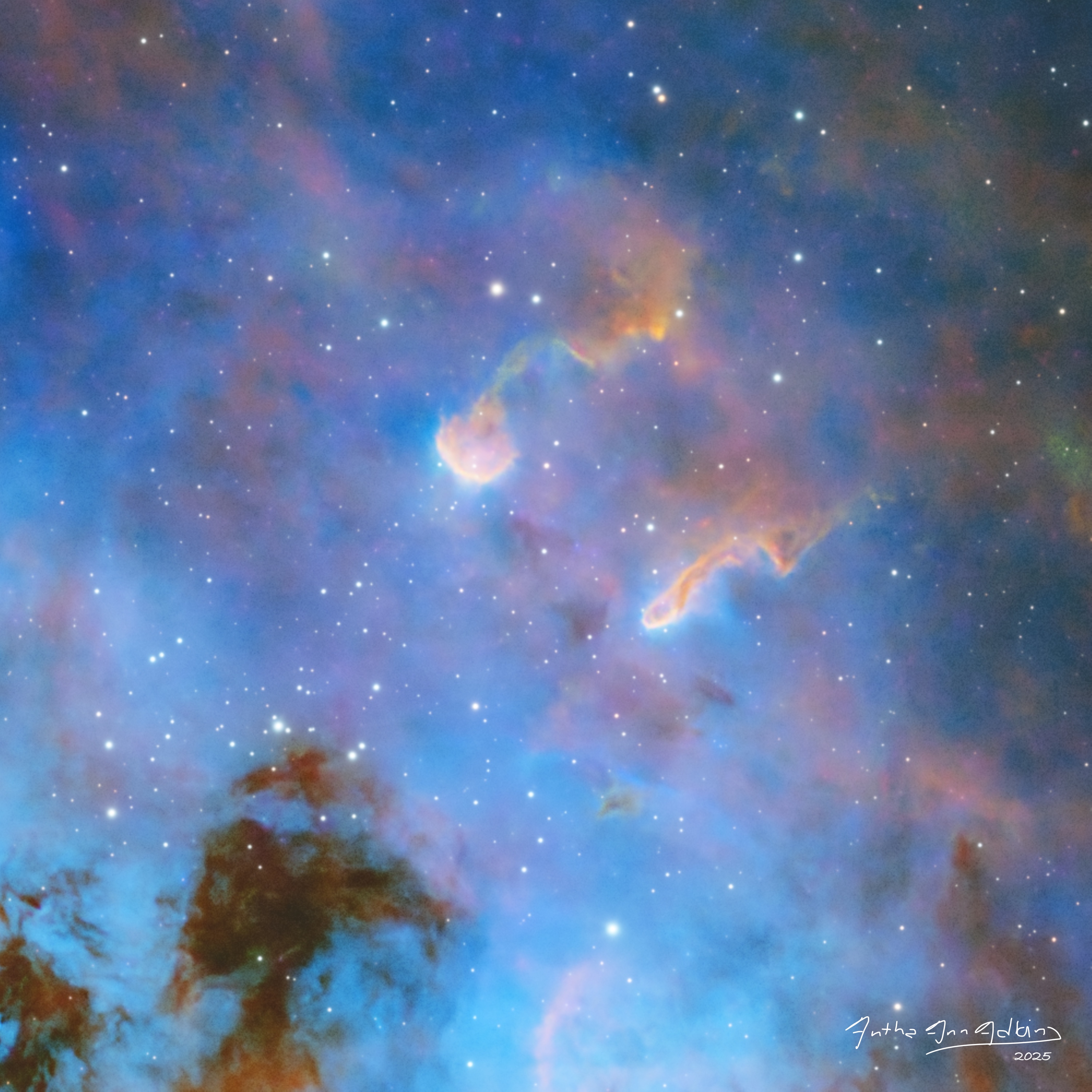
The tadpoles are believed to be denser clumps of material. The tails are theorized to be formed from ionized gas from the edge of the tadpole closest to the O-type stars flowing along the magnetic field away from the O-type stars. The more tadpole-like nebula, Sim 129, is on the far side of the nebula from us and is theorized to contain young stars. Sim 130 is on the near side of the nebula closer to us and is theorized to contain “incipient stars” – the earliest stage of star formation, so the stellar evolutionary stage in the two tadpoles is different. I am always amazed when I realize that our galaxy is still under construction!
Sh2-236 is located in the Milky Way, approximately 10500 light years away. The square “box” of the nebula in the first image is 60 arc minutes across, so the nebula is approximately 183 light years across.
I collected the frames for this image under the fantastic dark skies of Dell City, Texas. When we go out there, I generally try for some easier targets and a more difficult target – this was one of the easier targets. I need far less time than I do for images from my light-polluted driveway, but it was something of a guess to know whether I’d taken enough data to end up with a good image. In this image, the stars came from images using red-green-blue filters with about 17 minutes of data each, and the nebula came from images using Sulfer ii (4.1 hours of data mapped to red), Hydrogen alpha (4.3 hours of data mapped to green) and Oxygen iii (4.25 hours of data mapped to blue) filters, the standard SHO mapping. But after doing that mapping, I used Narrowband Normalization to shift the colors so that it wasn’t overly green and to enhance the reds and blues. The nebula was processed separately from the stars to maximally enhance it.
Camera geek info:
- William Optics Zenith Star 73 III APO telescope
- William Optics Flat 73A
- ZWO 2” Electronic Filter Wheel
- Antila RGB and SHO filters
- ZWO ASI183MM-Pro-Mono camera
- William Optics Uniguide 32MM F/3.75
- ZWO ASI220MM-mini
- ZWO ASiair Plus
- iOptron CEM40
- Dell City, Texas Bortle 2 – 3 skies
Frames:
- November 12, 2025
- 17 300 second Gain 150 Ha lights
- 30 1 second Gain 150 Ha flats
- 14 300 second Gain 150 Oiii lights
- 30 0.5 second Gain 150 Oiii flats
- 15 300 second Gain 150 Sii lights
- 30 1 second Gain 150 Sii flats
- November 13, 2025
- 17 300 second Gain 150 Ha lights
- 30 1 second Gain 150 Ha flats
- 18 300 second Gain 150 Oiii lights
- 30 0.5 second Gain 150 Oiii flats
- 15 300 second Gain 150 Sii lights
- 30 1 second Gain 150 Sii flats
- November 10, 2025
- 18 300 second Gain 150 Ha lights
- 30 1 second Gain 150 Ha flats
- 19 300 second Gain 150 Oiii lights
- 30 0.5 second Gain 150 Oiii flats
- 19 300 second Gain 150 Sii lights
- 30 1 second Gain 150 Sii flats
- November 11, 2025
- 34 30 second Gain 150 Red lights
- 30 0.05 second Gain 150 Red flats
- 35 30 second Gain 150 Green lights
- 30 0.02 second Gain 150 Green flats
- 35 30 second Gain 150 Blue lights
- 30 0.02 second Gain 150 Blue flats
- 30 Flat Darks matching flat durations from library
- 30 Darks matching light durations from library
Processing geek info:
- PixInsight
- BlurXterminator
- NoiseXterminator
- StarXTerminator
- Narrowband Normalization
 Space&Aliens
You’re finding so many beautiful sights in the cosmos!
The universe is full of them! I don’t think I will ever get bored. It’s quite amazing!