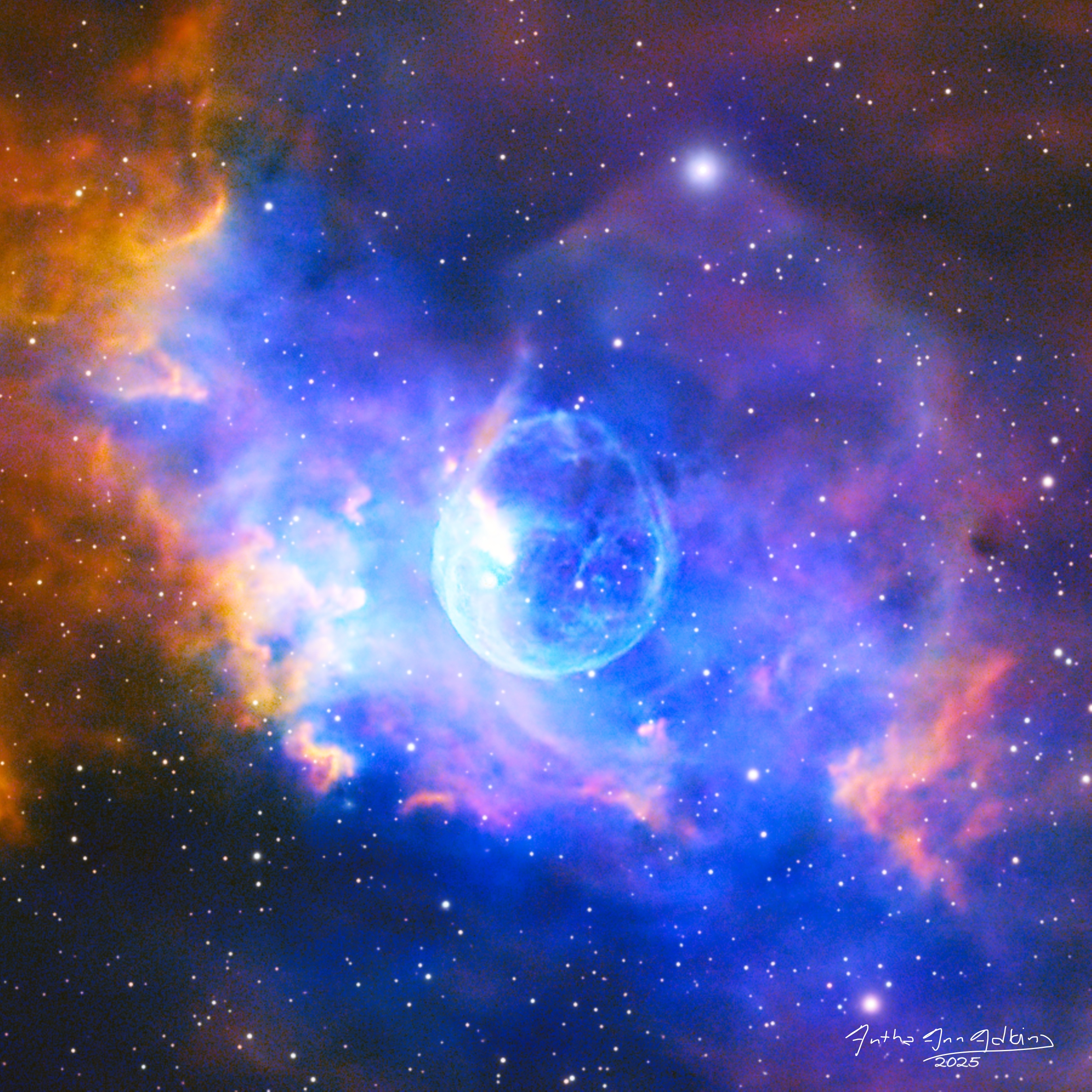
NGC7635, or the Bubble Nebula, consists of an emission nebula numbered Sharpless Sh2-162 surrounding a bubble surrounding a massive young type O star. The emission nebula Sh2-162 is part of a molecular cloud, an interstellar cloud of gas molecules, whose density allows the formation of molecules such as molecular hydrogen (H2) and carbon monoxide (CO). The source of energy creating the bubble and lighting up the emission nebula is the young, hot, type O star BD+60 2522. The star is about 27 +/- 7 times the mass of the sun and 2 million years old. The bubble is estimated to only be about 50,000 years old and is striking for appearing nearly spherical and for its star not being near its geometric center (in this image, the star is the bright white circle to the left underneath the bright white arc on the bubble’s surface). The bubble was created by the solar wind from the star pushing the material around it into a thin, dense shell. I found a paper from 2019 that argues that because the star is moving at a relatively high velocity and the bubble is relatively young, the star is creating a bow shock. If the bow shock is the case, the bubble is probably closer to us than the emission nebula and moving towards it. The bubble and nebula being significantly brighter on one side (the left side in this image) could be explained either by the bow shock or by the interstellar matter on that side being denser.
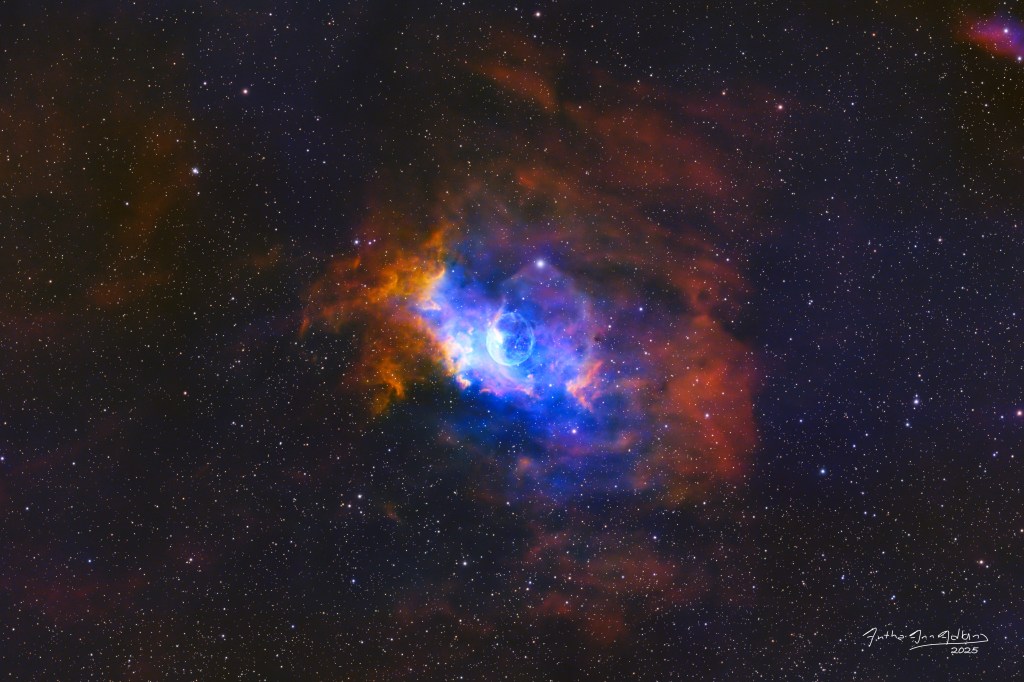
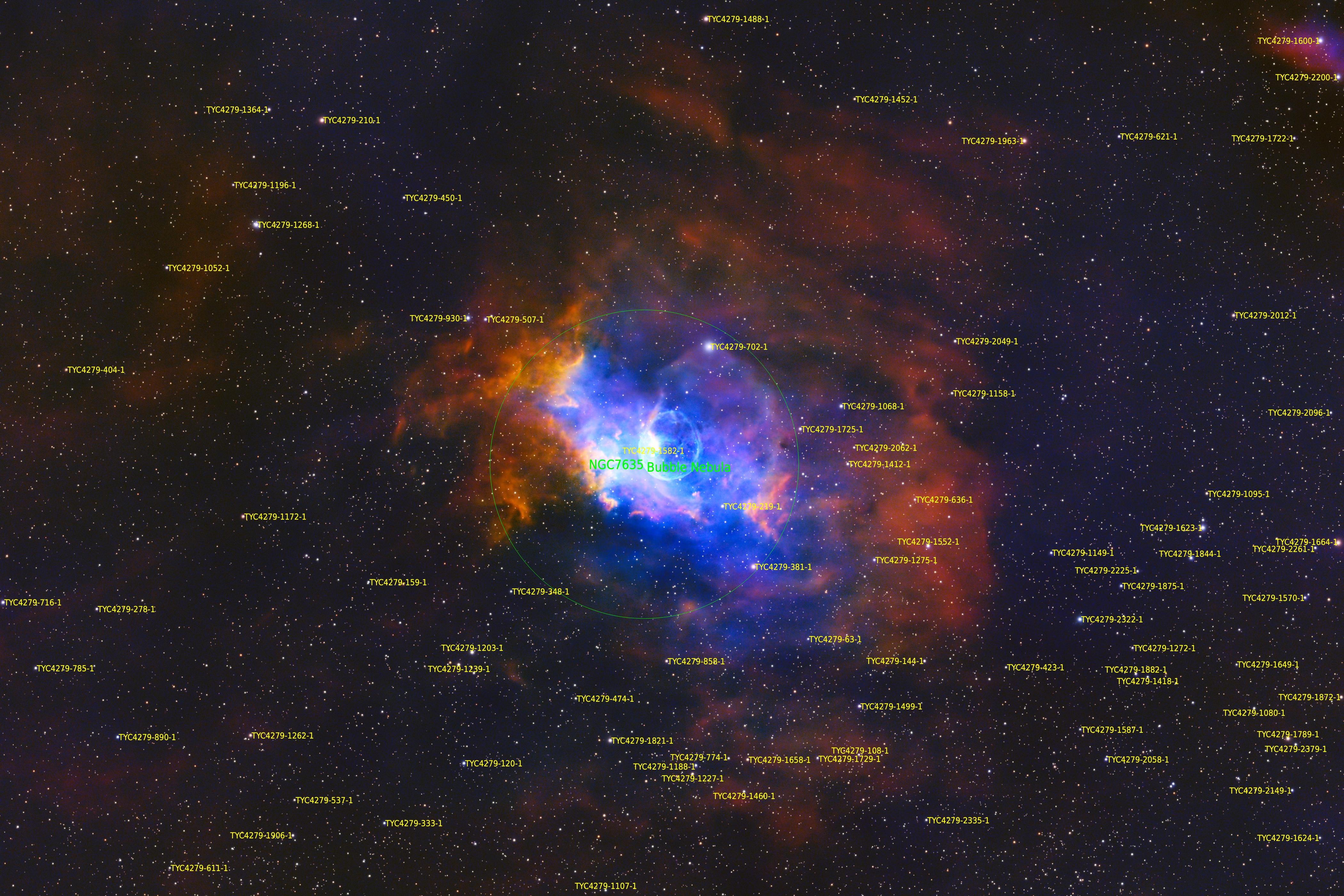
The Bubble Nebula is located in the Milky Way, approximately 8155 light years away. The nebula has an apparent size of 0.69 degrees, so it is approximately 99 light years across. The bubble itself is about 3 arc-minutes in diameter, so it is approximately 7 light years across.
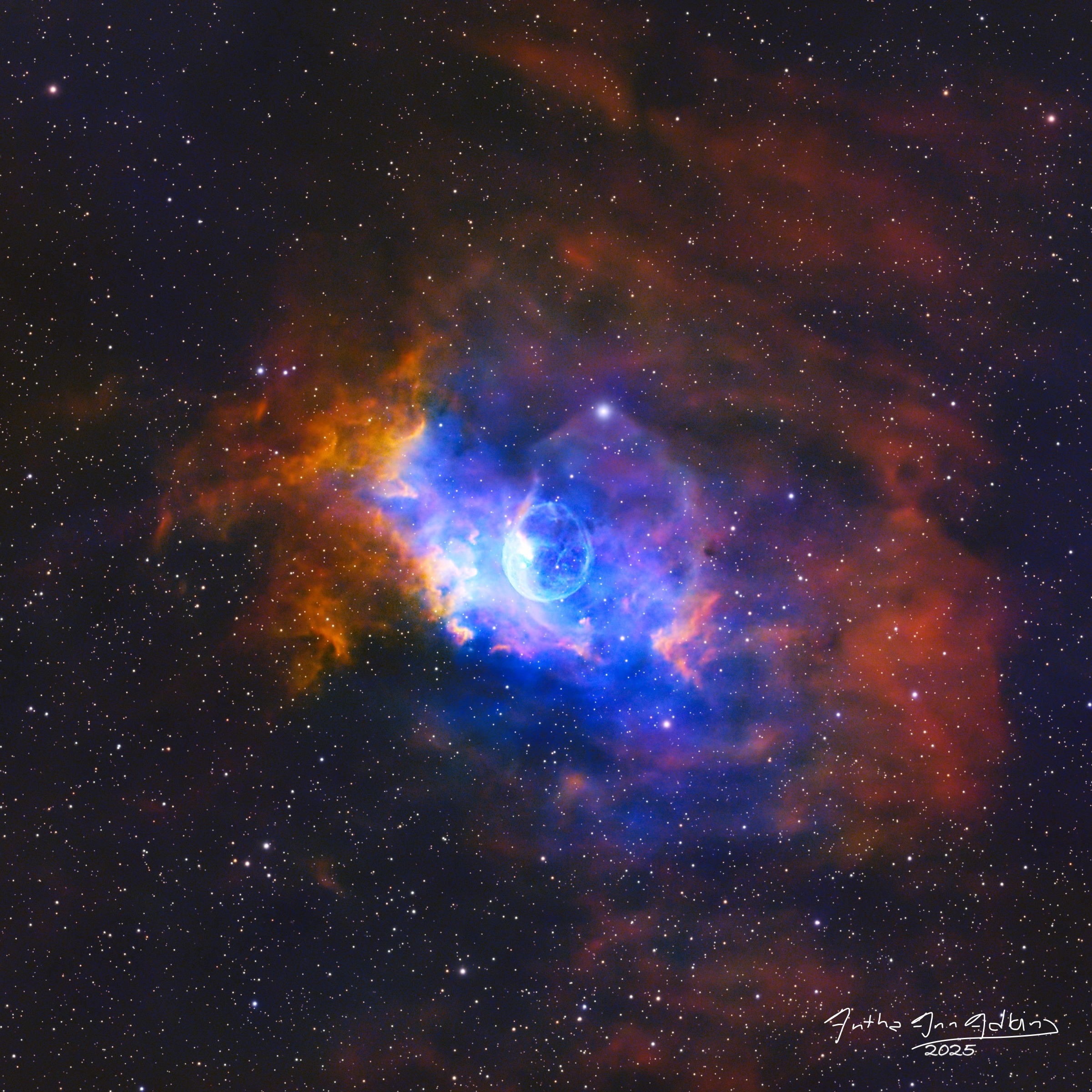
In this image, the stars came from images using red-green-blue filters with 12 to 33 minutes of data each, and the nebula came from images using Sulfer ii (7.4 hours of data mapped to red), Hydrogen alpha (2.8 hours of data mapped to green) and Oxygen iii (8.1 hours of data mapped to blue) filters, the standard SHO mapping. But after doing that mapping, I used Narrowband Normalization to shift the colors so that it wasn’t overly green and to enhance the reds and blues. This tool made getting the colors in this nebula look good a lot easier! The nebula was processed separately from the stars to maximally enhance it.
I think this nebula is stunning! We live in a universe filled with wonders.
Camera geek info – Narrowband:
- William Optics Pleiades 111 telescope
- ZWO 2” Electronic Filter Wheel
- Antila SHO and RGB filters
- Blue Fireball 360° Camera Angle Adjuster/Rotator
- ZWO ASI183MM-Pro-Mono camera
- William Optics Uniguide 32MM F/3.75
- ZWO ASI220MM-mini
- ZWO ASiair Plus
- iOptron CEM40
- Friendswood, Texas Bortle 7-8 suburban skies
Frames:
- August 7, 2025
- 56 180 second Gain 150 Ha lights
- 30 0.5 second Gain 150 Ha flats
- August 8, 2025
- 4 180 second Gain 150 Oiii lights
- 30 0.2 second Gain 150 Oiii flats
- August 14, 2025
- 31 180 second Gain 150 Oiii lights
- 30 0.2 second Gain 150 Oiii flats
- August 16, 2025
- 42 180 second Gain 150 Oiii lights
- 30 0.2 second Gain 150 Oiii flats
- September 4, 2025
- 50 180 second Gain 150 Sii lights
- 30 0.5 second Gain 150 Sii flats
- September 11, 2025
- 55 180 second Gain 150 Oiii lights
- 30 0.2 second Gain 150 Oiii flats
- September 12, 2025
- 65 180 second Gain 150 Sii lights
- 30 0.5 second Gain 150 Sii flats
- September 13, 2025
- 100 20 second Gain 150 Red lights
- 30 0.02 second Gain 150 Red flats
- 35 20 second Gain 150 Green lights
- 30 0.01 second Gain 150 Green flats
- 51 20 second Gain 150 Blue lights
- 30 0.01 second Gain 150 Blue flats
- October 25, 2025
- 30 180 second Gain 150 Oiii lights
- 30 0.2 second Gain 150 Oiii flats
- 33 180 second Gain 150 Sii lights
- 30 0.5 second Gain 150 Sii flats
- 30 Flat Darks matching flat durations from library
- 30 Darks matching light durations from library
Processing geek info:
- PixInsight
- BlurXterminator
- NoiseXterminator
- StarXTerminator
- Narrowband Normalization
 Space&Aliens
These are just amazing!
Katherine
Thanks!
Wow, double wow, and triple wow!
Thanks!