
It’s a well-known astrophotography curse that buying new equipment means weeks, if not months, worth of cloudy skies. My new telescope, a William Optics Pleiades 111, a 11.1 cm/4.37 inch diameter refractor that I’ve nicknamed “Blue”, was no exception. It took about a month after I got the telescope (and the additional two counter weights I needed to balance it) for the skies to at least somewhat clear. I got everything set up, just to watch the clouds roll in. Happily, they then rolled back out. And then rolled back in. And out.
I ended up with enough data to make a first light picture, but I’ll need to collect more data for a final image.
I had contemplated what to image for first light. Since the telescope name is Pleiades, the Pleiades would have been a good target, except they’re currently barely above the horizon at sunset. My favorite nebula, the Orion nebula, would have been a good target, except it’s also currently barely above the horizon at sunset. It’s “galaxy season,” so I decided to image a galaxy. I’ve imaged M101 before because it hosted a supernova in 2023, so it gave me a good point of comparison.
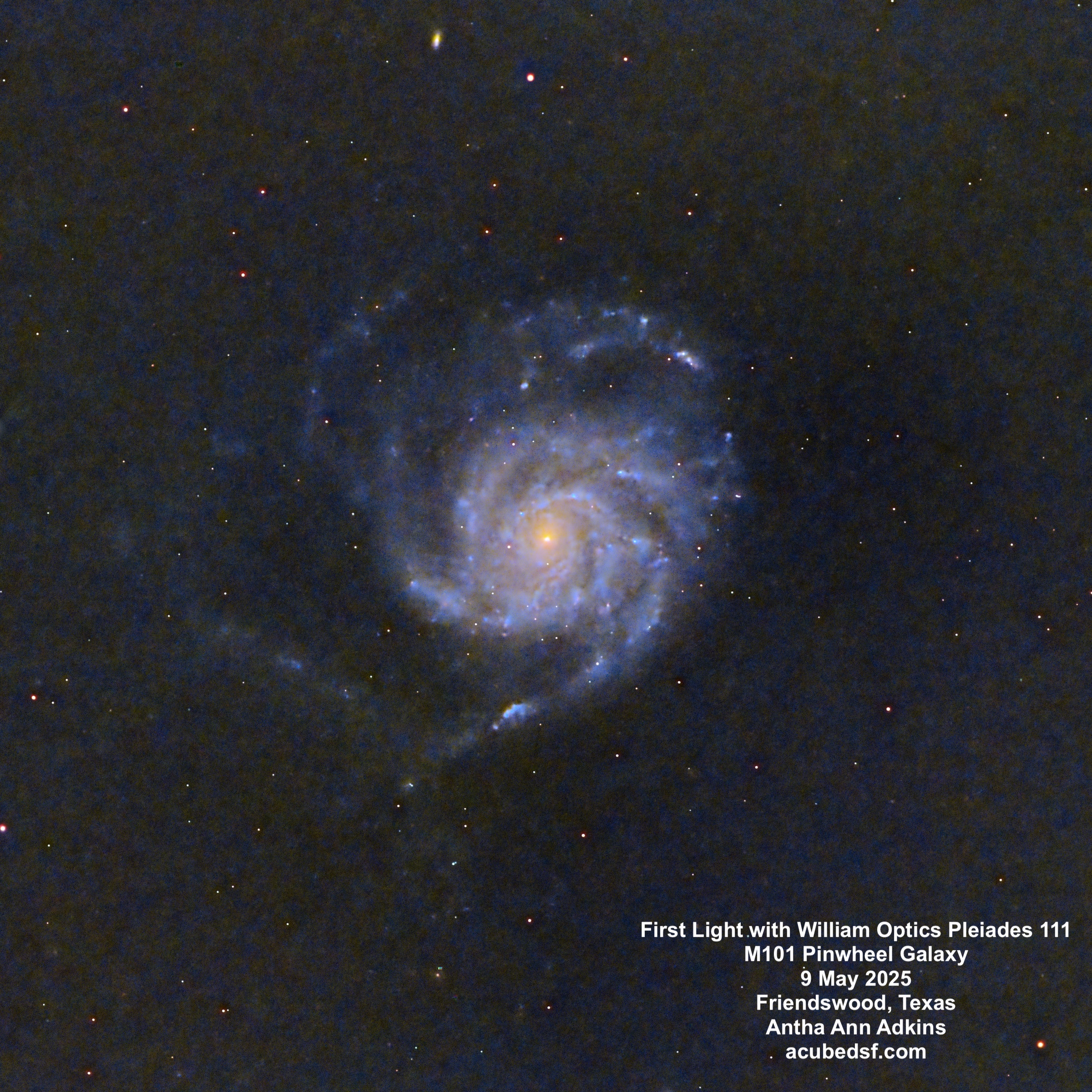

The comparison isn’t entirely a fair one. On the one hand, this is an entirely new setup, with a much larger diameter telescope, an astro camera instead of a consumer camera, and a guide scope and guide camera to better control the tracking mount. Additionally, I’ve picked up a lot of processing skill in the last two years, such as using shorter images for the stars so they don’t “bloat.” On the other hand, this was 3.4 hours of galaxy data from my Bortle 7-8 light polluted driveway instead of 10.6 hours from the Bortle 2-3 dark skies of Dell City.
Because of the light pollution and limited imaging time, there is a lot more background noise in the new image. But the stars are enormously improved from the old image. And there is more detail in the new image. I can’t wait to see how an image with more data turns out!
Once the clouds roll away again ….
Camera geek info May 9, 2025 (new image):
- William Optics Pleiades 111 telescope
- ZWO 2” Electronic Filter Wheel
- Antila RGB filters
- Blue Fireball 360° Camera Angle Adjuster/Rotator
- ZWO ASI183MM-Pro-Mono camera
- William Optics Uniguide 32MM F/3.75
- ZWO ASI220MM-mini
- ZWO ASiair Plus
- iOptron CEM40
- Friendswood, Texas Bortle 7-8 suburban skies
Frames (new image):
- May 9, 2025
- 32 30 second Gain 150 Red lights for stars
- 24 30 second Gain 150 Green lights for stars
- 22 30 second Gain 150 Blue lights for stars
- 53 60 second Gain 150 Red lights for galaxy
- 66 60 second Gain 150 Green lights for galaxy
- 86 60 second Gain 150 Blue lights for galaxy
- 30 0.2 second Gain 150 Red flats
- 30 0.1 second Gain 150 Green flats
- 30 0.1 second Gain 150 Blue flats
- Darks, Flat darks from library
Camera geek info (old image):
- William Optics Zenith Star 73 III APO telescope
- William Optics Flat 73A
- Canon EOS 60D in manual mode, 2 minute exposure, ISO 1600 and ISO 2000, custom white balance 3500K
- iOptron CEM40
- Dell City, Texas Bortle 2-3 dark skies
Frames (old image):
- June 10, 2023
- Run 1 1600 ISO
- 99 2 minute lights
- 31 0.01 second flats
- 20 0.01 second flat darks
- Run 2 1600 ISO
- 39 2 minute lights
- 31 0.02 second flats
- 30 0.02 second flat darks
- 71 2 minute darks
- Run 1 1600 ISO
- June 11, 2023 2000 ISO
- 151 2 minute lights
- 31 0.02 second flats
- 20 0.02 second flat darks
- 31 2 minute darks
- June 12, 2023 2000 ISO
- 30 2 minute lights
- 31 0.02 second flats
- 30 0.02 second flat darks
- 32 2 minute darks
Processing geek info:
- PixInsight
- BlurXterminator
- NoiseXterminator
- StarXTerminator
- Generalized Hyperbolic Stretch
 Space&Aliens
Pingback: William Optics Pleiades 111 First Light and More Nights with M101 the Pinwheel Galaxy | Space&Aliens