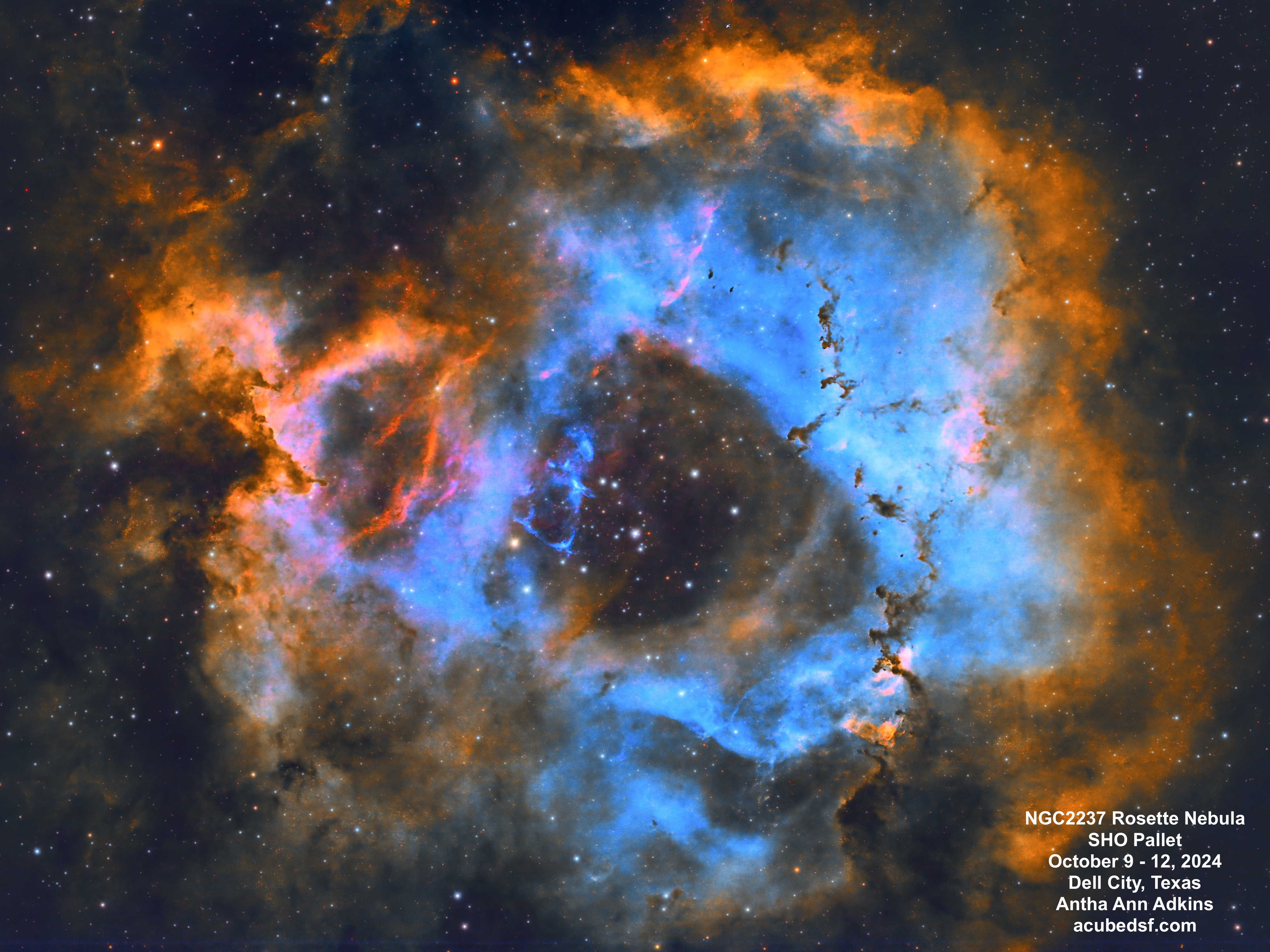
The Rosette Nebula, also numbered New General Catalogue (NGC) 2237 or Caldwell 49, is an emission nebula. It is a large star-forming region containing the NGC2244 (Caldwell 50) star cluster in its center. The star cluster was made from the gases in the nebula and contains some massive type O stars, which in turn produce radiation and stellar wind that blow away and light up the nebula around them. The stars in this cluster are young, less than 5 million years old. The Rosette Nebula is located in the Milky Way, approximately 5200 light years away, and it has an apparent size of 1.3 degrees, so it is approximately 120 light years across.
When we visit the lovely dark skies of Dell City, Texas, I try to collect data on some challenging objects that I don’t think I can do from my light-polluted driveway. I’m not always successful in meeting the challenge (super dim objects take a lot of hours of data to image), so I also try to collect data on some brighter objects so I know I’ll come home with some nice images. The Rosette Nebula was my choice for one of my “sure it will be nice” images from our last trip.
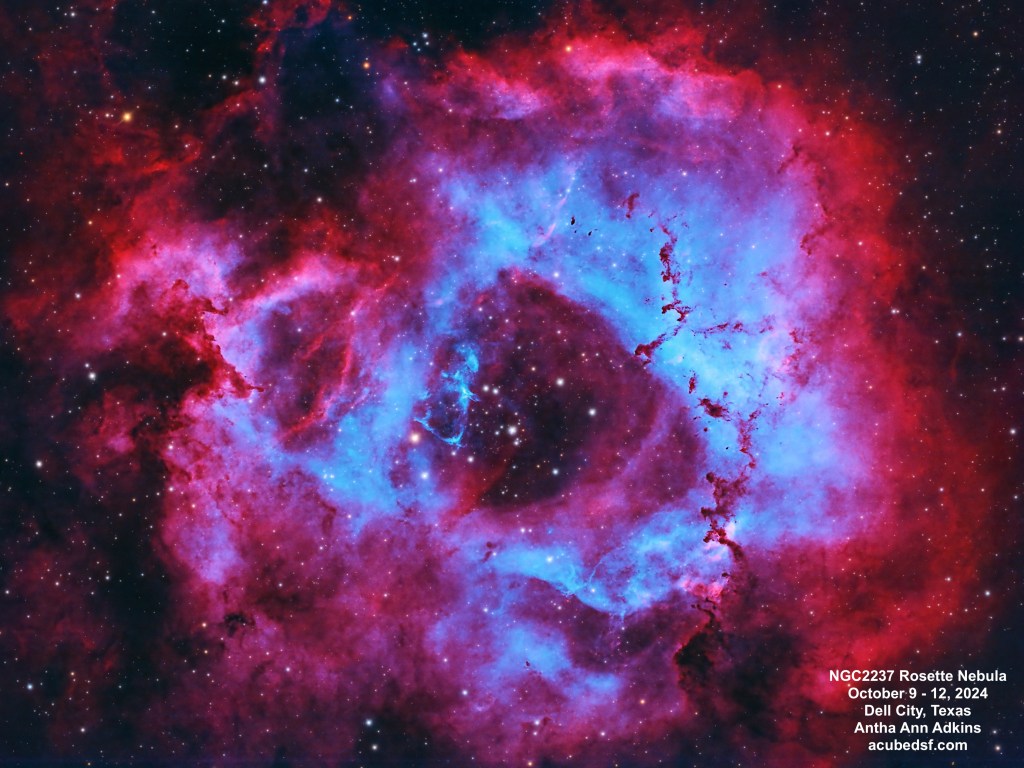
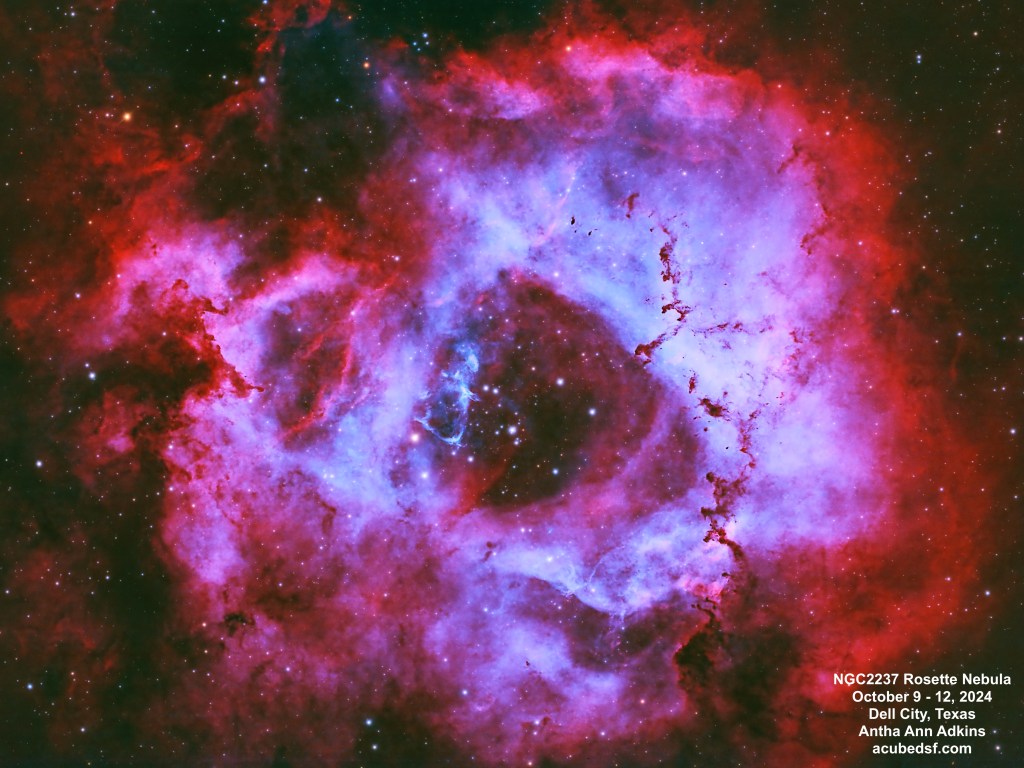
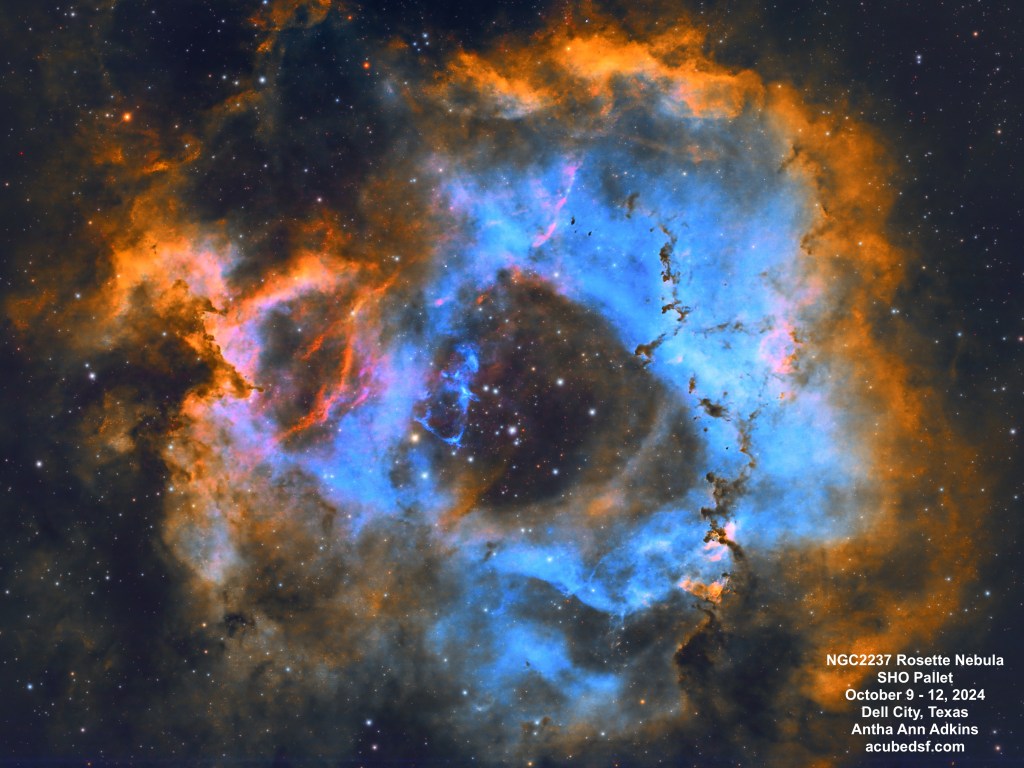
I think it is a stunning nebula. I processed the data using two different palettes, ending up with three different versions. The first palette, a “natural” palette, maps H-alpha (which is red) to red, Sii (which is also red) to a more pink color, and Oiii (which is blue) to purple/blue. I tried different weightings/emphasis of the colors and ended up with one version where the nebula center is more blue and one version where the nebula center is more purple. The second palette, the “Hubble” palette or SHO palette, maps Sii to red, H-alpha to green, and Oiii to blue (and then cuts out most of the green). I also tried different weightings/emphasis of the colors, and I ended up with one version I liked the best. I like the colors in the “natural” palette, but I think the Hubble palette does a better job of showing off the details of the nebula.
Which version do you like the best?
Camera geek info – Narrowband:
- Williams Optics Zenith Star 73 III APO telescope
- Williams Optics Flat 73A
- ZWO 2” Electronic Filter Wheel
- Antila SHO and RGB filters
- ZWO ASI183MM-Pro-Mono camera
- ZWO ASiair Plus
- iOptron CEM40
- Dell City, Texas Bortle 2-3 dark skies
Frames:
- October 9, 2024
- 135 60 second Gain 150 Oiii lights
- 30 0.5 second Gain 150 Oiii flats
- October 10, 2024
- 129 60 second Gain 150 Ha lights
- 30 0.2 second Gain 150 Ha flats
- October 11, 2024
- 27 60 second Gain 150 Red lights
- 30 0.05 second Gain 150 Red flats
- 26 60 second Gain 150 Green lights
- 30 0.02 second Gain 150 Green flats
- 25 60 second Gain 150 Blue lights
- 30 0.02 second Gain 150 Blue flats
- October 12, 2024
- 129 60 second Gain 150 Sii lights
- 30 1 second Gain 150 Sii flats
- 30 Flat Darks from library
- 30 Darks from library
Processing geek info:
- PixInsight
- BlurXterminator
- NoiseXterminator
- StarXTerminator
- Generalized Hyperbolic Stretch
 Space&Aliens
Wow! Stunning.
Thanks! I love what I can capture from the dark skies.
I like the first one, because it seems like what it would look like if I could see it (if I understand your description correctly). But the SHO image is more what I expected – this makes me wonder how a lot of those pictures I’ve seen in the past were processed!
The SHO palette is also know as the “Hubble” palette, and it is how many Hubble narrowband images are mapped, including the famous pillars of creation image. So you are probably used to seeing images using this palette!