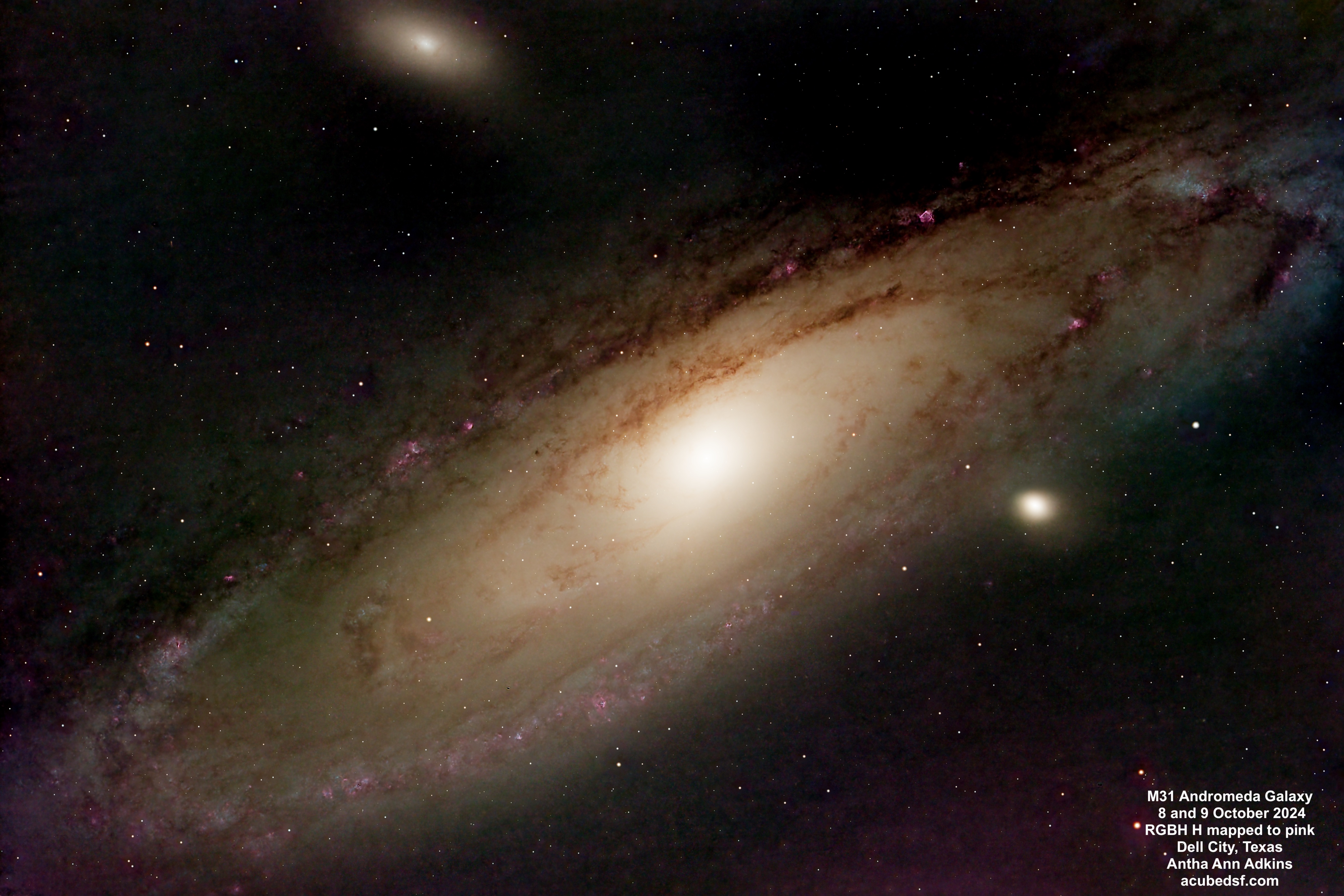
When we travel to the fabulous dark skies of Dell City, Texas, I try to pick a combination of challenging targets and targets that I’m confident I’ll get good results with. In October, one of my picks for the “good result” target was M31, the Andromeda Galaxy.
It seemed fitting to image the Andromeda Galaxy now because we are approaching the 100 year anniversary of Dr. Edwin Hubble’s November 23, 1924 New York Times article confirming that some objects classified as nebulae were, in fact, “island universes” – galaxies separate from our own. Hubble used the Cephid variable stars in the Andromeda Galaxy and in M33 to measure the distance to those two galaxies and determine that they had to be outside of our own galaxy – on the order of 1 million light years away. Based on that distance and its apparent size, Hubble calculated that the Andromeda Galaxy’s diameter was 45,000 light years.
100 years later, the Andromeda Galaxy is known to be 2.56 million light years away. Its apparent size is 3.167 degrees by 1 degree, giving it a diameter of 141,000 light years. So even further and even bigger than Hubble calculated!
It is amazing to me that we’ve only understood that there were other galaxies for 100 years! And I think it is cool that we keep learning more and more about the universe around us.
This image of the Andromeda Galaxy was captured using red, green, blue and hydrogen-alpha filters. Although Ha actually is in the red part of the spectrum, it is frequently mapped to purple-pink so it stands out, and I have used that mapping here. These Ha regions are star-forming nebula in the Andromeda Galaxy, similar to our own Orion nebula and Eagle Nebula.
So while Hubble proved that Andromeda was a galaxy and not a nebula … it also contains its own nebulae. And we can see them! How amazing is that?
Camera geek info:
- Williams Optics Zenith Star 73 III APO telescope
- Williams Optics Flat 73A
- ZWO 2” Electronic Filter Wheel
- Antila RGBH filters
- ZWO ASI183MM-Pro-Mono camera
- ZWO ASiair Plus
- iOptron CEM40
- Dell City, Texas Bortle 2-3 dark skies
Frames:
- October 8, 2024
- 196 60 second Gain 150 Ha lights
- 30 0.5 second Gain 150 Ha flats
- 168 60 second Gain 150 R lights
- 30 0.05 second Gain 150 R flats
- 174 60 second Gain 150 G lights
- 30 0.02 second Gain 150 G flats
- 173 60 second Gain 150 B lights
- 30 0.02 second Gain 150 B flats
- 30 0.02 second darks
- 30 0.05 second darks
- 30 0.5 second darks
- 30 60 second darks
Processing geek info:
- PixInsight
- BlurXterminator
- NoiseXterminator
- StarXTerminator
- NBColourMapper
 Space&Aliens
Pingback: M31 Andromeda Galaxy Astrophotography Learning Curve | Space&Aliens