
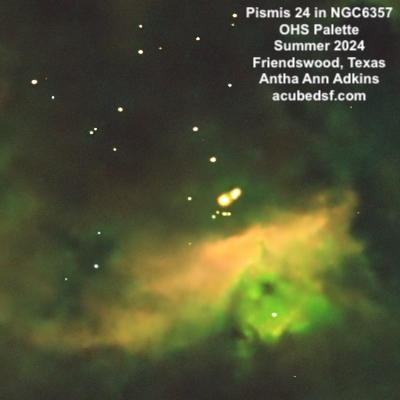
NGC6357, the Lobster Nebula, is an emission nebula. It is a large star-forming region containing three star clusters, many young stars, and some massive stars. One cluster is Pismis 24, located just above the bright blue core in this picture. The stars in this cluster are about 1 million years old and four are massive – 40 – 120x the mass of our sun, among the most massive stars in our galaxy. The Lobster Nebula is located in the Milky Way, approximately 5550 light years away, and it has an apparent size of 60 x 45 arc min, so it is approximately 97 x 73 light years across.
From my driveway, the Lobster Nebula is low to the South and is only visible for a short time from when it rises above my house to when it goes behind the pine tree. So it took many nights of data collection to get enough data to make this image – 12.2 hours of data collected over 13 nights. And it would still benefit from more! I may collect more data the next time we visit the dark skies of Dell City, Texas, where I have an unimpeded view to the South. But, until then, I have declared the end of Lobster season!
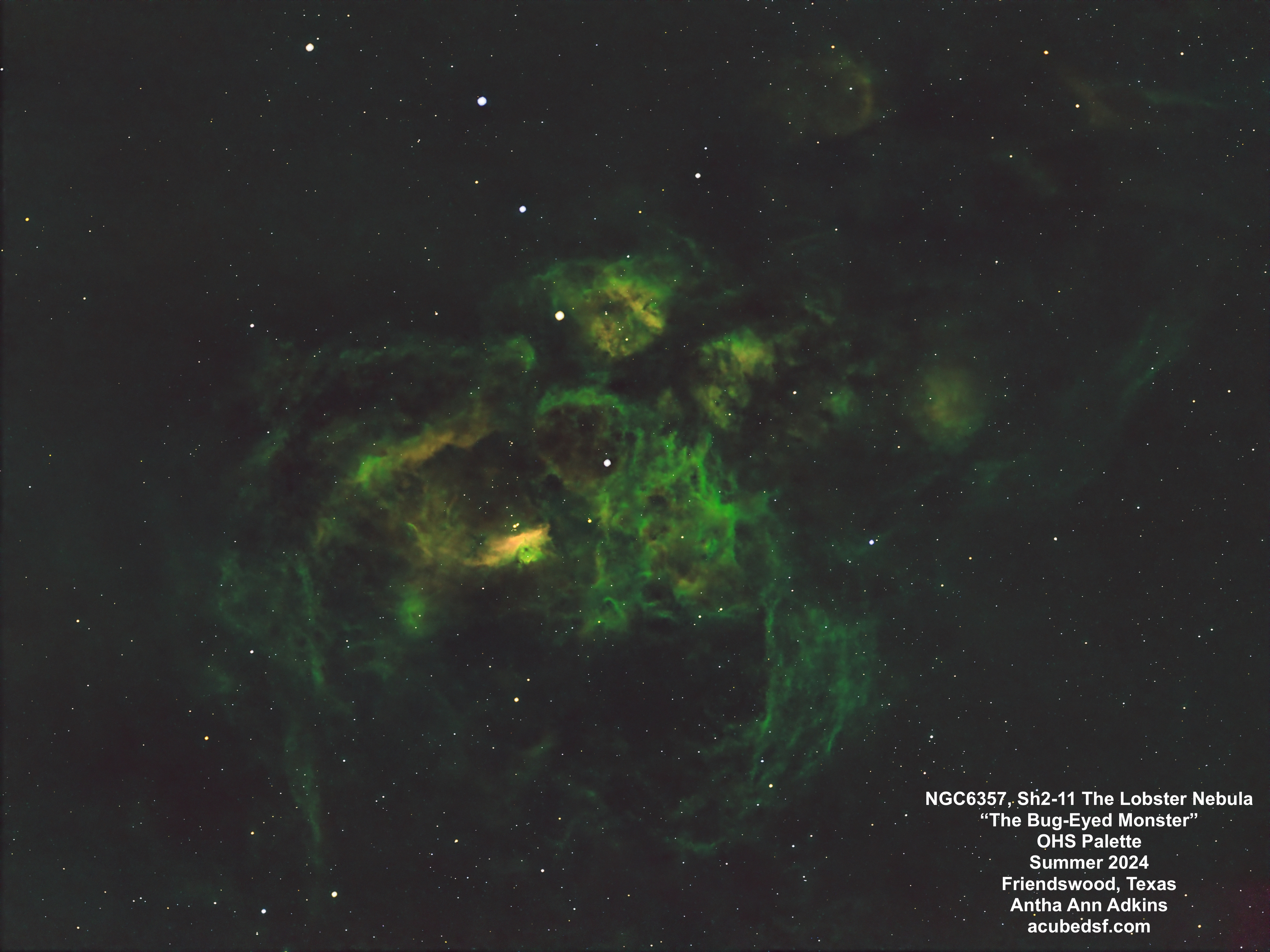
Although NGC6357 is traditionally named the Lobster Nebula, I think it looks like a bug-eyed monster. And a bug-eyed monster should be green with a red core and have red eyes. So in addition to the traditional Hubble SHO (Sii mapped to red, Ha to green, and Oiii to blue), I also made a version using a OHS (Oiii mapped to red, Ha to green, and Sii to blue) palette. I thought this version produced a nice contrast in the pillar in the core near the Pismis 24 cluster.
Which color palette do you like better?
Camera geek info – Narrowband:
- Williams Optics Zenith Star 73 III APO telescope
- Williams Optics Flat 73A
- ZWO 2” Electronic Filter Wheel
- Antila SHO filters
- ZWO ASI183MM-Pro-Mono camera
- ZWO ASiair Plus
- iOptron CEM40
- Friendswood, Texas Bortle 7-8 suburban skies
Frames:
- June 7, 2024
- 106 60 second Gain 150 Ha lights
- 30 0.05 second Gain 150 Ha flats
- June 8, 2024
- 51 60 second Gain 150 Oiii lights
- 30 0.05 second Gain 150 Oiii flats
- June 13, 2024
- 73 60 second Gain 150 Sii lights
- 30 0.05 second Gain 150 Sii flats
- June 14, 2024
- 82 60 second Gain 150 Sii lights
- 30 0.05 second Gain 150 Sii flats
- June 15, 2024
- 81 60 second Gain 150 Oiii lights
- 30 0.05 second Gain 150 Oiii flats
- June 28, 2024
- 69 60 second Gain 150 Oiii lights
- 30 0.05 second Gain 150 Oiii flats
- June 29, 2024
- 37 60 second Gain 150 Sii lights
- 30 0.05 second Gain 150 Sii flats
- July 3, 2024
- 51 60 second Gain 150 Ha lights
- 30 0.05 second Gain 150 Ha flats
- August 6, 2024
- 13 60 second Gain 150 Oiii lights
- 30 0.05 second Gain 150 Oiii flats
- August 8, 2024
- 61 60 second Gain 150 Oiii lights
- 30 0.05 second Gain 150 Oiii flats
- August 6, 2024
- 37 60 second Gain 150 Oiii lights
- 30 0.05 second Gain 150 Oiii flats
- August 6, 2024
- 34 60 second Gain 150 Oiii lights
- 30 0.05 second Gain 150 Oiii flats
- August 6, 2024
- 36 60 second Gain 150 Oiii lights
- 30 0.05 second Gain 150 Oiii flats
- 30 Flat Darks from library
- 30 Darks from library
Processing geek info:
- PixInsight
- BlurXterminator
- NoiseXterminator
- StarXTerminator
- Generalized Hyperbolic Stretch
- NBColourMapper
 Space&Aliens
I’m glad this bug isn’t a bug in my back yard.
Hahaha! Me too!