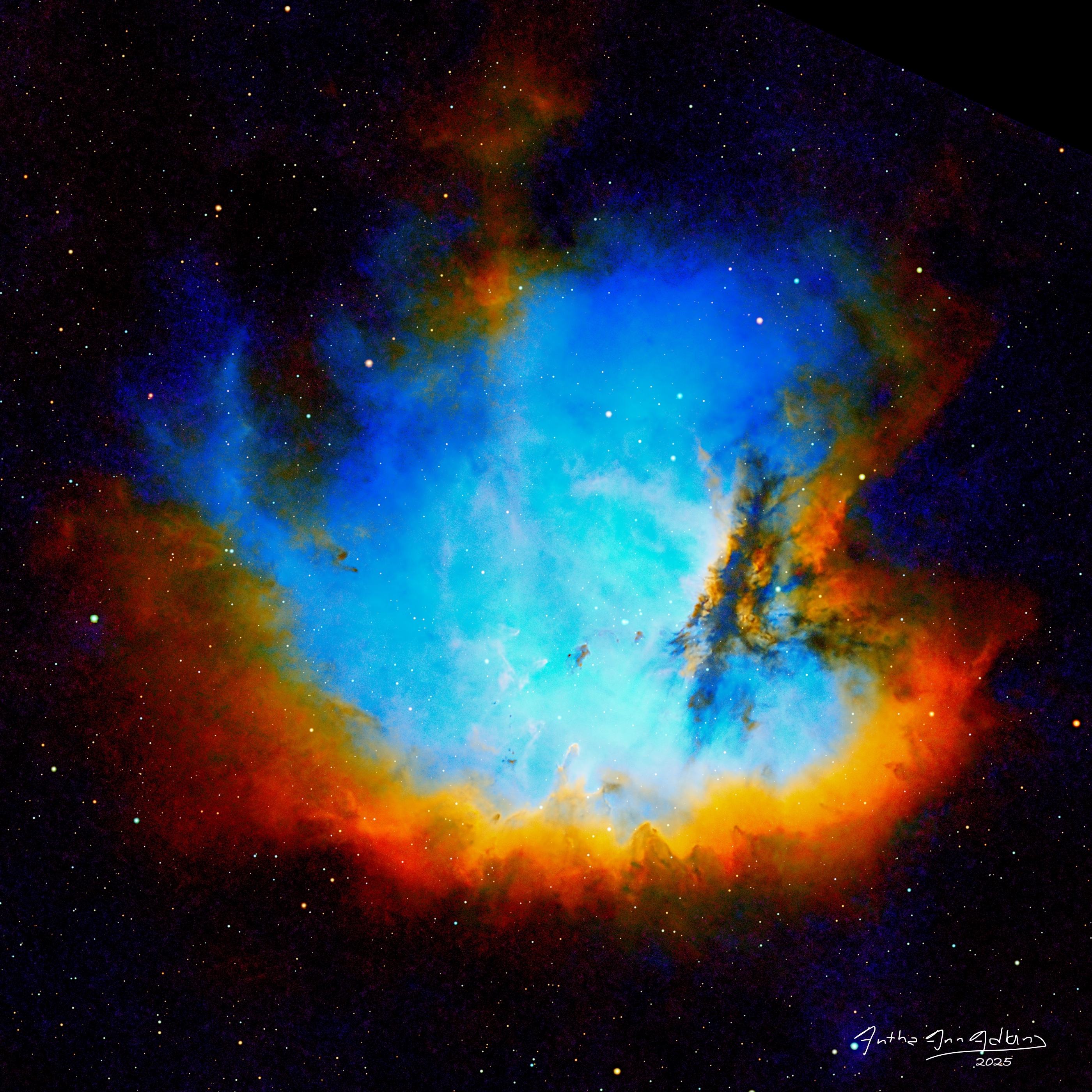
Sharpless Sh2-184 NGC281 is commonly called the Pac-Man Nebula for obvious reasons – it looks like the video game character Pac-Man with its round shape and open mouth. Yet I also see a spouting whale – same big mouth but with a tail and spouting water out of its blowhole. Can you see it?
I made two versions of this – one “square” with the frame that is missing the stars in the upper right corner, and one “surfing the waves” angled one that has a complete starfield. Which version do you like better?

This image shows HII region Sharpless Sh2-184 (the whole image) and the open cluster IC1590 (stars in the blue region).
Sh2-184 is an H II region emission nebula, a region of ionized atomic hydrogen. The H II regions in the Sharpless 2 catalog were “defined not only in terms of the ionized gas but also in terms of the hot stars which are responsible for the ionization.”
The young open cluster IC1590 is about 3.5 – 4.4 million years old. Among other stars, it contains four O type stars, short-lived, hot, massive stars that ionize the surrounding molecular cloud.
The massive stars are believed to be triggering star formation in the surrounding H II region by ionizing, heating, and compressing gas in molecular cloud in which they formed. In the periphery of the open cluster, Young Stellar Objects (YSOs), young, low-mass stars deeply embedded in parent molecular cloud, are found that are 1 – 2 million years old and 0.5 – 3.5 times the mass of our sun. I am always amazed when I realize that our galaxy is still under construction!
Sh2-184 is located in the Milky Way, approximately 10110 light years away. This image is 50 arc minutes across, so the image is approximately 150 light years across.
I collected the frames for this image under the fantastic dark skies of Dell City, Texas. When we go out there, I generally try for some easier targets and a more difficult target – this was one of the easier targets. I need far less time than I do for images from my light-polluted driveway, but it was something of a guess to know whether I’d taken enough data to end up with a good image. In this image, the stars came from images using red-green-blue filters with 30 minutes of data each, and the nebula came from images using Sulfer ii (3.33 hours of data mapped to red), Hydrogen alpha (3.5 hours of data mapped to green) and Oxygen iii (3 hours of data mapped to blue) filters, the standard SHO mapping. But after doing that mapping, I used Narrowband Normalization to shift the colors so that it wasn’t overly green and to enhance the reds and blues. The nebula was processed separately from the stars to maximally enhance it. As always, I like color, so I leaned into the rich colors.
What do you think of the colors? What do you think of the alternate name?
Camera geek info – Narrowband:
- William Optics Zenith Star 73 III APO telescope
- William Optics Flat 73A
- ZWO 2” Electronic Filter Wheel
- Antila RGB and SHO filters
- ZWO ASI183MM-Pro-Mono camera
- William Optics Uniguide 32MM F/3.75
- ZWO ASI220MM-mini
- ZWO ASiair Plus
- iOptron CEM40
- Dell City, Texas Bortle 2 – 3 skies
Frames:
- November 8, 2025
- 11 300 second Gain 150 Ha lights
- 30 1 second Gain 150 Ha flats
- 11 300 second Gain 150 Oiii lights
- 30 0.5 second Gain 150 Oiii flats
- 11 300 second Gain 150 Sii lights
- 30 1 second Gain 150 Sii flats
- November 9, 2025
- 9 300 second Gain 150 Ha lights
- 30 1 second Gain 150 Ha flats
- 9 300 second Gain 150 Oiii lights
- 30 0.5 second Gain 150 Oiii flats
- 8 300 second Gain 150 Sii lights
- 30 1 second Gain 150 Sii flats
- November 10, 2025
- 60 30 second Gain 150 Red lights
- 30 0.05 second Gain 150 Red flats
- 60 30 second Gain 150 Green lights
- 30 0.02 second Gain 150 Green flats
- 60 30 second Gain 150 Blue lights
- 30 0.02 second Gain 150 Blue flats
- November 11, 2025
- 22 300 second Gain 150 Ha lights
- 30 1 second Gain 150 Ha flats
- 16 300 second Gain 150 Oiii lights
- 30 0.5 second Gain 150 Oiii flats
- 21 300 second Gain 150 Sii lights
- 30 1 second Gain 150 Sii flats
- 30 Flat Darks matching flat durations from library
- 30 Darks matching light durations from library
Processing geek info:
- PixInsight
- BlurXterminator
- NoiseXterminator
- StarXTerminator
- Narrowband Normalization
 Space&Aliens
Another Wow!!!!