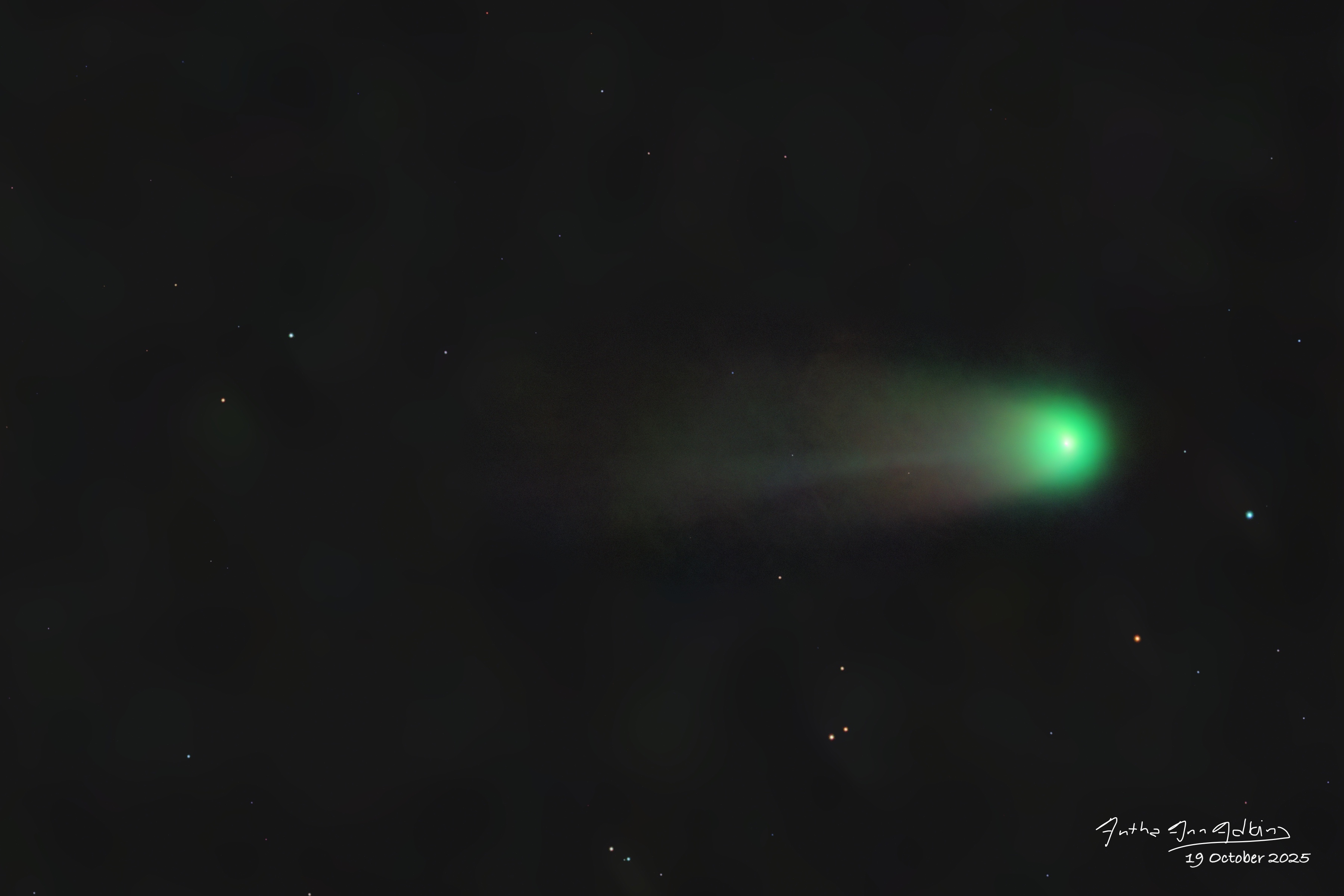
On Sunday, October 19, 2025, my husband I drove back to Sargent, Texas for darker skies (Bortle 4) and another try at Comet C/2025 A6 Lemmon. Happily, this time the sky was clear and I successfully captured the comet with my small telescope. I was also successful in seeing it with binoculars. I was less successful with a wide angle shot with my camera on a tripod – the comet was not obvious and I was fooled by internal reflections of some bright green lights on the horizon. I’m going to spend some more time with those images, but I’m not hopeful of pulling out a nice comet picture from them.
Based on this experience, I was pretty sure the comet would not be naked eye visible even from Bortle 4 skies at its closest approach to Earth on October 21.
As the comet got closer to Earth, its relative angular motion increased. I didn’t want the comet to “smear” in the pictures, so I was taking shorter frames based on the comet only moving a half pixel per frame. There’s a trade-off, though, between completely freezing the comet’s motion in a frame and capturing enough light to separate the comet’s tail from the background noise. In this case, I think the frames were too short – the comet’s coma and tail are many pixels wide, and I probably should have accepted some motion in exchange for collecting more data. This also wasn’t much data: 6.25 minutes of red data, 6.4 minutes of green data, and 5.75 minutes of blue data.
The comet still got better from here … but it’s taking a while to get these images processed. More to come!
Camera geek info – telescope:
- William Optics Zenith Star 73 III APO telescope
- William Optics Flat 73A
- ZWO 2” Electronic Filter Wheel
- Antila RGB filters
- ZWO ASI183MM-Pro-Mono camera
- William Optics Uniguide 32MM F/3.75
- ZWO ASI220MM-mini
- ZWO ASiair Plus
- iOptron CEM40
- Sargent, Texas Bortle 4 skies
Frames – telescope:
- October 19, 2025
- 75 5 second Gain 150 R lights (56 for stars)
- 30 0.05 second Gain 150 R flats
- 77 5 second Gain 150 G lights (48 for stars)
- 30 0.02 second Gain 150 G flats
- 69 5 second Gain 150 B lights (34 for stars)
- 30 0.02 second Gain 150 B flats
- Matching darks and flat darks from library
 Space&Aliens
Pingback: Comet C/2025 A6 Lemmon Widefield on 19 October 2025 | Space&Aliens