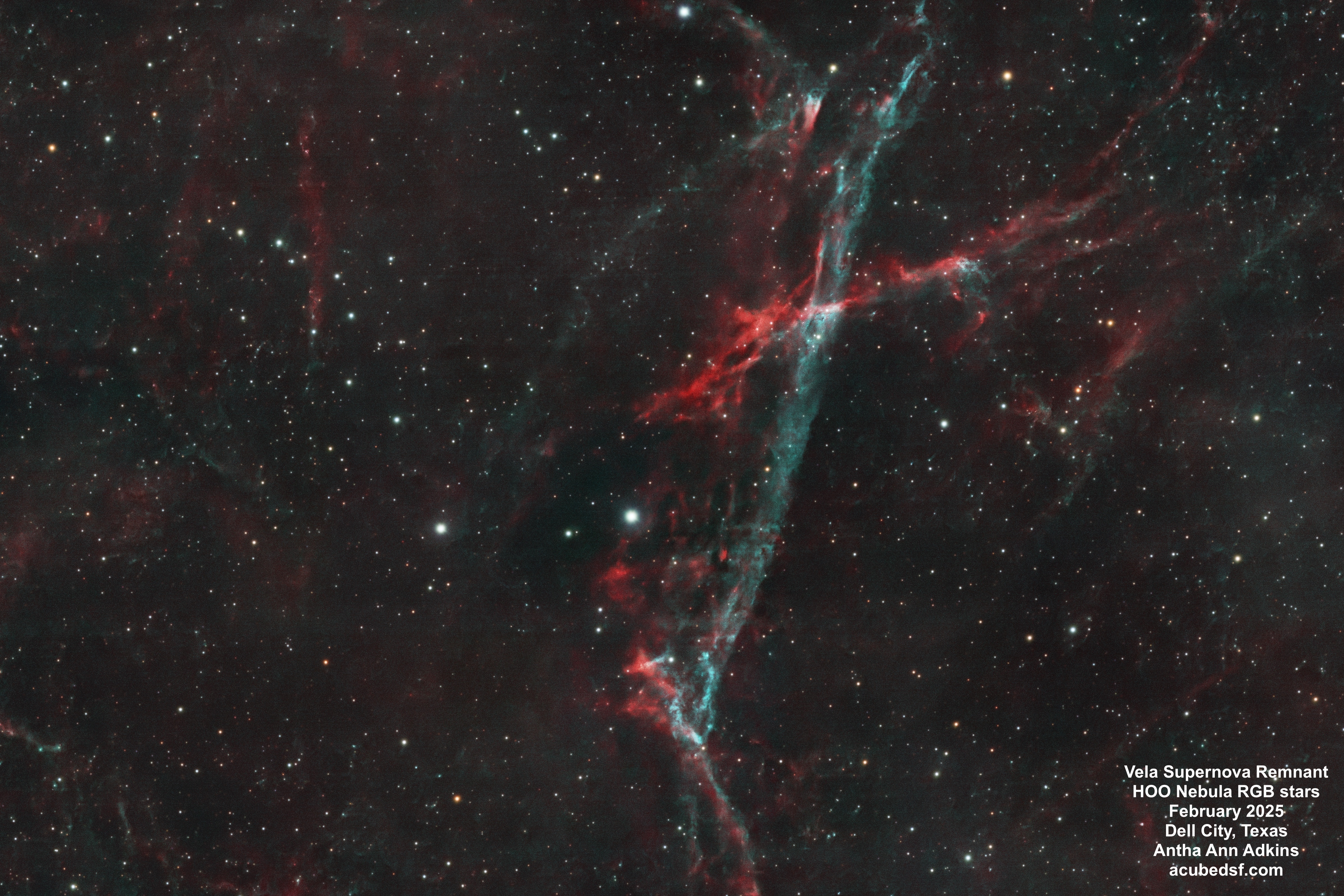
The Vela Supernova Remnant (SNR) or G263.9-03.3 is the material expelled from the explosion of a star in a supernova. In this case, the original star was estimated to be 8.1 – 10.3 times the mass of the sun, and the final star, PSR J0834-4511 is a pulsar, a magnetized rotating neutron star. The supernova was estimated to occur 18000 +/-9000 years ago based on its motion away from the SNR. The Vela SNR located in the Milky Way, approximately 815.5 light years away, and it has an apparent size of 4.25 degrees, making it 60.5 light years across.
This image is only a portion of the whole nebula. In this image, the stars came from images using red, green, and blue filters, and the nebula came from images using Hydrogen alpha (mapped to red) and Oxygen iii (mapped to blue) filters. The nebula was processed separately from the stars to maximally enhance it. I didn’t really have enough data – only 41 minutes of Oxygen iii data and 185 minutes (3.1 hours) of Hydrogen alpha data, so it took some very careful processing to get even this much of the SNR remnant visible.
I’m looking forward to returning to the fabulous dark skies of Dell City, Texas to collect more data on this beautiful object and also to collecting data from more parts of it.
While researching this object, I learned that pulsars were first discovered by a woman – Dame Jocelyn Bell Burnett, a Northern Irish astrophysicist. She discovered a radio signal, determined that it had a regular pulse, and then found three other similar signals. The physicists had to convince themselves that these were not man-made signals or alien transmissions. Bell Burnell is listed as the second author on the paper announcing its discovery. Yet, possibly because she was a graduate student at the time (or because she was a woman), she wasn’t recognized by the Nobel committee when they awarded the prize for this discovery. She attributed not being recognized to her having been a research student at the time and noted that she was in good company. Her speech on the discovery is funny and well worth reading. She stayed active in astrophysics and has received a number of other prestigious awards.
The other thing I noticed in the data I collected about this object is that when this supernova occurred (even with the longest ago estimate), people would have seen it. This would have been before recorded history though (even with the shortest ago estimate). I wonder what they thought? What do you think they thought?
Camera geek info:
- William Optics Zenith Star 73 III APO telescope
- William Optics Flat 73A
- ZWO 2” Electronic Filter Wheel
- Antila HO and RGB filters
- ZWO ASI183MM-Pro-Mono camera
- ZWO ASiair Plus
- iOptron CEM40
- Dell City, Texas Bortle 2-3 dark skies
Frames:
- February 15, 2025
- 51 60 second Gain 150 Ha lights
- 30 1 second Gain 150 Ha flats
- February 17, 2025
- 37 30 second Gain 150 Red lights
- 30 0.05 second Gain 150 Red flats
- 8 30 second Gain 150 Green lights
- 30 0.02 second Gain 150 Green flats
- February 18, 2025
- 30 30 second Gain 150 Red lights
- 30 0.05 second Gain 150 Red flats
- 40 30 second Gain 150 Green lights
- 30 0.02 second Gain 150 Green flats
- 39 30 second Gain 150 Blue lights
- 30 0.02 second Gain 150 Blue flats
- 9 60 second Gain 150 Ha lights
- 30 1 second Gain 150 Ha flats
- February 19, 2025
- 96 60 second Gain 150 Ha lights
- 30 0.5 second Gain 150 Ha flats
- 41 60 second Gain 150 Oiii lights
- 30 0.2 second Gain 150 Oiii flats
- February 21, 2025
- 29 60 second Gain 150 Ha lights
- 30 0.5 second Gain 150 Ha flats
- 30 Flat Darks matching flat durations from library
- 30 Darks from library
Processing geek info:
- PixInsight
- BlurXterminator
- NoiseXterminator
- StarXTerminator
- Generalized Hyperbolic Stretch
- ImageBlend
 Space&Aliens
Wow! Beautiful! Stunning colors!
Thanks!