Comet C/2023 Tsuchinshan ATLAS looped around the sun on September 27, 2024 and started on its path back towards the outer solar system. For a few days, it was not visible because it was too close to the sun. But it was predicted to become visible again around October 11, and it would be the closest to the Earth on October 12, 2024.
We were in Dell City at the time and staked out a sunset viewing spot with a long view to the west.
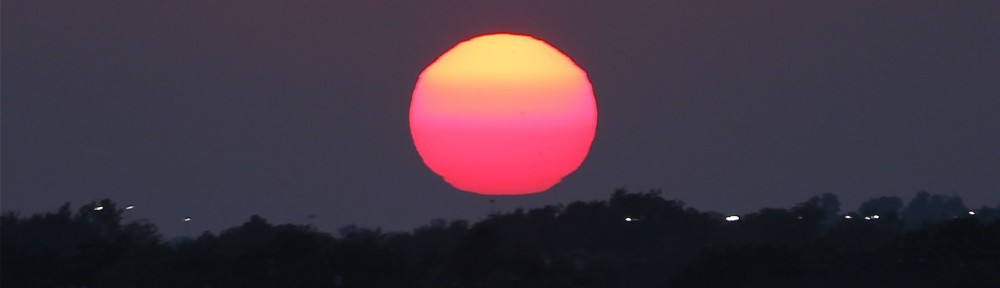
We made our first attempt to see the comet on October 10, 2024. The comet should have been barely above the horizon at sunset, and unless it was truly extraordinary, we were unlikely to be able to see it. We were treated to a lovely sunset, but we could not spot the comet. I had told myself this was a dry run, so I wasn’t too disappointed. And, when we returned back to our B&B, we were treated to a rare viewing of the northern lights from Texas.
We made a second attempt to see the comet on October 11, 2024. The comet was supposed to be higher above the horizon at sunset than the day before. There were low clouds in the sky. We saw a lot of “fake comets” – bright airplane contrails. Eventually my husband found the comet with his binoculars – success! I started taking pictures, but I hadn’t used the right settings, and when I discovered that later, I suspected that the data would not be usable. I was right – I can see a moving smudge in the images, but it’s not good enough for PixInsight to comet align the images (and there aren’t enough stars in the images for it to star align them).
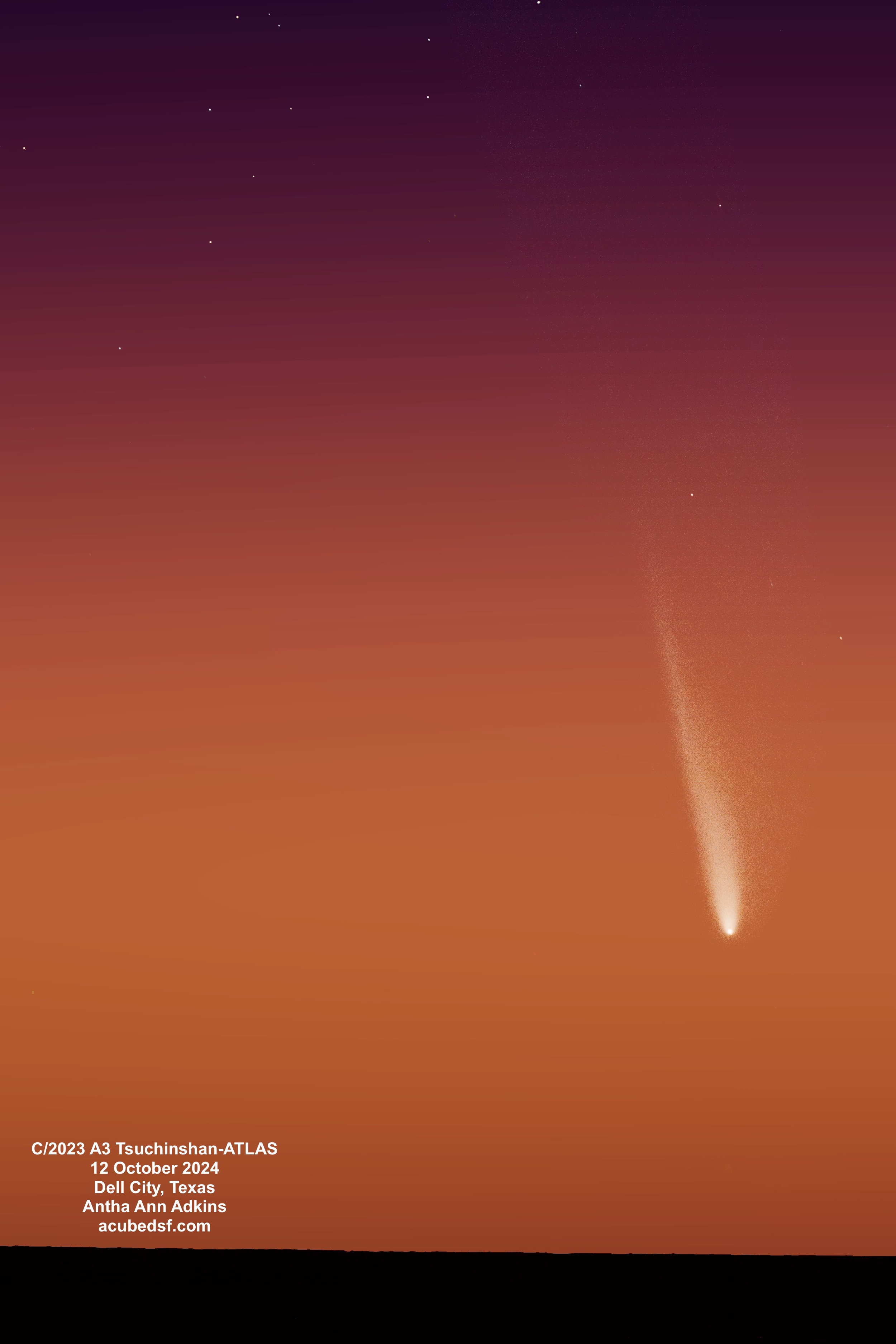
We made a third attempt – third time is the charm! – on October 12, 2024. The comet was supposed to be more than 10 degrees above the horizon at sunset, and it had been the closest it would be to the Earth, 0.47239 AU or 70668538.14 km, just nine hours earlier. This time there weren’t any clouds. And this time we could easily find the comet and see that it had a huge tail! Given my experience the night before, I made sure I was using good camera settings, and I could see the comet and its tail in single images.
I used PixInsight to stack 50 images (8.3 minutes of data) to make this final image – my first post-solar-swing image of C2023 A3. Isn’t it beautiful?
Today, on this day of Thanksgiving, I am most thankful for my family and friends, near and far. But I’m also thankful for all the wonder to be found in this universe we live in, and particularly for this comet. Happy Thanksgiving!
Camera geek info:
- Canon EOS 60D in manual mode, 4 second exposures, ISO 800
- Canon EF 85 mm f/1.8 lens at f/11 manual focus at infinity
- Intervalometer
- Tripod
- Dell City, Texas Bortle 2-3 dark skies
Frames:
- October 12, 2024
- 50 10 second lights
- 31 0.01 second flats
- 31 0.01 second flat darks
- 30 10 second darks
Processing geek info:
- PixInsight
- BlurXterminator
- NoiseXterminator
- StarXterminator
- NormalizedScaleGradient
 Space&Aliens
Beautiful sunset and photo.
Thanks! It was fun going comet hunting.
Pingback: Spectacular Comet C/2023 A3 Tsuchinshan ATLAS Image Collection | Space&Aliens