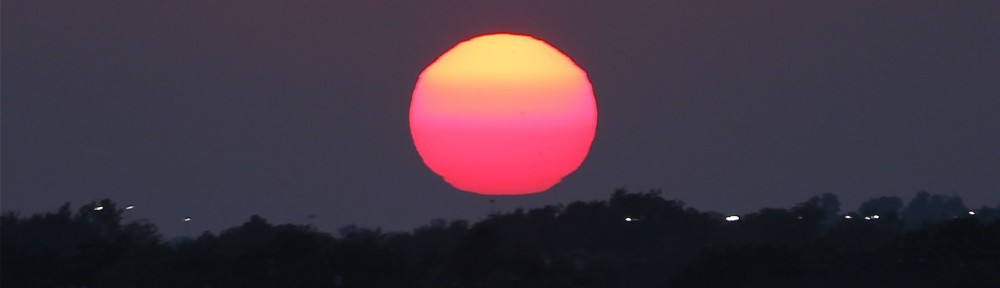
I have a bunch of wide field comet images from Dell City, Texas and Pearland, Texas that are proving … challenging … to process, given that they were taken near dusk with a DSLR on a tripod. Everything is changing – the Earth is rotating (so the stars are moving relative to the camera on a non-tracking tripod), the comet is moving relative to the stars, and the sky brightness is changing.
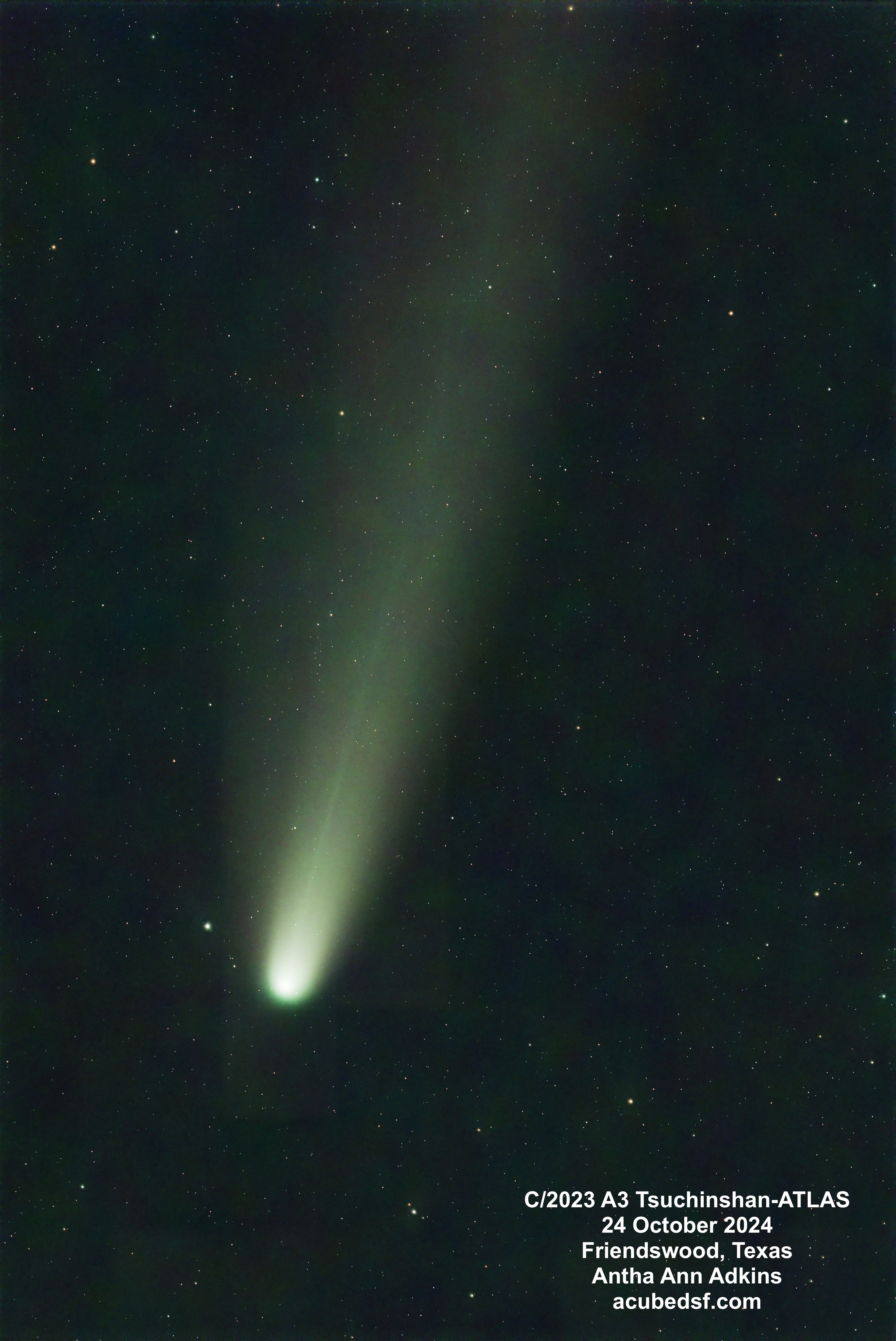
But now Comet C/2023 A3 Tsuchinshan Atlas is getting higher in the night sky, so it is no longer visible only at dusk. So I could set up my tracking mount and telescope to image it. The tail is still really long – much longer than I can capture in the field of view of my telescope!
Even with a tracking mount and dark sky, processing a comet moving relative to the stars is still really challenging, and I really benefited from following the “Standard Comet” example in Adam Block’s Comet Academy.
Camera geek info:
- Williams Optics Zenith Star 73 III APO telescope
- Williams Optics Flat 73A
- ZWO 2” Electronic Filter Wheel
- Antila RGB filters
- ZWO ASI183MM-Pro-Mono camera
- ZWO ASiair Plus
- iOptron CEM40
- Friendswood, Texas Bortle 7-8 dark skies
Frames:
- October 24, 2024
- Interleaved LRGB lights
- 11 60 second Gain 150 R lights
- Interleaved LRGB lights
- 10 60 second Gain 150 G lights
- 10 60 second Gain 150 B lights
- 30 0.05 second R flats
- 30 0.02 second B and G flats
- 30 0.05 second darks
- 30 0.02 second darks
- 30 60 second darks
Processing geek info:
- PixInsight
- BlurXterminator
- NoiseXterminator
- StarXTerminator
- ImageBlend
 Space&Aliens
Great shot!
Thanks! I’m still working on getting my other data to process … comets are challenging!
Pingback: Spectacular Comet C/2023 A3 Tsuchinshan ATLAS Image Collection | Space&Aliens