
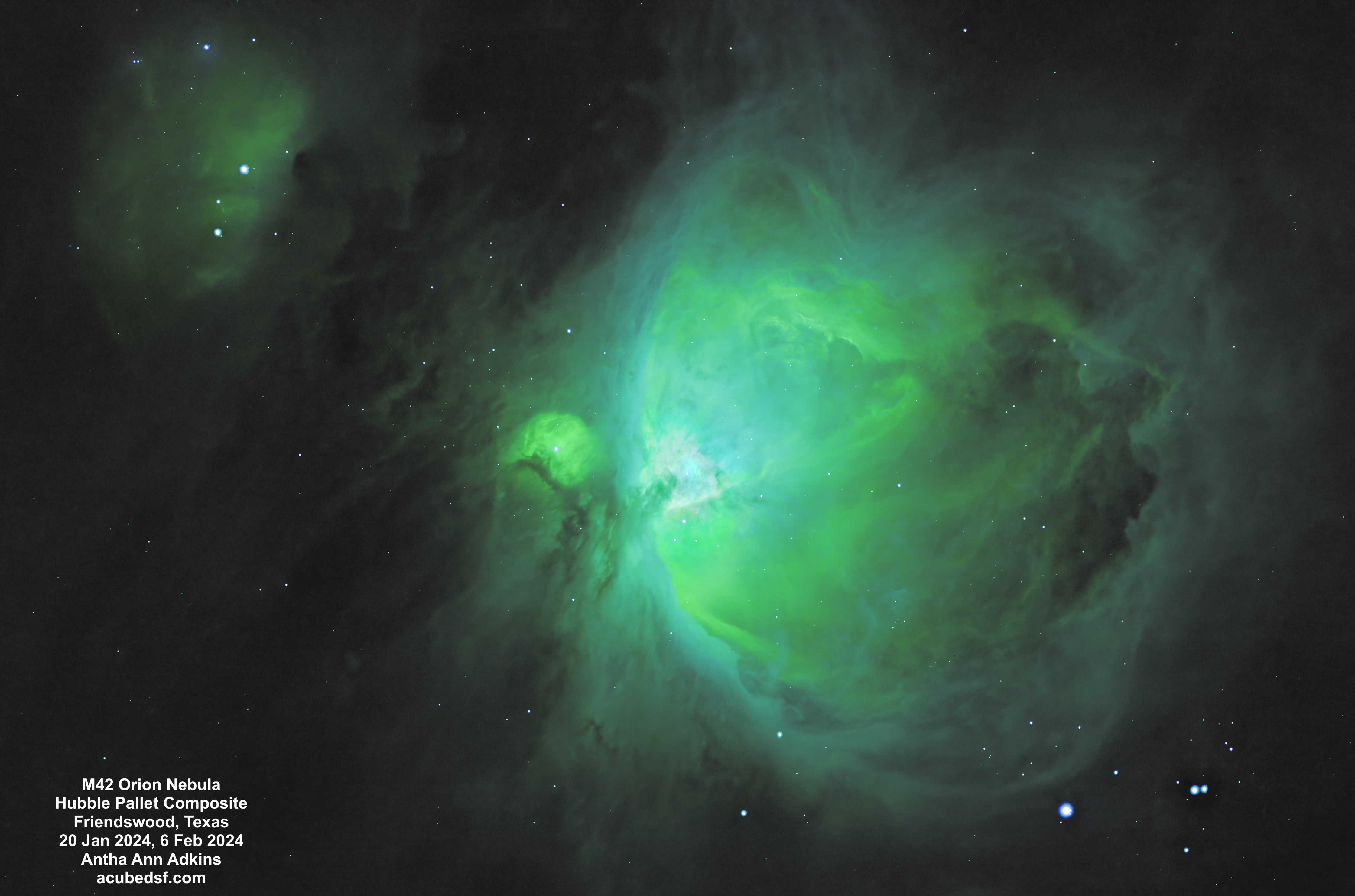
Just as I used M42 the Orion Nebula as the target for first light with my new RGB filters, I also used M42 the Orion Nebula as the target for first light with my new narrowband filters.
I used the standard set of narrowband filters: H-alpha, Oiii, and Sii.
Not only did generating these images involve learning how to use my new hardware, but it also involved learning new processing, both processing narrowband data and making a composite image.
For narrowband imaging, each filter needs to be assigned a color to map it to an RGB image. The figure below shows how colors map to wavelengths, and the table below shows what colors the three narrowband filters map to. If a natural mapping is used, the final image will use red and turquoise only. So a false color mapping is often used to better bring out details. One common pallet is the Hubble pallet, where Hα is assigned to green, Oiii is assigned to blue, and Sii is assigned to red. PixInsight has a new tool, NBColourMapper, which can make these color mappings – or any other assignment. For these images, I only had a limited amount of Sii data, so they are limited in the color that Sii is mapped to. For these images, I tried both a “natural” mapping and a “Hubble” mapping. Which do you like better?

| Element | Emission line | Wavelength | Color |
| Hydrogen | Hα | 656.3 nm | Red |
| Oxygen | Oiii | 500.7 nm | Turquoise |
| Sulfur | Sii | 671.6 nm | Red |
The Orion Nebula has an enormous amount of dynamic range – more than can be captured in a single setting. If the image is exposed to bring out the detail in the core of the nebula, the edges are too faint. If the image is exposed to bring out the edges of the nebula, the core is blown out. For these images, I made three versions of the image from two different sets of exposures: a version optimized for the core from the 60 second data, a version optimized for the middle zone from the 180 second data, and a version optimized for the outer edges from the 180 second data.
I tried a number of different processing flows to try to make a good composite from the three images using the new PixInsight tool BlendImage. What I thought ended up working was the following process:
- Make mask for core area from bright area of mid version
- Apply core mask to core image as protecting
- Use core image as base image in ImageBlend
- Use mid image as blend image in ImageBlend
- Blend using lighten/mask
- Set opacity so edges look good
- Make mid mask for mid area from bright area of outer version
- Apply mid mask to mid_core image as protecting
- Use mid_core image as base image in ImageBlend
- Use outer image as blend image in ImageBlend
- Blend using lighten/mask
- Set opacity so edges look good
Astrophotography often extends what the human eye can see by taking (or integrating to) long exposure times, much longer than the human eye and brain can combine. To me, narrowband mapping and composite imagery (as long as it’s labeled as such), is just another extension. What do you think?
Camera geek info:
- Williams Optics Zenith Star 73 III APO telescope
- Williams Optics Flat 73A
- ZWO 2” Electronic Filter Wheel
- Antila SHO filters
- ZWO ASI183MM-Pro-Mono camera
- ZWO ASiair Plus
- iOptron CEM40
- Friendswood, Texas Bortle 7-8 suburban skies
Frames:
- January 20, 2024
- SHO lights
- 47 60 second Gain 50 Ha lights
- 60 60 second Gain 50 Oiii lights
- 54 60 second Gain 50 Sii lights
- 30 0.05 second Gain 50 H flats
- 30 0.05 second Gain 50 O flats
- 30 0.05 second Gain 50 S flats
- 30 0.05 second flat darks
- 30 60 second darks
- SHO lights
- February 6, 2024
- SHO lights
- 15 180 second Gain 50 Ha lights
- 49 180 second Gain 50 Oiii lights
- 30 0.05 second Gain 50 H flats
- 30 0.05 second Gain 50 O flats
- 30 0.05 second flat darks
- 14 180 second darks
- SHO lights
Processing geek info:
- PixInsight
- BlurXterminator
- NoiseXterminator
- StarXTerminator
- Generalized Hyperbolic Stretch
- NBColourMapper
- ImageBlend
 Space&Aliens
You’ll soon be ready for a new career!
Thanks! It would be fun!