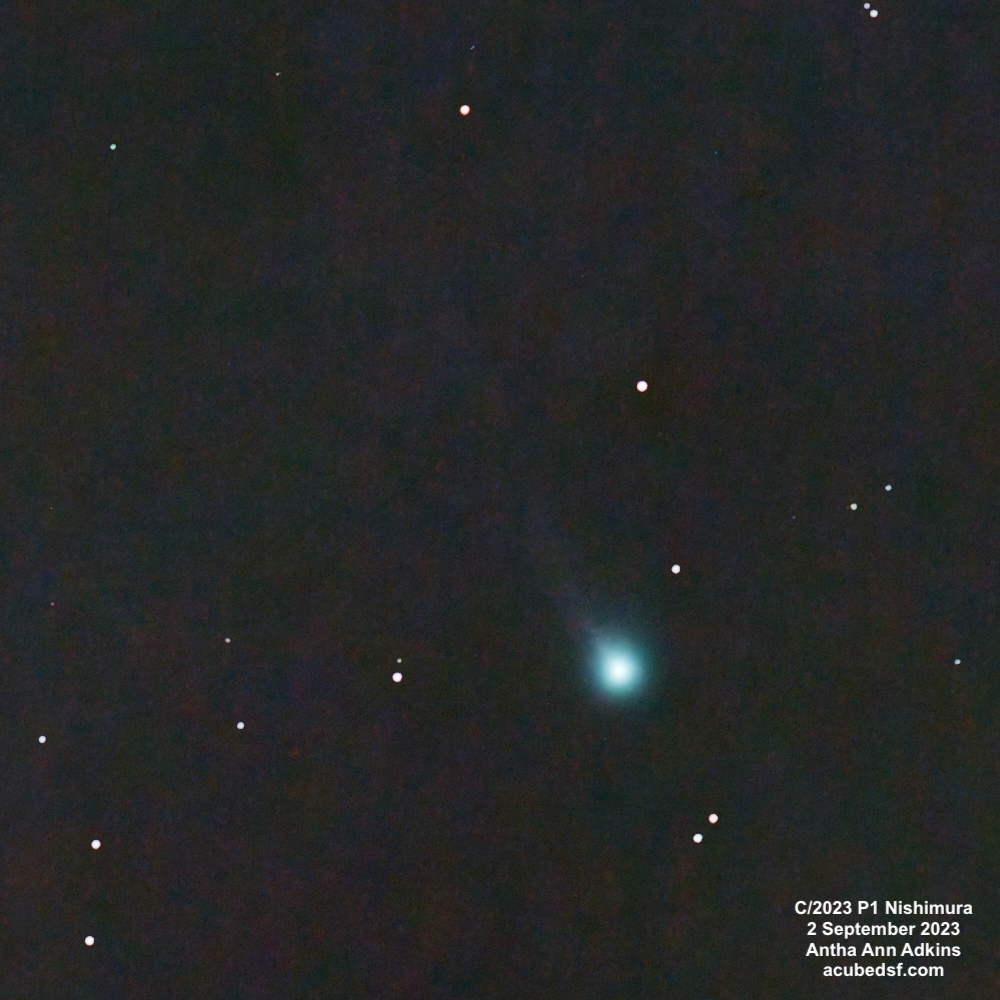
Comet Nishimura on September 2, 2023
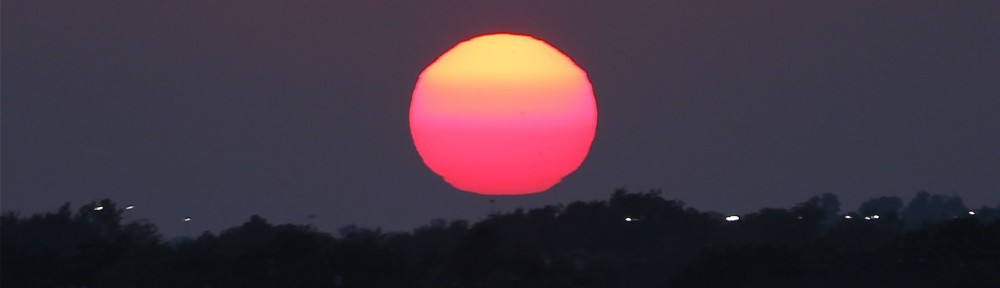
Having learned how to process comets thanks to the excellent videos by Adam Block, I went back and finished processing my first image of Comet Nishimura from September 2, 2023. That morning we got up at 3:30 AM and drove over to Bacliff, Texas to get a good view to the East, and got set up. I found the comet, started taking pictures, and enjoyed watching the sunrise. As the sun rose over the flat water, we saw dolphins arcing out of the water – one of my favorite sights on the Texas Gulf Coast.
Because the September 2 images involved a compact comet with not much tail and a short range of locations and a rapidly brightening background, I modified the excellent instructions from Adam Block as follows:
Register and process images as normal (noting the reference image), then removing the comet using a circular mask that covered the first and last locations and PixelMath. I could get away with this because the comet didn’t have a large tail and hadn’t moved very far and there were no visible stars in the masked-out region. In this case, I integrated unweighted; if I were doing it again, I would use the weighting I determined below.
Run SubframeSelector to determine what parameter to weight the images with – PSF SNR seemed to best reflect the lower quality due to the sky brightening in the last images.
Run CometAlignment on the debayerd data to get comet-aligned images. Use PixelMath to make a mask to mask the comet core. Run StarXterminator to generate comet-only images. Integrate the images using PSF SNR weighting. Then post-process as normal. I could barely see the comet tail in these images and I tried a variety of stretches to try to pull it out. I ended up using STF and Histogram Transfer plus Curves.
Finally, put the stars image and the comet image back together using PixelMath.
Whew! Comet processing is a lot more complicated than galaxies and nebulae. Fun to see something new in the sky, though.
Camera geek info:
- Canon EOS 60D in manual mode, 60 second exposures, ISO 800
- Williams Optics Zenith Star 73 III APO telescope
- Williams Optics Flat 73A
- SkyTech 2” LPRO-MAX CCD Filter
- iOptron CEM40
- Bacliff, Texas Bortle 6 suburban skies
Frames:
- 24 60 second lights
- 30 0.03 second flats
- 30 0.03 second flat darks
- 30 60 second darks
Processing geek info:
- PixInsight
- NoiseXterminator
- StarXTerminator
 Space&Aliens
Pingback: Comet Nishimura Tail Growth | Space&Aliens